Retaliation, Umpires Knowing the Code

On the Importance of Umpires Knowing at Least Something About the Game they’re Purporting to Officiate

Prince Fielder connects for the first of his homers on Sunday. Phil Coke did not approve.

On Saturday, Prince Fielder launched two home runs off of Boston’s Josh Beckett within the game’s first five innings. In the bottom of the seventh, he was hit on the calf by Red Sox reliever Matt Albers.

Phil Coke came out of the Detroit bullpen a half-inning later with the perfect opportunity to exact retribution: He faced Fielder’s first-base counterpart and fellow superstar, Adrian Gonzalez, with a 10-run lead. Instead of sending a message, however, he struck Gonzalez out.

There may be great power in hindsight for Phil Coke, or he may have had the finer points of the “We’ve seen enough of this crap” method of pitching explained to him by teammates or coaches after the game. That would explain his appearance on Sunday, when, in the seventh inning, the left-hander made up for opportunities lost. With Dustin Pedroia on second and two outs in a game the Tigers trailed 9-7, Coke—a day late—went gunning for his man.

His aim was as poor as his timing, however, as Coke’s pitch sailed up near Gonzalez’s head, without any real danger of hitting him. Which is where the umpiring at Comerica Park comes into question.

At this point, plate ump Dan Iassogna should have been all over Coke. Ejection would have been justified even without the previous day’s action, based only on the location of the pitch, but Iassogna did nothing. (In his defense, even Gonzalez didn’t take the pitch too seriously, joking with Iassogna and Tigers catcher Alex Avila about whether he should start to get scared.)

It might have been a good idea. With his next offering—and two bases open, after Pedroia took third on the previous pitch—Coke hit Gonzalez in the back. Bobby Valentine raced out for a chat involving, among other things, disbelief that the pitcher had not yet been ejected. It didn’t have much effect; only after crew chief Dale Scott consulted with Iassogna were warnings even issued. Coke remained in the game.

Iassogna has some history with this type of thing, having notably erred on the reactionary side earlier in his career, much to his own detriment. In 2002, before he had even reached full-time status with MLB, Iassogna was behind the plate for a game in which the Dodgers led the Reds 4-0 going into the ninth inning. After Los Angeles closer Eric Gagne gave up a bloop single and a two-run homer, he hit Adam Dunn with his next pitch. That was all Iassogna needed to see; he tossed Gagne on the spot.

The details of this particular story matter, however. Gagne’s pitch to Dunn was clearly unintentional; it only grazed the bottom of the slugger’s jersey, failing even to hit flesh. When Gagne was ejected, Dogers manager Jim Tracy lost his mind.

“I went crazy,” he said. “I’ve been very upset a few times as a big league manager, but that was maybe the most upset I’ve been on a baseball field, because of what I perceived to be as a lack of understanding as to exactly what it was that was going on. . . . I don’t know of any pitcher in baseball, after a home run has preceded the at-bat and you’re in the ninth inning trying to win, who’s going to hit the next guy and bring the tying run to the plate.”

Gagne and Tracey were both ejected, the Reds tied the game with two more runs off three more pitchers, and Cincinnati won it in the 13th against Omar Daal, who had been scheduled to start for the Dodgers the following day.

It’s enough to make an ump gun shy, which Iassogna might be these days. That certainly appeared to be the case on Sunday.

“They should’ve given a warning after the one at (Gonzalez’s) head, the first pitch,” said Valentine in the Boston Herald.

Gonzalez, too, worried about the lasting effects of the umpire’s decision.

“You know it’s going to happen,” he said of potential future retribution, in an ESPN Boston report. “We’ve all got seven more years here. It might not happen the next series, but eventually it’s going to happen. . . . I just think it’s a bad call on their end because now it’s putting Miggy’s (Miguel Cabrera) and Prince’s careers at risk. You know it’s going to happen eventually.”

Next chance: May 28, in Boston. No word yet on the whereabouts of Dan Iassogna that week.

– Jason
Managers Play their Best Lineups

Joe Girardi Mostly Ignores Roster Games; Yankees Still Kick Red Sox in the Teeth

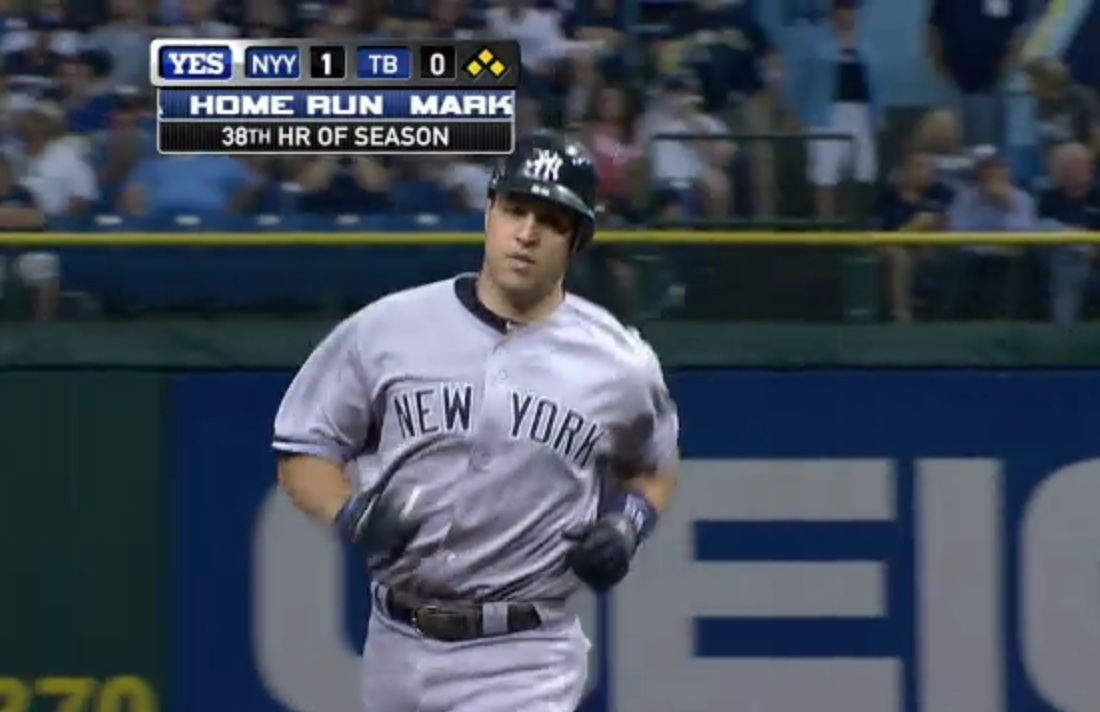
Mark Teixeira started -- and homered (twice) -- before everything fell apart for New York.

Prior to Wednesday’s game against Tampa Bay, Yankees manager Joe Girardi found himself in a terrifically sweet position. The Yankees had little to play for; they would finish with the American League’s best record regardless of the outcome.

A loss, however, would give the Rays a leg up on the American League wild card. More pertinently, it would provide a possible knockout shot to the Red Sox—and what Yankee wouldn’t enjoy that?

With so much on the line for his opponent, however, Girardi was, under the auspices of baseball’s unwritten rules, obligated to utilize his best players. So the question became, Would it be okay if he didn’t?

The answer: Of course. Winning, or putting your team in a position to win, trumps nearly every facet of the Code. It’s safe to assume that Girardi—a Yankees catcher for four years before taking over as manager in 2008—takes joy in any opportunity to stick it to Boston. On Wednesday, he could do so under cover of getting his own team ready for the postseason. The skipper had a playoff series to prepare for, and resting his players may well be vital to that preparation.

In fact, Girardi did exactly that against the Rays on Sept. 22, resting Curtis Granderson, Alex Rodriguez, Robinson Cano, Russell Martin and Brett Gardner in a game New York would lose, 15-8.

But with the season on the line for Tampa Bay on Wednesday, Girardi started what’s essentially been his regular lineup, and stuck with it until rain delayed the game in the seventh.

With New York holding a 7-0 lead, the skipper went to his bench: Eric Chavez replaced Mark Teixeira in the lineup, and took over at third base. Brandon Laird moved from third to first. Chris Dickerson took over for Nick Swisher in right field. Heck, A.J. BurnettA.J. Burnett!—saw action in the seventh.

That strategy, of course, is covered by its own set of unwritten rules. With the game comfortably in hand, Girardi could have been accused of running up the score had he continued to play aggressively. Such a full utilization of his role players was definitely not that.

As it was, of course, we all realized exactly how far behind us the days in which a 4-0 lead was considered safe actually are. Tampa Bay tied the game with six in the eighth and one in the ninth, and won it—and the wild card—on Evan Longoria’s 12th-inning homer.

Boston fans might bemoan Girardi for his late-game lineup manipulations, but their manager didn’t. “They can do whatever they want,” said Terry Francona in a MassLive.com article published Monday. “They have played themselves into that position; they’ve earned the luxury. I have never had a problem with that.”

* * *

The piece of Code mandating that managers utilize their best lineups when playing contenders late in the season really comes into play when an also-ran rests its regulars against a club with playoff hopes—”to get a look at the kids,” or some such. Few issues will be taken should the occasional prospect be utilized for evaluation purposes, but generally speaking the rule is firm: Play the rookies against Pittsburgh; sit ’em against St. Louis.

Take 2004, for example. Going into the season’s final series, the Giants and Houston were tied for the wild card lead with 89-70 records. The Astros closed with three home games against Colorado, while the Giants visited Los Angeles.

Suffice it to say that members of the San Francisco clubhouse took note when Rockies manager Clint Hurdle trotted out a series-opening lineup featuring six rookies—Aaron Miles, Clint Barmes, Garrett Atkins, Jorge Piedra, Brad Hawpe and JD Closser.

The Giants managed to take two of three from the Dodgers, but it wasn’t enough; the Astros swept punchless Colorado.

“All we needed was for Houston to lose one game,” said then-Giants reliever Matt Herges. “We were watching that, yelling, ‘This is a joke.’ We couldn’t stand Clint Hurdle after that.”

“If we’re in that position, it means we stunk all year,” said Hall of Fame manager Sparky Anderson. “Well, let’s stink a little more if we have to, but we’re going to give them the best shot we’ve got.”

That, however, is not a universal view. For the flip side of the argument, we turn to Tigers manager Jim Leyland.

“Goddammit, if I’m that far out of the pennant race, the players I was playing weren’t worth a shit, anyway,” he said. “You might as well take a chance and look at some new players for next year.”

Which brings us back to Joe Girardi, who doesn’t have to worry about any of that. His players don’t stink, he could have gotten away with virtually anything he wanted in this regard during yesterday’s game and, as a bonus, he helped kill Boston’s season.

Not bad for a day’s work.

– Jason

Francisco Cervelli, John Lackey, Retaliation

Cervelli-abration: How Much is Too Much, and What to do About it?

So Francisco Cervelli hit a big home run and clapped his hands in celebration as he stepped on the plate, directly under the nose of Red Sox catcher Jarrod Saltalamacchia.

The next pitch Cervelli saw hit him square in the back.

It certainly looked incriminating, and although pitcher John Lackey denied all intent, that’s what he’s supposed to do. The Yankees broadcast crew jumped on it immediately, with Michael Kay not missing a beat after Cervelli was drilled before saying, “I’m going to tell you why Cervelli just got hit. I will tell you why. Because when he hit the home run he celebrated at home plate and clapped his hands right in front of Saltalamacchia.” The telecast then cut to a pre-queued clip of the moment. (Watch it, preceded by the home run itself, here.)

Kay was hardly the only one to see it in this light. Another example, from the Boston Globe, which structured its use of quotes to paint a particular picture:

“He was pumped for that [third] home run of his career,” Lackey said. “I thought it was a little excessive, honestly.”

Said Saltalamacchia: “He’s done a lot of that stuff. … He likes to get excited. That’s fine. As far as the clapping goes, yeah, it could have been a little much. You don’t show anybody up. You play the game the way you play it. You’ve got to stay in your boundaries.”

Seems pretty cut and dried. There are some compelling arguments to the contrary, however.

Start with the fact that the Red Sox trailed 4-2 at that point in the seventh, and Lackey’s primary job was to keep that deficit static. The last thing he’d rationally want is to put the leadoff hitter on base with the lineup about to turn over. (Sure enough, Cervelli came around to score New York’s final run.)

Said Lackey in the Boston Herald, “I’ve been fined twice for hitting guys this year and I’ve paid them because they were right. But this one, I’m not afraid to tell you if I’m trying to hit somebody. I would’ve told him to his face.”

The statement that rang truest from Lackey, from the New York Daily News, pointed out in stark terms every truth of the situation. The Globe excerpt above utilized part of it, but cut out the key final sentiment.

“(Cervelli) was pumped for that ninth home run of his career (third actually), yeah. I don’t know. I thought it was a little excessive, honestly, but that’s not a spot you handle something like that.”

Naysayers can start their counter-arguments with the fact that this game doesn’t mean anything because Boston and New York are both going to the playoffs, then talk about Boston wanting to avoid facing Justin Verlander twice in the ALDS.

But those who think a starting pitcher in the midst of a pennant race is willing to compromise a victory in order to take care of some vendetta—especially with five games remaining between the teams during which to drill Cervelli at a more opportune moment—must ignore an awful lot of reality to do so.

More of an affront to the Code than anything Lackey did was Cervelli’s celebration—specifically, where it took place. Had he clapped his hands upon seeing the ball leave the yard, the Red Sox would not likely have noticed. Had he waited for several steps after crossing the plate, on his way back to the dugout, same thing.

As Craig Calcaterra wrote over at HardballTalk, “Cervelli pumps his fist when he gets a good sandwich. He woops it up if he tosses a wadded up piece of paper into a trash can on the first try. If Cervelli gets one more home run in his career it’ll be a gift from the friggin’ gods, so let him have his little moments.”

Done and done. The guy has to measure those moments, however, to ensure they occur somewhere than directly in front of his opponent. Otherwise, he can expect more of the same kind of treatment he received from Lackey.

Perhaps next time it’ll even be intentional.

Update (9-1-11): MLB didn’t buy it. Lackey’s been fined.

– Jason

David Ortiz, David Ortiz, Don't Showboat, Don't Play Aggressively with a Big Lead, Everybody Joins a Fight, Swinging 3-0

Pride, Punches and Papi: Things to do when Your Team is Getting Hammered

David Ortiz charged the mound on Friday. What he thought he was doing was putting an end to some half-baked intimidation tactics from Orioles pitcher Kevin Gregg. What he actually did, however, held significantly more interest. With one inspired charge the guy tore open baseball’s unwritten rulebook, giving us a good look inside; before the game was done, the Red Sox and Orioles touched on no fewer than five distinct sections of the Code.

To recap: Boston hammered the O’s for eight first-inning runs, highlighted by Ortiz’s three-run homer. By the time Ortiz batted in the eighth, the score was 10-3. Gregg—Baltimore’s closer, in the game to get some reps—threw three inside fastballs to him, two of which forced Ortiz to jump backward.

After the third, Ortiz took a few steps toward the mound, pointing and shouting. Dugouts emptied, but no punches were thrown. Once order was restored and the at-bat resumed, Ortiz popped up Gregg’s next pitch to right field. As he ambled toward first, Gregg lit into him verbally, inspiring Papi to cut short his trot in favor of a sprint toward the mound. (Watch it here.)

Enter the unwritten rules.

When your pitching staff can’t seem to slow down the opposition, make things uncomfortable. Boston had abused Baltimore pitchers to that point, scoring 20 runs over two games. (It was part of a five-game streak in which the Orioles gave up 10 or more runs four times.) A pitcher can hardly be blamed for trying to gum up a roll like that.

What’s unknown is whether Gregg requested entry into the game specifically for this purpose. As it was, the right-hander did everything by the book. Drilling a hitter for his team’s success is usually unnecessary. The pitcher’s job in such a situation is to move a hitter’s feet, make him uncomfortable, get him out of his groove. Gregg wanted Ortiz to think about something other than hitting another homer, and in that regard he was wildly successful.

“I take offense to every run scored off every one of our pitchers . . .” Gregg said after the game, in an AP report. “You get tired of getting your butt kicked every night when you come in here, and I’m going to stick up for what’s ours and try to get the plate back.”

This leads to a corollary rule, exhibited here on a purely theoretical basis owing to the fact that Gregg probably wasn’t trying to hit Ortiz (but presented in case he was):

Hitting a guy intentionally is harder than it looks. “As a pitcher, your preparation and your mechanics all prepare you to throw the ball to a spot, usually to the catcher’s glove, and that’s where your focus is,” said former pitcher Shawn Estes, who famously missed Roger Clemens while trying to retaliate for the Rocket’s shenanigans against Mike Piazza in the 2000 World Series. “Well, it’s tough to take your focus off that and try to hit a moving object. . . . It’s not as easy as it looks.”

If Gregg missed his target—three times—he wouldn’t have been the first to do so.

Other pieces of the Code in question on Friday:

Don’t swing at a 3-0 pitch with a big lead late in the game. The fastball that Ortiz popped up came on a 3-0 count, with his team holding a seven-run in the eighth. That’s domain in which a pitcher unequivocally expects a freebie. (With such a lead, say the baseball Gods and Kevin Gregg, it’s the least a hitter can do.) “It’s 3-0, they’re up seven, and I think there are some ethics to this game and guidelines that you have to stay within,” Gregg said in the Boston Herald.

There’s little question that the pitcher was sending a message with his inside fastballs. With that swing, Ortiz sent one of his own.

Run to first base like you care. This is where things got sticky. Ortiz, clearly unhappy to have hit a short fly ball, took a few sad steps toward first before starting to trot. Had Gregg not been predisposed to friskiness, it’s unlikely he would have taken umbrage. But keyed up as he was after Ortiz’s 3-0 swing, the slight delay provided all the provocation necessary for the right-hander to profanely urge Papi to step it up.

Plate ump Mike Estabrook tossed Gregg immediately, but it wasn’t enough to keep Ortiz from turning and charging. He ended up throwing several punches (none of which connected), and benches again cleared. Ejections (primarily Ortiz and Gregg) followed.

Everybody joins a fight. This is a no-brainer. From The Baseball Codes: “Most of the Code is about respect for the opponent, but this rule is about respecting teammates. It’s the most basic of sacrifices, and the fact that the majority of baseball fights don’t involve much actual fighting is almost incidental; it’s a matter of loyalty that can’t be ignored. Hall of Famer Ernie Banks called a player’s failure to join a fight ‘the ultimate violation of being a teammate.’ ”

On Friday, Boston’s Josh Reddick took this rule to an extreme. He was on third base when Ortiz hit the ball, and tagged up. Once hostilities erupted, however, he headed for the mound rather than the plate. That was enough for the umpires to declare him to be the third out of the inning.

As if to take things a step further, Red Sox infielder Marco Scutaro—all 5-foot-10 of him—was the first guy to reach Gregg (6-foot-6, 230 pounds), and as such was tasked with trying to slow the big fella down. It can only be seen for a moment in the game footage, but Gregg offers an inadvertently impressive show of strength, tossing around a clinging Scutaro basically by waving his arm.

We could also get into the concept of waiting for retribution, as Sunday’s series finale featured three HBPs and one near-HBP, most of which were likely unintentional. (It was Red Sox pitcher Kyle Weiland’s first big league start, and neither of his hit batsmen bore any hallmarks of intention; also fitting that bill was Orioles pitcher Jeremy Guthrie, who hit Kevin Youkilis with a changeup.) If there was a message pitch, it came from Mike Gonzalez, who in the sixth threw a fastball behind Ortiz.

After that, though, all remained quiet. Gregg had his say, Ortiz had his own, each club followed up and everybody moved on. Wildness has its time, but so too does order. It’s the Code at work, and it’s a beautiful thing.

Bat tossing, Don't Showboat, Josh Beckett, Luke Scott

Scott Flips Bat, Beckett Flips Out

With all the recent flap about Felipe Lopez’s bat flip against the White Sox, it seems worth pointing out that he’s not the only guy doing such things this season.

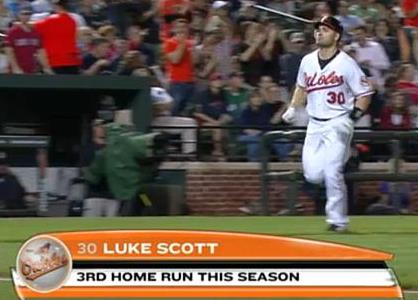
Last week, Orioles outfielder Luke Scott tossed his bat with considerable verve after hitting a monster home run against Josh Beckett. This may have gone unnoticed had Beckett not tried to shout him down in the aftermath, then gotten into an argument with the umpire over it.

(Unfortunately, MLB.com’s video cuts away before the bat flip on every single replay.)

After the inning, Beckett was approached by plate ump Fieldin Culbreth, which culminated in an animated conversation during which the pitcher gestured toward the Orioles dugout. One possibility: Culbreth was warning him against retaliation. (If so, it worked; Beckett faced Scott once more in the game, retiring him on a fly ball.)

For a guy so clearly perturbed, Beckett wasn’t much in the mood after the game to deconstruct the moment with reporters.

“What is this, TMZ?” he said. “I thought we were talking about a baseball game. You want to know about bat flips and talking to umpires. I think, why don’t we just stick to the game.”

It’s a fair enough tactic. If Beckett expressed sufficient outrage it’d be all the easier to pin him with the drilling for which Scott seems destined. The one clue Beckett offered up to the press: “These things have a way of working themselves out.”

The teams next meet May 16.

– Jason