Clint Hurdle, Dusty Baker, Gamesmanship, Jim Tracy, Kevin Towers, Tony La Russa

Lights, Rain and Radar: How to Get into your Opponent’s Head, an Introductory Course in Gamesmanship

When the lights go down in St. Louis . . .

When the lights went out in St. Louis last night, there were two outs in the 11th inning and San Francisco’s Brian Wilson was on the verge of closing out a 7-5 victory.

Instead, the teams sat for 16 minutes while the sound guy at Busch Stadium played Journey’s “Lights” and somebody tried to deal with the electrical system.

The chatter after Wilson finally returned to record the game’s final out had to do with the possibility of malfeasance on the part of Tony La Russa. Did the Cards’ manager manipulate the power grid in an effort to cool down the opposing closer?

Of course he didn’t. Or at least he probably didn’t. Still, the coincidental timing was enough for Bruce Bochy to quip afterward that it was “pretty good gamesmanship” on La Russa’s part.

The Giants’ skipper was joking, but there’s a reason La Russa’s name comes up during moments like this.

Earlier this year, for example, he was accused of selectively distributing weather information when the Cardinals were hosting Cincinnati, then pitching reliever Miguel Batista instead his scheduled starter, Kyle McClellan. Batista threw all of six pitches before rain halted the game for more than two hours.

Afterward, McClellan, fresh, took his rightful place on the mound.

Dusty Baker, meanwhile, claiming an information inequity between the teams, had his starter, Edinson Volquez, warm up from the get-go. The right-hander never got a chance to pitch, however; when play resumed, Baker had to turn to Matt Maloney rather than risk having Volquez get hot twice.

“It’s really a tough start,” Baker said in an MLB.com report. “The information that we received was probably not the same information they received, or else we wouldn’t have started [Volquez] in the first place. We were told there was going to be a window of opportunity there. That window lasted about three minutes.”

Maloney gave up three runs in three innings, and the Cardinals won, 4-2.

La Russa, of course, is hardly alone when it comes to gamesmanship. In April, Livan Hernandez accused the Pirates of doing much the same thing.

Weather reports, however, are far less interesting than the other tally on Pittsburgh’s gamesmanship scorecard. That came when Clint Hurdle appeared to dupe Rockies skipper Jim Tracy with two outs in the 14th inning of a tie game. With a runner on first, Andrew McCutchen stepped into the on-deck circle as Jose Tabata batted.

That had been McCutcheon’s spot in the order earlier in the game, but the outfielder was removed as part of a double-switch. The guy actually scheduled to hit next was relief pitcher Garrett Olson, whose last plate appearance had come in 2009, and who has collected all of one hit in his five-year career.

Had Tracy been paying better attention, he might have realized that the Pirates’ bench was empty, leaving Olson to fend for himself at the plate.

It never came to that. Seeing McCutchen, Tracy had reliever Franklin Morales pitch to Tabata—who promptly lashed a game-winning double. (Watch it here.)

From the Pittsburgh Post-Gazette: “Asked if the move was a decoy to get the Rockies to think McCutchen was up next … ‘No, come on, why would we do that,’ Hurdle said with a sly chuckle.”

* * *

Rain delays and decoys are one way for a home team to gain an advantage. Radar guns are another.

Earlier this season, Diamondbacks GM Kevin Towers admitted to the Arizona Republic that when he held the same post with San Diego, the Padres took to manipulating their ballpark’s radar gun to get into the heads of opposing pitchers.

“I know for a fact that every time Brad Penny pitched for the Dodgers in San Diego it was probably the lowest velocities he ever had,” he said. “He liked velocity. He’d stare at the board. He was throwing 95-96, but we’d have it at 91 and he’d get pissed off and throw harder and harder and start elevating.”

Hardball Talk’s Aaron Gleeman checked, and—lo and behold—Penny is 1-5 with a 6.47 ERA in 10 career games pitched in San Diego.

(The subject was initially raised when fireballing Aroldis Chapman, after topping out at 106 mph earlier in the season, dropped nearly 15 mph off his fastball in San Diego, then magically regained his velocity during Cincinnati’s next series. Towers’ comments could themselves have been a form of gamesmanship, as his new club uses the non-manipulatable Pitch-f/x system, and the Padres—and all their secrets—are now the enemy.)

The tactic works both ways. During the 2002 postseason, when Robb Nen was throwing pus with a shredded shoulder during what would be the final innings of his career, the folks at AT&T Park shut off the radar gun altogether when the Giants’ closer entered the game. It might not have fooled anyone on the opposing team, but it certainly didn’t hurt.

– Jason

Brian Fuentes, Clubhouse Etiquette, Don't Call Out Teammates in the Press, Edinson Volquez, Fred Wilpon, The Baseball Codes

You Talk Too Much: The Fine Art of Complaining Your Way into the Doghouse

Edinson Volquez, in a moment of not saying anything.

It’s been a bad week for baseball types to talk, with every talker doing his darndest to deflect blame that he incontrovertibly deserves.

In Cincinnati, Edinson Volquez continued his season-long meltdown on Sunday by giving up seven runs to Cleveland over 2 2/3 innings. The right-hander has a 6.35 ERA and leads the National League with 38 walks.

Volquez’s problem, according to Volquez: the Reds’ offense.

“Everybody has to step up, start to score some runs,” he said in the Cincinnati Enquirer. “In the last five games, how many runs have we scored? Like 13? That’s not the way we were playing last year. We’re better than that.”

This is a terrific way to further alienate teammates who are already undoubtedly upset with the pitcher’s inability to keep Cincinnati in games. It’s even more infuriating than Gaylord Perry’s habit of physically showing frustration on the mound when his teammates made errors behind him in the field. At least Perry took the blame when he deserved it. Plus–unlike Volquez–he was a winner.

Cincinnati’s response was swift; on Monday, Volquez was optioned to Louisville. It was a dramatic move–the right-hander was their opening day starter, a former All-Star who went 17-6 in 2008. Of course, the guy has long battled maturity issues, being kicked by the Rangers all the way down to Single-A from the big leagues in 2007, shortly before they shipped him to Cincinnati (in exchange for Josh Hamilton).

If Volquez jeopardized his own spot in a major league clubhouse, Brian Fuentes jeopardized that of his manager. After Oakland’s interim closer gave up the lead yesterday against the Angels, he used his time in front of the post-game media to light into Bob Geren.

As with Volquez, it was primarily a matter of frustration. Fuentes has picked up losses in four straight appearances; his seven on the season already stand as a career high. He’s on pace to lose more games than any reliever in history.

At issue: how Fuentes has been used. He hasn’t had a save opportunity since May 8, coming primarily into tie games as of late. It happened again on Monday, when Fuentes walked one of the two hitters he faced before being pulled in favor of Michael Wuertz, who promptly let his inherited runner score, tagging Fuentes with the loss.

MLB.com’s Jane Lee posted the entire transcript of the reliever’s bluster:

What did you think of the situation you were placed in tonight?

It’s surprising yet not surprising all at the same time.

How do you feel with the way the manager has handled you as a reliever?
Pretty poorly.

How much communication do you have with him?
Zero.

Why is it pretty poorly?
There’s just no communication. Two games, on the road, bring the closer in a tied game, with no previous discussions of doing so. And then, tonight, in the seventh inning, I get up. I haven’t stretched, I haven’t prepared myself. If there was some communication beforehand I would be ready to come into the game  – which I was, when I came into the game, I was ready. Just lack of communication. I don’t think anybody really knows which direction he’s headed.

How much different is this compared to past managers?
It’s a pretty drastic difference.

What goes through your mind when the phone rings in the seventh tonight?
I thought he misspoke. I thought it was some sort of miscommunication, but he said, ‘No, you’re up,’ so I got up and cranked it up. You can’t try to guess along with them. Very unpredictable.

At the beginning of the season, did he tell you that you were the closer?
Yes, from get go, I’ve been closing.

In regards to communication, is that something that ought to change?
It should. It’s not my decision. I can’t predict the future. If he decides to take that step, then there will be communication. If not, I’ll make sure I’m ready from the first.

Does there need to be a “clear the air” meeting?
Some people might think so. At this point I have nothing to say.

Has this been boiling up or is it just recent?
Just recent, really. I think the games in San Francisco were some unorthodox managing. I thought it was maybe the National league thing, that maybe that had something to do with it, but tonight was pretty unbelievable.

“Unbelievable” is an appropriate term. Fuentes has some validity with his points, but going public with them makes him look like a half-bit pitcher searching desperately for excuses. In the process, he completely undermined his manager and potentially damaged team chemistry. Today saw calls for Geren to resign, and questions have been raised about how the team will communicate moving forward.

This is a lot of damage for a pitcher who has been with the A’s for all of two months to inflict over the course of a five-minute interview.

The Reds sent Volquez to the minors. Fuentes doesn’t have to worry about that, but his position in the bullpen is certainly in danger. (Geren said that would have been the case even had Fuentes kept his mouth shut.) A’s closer Andrew Bailey is due back soon from the DL, and the return to health of Joey Devine and Josh Outman makes Fuentes expendable; shuffling him out of sight until he can be dealt to a contender should not be too difficult. (Fuentes came back tonight, and, without backing down from his statements, apologized to Geren—assumedly for the public nature of his discourse.)

* * *

Most noteworthy of all talkers was Mets owner Fred Wilpon, who set New York atwitter as soon as the New Yorker published Jeffrey Toobin’s profile of him. Amid what is otherwise a sympathetic story, Wilpon spent a few choice paragraphs disparaging his players. Jose Reyes, he said, will never get “Carl Crawford money” when he hits free agency after this season, because he’s too frequently injured. (The direct quote: “He’s had everything wrong with him.”)

Carlos Beltran was given a seven-year, $119 million deal by “some schmuck” (that would be Wilpon referring to himself), which the owner has come to regret. David Wright, he said, while a very good player, is not a superstar.

And the team as a whole: “Shitty.”

Yikes. In one brutal volley, Wilpon inadvertently undermined his financial recovery from the Bernie Maddoff fallout, at least as far as the Mets are concerned. (This despite the fact that, like Fuentes, Wilpon probably didn’t say anything that was inaccurate). He’s not going to re-sign Reyes, that much is now clear; what leverage the Mets held in trade talks regarding their shortstop has been radically diminished. Beltran, too, is on the trading block, but what kind of bargaining position will the Mets be in after their owner proclaimed the center fielder to be “sixty-five to seventy percent of what he was?” Will Wright—or any other player, for that matter—want to stick around a dysfunctional ballclub once free agency comes calling?

Most of all, Wilpon wants to sell part of the team, which may be harder to do after he’s publically acknowledged that it’s shitty. Not to mention that whoever buys in would have to defer to a proven loose cannon.

Other players on all three teams—the Reds, A’s and Mets—have done a good job avoiding additional conflict, opting against saying anything to further inflame their situations. Dennis Eckersley, however, let loose on Fuentes during an interview on the A’s flagship radio station (as tweeted by Chronicle columnist John Shea and compiled by Hardball Talk). Eck was talking about Fuentes, but conceptually he could have be referring to any one of the three:

“Weak. If you fail, you fail. You don’t throw the manager under the bus.  . . . He makes a ton of money, and he’s not the greatest closer in the universe. So zip it … It makes him look bad. It just does. At the same time, it doesn’t show a lot of respect for the manager … If I’m the manager, he’s in my office. If that was La Russa, are you kidding me? He’d chop my head off. I would make a formal apology … Geren’s got to do something.”

Geren does have to do something. As do the Reds (Volquez can’t stay in the minors forever) and the Mets.

All that’s left to figure out is what.

Update: Wilpon has apologized to the Mets, via conference call.

Update 2: For Geren, the piling on has officially begun. The latest: Huston Street weighed in on his ex-manager’s shortcomings from Colorado. Plus, a tale about Mike Sweeney not getting along with the guy, which really doesn’t look good considering that if there was a Nicest Man in the History of Baseball Award, it’d likely go to Sweeney. Unless the A’s experience extraordinary success into October, the chances of Geren returning next year are at this point minimal. If he makes it even that long.

– Jason

Albert Pujols, Francisco Cordero, Retaliation

Cards Sensitive, Cordero Indignant, Next Chapter all but Written

Francisco Cordero has some things to say.

That the Yankees hate the Red Sox (and vice versa) is not quite true.

That Yankees fans hate Red Sox fans (and vice versa) is much more to the point. What happens between the teams on the field is primarily about competition, not vitriol. It’s a process involves little actual animosity.

The same does not hold true for the Cardinals and the Reds.

These teams share a laundry list of recent dustups, starting last year with Brandon Phillips calling the Cardinals “little bitches”; continuing on to Phillips starting a fight with Yadier Molina, and Johnny Cueto kicking Jason LaRue onto the disabled list; and more recently to Tony La Russa slyly using the weather report to outmaneuver Dusty Baker just last month.

The latest episode came Sunday, at the end of Cincinnati’s 9-7 victory over the Cardinals—the final moments of what would be the Reds’ first three-game sweep of St. Louis since 2007. They scored eight consecutive runs to beat Chris Carpenter for the first time in five years.

With one out in the ninth inning—after St. Louis had tightened what had been a 9-2 deficit over the previous seven hitters—closer Reds closer Francisco Cordero drilled Albert Pujols with an 0-2 pitch. (Watch it here.)

To watch the response from the Cardinals bench, it seems that Kyle Lohse isn’t the only one doing impressions of La Russa. Acting manager Joe Pettini—in charge while La Russa dealt with health issues—pitching coach Dave Duncan and backup catcher Gerald Laird picked up the indignant we-will-not-be-abused mantle so visibly embraced by their skipper, lighting into Cordero from the dugout as the Reds congratulated one another on the field. Cordero responded in kind, shouting and gesturing toward the St. Louis bench. (Watch it here.)

“The soap opera continues between these guys,” Pettini said in the St. Louis Post-Dispatch. “It’s always something when you come in here.”

The reality, of course, is that closers, by dint of being used almost exclusively in close games, almost never send message pitches—at least not ones that hurt. That was certainly the case here; Pujols was the tying run, Matt Holliday and Lance Berkman were to follow, and the pitch in question was no more than a few inches inside, hitting Pujols on the left wrist.

Pujols himself said that Cordero wasn’t trying to hit him, that it was “probably something that slipped.”

The teams next meet on July 4 in St. Louis. (Brace for the inevitable “Fireworks at Busch” headlines.) If there’s a clear target on the Cardinals, it’ll likely be Laird, Cordero’s former teammate on the Rangers, who accounted for much of the shouting and who, unlike Pettini and Duncan, occasionally takes the field.

“I just told (Laird), ‘Say it again’ . . .” said Cordero. “I thought it was funny that a guy who wasn’t playing was yelling at me.”

It was little more than posturing on the Cardinals’ part, and even they know it. Perhaps it’ll somehow distract Cincinnati in the future, but even that’s unlikely. Mostly, it served only to unnecessarily perpetuate what’s becoming a significant history of bad blood.

(Reds broadcaster Marty Brennaman didn’t help matters any when he said on the air that Carpenter was a “whiner and excuse-maker,” that Duncan was “infantile” and that the Cardinals “might be the most disliked team in baseball.”)

“The teams don’t like each other,” said Berkman after the game in the Cincinnati Enquirer. “That’s just part of the deal.”

– Jason

Hal McCoy, Jonny Gomes, Reporters' etiquette

Make Sure You Hear What You Think You Hear Before You Go Ahead and Report It

Although many media outlets reporting on the Jonny GomesAdam Wainwright affair are spinning it as a matter of player disrespect, there’s more to it than that.

At the surface, it seems clear: Gomes is reported to have walked into the Cincinnati clubhouse moments after hearing that Cardinals ace Wainwright would likely be shelved for the season with a blown-out elbow, singing something along the lines of  “Wainwright’s gone.”

The firestorm was immediate. People suggested that Gomes stay loose the first time he steps in the box against the Cardinals, because Tony La Russa is a man of applied vengeance and because none of Wainwright’s fellow St. Louis pitchers are likely to cotton well to the sentiment.

Well, okay. If it happens that Gomes wears a fastball for his actions, so be it.
Except that according to him, those were neither his actions, nor his intent. And there’s plenty of evidence in his corner to believe him.

The true breach of etiquette came from writer Hal McCoy, the guy who initially reported Gomes’ would-be song in his blog for the Dayton Daily News.

McCoy explained in a follow-up post that as he was getting ready to depart the Reds clubhouse, he “thought” he heard the words Gomes was singing. Then he reported them. (McCoy has since removed the offending paragraph from his blog.)

Etiquette is required of reporters as much as it is of players inside big league clubhouses. As most reporters will attest, running overheard items—especially inflammatory ones—is inherently dangerous because there’s frequently more to the story.

At the very least, a thorough reporter will take the item directly to the player in question for further comment, to ensure what’s being reported is what was intended. (It’s also standard practice for reporters to bring inflammatory on-the-record statements back to the offending party to confirm intent. And regardless of what Gomes did or did not sing, he was clearly not on the record.)

McCoy is a Hall of Famer, a sportswriting legend. Perhaps he’s still trying to figure out the immediacy of the Internet and the place of blogging in the reporting universe. The rise of new media has engendered a rule that he and every other sportswriter is well-served to observe: the traditional “scoop”—in which a reporter breaks a news story and gets to watch with glee as his competition scrambles to catch up before the next day’s paper goes to press—is ancient history.

These days, breaking a story gives a reporter only a momentary advantage, as every competing outlet can pump out their own reports just moments later. (This, in fact, is the primary job description of most bloggers. Craig Calcaterra offered up a prescient and insightful post on this very topic earlier this month.)

Much more important is accuracy. Had McCoy taken the time to corroborate what he heard with the player in question, he wouldn’t have the mess on his hands that he does. Nor would Jonny Gomes.

Gomes is widely seen as one of baseball’s good guys—McCoy himself said so even as he apologized for his quick draw—and has been scrambling to repair his image.

To McCoy’s credit, he’s owned responsibility for his actions, which is something Hall of Famers do.

Of course, that might not help the impending bruise about which Gomes is worried should McCoy have indelibly painted a target on his back when it comes to the Cardinals.

— Jason

Jordan Smith, Rookie Etiquette

How to Make an Inauspicious Outing Even Worse, No. 762

By most measures, Jordan Smith has had a fine rookie season for the Cincinnati Reds. He’s compiled a 3.32 ERA in 37.1 innings out of the bullpen, with 22 strikeouts against only nine walks. He’s even racked up a save.

On Monday, however, he learned a valuable lesson in rookie comportment.

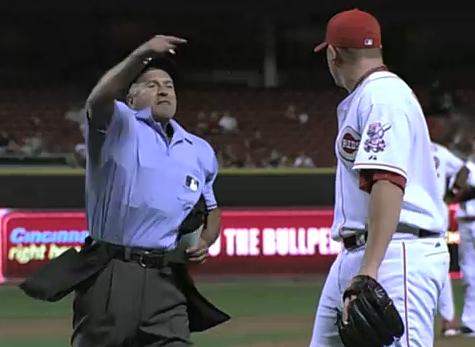
In what was by far his worst appearance as a big leaguer—and probably his worst appearance ever—Smith threw nine pitches to two batters, only one of which was a strike. After walking the second man, he was removed by manager Dusty Baker.

Which is pretty much where things fell apart. On his way off the field, Smith decided to have a chat about the strike zone with plate ump John Hirschbeck.

At this point he would have been well served to observe the first rule of rookiedom (generally more valid in years past than today, but still rock-solid when it comes to umpires): Don’t speak unless spoken to.

Words led to shouting; shouting led to ejection. (Watch it here.)

With his display of ill temper, Smith undoubtedly made it more difficult for himself the next time he sees Hirschbeck. Much like veteran players, many umps like to test rookies, just a little, to see what they’re made of.

“The longer you play, the more rope you get,” said Andy Van Slyke, describing the phenomenon.

Whether Hirschbeck had been intentionally squeezing Smith is unclear, but there’s certainly precedent to fall back on.

Take Wade Miller. In the pitcher’s major league debut for Houston in 1999, a start against Arizona, umpire Rich Rieker was being extremely judicious with his strike calls.

After one pitch that split the plate was called a ball, Miller gave the ump a protracted glare. That was all his catcher, Randy Knorr, needed to see. He quickly trotted out for a mound visit.

“I said, ‘Wade, man, just get through today. If you get through today, you’ll be fine. Just don’t show up the umpire. He’s testing you. I’m trying to work him back there, don’t be snapping the ball on him or anything like that.’ ”

Miller ended up allowing seven runs over three innings, but ultimately passed the test. The final batter he faced, Arizona pitcher Brian Anderson, was called out on strikes.

“As he walked off the field,” said Knorr, “I think the umpire said, ‘Good job, Wade.’ ”

– Jason

Johnny Cueto, Juggling the Rotation

Quirk in the Rotation Helps Cueto Avoid Cards

When Reds pitcher Johnny Cueto went all Jet Li on Jason LaRue’s face on Aug. 10, kicking the St. Louis catcher onto the disabled list during a mid-fight scrum, everybody’s eyes quickly turned toward the teams’ next meeting—which happened over the weekend.

Anticipation can be a wondrous thing.

This particular anticipation, of course, was short-circuited when the Reds rotation shook out (inadvertently or otherwise) so that Cueto was not scheduled to face the Cardinals.

Cueto would have served as the most obvious target in recent memory, and Reds manager Dusty Baker opted to delay the inevitable; because it was the final meeting for the teams this season (barring a potential showdown in the playoffs), any retribution the Cardinals are able to inflict will have to wait for next year.

There had already been talk that the Reds might try to limit the pitcher’s visibility over the course of the weekend, but Cueto took things a step further, leaving the country with team permission to attend the funeral of an uncle in the Dominican Republic.

Since the fight, LaRue’s injuries—reported as concussion syndromes—have knocked him out for the season. Cueto was suspended seven games for his actions, essentially missing one start in the process.

The suspension also Baker the leeway to mix and match where in the rotation he reinserted Cueto (which he did in conjunction with figuring out how to reduce the work on fatigued rookie Mike Leake), the better to have the pitcher avoid St. Louis.

It wouldn’t be the first time such juggling has occurred. After Roger Clemens bounced a fastball off Mike Piazza‘s helmet in 2000, Yankees manager Joe Torre arranged his pitching rotation to ensure that Clemens was his Game 2 starter at Yankee Stadium, despite the fact that he was the Yankees’ best pitcher that year. This made Clemens the only member of the four-man World Series rotation to avoid pitching at Shea (where he would have been an obvious target the moment he stepped to the plate in the non-DH park).

“Did I juggle the rotation to keep him from pitching at Shea? Yeah, I probably did,” said Torre. “I’m not going to deny that. I didn’t need another soap opera.”

– Jason