Josh Hamilton, Respect Teammates

Hamilton Breaks Arm, Hurts Feelings, Loses Face

Josh Hamilton clearly was not happy with the way things went Tuesday.

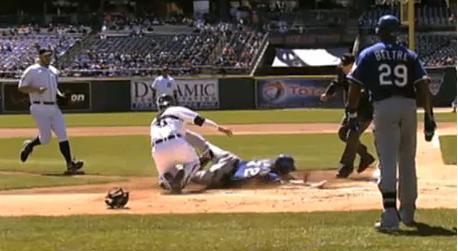
With Hamilton on third, third base coach Dave Anderson noticed that nobody was covering the plate as Tigers catcher Victor Martinez went to chase a popup that was ultimately caught in front of the Tigers dugout by Brandon Inge. Anderson urged Hamilton to score, but Inge flipped the ball to Martinez, who beat a diving Hamilton to the plate.

The result: a broken arm and six to eight weeks on the disabled list.

Hamilton was out, he was injured and he was frustrated. And he let it get to him, lashing out at Anderson after the game, essentially blaming his coach for the injury.

“I listened to my third base coach,” he said. “That’s a little too aggressive. The whole time I was watching the play I was listening. [He said], ‘Nobody’s at home, nobody’s at home.’ I was like, ‘Dude, I don’t want to do this. Something’s going to happen.’ But I listened to my coach. And how do you avoid a tag the best, by going in headfirst and get out of the way and get in there. That’s what I did.”

(Watch the play, and hear Hamilton discuss it, here.)

Hamilton is allowed to take issue Anderson’s call, personally or directly to Anderson. What he’s not allowed is to call out a coach in public. It undermines every bit of authority Anderson possesses.

This doesn’t happen frequently, but it’s not it’s never happened before. In 1986, for example, Angels baserunner Bobby Grich, having rounded third on a single by Bob Boone, retreated to the base, only to be thrown out by a relay from Jim Rice to Wade Boggs to Spike Owen.

The Angels were trailing 3-2; Grich would have been the tying run, had he scored. He threw his helmet to the ground and animatedly gestured toward third base coach Moose Stubing, showing him up not just in word, as Hamilton did to Anderson, but in deed.

Afterward, Stubing accepted full responsibility for the blown play, but that’s almost beside the point. No matter how badly he failed at his job, the unwritten rules mandate respect from player to coach, and vice versa—especially on the field. It’s the same section of Code that keeps managers from removing position players in the middle of an inning for anything but injury.

It took some time for Grich to understand this, but after the game he tracked down his coach to apologize.

Hamilton took even longer. He had hardly backed down early Wednesday when he told reporters, “I threw him under the bus by telling the truth about what happened. What do you want me to do, lie about it? People are going to blame who they want to blame.”

Never mind the fact that Hamilton’s status in the game is lofty enough to allow him to do whatever his instincts tell him on the field. He would not have been second-guessed for staying at third, no matter what happened.

Also never mind the fact that players are taught to go feet-first when sliding into home.

Later that same afternoon, however, the slugger had either reconsidered his stance, or had been instructed in no uncertain terms to turn the other cheek. Finally, he apologized to Anderson.

“I see where I need to take responsibility for it,” Hamilton said. “I was just frustrated—more so for getting injured.”

– Jason

Bill Hall, Nick Swisher, Slide properly, Tsuyoshi Nishioka

It’s Been a Bad Week for Takeout Slides, at Least as far as Middle Infielders are Concerned

How much is too much, and when is enough when it comes to takeout slides? These questions were asked multiple times and with no firm answer in Houston and New York last week.

Start with Bill Hall. Was flying into Marlins shortstop Hanley Ramirez on a play at second base, as the Astros second baeman did Friday, too much? It was certainly aggressive. Ramirez, firmly planted behind and to the left of second base as he attempted to turn a double-play, provided a stationary target as Hall went out of his way to take him out. (Watch it here.)

That, however, is what players are taught to do—interrupt the fielder at any cost, so long as it’s clean. And Hall’s slide was clean, if a touch late. He went in feet first and spikes down, with one clear purpose: prevent the double-play. That he went out of his way—but not too far out of his way—to do it falls well within the definition of getting the job done.

“Clean play? Dirty play? That’s hard to tell unless it’s very obvious,” said Marlins manager Edwin Rodriguez in the Palm Beach Post. “He came hard but he was in range. He was touching the base. That’s the way he plays and that’s the way it should be—play hard.”

Hall ended up going shin-to-shin with Ramirez, knocking them both down for several minutes. Hall returned to the game; Ramirez sat out until Tuesday.

A day prior, Nick Swisher of the New York Yankees took out Twins second baseman Tsuyoshi Nishioka in a similar play, with far graver consequences. Swisher’s slide—like Hall’s, off the base and intended to break up the double-play—broke the second baseman’s fibula, just six games into his big league career. (Watch it here.)

The reason both infielders were hurt is that neither of them jumped. Ramirez fielded the throw in an awkward place coming from the shortstop position and had to adjust; Nishioka might simply never have learned any difference.

Twins broadcaster Dan Gladden, who spent a year playing in Japan (winning the Japan Series with the Yomiuri Giants in 1994), was quoted in the Minneapolis Star Tribune talking about the dearth of such tactics in that country.

“When I got over there I told them, ‘I don’t slide to the bag. We are taught to break up double plays,’ ” he said. “The coach told me, ‘We expect the Americans to play that way.’ ”

Swisher went so far as to visit Nishioka in the X-ray room at Yankee Stadium to offer a personal apology for the inadvertent injury. Nishioka told him there was no apology necessary. And that was it. No retaliatory strikes the following day. No bad blood resulting from a hard, clean play.

The same can not be said for the Marlins. Ramirez was injured far less severely than Nishioka, but despite the fact that he publicly exonerated Hall—“My opinion is he was trying to break up a double play,” he said in the Post. “He told [Marlins infielder Greg] Dobbs that he was sorry but … he was trying to do his job.”—his teammates clearly had a score to settle.

Saturday’s game was too consistently close to consider a retaliatory strike, but on Sunday, with a 6-1 lead in the seventh inning, Edward Mujica drilled Hall in the hip. The intent was clear; Mujica has hit only three guys over the course of his six-year career and walks almost nobody. His control is exquisite. He was quickly ejected.

Ramirez being the face of his franchise certainly had something to do with it. The fact that he has a history of calling out Marlins pitchers for lack of retaliatory response may also have factored in. (Then again, Mujica was with San Diego during that particular tirade, and may have been entirely ignorant of it.)

Had Hall been out of line with his slide, with a barrel roll or some other questionable tactic—in other words, had he deserved the response—it might have ended there. As it was, Houston reliever Anuery Rodriguez stood up for his guy by plunking Gaby Sanchez in the ninth. This one was easy to see coming; Rodriguez is a rookie with a double-digit ERA. His performance on the field is not winning much respect from his teammates, so he felt the need to earn it in a different capacity. He, too, was ejected. (Watch both ejections here.)

The Marlins and Astros meet once more this season, in July. There’s no reason for renewed hostilities at that point—but then again there rarely is. Stay tuned.

– Jason

A.J. Pierzynski, Felipe Lopez, Joe Maddon, Ozzie Guillen, Retaliation

Lopez Bat Toss Sparks Quick Confrontation, String of Ludicrous Denials and, Ultimately, an Apology

A.J. Pierzynski is less than appreciative of Felipe Lopez's bat toss Saturday.

Most baseball retaliation looks the same: a pitcher throwing a ball as hard as he can at the backside, legs or ribs of an opposing batter.

Sometimes, though, batters get theirs, too. Unfortunately for them, their actions rarely hold the same weight; whereas a vengeance-minded pitcher can be seen as sticking up for his teammates, his counterpart at the plate is often looking out only for himself. Such displays frequently resemble hot-headed reaction far more than they do retaliation.

Case in point: Felipe Lopez. On Saturday, the Rays’ third baseman took an inside pitch in the ninth inning from White Sox reliever Chris Sale that apparently didn’t meet his liking.

Lopez hit the next pitch out of the park, and as part of his follow-through whipped his bat toward the mound. (Watch it here.)

Needless to say, this was not taken well by pretty much anybody on the field. Chicago catcher A.J. Pierzynski was waiting for him when he crossed the plate, delivering a sternly worded message while gesturing toward the mound. Lopez’s body language looked as if he was trying to deny intent; had he been aggressive, it’s not difficult to picture a fight breaking out.

The Sox weren’t the only ones upset.

“That’s not who we are. That’s not how we play,” Rays manager Joe Maddon said Sunday in the St. Petersburg Times . “I’m not into the end zone demonstration that much. I think we’ve really morphed into this, I believe, very classy group over the last several years and I want to maintain that kind of thought about us. I don’t even want to say image—you think about the Rays, you think these guys handle themselves in a certain way. So we don’t do that here.”

It’s a point that Maddon had to make. Forget the image he’s trying to maintain—outbursts like Lopez’s can lead not just to his own potential peril, but can put his teammates in danger, as well.

It’s difficult to believe that Lopez, who’s in his 11th season, didn’t understand the potential repercussions of his actions. Then again he’s with his eighth team (not counting two stints with St. Louis), and was cut by the Cardinals last year after ongoing bouts of unprofessionalism. With that in mind, selfish behavior shouldn’t come as too much of a shock. (He couldn’t have had much of an issue with Sale, who’s in just his second season and who has now faced Lopez all of twice.)

Such is the power of Joe Maddon that Lopez took the surest available path to absolution, calling Ozzie Guillen after the game to apologize. (Maddon even went also recalled that Roy Halladay once called him to apologize after some inflammatory comments he inadvertently made, and that the gesture was appreciated.)

If any part of this affair went according to the Code, it was the entire array of responses. As in, outside of Maddon decrying the general spectacle of it all, everybody denied pretty much everything.

“It was unfortunate, but I wasn’t trying to do that,” Lopez said in the St. Petersburg Times. “I wasn’t mad at anything. The bat, it slipped, and it went over there. I think if I tried to do that, it wouldn’t happen.”

Pierzynski denied there was a confrontation at the plate, saying, “I don’t know what you are talking about. I just said hi. He lives down the street from me in Orlando, and I was asking how his house was.”

Guillen, after receiving Lopez’s call: “I don’t think he meant to throw (the bat) to the pitcher.”

Still, in order to give heads some time to cool, Maddon held Lopez out of yesterday’s game. It only buys about a week; the Rays visit Chicago on April 18.

– Jason

Thanks to reader Russ Buker in St. Petersburg for the heads up.

Media

The Code isn’t for Everyone – Just Those who Care

The inimitable Charles P. Pierce.

Charles P. Pierce is a writer for the Boston Globe. He’s one of the more gifted sportswriters in the field. (One of my favorite pieces he’s written ran a few years back in Sports Illustrated.)

He also doesn’t like baseball’s unwritten rules. Said so himself today, right there on his Globe blog:

You know one of the reasons I don’t get (baseball)? This kind of nonsense. A young guy’s not supposed to swing away in a situation because of some secret Templar code that Jim Leyland and Buck Showalter have tattooed on the inside of their eyelids? “Baseball etiquette,” my Aunt Fanny. Get over yourselves, the lot of you.

Of course, in hating on the Code he cuts to the heart of the Code: Those who don’t care don’t get it. Try explaining to somebody who doesn’t love baseball the justifiable propriety of a pitcher putting a fastball into a hitter’s backside in response to something that happened earlier in the game.

Can’t be done.

Pierce calls himself a baseball agnostic, immune to that “extra thing” that “makes maundering children out of slumming poets and distinguished professors of history.” (The problem with gifted writers is that when they snark against things you like, it’s frequently high-quality stuff.)

Which is just fine. I am not a baseball agnostic. I’m not even born-again. I’ve been there since the beginning, still cherishing that first game with my dad, a subject Pierce also savages in his blog. (Okay, he savages the clichéd overuse in memoirs of the First Game with Dad narrative, something with which I’m kind of inclined to agree.)

Still, to those who care about the game—a group that includes most of the people within the game—the Code is vital. It’s what sets baseball apart as a sport, the thing that defines, in concrete terms and with concrete repercussions, that respect is paramount and mandatory.

To put it in other terms: If LeBron James played baseball and left the Indians for the Yankees, then opted to do a baseball version of his chalk-throwing routine before his first game as a visitor at Jacobs Field, do you think he might be wearing a fastball before the end of the series? Do you think he’d do it again after that?

It doesn’t matter what our fictional baseball-playing LeBron James thinks about the unwritten rules. It matters only that they exist and that he would abide by them, because everybody ultimately does.

Baseball mandates as much. It’s one of the things that make the sport special to many of those who care about it. Should Charles Pierce ever come around to caring, perhaps he’ll discover as much.

– Jason

Don't Play Aggressively with a Big Lead, Swinging 3-0

The Differences Between Spring Training and the Regular Season Sometimes aren’t so Different After All

Buck Showalter: Not a fan of the 3-0 swing.

As March draws to a close, it’s a good time to ponder the meaning of spring training games.

They exist to help players prepare for the season, that much is obvious. But what of their actual function? Because they don’t count, they’re handled differently than other contests.

Managers regularly empty their benches with steady streams of substitutions. Pitchers don’t fret about poor outings—at least early on—under the hypothesis that they’re working out winter kinks; if they feel like throwing 10 curveballs in a row then by gorum that’s what they’ll do, regardless of what hitters are doing to those curveballs.

But still, they are games. And games are played with certain elemental consistencies.

The last two weeks have seen separate incidents that bring to the fore the question “What’s appropriate in spring training and what’s not?” Both, coincidentally, involved catchers for the Orioles.

On March 15, Pittsburgh’s Andrew McCutchen tried to score from first on a hit by Baltimore’s Matt Diaz, but was tagged out when Matt Wieters blocked the plate, forcing McCuthen into his shin guards.

“I don’t know what (Wieters) was thinking,” McCutchen said afterward in the Pittsburgh Tribune-Review. “It’s spring training. We’re not trying to get hurt. I wasn’t expecting that much contact. I’m OK, though.”

It harkens back to Pete Rose bowling over Ray Fosse in the 1970 All-Star Game. How much is too much when it comes to hard-nosed baseball during the course of an exhibition?

In this case, however, it was McCutchen himself initiating the contact; Weiters did nothing more than react precisely as a catcher should—protecting both himself and the baseball.

As Yahoo’s Kevin Kaduk observed, “Why did McCutchen slide if he was uninterested in making contact? There’s two bangs in a bang-bang play and McCutchen could have easily withheld one by simply peeling off if he felt the run wasn’t that important in the whole scheme of things.”

On Monday, another Baltimore catcher, Jake Fox—who leads the Grapefruit League with 10 home runs—showed that he’s not much afraid to take his hacks, regardless of the circumstances. With runners on second and third and nobody out in the eighth inning—and his team holding a 13-3 lead against the Tigers—Fox swung 3-0.

One of the clearest-cut sections of baseball’s unwritten rulebook mandates that when one’s team holds a big lead late in a game, one does not, as a hitter, swing at a 3-0 pitch. We’ve gone over it in this space before, but the prevailing notion holds that any pitcher in the wrong end of a blowout game is not on the most solid of footing to begin with. With that in mind, and because the last thing a manger wants to see with his team down by double digits (or something close to it) is a bubble reliever trying to get fine, the next pitch is almost certain to be a fastball down the heart of the plate.

Because of this, hitters are expected to back off and give the pitcher sufficient leeway with which to regain his footing.

Were this the regular season, Fox’s actions would have drawn unequivocal ire, but did the fact that they came in a spring training game affect things? Jake Fox is a journeyman, has played for three teams since 2007, and last year was the first in which he logged no time in the minors. While his prodigious display of power this March has all but locked up a roster spot, one can never be too careful, right? The more numbers he puts up, the better his chances of earning a real payday.

Then again, he was facing a minor leaguer in Chance Ruffin. And regardless of circumstance, proper etiquette is proper etiquette. Ruffin was wearing a big league uniform and facing a big league hitter, and deserves an according level of respect. As does the game itself.

Two people who agree were Jim Leyland and Buck Showalter. Once Fox walked, Leyland raced to the top step of the dugout and berated him for his transgression.

Showalter took things a step farther, yanking off his hat and enumerating at high volume to those in the dugout the ways in which Fox had soiled the reputation of the game. He then sent in a pinch-runner, and made sure to meet Fox in the dugout, where he then unloaded on him. Wrote Jeff Zrebiec of the Baltimore Sun, “It apparently wasn’t the first time this spring where Fox ignored a clear take situation.”

If Leyland feels that there’s a lesson to be taught here, it shouldn’t take long—Baltimore and Detroit meet in the teams’ second series of the season, starting April 4.

– Jason

Chris Carpenter, Nyjer Morgan, Retaliation, Tony La Russa

Tony La Russa Proves Again that his Memory is Better than Ours

Tony La Russa | SD Dirk/Flickr

Last season, Nyjer Morgan suffered one of the most protracted on-field meltdowns in recent baseball history, shifting his public perception from that of a garrulous, personable guy to somebody in genuine need of psychiatric help over the course of about two very rough weeks.

He’s learning this spring that repercussions can carry, and that a little reputation can take a player a long way. Sometimes in the wrong direction.

Monday, the Washington outfielder ran into Albert Pujols while trying to beat out a fifth-inning bunt against the Cardinals. It was hardly his fault that the throw from Cardinals catcher Gerald Laird tailed into him, forcing Pujols into contact, but the lasting image was of the all-everything first baseman trying to shake his wrist loose after the play, sufficiently dinged to elicit a visit by a trainer. (Pujols stayed in the game.)

Morgan’s true problem on the day, if it was really his problem at all, came from Tony La Russa.

It dates back to last August, when Morgan went out of his way to run into Cardinals catcher Bryan Anderson (one of the earlier incidents in the aforementioned meltdown).

In a way, La Russa is a bit like Gaylord Perry. Perry played up his reputation as a greaseballer, fidgeting and wiping all over his body before each pitch, with the understanding that getting hitters to think he was loading up a baseball was nearly as valuable as actually doing so.

Similarly, La Russa revels in his reputation as a staunch defender of baseball decency, someone who will unflinchingly order his pitchers to retaliate in the name of on-field justice. Whether or not he actually does it is almost beside the point; whenever a Cardinals pitcher drills an opponent in any circumstance that can be even loosely construed as retaliatory, questions immediately emerge as to La Russa’s intentions. And any energy the other team expends stewing about the St. Louis manager is energy they’re not focusing on the game before them.

Which is a long way of saying that when Chris Carpenter hit Laynce Nix later in the frame, La Russa was quickly fingered as a prime source of inspiration.

Washington starter Livan Hernandez wasted no time settling the score, drilling Colby Rasmus in the bottom of the inning. La Russa, reported Adam Kilgore of the Washington Post, “seemed to be glaring at the Nats’ dugout as Rasmus made his way to first.”

(Swayed perhaps by the low-key vibe of spring training, Hernandez violated a key unwritten rule in admitting the intent of his pitch to reporters after the game. Expect retribution of the official variety—suspension and/or fine—soon.)

Because La Russa is in charge of the Cardinals (or so we suspect, as far as this particular incident is concerned), St. Louis reliever Miguel Batista hit Ian Desmond in the back two innings later. (Batista actually retired Morgan before drilling Desmond, perhaps indicating that La Russa’s book on Morgan is finally closed.)

This was the tipping point.

Desmond had words, first for catcher Tony Cruz, then, upon reaching first, for Batista. Benches emptied, led by none other than Morgan (who was restrained by Nationals coach Trent Jewett). Nationals manager Jim Riggleman had to be held back when he approached La Russa with malice. Ultimately, no punches were thrown.

“There was no question in my mind that Batista was going to hit somebody,” said Riggleman after the game, in an AP report.

In a fascinating subplot that plays right into La Russa’s intrigue, Kilgore posited that Batista, on the bubble for a roster spot, “may have made the team” with his actions.

Apparently more savvy about this sort of thing than Livan Hernandez, both La Russa and Carpenter denied intent after the game.

“It’s the same story—it happens to us, it happens to them,” said La Russa after the game, in a very La Russa-like this-stuff-has-been-around-forever denial. “You get hit, you think it’s intentional. They hit you, it was accidental. It’s been 100 years of this stuff. It’s not going to go any farther. That’s it.”

One more unwritten rule was violated during the scrum, when it was pointed out that Carpenter—already in the clubhouse when the benches cleared—did not join his teammates on the field. He was in the process of talking to Brian Feldman from KMOV in St. Louis when the incident went down. Feldman reported the following:

Mar. 21, 3:18 p.m. -Was in the clubhouse talking to Carpenter when the benches cleared on the field. Batista was thrown out of the game for hitting a Nationals player…says he was told they believed he did it on purpose. It’s unclear whether he did or not.

Mar. 21, 3:20 p.m. -That beaning from Batista was in retaliation to Rasmus getting hit earlier. Apparently Tony was not happy at all when that happened. So its possible he told Batista to do it…but that’s anyone’s guess.

For his part, Carpenter claimed that once he understood the severity of the situation (including, according to the AP, hearing that “Washington players and coaches blamed him for igniting the fireworks and were questioning why he wasn’t on the field”), he beelined to the dugout.

“The most idiotic thing was that it was a spring training game. It was stupid,” he said. “If they think it’s my fault, I’ll go out there. I didn’t hit Laynce Nix on purpose.”

The quote of the day came from Desmond, who was a teammate of Batista in Washington last season.

“Yeah, it was intentional, but I mean Miggy throws like Miss Iowa,” he said with a laugh—a not-so-subtle reference to the flap Batista stirred last year with comments about the Hawkeye state’s beauty queen. “We were really trying to keep the fans around. Once (Albert) Pujols came out of the game and (Chris) Carpenter came out of the game we knew they were going to leave so we decided to add a little entertainment.”

The true entertainment value will be calculated next time these teams meet, on April 19.

– Jason

Bill Hall, Cole Hamels, Nyjer Morgan, Retaliation

Spring: A Time of Hope—and Retaliation

Nyjer Morgan, at the height of last year's problems.

Spring training is a grand old time for pitchers to let off some steam. Be they perturbed by an event from the game in front of them or harboring long memories from seasons past, the allure of repercussion-free retaliation (who cares if runs score during an exhibition game?) is felt at least a few times each season.

Look no farther than this week’s matchup between Cole Hamels and Bill Hall.

Hall, now with the Astros, was unhappy that Hamels appeared to be quick-pitching him, throwing the ball before he was fully ready. (How this tactic would help Hamels prepare for the regular season, I’m not sure.)

So Hall stepped out in an effort to slow Hamels. The pitcher’s response was to send his next offering inside, which was sufficient to send Hall from zero to boiling. According to the Houston Chronicle, he had to be restrained by plate ump Laz Diaz.

After the game, Hall called Hamels a “marked man”—not so much, he explained later, as it pertains to the left-hander’s physical wellbeing, but to the on-field respect he receives. Translation: Expect Hall to show Hamels up at the earliest available opportunity.

From the Chronicle:

I don’t know if he was mad because he gave up a homer (to Carlos Lee in the previous at-bat) or if he was mad because the umpire gave me time. But I’m not going to let him speed-pitch me. Obviously, he threw a pitch in, and I’m not going to let him disrespect me either. He kind of said something that I didn’t like too much. It’s over with. He’s definitely a marked man for me now, so when I do some damage off him, I’m going to let him know I did some damage off him. I can guarantee that.

I don’t feel like I do a lot of things to have pitchers mad at me for doing things on the field. I feel like I play the game the right way. But if you disrespect me, I’m going to do my best to disrespect you back. Obviously not in a way to disrespect the game, but obviously I’m going to let him know when I face him.

Well, okay. Houston opens with three games at Philadelphia, starting April 1. With Hamels scheduled to be Philadelphia’s No. 4 starter, however, Hall will likely have to wait until September—September!—for a chance to disrespect him back.

Elsewhere in the Grapefruit League, Nyjer Morgan was hit by Ricky Nolasco and wasted no time in accusing the pitcher of intent. Then again, after Morgan’s protracted saga against the Marlins last season—partial tally: he separated the shoulder of catcher Brett Hayes in a play at the plate; he reacted to being hit the following day by stealing two bases with his team down big (as clear an insult to the Marlins as could be delivered); he charged the mound when he was hit again later in retaliation for the stolen bases—one could hardly blame Nolasco.

Again, this is spring training—a time when many of these sorts of grudges get handled like this.

Rather than go on a near-meltdown-level tirade like last season, however, Morgan should be commended for his level-headed approach this time around. Instead of getting bothered, he stole second, advanced to third, then scored. (Watch the drilling here.)

From MLB.com):

“No question, without a doubt,” said Morgan when asked if he felt Nolasco hit him on purpose Sunday. “It’s obvious because of what happened last year. Obviously, they haven’t turned the page. But I’m going to be a stronger player, better person. I’m not going to react to it. I felt better by going out there and being able to steal that bag, getting myself over to third and generating a run. I felt more satisfied after that than staring at him and putting on my mean mug.”

The “mean mug,” of course, is a time-tested part of on-field intimidation. It’s what Morgan does with the rest of his body that truly counts.

He’s off to a good start.

Update: Yahoo’s David Brown recently spoke to Florida’s Logan Morrison for his Answer Man column. Included in the conversation was the following exchange:

DB: Can there be peace between the Marlins and Nyjer Morgan?

LoMo: Yeah, absolutely there can be. You want me to expound on that?

DB: Please.

LoMo: Just don’t steal second base and third down by 10 runs.

DB: He was just fighting for that run. Trying to get back into the game.

LoMo: You could call it that.

DB: Nobody overreacted?

LoMo: I’m going to say everybody overreacted. … But … there’s baseball etiquette and baseball rules that need to be followed and they weren’t followed.

Update 2: Nolasco continues to deny intent.

– Jason

Kyle Drabek, Mike Trout, Rookie Hazing

Spring: A Time of Renewal, and Making Rookies Miserable

Spring training is a time for players to prepare for the season ahead. Typically that would mean on-the-field business … except that somebody keeps stocking clubhouses with rookies.

And veterans need to prepare their hazing chops just as much as their batting eye.

For a simple prank we turn to Dunedin, Fla., the spring home of the Toronto Blue Jays. Ricky Romero took some gum, blew a bubble, and stuck it to the cap of rookie Kyle Drabek. As is customary, none of Drabek’s teammates pointed it out, leaving him to bear the shame of the bubble-cap through much of the team’s workout.

The prank is as old as bubble gum itself. The fact that the Toronto Star meticulously documented it with a fabulous photo essay, however, makes this one particularly worth our while.

More serious business occurred in Arizona, where, during the Angels’ game with the A’s, a scoreboard message appeared imploring fans to call “Mike Trout directly with your baseball questions,” and included a phone number. Trout’s actual number.

The player who got it posted: Jared Weaver.

At 19, Trout is among the most hyped players in the minor leagues. Which doesn’t do a thing to alter his rookie status.

Or keep him from needing a new phone number.

(Thanks to reader James Ho for the Blue Jays tip.)

– Jason

Hal McCoy, Jonny Gomes, Reporters' etiquette

Make Sure You Hear What You Think You Hear Before You Go Ahead and Report It

Although many media outlets reporting on the Jonny GomesAdam Wainwright affair are spinning it as a matter of player disrespect, there’s more to it than that.

At the surface, it seems clear: Gomes is reported to have walked into the Cincinnati clubhouse moments after hearing that Cardinals ace Wainwright would likely be shelved for the season with a blown-out elbow, singing something along the lines of  “Wainwright’s gone.”

The firestorm was immediate. People suggested that Gomes stay loose the first time he steps in the box against the Cardinals, because Tony La Russa is a man of applied vengeance and because none of Wainwright’s fellow St. Louis pitchers are likely to cotton well to the sentiment.

Well, okay. If it happens that Gomes wears a fastball for his actions, so be it.
Except that according to him, those were neither his actions, nor his intent. And there’s plenty of evidence in his corner to believe him.

The true breach of etiquette came from writer Hal McCoy, the guy who initially reported Gomes’ would-be song in his blog for the Dayton Daily News.

McCoy explained in a follow-up post that as he was getting ready to depart the Reds clubhouse, he “thought” he heard the words Gomes was singing. Then he reported them. (McCoy has since removed the offending paragraph from his blog.)

Etiquette is required of reporters as much as it is of players inside big league clubhouses. As most reporters will attest, running overheard items—especially inflammatory ones—is inherently dangerous because there’s frequently more to the story.

At the very least, a thorough reporter will take the item directly to the player in question for further comment, to ensure what’s being reported is what was intended. (It’s also standard practice for reporters to bring inflammatory on-the-record statements back to the offending party to confirm intent. And regardless of what Gomes did or did not sing, he was clearly not on the record.)

McCoy is a Hall of Famer, a sportswriting legend. Perhaps he’s still trying to figure out the immediacy of the Internet and the place of blogging in the reporting universe. The rise of new media has engendered a rule that he and every other sportswriter is well-served to observe: the traditional “scoop”—in which a reporter breaks a news story and gets to watch with glee as his competition scrambles to catch up before the next day’s paper goes to press—is ancient history.

These days, breaking a story gives a reporter only a momentary advantage, as every competing outlet can pump out their own reports just moments later. (This, in fact, is the primary job description of most bloggers. Craig Calcaterra offered up a prescient and insightful post on this very topic earlier this month.)

Much more important is accuracy. Had McCoy taken the time to corroborate what he heard with the player in question, he wouldn’t have the mess on his hands that he does. Nor would Jonny Gomes.

Gomes is widely seen as one of baseball’s good guys—McCoy himself said so even as he apologized for his quick draw—and has been scrambling to repair his image.

To McCoy’s credit, he’s owned responsibility for his actions, which is something Hall of Famers do.

Of course, that might not help the impending bruise about which Gomes is worried should McCoy have indelibly painted a target on his back when it comes to the Cardinals.

— Jason