The Baseball Codes

Ott’s RBI, continued

Well, I put out a call and people responded. Unfortunately, it seems that nobody really knows what happened, because that sort of thing happened all the time.

From SABR member Pete Palmer:

Although RBI were first officially recorded in 1920, there were no rules about them until 1930. The bases loaded walk was specifically noted as an RBI then. In the 1920s, some scorers gave RBI for a bases loaded walk and some didn’t. Since there were no rules, you can’t really fault the scorers for what they did. After all, in the 1880s a walk was counted as an error for the pitcher. The modern encyclopedias subtracted these as well as the assists on a strikeout for pitchers.

It would make sense to go back and dig these bases loaded walks up and credit an RBI for them. Of course, we don’t have a complete set of play-by-plays, but we do have a lot. The whole compilation of RBI especially in the 20s, had hundreds if not thousands of errors besides this type, so it is better to assume the posted number is an approximation.

Elias recently changed some stats, although we don’t know which ones except for the league leaders shown in their record book. In 1921, George Kelly had 122 RBI. Elias changed him to 127 which led the league, but Retrosheet found 131.

It’s as good an explanation as I’ve yet heard. In the course of reporting his book 1921, Steve Steinberg reports that he uncovered a number of statistical discrepancies, essentially confirming Palmer’s account.

It might not be entirely satisfying, but it is an answer.

– Jason

The Baseball Codes

Where’s Ott’s RBI?

A reader named Robert contacted me today with a fascinating question. I can’t say it any more concisely than he did, so I won’t try:

In Baseball Codes,  page 74, it is stated that Mel Ott was walked with the bases loaded.  On the day in question, October 5, 1929, second game of doubleheader, Ott was walked five times.  If we go back to September 24th we find that Ott drove in three runs, bringing his total for the year to 151.  That (151) was his final RBI total for 1929.  Ott did not get credit for an RBI in the game of October 5th.  Why?

Sure enough, Ott received no RBI for his five-walk day, which included one with the bases loaded. The Giants scored 12 runs that Oct. 5 but were only credited with 10 RBIs.

My instinct tells me that rules at the time disallowed RBIs being awarded for bases-loaded walks, but that’s strictly hypothesis.

And so I ask you: Any ideas about why this might be?

– Jason

Intimidation, Ryne Duren

Ryne Duren and his Unique Powers of Intimidation

Relief pitcher Ryne Duren, who pitched for eight teams over his 10-season career—but who’s best known for his stint with the Yankees in the late-1950s and early ’60s—passed away Thursday at age 81.

He was known for throwing hard, and he was known for seeing poorly. It was a terrific combination for intimidating the opposition.

He merited a passage in The Baseball Codes, which didn’t make the final edit. In honor of Mr. Duren, here it is, straight from the cutting-room floor.

New York Yankees reliever Ryne Duren, a three-time All-Star who led the American League in saves in 1958, didn’t have to wave his arms or act intimidating on the mound—all he needed was to warm up. Duren had one of the league’s most potent fastballs, paired with one of the league’s worst senses of where his pitches were going. (He twice finished among the American League’s top 10 in hit batsmen, despite starting only one game each season.) That, combined with Duren’s poor eyesight—his eyeglass lenses might have been the thickest in major-league history—was enough to keep batters perpetually ill at ease. The right-hander knew this, and did what he could to perpetuate their discomfort.

Duren would often hit the backstop with at least one of his warm-up pitches, buttressing the perception of his wildness. In “Ball Four,” teammate Jim Bouton wrote that “Ryne Duren was a one-pitch pitcher. His one pitch was a wild warm-up.”

Joe Nossek remembered a spring training game against Duren in which the pitcher had on sunglasses and spent an undue amount of time digging at the pitching rubber. “The first pitch,” said Nossek in the Chicago Tribune, “was right at my gourd. The next pitch he’s doing the same thing, looking at the mound, digging around with his foot. The catcher, Ed Fitzgerald, said, ‘Look at him, he can’t even find the pitching rubber.’ Aah, just what I needed to hear. I was up there for three more pitches, and I whiffed.”

Broadcaster Tim McCarver once told a story to partner Ralph Kiner about Duren hitting a batter in the on-deck circle. Kiner said he already knew the story.

“That batter,” he said, “was me.”

– Jason

Bert Blyleven, Bert Blyleven, Don't Peek, Hotfoots

A Selection of Blyleven, in Honor of the Hall

Today we’re honoring Bert Blyleven’s acceptance into the Hall of Fame with a pair of Byleven-based excerpts—the first from The Baseball Codes, and the second from the book’s initial draft, which didn’t make the final cut.

The right-hander’s kookiness is legendary, as was his penchant for practical jokes—one in particular.

The undisputed master of the hotfoot was pitcher Bert Blyleven. The right-hander pitched in the major leagues for twenty-two years, and if Cooperstown applied the instigation of podiatric discomfort as one of its entry criteria, he would have been enshrined five years after his 1992 retirement. How good was he? For a time, the fire extinguisher in the Angels’ clubhouse read “In case of Blyleven. Pull.”

Ordinary hotfoot artists settle for wrecking their teammates’ cleats, but Blyleven was so good that he took the rare step of drawing the opposition into his line of fire. In 1990, the pitcher, then with the Angels, set his sights on Seattle manager Jim Lefebvre, who made the mistake of conducting an interview near the Anaheim dugout. Never mind that Lefebvre was there at the request of Angels analyst Joe Torre; Blyleven was deeply offended. There was, in the pitcher’s mind, only one appropriate response.

“I crawled behind him on my hands and knees,” Blyleven said. “And I not only lit one shoe on fire, I lit them both on fire.” Torre saw it all, but continued the interview as if nothing was happening. As Blyleven retreated to the dugout to enjoy the fruits of his labor, he was dismayed to see that Lefebvre refused to play along. “We all stood there and watched the flames starting,” said Blyleven. “The smoke was starting to come in front of [Lefebvre’s] face, but he was not going to back down. By God, he was going to continue this interview. And Joe was laughing, trying not to roll.”

Torre offered up an apology as soon as the interview wrapped, but Lefebvre was too busy trying to extinguish his feet to pay much attention. He also knew exactly whom to blame. Blyleven, the following day’s starter for the Angels, found out later that Lefebvre offered a hundred dollars to anyone on his team who could hit a line drive off the pitcher’s face. Part of the reason the manager was so angry was that he was deeply superstitious about his shoes; in fact, he continued to wear the scorched pair for several weeks, despite the damage.

In the end, Lefebvre wasn’t the prank’s only dupe. “Bert really screwed me up with that one, because Lefebvre thought I was in on it, and I wasn’t,” said Torre. “Lefebvre didn’t think it was very funny—they were brand-new shoes and he got embarrassed in public. Blyleven was nuts—absolutely nuts.”

The unpublished excerpt has to do with the topic of peeking—a hitter looking backward in an effort to pick up the catcher’s signs. This, as Blyleven explains, is strictly forbidden.

The day before one of his starts as a member of the Minnesota Twins, Bert Blyleven was watching his team’s game against the Milwaukee Brewers on the clubhouse TV. Incredibly, he could swear that as Paul Molitor fiddled with the bat resting on his shoulder, the hitter took the opportunity to look back at catcher Tim Laudner.

“I ran down between innings and told Laudner, ‘Next time Molitor comes up there, you tell that son-of-a-bitch that I’m pitching tomorrow, and I caught him peeking.’ Well, the next time Molitor gets in the box, I see my catcher talking to him. Laudner told him, and you could see Molitor step out and kind of shake his head. After the inning was over I went over to Timmy and said, ‘Timmy, what’d he say?’ He said, ‘Tell Bert I’m not peeking.’ Well, I saw him peeking.”

When Blyleven started the following day, Molitor led off the game. “I damn near knocked his helmet off,” said Blyleven, whose intimidation set the stage for strikeouts in Molitor’s first two at-bats. “He was a pretty easy out the rest of the day.”

The point being that the absence of concrete evidence didn’t matter a bit. Blyleven thought Molitor was peeking, so Molitor was peeking.

So congratulations, Bert. The Hall of Fame is about to become a much livelier place.

– Jason

Omerta Code, Oney Guillen, Ozzie Guillen

Oney Tweets, Ozzie Deflects, Baseball Stews

The primary reason that more players don’t talk about baseball’s unwritten rules is the first one on the list prohibits just such action. The clubhouse is a sanctified space, the rare—the only—place that ballplayers can communicate with each other, air grievances, goof around, act like teenagers and not worry a bit about repercussions from the outside world.

Unless, of course, one of their own starts blabbing.

We’re speaking of course about Oney Guillen, who last week took up for his father, White Sox manager Ozzie, when former Chicago closer Bobby Jenks (who recently signed with Boston) made mildly disparaging remarks to MLB.com:

I want to play for a manager who trusts his relievers, regardless of what’s going on. With the way Ozzie was talking this winter and the way he treated me, I don’t want to fight with the guy. How many times did he question my ability, and then saying how he would love to have me back, but I would have to come to spring training and fight for the closer’s role like anyone else?

Why would I come back to that negativity? I’m looking forward to playing for a manager [Terry Francona] who knows how to run a bullpen.

Necessary? No. But mild enough. People in all walks of life are usually well served to avoid burning bridges, but as far as Jenks statements are concerned, they could have been a whole lot worse.

Like Oney’s response, for example. In a stream of tweets, the younger Guillen didn’t just weigh in on Jenks’ quotes, but proceeded to spill many of the beans, real or imagined, he had on the guy. Several items from a wide selection:

•    hahah memo to bobby jenks get a clue u drink to much and u have had marital problems hugeee ones and the sox stood behind u
•    they did not air out ur dirty laundry, u came to srping not drinking and then u sucked and started srinking again be a man
•    u cried in the managers office bc u have problems now u go and talk bad about the sox after they protected u for 7 years ungrateful.
•    and u self diagnosed urself bc u didnt want to pitch un real i hope the sox let this guiy fucking have it
•    oh and yes i remember clearly u blowing a hugee game in 09 and u laughing ur bearded ass off while everyone busting there tail
•    one little story remember when u couldnt handle ur drinking and u hit a poor arizona clubby in the face i do. and later u covered it with

He also called Jenks a “fat ass,” a “yellow beard dipping idiot” and wished that AL pitchers came to bat so “they” (assumed to be members of the Chicago staff) “can drill that ass.”

This is bad. Very, very bad. Oney Guillen doesn’t have to answer to anybody, but he has to realize that his father could well absorb negative repercussions  for this, both within the clubhouse and from around the league.

This isn’t to say that Ozzie Guillen will lose the trust of his own players going forward, or that every free agent who gets an offer from the White Sox will let this incident color his decision on whether to play there, but it would hardly be surprising if those things happen.

If Ozzie was discussing sensitive clubhouse business with family members—and drinking problems and assault on clubbies fall under that category—he was entirely out of line.

The one thing that Ozzie has going for him is the fact that Oney Guillen was employed by the White Sox until March, and could well have picked up all his information first-hand, without a word from his father. (That said, Oney was forced out of his job in the scouting and video department after tweeting disparaging remarks about White Sox GM Kenny Williams.)

Oney again tweeted criticism of Williams in August, for having too few relievers available during a series with the Royals. Even then fingers started pointing toward Ozzie in response to his son’s behavior.

“What am I going to do, get fired because my kid said something?” the elder Guillen told USA Today at the time. “Anybody can say whatever they want. I never talked to Oney. I understand his point. He’s a fan. As my kid, sometimes you wish he doesn’t say that. But how many times do I say something people wish I don’t say it?”

(Oney defended himself on Chicago radio station WSCR Wednesday, saying that “there are millions of things that happen [in the clubhouse] that haven’t ended up on his kid’s Twitter account. You can’t say, off one minor incident, that everything that happens is going to end up on his kid’s Twitter account.” That’s not necessarily a threat to divulge more, but it could certainly be taken like one.)

Ultimately, whether Ozzie gave too much information to Oney, or whether Oney gathered it himself; whether Oney is telling the truth or making things up simply to lash out at Jenks; whether Ozzie should be culpable, even if he had nothing to do with it . . . none of it matters.

What’s left after the details settle is the impression that Ozzie Guillen can’t control the information coming out of his clubhouse, and his own son is the primary reason for that. White Sox pitcher Matt Thornton said as much on Chicago’s ESPN 1000.

“Anytime you bring clubhouse stuff out in the open, I don’t care what it is, it’s that person’s personal business and also the clubhouse’s personal business,” he said. “That’s the first time all this stuff has really irritated me. It doesn’t matter what’s true and what’s not true, I don’t care about that. The fact that anything was said at all is ridiculous. It’s definitely gotta be addressed and taken care of real quick around here.”

Thornton is an Ozzie Guillen guy (at least as long as they’re both employed by the White Sox).

One can only imagine what non-Ozzie Guillen guys are saying.

– Jason

Chase Utley, Everybody Joins a Fight, Jeremy Affeldt, Jonathan Sanchez, Unwritten-Rules

Sanchez Steamed at Utley’s Toss; Affeldt Stays Put During Fight

There was finally some Code-based action in the post-season Saturday, in San Francisco’s Game 6 clincher over the Phillies. It’s about time; these playoffs had been entirely too sedate.

It started when Giants lefty Jonathan Sanchez drilled Chase Utley in the shoulder blade. It was clearly unintentional—there was already a man on first and nobody out in a 2-2 game—but that wasn’t the issue.

The ball bounced off Utley and up the line toward first base. The hitter, moving in that direction, caught in on a hop and tossed it back to the mound.

This did not sit well with Sanchez. He yelled, “That’s bullshit,” at the startled runner, to which Utley quizzically replied, “What’s bullshit?”

Within moments, both benches had emptied. (Watch it here.)

At issue for Sanchez:  disrespect from Utley.

“You don’t throw the ball back to the pitcher,” he said in an ESPN report. “You’re a professional. You don’t do that. And when he did it, he had this smile on his face, this look that said, ‘You’re nothing.’ And I didn’t like that at all. So I told him.”

There is, of course, the fact that Sanchez was struggling and clearly frustrated, and, if not looking for a confrontation, at least prone to embracing one.

Utley might have been telling Sanchez, “You can’t hurt me.” He might have been saying, “Here’s what I think about you and your tactics.” He might not have intended anything at all, and was simply returning the baseball he unexpectedly held to its place of origin. Not only did he not attempt to stare down the pitcher as he tossed the ball, he barely looked in his direction.

We don’t know what he meant, because he isn’t talking. “It’s just part of the game,” he told Jeff Fletcher of FanHouse. “You’ll have to ask (Sanchez).”

No matter the answer, there’s little doubt that Sanchez over-reacted. His was the response of a pitcher clearly on the ropes, with little left to lose. Although it’s improbable, the notion arose that he might be trying to get both himself and Utley tossed from the game, because he wasn’t going to last long, anyway. (Although Sanchez didn’t know it at the time, Bruce Bochy had already started toward the mound to remove the pitcher when the bad blood started to go down.)

Should Utley have reacted as he did? Probably not. Were his actions meritorious of the response they received? Absolutely not. The pitcher, in that situation, should have without question risen above such a level of perceived slight.

Clearly, Sanchez was not on his game, in pretty much any capacity.

* * *

As Sanchez was having his mini-meltdown on the mound, another suspect Code violation took place on the opposite side of the field.

As the benches emptied to surround the would-be combatants, the bullpens followed. The Giants’ pen, a level above Philadelphia’s, put San Francisco’s relievers a few steps behind their counterparts in the race to the field. One of them never made it at all.

Jeremy Affeldt, who had begun warming up moments earlier, made a move to join his teammates. Instead, bullpen coach Mark Gardner grabbed him, and issued an order.

“He said, ‘You stay here. You need to lock it in right now,’ ” Affeldt told the San Francisco Chronicle. ” ‘We’ve got a long game ahead of us, and you need to stay focused.’ ”

So the lefty stayed put, much to the delight of Phillies fans, who derided him for his failure to join the on-field scrum. He entered the game when the field cleared, and threw two scoreless innings—including working out of the two-on, no-out jam he inherited from Sanchez.

This is the only instance on record I’ve encountered of a player able to avoid any negative clubhouse repercussions for failing to join his teammates in an altercation.

It couldn’t have been more appropriate.

– Jason

Articles

Playoffs in San Francisco a Busy Time

Posts  to this site have been fewer in frequency lately. This is partly due to the limited number of games offering fewer chances for the unwritten rules to crop up.

More so, however, is ongoing playoff coverage. As the Giants continue to win, I’ve been busy covering them for a number of news outlets.

I’ve had two articles in the New York Times recently, one—which came out online today, in advance of tomorrow’s Sunday print edition—details what’s happened to Pablo Sandoval this season in terms of his diminished success.

Another, which came out a couple weeks ago, talks about Buster Posey, and the Giants’ decision to keep him in the minor leagues to start the season.

Not quite the Code, but hey, it’s the playoffs.

– Jason

No-Hitter Etiquette

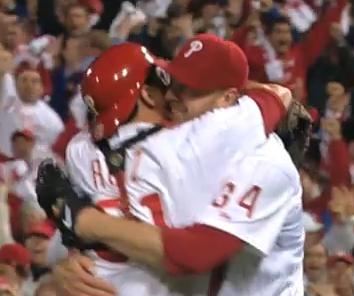
Halladay Brings No-Hitter Etiquette to the Postseason

Needless to say, there were some no-hitter superstitions observed—or not—during Roy Halladay’s no-hitter against Cincinnati on Thursday.

Things got quiet in the Phillies dugout at about the sixth inning. “People stayed in their seats and sat there and watched the game,” said Charlie Manuel in the Philadelphia Inquirer. “[Halladay] came in and went down to the end of the dugout, sat in his chair, and didn’t say a word.”

In the bullpen, the relievers stayed seated and attentive. Ryan Madson, even though he needed to use the restroom in increasingly desperate fashion, did not move to do so until after the game.

The same even held true for team executives in the owner’s box, who stayed put through the final innings.

The same can’t be said for those in the broadcast booth. On ESPN Radio, Dave Campbell and Jon Sciambi wasted no time referencing the no-hitter, once it became apparent, with Campbell going so far as to “wonder if Don Larsen is watching?”

“I said something going to break at seven and eight,” said Sciambi in the Milwaukee Journal-Sentinel. “My first job is to serve the listener. On radio, specifically, they wouldn’t have the first clue if I didn’t fill them in on it. It’s my responsibility to tell them what is going on.”

Brian Anderson and Joe Simpson did likewise on TBS.

“There’s a responsibility there to make sure you catch audience,” said Anderson, the TV voice of the Milwaukee Brewers. “My nightmare is for people to be flipping through the channels and not know what’s going on in this game because I’m trying to follow some baseball etiquette.”

Charlie Manuel, Play Your Best Lineup

Manuel Plays Late-Season Roster Roulette; Braves Benefit

When the Phillies played Atlanta on the season’s final day, there were questions about whether Philadelphia manager Charlie Manuel would go all out for a victory. It was a must-win for the Braves, but not for the long-since-clinched Phillies, and he had the clear option of resting his roster in advance of the playoffs.

In the end, he did a little of both. Manuel started his regulars, and left his entire starting outfield in for the game’s duration. Even though every infielder was pulled early, they each got at least three at-bats. Manuel even pulled off a double-steal in the eighth inning, and his team battled back from an 8-2 deficit (thanks largely to its bench) to pull within 8-7.

Still, that Cole Hamels went only two shutout innings (followed, though not consecutively, by an inning each from fellow starters Roy Oswalt and Joe Blanton) could be openly criticized. Manuel, however, did what he felt was best for his team.

He also brought to the fore an unwritten rule that’s valid only in the season’s final days (or sometimes weeks): teams with nothing left to play for should give their best efforts down the stretch against teams that still have hope.

It’s why in 1991, the fourth-place Giants trotted out a series of young players when facing the sixth-place Astros in their second-to-last series of the season, but utilized their starters against the Dodgers in their final three games. Los Angeles was battling the Braves for the N.L. West crown, and after the Giants won two of three, had to settle for second, one game back.

In 2004, Rockies manager Clint Hurdle paid no attention to the Code, trotting out lineups with as many as six rookies for Colorado’s season-ending series against Houston. San Francisco would have taken the wild card had the Rockies won a single game in that series, but the Astros swept, winning it for themselves.

“We were sitting there watching that, yelling, ‘This is a joke,’ ” said Giants closer Matt Herges. “We couldn’t stand Clint Hurdle after that.”

The counter to that opinion comes from no less an authority than Tigers manager Jim Leyland, a man whose track record of putting his team before any sort of moral convention is unmatched.

“My first concern is my organization,” he said. “If I have to play some younger players because I’m looking at them for next year, well, goddammit, if I’m that far out of the pennant race, the players I was playing weren’t worth a shit anyway. . . . That’s the one trump card the manager has. I’ve got the lineup card. I decide who goes to work today.”

In Atlanta, Charlie Manuel had the best of both worlds. His pitchers are rested, his regulars gave it their best, and nobody, really, is complaining.

– Jason

Rookie Hazing

It’s October, So Ride, Rookies, Ride

It’s the last weekend of the regular season, which means one thing: rookies all around baseball spent an awful lot of time recently commuting through airports and on busses in something other than their normal wardrobe. It’s a time-tested tradition, an irrevocable unwritten rule, serving as another tool to put rookies in their place.

They haven’t always been so creatively attired, however. It started decades ago with gaudy footwear, frequently purchased at a particularly funky shoe emporium in Atlanta. Occasionally rookies’ pants would be trimmed at the shins to better show off their new kicks.

Slowly it developed into the circus act we know today, with rookies being forced into costumes, dresses, dainty undergarments … and worse. The Rockies are known to dress their rookies in Hooters outfits, then stop the team bus at the local Hooters and put them to work.

“In Montreal, we had to go through customs, and then we’d get dropped off in different spots where we lived,” said Jamey Carrol. “I lived a block over from one of the main dropoff spots, so I had to walk in a French maid outfit with purple hair, pulling my suitcase, at 10 pm. That was definitely something I remember. You never know, in Montreal, what you’ve got going on the streets, you know.”

Here’s a sampling of this year’s offerings, from around the league.

Marlins: Babies and a lifeguard, among others. (Photos)
Red Sox: Reno 911 and Nacho Libre, among others. (Video)
Cubs: Cowgirl and figure skater. (Video)
Twins: Cartoon characters. (Photos)
Diamondbacks: Swim team. (Photo)
Phillies: Fireman and a leather king, among others. (Photo)
Reds: Grab bag. (Photo)