Ken Burns, Mentions

Ken Burns, Man of Distinction and Discriminating Tastes

NPR’s Monkey See blog recently published an interview with Ken Burns, discussing the documentarian’s latest endeavor, The Tenth Inning.

The interview itself is grand, but one particular piece of it, somewhere in the middle, was of particular interest:

Interviewer: I was just reading The Baseball Codes –

Burns: Right, oh, isn’t that great?

Interviewer: —which I absolutely loved.

Burns: I loved that.

Bring on the weekend and the playoffs. I’m pretty well good to go.

– Jason

Chase Utley, Slide properly

Utley’s Slide Draws Mets’ Ire

Chase Utley plays hard. On this count, he has been exceedingly consistent throughout his career.

On Friday, he played hard. The Mets should have expected it. Instead, they offered barely-veiled threats of retaliation.

The play in question was a slide into second base in the fifth inning, as Utley tried in vain to break up a double-play, taking out second baseman Ruben Tejada in the process. (Watch it here.)

The slide was far from perfect; it was late, it was a touch awkward and Utley didn’t begin to slide until he was virtually atop the base, leaving him to land well beyond the bag, at Tejada’s knees.

Fault the execution, but not the intent or the intensity.

This is not the tack the Mets took. Jose Reyes called it “a little dirty.” David Wright said the Mets would “have to reevaluate the way we go into second base,” a not-so-subtle reference to retaliatory basepath tactics. “If he doesn’t mind guys coming in like that when he’s turning a double play,” said Wright in the New York Post, “we don’t have any problem with it.”

These, of course, are Tejada’s fellow infielders, and they might feel obliged to stick up for their own. Their own manager, however, had a different take.

“That’s a style that needs to get back into the game of baseball,” said Jerry Manuel. “You’re not trying to hurt anybody, but you have to go hard.”

Sure enough, Utley was not hit by a pitch through the remainder of the series. One of his saving virtues might have been that he’s so consistent with his intensity. Infielders will put up with considerably more abuse from guys who play all out, all the time, than from those who pick their spots.

From the Baseball Codes:

“When I was playing second base in Pittsburgh and we were running for the pennant,” said Phil Garner, “(Bill) Buckner absolutely smoked me on a double play— damn near broke both my legs.” Garner wasn’t ticked off at the play itself, which was clean and not unlike the treatment he regularly received from players like Don Baylor and Hal McRae (who was so consistently ferocious on the base paths that the 1978 rule disallowing the hindrance of a fielder who has just made a play is known informally as the “Hal McRae Rule”). Garner was angry because he’d never seen it before from Buckner. “This sumbitch slides thirty feet short for 160 ballgames, and now, in the 161st he’s going to slide in hard?” said Garner. “Fuck that. Play the game hard in Game 1 just like you did that day.” Buckner hadn’t violated any of baseball’s written rules—his play wasn’t dirty, just devious—but in Garner’s mind he’d clearly violated the Code. The next time Garner had the chance to turn Buckner into the lead out of a double play, he aimed his relay throw directly between the baserunner’s eyes. Buckner threw up a hand in self-defense; he deflected the ball but broke a finger in the process. Message sent.

Or take Carlos Delgado, who, while on base as a member of the Toronto Blue Jays in 2004, took out Red Sox first baseman Doug Mientkiewicz with a forearm shiver. One problem with the play, at least to Mientkiewicz, was that he wasn’t playing first base at the time but had volunteered to man second after Boston experienced an unforeseen shortage of players at the position. The infielder had, at that point, played all of one inning there in his seven-year major-league career and was by no means comfortable.

Also, in Mientkiewicz’s opinion, such takeouts weren’t a regular part of Delgado’s repertoire. “I’d seen him veer off on double plays for five years and not even slide into second,” he said. “Yet he sees somebody playing second who’s never played there before and he takes full advantage of it. If Aaron Rowand had knocked me on my ass I don’t think I’d have been that mad, because Aaron goes full tilt from the word ‘go.’ . . . If I were to always see Carlos taking guys out at shortstop, I never would have said a word.”

When Mientkiewicz got up screaming, the pair had to be separated. Red Sox pitcher Derek Lowe drilled the Toronto All-Star during his next at-bat, and Delgado was forced to avoid several other pitches during the course of the three-game series. (“Curt Schilling missed him once and came to me and apologized,” said Mientkiewicz.)

At least Utley hasn’t had to face that level of response. Yet.

– Jason

Cheating, Humidor, Tim Lincecum

Rocky Mountain Hijinx

Q: Are the Rockies cheating? Does it matter? Should they stop?

A: Don’t know, not really and, if applicable, yes.

The rumors took root nationally in July, when Giants broadcaster Jon Miller asserted that whispers around the league said the Rockies selectively delivered baseballs to the umpires at Coors Field—balls from the humidor when the opposition was hitting, dry balls when the Rockies were at the plate.

(The team took to storing game balls in a humidor several years back to help them retain moisture. As is evidenced by the early years of baseball in the altitude of Denver, dry baseballs travel a very, very long way when hit.)

The story got new legs over the weekend, when Tim Lincecum, on the mound in the opener of a crucial three-game set between the Giants and the Rockies, got a new ball from plate umpire Laz Diaz, rubbed it up, then tossed it back while uttering a phrase that could clearly be seen on the TV broadcast: “Fucking juiced balls. It’s bullshit.”

If that’s what the Rockies are doing, it’s just baseball.

It’s the same theory behind select home bullpens being much nicer than their counterparts on the visitors’ side, with perfectly sloped mounds as opposed to misshapen inclines that hinder the preparation process.

It’s why a grounds crew will occasionally manicure a field to suit the home team’s strength, be it speed (bake the ground in front of the plate to facilitate high chops), lack of speed (water the basepaths into mush, to slow down the opposition), bunting ability (Ashburn’s Ridge in Philadelphia sloped the baseline slightly inward, to help Richie Ashburn’s offerings stay fair) or preference of the starting pitcher (mounds can be slightly raised or lowered, depending on the stature of the guys using them).

Heck, just a few years back, the story broke about the Twins manipulating the air conditioning at the Metrodome to blow in when opponents batted, and out when Minnesota was up.

If the Rockies are, indeed, cheating, they wouldn’t even be the first team to use a humidor to its benefit—although the 1967 Chicago White Sox did the reverse of what the Rockies are accused of. Because they had good pitching and an awful offense (they scored almost 200 runs fewer the league-leading Boston), the White Sox took to storing game balls in a humidified room, adding as much as a half ounce of water weight to each one. This hindered visiting hitters, but didn’t much affect the White Sox, who couldn’t hit, anyway.

There’s no reason to condemn Colorado for trying, but if they are cheating, there’s plenty of reason to put a stop to it—which is precisely what MLB did, ordering umpires to intervene in the process that delivers balls from the humidor to the field. (Up until now, it was handled entirely by Rockies employees.)

Which pretty much settles the score. Most cheating in baseball is fine, but if you get caught, you have to stop. Based on the 10-9 score the day after Lincecum’s “juiced balls” performance, it would appear that they have.

Which is all anybody could ask. Now play ball.

– Jason

Javier Vazquez, Retaliation

When It’s Clearly Not Intentional

Javier Vazquez hit three batters in a row last night against the Rays, and didn’t draw a peep of protest.

Why? Well, despite decent control (he’d previously hit only four batters this season, over nearly 150 innings), Vazquez isn’t good right now.

Also, because he’s been demoted to the bullpen and desperately needed a good outing.

Also, because he’s in danger of not making the playoff roster, let alone the starting rotation.

Also, because two of the pitches in question were breaking balls, one at 67 mph, and the other thrown softly enough that it bounced off the helmet of Kelly Shoppach and didn’t even stagger him.

Also, because the first two HBPs (Desmond Jennings and Willie Aybar) followed a leadoff walk to Ben Zobrist, so the third HBP (Shoppach) drove in a run. (Watch it here.)

Clearly, this wasn’t what Vazquez had in mind.

He became the first Yankee to hit three straight batters, and only the eighth player in history to do so. (Jeff Weaver did it last, pitching for the Dodgers in 2004.)

How do we know the Rays didn’t take it personally? Alex Rodriguez led off the following inning for New York; despite Tampa Bay’s 10-3 lead (a perfect situation for retaliation, if that’s what one’s after), reliever Mike Ekstrom put his first pitch over the plate, and A-Rod grounded to short.

Discussion over.

– Jason

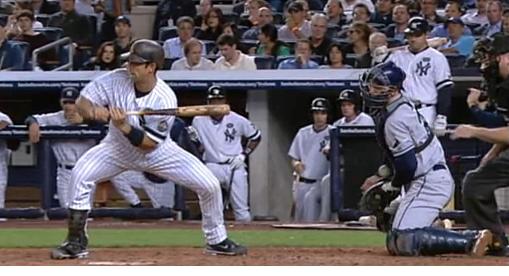
Gamesmanship, Jorge Posada

Posada Enrolled in Classes at Derek Jeter Acting Academy

Maybe he was just trying to take some heat off his captain. More likely, this kind of thing happens more often than we think, but we’re paying attention now.

Either way, Jorge Posada took first base last night after not being hit by a pitch.

Sound familiar?

Of course, the sum of Posada’s histrionics involved taking off his shin guard and offering a slight grimace, not hopping around and wincing to the point that medical intervention was necessary. (Watch it here.)

It was an 0-2 pitch from Tampa Bay’s James Shields that skipped on the ground in front of Posada’s feet. He hopped back, never indicating that the pitch did anything but hit him. The relative lack of outcry compared to the recent Derek Jeter incident could have also had to do with the fact that there were already two outs, Posada never scored, and the Yankees won handily anyway, 8-3.

Still, it’s a reminder to all those who bandied about the phrase “Derek Cheater” this week that this is something heady ballplayers do.

– Jason

Rookie Hazing, Will Rhymes

Rhymes’ Homer Earns Cold Shoulder

Reader Greg points out in response to the earlier post about Chris Carter, that Will Rhymes hit his first big league home run last night for the Tigers.

That it had to be determined by review was interesting; even better was the time for planning the delay allowed players on the Tigers bench. TV cameras captured it perfectly: Rhymes enters a stone-silent dugout, and begins walking by his teammates, slightly stunned.

You’ll rarely see a more genuine baseball moment, however, than the Tigers simultaneously jumping up and mobbing their young teammate. (Watch it here.)

Baseball customs—like any traditions—are meant to be passed on, and in that instant, the Tigers passed along a great one.

– Jason

Chris Carter, Rex Hudler, Rookie Hazing, Todd Greene

Rookie’s First Hit was Inevitable; So was his Treatment in the Dugout

Rookie hazing happens. It’s a regular part of the rhythm of a baseball season, with first-year players doing everything from menial clubhouse chores to dressing in drag on late-season road trips.

There’s one bit of rookie hazing, however, that has never been met with as much joy as it was yesterday in Oakland.

In the seventh inning of last night’s game against the White Sox, A’s rookie Chris Carter got his first hit—after a nearly record-setting 12 games and 33 at-bats. (Watch it here.)

It was the longest such hitless streak to begin a career in Oakland history, and the longest by any non-pitcher since Vic Harris set the all-time record by going 35 at-bats without a hit in 1972.

Carter was immediately removed for pinch-runner Gabe Gross, and so was able to quickly see what his teammates had in store. While Carter’s hitless streak was atypical, the reaction in the dugout was not.

While bench coach Tye Waller tucked away the actual game ball, other A’s took markers to a dummy ball that was presented to the rookie as the real thing. Though there’s been no mention of what was actually written, we can turn to examples of dummy balls from the past for clues:

  • The ball given to Rick Cerone after his first hit in 1975 read, “8-22-75, Kansas City, First ——- major league hit.”
  • Bob Brenly’s first hit—not as a rookie, but as a new member of the American League, with the Blue Jays in 1989—featured a ball marked by John Candelaria with inscriptions that included, “Here’s your first AL hit,” and “What a horseshit league.”
  • Phil Nevin was somewhat gentler with Frank Catalanotto, refraining from cuss words but going out of his way to misidentify the pitcher and spell the rookie’s name wrong, among other things.

Eventually, the A’s didn’t even give Carter the chance to enjoy his fake ball, seizing it from him and tossing it into the crowd. Soon enough, of course, the actual ball was presented to him in good condition.

“I feel like I’m part of the team now,” said Carter afterward.

Perhaps the best story about helping a rookie a commemorate a moment comes courtesy of Rex Hudler:

I didn’t like rookies getting on the airplane before I did. They had to carry a sack of beer onto the plane, and make sure all the vets had beer or water or whatever we were drinking.

Todd Greene was a real young kid. He had been a No. 1 pick by the Angels, and he got on the plane ahead of me. I didn’t like that, so I pulled him aside. . . . I might have been a little hard in the way I delivered the message. I was better when I got to the Phillies at the end of my career—I knew how to critique players, how to love them. To be a leader, you can’t just hammer them, and I hammered Greenie.

So Greenie hits his first big league homer in Detroit, in dead center field, out past the flagpole, just to the left. There’s a section left of the flagpole in center field, where a lot of people sat with free or low-cost tickets. I took two balls out there at the end of the inning and said, “I got two balls for whoever caught that one, two for one—it’s hit first big-league homer.”

Then I heard the center fielder yelling at me, and I turned around, and the home plate umpire is screaming at me because I’m interrupting the game. Well, I was all the way out there in center field, so I climbed up the center field wall and sat down with the people, and got the ball. The half-inning was a long one, maybe 15 minutes, and I’m out there talking with the people in my uniform, and when it was done I come back in, and everyone was going, “Hud! What the hell were you doing out there?”

I said, “Greenie, I got your ball for you, man!” You’d have thought I gave him a 10-carat diamond. And now, every time I see him, he tells someone, “Hud went out into the center field stands and got my ball for me.” He never forgets. It’s a form of love.

If only Chris Carter can be that lucky.

– Jason

Don't Bunt to Break Up a No-Hitter, Felix Hernandez, Julio Borbon

Bunt on King Felix? Preposterous!

It’s perpetually incredible that major league players can be unclear on the sport’s primary unwritten rules. Some claim complete ignorance, some apathy. Some are simply too green to have heard of them.

Occasionally, however, a player will think he knows the rules when in fact he’s a bit hazier on the topic than he’d care to admit.

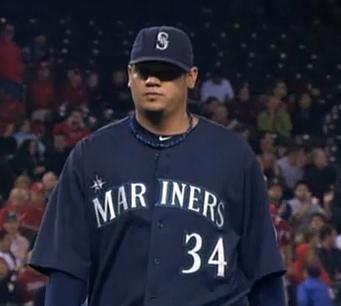
Take Felix Hernandez, who, in the middle of a would be no-hitter against Texas on Friday, got up on his high horse about a Code violation that wasn’t really a violation at all.

Julio Borbon bunted.

We hear it frequently: Don’t bunt to break up a no-hitter. Give a pitcher your best effort, because enduring mound performances deserve no less. The concept rose to prominence in 2001, when Padres catcher Ben Davis broke up Curt Schilling’s perfect game with a bunt, and all hell broke loose from the Arizona clubhouse.

“You shouldn’t do that,” Hernandez said in the Everett Herald, about Borbon’s effort. “Sixth inning and a guy is throwing a no-hitter, it’s disrespect.”

It’s a decent rule, especially if it’s late in the game (as was the case with Davis) and the guy bunting doesn’t make ordinary practice of the tactic (as was also the case with Davis).

Borbon, however, has some speed. And the game was still in the middle innings.

More importantly, the Rangers trailed only 2-0 at the time. Borbon’s effort, had it been successful, would have brought the tying run to the plate, something the rest of his teammates had been unable to do to that point in the game.

In this case (and in that of Davis, who also bunted facing a 2-0 deficit), winning trumps all. Do what you must to win the game.

We’ve seen the tactic unsuccessfully attempted at least twice this year, by Gordon Beckham (against Chicago’s Ted Lilly, whose no-no was broken up later in the game) and Evan Longoria (in the middle of Dallas Braden’s perfect game).

The guy who had it absolutely correct: Borbon.

“What was I supposed to do, let him have it his way?” he said in an MLB.com report. “I realize he was throwing a no-hitter, but I wasn’t getting out of my game. If the game was one-sided it might be different, but in a close game like that, it could be a difference-maker.

“I was trying to get it down and get something going. I wasn’t worried about the no-hitter. If we were down six, seven eight runs, I’m going to swing the bat. But down 2-0 in the sixth inning, I don’t think I was being disrespectful to him or the game or to anybody. I was trying to do something for the team.”

Just like he was supposed to.

– Jason

Mark Buehrle, Ozzie Guillen, Retaliation, The Baseball Codes

Buehrle Drills Cuddyer (Yawn), then Almost Admits Intent (Really?)

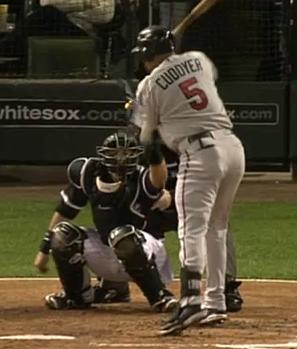
That Mark Buehrle intentionally drilled Michael Cuddyer yesterday is hardly unusual. White Sox first baseman Paul Konerko had been hit on the upper lip by Carl Pavano in the first, and Cuddyer was Minnesota’s leadoff hitter in the second.

Umpire Jerry Crawford delayed his warnings, Buehrle hit Cuddyer in the shoulder blade, and, as is proper when this sort of thing happens, everybody moved on. (Watch it here.)

Until after the game, anyway, when Buehrle actually talked about his motivation.

“When I’m told to do something I try to go out there and do it to the best of my ability,” he told reporters. “Obviously you got to protect your guys.”

Rare is the instance when a pitcher admits to something like this, even in as roundabout a way as Buehrle. It’s tantamount to public confession, and, although Buehrle’s statement is probably too vague to fall into this category, frequently leads to discipline from the league.

Of course, Buehrle knows a thing or two about following Ozzie Guillen’s orders when it comes to things like this. I’ve excerpted this section before, but it bears repeating. From The Baseball Codes:

In 2006, Ozzie Guillen quickly identified Texas’s Hank Blalock as a target for retaliation after Rangers pitcher Vicente Padilla twice hit Chicago catcher A. J. Pierzynski during a game. That was the plan, anyway. Filling the space between conception and exe¬cution, however, was Guillen’s choice of executioner: rookie Sean Tracey.

The right-hander had appeared in all of two big-league games to that point and was understandably nervous. Even under optimal circumstances he didn’t have terrific control, having led the Carolina League in wild pitches two years earlier, while hitting twenty-three batters. When Tracey was suddenly inserted into a game at Arlington Stadium with orders to drill the twentieth major-league hitter he’d ever faced, it was hardly because he was the best man for the job. To Guillen, Tracey was simply an expendable commodity, a reliever whose potential ejection wouldn’t much hurt the team, especially trailing 5–0, as the Sox were at the time. . . .

When the right-hander’s first pitch to Blalock ran high and tight but missed the mark, Tracey did what he’d been taught in the minors, sending his next pitch to the outside corner in order to avoid suspicion. Blalock tipped it foul. When Tracey’s third effort was also fouled back, for strike two, the pitcher altered his strategy and decided to go after the out, not the batter.

According to his manager, it was the wrong decision. After Blalock grounded out on the fifth pitch of the at-bat, Guillen stormed to the mound and angrily yanked Tracey from the game. He didn’t let up after they returned to the dugout, berating the twenty-five-year-old in front of both his teammates and a television audience. With nowhere to hide, Tracey sat on the bench and pulled his jersey up over his head, doing his best to disappear in plain sight. Two days later, without making another appearance, he was returned to the minor leagues, and during the off¬season was released. . . .

Ultimately, Tracey shouldered the responsibility for his actions, saying he “learned from it,” but the lesson was lost on his more tenured teammate, Jon Garland, a seven-year veteran en route to his second consecutive eighteen-win season. Before Padilla’s next start against the White Sox, Guillen launched a pre-emptive verbal sortie, positing to members of the media that if the Rangers right-hander hit any Chicago player, retribution would be fast and decisive. His exact words: “If Padilla hits somebody, believe me, we’re going to do something about it. That’s a guarantee. I don’t know what’s going to happen, but something’s going to happen. Make sure [the Rangers] know it, too.” Padilla did, in fact, hit Chicago shortstop Alex Cintron in the third inning, at which point it didn’t take much predictive power to see that a member of the Texas lineup would soon be going down. The smart money was on the following inning’s leadoff hitter, second baseman Ian Kinsler.

The smart money was correct, but the payoff left something to be desired. Garland’s first pitch sailed behind Kinsler, a mark clearly missed. Plate umpire Randy Marsh, well versed in the history between the clubs, opted against issuing a warning, effectively granting Garland a second chance. The pitcher didn’t exactly seize the opportunity, putting his next pitch in nearly the same place as the first. At this point, Marsh had no choice—warnings were issued and hostilities were, willingly or not, ceased. Guillen rushed to the mound for a vigorous discussion about the merits of teammate protection. Kinsler ultimately walked, and after the inning Guillen reprised his dugout undressing of Sean Tracey, spewing invective while Garland listened and the White Sox batted.

Buehrle was with the White Sox at the time, and is all too aware of the repercussions that come with failing to follow his skipper’s orders. (Not that he wouldn’t have done it on his own, anyway.)

He still has to work on keeping these things to himself, but at least Guillen— the league’s poster child for saying far more than he should—has little to hold over him in this regard.

– Jason

Derek Jeter, Gamesmanship

Jeter Just Doing What Ballplayers Do

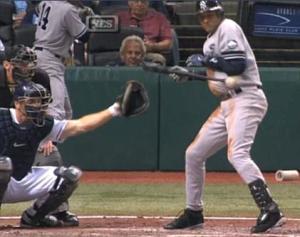
The sports world is absolutely fascinated with Derek Jeter right now, the golden-boy Yankees captain-cum-cheater who acted gravely wounded by a ball that didn’t hit him during a game last night against Tampa Bay. (Watch it here, complete with commentary from each team’s broadcast crew.)

I don’t get the criticism. This is what ballplayers do.

Sure, they’re not often caught en flagrante to the degree that Jeter was, but at heart, they’re all the same in this regard. You’d be hard-pressed to find a single example in the history of the game in which a player willfully informed an umpire that a call had been incorrect in favor of the opposition. It doesn’t happen on balls or strikes or plays at the bases. It doesn’t happen on difficult fair-foul calls.

And it certainly doesn’t happen on hit-by-pitches.
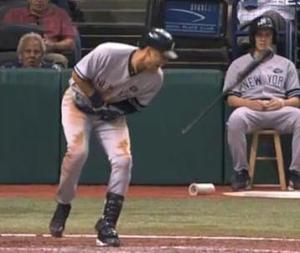
Sure, Jeter went overboard with his Shakespearian dramatics. If you want to make a distinction between benefitting from an umpire’s bad call and influencing an umpire into making a bad call, that’s fair. But the underlying tenets are the same: in baseball, every advantage counts; you get ’em where you can.

“He told me to go to first base. I’m not going to tell him I’m not going to first, you know,” said Jeter, afterward. “It’s part of the game. My job is to get on base. Fortunately for us it paid off at the time, but I’m sure it would have been a bigger story if we would have won that game.”

Nobody ever called out an outfielder for acting as if he caught a ball he actually trapped.

“Play it off—that’s not cheating if the umpire lets you get away with it,” said longtime outfielder Von Joshua. “Any means you can to win a baseball game. . . . Sometimes you get it, sometimes you don’t. That’s just part of the game.”

Even Rays manager Joe Maddon was impressed by Jeter’s effort. “I thought Derek did a great job, and I applaud it,” he said in an MLB.com report, “because I wish our guys would do the same thing.”

Heck, is it really so different than A.J. Pierzynski sticking his elbow into the path of a pitched ball in order to get on base? Neither are admirable, but both are accepted. (Of course, when Pierzynski did it with the bases loaded and a 9-2, eighth-inning lead in 2004, he insured himself a future drilling.)

HardballTalk points out similar displays from Yunel Escobar and Pierzynski, again.  It’s pure gamesmanship.

Jeter even has precedent on his own team. In a 1928 game between the Yankees and Browns, with two outs and Lou Gehrig the baserunner at first, second-base umpire George Hildenbrand turned to watch the play on the lead runner when Bob Meusel hit a ground ball to shortstop Red Kress.

Except that Kress threw to first, and Hildenbrand was caught with his back to the play.

Meusel had been thrown out cleanly, but Hildenbrand hadn’t seen it. Instead, he appealed to Meusel’s honesty.

“Everybody knows you’re out, Bob. Everybody saw it . . .” he said, according to the Baseball Hall of Shame, Vol. IV. “Be a sport and call yourself out.”

Meusel’s response: “George, you’ve been getting nine thousand bucks a year for a long time as an umpire. Now’s a good time to start earning it.”

Hildenbrand had no choice. The runner was safe, and Browns pitcher Al Crowder had to seek his fourth out of the inning.

So wnough with the calls of “Derek Cheater.” The guy was just doing what big leaguers do.

Update (9-22-10): Jorge Posada did kinda sorta the same thing.

– Jason