Francisco Rodriguez, Protect Teammates

Mets Players Compelled to Back K-Rod, Even as they Shake Their Heads in Disgust

By now, we all know what happened with Francisco Rodriguez—the fight with his father-in-law in the Mets’ family lounge at Citi Field; how he pummeled a much older man; his arrest and arraignment.

How does the Code play into it? Rodriguez is a member of the New York Mets, and his teammates are expected to stand up for him. Even if they can’t tolerate the guy, or what he did.

Carlos Beltran is a prime example. Talking to ESPN New York, he detailed this exact dilemma in clear terms:

It’s disappointing, man. You don’t want to see no one go through that. But it is what it is. Now he has to deal with that situation. Us, as players, as teammates, even though we don’t agree with what he did, we have to support him. He’s part of the ballclub. He’s going to come here and do his thing.

“You always protect your teammate, from management or the front office, even if they are wrong,” Jose Rijo told me a few years back. “They are your teammates, and you hate to see anything happen to them. Your teammate is like your girlfriend—once you get to know them, you love them no matter what.”

A more appropriate metaphor is teammates as brothers. Clubhouse fights are hardly uncommon, but the quickest way to get over them and build instant cohesion is for somebody wearing a different uniform to step in with an opinion on the matter.

Former Indians third baseman Al Rosen, a Jew, told a story about some vicious insults hurled his way from the dugout of the Chicago White Sox in the 1950s.

“Today they don’t allow bench jockeying, but in those days it was prevalent,” he said. “There was a lot of brutal stuff that went on. They tried to get to a player, and obviously a racial or religious epithet will do it. I went into the dugout at Comisky Park one time looking for the guy who had been on me for games and games. I looked right down the bench and said, ‘The son of a bitch who’s been saying that come on out.’ Nobody would.

Saul Rogovin, who was Jewish and pitched for them, knew who it was, and he told me later on, ‘Al, I wanted to tell you who it was, but I was a teammate of his.’ He was put in that spot, and he couldn’t get out of it.”

As reported by Buster Olney, Francisco Rodriguez has far too big a contract to serve as reasonable trade bait for pretty much anybody (if his option kicks in, the Mets will be paying him $17.5 million by 2012), meaning he’ll likely be in New York for the long run.

If they haven’t already, his teammates should begin preparing their “no comments” right now.

– Jason

David Bush, Don't Swing on the First Pitch After Back-to-Back Home RUns, Intimidation

D’Backs Go Deep Again and Again . . . and Again . . . and Again

In June, we declared the antiquated unwritten baseball rule mandating that hitters take the first pitch after back-to-back home runs to be unequivocally dead.

It’s not that most hitters don’t abide by it—it’s that most hitters haven’t heard of it.

If more proof is needed, look toward the Arizona Diaondbacks’ efforts last night, when Adam LaRoche, Miguel Montero, Mark Reynolds and Stephen Drew took Milwaukee right-hander David Bush deep, all in a row, in the fourth inning. (Watch it here.)

Reynolds, batting after back-to-back homers, swung at (and missed) the first pitch he saw.

Drew watched one, but that’s because it was out of the strike zone.

The guy who followed them all, Gerardo Parra, swung at the first pitch, singling to right field.

The true Code violation here was Bush’s refusal to take advantage of the stipulation allowing him free reign to knock somebody down. The Arizona lineup had become all too comfortable at the plate, a development that Bush did nothing to discourage.

It’s another example of how the game has changed. Bob McClure recalls giving up back-to-back homers while pitching for the Brewers in the 1980s, and knocking down the next hitter, Dave Kingman, in response.

“The catcher, Charlie Moore, called for a fastball away, but he knew better,” he said. “He went through them all. He called for a fastball away. I said no. Curveball. No. Changeup. No. Fastball in. No. And then he goes (flip sign), and I nod. I threw it, and it was a good one. It went right underneath (Kingman) and almost flipped him. He was all dusty and his helmet was over here and he was grabbing at his bat and his helmet. . . . Back then, we were taught the 0-2 up and in. Home run, next guy: boom! Knock him down.”

It’s about more than respect. It’s about pitchers utilizing the tools at their disposal to better insure their own success. Angels pitcher Paul Foytack, the first pitcher to ever give up four consecutive homers also failed to utilize those tools, going down nearly as meekly as Bush.

It was 1963, and Foytack started by allowing consecutive home runs Cleveland’s Woody Held, pitcher Pedro Ramos (batting a robust .109 at the time) and Tito Francona. At that point, he said, he decided to send a message by knocking down the next hitter, rookie Larry Brown. Even that didn’t go quite as planned, however; Foytack missed his spot, left the ball over the plate, and Brown hit his first career home run—and the fourth in a row for the Indians.

That’s how it’s not supposed to go. Here’s a small handful of examples of more successful operations:

  • In 1944, Cardinals Walker Cooper, Whitey Kurowski and Danny Litwhiler hit consecutive homers against Reds pitcher Clyde Shoun. The next hitter, Marty Marion, was knocked down.
  • In 1991,Angels pitcher Scott Bailes hit Randy Velarde of the Yankees after giving up consecutive home runs.
  • In 1996, after the Red Sox connected for three home runs against the Angels, reliever Shawn Boskie threw a pitch behind Jose Canseco’s back.
  • In 2003, Astros pitcher Shane Reynolds gave up three home runs to the Pirates, then put a pitch under the chin of Brian Giles.
  • Mike Hegan: “In April of 1974, I hit behind Graig Nettles the whole month. Graig hit 11 home runs, and I was on my back 11 times. That’s the kind of thing that happened.”

None of this is intended to suggest that success merits retaliation. (The Commissioner’s office agrees; for his actions against New York, Bailes was ejected and fined $ 450.)

There is, however, importance in a pitcher’s ability to keep hitters light on their feet, and wondering at least a little about what his intentions might be on any given pitch. The more they think about their own safety, after all, the less they think about the act of hitting.

The Diamondbacks didn’t wonder about any of that with David Bush last night. Perhaps they should have.

– Jason

Brandon Phillips, Don't Call out Opponents in the Press, Fights, Johnny Cueto

A Dark Day for Baseball Etiquette in Cincinnati, Pretty Much All Around

This is what can happen when a player utters even a syllable too many about his opponent. (Though to be fair to the Cardinals, “little bitches” is a full four syllables.)

A day after forgetting to use his inside-the-clubhouse voice when discussing feelings about the St. Louis ballclub with the press—which included referring to them by the above epithet—Cincinnati’s Brandon Phillips stepped to the plate yesterday as the Reds’s first hitter of the game.

Upon entering the batter’s box, he tapped his bat on the shin guards of Cardinals catcher Yadier Molina and plate ump Mark Wegner as a means of greeting.

There’s nothing wrong with this. It’s standard practice for Phillips, meant as nothing but a friendly hello.

At least until he encountered a short-fused catcher who clearly prefers that his team be referred to in terms more genteel than “little bitches.”

“Why are you touching me?” he asked Phillips, as reported in the Cincinnati Enquirer. “You are not my friend, so don’t touch me.”

Phillips had thrown down the gauntlet with his comments, and Molina was only too happy to pick it up. Both teams flooded the field, and the scrum quickly turned into a baseball rarity—a fight in which actual blows were thrown. Managers Dusty Baker and Tony La Russa were ejected. (Watch it here.)

The appropriate response to Phillips and Molina: Grow up a little.

The unwritten rules mandate on-field retaliation only for on-field breaches of etiquette, and nothing more. Phillips ran his mouth, and the Cardinals responded in the best way possible, holding him to a combined 1-for-10 over the ensuing two games, while winning both to move into a tie with Cincinnati in the NL Central.

Molina should have let his comments go, and concentrated on the game, not a silly schoolyard spat. (He did use the confrontation as a bit of personal motivation, hitting a second-inning homer off Johnny Cueto.)

Now, what had been an unendorsed bit of foolishness from a single player has turned into genuine bad blood. It certainly helps make things interesting as the teams battle for the division lead, but these matchups are loaded with motivation based on baseball alone. Watching players act like testosterone-fueled kids does nothing for the purity of a good stretch drive.

* * *

During the course of the festivities, Baker and La Russa got into it, bringing quickly to mind the fact that they haven’t had the smoothest relationship over the years.

When Baker was with the Cubs in 2005, La Russa went public about concerns over Kerry Wood’s inside pitches, which was followed by Cards pitcher Dan Haren hitting his counterpart on the Cubs, Matt Clement.

Baker took it as an attempt at “selling wolf tickets,” or overtly trying to intimidate his team, saying in the Chicago Tribune that “no one intimidates me but my dad and Bob Gibson—and this bully I had in elementary school. But I grew bigger than him, and he stopped bullying me.”

The two eventually met and settled things, but it didn’t take long for their history to bubble to the surface yesterday.

* * *

Another unwritten rule was broken in the middle of the crowd of players, when Cueto, backed up against the backstop by a pile of humanity, opted to kick his way free.

There are rules to any fight; in the Code-driven world of professional baseball, this is especially true. It’s why Izzy Alcantara has gained such notoriety, and why Chan Ho Park’s attempted drop kick of Tim Belcher in 1999 continues to be replayed.

Square up and hit a guy, if you must, but the unwritten rules stipulate that kicking a player as means of attack is less than manly; something even for little bitches, if you will.

Cueto’s spikes landed, apparently repeatedly, on the face of St. Louis catcher Jason LaRue, who suffered a concussion and bruised ribs, and has been ruled out of playing today—and possibly much longer.

“He could have done some real damage (on LaRue),” said Chris Carpenter in the Cincinnati Enquirer. “He got him in the side of his eye, he got him in his nose, he got him in his face. Totally unprofessional. Unbelievable. I’ve never seen anything like that. He got kicked square in the side of the face with spikes. C’mon, give me a break.”

Cueto was on the mound for the Reds yesterday, but batted first with two runners on, and later during a 2-2 game. Neither situation was appropriate for retaliation.

The teams meet again in early September. This time, on-field payback—should that be the route the Cardinals choose to take, and with La Russa at the helm, it’s a good bet—will be entirely appropriate.

Buckle in.

Update (Aug. 12): Cuteo has been suspended for seven games—effectively, two starts—for his part in the brawl. If he knows what’s good for him, he’ll appeal in an effort to delay his punishment until just before the Reds visit St. Louis on Sept. 3.

– Jason

Brandon Phillips, Don't Call out Opponents in the Press

Phillips: Cardinals are ‘Little Bitches’; Cardinals: 7-3 Victory

If Brandon Phillips’ isn’t Jonathan Sanchez’s newest favorite person, he should be.

Sanchez, the Giants’ No. 4 starter, let his mouth run loose on Sunday, when he guaranteed that his team would sweep its upcoming three-game series against San Diego and win the National League West.

Confidence is great, but braggadocio is rarely appreciated by one’s opponent. But just as pundits were beginning to dig into the concept of how to let sleeping dogs lie, Phillips laid down a distraction of such gravity that Sanchez may as well have forgotten how to speak English, for all the attention he’s getting.

Turns out that Phillips doesn’t like the Cardinals. Like, even a little. Despite missing a recent game after fouling a ball off his leg, he was geared up for Cincinnati’s showdown with its NL Central rivals.

His full quote, as reported by Hal McCoy of the Dayton Daily News:

“I’d play against these guys with one leg. We have to beat these guys. I hate the Cardinals. All they do is bitch and moan about everything, all of them, they’re little bitches, all of ’em.

“I really hate the Cardinals. Compared to the Cardinals, I love the Chicago Cubs. Let me make this clear: I hate the Cardinals.”

  • Fact: Phillips is a fun-loving guy.
  • Fact: Phillips is a bit of a loose cannon.
  • Probable fact: Phillips was merely joking around, and said what he did facetiously, in a light-hearted moment.
  • Indisputable fact: None of that matters.

Earlier this season, Phillips claimed he meant no disrespect to the Washington Nationals when he beat his chest after scoring a run. It made no difference; he still got drilled in response.

Similar retaliation for Phillips’ recent statement is unlikely—his on-field act in Washington was met with an on-field response; this is a different matter entirely. Still, that hardly means the incident is over.

When David Cone publicly called out Dodgers pitcher Jay Howell in the 1988 NLCS, the Dodgers responded with a wave of bench jockeying so vicious that a rattled Cone lasted just two innings into his Game 2 start. (The story is outlined here, within the context of Carlos Zambrano’s calling out A’s pitcher Jerry Blevins earlier this season.)

Yesterday, the Cardinals let their pitching do their talking, as Phillips went 0-for-5 and struck out to end a 7-3 St. Louis victory that cut Cincinnati’s lead in the division to a single game.

Tony La Russa also got involved. Just as Dodgers manager Tommy Lasorda amplified Cone’s quote to motivate his team in 1988, La Russa did his part to give Phillips’ statement some legs.

“We win the right way and we lose the right way,” he told reporters. “We’ve received a lot of compliments over the years that when we lose we tip our caps and when we win we keep our mouths shut. That’s my comment.”

Given a moment to think it over, however—in the post-game shower, no less—La Russa flagged down reporters and added this:

“I don’t think that will go over well in his own clubhouse. Phillips is ripping his teammates — Scott Rolen, Miguel Cairo, Russ Springer, Jim Edmonds—all the ex-Cardinals over there. He isn’t talking about this year. He is talking about the way we’ve always played and those guys are old Cardinals. Tell him he’s ripping his own teammates because they are all old Cardinals.”

If that’s the case, he’s doubly ripping the former Reds—Ryan Franklin, Jason LaRue, Kyle Lohse, Felipe Lopez, Aaron Miles and Dennys Reyes—in the St. Louis dugout.

The most vocal any Cardinals player got in response was to point to Phillips’ performance on the day, and reiterate that the game is played on the field, not in the media.

“I didn’t know we had bad blood,” Skip Schumaker said in the St. Louis Post-Dispatch. “They can talk. And we’ll leave our comments to ourselves.”

It’s reminiscent of a similar dispute in 1972, when Angels pitcher Clyde Wright decided to talk about defending AL Cy Young and MVP winner Vida Blue, immediately after besting him in a 3-1 victory.

“Why should I be up for him?” Wright is quoted as saying in Ron Bergman’s book, Mustache Gang. “He’s just another pitcher now. I’m 8-3 and he’s 1-4. I can get up for the A’s, but not for Vida Blue. He doesn’t look as aggressive as before. You can see it in his eyes. He ran out to the mound, sure, but we all do that now.”

Blue’s response came eight days later, when he gave up a single run over nine innings to top Wright and the Angels. It was only then that he offered an opinion about what Wright had said.

“I don’t think Clyde Wright looked as aggressive as before,” Blue said after the game. “He ran out to the mound, but we all do that now. I can get up for the Angels, but not for Clyde Wright. What’s he now—8-4? I’m 2-4, but I’d say this even if I were 24-4.”

The Cardinals hardly needed motivation from Brandon Phillips to win the NL Central; how they perform down the stretch will be independent of anything he did or could say. (The same holds true for the Padres, in regard to Jonathan Sanchez.)

If they do pull it out, however, one sentiment pertaining to his statement will be irrefutably true: It didn’t hurt anybody but Cincinnati.

Update (Aug. 10): Talking about it today, Phillips didn’t back down, essentially saying that he said his piece, and now he just wants to win.

Reds manager Dusty Baker in McCoy’s column in the Dayton Daily News:  “You prefer that they don’t say that, but everybody refers to the freedom of speech and then you say things and get in trouble for it. I talked to him about it and it just puts a little more pressure on him to play better personally.”

– Jason

Gary Varsho, Joe Kerrigan, John Russell, Know the Pipeline

Kerrigan Out in Pittsburgh; Did he Know Too Much?

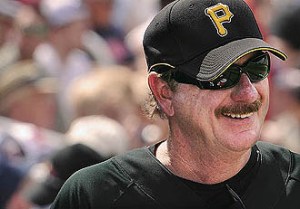
Joe Kerrigan

That the Pirates fired two coaches yesterday is hardly shocking. They’re the Pirates; these things happen.

At first, it was thought to be a step toward the eventual ouster of manager John Russell. Then it came out that Russell was behind the dismissals . . . as were baseball’s unwritten rules.

Russell refused to discuss his motivation for sacking pitching coach Joe Kerrigan and bench coach Gary Varsho, beyond platitudes that there were “some issues that I felt we needed to change,” and that he “lost two friends.”

A motivating factor could easily have been Kerrigan’s on-field performance—hope for Pirates pitchers was never high, and they’ve still managed to underperform—but there appears to be more to the story.

The firings, reported the Pittsburgh Post-Gazette, were a matter of loyalty—or lack thereof: “Several players and others inside the team described scenes on recent road trips to Texas, Oakland and St. Louis where Kerrigan and Varsho either were openly critical of Russell or having mini-meetings with some coaches or players away from Russell.”

It’s not like this is new territory for Kerrigan. Baseball’s Code warns that there’s a mole on nearly every team, someone who carries sensitive information to the front-office and, as an occasionally unintended consequence, poisons clubhouse relationships.

According to multiple sources, Kerrigan is such a coach. In Joe Torre‘s book “The Yankee Years,” writer Tom Verducci identified issues within the New York clubhouse during Kerrigan’s tenure as bullpen coach:

(Torre) knew Kerrigan was connected to the front office by way of (GM Brian) Cashman, and word reached Torre that Kerrigan was having private conversations with Cashman about the team and Torre. One staff member even said Cashman had telephoned Kerrigan during a game.

Also in the book was the assertion that Kerrigan had “confrontations with players in just about every stop of his baseball life, including Philadelphia, Boston and the Yankees.”

Hall of Fame baseball writer Tracy Ringolsby wrote that Kerrigan was “a clubhouse mole when he was on the coaching staff in Montreal, Boston and Baltimore.” It’s possibly what led to his rise to the Red Sox managerial office after Jimy Williams was fired in mid-2001.

And this, from InsidePittsburghSports.com: “One veteran front-office executive said this of Kerrigan upon his hiring by the Pirates, ‘John Russell better have his head on a swivel because he has a manager killer on his staff now. Joe Kerrigan might be the biggest backstabber in baseball.’ ”

Kerrigan brings an intense devotion to film study and numbers-crunching to his coaching, traits that can be appealing to a general manager looking to balance out a staff heavy in more traditional baseball men. Even more enticing, perhaps, is the opportunity to have a reliable ear to the ground.

At some point, however, the question shifts to the cost one is willing to pay for information gained. Among other things, it helped lead to Torre’s departure from the Yankees.

Pirates GM Neil Neal Huntington backed Russell’s decision, clearly too late to salvage any hope of respectability for the Pirates and their young nucleus this season.

In this case, however, the focus is on next year. The quickest path to a clean slate is to wipe clean the messiest smudges.

– Jason

Adrian Beltre, Josh Beckett, Retaliation

Cleveland Retaliates, and Retaliates Again; Boston Unimpressed

Josh Beckett was a bit wild on Tuesday, or a bit intentional. Either way he drilled two members of Cleveland’s lineup—Shelley Duncan in the first inning, and Shin-Soo Choo in the third.

Predictably, the Indians targeted David Ortiz for retaliation; in the seventh inning, Justin Germano threw a ball behind him.

Should a pitcher fail to hit a batter in situations like this, where retaliation is clearly the intent, there can be only two possibilities: The near miss was intended to serve as sufficient warning, or the pitcher missed his spot.

In this case, the Red Sox clearly thought it was the latter. So when reliever Jensen Lewis kicked off the eighth with a pitch that shot behind Adrian Beltre, the Boston dugout deemed it to be overkill. Benches emptied; Beckett in particular was chock full of fury.  (Watch it here.)

“If you’re going to retaliate and you feel like you want to protect your players, we know how this game goes, and we would respect it if you’d have got the job done in the first or second attempt,” said Red Sox left fielder Bill Hall in the Boston Globe. “But five attempts is a little too much. You’ve got balls flying over people’s heads. That’s a danger to our careers. So if you’re going to do it, get the job done the right way, and get it done as quick as possible. You can’t keep trying in the same game to retaliate. Obviously we got a little fed up with that.”

Hall’s stance is firmly in the mainstream. Retaliation is often tolerated, but teams usually get only one shot. It’s what made Shawn Estes’ miss of Roger Clemens at the tail end of the Clemens-Piazza-beanball-thrown-bat imbroglio in 2002 so anticlimactic; Mets fans wanted blood, and Clemens wasn’t so much as grazed by his designated driller. Still, a message (however watered down) was sent, and both teams moved on.

Not so Tuesday. The Indians wanted a piece of somebody wearing a home uniform at Fenway Park, and overextended to get it. They took one too many shots, and justifiably pushed the Red Sox over the edge.

The Code—just like many savvy umpires—gives a team one shot at retaliation. If they fail to execute, that’s their own fault, not that of their opponents, and it’s time to let things go.

Update: Six players were disciplined following the fracas, including Dustin Pedroia, Kevin Youkilis, Mike Cameron and Jacoby Ellsbury, all of whom were on the DL and all of whom charged the field—a no-no according to league rules. But hey, everybody joins a fight.

– Jason

Retaliation

Brewers’ Batters Battered; What’s the Appropriate Response?

As mentioned in this space two weeks ago, the Brewers lead the National League by a wide margin when it comes to being hit by pitches. (As of Thursday morning, they’d been drilled 57 times—the league average is 34—with Rickie Weeks and Prince Fielder holding the top two spots in the major leagues, with 19 and 18 HBPs, respectively.)

There’s been grumbling around Milwaukee that Brewers manager Ken Macha has not taken a firm enough stance when it comes to discouraging such behavior, especially in light of the fact that his pitchers had hit only 37 batters of their own.

As an example, the Milwaukee Journal Sentinel pointed to the team’s most recent series, against the Cubs, in which four members of the Brewers were hit—including Carlos Gomez twice, once in the head (see photo above)—before a single Cub was targeted. Part of the problem was that Chicago pitchers drew warnings during each of the first two games, effectively precluding response from Milwaukee.

“It makes it tough after they issue warnings,” said Brewers pitcher David Bush in the article. “Some of them seem intentional. Some have stood out. That’s one of the players’ complaints with warnings being issued. It doesn’t always give the other team an opportunity (to retaliate). It makes things fester a little longer than they should.”

Bush is right. Umpires have been systematically ordered by MLB to issue swift warnings in an effort to stem whatever retaliatory tide might be rising. The league’s goal is clear: a reduction in the number of intentionally hit batters inevitably leads to a reduction in the number of unintentional injuries. And owners want to keep their multimillion-dollar investments as far from injury as possible.

This comes, of course, at a cost. The unwritten rules—particularly those involving retaliation—have been rendered somewhat toothless in recent years. Even if the Brewers wanted to respond along the way, they had to risk ejection to do so. And when a Milwaukee pitcher finally did hit a member of the Cubs, in the third game of the series (LaTroy Hawkins scraped Alfonzo Soriano with an inside fastball), he was tossed, even without a prior warning.

“I’ve never liked it when the umpires issue a warning, because now you’re leaving it up to their judgment, when the players know what’s going on,” said Twins manager Ron Gardenhire several years ago. “Now, an umpire has to react to it because he has been told to do this by Major League Baseball. It puts umpires in situations where they have to be the cops, and that’s tough. They have enough to worry about without having to control some of this stuff.”

“That part of the game used to be better,” said Dodgers coach Larry Bowa. “It used to be policed by the players, and no question it was better then. Now, a guy throws, and you get a warning to both teams. So, instead of evening the score, it festers, and you wait, and wait.”

Interesting that both Bowa and Bush used the word “fester,” because that’s exactly what happens.  Grudges that are not settled immediately can quickly blow up into unnecessarily problematic encounters should the players behind them be forced to wait for a significant length of time to retaliate.

(For example, in 1997 the Royals had to bide their time until the following season to exact retaliation against Phil Nevin for bowling over catcher Mike Sweeney, by which point Nevin had changed teams. Without proper understanding of what led to their new teammate’s indelicate treatment, the Angels ended up instigating a vicious on-field brawl.)

The Journal Sentinel article goes on to discuss a number of other points:

  • Albert Pujols has been hit only once this season, in part says Bush, because Cardinals manager Tony La Russa is known to retaliate for such things.
  • In light of Gomez’s injury, Macha suggested that any big league pitcher is skillful enough to keep from hitting an opponent in the head.
  • Brewers GM Doug Melvin went so far as to suggest a $25,000 fine for such an act, saying that it’s ultimately up to the players’ union to put an end to the practice.

Each of these items merits its own exploration, but all are affected by the same overarching topic: Retaliation is an essential part of the game, and by precluding its proper execution, baseball is doing itself a disservice.

Just ask a pitcher.

– Jason

Andrew McCutchen, Mike Leake, Paul Maholm, Retaliation

McCutchen Again on the Wrong Side of a Fastball; This Time Pirates React

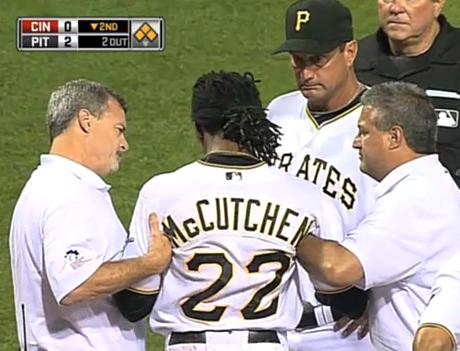
In May, Dodgers reliever Ramon Ortiz buzzed Pittsburgh’s Andrew McCutcheon, then dropped him with a fastball aimed directly at his head.

Pirates starter Zach Duke had the chance to retaliate directly two innings later, when Ortiz came to bat, but failed to take action, striking his opponent out on four pitches—three of them curveballs. For that, he drew considerable heat from within his own clubhouse.

Yesterday, McCutcheon’s head was again at the wrong end of a fastball, only this time, he didn’t get out of the way. Cincinnati’s Mike Leake drilled the outfielder in the neck, just below his helmet, laying him out in the batter’s box for several minutes and knocking him out of the game. (Watch it here.)

It was almost certainly unintentional (there were two runners on base and Pittsburgh held a 2-0 lead in the second inning), and McCutcheon was ultimately found to have avoided both fractures and a concussion (he returned to action today).

None of that mattered. In addition to his pitch to McCutcheon, Leake had come up and in to Ronny Cedeno just two batters earlier, and a message needed to be sent about just how much the Pirates were willing to tolerate. After the Duke debacle earlier in the year, the answer was clear.

When Leake stepped to the plate the following inning, Pittsburgh pitcher Paul Maholm promptly drilled him in the knee with a fastball. Leake knew what it meant, and didn’t so much as look toward the mound as he took his base. (Watch it here.)

Reds manager Dusty Baker insisted that Leake was simply a wild pitcher who lost control, and not somebody with an agenda. Still, he laid out the purpose for inside pressure, and why it’s valuable.

“There was a thing when you first came up to the league: Let’s see if this kid can hit a fastball — he hit a fastball. Let’s see if he can hit a slider — he hit a slider,” he said on the Reds’ Web site. “Let’s see if he can hit a curveball — he hit a curveball. Then, they would see if he could hit it on your back — if they could intimidate you. And there have been many players that couldn’t handle that part of being knocked down.”

Got that? Intimidation: OK. Drilling a guy above the shoulders: Definitely not OK. Maholm did what he had to do, and both Baker and Leake were right on board with it.

Just like they should be.

– Jason

David Wright, Don't Enter the Opponent's Clubhouse, Pedro Guerrero, Willie Mays

Today’s Lesson: Never Refuse an Invitation From Willie Mays

In 1992, Pedro Guerrero spurred a battle inside the Cardinals clubhouse, when he invited Sammy Sosa inside about a half-hour after the Cubs beat St. Louis in a tense, tightly-played game. The two had pre-arranged dinner plans, but when Sosa arrived early, Guerrero instructed him to settle in and wait.

Sosa complied, spurring St. Louis players Rex Hudler and Todd Worrell to order that Guerrero remove the interloper. Within moments, Guerrero and Worrell were exchanging blows over the matter.

“I dragged them out of a locker—both of them were wrestling with each other,” said then-Cardinals mananger Joe Torre. “It was a draw, because they were both as strong as an ox.”

At issue was the unwritten rule stipulating that players not step set foot in an opponent’s clubhouse. It’s fraternization of the highest order—cordial relations with the enemy on his own turf. Guerrero might have been a 15-year veteran at that point, but even his elder-statesman status couldn’t gain him sway in this regard.

Willie Mays, however, is another story.

When the Mets visited San Francisco in July, Mays extended an impropmtu invitation for David Wright to meet him in the home clubhouse at AT&T Park, about an hour before game time.

Wright, already in full uniform, responded immediately, hustling down the hallway between the two clubhouses, skirting early-arriving fans in the process.

The two first met in 2008, during the ceremonies for the final game at Shea Stadium. In part, they talked baseball; in part, Mays recruited Wright for a charity event he was holding in Newport News, VA, about 20 miles from Wright’s hometown of Norfolk.

When they met again a few weeks ago, the agenda was similar. Again, Mays was hosting his event, and again he wanted Wright’s assistance.

In accepting Mays’ invitation, Wright didn’t come close to mingling with players—the meeting took place in the office of clubhouse manager Mike Murphy—but he had to enter the clubhouse to get there.

While the subject is hardly the taboo it once was, especially among players visiting ex-teammates after changing organizations, it still merits widespread recognition around the league. Often, players will simply send word to their pals that they’re waiting outside, and catch up in neutral territory.

Wright’s visit was benign enough to raise nary an eyebrow. The same couldn’t be said for Pedro Guerrero in ’92. Shortly after his incident with Worrell, Torre slapped down a moratorium on visiting players in the locker room, going so far as to publicly cite Mets outfielder Vince Coleman, late of the Cardinals, as a prime example of someone who had been making himself too comfortable on the wrong side of the clubhouse doors.

“I never wanted my players to fraternize,” said Torre. “I didn’t want guys visiting our clubhouse or having our guys visit their clubhouse. I thought that was a separation that had to be maintained.”

It was, and in many cases, still is. David Wright and Willie Mays excepted, of course.

– Jason

Jim Leyland, Matt Garza, No-Hitter Etiquette

How to Respect Your Local No-Hitter: A Brief Primer

On May 12 1984, with two outs in the ninth inning, the only thing that stood between Cincinnati’s Mario Soto and a no-hitter was Cardinals slugger George Hendrick. Soto’s first pitch to him was a fastball that split the plate. Hendrick watched it for strike one.

Soto’s second pitch was identical to the first. Again Hendrick watched it. Strike two.

Soto, however, inexplicably wanting something more from his experience, decided to buzz Hendrick with his 0-2 pitch, knocking him to the dirt. Hendrick took it calmly, returned to the batter’s box, and hit the next pitch for a home run. No-hitter over.

“I don’t know why he did that,” Hendrick said when he got back to the bench. “I was going to let the man have his no-hitter.”

It’s a matter of course for many in the game; no-hitter etiquette mandates a degree of respect for extraordinary feats. Hendrick might be more of an exception than a rule—hitters rarely want to stop hitting—but if a game is out of hand (as was Soto’s, with a 5-0 score), managers tend to leave the status quo alone, and let the inevitable play itself out.

This isn’t what happened on Monday, when, with two outs in the ninth inning of Matt Garza‘s no-hitter against Detroit, Tigers manager Jim Leyland called for Ramon Santiago to pinch-hit for Danny Worth. Like Soto’s gem, the score was 5-0, too steep a hill for the Tigers to realistically climb.

In Boston tonight, I talked to Leyland about his decision.

With two outs in the ninth inning of a 5-0 game, did you realistically think you had a chance to come back?

Probably not. Probably not. But that doesn’t mean that you don’t have a chance. The thing in that situation, the one big difference, is the five instead of four. If you’re down four runs, it’s okay to bunt in that situation for a hit. He gets on, someone else gets on, somebody walks, you send the tying run to the plate. With a five-run lead, not as much.

So it’s beyond the reach of a grand-slam. Knowing you’re not going to win, at what point do you let the guy have his no-hitter?

I don’t think you ever say that. I don’t ever say that.

No matter what the score, you’d send up your pinch-hitters?

Yeah, absolutely. I don’ think you ever say, “Let the guy have his no-hitter.” That’s not the way the game is played. If I’m going to say that, I might as well go home. That sends the wrong message to the people  who paid for a ticket. I learned that from my parents—you get what you earn.

We play every game and compete until the end. There are 27 outs in a game, and you try to utilize all of them. It doesn’t matter what the score is. You have to understand the situation. Even if it’s 10-1 in the ninth inning, you might send someone up there to save a guy a tough at-bat against a tough pitcher, or a bench guy might be playing in the game the next day, so you want to get him an at-bat to help him track the ball a little bit. A lot of things go into it—it’s not cut-and-dried.

At this point, Leyland launched into a mini-soliloquy that beautifully summed up his position.

We’re paid to compete until the last out, regardless. That’s what we do for a living. Garza pitched a no-hitter, and I tip my cap to him. But when Verlander pitched his no-hitter against Milwaukee, he earned it, and he was supposed to earn it. That’s just the way things go.

You don’t want a no-hitter pitched against you. Everybody’s talking about how you should just let him have it. Well, no you shouldn’t. Nobody wants to be that team. Detroit hadn’t had a no-hitter pitched against it in years. I didn’t want to be the guy from Detroit who finally got no-hit.

One of the beautiful aspects of baseball’s Code is that two people can see things from opposite perspectives, and each can make a convincing argument as to why he’s correct. I disagree with Leyland’s opinion; if a game like that is out of hand, things should be left to run their course.

Take, for example, the instance in 1932, when Detroit curveball specialist Tommy Bridges took a perfect game into the ninth inning against Washington. With two outs and facing a 13-0 deficit, Senators manager Walter Johnson sent pinch-hitter Dave Harris to the plate, primarily because Harris was an adept curveball hitter. Sure enough, he connected for a single, ruining Bridges’ feat. For his move, Johnson was roundly condemned by pundits around the country.

Bridges, however, took up a stance that would make Leyland proud. “I would rather earn it the competitive way,” he said, “than have it handed to me.”

– Jason