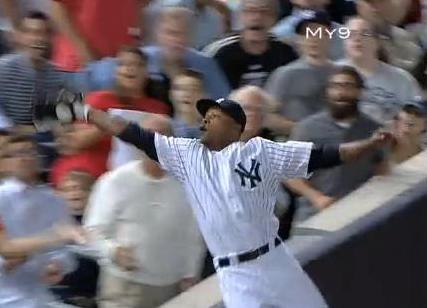
By now, you’ve probably seen the umpiring butchery that Mike DiMuro foisted upon Cleveland, when he ruled that Dewayne Wise caught a foul ball while tumbling into the stands that the right fielder very clearly did not catch. (Watch it here.)
The real question, as it concerns the unwritten rules, is one of gamesmanship. Wise knew that he didn’t catch the ball, but was more than happy to accept the out. Did he act appropriately?
Of course he did. It’s the same reasoning used by outfielders who have trapped flyballs but act as if they caught them. (Wise was even more innocent than that—he didn’t act in any way like he made the catch.)
“Everybody thought it was pretty funny,” he told the Westchester Journal News. “They’re just laughing about it, the way I got up smiling. What was I supposed to do? I’m not going to laugh and show up the umpire right there.”
He was also not going to willingly give up one of the 27 outs necessary for his team to win the game.
“Baseball is a game where you try to get away with anything you can,” said Hall of Famer Hank Greenberg in the Saturday Evening Post. “You cut corners when you run the bases. If you trap a ball in the outfield, you swear you caught it. Everybody tries to cheat a little.”
“It’s not cheating,” said former outfielder and minor league manager Von Joshua, ” if the umpire lets you get away with it.”
Wise’s action is less like his teammate Derek Jeteracting like he was hit by a ball that struck his bat, and more like Greg Maddux, a master at throwing scuffed baseballs. Maddux didn’t scuff them himself, however—he held onto ones that had acquired abrasions through the course of regular use, taking what was legally given to him during the course of the game and using it to his fullest advantage.
Mark Teixeira started -- and homered (twice) -- before everything fell apart for New York.
Prior to Wednesday’s game against Tampa Bay, Yankees manager Joe Girardi found himself in a terrifically sweet position. The Yankees had little to play for; they would finish with the American League’s best record regardless of the outcome.
A loss, however, would give the Rays a leg up on the American League wild card. More pertinently, it would provide a possible knockout shot to the Red Sox—and what Yankee wouldn’t enjoy that?
With so much on the line for his opponent, however, Girardi was, under the auspices of baseball’s unwritten rules, obligated to utilize his best players. So the question became, Would it be okay if he didn’t?
The answer: Of course. Winning, or putting your team in a position to win, trumps nearly every facet of the Code. It’s safe to assume that Girardi—a Yankees catcher for four years before taking over as manager in 2008—takes joy in any opportunity to stick it to Boston. On Wednesday, he could do so under cover of getting his own team ready for the postseason. The skipper had a playoff series to prepare for, and resting his players may well be vital to that preparation.
In fact, Girardi did exactly that against the Rays on Sept. 22, resting Curtis Granderson, Alex Rodriguez, Robinson Cano, Russell Martin and Brett Gardner in a game New York would lose, 15-8.
But with the season on the line for Tampa Bay on Wednesday, Girardi started what’s essentially been his regular lineup, and stuck with it until rain delayed the game in the seventh.
With New York holding a 7-0 lead, the skipper went to his bench: Eric Chavez replaced Mark Teixeira in the lineup, and took over at third base. Brandon Laird moved from third to first. Chris Dickerson took over for Nick Swisher in right field. Heck, A.J. Burnett—A.J. Burnett!—saw action in the seventh.
That strategy, of course, is covered by its own set of unwritten rules. With the game comfortably in hand, Girardi could have been accused of running up the score had he continued to play aggressively. Such a full utilization of his role players was definitely not that.
As it was, of course, we all realized exactly how far behind us the days in which a 4-0 lead was considered safe actually are. Tampa Bay tied the game with six in the eighth and one in the ninth, and won it—and the wild card—on Evan Longoria’s 12th-inning homer.
Boston fans might bemoan Girardi for his late-game lineup manipulations, but their manager didn’t. “They can do whatever they want,” said Terry Francona in a MassLive.com article published Monday. “They have played themselves into that position; they’ve earned the luxury. I have never had a problem with that.”
* * *
The piece of Code mandating that managers utilize their best lineups when playing contenders late in the season really comes into play when an also-ran rests its regulars against a club with playoff hopes—”to get a look at the kids,” or some such. Few issues will be taken should the occasional prospect be utilized for evaluation purposes, but generally speaking the rule is firm: Play the rookies against Pittsburgh; sit ’em against St. Louis.
Take 2004, for example. Going into the season’s final series, the Giants and Houston were tied for the wild card lead with 89-70 records. The Astros closed with three home games against Colorado, while the Giants visited Los Angeles.
Suffice it to say that members of the San Francisco clubhouse took note when Rockies manager Clint Hurdle trotted out a series-opening lineup featuring six rookies—Aaron Miles, Clint Barmes, Garrett Atkins, Jorge Piedra, Brad Hawpe and JD Closser.
The Giants managed to take two of three from the Dodgers, but it wasn’t enough; the Astros swept punchless Colorado.
“All we needed was for Houston to lose one game,” said then-Giants reliever Matt Herges. “We were watching that, yelling, ‘This is a joke.’ We couldn’t stand Clint Hurdle after that.”
“If we’re in that position, it means we stunk all year,” said Hall of Fame manager Sparky Anderson. “Well, let’s stink a little more if we have to, but we’re going to give them the best shot we’ve got.”
That, however, is not a universal view. For the flip side of the argument, we turn to Tigers manager Jim Leyland.
“Goddammit, if I’m that far out of the pennant race, the players I was playing weren’t worth a shit, anyway,” he said. “You might as well take a chance and look at some new players for next year.”
Which brings us back to Joe Girardi, who doesn’t have to worry about any of that. His players don’t stink, he could have gotten away with virtually anything he wanted in this regard during yesterday’s game and, as a bonus, he helped kill Boston’s season.
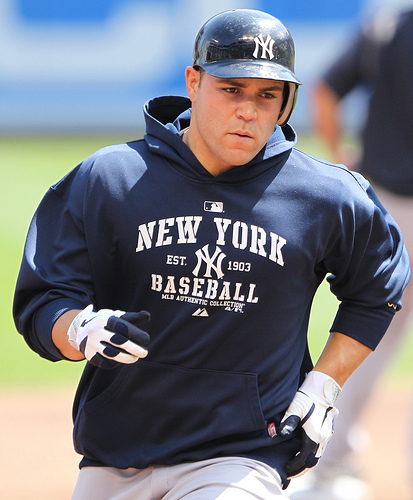
So Francisco Cervelli hit a big home run and clapped his hands in celebration as he stepped on the plate, directly under the nose of Red Sox catcher Jarrod Saltalamacchia.
The next pitch Cervelli saw hit him square in the back.
It certainly looked incriminating, and although pitcher John Lackey denied all intent, that’s what he’s supposed to do. The Yankees broadcast crew jumped on it immediately, with Michael Kay not missing a beat after Cervelli was drilled before saying, “I’m going to tell you why Cervelli just got hit. I will tell you why. Because when he hit the home run he celebrated at home plate and clapped his hands right in front of Saltalamacchia.” The telecast then cut to a pre-queued clip of the moment. (Watch it, preceded by the home run itself, here.)
Kay was hardly the only one to see it in this light. Another example, from the Boston Globe, which structured its use of quotes to paint a particular picture:
“He was pumped for that [third] home run of his career,” Lackey said. “I thought it was a little excessive, honestly.”
Said Saltalamacchia: “He’s done a lot of that stuff. … He likes to get excited. That’s fine. As far as the clapping goes, yeah, it could have been a little much. You don’t show anybody up. You play the game the way you play it. You’ve got to stay in your boundaries.”
Seems pretty cut and dried. There are some compelling arguments to the contrary, however.
Start with the fact that the Red Sox trailed 4-2 at that point in the seventh, and Lackey’s primary job was to keep that deficit static. The last thing he’d rationally want is to put the leadoff hitter on base with the lineup about to turn over. (Sure enough, Cervelli came around to score New York’s final run.)
Said Lackey in the Boston Herald, “I’ve been fined twice for hitting guys this year and I’ve paid them because they were right. But this one, I’m not afraid to tell you if I’m trying to hit somebody. I would’ve told him to his face.”
The statement that rang truest from Lackey, from the New York Daily News, pointed out in stark terms every truth of the situation. The Globe excerpt above utilized part of it, but cut out the key final sentiment.
“(Cervelli) was pumped for that ninth home run of his career (third actually), yeah. I don’t know. I thought it was a little excessive, honestly, but that’s not a spot you handle something like that.”
Naysayers can start their counter-arguments with the fact that this game doesn’t mean anything because Boston and New York are both going to the playoffs, then talk about Boston wanting to avoid facing Justin Verlander twice in the ALDS.
But those who think a starting pitcher in the midst of a pennant race is willing to compromise a victory in order to take care of some vendetta—especially with five games remaining between the teams during which to drill Cervelli at a more opportune moment—must ignore an awful lot of reality to do so.
More of an affront to the Code than anything Lackey did was Cervelli’s celebration—specifically, where it took place. Had he clapped his hands upon seeing the ball leave the yard, the Red Sox would not likely have noticed. Had he waited for several steps after crossing the plate, on his way back to the dugout, same thing.
As Craig Calcaterra wrote over at HardballTalk, “Cervelli pumps his fist when he gets a good sandwich. He woops it up if he tosses a wadded up piece of paper into a trash can on the first try. If Cervelli gets one more home run in his career it’ll be a gift from the friggin’ gods, so let him have his little moments.”
Done and done. The guy has to measure those moments, however, to ensure they occur somewhere than directly in front of his opponent. Otherwise, he can expect more of the same kind of treatment he received from Lackey.
Well, things have officially gotten interesting. A day after Yankees catcher Russell Martinaccused the Blue Jays of stealing New York’s signs, New York manager Joe Girardi injected some seriousness into the charge.
During the course of the Yankees’ 7-1 loss to Toronto, Girardi had Martin display complex sign sequences for pitcher Freddy Garcia even with the bases empty—a time during which catchers ordinarily utilize only the most basic signals. The only possible reason for this: the prospect that the Jays employ a comprehensive system for sign stealing, likely from somewhere beyond the field of play.
When questioned about it, Girardi didn’t hold much back.
“Sometimes we have inclinations that certain things might be happening in certain ballparks and we are aware of it and we try to protect our signs,” Girardi said in an ESPN.com report.
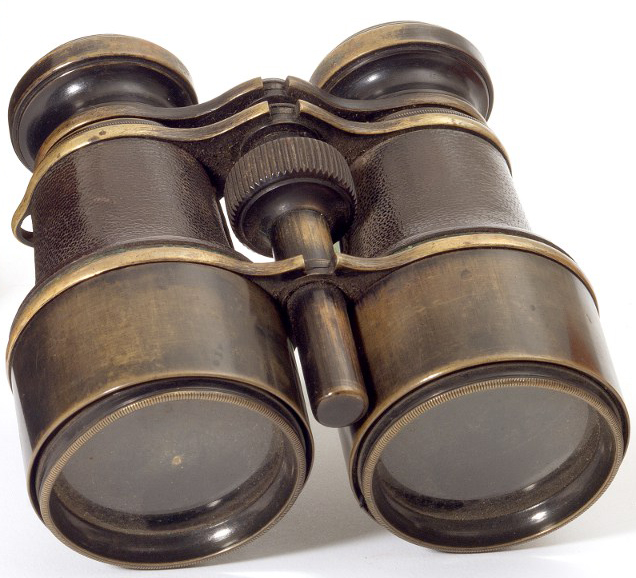
In response to a question about whether that could mean using foreign devices such as binoculars or even TV cameras, Girardi said, “Could be,” and added that “there are ballparks where you need to protect your signs.” The manager softened his stance somewhat by pointing out that he was “not accusing anyone” of impropriety.
Not directly, anyway.
Blue Jays manager John Farrell, of course, denied everything. “I have no idea what that might be referring to,” he said. “Honestly, why that would even come out, I don’t know. We play this game to compete every day and we don’t look to any other means than what takes place between the lines.”
Accusing a team of stealing signs from the basepaths is mild, usually serving merely as a preventative method against it happening again. When entire ballparks—and binoculars and relay systems and everything else associated with pilfering signs from beyond the field of play—are brought under scrutiny, things become significantly more charged. Rare is the player who won’t forgive a basepath sign stealer; even rarer is the manager willing to forgive an institutional breach of confidence such as the one to which Girardi alluded.
As referenced yesterday, this is hardly new territory, with the Phillies standing accused of similar tactics last season. They had a solid base on which to build; the Yankees themselves served as some of the first practitioners of off-field espionage. In 1905, back when they were still known as the Highlanders, the team rigged a hat-store advertisement on their outfield wall so that the crossbar in the letter “H” could be manipulated in accordance with the upcoming pitch. In 1909, Highlanders manager George Stallings rented an apartment behind the right-field fence of the team’s Hilltop Park, from which he had someone relay signs by flashing a mirror at the batter. (On cloudy days, a similar crossbar continued to come in handy—this time in a “Highlanders” sign.) When Detroit went to New York for a must-win series at the end of that season, Tigers manager Hughie Jennings—having heard the rumors and willing to take no chances—showed up to the ballpark early and, with some help from his team, tore down the scoreboard in which the New York spy—the guy relaying the signals—had been hiding.
A more modern implementation came courtesy of Billy Martin, during Game 1 of the 1976 World Series. A commotion was raised in the middle innings when three New York scouts were found in the ABC-TV booth, gathered around a television set and speaking into walkie-talkies. Cincinnati had previously granted permission for the scouts to assist with defensive alignments from on high, but watching them in action raised Red flags and they were removed from the premises.
Going public with his own complaints is a decent gambit for Girardi. Save for annoying Farrell and other members of the Blue Jays, there’s little downside to thinly veiled accusations—but by bringing the subject to the media, Girardi has insured vigilance not just from their own dugout, but from the public at large. Had the Blue Jays been stealing signs with a TV camera or some other such device, they’d be hard-pressed to continue the practice, at least in the short term.
The primary question with which we’re left: If Girardi feels that “certain things might be happening in certain ballparks,” where else might they be happening, and who else knows about it?
It’s been a while since a good sign-stealing controversy erupted in the big leagues. That type of eruption, of course, is contingent on an eruption of offense, which is what the Blue Jays had against the Yankees on Thursday.
On its surface, Toronto’s 16-7 victory was little more than a solid whooping, as the Jays jumped on Bartolo Colon for eight first-inning runs and touched four New York relievers for at least a run apiece.
Then Russell Martin went and opened his mouth.
“You move your head one way it’s a fastball, you move your head the other way it’s a slider,” he said in an ESPN report. “It was pretty blatant.”
Martin was referring to Blue Jays baserunners, particularly the ones frequently camped at second, who he accused of looking in to his signs and signaling upcoming pitches to the men at the plate. These are the kinds of things that happen when one’s starting pitcher throws 42 pitches over two-thirds of an inning, resulting in six hits and eight runs (three earned).
Martin’s primary issue was that he (or anyone else in the dugout) didn’t catch on to the Jays’ system (if that’s indeed what it was) until the fourth inning, when he noticed Jose Bautista acting strangely (moving his head this way or that, perhaps) while at second base.
Turns out that Toronto has a bit of a history with the subject. From The Baseball Codes:
Marty Barrett played second base in Boston for nine seasons in the 1980s, every one of them with right fielder Dwight Evans. While playing the field, Evans liked to know the pitch that was coming in advance, to help him get an early break on balls hit his way, so Barrett would make a fist and put it behind his back. If his hand didn’t move, a fastball was imminent. If his arm wiggled, it would be something softer.
In Fenway Park, the bullpens for both teams are located in right field, allowing visiting relievers a clear view of Barrett’s machinations. The only club to pick up on his tactic, though, was the Toronto Blue Jays. Through much of the 1980s, bullpen coach John Sullivan would look over the fence at Barrett’s arm, then signal the hitter with a towel (draped over the fence meant fastball, off the fence meant curve). Sometimes, so as not to draw too much attention, Toronto pitchers would simply stand up or sit down, depending on the pitch type, in accordance with prearranged signals. During Barrett’s final two seasons as a full-time player in Boston, the Blue Jays went 13-0 in Fenway Park (as compared with 6-7 when the teams played in Toronto). “Haywood Sullivan [the Red Sox general partner] came down a couple of times and said, ‘I think they’re getting our pitchers’ pitches,’ ” said Bill Fischer, the Red Sox pitching coach at the time. “We would look at the videotape for hours, and we couldn’t find anything.”
“You’re taught to catch things on the field,” said Blue Jays manager Bobby Cox, who helmed the sign-stealing operation. “You watch body language with coaches at first and third, and runners with their body language when the hit-and-run and squeeze is on. There’s tip-offs and tells throughout a nine-inning ballgame. If you pay attention, you might catch something.”
Fischer eventually discovered the secret, but only after he joined Cox’s Braves staff in 1992, at which point the manager fessed up and told him that Toronto “had every pitch” the Red Sox had thrown.
The standard major league attitude toward these kinds of activities is that teams are expected to do whatever they can to get an edge within the boundaries of fair play, and if somebody’s getting his signs picked it means mostly that he needs better signs. Once a team is caught trying to pinch them, the activity is expected to cease (or at least be carried out more discreetly); should this happen, everybody tends to go on their merry way.
(This should not be confused with stealing signs via a telescope or any other equipment beyond one’s own observational power from field level—a tactic that is never sanctioned. When Phillies bullpen coach Mick Billmeyer was spotted pointing binoculars at Rockies catcher Miguel Olivo last year—followed shortly thereafter by Shane Victorino on the dugout phone, ostensibly to receive and relay whatever signs Billmeyer had picked up—the commissioner’s office stepped in to offer a watchful eye. The Yankees, in fact, had their own run-ins with the Phillies on this subject during Game 4 of the 2009 World Series, when catcher Jorge Posada visited pitcher CC Sabathia six times in the first inning, then eight more times in the fifth—because, said the rumors, New York had suspicions of Philadelphia stealing signs via in-house TV cameras.)
To his credit, the just-change-our-signs mentality is precisely the one Martin employed. “It’s up to us to catch it and change the signs,” he said. “I’m not blaming them for anything. . . . It’s one of those things you don’t really talk about, but it’s part of baseball. It’s always been.”
In an AP report, Yankees manager Joe Girardi detailed some of the ways to tell if a team might have your sign. “You watch some of the swings that clubs are taking,” he said. “Are they fooled on any of the pitches? Are they bailing when you’re throwing the ball in? There’s a lot of things that you watch for.”
Former Red Sox pitcher Al Nipper put it more bluntly in The Baseball Codes: “When you’re throwing a bastard breaking ball down and away, and that guy hasn’t been touching that pitch but all of a sudden he’s wearing you out and hanging in on that pitch and driving it to right-center, something’s wrong with the picture.”
In the fourth inning, Martin saw something along those lines, and responded by switching up his signs with pitcher Hector Noesi. The batter, Aaron Hill struck out swinging. (Changing signs is easier than it sounds; the signs themselves remain the same—only the indicator for which sign to pay attention to changes.)
Like Martin, Girardi failed to find fault with the Blue Jays for stealing his signs, if in fact that’s what they were doing.
The surest tell? When asked about it later, Toronto manager John Farrell didn’t flatly deny that it was happening, but claimed to be “unaware” of those types of activities.
Of course he was. Even Bobby Cox expressed outrage when asked about Toronto’s system utilizing Marty Barrett’s signals—about 20 years after the fact. He finally settled in and discussed the topic, but still refused to confirm many specifics.
His answers, however, left enough wiggle room to see exactly how much he knew. Which is all part of the espionage.
The most important factor in the Posada Madness pandemic that erupted over the weekend in New York is the ongoing viability of Jorge Posada—both as an everyday player or even somebody meritous of a roster spot.
The big picture will likely be sorted out in short order. Aging and ineffective performers—even those as vital to their teams’ recent history as Posada—are rarely granted much leeway.
More interesting to the purposes of this blog is how it played out. Both sides—Posada on one and the Yankees (particularly GM Brian Cashman) on the other—set about shredding standard decorum under the increasingly gleeful glare of the New York media. A quick recap, in case you were taking your five-year-old daughter on her first ski trip, like me, and missed the entire thing:
Saturday night: Joe Girardi pencils Posada, New York’s designated hitter, into the No. 9 spot in the order—the first time the 39-year-old has been positioned so low since 1999.
An hour or so before first pitch Posada asks out of the lineup.
According to New Jersey Record columnist Bob Klapisch, Posada doesn’t explain himself, and Girardi doesen’t press him. Accounts differ about what is said, but multiple sources tell multiple media members that Posada feels insulted. The term “hissy fit” was used at least once to describe the encounter between player and manager. Considering when the request came—prior to a nationally televised game against the Red Sox—and who it came from—Girardi, a guy Posada has reportedly not much liked since their days together as co-catchers on the Yankees—perhaps this should not be surprising.
Cashman intervenes, urging Posada to reconsider his decision. Posada does not reconsider.
Cashman takes the audacious step of meeting with reporters in the press box during the game, to clarify that Posada is healthy, and that management has nothing to do with his absence from the game.
With timing that one can only assume is in response to Cashman’s impromptu press conference, Posada’s wife, Laura, counters that claim, tweeting that Posada’s back is too stiff to play.
After the game, Posada downplays his physical ailments (he hadn’t, after all, previously raised the issue with Girardi or team trainers), and says he just needed time to “clear his head.” He then sets his sights on Cashman, saying, “I don’t know why he made a statement during the game. I don’t understand that. That’s the way he works now.”
On Sunday, Posada apologized to both Girardi and Cashman, saying, “All the frustration came out. It was just one of those days you wish you could take back.”
The Yankees, in turn, decline to discipline their former star, who in the three games since has appeared only once, as a pinch-hitter.
Ultimately, nobody came out looking too good. Girardi, by way of essentially staying out of it (Everybody needs a breather now and again, he told the press, rather than justifiably lighting into his catcher), is the least scathed. Posada and Cashman: not so much.
Posada: An unwritten rule mandates that managers refrain from removing position players from the middle of innings except in cases of injury. The counter to this rule holds that players not remove themselves from the lineup while at the wrong end of a hissy fit.
Big league clubhouses are rife with what is commonly referred to as a “warrior mentality.” The term isn’t particularly accurate in this case, in that warriors go to battle against opponents. In this case, Posada needed to be in the lineup to prove his allegiance, not his ability, to his teammates—not the Red Sox. For a veteran, a proven winner, to turn his back on his teammates in a key game for reasons that can only be construed as personal is inexcusable. Posada is no different than any other ballplayer in this regard; his ego will never be as important as the success of his team. His teammates know it, and his position in the clubhouse hierarchy depends upon it.
A reader asked how Posada’s move compares to Cal Ripken removing himself from the Orioles’ lineup in 1998. Ripken was, like Posada, in the late stages of his career. Ripken’s consecutive-games streak had grown so mountainous by that point that it trumped any move manager Ray Miller could have made that involved his star shortstop spending a game on the bench. Ripken was hampering himself and his team by staying in the lineup every day. He ended his streak for the greater good, and was lauded for it.
Another example, from earlier this season, saw Giants outfielder Pat Burrellask out in the middle of a game. His reason: Tim Lincecum was throwing a no-hitter, and Burrell didn’t want his sub-par glove and lack of range to be the reason Lincecum gave up a hit. Like Ripken, he did it for the greater good. (Lincecum did indeed give up a hit in the seventh inning—the same inning in which Burrell was removed. This brings up the topic of changing nothing during the course of a no-hitter, including defensive players, but that’s a topic for another post.)
The primary guy to have Posada’s back through his ordeal has been Derek Jeter, who told the New York Daily News that he “didn’t think it was that big a deal. If you need a day, you need a day.”
Whether or not the captain actually believes this is incidental. Perhaps he’s sticking up for Posada because that’s what teammates do, but it’s hard to imagine that Jeter picturing his own neck on the chopping block didn’t play a part.
Cashman: The guy is a veteran, and no matter how well he does his job, he probably puts up with more grief from the New York media than the next several most second-guessed GMs combined. He, of all people, should understand the machinations of communication in the big leagues, and that going through the media for any of it rarely turns out well.
On one hand, Cashman’s method of delivery added layers of importance and urgency to his message. Short of suspending Posada or releasing him outright (both of which would have brought their own headaches), there was no less equivocal way for Cashman to inform the veteran that he was not messing around.
Wrote Buster Olney on ESPN.com Insider, Cashman “is not only willing to be the instrument of change with the team’s older players, he views it as his responsibility to the Steinbrenners.”
That has to be a particularly difficult place to inhabit, especially when it comes to icons like Posada and Jeter, and Cashman is taking a hard-line approach. (Telling Jeter to test the waters during off-season contract negotiations was a clear step in this direction.) To do it the way he did it, however—not just publicly, but in a manner so unusual that the delivery itself brought attention, independent of the message delivered—was to ignore the service and success that Posada has given the organization over the last 17 years.
Even the enemy was motivated to chime in, with David Ortiz telling the Boston Herald that “they’re doing (Posada) wrong.”
Ultimately, Posada’s actions amounted to nothing more than a really bad day. Holding him accountable is reasonable. Benching him for lack of production is also reasonable. From a baseball (if not contractual) standpoint, giving him his outright release would be entirely justified.
From former GM Jim Bowden, on ESPN.com: “Until you are ready to . . . ask Posada to step aside, and keep him out of the lineup for good, you PROTECT HIM! He’s a Yankee, a five-time world champion Yankee who is known for his class and dignity. Show him the same.”
Taking it public like Cashman did serves only one purpose. It tells the rest of the aging roster—Jeter in particular—that when it’s time to go, they better not mess around.
Time will tell if the ends were worth the means, but as of right now it’s not looking too good.
Russell Martin during his sweet spot—after his second homer and before he was drilled.
The plunking of Russell Martin on Saturday, April 23, by Baltimore pitcher Josh Rupe was enough to fire up the usually stoic Joe Girardi, who was seen pumping his fist in the dugout in response to Brett Gardner’s revenge homer a batter later.
Why so impassioned? Martin was drilled high between the shoulder blades, just below his head, after hitting two home runs in what would end up a 15-3 laugher for the Yankees.
“What happened last night, it’s ugly, it’s unfortunate,” said Girardi in the New Jersey Star-Ledger.
O’s skipper Buck Showalter agreed, though he stuck by his pitcher’s claim of innocent intent. Of course he did. That’s his job.
More interestingly, when asked how he might respond should the Yankees retaliate, he told the Baltimore Sun, “We’ll deal with it. It’s self-inflicted.”
That’s a big statement from a manager—a tacit admission to the opposing club that, should they handle their business appropriately, they will have an uncontested free shot available to them the next time the teams meet.
Rupe issued the requisite denial in which he insisted he was attempting nothing more than to pitch inside. Then he took it a step further.
“I know how it looked, and for me and a lot of these guys on this team, I pitch in,” he said in an MLB.com report. “That’s what I do when I’m coming out of the ‘pen. I’ve already given up a home run, and yeah, I was really [ticked] off. But I’m not going to resort to possibly hurting a guy and end his career or anything like that. There’s no reason for me to do that.”
There might even be some truth to the sentiment. Rupe came in with the bases loaded in the eighth, and promptly gave up a grand slam to Alex Rodriguez. He later hit Martin with two outs in the ninth. Any fastball fueled by frustration is bound to get wild, regardless of its intended target. This doesn’t excuse the pitch, of course, or get the Orioles off the hook. And it certainly didn’t change the Yankees’ collective opinion.
Martin, on Rupe’s intent: “Yes—there’s no doubt about it. I want to stay in the lineup, so I’m not going to do anything stupid, but I wouldn’t recommend him doing that again.”
Girardi: “It was right at his head.”
Mark Teixeira: “That’s a heck of a coincidence if it wasn’t intentional. . . . There’s no place for it.”
Teixeira’s opinion holds extra merit, as he went in spikes high against Baltimore infielder Robert Andino in the seventh inning. Andino immediately got up and had words for the baserunner.
It was not Teixeira who was targeted, however, despite coming to bat the following inning with the Yankees ahead, 9-3. (He walked, loading the bases.)
In the series finale the following day, no batters from either team were hit. Perhaps the Yankees’ blowout victory the previous day allowed them to move on. More likely, the combination of a close score on Sunday (the game was tied, 3-3, going into the 11th inning) and proximity to the initial incident was enough to put Girardi off … for the time being.
Still, he made sure to say, “I think it’s important that your players have each others’ backs during a long season. As a team, you have to take care of each other.”
How much is too much, and when is enough when it comes to takeout slides? These questions were asked multiple times and with no firm answer in Houston and New York last week.
Start with Bill Hall. Was flying into Marlins shortstop Hanley Ramirez on a play at second base, as the Astros second baeman did Friday, too much? It was certainly aggressive. Ramirez, firmly planted behind and to the left of second base as he attempted to turn a double-play, provided a stationary target as Hall went out of his way to take him out. (Watch it here.)
That, however, is what players are taught to do—interrupt the fielder at any cost, so long as it’s clean. And Hall’s slide was clean, if a touch late. He went in feet first and spikes down, with one clear purpose: prevent the double-play. That he went out of his way—but not too far out of his way—to do it falls well within the definition of getting the job done.
“Clean play? Dirty play? That’s hard to tell unless it’s very obvious,” said Marlins manager Edwin Rodriguez in the Palm Beach Post. “He came hard but he was in range. He was touching the base. That’s the way he plays and that’s the way it should be—play hard.”
Hall ended up going shin-to-shin with Ramirez, knocking them both down for several minutes. Hall returned to the game; Ramirez sat out until Tuesday.
A day prior, Nick Swisher of the New York Yankees took out Twins second baseman Tsuyoshi Nishiokain a similar play, with far graver consequences. Swisher’s slide—like Hall’s, off the base and intended to break up the double-play—broke the second baseman’s fibula, just six games into his big league career. (Watch it here.)
The reason both infielders were hurt is that neither of them jumped. Ramirez fielded the throw in an awkward place coming from the shortstop position and had to adjust; Nishioka might simply never have learned any difference.
Twins broadcaster Dan Gladden, who spent a year playing in Japan (winning the Japan Series with the Yomiuri Giants in 1994), was quoted in the Minneapolis Star Tribune talking about the dearth of such tactics in that country.
“When I got over there I told them, ‘I don’t slide to the bag. We are taught to break up double plays,’ ” he said. “The coach told me, ‘We expect the Americans to play that way.’ ”
Swisher went so far as to visit Nishioka in the X-ray room at Yankee Stadium to offer a personal apology for the inadvertent injury. Nishioka told him there was no apology necessary. And that was it. No retaliatory strikes the following day. No bad blood resulting from a hard, clean play.
The same can not be said for the Marlins. Ramirez was injured far less severely than Nishioka, but despite the fact that he publicly exonerated Hall—“My opinion is he was trying to break up a double play,” he said in the Post. “He told [Marlins infielder Greg] Dobbs that he was sorry but … he was trying to do his job.”—his teammates clearly had a score to settle.
Saturday’s game was too consistently close to consider a retaliatory strike, but on Sunday, with a 6-1 lead in the seventh inning, Edward Mujica drilled Hall in the hip. The intent was clear; Mujica has hit only three guys over the course of his six-year career and walks almost nobody. His control is exquisite. He was quickly ejected.
Ramirez being the face of his franchise certainly had something to do with it. The fact that he has a history of calling out Marlins pitchers for lack of retaliatory response may also have factored in. (Then again, Mujica was with San Diego during that particular tirade, and may have been entirely ignorant of it.)
Had Hall been out of line with his slide, with a barrel roll or some other questionable tactic—in other words, had he deserved the response—it might have ended there. As it was, Houston reliever Anuery Rodriguez stood up for his guy by plunking Gaby Sanchez in the ninth. This one was easy to see coming; Rodriguez is a rookie with a double-digit ERA. His performance on the field is not winning much respect from his teammates, so he felt the need to earn it in a different capacity. He, too, was ejected. (Watch both ejections here.)
The Marlins and Astros meet once more this season, in July. There’s no reason for renewed hostilities at that point—but then again there rarely is. Stay tuned.
Relief pitcher Ryne Duren, who pitched for eight teams over his 10-season career—but who’s best known for his stint with the Yankees in the late-1950s and early ’60s—passed away Thursday at age 81.
He was known for throwing hard, and he was known for seeing poorly. It was a terrific combination for intimidating the opposition.
He merited a passage in The Baseball Codes, which didn’t make the final edit. In honor of Mr. Duren, here it is, straight from the cutting-room floor.
New York Yankees reliever Ryne Duren, a three-time All-Star who led the American League in saves in 1958, didn’t have to wave his arms or act intimidating on the mound—all he needed was to warm up. Duren had one of the league’s most potent fastballs, paired with one of the league’s worst senses of where his pitches were going. (He twice finished among the American League’s top 10 in hit batsmen, despite starting only one game each season.) That, combined with Duren’s poor eyesight—his eyeglass lenses might have been the thickest in major-league history—was enough to keep batters perpetually ill at ease. The right-hander knew this, and did what he could to perpetuate their discomfort.
Duren would often hit the backstop with at least one of his warm-up pitches, buttressing the perception of his wildness. In “Ball Four,” teammate Jim Bouton wrote that “Ryne Duren was a one-pitch pitcher. His one pitch was a wild warm-up.”
Joe Nossek remembered a spring training game against Duren in which the pitcher had on sunglasses and spent an undue amount of time digging at the pitching rubber. “The first pitch,” said Nossek in the Chicago Tribune, “was right at my gourd. The next pitch he’s doing the same thing, looking at the mound, digging around with his foot. The catcher, Ed Fitzgerald, said, ‘Look at him, he can’t even find the pitching rubber.’ Aah, just what I needed to hear. I was up there for three more pitches, and I whiffed.”
Broadcaster Tim McCarver once told a story to partner Ralph Kiner about Duren hitting a batter in the on-deck circle. Kiner said he already knew the story.
Javier Vazquezhit three batters in a row last night against the Rays, and didn’t draw a peep of protest.
Why? Well, despite decent control (he’d previously hit only four batters this season, over nearly 150 innings), Vazquez isn’t good right now.
Also, because he’s been demoted to the bullpen and desperately needed a good outing.
Also, because he’s in danger of not making the playoff roster, let alone the starting rotation.
Also, because two of the pitches in question were breaking balls, one at 67 mph, and the other thrown softly enough that it bounced off the helmet of Kelly Shoppach and didn’t even stagger him.
Also, because the first two HBPs (Desmond Jennings and Willie Aybar) followed a leadoff walk to Ben Zobrist, so the third HBP (Shoppach) drove in a run. (Watch it here.)
Clearly, this wasn’t what Vazquez had in mind.
He became the first Yankee to hit three straight batters, and only the eighth player in history to do so. (Jeff Weaver did it last, pitching for the Dodgers in 2004.)
How do we know the Rays didn’t take it personally? Alex Rodriguez led off the following inning for New York; despite Tampa Bay’s 10-3 lead (a perfect situation for retaliation, if that’s what one’s after), reliever Mike Ekstrom put his first pitch over the plate, and A-Rod grounded to short.
 By now, you’ve probably seen the umpiring butchery that Mike DiMuro foisted upon Cleveland, when he ruled that Dewayne Wise caught a foul ball while tumbling into the stands that the right fielder very clearly did not catch. (Watch it here.)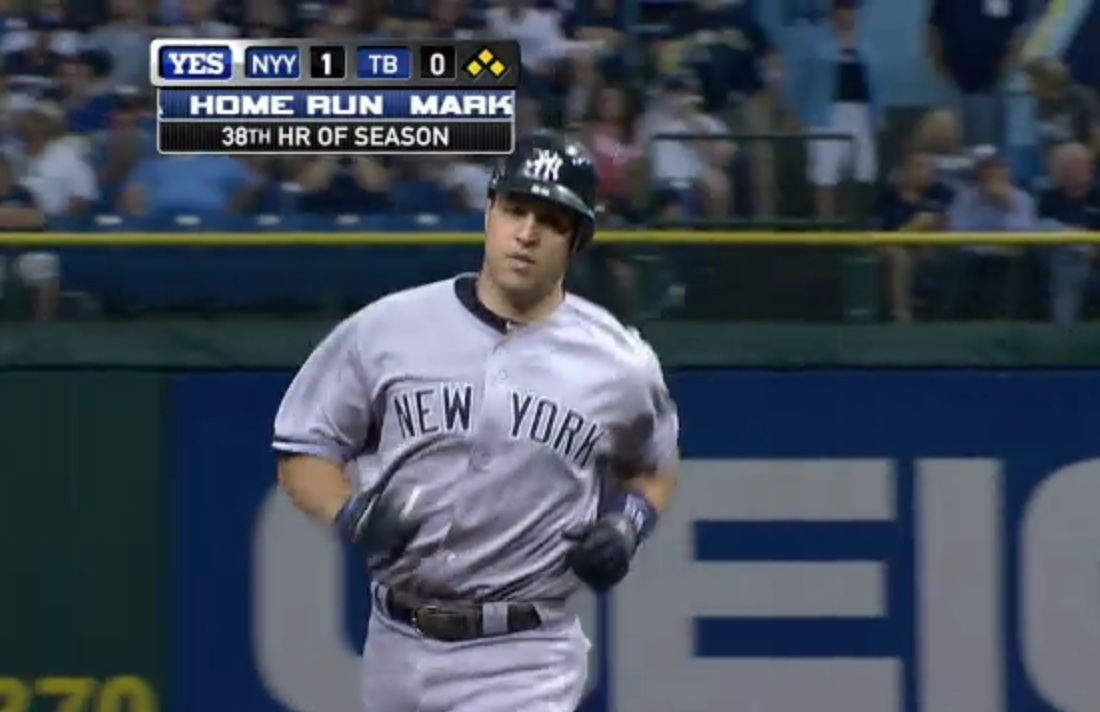




 The Baseball Codes