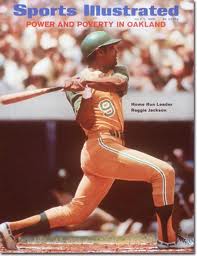
As means of explaining the relative lack of frequency of posts to this site recently , I figure it’s time to announce my latest project: a book about the championship Oakland A’s teams of the early 1970s, to be published by Houghton Mifflin in spring, 2015. Suffice it to say that I’ve been fairly well inundated.
I bring it up here because during the course of my research I’ve encountered any number of unwritten rules-related issues from back in the day, covering all manner of topics. Referencing them regularly through the off-season seems like a decent way to pass the time until pitchers and catchers report in February. They might not mean much now, but boy are they fun.
For now, it seems like the best way to approach it is offer up entire excerpts—from game stories, mostly, primarily from the Oakland Tribune’s beat writer par excellence, Ron Bergman. This one is from July 18, 1969.
Even before the game, Reggie Jackson was ticked off.
“I’m telling you,” he said, spitting on his hands, “if they try that stuff on me when Chuck’s pitching, somebody’s going to get hurt.”
It just so happens that Jackson’s roommate, Chuck Dobson, is pitching tonight for the Oakland Athletics in the opener of a three-game series against the California Angels.
For the second game in a row and the seventh time this season, Jackson was hit by a pitch last night during the A’s 8-2 victory in Seattle. This one, thrown by loser Marty Pattin (7-9), struck him on the right forearm. …
“What they’re trying to do,” said Reggie, “is make a good pitch inside for a strike or miss.”
What the inflamed major league home run leader meant was miss by hitting him.
“That’s one base,” Reggie continued. “That’s better than four. I don’t mind. It’s all part of the game. But all I ask is protect me. A man’s got 35 homers for you, you got to throw at someone on the other team and hurt them.”
Someone reminded Reggie that [A’s pitcher] Lew Krausse threw at Don Mincher Wednesday night after Jackson was hit by Gene Brabender.
“Yeah,” snapped Jackson. “Throw the ball and holler ‘watch out.’ ” When they throw at me they don’t holler watch out. Look, someday I’m going to be hit on the hand and it’s going to break. [Jackson was referring to the hand he threw up when protecting his head.] Then what? I’m going to have to go out there with shin guards on my arms. ”
Catfish Hunter, who won his third in a row with a six-hitter, said he would have retaliated had he thought the Pilot pitchers were throwing close to Jackson deliberately.
“If they start throwing at his head, then I’ve got to brush them back,” said Hunter, referring to Seattle’s Don Mincher, who homered off the A’s for the third straight game.
Of the seven times Jackson had been hit over the team’s first 92 games to that point, most had been on his aforementioned hand. The aforementioned Mincher, who led Seattle with 25 homers in 1969, would be acquired by the A’s for the 1970 season, and again led his team in homers, with 27.
Also worth noting: Reggie’s prescience in envisioning Barry Bonds’ body armor, three decades before it actually came about.
Victor Martinez looked at Grant Balfour during the ninth inning of yesterday’s ALCS Game 3. Apparently he didn’t do it correctly.
Balfour began jawing. Martinez jawed back. They exchanged at least 16 letters’ worth of four-letter words. Dugouts emptied. Angry hops behind phalanxes of teammates were hopped. Then Balfour got back to his job, got three quick outs, and sealed Oakland’s 6-3 victory.
Balfour is fiery. Also, Australian. He does a lot of spectacularly accented shouting on the mound, usually toward nobody in particular. It does, however, further his goal of being as intimidating as possible.
Martinez was having none of it. After fouling off a 1-2 pitch, he stared down the pitcher while adjusting his batting gloves. Upping the ante, Balfour impolitely told him to knock it off. Martinez responded in kind. According to videotape evidence, each thinks the other is a “bitch.” (Watch a bleeped version here.)
“Fuck that,” Martinez said to reporters after the game. “Not even the greatest closer, that’s Mariano [Rivera], tells you stuff like that. I’m not a rookie that he’s going to come in and say little shit like that.”
Balfour’s intimidation jab, it seems, was successfully parried. (It’s easy to say that Balfour is now in Martinez’s head, putting the hitter at future disadvantage, but it would be just as easy to say that Martinez did the same thing in reverse. )
The moment calls to mind one of the least plausible mound charges in history, mostly because it came from a guy widely considered to be among the best human beings to wear a baseball uniform. It was 2001, and in a game between the Royals and Tigers, Mike Sweeney caught everybody by surprise by going out of his squeaky-clean character to charge pitcher Jeff Weaver.
His reason: Weaver, he said, “said something I didn’t like.”
(Weaver’s insult came in response to Sweeney’s request that the rosin bag be moved to a different spot on the mound.)
Sweeney tackled Weaver, punches were thrown and the game was delayed for 12 minutes.
“It’s something I’ve never done before and it’s something I’m not proud of. But I had to do it,” Sweeney said later. “Weaver is a talented young pitcher, but I’d like to see him respect the game more. Tonight, what he did was uncalled for and I did what I did.”
The lesson: Don’t mess with a man’s respect.
Another incident had a more lasting impact. In 1931, the White Sox were playing an exhibition game against a Houston club from the Texas League, whose 20-year-old pitcher, reported Sport Magazine (and re-reported in David Gallen’s book, The Baseball Chronicles), would not stop talking to the hitters.
“Well, lookee, now watta we got here?,” he said. “Jes’ keep that ol’ bat on the shoulder, fellah. I’m a gonna breeze this here one right across the middle. Now don’t get the catcher fussed up by swingin’ at it. Jes’ save yer strength and watch ‘er go by.”
Irate White Sox manager Owen Bush called out to his hitter.
“What’s going on out there?,” he yelled. “You’re supposed to be a major-leaguer. You’re letting that dizzy kid make a fool outa ya!”
That “dizzy kid” was named Jay Hanna Dean. The next season he would win 18 games for the St. Louis Cardinals en route to a Hall of Fame career. And Bush’s inadvertent nickname stuck; the right-hander’s given name was quickly lost to history.
As for Balfour, he insisted that there were no prior problems with Martinez. He even went so far as to indicate there wasn’t even a present problem.
“It’s all good,” he said in an MLB.com report. “I’m cool with it, bro. Hey, he’s a great competitor. He’s a great hitter. I like a little fire and obviously he does, too. It makes for a bit of fun, right?”
Catcher Derek Norris watches the ball. Pitcher Jarrod Parker watches the ground. Mark Reynolds watches Jarrod Parker.
That Mark Reynolds crushed a 457-foot homer off Oakland’s Jarrod Parker Monday should not come as a surprise. The guy had already hit one that far this season, has two of the 16 longest hit this season (according to ESPN’s Home Run Tracker) and has hit eight more than 400 feet in just over a month.
This one, however, was special. It was a revenge blast.
Reynolds was unhappy after Parker had drilled him in the shoulder in the first inning, two batters after Jason Kipnis and Asdrubal Cabrera had hit back-to-back homers. The action was sufficiently questionable for plate ump Angel Hernandez to warn both dugouts.
So after Reynolds connected in the fifth, he took several slow steps to first before starting to jog, a deliberate message. (Watch it here.)
He elaborated after the game, telling the Cleveland Plain Dealer, “I normally don’t pimp anything, but he hit me near the head. I don’t mind getting hit—it helps the on-base percentage—but when you come near the head. . . . I was on a mission right there, to hit a ball as far as I could, as kind of payback for hitting me almost in the head.”
It’s not like this kind of thing is new. In 2006, Albert Pujols responded to an earlier strikeout celebration by Oliver Perez by hitting a homer, then flipping his bat.
In 2004, Ken Griffey Jr. homered off of Josh Beckett, then stared into the Marlins dugout—a message to Jack McKeon, who had been fired in Cincinnati four years earlier, and blamed Griffey for it. (Tension in the ballpark quickly rose.)
Welcome to the pantheon, Mark Reynolds. You’re in some pretty heady company.
With Yu Darvish’s near-perfect game Tuesday came the inevitable cries of jinx. It didn’t hurt that the TV broadcast included the comment, “Darvish looking for number six, and the second perfect game …” precisely as the right-hander released the two-out, ninth-inning pitch that Marwin Gonzalez would slap to center for Houston’s first hit.
The backpack, of course, is a tradition in which the least-tenured member of a team’s relief corps is forced to lug around the bullpen’s candy supply, as well as finger fixers like nail clippers, frequently in as humiliating a satchel as possible.
If Ortiz thinks he has it bad, however, he has nothing on A’s reliever Sean Doolittle.
I was in the Oakland clubhouse yesterday, where Doolittle was fixing up the greatest candy bag I have encountered in many years on the Rookie Embarrassment beat.
Doolittle is the one doing the toting. That the left-hander appeared in three postseason games for the A’s last year counts for little; he’s still some 80 games behind teammate Evan Scribner when it comes to big league seniority. And he was sick of last season’s beat-up Hello Kitty bag.
Teammate Jerry Blevins acquiesced and purchased a new one—a fuzzy white, google-eyed unicorn, with pink hooves and a gold horn. Unfortunately, the new bag was far too small to hold the necessary supplies. Solution: affix old bag to new. Blevins began the process with safety pins, but left it to Doolittle himself to finish the job—akin, I thought, watching Doolittle struggle with the task, to having a victim dig his own grave. (See the bag in action here.)
“What can I say?” Doolittle said, affixing super glue just so. “I’m just doing what has to be done.”
A kiss is just a kiss—unless it happens in the ninth inning of a playoff game. Then, all hell breaks loose.
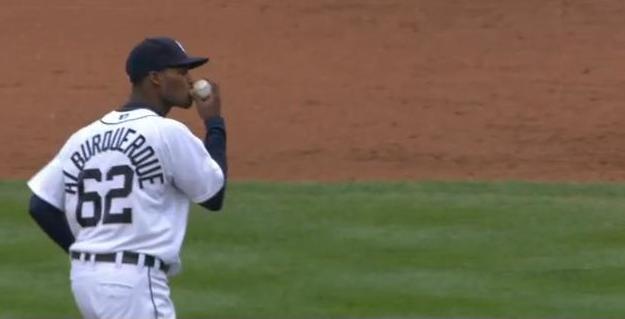
Tigers reliever Al Alburquerque put it to the test on Sunday. With the game tied, runners at the corners and two outs, the right-hander was called upon to face A’s slugger Yoenis Cespedes, who he retired on a comebacker to the mound. Before tossing the ball to first, however, Alburquerque planted a wet one on the horsehide. (Watch it here.)
“Did I see what I just saw?” Tigers catcher Gerald Laird, who had been removed for a pinch-hitter a half-inning earlier, recalled thinking. “Obviously,” he said later, “I did.”
So did the A’s. After the game, outfielder Josh Reddick told reporters that he “didn’t appreciate it,” that he “thought that was immature” and “not very professional.” Cespedes said that he may kiss his bat the next time he connects against Alburquerque.
By Monday afternoon, however, during an off-day at Oakland’s O.co Coliseum, the A’s were downplaying the incident as a non-story.
“What am I going to do, yell at them?” asked Jonny Gomes. “That doesn’t take care of anything. Bash them in the media? That doesn’t take care of anything. Just let the baseball gods take care of it. That’s why the baseball gods are there.”
For his part, Alburquerque, 26, said Monday that he intended no disrespect to Cespedes or the A’s, and that his actions were colored by “the emotion of the game.” Regardless, the second-year pitcher, a native of the Dominican Republic, was pulled aside after the game by Miguel Cabrera, Alex Avila and Octavio Dotel, who explained to him the reality of the situation.
“We just talked common sense,” said Avila. “First, you don’t want to kiss a baseball that you’re about to throw to first base, because if he does that and throws it over Prince [Fielder]’s head, it doesn’t look so good. Also, the last thing you want to do is fire the other team up.” (The rest of the Tigers later took to jibing Alburquerque fairly relentlessly, including asking the flummoxed pitcher if the ball kissed him back.)
While this particular antic isn’t exactly commonplace, it does have some historical precedent when it comes to similar showmanship. Perhaps the most prominent example occurred during Game 7 of the 1982 World Series, when St. Louis Cardinals pitcher Joaquin Andujar fielded a grounder by Milwaukee’s Jim Gantner, then held the ball while watching watch Gantner run until the final possible moment, firing the ball to first base just in time.
Gantner turned and called the pitcher a hot dog (among other things), Andujar responded with a parade of his own curse words at high volume, and the pair had to be separated.
Closer to the tenor of Alburquerque’s display was Sammy Sosa, who in a spring training game in 1999 hit two home runs against Arizona’s Todd Stottlemyre, and bowed to the crowd, Japanese-style, after each. Sosa said afterward that his intent was to show respect to the fans. Stottlemyre didn’t buy it.
“I sure don’t remember Mickey Mantle bowing after home runs,” he told the Associated Press. “I guarantee Joe DiMaggio didn’t bow.”
In neither case did the pitcher retaliate. In fact, the most appropriate form of retaliation is the one utilized by Philadelphia in 1993 against Bryan Hickerson, after the Giants reliever snared a line drive by Wes Chamberlain to end the sixth inning and spiked the ball into the turf.
“That infuriated us,” said Phillies outfielder Milt Thompson. Dusty Baker, then the Giants manager, said that Hickerson’s display was not directed at the opposing dugout, and that if the Phillies wanted to take it personally, it was up to them. They did, and it was; Philadelphia, down 8-3 at the time, came back to win, 9-8, in 10 innings.
This is exactly the type of thing that the A’s, down two games to none, have in mind. “Our best retaliation,” said Brandon Inge,” is to win three in a row.”
Ultimately, Avila had the most concise take on the subject.
“It’s baseball, not a soap opera,” he said. “It’s probably not the best thing to do in a playoff game, but at the same time there are much more important things going on.”
Boston, a day after getting gut-punched 20-2 by the Oakland A’s, had mustered not so much as a baserunner with two outs in the fifth inning Saturday against right-hander A.J. Griffin.
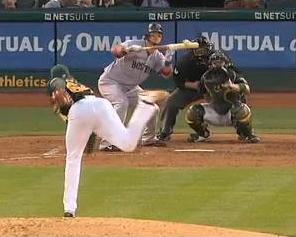
Frustration was inevitable, but was it sufficient to explain why Jarrod Saltalamacchia would bunt in the middle of a perfect game? The Red Sox catcher did, and reached base safely, which seems like a no-brainer: The guy was in clear violation of the Code. Heck, he even had a parallel with the most famous perfect game breaker-upper in history, Ben Davis—another catcher, who pulled the trick against Curt Schilling in 2001.
There was, however, a notable difference: For some unexplainable reason, A’s manager Bob Melvin had put on a defensive shift. With third baseman Adam Rosales positioned where the shortstop usually stands, Saltalamacchia was given the same kind of wide-open invitation all left-handed batters receive in that situation: an easy base hit with a well-placed bunt. Saltalamacchia, who has all of three sacrifice bunts in his career—all in 2007—took him up on the offer. (Watch it here, starting at the 1:03 mark.)
If the theory behind the governing rule is that a team’s first hit should be above board, with no gimmickry involved, then it should only follow that the defensive positioning of the pitcher’s team should follow suit. When Melvin opted not to play things straight up—despite holding a 5-0 lead—his opposition can hardly be faulted for acting similarly.
Melvin acknowledged as much after the game. “I probably should have had the third baseman in,” he told the San Francisco Chronicle.
To Griffin’s credit, the pitcher appeared to not hold any grudges. “It’s a good way to try to get momentum for your team,” he said. “There’s not anything I can do about it except try to get the next guy. Whatever.” (Bobby Valentine, who has far bigger controversies to consider than this one, added the sentiment, “Who cares?”)
There’s lots of blame to go around for Boston’s misery this season, but not on this play. If Griffin has a beef with anybody, it should be Bob Melvin.
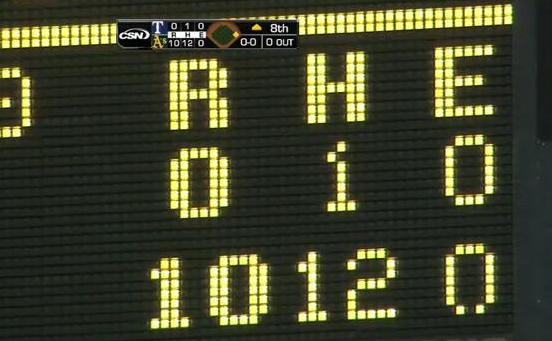
When A’s starter Jarrod Parker gave up an eighth-inning single to Michael Young Monday, it saved his manager some headaches. Parker is a rookie, had already exceeded his closely monitored pitch count, and, until Young reached safely, had not yet given up a hit to the Rangers.
Bob Melvin had already told himself that the eighth would be Parker’s final frame, regardless of the outcome. He was prepared to do what Terry Collins wouldn’t, just days earlier: capsize a no-hitter in progress.
Because it never came to pass, however, and because intentions are far less fun to criticize or defend than actions, we’ll turn our attention to Ray Ratto of CSNBay Area. Never one to subscribe to superstition (or even buy it off the newsstand), Ratto set about needling those on the collective edge of their seat during Parker’s gem.
In the seventh inning, he took some notice of folks on Twitter trying to draw attention to Parker’s feat without actually coming out and saying it, for fear of the dreaded jinx. From Ratto’s ensuing column:
Superstition lives in baseball, at least among the devout and experienced. Well, I am a man of science, in that I believe in evolution for some people. So I blurted out in response to one such devotee of tradition, “You mean JARROD PARKER’S NO-HITTER THROUGH SEVEN INNINGS? IS THAT WHAT YOU’RE TRYING NOT TO REFER TO?”
Did he jinx anything? Parker gave up his first hit two pitches later.
For those of you unfamiliar with Ratto’s style from his years at the San Francisco Chronicle and Examiner, his response to the ensuing fallout paints a fairly accurate picture:
So it was my fault, except for the following things. Jinxes don’t exist, and superstitions are idiotic. There are no baseball gods minding the store for etiquette violations, and if there were baseball gods, they still haven’t fully explained the color line to my satisfaction, so to hell with them anyway. Plus, Parker wasn’t reading my Twitter feed at the time, plus nobody else in the dugout was, plus, they already knew very well he had a no-hitter, plus shut up.
Other than that, yes, it was my fault.
In Ratto’s mind, even if there was a jinx, he should be doubly thanked for sparing Melvin the fallout from having to remove a pitcher from his own no-hitter.
Last weekend brought us this season’s first incident of a foreign player being brought quickly up to speed with this country’s baseball mores. It also brought us the lesson that reticence doesn’t always count for a whole lot.
The student: Oakland outfielder Yoenes Cespedes, who on Friday pummeled a Jason Vargas fastball 462 feet, the ball landing above the luxury suites in left-center field at Oakland-Alameda County Coliseum—a blast impressive enough to inspire the hitter to stand and watch it fly. (Watch it here.)
The teacher: Seattle’s Felix Hernandez, who drilled Cespedes the following day. First base was open, and the Mariners led 7-0 at the time.
Deserving or not, this was a lesson that Cespedes—a recent immigrant from Cuba—did not require. The guy had played in all of three major league games when he went deep, and seemed to quickly recognize his error.
“I followed the ball, but I don’t like that to do that again,” he said in the San Francisco Chronicle, following Friday’s game. “I come from Cuba, where it’s a little less quality games, so we do that. But here I don’t want to do that.”
That didn’t seem to matter to Hernandez. Although the right-hander denied it, Cespedes said he was “100 percent for sure” that the drilling was intentional, according to the San Jose Mercury News.
In the end, it doesn’t much matter. The lesson was sent, intentional or not, and the American League’s early home run leader came away just a bit wiser.
Edinson Volquez, in a moment of not saying anything.
It’s been a bad week for baseball types to talk, with every talker doing his darndest to deflect blame that he incontrovertibly deserves.
In Cincinnati, Edinson Volquez continued his season-long meltdown on Sunday by giving up seven runs to Cleveland over 2 2/3 innings. The right-hander has a 6.35 ERA and leads the National League with 38 walks.
Volquez’s problem, according to Volquez: the Reds’ offense.
“Everybody has to step up, start to score some runs,” he said in the Cincinnati Enquirer. “In the last five games, how many runs have we scored? Like 13? That’s not the way we were playing last year. We’re better than that.”
This is a terrific way to further alienate teammates who are already undoubtedly upset with the pitcher’s inability to keep Cincinnati in games. It’s even more infuriating than Gaylord Perry’s habit of physically showing frustration on the mound when his teammates made errors behind him in the field. At least Perry took the blame when he deserved it. Plus–unlike Volquez–he was a winner.
Cincinnati’s response was swift; on Monday, Volquez was optioned to Louisville. It was a dramatic move–the right-hander was their opening day starter, a former All-Star who went 17-6 in 2008. Of course, the guy has long battled maturity issues, being kicked by the Rangers all the way down to Single-A from the big leagues in 2007, shortly before they shipped him to Cincinnati (in exchange for Josh Hamilton).
If Volquez jeopardized his own spot in a major league clubhouse, Brian Fuentes jeopardized that of his manager. After Oakland’s interim closer gave up the lead yesterday against the Angels, he used his time in front of the post-game media to light into Bob Geren.
As with Volquez, it was primarily a matter of frustration. Fuentes has picked up losses in four straight appearances; his seven on the season already stand as a career high. He’s on pace to lose more games than any reliever in history.
At issue: how Fuentes has been used. He hasn’t had a save opportunity since May 8, coming primarily into tie games as of late. It happened again on Monday, when Fuentes walked one of the two hitters he faced before being pulled in favor of Michael Wuertz, who promptly let his inherited runner score, tagging Fuentes with the loss.
MLB.com’s Jane Lee posted the entire transcript of the reliever’s bluster:
What did you think of the situation you were placed in tonight?
It’s surprising yet not surprising all at the same time.
How do you feel with the way the manager has handled you as a reliever?
Pretty poorly.
How much communication do you have with him?
Zero.
Why is it pretty poorly?
There’s just no communication. Two games, on the road, bring the closer in a tied game, with no previous discussions of doing so. And then, tonight, in the seventh inning, I get up. I haven’t stretched, I haven’t prepared myself. If there was some communication beforehand I would be ready to come into the game – which I was, when I came into the game, I was ready. Just lack of communication. I don’t think anybody really knows which direction he’s headed.
How much different is this compared to past managers?
It’s a pretty drastic difference.
What goes through your mind when the phone rings in the seventh tonight?
I thought he misspoke. I thought it was some sort of miscommunication, but he said, ‘No, you’re up,’ so I got up and cranked it up. You can’t try to guess along with them. Very unpredictable.
At the beginning of the season, did he tell you that you were the closer?
Yes, from get go, I’ve been closing.
In regards to communication, is that something that ought to change?
It should. It’s not my decision. I can’t predict the future. If he decides to take that step, then there will be communication. If not, I’ll make sure I’m ready from the first.
Does there need to be a “clear the air” meeting?
Some people might think so. At this point I have nothing to say.
Has this been boiling up or is it just recent?
Just recent, really. I think the games in San Francisco were some unorthodox managing. I thought it was maybe the National league thing, that maybe that had something to do with it, but tonight was pretty unbelievable.
“Unbelievable” is an appropriate term. Fuentes has some validity with his points, but going public with them makes him look like a half-bit pitcher searching desperately for excuses. In the process, he completely undermined his manager and potentially damaged team chemistry. Today saw calls for Geren to resign, and questions have been raised about how the team will communicate moving forward.
This is a lot of damage for a pitcher who has been with the A’s for all of two months to inflict over the course of a five-minute interview.
The Reds sent Volquez to the minors. Fuentes doesn’t have to worry about that, but his position in the bullpen is certainly in danger. (Geren said that would have been the case even had Fuentes kept his mouth shut.) A’s closer Andrew Bailey is due back soon from the DL, and the return to health of Joey Devine and Josh Outman makes Fuentes expendable; shuffling him out of sight until he can be dealt to a contender should not be too difficult. (Fuentes came back tonight, and, without backing down from his statements, apologized to Geren—assumedly for the public nature of his discourse.)
* * *
Most noteworthy of all talkers was Mets owner Fred Wilpon, who set New York atwitter as soon as the New Yorker published Jeffrey Toobin’s profile of him. Amid what is otherwise a sympathetic story, Wilpon spent a few choice paragraphs disparaging his players. Jose Reyes, he said, will never get “Carl Crawford money” when he hits free agency after this season, because he’s too frequently injured. (The direct quote: “He’s had everything wrong with him.”)
Carlos Beltran was given a seven-year, $119 million deal by “some schmuck” (that would be Wilpon referring to himself), which the owner has come to regret. David Wright, he said, while a very good player, is not a superstar.
And the team as a whole: “Shitty.”
Yikes. In one brutal volley, Wilpon inadvertently undermined his financial recovery from the Bernie Maddoff fallout, at least as far as the Mets are concerned. (This despite the fact that, like Fuentes, Wilpon probably didn’t say anything that was inaccurate). He’s not going to re-sign Reyes, that much is now clear; what leverage the Mets held in trade talks regarding their shortstop has been radically diminished. Beltran, too, is on the trading block, but what kind of bargaining position will the Mets be in after their owner proclaimed the center fielder to be “sixty-five to seventy percent of what he was?” Will Wright—or any other player, for that matter—want to stick around a dysfunctional ballclub once free agency comes calling?
Most of all, Wilpon wants to sell part of the team, which may be harder to do after he’s publically acknowledged that it’s shitty. Not to mention that whoever buys in would have to defer to a proven loose cannon.
Other players on all three teams—the Reds, A’s and Mets—have done a good job avoiding additional conflict, opting against saying anything to further inflame their situations. Dennis Eckersley, however, let loose on Fuentes during an interview on the A’s flagship radio station (as tweeted by Chronicle columnist John Shea and compiled by Hardball Talk). Eck was talking about Fuentes, but conceptually he could have be referring to any one of the three:
“Weak. If you fail, you fail. You don’t throw the manager under the bus. . . . He makes a ton of money, and he’s not the greatest closer in the universe. So zip it … It makes him look bad. It just does. At the same time, it doesn’t show a lot of respect for the manager … If I’m the manager, he’s in my office. If that was La Russa, are you kidding me? He’d chop my head off. I would make a formal apology … Geren’s got to do something.”
Geren does have to do something. As do the Reds (Volquez can’t stay in the minors forever) and the Mets.
Update 2: For Geren, the piling on has officially begun. The latest: Huston Streetweighed in on his ex-manager’s shortcomings from Colorado. Plus, a tale about Mike Sweeney not getting along with the guy, which really doesn’t look good considering that if there was a Nicest Man in the History of Baseball Award, it’d likely go to Sweeney. Unless the A’s experience extraordinary success into October, the chances of Geren returning next year are at this point minimal. If he makes it even that long.
Rookie hazing happens. It’s a regular part of the rhythm of a baseball season, with first-year players doing everything from menial clubhouse chores to dressing in drag on late-season road trips.
There’s one bit of rookie hazing, however, that has never been met with as much joy as it was yesterday in Oakland.
In the seventh inning of last night’s game against the White Sox, A’s rookie Chris Carter got his first hit—after a nearly record-setting 12 games and 33 at-bats. (Watch it here.)
It was the longest such hitless streak to begin a career in Oakland history, and the longest by any non-pitcher since Vic Harris set the all-time record by going 35 at-bats without a hit in 1972.
Carter was immediately removed for pinch-runner Gabe Gross, and so was able to quickly see what his teammates had in store. While Carter’s hitless streak was atypical, the reaction in the dugout was not.
While bench coach Tye Waller tucked away the actual game ball, other A’s took markers to a dummy ball that was presented to the rookie as the real thing. Though there’s been no mention of what was actually written, we can turn to examples of dummy balls from the past for clues:
The ball given to Rick Cerone after his first hit in 1975 read, “8-22-75, Kansas City, First ——- major league hit.”
Bob Brenly’s first hit—not as a rookie, but as a new member of the American League, with the Blue Jays in 1989—featured a ball marked by John Candelaria with inscriptions that included, “Here’s your first AL hit,” and “What a horseshit league.”
Phil Nevin was somewhat gentler with Frank Catalanotto, refraining from cuss words but going out of his way to misidentify the pitcher and spell the rookie’s name wrong, among other things.
Eventually, the A’s didn’t even give Carter the chance to enjoy his fake ball, seizing it from him and tossing it into the crowd. Soon enough, of course, the actual ball was presented to him in good condition.
“I feel like I’m part of the team now,” said Carter afterward.
Perhaps the best story about helping a rookie a commemorate a moment comes courtesy of Rex Hudler:
I didn’t like rookies getting on the airplane before I did. They had to carry a sack of beer onto the plane, and make sure all the vets had beer or water or whatever we were drinking.
Todd Greene was a real young kid. He had been a No. 1 pick by the Angels, and he got on the plane ahead of me. I didn’t like that, so I pulled him aside. . . . I might have been a little hard in the way I delivered the message. I was better when I got to the Phillies at the end of my career—I knew how to critique players, how to love them. To be a leader, you can’t just hammer them, and I hammered Greenie.
So Greenie hits his first big league homer in Detroit, in dead center field, out past the flagpole, just to the left. There’s a section left of the flagpole in center field, where a lot of people sat with free or low-cost tickets. I took two balls out there at the end of the inning and said, “I got two balls for whoever caught that one, two for one—it’s hit first big-league homer.”
Then I heard the center fielder yelling at me, and I turned around, and the home plate umpire is screaming at me because I’m interrupting the game. Well, I was all the way out there in center field, so I climbed up the center field wall and sat down with the people, and got the ball. The half-inning was a long one, maybe 15 minutes, and I’m out there talking with the people in my uniform, and when it was done I come back in, and everyone was going, “Hud! What the hell were you doing out there?”
I said, “Greenie, I got your ball for you, man!” You’d have thought I gave him a 10-carat diamond. And now, every time I see him, he tells someone, “Hud went out into the center field stands and got my ball for me.” He never forgets. It’s a form of love.
 As means of explaining the relative lack of frequency of posts to this site recently , I figure it’s time to announce my latest project: a book about the championship Oakland A’s teams of the early 1970s, to be published by Houghton Mifflin in spring, 2015. Suffice it to say that I’ve been fairly well inundated.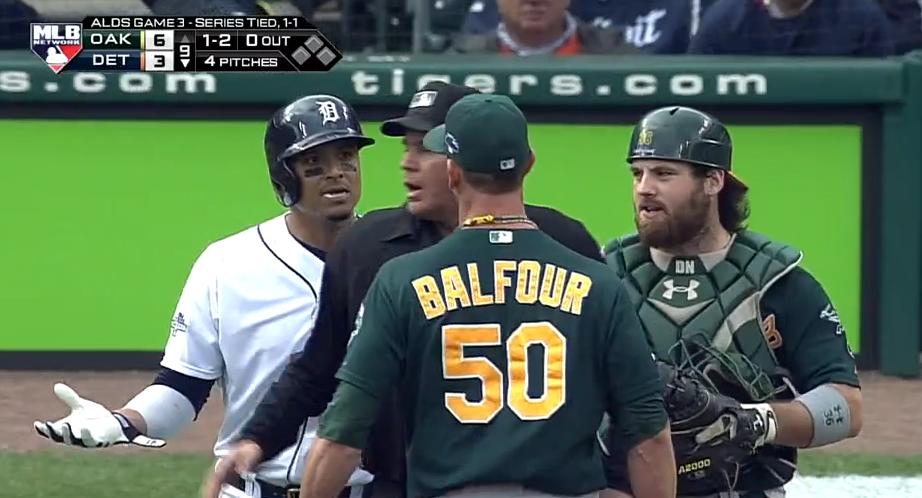




 The Baseball Codes