Retaliation, Rookie Etiquette, The Baseball Codes

On the Importance of Occasionally Embracing the Silence

Frenchy fights

This is what happens when catchers start talking to hitters about their retaliatory instincts.

The reason we don’t frequently hear about this situation is that most catchers, based upon some combination of smarts and seasoning, understand that such banter is rarely productive. The brainpower of Cubs catcher’s Willson Contreras is entirely speculative, but his lack of seasoning is beyond question—last night was only the 24-year-old’s 20th game as a big leaguer.

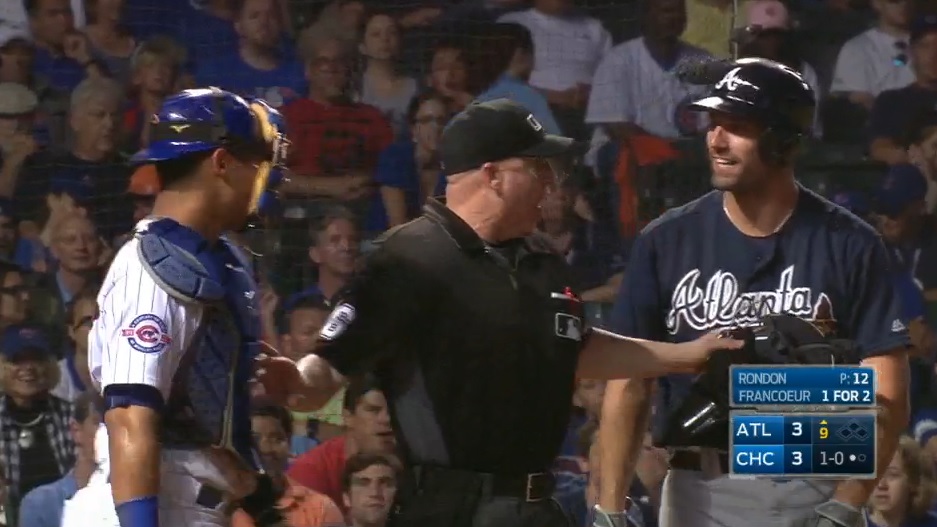
So when, in the eighth inning of Chicago’s game against Atlanta, Contreras followed an inside fastball from reliever Hector Rondon with a lecture to the hitter, Jeff Francoeur, things took a turn, and benches emptied. (Watch it here.)

Some backstory:

It was a long night for Cubs hitters, with Chicago’s Kris Bryant twice being plunked by Lucas Harrell, on a full-count fastball in the fourth, and on a 1-2 curveball in the eighth. The latter, which hit Bryant on the knee and led to his precautionary removal from the game, was Harrell’s final pitch of the night.

Chicago’s problem, if Chicago had a problem, was that right-hander Hunter Cervenka, in relief of Harrell, drilled the first batter he faced, Anthony Rizzo. Every one of the hit batters came with Atlanta trying to protect a 2-0 lead. Intent did not appear to play a part in any of them.

The actual issue wasn’t that Rondon responded with a message pitch to Francouer in the bottom half of the frame—a pitch that, for not coming close to connecting with the hitter should have been entirely unobjectionable—but that Contreras decided to harp about it.

Nobody discussed what was actually said with reporters—the incident’s principals declined to talk, and Cubs manager Joe Maddon said only that “Francouer took exception, which he should not have”—but it’s clear from the video that Contreras had some things to get off his chest before allowing Francouer to get back to hitting.

The entire point of message pitches, as I’ve been led to believe, is that they’re just that: pitches that bear meaning. Francouer was not upset at Rondon’s inside heater, nor should he have been. It was only when the catcher, young buck that he is, decided to lecture him about it that things grew heated. (It’s possible, but far from certain, that Francouer would have accepted a lecture from a more seasoned player.)

Had Contreras let the pitches do the talking—which is, again, their purpose—all would likely have ended calmly. Another lesson in what’s certain to be a season full of them for a young player.


Retaliation, The Baseball Codes

Cueto Goes Gunslinger: A Lesson on the Merits of Retaliation

Cueto-Franco

We’ve been thinking a lot about baseball retaliation this season—what it means in the modern landscape, and when (and if) it’s ever justified. We’ve thought about it so much, in fact, that one of our most noted bat-tossers had to clarify the idea of “a baseball play,” distinguishing between game action and sideline stupidity, and how a hard slide into a red-ass Rangers infielder should not lead to fisticuffs.

On the other end of the spectrum is Diamondbacks exec Tony La Russa, noting that retaliation is merited even in some cases of unintentional HBPs, should a pitcher with shaky command insist on working the inside edge—a tactic he decried as “intentionally careless.”

Which brings us to Johnny Cueto.

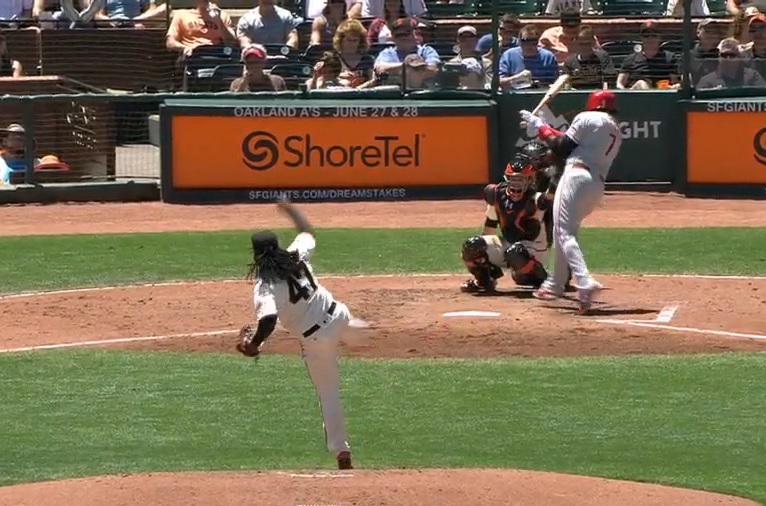
Yesterday in San Francisco, Phillies starter Aaron Nola was terrible, giving up 10 hits and five earned runs over 3 1/3 innings. Also, he hit three batters along the way. Nola is known for his outstanding control (indeed, he didn’t walk a batter against the Giants), but, given his awful June (he became the first Phillies pitcher since 1982 to go four straight starts with fewer than four innings pitched, during which he put up a 15.23 ERA), it’s difficult to mistake any of his mistakes as intentional.

His first and second HBPs, in the first and third innings, each loaded the bases. His third came one batter after his second, and drove in a run. Two of the three came on curveballs.

It mattered little to Cueto. Granted a 5-1 lead with two outs in the top of the fourth, the right-hander planted a fastball into the ribs of cleanup hitter Maikel Franco. Intent was obvious, and plate umpire Doug Eddings immediately warned both benches against further hijinks. (Watch it here.)

We can debate the merits of Cueto’s actions (while making note that the guy has some history with this kind of thing), but more pertinent to this conversation are the consequences.

Cueto, who had allowed one hit prior to drilling Franco, walked the next batter and then gave up back-to-back singles, scoring two runs. An inning later he gave up two singles, a double and a walk, leading to two more runs and a 5-5 score. In the sixth, the Giants having taken a 6-5 lead, Cueto gave up a leadoff homer to Odubel Herrera, costing himself a decision in what otherwise could have been his 12th win. It was his worst start of the season.

Did hitting Franco have anything to do with it?

After the game, Cueto denied intent, then blamed his downturn on Eddings having shrunk the strike zone. Giants manager Bruce Bochy was more clear-eyed, noting that Cueto looked rattled after the warning.

If there is an enduring lesson here, it is that any pitcher who decides to take up for his teammates in such a fashion—whether or not his teammates actually desire such a thing—must be able to withstand whatever repercussions come his way.

On Sunday, that was not Johnny Cueto, who by every reasonable interpretation should have known better.

Retaliation, The Baseball Codes

The Best Kind of Revenge

Panik mashes

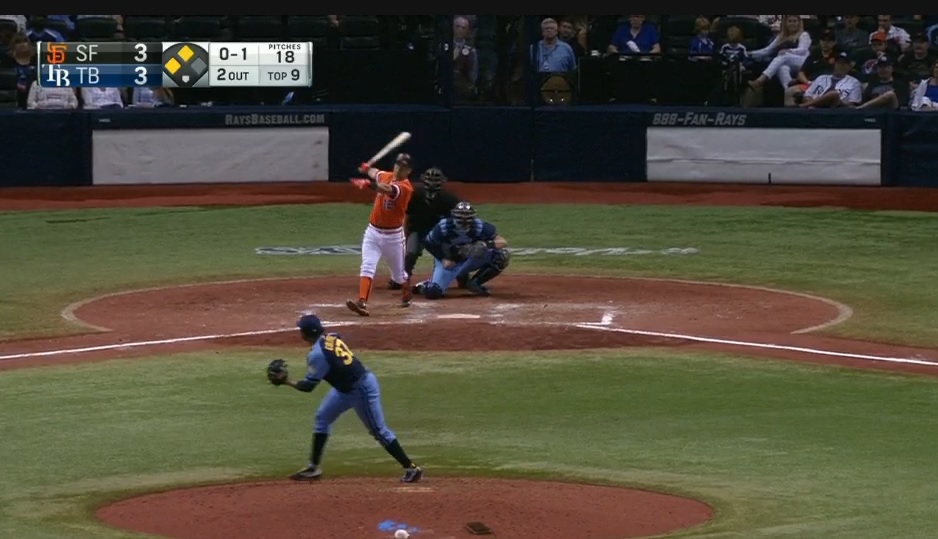
On Saturday, Rays starter Matt Moore put a 92 mph fastball directly into Joe Panik’s helmet. (Watch it here.)

It was, without question, unintentional. It came in the top of the fifth, there was nobody out, and Tampa Bay was clinging to a 3-1 lead. Also, the bases were loaded.

That is how Panik came to drive in San Francisco’s second run of the game.

The blow was severe—as is any head shot—but wasn’t enough to knock Panik from the game. It also wasn’t severe enough to merit a retaliatory fastball from any of the six Giants pitchers who followed. (That the DH was in play to protect Moore may have been a factor, but given San Francisco’s general reticence when it comes to that type of behavior, a payback HBP wouldn’t have been expected anyway.)

Panik authored his team’s response himself, hitting a tie-breaking homer in the ninth against Tampa Bay’s previously unhittable closer, Alex Colome, which won the game for the Giants. (Watch it here.)

Now that’s what retaliation is supposed to look like.


Retaliation, Yordano Ventura

Immovable Object Meets Unstoppable Force: Meatheaded Melee Brings Machado to Mound

Machado-Ventura

When Nolan Ryan was busy scaring the hell out of American League hitters, he made a habit of tamping down the grass in front of home plate before games with his cleat, taking care to stare down the opposing dugout all the while. His message: Don’t you dare bunt on me. Those who chose to ignore him knew all too well what kind of response they’d receive. Ryan’s red-ass reputation preceded him, and hitters were (usually) smart enough to avoid ticking the guy off.

Which is to say, the two guys at the center of yesterday’s Throwdown in B-Town bear some reputations of their own, and consideration of this point could have served both of them well.

Manny Machado has gotten into it with Jonathan Papelbon (spurring the closer’s infamous choke hold on Bryce Harper last year). He’s flipped out at being tagged. Hell, the guy went so far as to take a bat to the head of an opposing catcher.

Royals pitcher Yordano Ventura, meanwhile, has beefed with Adam Eaton. He’s beefed with Brett Lawrie. He’s beefed with Mike Trout. He spurred a beef with Jeff Samardzija. And that was all within a month of each other, last April.

Which is also to say that whereas Nolan Ryan’s opponents knew enough to avoid angering him, when two hotheads stare each other down, it’s all too likely that neither of them have the best interests of their respective teams in mind.

Yesterday’s fracas started in the second inning, when Ventura buzzed Machado inside (raising his hackles, of course) before getting him to fly out to left field on a ball that the hitter at first thought would leave the yard. Machado and his hackles ended up staring down the pitcher, then pimping what turned out to be a wind-killed medium-deep flyball, then screaming at Ventura (and vice versa) before returning to the dugout. (Watch it here.)

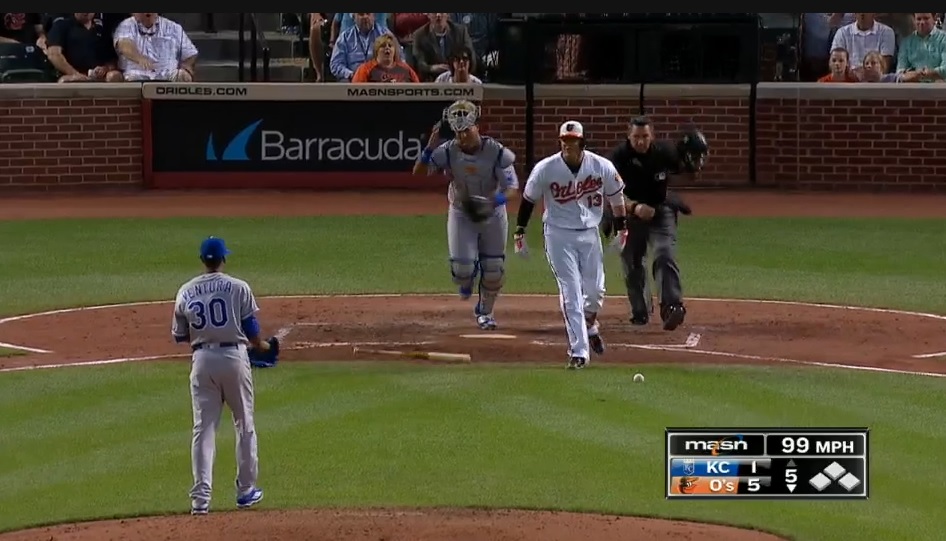
Back to reputations. Machado was clearly aware of Ventura’s, and knew what kind of response an unnecessary shouting match might deliver—if only because his manager, Buck Showalter, warned him of it before his fifth-inning at-bat. That’s the best explanation for his decision to charge the mound after the pitcher planted a 99-mph four-seamer into his backside. (Watch the whole thing here.)

Ventura, for his part, should have been more prescient. Know thine enemy and etc. when it comes to things like understanding what it’ll take to set a guy off.

That said, it’s likely that  Ventura knew precisely what he was doing. The right-hander had given up six earned runs in four-and-a-third innings to that point (which didn’t even include a would-be home run by Pedro Alvarez). His was a response borne of frustration and a likely desire to force his own damn exit.

The latter point can be illustrated by the bevy of quotes to emerge from the postgame clubhouses. On Baltimore’s side, Machado’s compatriots were all too eager to back him up. A sampling, via the Baltimore Sun:

  • O’s outfielder Adam Jones: “Manny ain’t at fault for nothing.”
  • Jones, on Ventura: “The talent is all there, but between the ears, there’s a circuit board that’s off balance. I don’t get it.”
  • Showalter: “[It’s] not the first time. Obviously, it must be something that’s OK because [Ventura] continues to do it. It must be condoned. I don’t know.”
  • Showalter again, on the possibility of continuation into today’s game: “Bring it on. Whatever. Bring it on. We’ll handle it. You try not to let one person’s actions speak for a lot of people, but it’s been going on a while with him.”
  • Mark Trumbo: “It’s important for everyone that’s at this level and in the game, period, to go about your business the right way. This isn’t the type of stuff that’s good for the game.”

The Royals were more reticent. Manager Ned Yost was representative when he offered a “Probably” when asked if Ventura’s wild-card nature was grating on his teammates, adding in a Kansas City Star report that “there’s a little frustration when things like this happen, yeah.”

When given the opportunity to defend his pitcher, he said, “I don’t know, that’s something you’re going to have to ask him.” Hardly a ringing endorsement.

“You see the reaction by [Ventura’s teammates],” said Jones, speaking on behalf of the opposition. “They weren’t too happy that he did something so stupid.”

Traditionally, this is the point at which Yost or any number of Ventura’s veteran teammates pulls him aside to talk about how reckless behavior on the mound impacts everybody, and that if somebody was injured trying to break up the fight, or if a Royal is drilled by a retaliatory pitch tonight, it’ll rest on Ventura’s shoulders. That would make sense, except for the fact that those conversations should have happened more than a year ago (and likely did), during the pitcher’s previous spate of madness.

At that point, the guy seemed to have learned his lesson:

Guess it didn’t take.

Ultimately, Baltimore exacted the purest kind of revenge, with the O’s next two hitters following the fracas, Mark Trumbo and Chris Davis, going back-to-back against reliever Chien-Ming Wang, to extend their lead to 8-1.

Here’s hoping that’ll suffice today and preclude any further response from Baltimore, unlikely as that may be.

Update (6/9/16): Machado’s been dinged for his actions: four games and $2,500.

Update II (6/9/16): And now Ventura: nine games, which will effectively cost him one or two starts.


Retaliation, The Baseball Codes, Umpires Knowing the Code

Syndergaard Handles His Business, Gets Manhandled by Ump in Response

Syndergaard tossed

And we’re back to discussions about timing.

Two weeks ago, talk concerned the Rangers’ extended wait to retaliate against Jose Bautista. Saturday, it was Mets starter Noah Syndergaard.

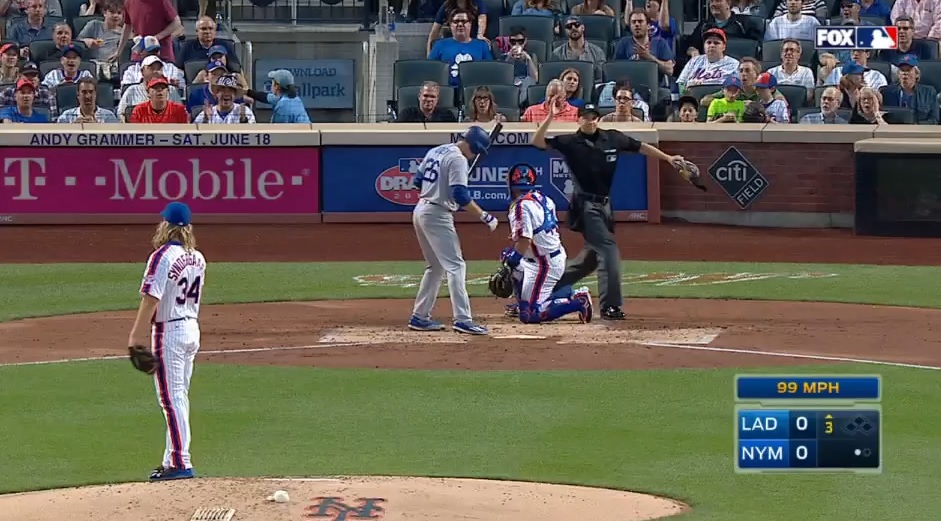
Much of the conversation had to do with whether Syndergaard deserved to be ejected for throwing a pitch behind Chase Utley. The pitch, a fastball,  flew so wide that Utley didn’t even flinch to try to avoid it. It was almost certainly a response to Utley’s devastating takeout of Ruben Tejada during last season’s playoffs. Also, it was entirely harmless, though plate ump Adam Hamari—who had clearly been prepped on preceding events—failed to see it that way.

Other parts of the conversation had to do with Utley’s handling of things. After finishing the at-bat against reliever Logan Verrett by striking out, he offered the best response possible—he homered twice, including a grand slam, in what became a 9-1 victory at Citi Field.

Which brings us back to timing. Saturday was the fifth meeting between the teams this year, and the eighth overall (counting the postseason) since Utley broke Tejada’s leg. This leaves us with an overarching question: why now?

Utley was omitted from the lineup for Game 3 of the NLDS, the one following the mishap, and New York pitchers opted against taking their frustrations out on other Dodgers. He pinch-hit in the deciding Game 5, but that was a one-run playoff game, which trumped any thoughts of retaliation.

This year’s meetings looked like this:

  • May 9: Utley gets two at-bats, both with the Mets trying to protect a 4-2 lead.
  • May 10: Every one of Utley’s four at-bats comes with the game tied.
  • May 11: Utley comes up four times, with the game tied or New York leading by no more than two runs.
  • May 12: Utley bats in the first inning with the game tied; in the second inning with the Dodgers leading, 4-0 (and hits a solo homer); and in the fifth and seventh innings with the Dodgers leading 5-0.
  • May 27: All of Utley’s at-bats come with the Mets holding no more than a three-run lead, until the eighth, when he hits in a 5-1 game (and strikes out).
  • May 28: Syndergaard drills him.

So what happened? If the Mets were inclined to retaliate, the obvious situations would have been on May 12 and one at-bat on May 27. There’s little chance that Terry Collins would order such a thing from on high (he’s already gone on the record against perpetuation of grudge matches), so deductive reasoning says that the pitchers Utley faced—Bartolo Colon and Sean Gilmartin in the former game, Jerry Blevins in the latter—simply had no stomach for this type of confrontation.

Deductive reasoning also says that Syndergaard probably did.

Still, there’s no getting around the duration between Utley’s perceived offense and Syndergaard’s response. The pitcher himself probably acknowledged as much with his weapon of choice—a non-contact fastball so far off its mark that Utley would have had a tough time throwing himself into it to earn an HBP.

In other words: perfect. Message sent, no harm done.

Except that Hamari refused to play along. Usually, we’re stuck with clueless umpires whose lack of boning up on prior history between teams leads to some tense moments. This was the opposite of that. Had Hamari taken even a moment to consider the events as they happened, he would have leveled a warning and both sides would have likely considered things even.

Chalk this one up as a win for the Dodgers, both literally and figuratively.

Retaliation, The Baseball Codes, Tony La Russa

PR Man Tony La Russa Would Like to Sell You on the Merits of Retaliation

La Russa watches

Tony La Russa is one of the most vengeful men baseball has ever known. An entire book, Buzz Bissinger’s “3 Nights in August,” went into great detail about his deliberative process as manager of the Cardinals when it came to figuring out which opponent to have drilled, and when.

On Tuesday, La Russa took a different avenue for retaliation.

It started when Pirates reliever Arquimedes Caminero popped two members of the Diamondbacks in the head—Jean Segura with a 96 mph fastball off the helmet, and Nick Ahmed with an 89 mph splitter off the chin. Both were almost certainly unintentional, and neither player was seriously injured. (In between, Arizona reliever Evan Mashall drilled Pittsburgh’s David Freese on the arm, leading to warnings for both benches, and Caminero’s ejection after hitting Ahmed. Watch it all here.)

In the Pirates broadcast booth, play-by-play man Greg Brown openly discussed La Russa’s history of retaliation, which was already more on the record than any manager in history. La Russa—now Arizona’s chief baseball officer—heard it, and invaded Pittsburgh’s booth to take direct issue. Brown directed the argument away from the microphones so that it would not be broadcast, and then opted against mention it on the air out of respect for La Russa. (Watch Brown discuss the incident here.)

La Russa blew that whole plan out of the water, however, by discussing the incident himself, with AZCentral. His goal was to explain why the Pirates were at fault, any lack of intent on their HBP’s be damned:

“A lot of guys who are pitching in don’t have the ability at this point to command it and it becomes very dangerous,” La Russa said in the article. “The reasoning you get from the other side is they didn’t mean to do it intentionally. If you don’t have command, then that’s intentionally careless.”

He was referring to Pittsburgh’s team philosophy, which has pitchers constantly working the inside edge, and has led the Pirates to leading baseball in hit batters from 2013 to 2015. Diamondbacks broadcasters repeatedly intoned a similar message during the game, decrying what they described as an institutionally reckless approach.

On Wednesday, Diamondbacks manager Chip Hale got right to the organizational talking points, echoing La Russa by telling reporters that Caminero was less at fault for the hit batters than Pittsburgh management.

“I don’t think the kid meant to do it,” he said. “When you put a guy out there that doesn’t have control in that area and you’re trying to pitch in, it’s not something that we can have here. The guy doesn’t have the ability to pitch in certain quadrants of the zone, we don’t do it. It’s almost the fault more of the coaching and the managing than it is the player at that point.”

The D’Backs have some history upon which to build their argument. In 2014, Pittsburgh closer Ernesto Frieri unintentionally broke Paul Goldschmidt’s hand with a pitch. (Arizona responded by drilling Andrew McCutchen in the back.) A year earlier, Pirates starter James McDonald hit Aaron Hill, breaking his hand.

La Russa’s response seems to be a new front in his retaliatory battle. A vengeance fastball to the ribcage might send a message to the opposing clubhouse, but a full-fronted PR battle against an opponent’s organizational philosophy? That’s a new one.

In case anybody doubts La Russa’s intentions, he went on the air with Arizona Sports 98.7 FM on Wednesday morning and discussed the situation further.

“So people are just telling them hey, you can’t just willy nilly throw the ball inside,” he said, via the station’s website. “It’s a real easy formula we’ve used for years: you can’t use us as targets, even if it’s unintentional. If you can’t command the ball inside, don’t throw it up and in — you’ve got to get the ball down. It’s really not that tough, it’s one that we try to enforce, and it’s one I think MLB could be more proactive in enforcing.”

Also, this: “They’ll just keep doing it to you, (and) pretty soon the guy the guy [who keeps getting hit] will not want to go to bat, and how do you win? So you’ve got to use common sense. It’s a competition and guys are going to anything they can to take something away from you.”

Adding that teammates are like family, La Russa said that if somebody slaps one of your family members, “you just slap back.”

Maybe La Russa’s canny, maybe he’s crazy. Maybe he’s both. The sport he loves is changing beneath his feet, moving away from the hard edges of intimidation and retribution, and toward the let’s-make-baseball-fun-again generation of bat flips and promo ops. Whether La Russa is willing to acknowledge these things is almost beside the point. Everything he’s said in recent days is based on inherent truths of competitive sports, regardless of whether the people hearing it agree with him.

The trick now is figuring out how to implement it all within the modern landscape. When it comes to guys like La Russa—at the top of his organizational food chain, who can do pretty much whatever the hell he wants—the question matters less on a day-to-day basis than in big-picture form. That’s why the messages he’s sending seem more a matter of selling the public on his approach. Yep, La Russa and his crew are waging a PR campaign on behalf of a team’s right to drill its opponents.

“Intimidation is an important part of sports,” he said on the radio. “People will try to intimidate you, if you back off you’re easier to beat. The game has a way of handling itself.”

Now we’re left to see how the rest of baseball responds.
Don't Play Aggressively with a Big Lead, Retaliation, The Baseball Codes

Replay Revenge Rocks Runaway Rally Against Redbirds


Maddon

Yesterday, Hardball Talk pointed out something brewing in a next-level unwritten rules controversy: management of the challenge system.

On Tuesday, in the ninth inning of a game in which the Cubs were leading the Cardinals, 8-1, St. Louis manager Mike Matheny ordered his infield to play in—a decidedly unusual move so late in a blowout. Typically, such tactics—things like having first basemen hold runners close—are eschewed when the final result is no longer in question. Pitchers even stop nibbling around the corners, the better to force action and end things quickly.

So why would he do it? ESPN’s Jesse Rogers may have an answer.

During the play in question, Addision Russell—the third batter of the ninth inning—was called out at first after grounding to St. Louis second baseman Kolten Wong. It would have been the inning’s second out.

Instead, Maddon challenged, and Russell was ruled safe. The Cubs went on to score four times, ultimately winning, 12-3. By all appearances, Matheny saw the move as disrespectful. The Code during runaway games is largely aimed at avoiding unnecessary embarrassment for an opponent that’s already been embarrassed enough, the equivalent of a college football team pulling its starters while holding a 35-point lead in the fourth quarter.

Maddon explained his replay process thusly, via MLB.com:

“That validates running hard to first base. Two things could happen there: Maybe [Russell] could hit .300 because of that play, but more than anything, if our minor league players are watching, they see the validation of running hard to first base all the time.”

Both things are true. But a baserunner saying that the bag he swiped late in a May blowout might be the one that allowed him to reach 50 is spurious logic. This isn’t much different.

The Code during a blowout also stipulates the cessation of aggressive tactics, which means station-to-station running: advance only one base on a single, two on a double, etc. Wanting to reward his player for a hit justly earned wasn’t aggressive on Maddon’s part, but the Cubs actions with the very next batter—Javier Baez scored Chicago’s ninth run from second base on a single by Tim Federowicz—were.

Remember, Maddon’s Cubs and the Cards already have some history.

Ultimately, this seems like an issue that should be more or less immune to the unwritten rules. If a guy earns a hit, a guy earns a hit, and his manager looking out for him in that regard is the least he can do. Had Maddon chosen to challenge a play on the basepaths, it’d be a different story. For the time being, however, watching the Cubs and Cards snipe at each other is its own special reward.


Bench Jockeying, Retaliation, The Baseball Codes

Staredown in the Twin Cities Reminds Us What Sensitive Creatures We’ve All Become

Donaldson stares

Blue Jays MVP Josh Donaldson—after getting targeted by pitches twice against the Twins over the weekend—garnered attention yesterday by decrying baseball’s unwritten rules as a matter of personal safety.

The direct quote, via SportsNet.ca:

“Major League Baseball has to do something about this. They say they’re trying to protect players. They make a rule that says you can’t slide hard into second base. They make a rule to protect the catchers on slides into home. But when you throw a ball at somebody, nothing’s done about it. My manager comes out to ask what’s going on and he gets ejected for it. That’s what happens. I just don’t get the point. I don’t get what baseball’s trying to prove. If I’m a young kid watching these games, why would I want to play baseball? Why? If I do something well or if somebody doesn’t like something that I do, it’s, ‘Oh, well, I’m gonna throw at you now.’ It doesn’t make sense. It just doesn’t make sense to me.”

Donaldson’s issues started with the third pitch of Saturday’s game—a called strike with which he disagreed. When he grounded to short on the very next pitch, Donaldson slowed down before reaching first base, according to the Toronto Sun, at which point Twins bench coach Joe Vavra yelled “nice hustle.”

When Donaldson returned verbal fire, plate umpire Toby Basner, thinking the comment had been directed at him, ejected the third baseman.

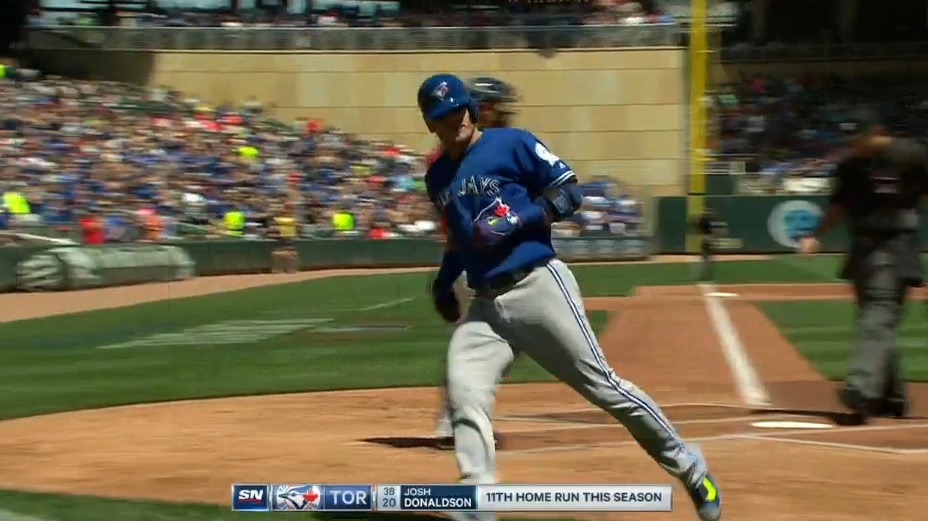
In the first inning of Sunday’s game, Donaldson hit a mammoth home run to straightaway center field. Instead of immediately returning to his own dugout, however, he took a couple steps toward the Twins bench on the first base side of the field, staring daggers all the while. (Watch it here.) His explanation: “I looked right at the guy who chirped me yesterday and got me thrown out, I was letting him know I was coming to play today. Don’t comment on the way I play. It’s not your business how I play. I’m not on your team. If someone has a problem with the way I play, my manager or teammates will say something to me, not the other team.”

In the sixth inning, Minnesota’s Phil Hughes responded by throwing one pitch that just missed Donaldson’s hip, and another behind his back. The intent was obvious. Jays manager John Gibbons, after vigorously arguing for Hughes’ ejection, was instead ejected himself.

At the core of his argument, Donaldson has a legitimate beef. In the modern landscape, non-baseball activities—like, say, a few moments’ worth of dugout stare-down—virtually never merit physical retribution.

What Donaldson received, however, was decidedly not physical retribution. No pitch hit him, and, given that Donaldson himself used Hughes’ excellent control to support his claims of intent, things seemed to play out the way Hughes wanted them to.

There are a couple of takeaways here. One is that the incident that so upset Donaldson—Vavra riding him from the bench—illustrates just how thin ballplayers’ skin has grown over recent generations. Bench jockeying was once an art form, with insults hurled as much to distract the target as anything else.

In the 1922 World Series, Giants manager John McGraw’s dugout-borne insults distracted Babe Ruth into a 2-for-17 slide—his worst Fall Classic ever. Hell, even Ruth’s called shot in the 1932 World Series was apparently a gesture meant to silence the bench jockeys in Chicago’s dugout, not to predict the homer he was about to hit.

Leo Durocher once rode opposing pitcher Claude Passeau so hard that upon being removed from the game, instead of handing the ball over to his manager, the pitcher fired it at Durocher, in the Brooklyn dugout.

No less a name than Mickey Mantle was so hounded by the Washington Senators that he failed to run out what became a double-play grounder, distracted to the point that he thought the lead out was the third of the inning.

Those, of course, are long-ago examples. Serious bench jockeying died out in the 1960s and ’70s. Still, “nice hustle” seems timid enough to ignore. Donaldson labeled it as the Twins “picking a fight from the bench,” but in reality, his decision to return fire—and subsequently getting tossed for it—is entirely on him. That’s precisely the result a good bench jockey is looking for.

The other part of the equation involves the pitches themselves.

“They’re putting my job in jeopardy,” Donaldson groused, invoking the gruesome face shot taken by Giancarlo Stanton in 2014. “What if he hits me in the neck right there? What if he hits me in the eye?”

Had Hughes hit him in the neck or the eye, Donaldson’s point would be unassailable. Even had Hughes drilled him in the time-tested fashion of planting one into his hip or thigh, or had he missed above the shoulders, Donaldson would have a legitimate gripe.

But a message pitch—even two of them—that fails to connect is not worth this level of vitriol. You mess with us, Hughes told Donaldson and the Toronto bench alike, and we’ll mess right back. It was a non-contact exchange of ideas, and that’s the sort of thing that helps keep baseball lively.


Basepath Retaliation, Jose Bautista, Retaliation, The Baseball Codes

Does Anybody Even Know What Baseball’s Unwritten Rules Are, Anymore?

We’ll get to questions about propriety and merit and the very nature of baseball’s unwritten rules in good time.

First, though, why’d the Rangers wait so long to do it?

Before the season started, the enduring questions regarding the rivalry between Texas and the Blue Jays had to do with the Rangers’ response to Jose Bautista’s world-beating bat flip during the teams’ ALDS showdown last October, and whether retaliation was imminent.

Matters seemed to be settled after the teams went an entire series at Toronto’s Rogers Centre in early May without so much as a peep. In the series finale, Bautista came to bat—twice—with his team leading 11-1. Let sit for a moment whether retaliation was even merited; if ever there was a place to enact it, it was right there, with no concern about an extra baserunner affecting the game’s outcome.

Bautista emerged unscathed. That should have closed the book on the incident. Should have, but didn’t.

On Sunday, Rangers reliever Matt Bush—making only his second big league appearance after a decade-long career nosedive—may have been trying to earn credibility points with his new teammates when he planted a fastball into Bautista’s ribcage.

It makes little sense why that pitch would bear any degree of intent. Texas had its chances back in Toronto. Bush was not with the Rangers at the time of Bautista’s perceived slight. The score was 7-6, and Bautista, leading off the top of the eighth, represented the tying run. And yet.

It was the final meeting of the season between the teams, and likely Bautista’s final at-bat of the game. Drilling him then left virtually no chance for recourse. “To me, it was gutless,” said Jays manager John Gibbons afterward, in an ESPN report. “The other 29 teams, they come at you right away, but to wait until the end, it just sort of tells you something.”

At that point, Bautista’s primary tool was the one he ended up using: a message-laden slide.

Forced to run by Justin Smoak’s grounder, Bautista launched himself late, at the legs of second baseman Rougned Odor. It was textbook, Bautista landing on the base instead of in front of it, undercutting Odor’s feet. According to the Code, it was clean—spikes down and centered. A million guys have made a million similar retaliatory slides over the years, the vast majority of which have been accepted by the opposition as nothing more than the price of doing business.

We are, however, in a new era, even beyond the rise of the Let’s Make Baseball Fun Again generation. It is a time of basepath sanity, where fielders’ safety is the subject of rulebook legislation. Bautista’s slide had nothing to do with fielders’ safety.

It probably didn’t matter either way to Odor, who would likely have come up swinging, regardless.

The rest of the story involves details, mostly:

  • Bautista absorbed a solid right hook from Odor, definitely in the 99th percentile of effective baseball punches, but still managed to keep his feet.
  • It turns out that Odor is quietly (or not so quietly) one of the premiere red-asses in the game.
  • Ejections for Bautista, Odor, Josh Donaldson, and Rangers coach Steve Bueschele.
  • Bush was allowed to remain in the game, but when asked afterward about the pitch in question, offered a telling no-comment.
  • Toronto exacted retaliation of its own in the bottom half of the inning with the time-tested tactic of drilling Bautista’s counterpart on the Rangers, Prince Fielder. Again the benches emptied, though no punches were thrown.
  • Subsequent ejections for Toronto pitcher Jesse Chavez and coach DeMarlo Hale.

In the aftermath of it all, we’re left with numerous questions. Most pertinent to this space has to do with the unwritten rules themselves. Although Bautista’s slide fell well within the boundaries of traditional Code tactics, it’s difficult to tell anymore whether traditional Code tactics—especially as they pertain to takeout slides—are even viable. Before, it was primarily middle infielders who didn’t appreciate them. Now, the league office has officially taken steps to legislate them out of the game. This likely means that baserunners are going to have to find new methods of conveying their grievances … or, more pragmatically, will have to learn to get over their grievances more quietly.

There’s also a bit of hypocrisy at hand. In the game’s aftermath, Bautista unloaded with both barrels at Rangers management, saying in the Toronto Star that “It shows a little bit of the apparent lack of leadership that they have over there when it comes to playing baseball the right way.”

Only last October, Bautista himself sparked a play-the-right-way controversy, only then he was on the other side of the debate, baseball traditionalists decrying his bat flip and its ensuing acclaim. To play both sides like that—to demand propriety only when it suits you—seems disingenuous.

There is, however, more to it. “Baseball plays are supposed to be taken care of by baseball plays,” Bautista also said yesterday. And he’s correct. A bat flip is not a baseball play. Drilling a batter is. So is taking out a fielder. The latest version of the Code mandates that non-baseball plays are largely exempt from retaliation. This is not what happened on Sunday.

Perhaps we’re facing another sea change with all of this, which is something we won’t know until we see players’ responses to coming contentions. Water has a way of finding its level.

Ultimately, amid the philosophical hand-wringing, we’re left with one primary concrete question: Why’d the Rangers wait so long to do it?

Update (5/17): Odor’s been clipped for eight games and outed as a hypocrite.

The Baseball Codes

Feeling Bad When You Do Bad Things is a Sign of a Healthy Disposition

Wright concern

How can a hitter be certain that a pitch that just hit him wasn’t intentional? The pitcher’s reaction can play a reasonable role.

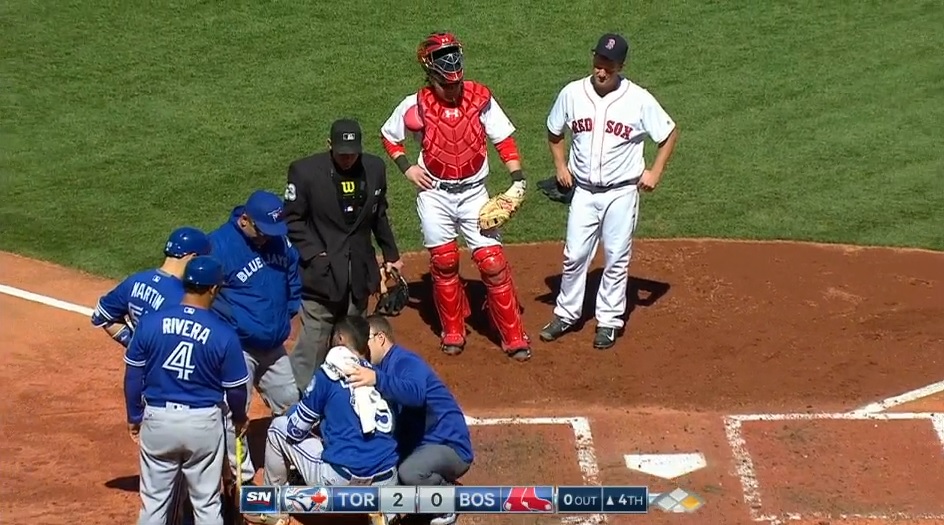
When Boston starter Steven Wright bounced an 87 mph floater off the side of Blue Jays first baseman Chris Colabello’s helmet on Sunday, he did nothing to hide his horror, immediately wincing, removing his cap and going into a shame-crouch on the side of the mound. He approached the plate, visibly distressed, as trainers tended to Colabello, and offered words of remorse to the hitter as he made his way to first base. (Watch it here.)

That was enough. Hell, it was more than many pitchers do—even pitchers who feel badly about similar situations. But Wright didn’t stop there.

When Colabello arrived at Fenway Park’s visitors clubhouse the following morning, he found a “large bottle of liquor” from Wright, per the Boston Globe.

“He didn’t have to,” Colabello said. “I’m sure that’s not cheap, too.”

It was a decent thing to do, however,  and when it comes to poorly placed fastballs (and potential associated retaliation), decency can go a long way.