Retaliation

Red Sox vs. Rays, Because of Course Red Sox vs. Rays

Papi pops

Would David Price have had such a long memory had it been anybody but the Red Sox? We’ll never know unless he tells us, of course, but the answer is, of course not.

In last year’s ALCS, Ortiz hit two long homers off of Price (who gave up seven runs in a Game 2 loss), watching the second for a beat longer than the pitcher would have liked. Afterward, Price complained to the Boston Globe about the possibility that Ortiz was just watching to see if the ball went fair. “I saw it and I knew it was fair,” he said. “Run.”

He faced Ortiz for the first time since then on Friday, and wasted little time making a statement, planting a first-pitch fastball into the slugger’s back. It was enough for plate ump Dan Bellino to issue a warning, but not—contentiously—for Price to be ejected. Umpires are known to delay warnings until the other team has a chance to respond (especially under questionable circumstances such as these), but in a series as combative as this one—which saw benches empty less than a week earlier—Bellino was taking no chances.

Neither was John Farrell, who argued his position to the point of ejection.

Already upset by unrequited aggrievence, the Red Sox grew further agitated when Price hit Mike Carp in the right forearm three innings later. That this one appeared to be less intentional did little to slow the rampage; benches emptied, with Ortiz animatedly pointing toward Price, who for the second time in the game managed to avoid ejection. (Watch it here.)

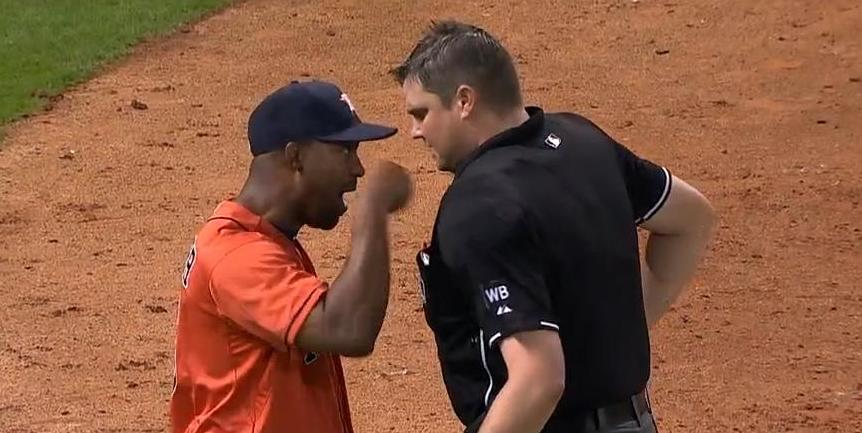
Not so for backup Red Sox manager Torey Lovullo, who began his conversation with the umpires by spiking his cap, and ended it by trudging off to the showers. Boston’s third manager of the evening, Brian Butterfield, was tossed in the sixth, along with Brandon Workman, when the Red Sox starter threw a pitch behind Evan Longoria.

(Why wait until then? Well, Longoria is Tampa’s biggest gun, and Workman was not long for the game, anyway—the pitch to Longoria was his 89th, the most he’s thrown since last August. As if there would be any other way.)

After the game, Ortiz pulled no punches.  “That’s means it’s a war. It’s on,” he said in a Tampa Bay Times report. “This guy that hit me better bring the gloves on. I have no respect for him no more.”

Fueling his rage was the fact that the Red Sox absorbed four ejections while hitting nobody with a pitch, while Tampa Bay emerged unscathed, despite hitting two.

At least one player in the Rays clubhouse, however, wishes things were handled differently.

“I wish he would have hit me so it could have been done and over right there,” Longoria said. I just don’t want to get hit in the head, just make sure it’s down below the neck. Hopefully we’re beyond it.”

If the Red Sox are playing by the unwritten rules, it should be over. Butterfield had his shot, and he missed (with the possibility that he threw it intentionally wide with the score 2-1, to avoid unnecessary baserunners).

At this point, however, in the self-sustaining biodome of animosity that is Boston-Tampa Bay, all reactions seem to be on the table. These teams have disliked each other so intensely, for so long, that every slight is magnified and the need for response set in stone. While the rest of baseball seems more content than ever to not sweat the small stuff when it comes to the Code, that’s all these two clubs seem to do.

Update (5-31): Ortiz: Price is “a little girl.” Price: “This is not a war.

Retaliation, Unwritten-Rules

A’s Push Back on Porter, Houston Pilot Pops


Porter tossed

Leave it to Bo Porter to show us how closely the Code can be  linked both to perspective and perception.

On Thursday, his pitcher, Paul Clemens, was ejected for drilling Oakland’s Jed Lowrie. The following night, he grew upset when A’s pitcher Fernando Abad received only a warning for hitting Houston’s Jason Castro. Both pitches were likely intentional. When Porter argued that point, he was tossed. (Watch it here.)

Those details, in a vacuum, place Porter pretty squarely in the role of aggrieved victim. Mix in a few pertinent facts, however, and it’s remarkable how much things change.

Lowrie was drilled because … well, it’s still not clear. Porter was obviously angry that the A’s shortstop bunted against the shift in the first inning of a game on April 18. Why he was angry is a point of some contention, which the manager has yet to explain with any sort of clarity. Still, he responded by apparently having Clemens throw at Lowry later in the game, and then had him drilled (again apparently, and again with Clemens on the mound) when the teams met again six days later. Plate ump Toby Basner knew the history, and tossed the pitcher for his actions.

On Friday, Oakland’s Brandon Moss bookended the ninth—another huge inning against the Astros in a season full of them—by getting hit twice. Neither appeared intentional: The first, from right-hander Josh Fields, barely grazed him. The second was a sailing cutter that had Anthony Bass, Houston’s sixth pitcher of the night, staring skyward in frustration after it found its mark.

No matter—after a time, enough is enough. It’s been said all week that Porter’s reckless behavior surrounding the Lowrie incident would eventually make targets out of his players, and on Friday it happened. Innocent as things may have been surrounding Moss, the tipping point had been reached. Castro was drilled, and Porter was irate.

Houston’s skipper has displayed no talent for instrospection to this point in the proceedings, but if he honestly assesses his role in this string of events, and wonders if he could have changed the outcome along the way with an even slightly cooler head, answers would be pretty easy to find.

Of course, chances are that—based on his exiting body of work, anyway—none of those answers would make him happy.

Porter’s go-to phrase through this entire affair has been “Baseball takes care of itself,” and in that, anyway, he is correct. On Friday, Oakland rolled a course correction into action. Here’s hoping that Porter views it with some clarity.

Retaliation

Spring Drill Exchange in Arizona Sets Tone for D-Backs

Wade Miley
Mr. Miley

There are benefits to blanket warnings that your team will no longer tolerate opposing pitchers throwing at your players. Say it enough, and back it up once or twice, and maybe people will believe it to be true.

Of course, should your pitcher, under said blanket, hit somebody unintentionally, cries of innocence tend to fall on deaf ears.

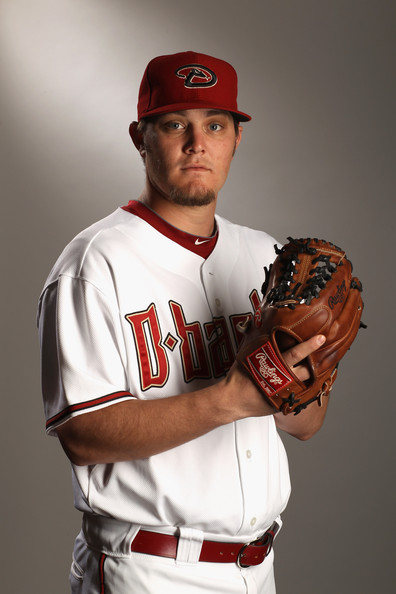
This is part of what made last week’s HBP exchange between the Diamondbacks and Rockies so confusing. Perhaps Arizona pitchers are training up their tough-guy attitude, which would help explain Wade Miley putting a fastball into Troy Tulowitzki’s calf on Wednesday.

It sure seemed like retaliation, coming as it did after  Rockies farmhand Tommy Kahnle hit Arizona’s Mark Trumbo in the back—which itself came after Diamondbacks GM. Kevin Towers said on his local radio show last October that “Come spring training, it will be duly noted that it’s going to be an eye for an eye,” and that pitchers who don’t agree “probably don’t belong in a Diamondbacks uniform.”

Unless there’s some unknown beef between Kahnle—whose lack of control has contributed to his never having pitched above the Double-A level—and Trumbo, the initial volley was almost certainly a case of a misplaced pitch. Was Miley out to prove that his team won’t tolerate wildness from farmhands?

But Towers’ statement—along with the facts that Miley has excellent control and Tulowitzki is an obvious retaliatory target—eliminates the perception that the drilling was a mistake. Even if the drilling was a mistake.

It was almost certainly a mistake when, later in the game, Arizona pitcher Jimmie Sherfy—a 22-year-old whose career consists of 17 1/3 innings at or below A-ball—hit Colorado’s Michael McKenry. Again, however, thanks to Towers’ decree, it didn’t matter. The Rockies responded in kind, right-hander Raul Hernandez throwing a pitch behind Jesus Montero in the eighth, at which point plate ump Doug Eddings finally saw fit to warn both dugouts.

It barely matters that Towers followed up his initial statement to clarify that he wasn’t in support of hitting guys on purpose, but rather if “our hitters are being made uncomfortable at the plate, we need to be the same way.” He added that his point was “about pitching inside effectively with purpose.”

Yeah, but still. Damage done.

Spring training is a great place to settle old scores—atone for injustices of the past when the games don’t count and tee times await those who get thumbed from ballgames early. Turning it into a proving ground for new scores, however, is reckless. Tulowitzki left that game and had not returned to the lineup as of the end of last week.

If Miley was throwing at Tulo, he was out of line. If the pitch legitimately got away from him, he can thank his GM for causing the rest of us to doubt that to be true.

(H/T to Troy Renck, who shares his own terrific insight at the Denver Post.)

Oakland A's, Retaliation

1971: On the Invention of the Dugout Brushback

Chuck Dobson Research for my next book, about the Oakland A’s dynasty of the 1970s, to be published by Houghton Mifflin in 2015, has turned up boundless examples of unwritten rules from that bygone era. Turns out that hot-headed pitchers of the time weren’t limited to the pantheon of Bob Gibson and Don Drysdale. From the Oakland Tribune, June 25, 1971:

It was just another rainout until Oakland’s Chuck Dobson threw a brushback pitch at Minnesota manager Bill Rigney.

Rigney was standing in the Twins’ dugout at the time.

“He didn’t roll it in there,” Minnesota coach Vern Morgan said afterward. “What is he, crazy?

Dobson was angry for historical reasons, and because Rigney made him change his pants. Dobson ripped his trousers sliding into a tag at home plate for the last out in the top of the third yesterday.

With the game still scoreless, Dobson went out to the mound to pitch the bottom of the inning, his right trouser leg taped together and mud rubbed on the tape to cover the whiteness.

Rigney yelled a protest at plate umpire Nestor Chylak and Dobson had to go inside and change. By the time he returned to the field, it was raining again—there had been a 39-minute delay in the firs tinning—and the game eventually was called without another pitch thrown.

Dobson took two steps off the mound, turned, and either lobbed or fired the ball into the Twins’ dugout, depending on who told the story. In any case, the ball bounced into the dugout.

“I wanted him to have the game ball,” Dobson said. “I don’t have much patience with him. He called us a bunch of garbage collectors the last year he managed the Angels (1969), and this year he said his team could beat us any time they wanted to. I probably shouldn’t have done it, but he called us too many bad names to just lay down and take it.”

“I didn’t see it,” Rigney said. “I was just turning around to sit down. I guess it almost hit (pitching coach Marv) Grissom. I heard it. It hit the wall. It sounded kind of like ‘splat.’ ”

Grissom charged out of the dugout and wagged a warning finger at the departing Dobson.

“He just fired it in there,” Grissom said. “That’s bush league. That should be an automatic ejection.”

 Dobson faced Minnesota once more during Rigney’s tenure—the following week, in Oakland—and was not hit by a pitch.

Retaliation

1976: Reggie Unhappy with Baltimore Protection

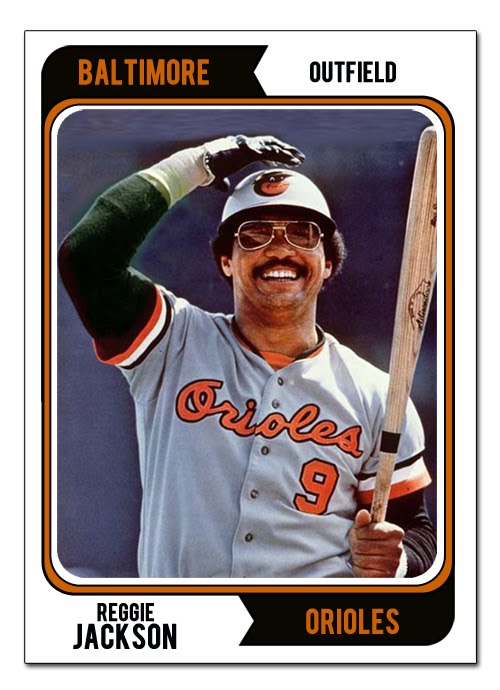
Reggie O'sResearch for my next book, about the OaklandA’s dynasty of the 1970s, to be published by Houghton Mifflin in 2015, has turned up boundless examples of unwritten rules from that bygone era. The latest concerns Reggie Jackson, freshly traded to the Baltimore Orioles in 1976, who was unappreciative of the fact that his teammates were getting knocked down, seemingly free of repercussion.

There’s little to tout  about a you-hit-my-guy-so-I’ll-hit-your-guy mentality, but the reality—more prevalent in 1976 than in the modern game—is that if pitchers are given the leeway to command the inner part of the plate without constraint, they frequently will. That command coming at the cost of a few hit batters is a built-in cost … until an opponent entices them to knock it off. Which was Jackson’s point. 

From the Associated Press, June 13, 1976:

Kansas City — An angry Reggie Jackson declared Saturday that if Orioles pitchers don’t hit a Kansas City batter this Sunday, “then, by God, I’m walking off this team.”

“But first, I’m going to fight them all myself,” he said, gesturing toward the Royals locker room. “So I get whipped… So what?”

Jackson stalked back and forth in front of a row of silent, dejected Baltimore players who had just lost, 7-6, on national television, for their eighth setback in a row.

Jackson’s anger — evidently shared by many of his teammates as well as manager Earl Weaver — stemmed from Lee May’s being hit in the head by a pitch from Royals reliever Marty Pattin in the ninth inning.

May was hit in the arm but not hurt in the first inning by Steve Busby. He was the first batter up in the ninth following Jackson’s three-run homer and was struck behind the left ear by Pattin.

The veteran slugger was helped off the field and taken to a hospital for x-rays. His condition was not immediately known.

“If we don’t hit somebody tomorrow, I just won’t believe it,” Jackson said. Still pacing and talking in a low growl, he unraveled the tape which bandaged his injured right wrist and spat expletives.

“But, Reggie, you know Earl’s philosophy on these things,” said a teammate.

“The hell with his philosophy. They hit him in the first inning and the manager says, ‘let’s not do anything.’ And look what happened. It’s time to change that philosophy,” Jackson said.

Weaver was told in his office moments later that his philosophy had been placed under fire.

“I’m beginning to wonder myself,” said the Baltimore skipper, adding, “I have no more to say.”

Media, Retaliation

Jim Fregosi on the Concepts of Hierarchy, Respect and Appropriate Response

Jim FregosiIn the wake of Jim Fregosi’s passing last week, Rick Bozich, longtime writer for the Louisville Courier-Journal, shared a story of some behind-the-scenes insight he gained into baseball’s retaliatory process, courtesy of the former big leaguer.

In short: In 1985, Cubs minor leaguer Shawon Dunston big-leagued a pre-game interview request from Bozich. When Fregosi—then managing the opposing Louisville Redbirds—heard about it, he responded on the field. The details are well worth a read.

(Although Dunston doesn’t come out looking great here, since I started interviewing him in the latter stages of his career and on into his current role as a part-time coach with the Giants, he has been among the most open, accessible people around. Maturity … and maybe the occasional well-placed fastball … works wonders.)

Fregosi will be missed.

[h/t to reader CBF.]

Oakland A's, Retaliation

1972: Clear-Headed and Hot-Headed Very Different States

Ken HoltzmanResearch for my next book, about the OaklandA’s dynasty of the 1970s, to be published by Houghton Mifflin in 2015, has turned up boundless examples of unwritten rules from that bygone era. On-field revenge was more institutionally prevalent then than it is now, leading some players to go to extremes. This tale of getting things done properly is brought to you via the Oakland Tribune, May 22, 1972:

[A’s pitcher] Ken Holtzman was sailing along with a 2-0 lead in the second inning when he grounded to Royals first baseman John Mayberry, 6-foot-3 and 220 pounds. Mayberry took the ball, ambled over to the bag to make the third out, but stopped instead of crossing over toward the dugout. The 165-pound Holtzman, running full speed, crashed into Mayberry and went down as if knocked out by Joe Frazier. When Lou Piniella led off the next inning, the still-shaken Holtzman threw the first ball over his head.

Holtzman: “I didn’t know where I was. I was so dizzy and so mad, I thought Piniella was Mayberry, so I threw the ball over his head. When I got back to the dugout, they told me what I’d done.” [Holtzman went on to say that he had hit the back of his head after falling, had bitten his tongue and was still dizzy upon being removed from the game in the sixth inning.]

Piniella is shorter and doesn’t weigh as much as Mayberry, and not only is Piniella white and Mayberry black, but Piniella bats right and Mayberry left.

By the time Mayberry came up again, Holtzman’s head had cleared. He threw a ball over HIS head and then struck him out.


Retaliation

Justin Verlander: Holding the Line for Sportsmen Across the Land

Justin VerlanderBy now, you’ve undoubtedly heard Seahawks cornerback Richard Sherman shooting off his mouth to disparage his opponent after making a nice play to close out Seattle’s win over the 49ers on Sunday. (Details at Deadspin.)

Shortly after the game, Justin Verlander tweeted this:

Why baseball is great: Players (at least some of them) keep each other accountable. No threat of impact, no taunting about imminent pain, just a suggestion to keep loose in the batter’s box—that happy feet might be in one’s future—is enough to get a guy thinking. As players frequently attest, anticipating a pitch like that is often worse than the pitch itself.

Oakland A's, Retaliation

1972: On Making Moon Mad

Blue Moon OdomResearch for my next book, about the Oakland A’s dynasty of the 1970s, to be published by Houghton Mifflin in 2015, has turned up boundless examples of unwritten rules from that bygone era. The latest, from Oakland Tribune beat writer Ron Bergman,  July 10, 1972: 

Jim Longborg threw a pitch in the first inning that bounced in back of Reggie Jackson. Blue Moon Odom retaliated by throwing behind Dave May, the first batter in the Milwaukee second. The ball nicked him in the back.

On the way to first, May exchanged words with Odom. Later in the inning, with May on third, Odom picked up Rick Auerbach’s attempted squeeze bunt and ran down May. A few more words were heard.

“Odom was saying that he didn’t think he hit May,” said plate umpire Don Denkinger. “At that point, I said if anything more happened, I’d have to warn both managers.”

Jackson said he thought Longborg was throwing behind him deliberately, and added, “It’s no fun, a pitch like that. It pleased me what Odom did. We like to play behind a guy like that.”

Longborg said he wasn’t throwing behind Jackson deliberately. Odom wouldn’t say that.

“That pitch didn’t get away from him that much,” Moon said. “He’s got pretty good control. It was intentional. They asked me why I threw behind May. I told them to ask their pitcher. It didn’t matter who’d been up first the next inning — my mother, or the manager — I still would’ve thrown at him. I meant to throw behind him. I didn’t try to hit him. I didn’t think I hit him until [A’s catcher Dave] Duncan told me later that I ticked his shirt. I told [Brewers first baseman] George Scott that I would’ve thrown at him if he’d been the first up. And he’s one of my big buddies.”

Over in the Milwaukee clubhouse, Scott shook his head from side to side.

“Man throw behind you, you got to throw at somebody else,” Scott said. “I’m glad I wasn’t the first one up.”

May walked in from the shower and said that “I definitely will remember this. It will stick in my mind. Lonborg wasn’t throwing at Jackson. I told Odom after he threw at me that I was coming out to get him. I went out to see what he was going to say. He didn’t have anything to say. When a guy throws behind you, he’s got something in mind.”

Oakland A's, Retaliation

Reggie: ‘You Got to Throw at Someone on the Other Team and Hurt Them’

Reggie Jackson, 1969As means of explaining the relative lack of frequency of posts to this site recently , I figure it’s time to announce my latest project: a book about the championship Oakland A’s teams of the early 1970s, to be published by Houghton Mifflin in spring, 2015. Suffice it to say that I’ve been fairly well inundated.

I bring it up here because during the course of my research I’ve encountered any number of unwritten rules-related issues from back in the day, covering all manner of topics. Referencing them regularly through the off-season seems like a decent way to pass the time until pitchers and catchers report in February. They might not mean much now, but boy are they fun.

For now, it seems like the best way to approach it is offer up entire excerpts—from game stories, mostly, primarily from the Oakland Tribune’s beat writer par excellence, Ron Bergman. This one is from July 18, 1969.

Even before the game, Reggie Jackson was ticked off.

“I’m telling you,” he said, spitting on his hands, “if they try that stuff on me when Chuck’s pitching, somebody’s going to get hurt.”

It just so happens that Jackson’s roommate, Chuck Dobson, is pitching tonight for the Oakland Athletics in the opener of a three-game series against the California Angels.

For the second game in a row and the seventh time this season, Jackson was hit by a pitch last night during the A’s 8-2 victory in Seattle. This one, thrown by loser Marty Pattin (7-9), struck him on the right forearm.  …

“What they’re trying to do,” said Reggie, “is make a good pitch inside for a strike or miss.”

What the inflamed major league home run leader meant was miss by hitting him.

“That’s one base,” Reggie continued. “That’s better than four. I don’t mind. It’s all part of the game. But all I ask is protect me. A man’s got 35 homers for you, you got to throw at someone on the other team and hurt them.”

Someone reminded Reggie that [A’s pitcher] Lew Krausse threw at Don Mincher Wednesday night after Jackson was hit by Gene Brabender.

“Yeah,” snapped Jackson. “Throw the ball and holler ‘watch out.’ ” When they throw at me they don’t holler watch out. Look, someday I’m going to be hit on the hand and it’s going to break. [Jackson was referring to the hand he threw up when protecting his head.] Then what? I’m going to have to go out there with shin guards on my arms. ”

Catfish Hunter, who won his third in a row with a six-hitter, said he would have retaliated had he thought the Pilot pitchers were throwing close to Jackson deliberately.

“If they start throwing at his head, then I’ve got to brush them back,” said Hunter, referring to Seattle’s Don Mincher, who homered off the A’s for the third straight game.

Of the seven times Jackson had been hit over the team’s first 92 games to that point, most had been on his aforementioned hand. The aforementioned Mincher, who led Seattle with 25 homers in 1969, would be acquired by the A’s for the 1970 season, and again led his team in homers, with 27.

Also worth noting: Reggie’s prescience in envisioning Barry Bonds’ body armor, three decades before it actually came about.