Retaliation

Yankees-Rays Blood Feud Continues, With CC Sabathia At The Helm

Finally, we’re seeing retaliation for something other than bat flipping and the like. Agree with it or not, at least the reason feels somehow tangible.

On May 11 in Tampa, Rays pitcher Yonny Chirinos drilled Yankees first baseman Luke Voit on the left arm with a 95-mph fastball, one batter after DJ LeMahieu had homered. Even if it was unintentional, the optics were terrible. It didn’t help that Chirinos hit Gary Sanchez two batters later, or that Gleyber Torres had been drilled the previous night. “It’s the same thing,” said CC Sabathia in the aftermath. “We hit a home run and they throw up and in. It’s stupid.”

Sabathia, of course, has some history with the Rays. He’s already been suspended this season for the way he closed the 2018 campaign, by drilling Tampa Bay’s Jesus Sucre in response to a Rays pitcher throwing behind the head of Austin Romine a half-inning earlier. Some grudges die hard.

Still, Sabathia’s ire didn’t seem to spread to his teammates. The Yankees had a small opening to respond later in the game, after the Rays opened up a 7-2 lead in the ninth, but did nothing. They had another chance the next day after New York scored four in the top of the ninth to build a 7-1 lead. Again, no action. This would likely have gone unnoticed for the fact that Sabathia has a long memory and a thirst for justice.  

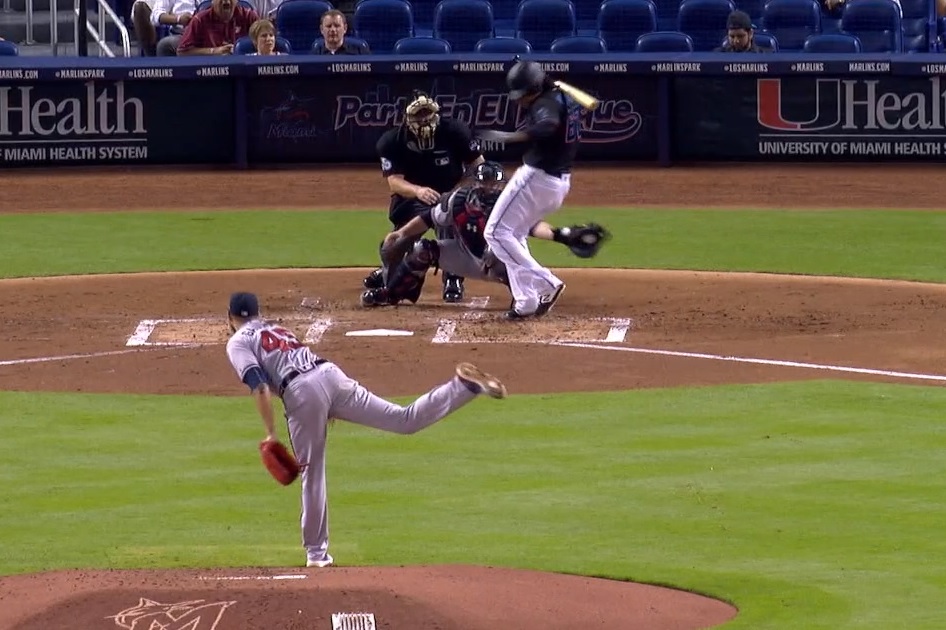
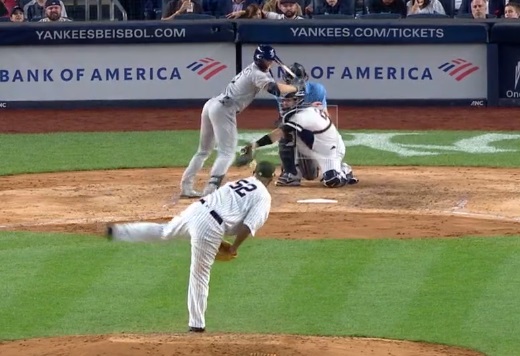
On Friday, in the series opener against the Rays at Yankee Stadium, the lefthander threw a pitch that forced Rays DH Austin Meadows to jackknife out of the way. Afterward, Romine said that he didn’t think it was intentional—a stance that lasted until he saw the video, which left little to doubt:  While walking back to the dugout after ending the inning, Sabathia shouted, “I definitely was trying to hit his ass.” During a tie game.

An inning later, the pitcher yelled at the Rays dugout some more.

“You know CC, he’s been around a long time,” Meadows told reporters after watching the video. “He’s a competitor. He obviously wanted to take a shot there, but it is what it is. Obviously, we had a beef back and forth. It’s part of the game, honestly. Luckily I didn’t get hit. But it is what it is.”

Things continued in Sunday’s series finale, when New York starter Chad Green drilled Daniel Robertson in the head after giving up back-to-back homers. Chance Adams later hit Yandy Diaz in the wrist, knocking him from the game. Robertson said afterward that he did not believe Green’s pitch was intentional, but Diaz was not so certain, saying, in the New York Post, “Maybe it was because I hit two home runs off them [on May 11].”

During the 2000s, the Rays had an extended beef with Boston, eight years’ worth of back-and-forth sniping that led to multiple brawls (all of which was dissected in The Baseball Codes). Now it seems like they’ve picked a new AL East opponent with which to do this particular tango. (Take a look at the above link about Sabathia drilling Sucre to see a rundown of some thorough short-term HBP detritus.)

The teams next see each other June 17 in New York. It would be surprising if things ended here.
Bat Flipping, Let The Kids Play, Retaliation

This Is The New Face Of Baseball Celebrations

Last month, Tim Anderson made clear to us that MLB might not have thought its Let The Kids Play campaign all the way through. It was produced in response to controversy over bat flips both big and little, and other displays of emotion on a ballfield. It was, we were led to believe, institutional approval for players making the sport just a bit more fun.

For that, it worked fine. It just failed to account for whatever’s coming next.

As Anderson showed us, when run-of-the-mill bat flips become routine, players will have to dive deeper, progressing to whatever will grab the most attention next.

We might have seen a preview of that last night.

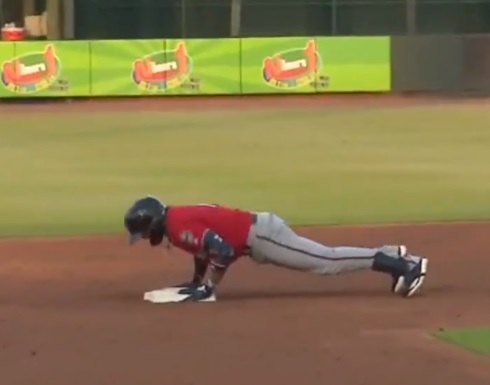
In the Single-A Florida State League, Royce Lewis of the Fort Myers Miracle—the No. 1 overall pick in the 2017 draft—smacked a ball to the wall in center field for a standup double, and as he reached second base dropped down for some celebratory push-ups. Forget the opposition; even the fans were displeased.

Perhaps not surprisingly, Bradenton Marauders pitcher Gavin Wallace responded later in the game by throwing a pitch behind Lewis’ back, for which he was subsequently ejected.

The Miracle’s official explanation, that Lewis was simply punishing himself for not hitting it out, is about as weak as misguided justification can get. (Batting .233 with no homers in 37 games, perhaps he’s prone to overreach when the rare occasion arises.)

So what does this tell us?

For one thing, at least some of the players who have been crying out for leeway regarding emotional displays are being disingenuous. Even while accepting that tossing one’s lumber can be an expression of uninhibited joy, when the act goes mainstream and players have to up their flip game to draw attention to themselves, that’s exactly what they’ll do. To judge by Anderson and Lewis, they’re already doing it. So it’s not entirely about exuberance. These are type-A athletes who spend their professional lives in the spotlight; Q ratings mean something to many of them.

It should be expected, which is what makes MLB’s failure to expect it especially glaring. Now that the league has embraced showmanship on an institutional level, it’s going to have to figure out how to deal with the aftermath. This is because through it all, pitchers—at least enough of them to matter—haven’t changed a bit. They know better than anyone that some celebrations are simply self-aggrandizement wrapped in a thin veneer of joy, and are commensurately annoyed by them. Guys who pump themselves up at the expense of the opposition continue to be seen as disrespectful, so the reactions of Keller and Wallace should in no way be construed as fringe opinions.

The league ultimately suspended Anderson after his grand bat toss
— not for the toss itself, but for using racially inflammatory language in the aftermath. Perhaps they were trying to send an indirect message. If so, it didn’t take.

“I want to be that guy you don’t want to play against, because I’m a dog,” Anderson told Sports Illustrated. “My team loves it, so I don’t care about anybody else. … I’m bringing something to baseball that’s never been brought, as far as the swag.”

Anderson’s attitude is neither good nor bad, per se. How he brings the swag will make a difference, as will the way his opponents react to it.

This is only the beginning, folks. Settle in for what looks to be a wild ride.

[H/T Bring Me The News.]

Retaliation

Braves Wait Nine Months For Retaliation, Then Miss Their Man

On Friday, we were reminded of the sustained vitality behind the long-established baseball concept of waiting for retaliation. In the big leagues, it’s what you have to do sometimes when you see a given opponent only every once in a while, and even then you must wait for an appropriate moment to minimize the chance that drilling somebody will cost you on the scoreboard. Ultimately, revenge fantasies can prove logistically difficult.

Okay, enough with the generalities.

Remember last August, when Jose Urena drilled Ronald Acuna Jr. for being awesome? The Braves do.

Atlanta hadn’t faced Urena since then, apparently not even in spring training. So when the Miami pitcher stepped into the box against Kevin Gausman in the second inning of Friday’s game, Gausman built up some clubhouse goodwill with a first-pitch fastball that let Urena know unequivocally that his act of cowardice had not been forgotten by the guys in the visitors’ dugout.

Gausman missed his mark, Urena leaning toward the plate as the thigh-high pitch sailed behind him. The target was clearly intentional; the miss was likely accidental. Plate ump Jeff Nelson tossed Gausman immediately.

This type of thing is hardly unheard of.

During the 1998 NLCS, Padres catcher Jim Leyritz was drilled by future Hall of Famer Greg Maddux one pitch after asking the plate umpire to check the ball for scuff marks. The Padres waited until the following May for retaliation, when Sterling Hitchcock planted a fastball into Maddux’s hip. (As it happened, Leyritz was Hitchcock’s personal catcher.) “It’s just baseball,” Leyritz said after the game, even as a coach on his own team, Davey Lopes, joked to him that “some guys hold a grudge a long time.”

In 2001, Barry Bonds homered against Russ Springer—and, as was his way, watched the ball fly—in the pitcher’s final game before losing more than a season to rotator cuff and labrum injuries. The next time Springer faced Bonds, in 2004, he drilled him. The next time he faced him after that, in 2006, he drilled him again. The latter HBP was noteworthy because Bonds was sitting on 713 career homers, one away from tying Babe Ruth.

Or go back to 1971, when Chris Speier homered off of Pittsburgh’s Steve Blass during the National League Championship Series. The next time the two squared off, the following June, Blass hit Speier in the ribs. “I was thinking, ‘Well, what the fuck was that for?’ ” said Speier later. “I had no idea, so I asked him the next day. He said, ‘You remember that home run you hit off me?’ I said, ‘You guys won the fuckin’ World Series! Whaddaya gotta drill me for?’ ”

As pertains to Friday’s incident, the real question is whether the second inning of a 1-1 game—during which Gausman had already given up a single, a walk and hit a batter—was the right time for the pitcher to do what he did. There were two outs, and by passing up the chance to retire a weak hitter like Urena, Gausman forced himself to face the top of the order with the bases loaded. Not smart.

That last part was only conceptual, of course. Because Gausman missed Urena, he did not load the bases, but in getting himself ejected he did his team no favors. Touki Toussaint relieved him with a 1-0 count on the batter, and proceeded to walk Urena on three more pitches.

Ultimately, it didn’t matter. Toussaint escaped trouble by striking out Curtis Granderson to end the inning, and the Marlins are the Marlins, so a tie game in the second inning is nearly as good as five-run lead against them in the ninth. Atlanta ended up winning the game, 7-2, and the series in a clean sweep, during which time they outscored Florida 19-5.

Hopefully, this beef is over. The teams next meet in June, which is when we should know for sure.

Update 5/7: Gausman’s been suspended five games.

Retaliation

IronPigs Troll Job Backfires, Which Is Less A Reason To Write About It Than Being Able To Put ‘IronPigs’ Into A Headline

This season has already given us one of the great minor league troll jobs in recent memory, and it wasn’t even directed at a specific player or team:

On Monday, we got another, when the Lehigh Valley IronPigs—the Triple-A affiliate of the Philadelphia Phillies—hit Jacob Rhame where it hurt.

Rhame, of course, was recently featured in these pages for his role in a kerfuffle with Philadelphia’s Rhys Hoskins, which started with Rhame’s head-high fastball and ended with Hoskins blasting a homer against him, then taking a trip around the bases so slow that it made Bengie Molina look like Tim Raines. (Actually, it ended when Rhame was suspended for two games, then sent to the minor leagues. But still.)

Rhame, now with the Syracuse Mets, was called into Monday’s game against Lehigh Valley during the sixth inning, and as he warmed up, the IronPigs’ video board showed a clip not only of Hoskins’ homer, but of his ensuing 34-second trot. Syracuse.com takes it from there:

IronPigs president and general manager Kurt Landes came into the visiting manager’s office and got an earful from Mets manager Tony DeFrancesco after the game. DeFrancesco told Landes the team was upset with the stunt, because whatever happened between the New York Mets and Philadelphia Phillies last week at Citi Field had nothing to do with what transpired on a field in Allentown, Pa., the following week.

Hitting coach Joel Chimelis said someone needed to be held accountable for showing the video. Landes apologized and said he was unaware the video was going to be shown.

Rhame and DeFranceso did not want to talk about the incident after the game.

In the big-league version, Hoskins punished his assailant with success, by homering off of him. The Mets’ minor-league counterparts did similarly, returning from a one-run deficit for a 7-4 victory, then beating the IronPigs again on Tuesday, 18-5, and Wednesday, 8-2, the latter victory vaulting them into first place. That makes a cumulative 30-7 score since the video was shown.

“They didn’t respect (us), not only the pitcher, they don’t respect us as a team,” said Syracuse outfielder Carlos Gomez (who’s been at the center of an abundance of unwritten-rules related dustups himself) in the Syracuse.com report. “They should not have played that video. We’re all professionals here.”

Did the IronPigs learn their lesson when it comes to trolling the Mets? The IronPigs did not learn their lesson:

Minor league baseball rules.

Retaliation

Head-Hunting Hoskins Hurts Hurler In Long Run

headhunter

It’d be easy to think that the Mets threw at Rhys Hoskins on Tuesday in response to the passel of New York hitters—five in five games, including two a day earlier—drilled by the Phillies over the early part of the season. As is frequently the way with these kinds of things, however, there’s more to the story. There was another trigger, too, far more central to baseball’s unwritten rules.

It happened during the sixth inning of Tuesday night’s game, with the Mets leading, 8-0—the kind of score that mandates its own unwritten rules about piling on. The idea, of course, has to do with restraint from embarrassing an opponent you’re already beating soundly.

There has always been debate about how big a lead is sufficient to take one’s foot off the gas, and at what point in the game it should happen. The Mets clearly felt that eight runs in the sixth was within those boundaries. As such, after J.T. Realmuto singled to center with one out, New York first baseman Pete Alonso opted against holding him on as a matter of professional courtesy. At that point in the game, the Mets were gearing toward ending things as quickly as possible, letting players on both teams get home to regroup and go at it again fresh the following day. Positioning Alonso in the hole, where he could cover more ground, was a step in that direction. The expectation was that the Phillies would not take advantage.

Realmuto took off on the first pitch.

This, according to some in the New York dugout, flew against the code. It’s an interesting dynamic, this idea of not pressing the issue. The impetus is pure—respect for an opponent who’s having a bad day—but its execution can sometimes be confusing. What if the Phillies disagreed that the sixth inning was too early to give up their running game? What if the 12 outs remaining seemed like a reasonable number with which to stage a rally or two? With guys like Hoskins and Bryce Harper in the lineup, scoring batches of runs was not out of the question.

The other possibility is that Realmuto, not being held on and with second base an easy 90 feet away, decided to run of his own accord. Despite nothing happening on the play—Hoskins fouled the ball off and Realmuto returned to first—the Mets were displeased. Rather than opt for a message pitch, they responded with some of the same. After the Phillies went down in order, with Realmuto failing to advance, New York found itself in a similar situation during the bottom half of the frame: Juan Lagares on first base with two outs. With the Phillies also opting against holding the runner, Lagares motored into third base on Robinson Cano’s single, despite the unwritten rule mandating that teams holding huge leads play station-to-station baseball, advancing only one base on a single, two on a double, etc.

Now it was the Phillies’ turn to be angry. New York’s next hitter, Michael Conforto, walked on four pitches, primarily because two of them appeared to have been intentionally thrown up and in. At first base, Hoskins discussed the situation with Conforto.

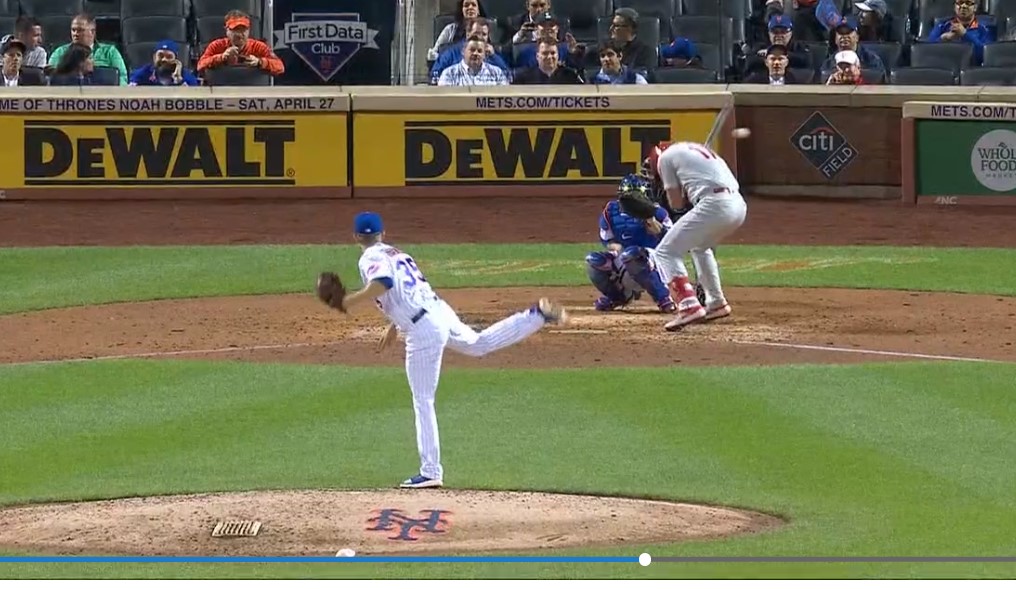
In a tit-for-tat world of code violations and the responses to them, the ledger appeared to be even. Then, with two outs in the ninth—the Mets having increased their lead to 9-0 on a single that drove in Legares from third (which wouldn’t have happened had he held at second)—Mets reliever Jacob Rhame threw a 97-mph, first-pitch fastball directly at Hoskins’ head. (Watch it here.)

That the hitter was able to duck out of the way helped prevent the situation from exploding, but only some. The delivery of a fastball above the shoulders is never acceptable in modern baseball, especially in response to an event that already appeared to have been answered. (For those who point to the dual HBPs the previous day as potential impetus, both were clearly unintentional. One loaded the bases, and the other, with the bases already loaded, drove in a run.)

Hoskins, angry, took a step toward the mound, triggering players from both dugouts to prepare to charge. Plate ump Scott Barry, however, quickly took control of the situation, issuing blanket warnings. Hoskins ended up walking on six pitches, every ball outside the strike zone coming in high and inside. He gave Mets catcher Travis d’Arnaud an earful while making his way to first base.

“I don’t get it,” said Bryce Harper after the game, in the Philadelphia Inquirer. “I understand that two of their guys got hit yesterday, but, I mean, if it’s baseball and you’re going to drill somebody, at least hit him in the ass. Not in the head. You throw 98, it’s scary now. You could kill somebody. Lose your eyesight. That’s bigger than the game.”

It’s possible that Rhame was wild, as he claimed after the game—although that sort of denial is standard fare—especially given that he walked two of the four batters he faced, with 10 of his 19 pitches coming in outside the strike zone. Even if this is true, however, he’d find few defenders in Philadelphia’s clubhouse.

“He didn’t miss up and in or out and up to a lefty the rest of the inning, so I’ll let you decide,” said Hoskins after the game. “But I understand baseball. They got hit a couple of times yesterday.”

If there’s a happy ending to this story, it’s that Hoskins was able to exact retaliation of his own, homering in the ninth inning of Wednesday’s game, against Rhame of all people.

That was the first part of his revenge. The second part was a glacially slow trot around the bases—at 34.2 seconds, the slowest in the five years since Statcast has been tracking such things. (It is also the longest such circuit in the history of TaterTrotTracker, which ceased tracking tater trots in 2016, save for one by Luke Scott, who was injured as he rounded the bases.)

To Rhame’s credit, he calmly rolled with the insult.

“He got me,” the pitcher told reporters after the game. “If I make a better pitch, he doesn’t get to run the bases. It’s his job, man. I’m not really thinking about any of that. … Going through my mind is, I shouldn’t throw one right down the middle to him. That’s about it.”

This will hopefully be it for this episode of Bad Blood Central, NL East Edition. The Mets and Phillies next meet in late June.

Update (4-26): Rhame has been suspended for two games.

Bat Flipping, Retaliation, Showboating

If You’re Gonna Drill A Guy, At Least Know When To Do It

Anderson plunked

In the wake of yesterday’s coverage of the Let Tim Anderson Play Incident, it seems prudent to follow up with a secondary discussion about pitchers hitting batters. Not whether they should (hot take: they shouldn’t), but, for those whose minds are already made up, when to do so.

On Wednesday, Brad Keller whiffed.

So let’s say a guy, maybe a guy who pitches for the Royals, is miffed that an opponent took some liberties in celebrating a home run against him. Maybe some other guys were chirping about it in his dugout, so this Royals pitcher decides to stand up for The Right Way to Play, and drills his opponent in response.

Let slide for a moment your feelings about the decision. In this scenario it is fait accompli, a resolute act. At this point, once said pitcher cannot be diverted from his course, it would behoove him to drill the offender at a juncture of minimal impact to the game. Ideally, it would happen with two outs and the bases empty, with his team comfortably ahead. Or perhaps first base would be open in a situation in which the hitter might have been intentionally walked anyway. There are various metrics to determine the right time, and reasonable discussions to be had about sufficient size for a lead, etc. If enough of those metrics aren’t met, it should be incumbent upon said pitcher to wait—for an inning, a game, a series or a season—until favorable conditions present themselves.

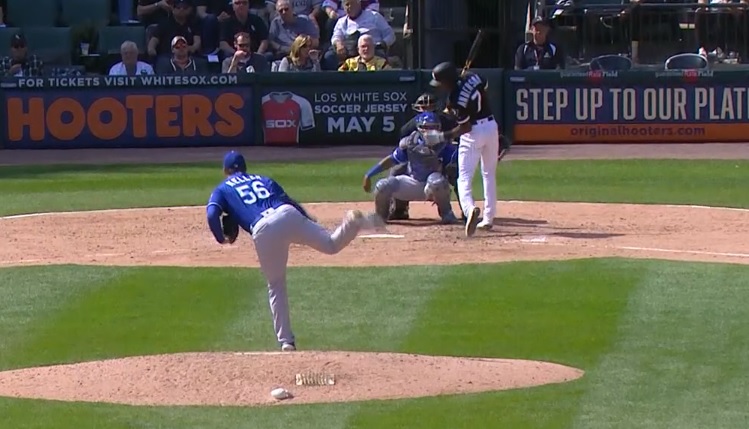
Brad Keller does not seem much for waiting. In Anderson’s very next at-bat, Keller plunked him in the backside, first pitch. While nobody among the ranks of those who approve of such things should take issue with the placement, the pitch’s timing was a downright disaster.

Anderson was leading off an inning in a tie game. Suddenly, Keller was forced to pitch out of the stretch while worrying about a guy who’d stolen six bases in 16 games. (Or at least Keller would have had to worry about pitching out of the stretch had he not been ejected. Instead, he saddled reliever Ian Kennedy with that task.)

Ultimately it didn’t matter. Kennedy retired the next three hitters in order and Kansas City won the game, 4-3, in 10 innings. But this is all about percentages. Had Anderson (or his replacement, after he was ejected along with Keller) come around to score, costing the Royals a victory, the Twitterverse would have lost its mind. That’s because Keller drilling Anderson when he did was even stupider than Keller drilling Anderson in the first place.

Baseball’s unwritten rules have softened over time, and I’m on the record as saying that, when it comes to retaliatory HBPs, that’s a good thing. But as the mandate to drill opponents recedes, the understanding of when to do so recedes right along with it. Which leaves guys like Keller, determined to get their pound of flesh, with a clearly insufficient understanding about how to do so.

There are no easy answers here. When-to-drill-a-guy lessons don’t come easily in an environment bent on preventing pitchers from drilling guys. (Look no further than Keller being ejected without warning for a fairly benign HBP that didn’t even inspire a mound charge. It might have been a Joe West issue, but there’s no denying MLB’s newfound interest in preventing this kind of thing.)

This is some weird middle ground we’re in. We’ll probably have to wait until a similarly impatient pitcher actually costs his team a game before people begin to acknowledge this in a widespread fashion.

Bat Flipping, Let The Kids Play, Retaliation, Showboating

In Wake Of Sox-Royals Dustup, Letting The Kids Play Is Turning Into More Of A Headache Than Anybody Imagined

Anderson flips

Last year this would have been a story about Tim Anderson and his celebratory histrionics.

Hell, last year this was a story about Tim Anderson and his celebratory histrionics. Twice.

This year, however, celebratory histrionics come with a perspective. That is, Major League Baseball has putatively endorsed them via its “Let the Kids Play” campaign, which makes things confusing when pitchers respond to said histrionics with disdain.

Pitchers like Kansas City’s Brad Keller, say.

Now, when Anderson does what Anderson is known to do—in this case, vigorously hurl his bat toward his own dugout after launching the 50th homer of his career—we’re conflicted in the aftermath. Letting the kids play seems like a swell idea to fans, to executives and to an unknown portion of ballplayers, but there appears to be a significant percentage of pitchers who disagree.

We had this conversation less than two weeks ago, when Pittsburgh’s Chris Archer—a known showboat himself—expressed displeasure with Derek Dietrich’s decision to pimp his homer by throwing a ball behind Dietrich in an ensuing at-bat. It was an old-school response that would have drawn little attention a generation ago … or maybe even last season.

But when the league itself encourages Anderson’s kind of behavior, the entire circumstance gets cloudy. That’s because the issue of respect is hardly one of clear delineation.

Are some bat flips okay, but others not? Anderson’s was less insouciant toss and more angry spike. Did that somehow cross an ever-shifting line? Had he not turned toward his dugout—or, more pertinently, turned his back toward the Royals dugout—would it have been better received?

Ultimately, it doesn’t matter. There’s bound to be a transition period between one epoch and another, and right now we’re stuck in a place where some players feel disrespected by some actions that many people—including baseball officials, apparently—would like to see more of. So when Brad Keller feels disrespected (or is sticking up for teammates who feel disrespected), there’s bound to be a reaction regardless of corporate messaging.

Yesterday it was a fastball to Anderson’s backside in his ensuing at-bat. Things did not end well. Anderson started yelling, but, restrained by catcher Martin Maldonado, never approached the mound. Still, dugouts and bullpens emptied, and tempers flared when White Sox manager Rick Renteria shouted for the Royals to clear the field, inflaming Kansas City bullpen coach Vance Wilson. Anderson, Renteria, Keller and Royals bench coach Dale Sveum were ejected.

In the aftermath, we’re left wondering two things: How many players still care about this kind of stuff, and how long will that last?

The Royals have at least two of them on their roster. “Keller did the right thing,” the pitcher’s teammate, Hunter Dozier, said after the game in a Chicago Sun Times report. “He aimed for the lower body. Hit him. It should just be like ‘OK, go to first and move on.’ It shouldn’t have been as big of a situation as it was.”

Dozier is spelling out the party line from a previous generation, offering instructions that, while once status-quo, are now … well, who really knows?  Dozier is 27. Keller is 23. Despite their old-school sensibilities, they seem an awful lot like the kids who the commissioner wants to let play.

This shift is clearly not going as smoothly as baseball’s PR machine would have liked. We’re stuck in a place where, when bat flipping becomes the new normal, showboats like Anderson have to up the ante simply to draw attention to themselves. Bigger antics. More vicious tosses. Sentiments like the one Renteria espoused after the game—“You want [Anderson] to not do that? Get him out”—might make sense to the vast majority of the population, but the key here is that upping the ante rarely sits well with pitchers, some of whom are bound to respond.

Ten days ago it was Chris Archer. Yesterday, it was Brad Keller. So long as hitters continue to push the celebratory envelope, there will always be a pitcher willing to respond.

Our only problem is that we continue to be surprised by it.

Update 1 (4-19-10): If you’re gonna drill a guy, at least know when to do it.

Update 2 (4-20-19): There was some incredulity in the immediate aftermath that Anderson was tossed from the game, given his primary role as victim. We later found out that it was due to language so severe that he was eventually suspended for a game.

Update 3 (5-28-20): Keller confirms that he drilled Anderson on purpose.

Let The Kids Play, Retaliation

David Bell Didn’t Like What Chris Archer Did To The Point That He’s No Longer Making Sense

Bell argues

Reds manager David Bell got to talking with reporters on Tuesday about his team’s Let-the-Kids-Play fight with the Pirates, for which he was ejected and ultimately suspended, and unfortunately for those following along, his comments didn’t make a whole lot of sense. All quotes from the Dayton Daily News:

  • “[Derek] Dietrich clearly didn’t do anything wrong because he wasn’t ejected or suspended. If MLB has a problem with what Derek did then there needs to be a rule against what he did.”

There is a rule against what he did—it’s unwritten, and it’s been around for about as long as baseball itself. We have recently been lulled into thinking that it’s no longer enforced, which seemed to be fine until we realize that  guys like Chris Archer still inhabit pitcher’s mounds. MLB promotional slogans aside, the reality is that some players still don’t appreciate showboating. Dietrich can pimp any homer any way he’d like; he just has to cop to the possibility that he’ll piss somebody off in the process.

To Bell’s other point, a lack of prohibition against a given act in the rulebook doesn’t automatically make that act acceptable. Had Dietrich, unprovoked, decided to approach the Pittsburgh bench and spit tobacco juice onto Clint Hurdle’s cleats, he wouldn’t have broken any rules. He’d still be an asshole, though.  

  • “I had one intention [in coming out to argue the call] and that was to defend our team and to defend our hitter and to get Archer ejected.”

Never mind that that’s technically three intentions. Trying to get Archer ejected without a warning for throwing a pitch that didn’t come close to hitting a batter is, to put it exceedingly mildly, a stretch.

  • “I felt my only course of action was to get their pitcher ejected for intentionally trying to hurt our player.”

It’s unclear how throwing a ball below the belt and well behind a hitter in any way constitutes intent to injure. By this point in the conversation Bell is in full-fledged protect-my-guy mode, and appears to be spitting out whichever authoritarian argument reaches his brain first.

  • “Whether they throw at their heads or their backs or their legs, it is all the same to me. For that to be OK, or even somewhat acceptable that it wasn’t at his head, to me that is a very dangerous approach.”

This is where Bell really goes off the rails, because drawing false equivalences can be downright dangerous. What Archer did was clearly not the same as throwing at an opponent’s head. What Archer did was not even the same as drilling a guy in the ribs. Any modern pitcher who intentionally rifles a ball above somebody’s shoulders becomes an automatic pariah among his peers, and rightly so. Chris Archer does not remotely fit that bill, at least to judge by his approach to Dietrich.

  • “I don’t know what those [unwritten] rules are. All I know is this is pretty simple—our hitter hit a home run and didn’t do anything against major league rules or the umpire’s rule or anybody’s else’s rules. But everybody in the ballpark knew he was going to have to stand up there and possibly get hit with a fastball, maybe hit in the head and done damage.”

Waitaminute. If everybody in the ballpark knew that retaliation was imminent, Dietrich must have done something pretty obvious to inspire it. One needn’t approve of Archer’s response to acknowledge this reality.

David Bell is well respected around the sport, deservedly so, and I agree with him that pitchers have no business seeking physical retribution for an act so simple as showboating. But that’s an awfully high horse he’s decided to mount in Dietrich’s defense—so high that he appears to have lost all contact with what’s actually happening below. Defending his players is part of the guy’s job, but over the last couple of days Bell may have been throwing himself into his work with just a touch too much vigor.

Let The Kids Play, Retaliation

Pirates, Reds Argue Whether We’re Actually Ready To Let The Kids Play

Puig fights

So it seems that we’re now talking in matters of degrees. We’re going to let the kids play and flip themselves silly and celebrate in all sorts of ways that would have gotten them drilled by a previous generation of pitchers, and baseball is going to be better for it.

At least until somebody acts exactly like MLB has promoted in its own promotional campaigns and we’re reminded that red-assed pitchers maybe don’t watch too many commercials and somebody does something stupid and we’re right back to where we started.

We’re talking of course, about Pittsburgh’s Chris Archer in the role of the Red-Ass, and Cincinnati’s Derek Dietrich in the role of the Kid (never mind that he’s 29, only six months younger than Archer—a marketing slogan is a marketing slogan), and Yasiel Puig as the enforcer of a player’s right to showboat. (Who better, amiright?)

A quick recap: In the second inning of yesterday’s game, Dietrich yammed a monster homer clear into the Allegheny, then stood in the box watching it for what even by let-the-kids-play standards seemed like an exceedingly long time.

Pittsburgh catcher Francisco Cervelli was the first to express displeasure, waiting as Dietrich crossed the plate to deliver some words of rapprochement, to which the runner did not respond. (According to Puig, Cervelli also warned that retaliation was coming, which, if true, surely played no small part in what was to come.)

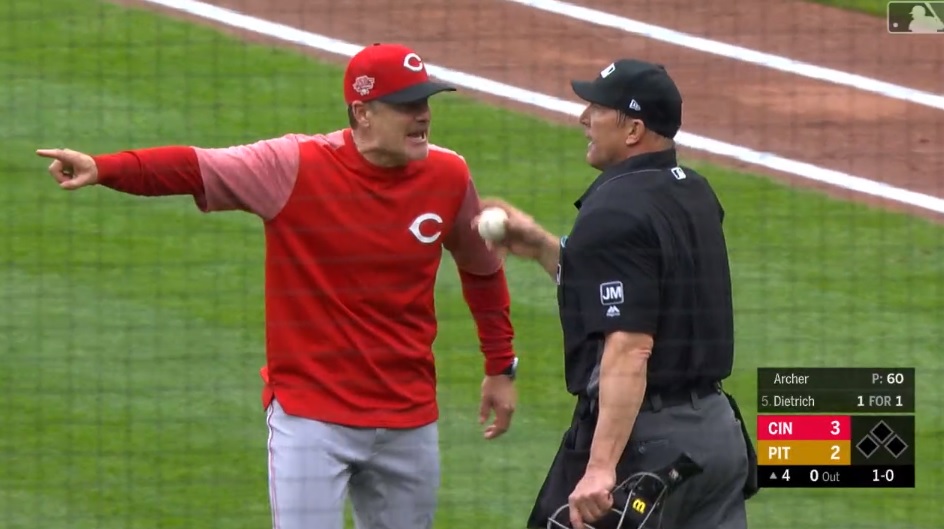
Archer continued his team’s messaging during Dietrich’s next at-bat, sending a pitch to the backstop, just behind the hitter’s rear end. Dietrich barely had to flinch to avoid it. Plate ump Jeff Kellogg immediately warned both benches. This is where things got interesting.

While Dietrich was downright passive in his response, Reds manager David Bell tore from the dugout to argue the warning, followed closely by a number of Reds players and coaches, notably Puig. Almost instantly, fists were thrown. (Again: notably Puig.) Cincinnati’s Bell, Puig and reliever Amir Garrett were ejected, as were Pittsburgh’s Felipe Vazquez and Keone Kela.

There’s a lot to unpack here. On one hand, Archer delivered a clear and harmless message, sent well behind the batter, below his belt. Annoying maybe, but hardly impactful. (“When someone is throwing at someone, they are trying to inflict pain or possibly hurt someone or send a message,” Dietrich said after the game, overblowing the details by a considerable margin.)

On the other hand, it was clear hypocrisy on Archer’s part, the idea being that a pitcher like him—a showboat in his own right—has no business getting angry when an opponent dishes out some of his own. And make no mistake: Archer’s emotional displays are prevalent to the point that his own team released a promo video about them before the game.

Or, take Bell, whose argument with Kellogg was that by acting so quickly, the umpire denied the Reds a chance to respond. Unless his argument was that Archer should have been ejected without warning. Either of which are nonsense, given that it was the Reds who started it, and that Pittsburgh’s answer didn’t even involve drilling a guy. What did Bell want to do? Escalate the situation by having one of his pitchers hit a Pirate? Send a similar message without fear of ejection? To what end?

Ultimately, of course, it won’t matter. If Bell or any member of his team is bent on responding, they’ll have no problem waiting until the next time the teams meet at the end of May. It’d be stupid, but that’s their prerogative.

There’s also the idea that, according to the unwritten rules, the aggrieved party in this type of situation dictates his team’s response. Had Dietrich made a mad dash for the mound, it would have made sense for his teammates to follow. But Dietrich didn’t do a thing. When Bell came out to argue, Puig seized the opportunity, vaulting the dugout rail to confront Archer on the field. Puig, of course, has never been much for the unwritten rules. This alone will earn him a suspension.

If you really want to get into the woods, examine the postgame sentiments of Vazquez, one of those ejected. “[Dietrich] shouldn’t have done that,” he said in a Pittsburgh-Post Gazette report. “That’s against the principles. If you do something like that you’re going to pay for it. We’re trying to play the game the right way by respecting it. Joey [Votto] can do it because he’s been here a long time. But a guy like him isn’t supposed to do that. He hasn’t earned the right. It was a little too much. We all knew it was going to be far but you’re not supposed to wait until the ball hits the ground to start running. You aren’t supposed to do that.”

The idea of veterans earning various rights not granted to their less-seasoned contemporaries is ages-old in baseball and, if expressed 20 years ago, wouldn’t be surprising. But in a landscape where an abundance of voices are calling for freer reign—to let the kids play—it’s an odd message. By Vazquez’s logic, the kids should be hamstrung, just like they always were, remaining reserved in their actions until such time as they’re sufficiently tenured to loosen up. That is, until they’re no longer kids.

Then again, Vazquez (née Rivero), as a Venezuelan national, is taking a decidedly counter approach to that espoused by a great many Latino players, who generally tend to default toward more celebratory practices, not fewer.

Ultimately, did Dietrich learn any lessons? To judge by the homer he hit six innings later, almost to the same spot as the first, no. He stood and admired that one, too.

The best thing to come out of this was @stormchasernick’s response to Cut4’s suggestion about art.

Reds-Pirates, May 27. Mark it on your calendars.

Update, 4-09-19: Archer has been suspended for five games, Puig for two and Bell for one. The Archer penalty in particular, which will only force him to bump back a start for a day or two, shows that MLB viewed his actions as relatively inconsequential. Which makes sense, given that he didn’t come close to hitting anybody.

Update, 4-11-19: David Bell’s talking, but he’s not making much sense.

Retaliation

Timing Matters When It Comes To HBPs, As The Guy Hitting After Bryce Harper Can Attest

Hoskins drilled

Baseballs slip from pitchers’ hands all the time, inadvertently contacting batters as a matter of accident. When it’s cold and windy and grip is poor, this is especially true. It was certainly true Sunday night in Philadelphia, as the Phillies and Braves combined for 15 walks and three hit batters.

When the timing of one of those hit batters is questionable, however, every mitigating factor flies out the window. Which is why the Phillies were so angry at Braves reliever Shane Carle.

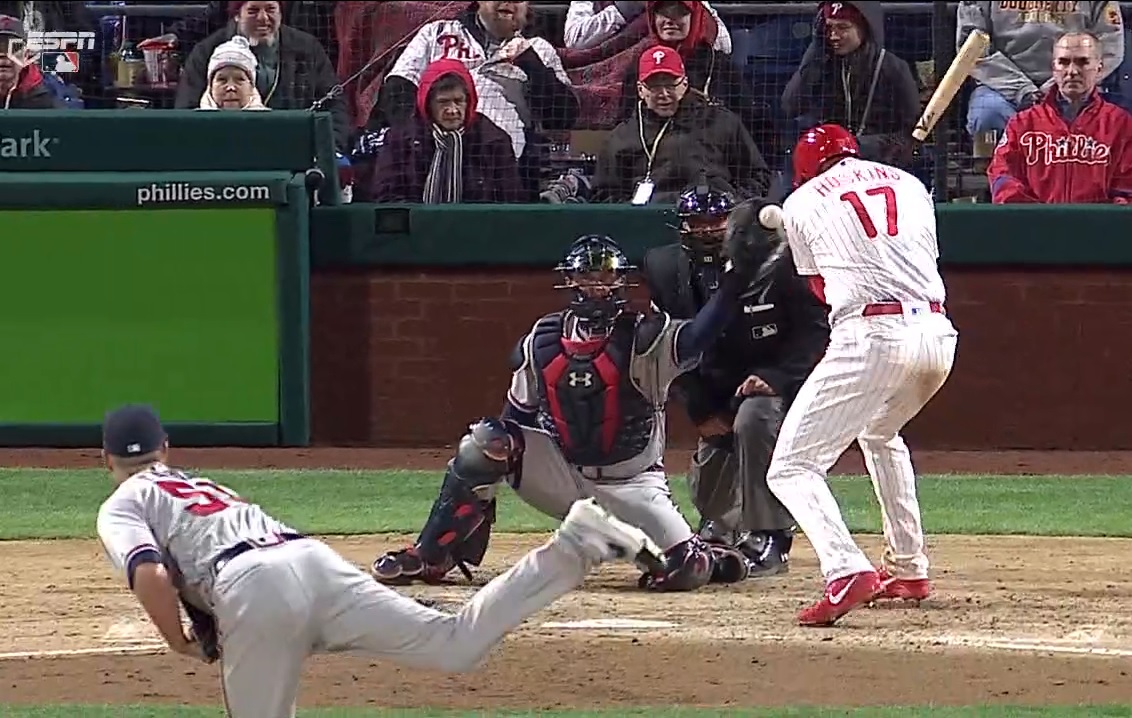
When Carle drilled Rhys Hoskins in the seventh inning, it followed a Bryce Harper and subsequent celebration with his teammates just outside the dugout. It might have been that Harper’s homer put the Braves into a 4-1 hole after they’d already lost the first two games of the series while giving up 18 runs. Nobody could blame them for frustration.

The other source of Philadelphia’s ire was that the pitch came in nearly head-high, eventually striking Hoskins on the shoulder.

The rest is details.

Never mind that Harper and Phillies starter Jake Arietta said that they didn’t think it was intentional, sentiments echoed by Braves manager Brian Snitcher and catcher Brian McCann. Carle had drilled Philadelphia’s cleanup guy right after being taken deep.

Hoskins got up yelling, clearly furious. It was the third time in two games against Atlanta that pitches had come close or actually hit him. Plate ump Rob Drake agreed, ejecting Carle.

After the game, Phillies manager Gabe Kapler unloaded.

“It really pisses me off when balls go underneath Rhys Hoskins’ chin,” he told the media, referencing the fact that Hoskins wears a C-flap on his helmet after having his jaw broken by a fouled bunt attempt last season. “It really bugs me. … He’s one of our leaders. He is, in many ways, the heartbeat of our club. It really bothers me when it happens.”

This matters less in a one-game sample than it does when considering that these teams—each of them hoping for full resurgence after long fallow periods—play each other 16 more times this season. Should Braves pitchers take liberties with the inside corner against Philadelphia, even without trying to hit anyone, they have to know that they’re playing with fire. The same can likely be said for members of the Phillies staff.

Here’s hoping that nothing comes of it, but boy it’s gonna be fun to watch.