Gamesmanship, Nyjer Morgan

Big League Chew: Morgan Pulls Out All the Stops (Among Other Things) to Get into Carpenter’s Head

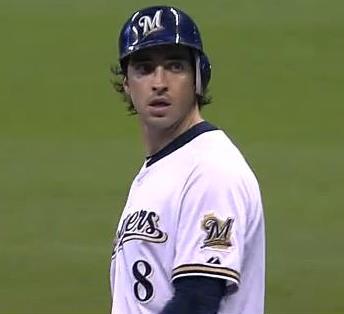
This is what happens when baseball’s premier red-ass butts heads with one of the game’s loosest cannons. As if there wasn’t enough tension built in to St. Louis’ desperate chase of the Brewers in the waning days of the NL Central, Nyjer Morgan threw decorum—and his chew—to the winds Wednesday, shouting down Chris Carpenter as the Cardinals ace tried to finish a complete-game shutout.

After the right-hander struck out Morgan for the first out of the ninth inning, he directed an inflammatory comment toward the plate (at least according to Morgan), to which the hitter replied—and I lean here on my decades of experience reading lips via sports telecasts—“fuck you.” (Watch it here.)

Morgan, it seems, had been swiping at low-hanging fruit throughout the game, trying to rattle a pitcher who’s proved susceptible to such tactics in the past. To Carpenter’s credit, he didn’t cave.

“He was yelling at me at second base,” said the pitcher in an MLB.com report. “He was yelling at me down the line when he hit the double. The whole game he’s screaming and yelling, the whole game. I’m not going to allow it to happen. I don’t know if that’s the way he plays, to try to get guys out of their game or what. But I’ve been around too long to allow that to happen, I can tell you that much.”

As Morgan strode purposefully back to the dugout following his at-bat, he dismissively tossed his wad of chewing tobacco toward the mound. It didn’t come anywhere close to Carpenter, but that wasn’t Morgan’s intention. It was simply as dismissive a message as he could send in that moment.

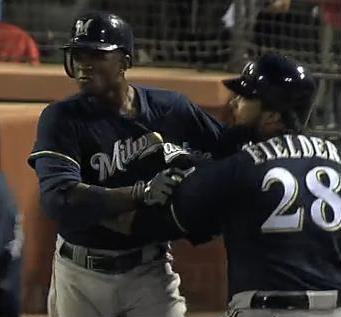
Albert Pujols responded by charging in from first base, Prince Fielder raced to restrain Morgan, and the benches emptied. (No punches were thrown or shoves exchanged.) Morgan was eventually tossed by the umpires, at which point he could be heard on the telecast saying, “He said it first, he’s got to go, too.”

Were it only that simple. Morgan knows—and was likely trying to exploit—a history with the Cardinals that dates back to August, 2010, when the outfielder—then with Washington—went out of his way to senselessly collide with Cardinals catcher Bryan Anderson in a non-play at the plate.

That was followed this spring by an exchange that started when Morgan ran into Pujols in a play at first. Morgan and Carpenter got into a verbal spat during a series at Miller Park earlier this season. The teams also had tension over a tit-for-tat hit-batter exchange involving Pujols and Ryan Braun.

Ultimately, Morgan is either genuinely off-kilter or wildly canny, using the tactic of supreme annoyance to get his opponents off their collective game. (The former was bolstered by his recent run-in with fans in San Francisco. The latter has been ably demonstrated for years by A.J. Pierzynski.)

No matter the answer, it comes down to Nyjer being Nyjer. He said after the game that the confrontation “was over with”—but he wasn’t quite telling the truth.

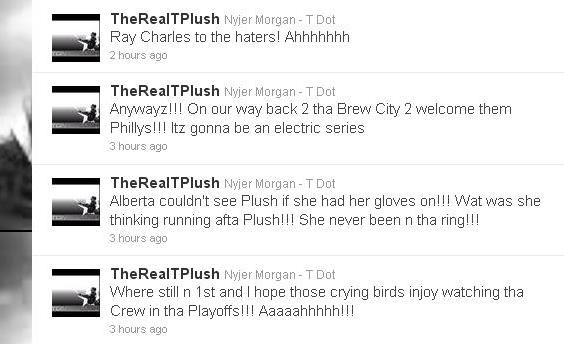
Not long afterward, Morgan sent out a series of tweets referring to Pujols as “Alberta” and saying “She never been n tha ring.” (See below.)

Ozzie Guillen once described Pierzynski this way: “If you play against him, you hate him. If you play with him, you hate him a little less.”

Through Morgan’s tenures in Pittsburgh and Washington, that appeared to be the case with him, as well. The Brewers, however, seem to love the guy.

He’d be well-advised to keep it that way.

Update: Morgan is headed in the wrong direction. Brewers management is not taking kindly to his act.

– Jason
Jason Motte, Retaliation, Ryan Braun, Tony La Russa

Hey Jered Weaver, this is Where Message Pitches are Meant to be Delivered

Ryan Braun: not happy with the way things played out.

As far as retaliation goes, it was awkward, it was ugly and if it wasn’t embarrassing to more than one party, then by all rights it should have been.

But at least it got the job done, within the boundaries of reason.

In the bottom of the seventh inning last night, Cardinals reliever Jason Motte wanted to deliver a message to Milwaukee. Brewers reliever Takashi Saito had drilled Albert Pujols a half-inning earlier, in his tender left wrist. It was clearly unintentional, as the rising fastball hit Pujols only after the hitter pulled his hands in to his chest and was spinning toward the backstop.

Sometimes intent doesn’t make a lick of difference. When Pujols goes down, reparations are frequently in order.

Never mind that it was a 7-7 score; when Ryan Braun led off the home half of the inning, Motte got right to it. And whiffed. Braun evaded Motte’s 98 mph inside fastball, which should, for practical purposes, have ended the hostilities. The pitcher had his shot and missed his mark.

This was plate ump Rob Drake‘s moment to step in and put an end to things. Players frequently appreciate some leeway when it comes to umpires’ warnings, at least to the point that each side is allowed their due shot. Drake, however, missed that mark by a mile.

Allowed a second chance, Motte drilled Braun in the ribs with a 97 mph four-seamer. Braun looked stunned after the first effort; when the second one found purchase without a peep from Drake he was downright flabbergasted.

Even at that point, Motte failed to get booted. (He did end up hitting the showers, but only because Tony La Russamade a pitching change. Based on La Russa’s history with these things, it seems likely that Motte started the inning solely because has the best fastball on the team, with the plan being to pull him after one hit batter. “We threw two balls in there real good just to send a message,” the skipper said afterward, in a semi-denial. “If he ducks them, it’s all over and we don’t hit him.”)

Only after Milwaukee skipper Ron Roenicke came out for a chat with Drake—presumably to fill the ump in on all he was missing—were warnings issued to both benches. (It was odd timing on Roenicke’s part; unless he was looking to get Motte retroactively bounced from the game, his discussion served little purpose beyond costing his own pitchers a chance to respond on Braun’s behalf.)

“That was ridiculous,” said Brewers catcher Jonathan Lucroy in the Milwaukee Journal-Sentinel. “We didn’t hit Albert Pujols on purpose. Are you kidding me? In that situation? If we wanted to put him on base, we would have walked him. That’s ridiculous. . . . We shouldn’t get punished for something we weren’t trying to do on purpose. Look at the situation. If we were getting beat by a lot or we were beating them by a lot and that happens, maybe we did it on purpose.  I mean, come on. We weren’t trying to hit anybody. It’s unbelievable.”

Lucroy is entitled to his opinion, but it’s tough to fault a pitcher for protecting his superstar. That Milwaukee’s best player led off the next inning made the timing perfect. That Motte was given two chances by an apparently clueless ump, however, is worth getting ticked off about. If the situation has anything working in its favor, it’s that, unlike Jered Weaver and Carlos Carrasco, Motte came nowhere near his target’s head.

The teams meet again today, then again at the end of the month.

– Jason

Clint Hurdle, Dusty Baker, Gamesmanship, Jim Tracy, Kevin Towers, Tony La Russa

Lights, Rain and Radar: How to Get into your Opponent’s Head, an Introductory Course in Gamesmanship

When the lights go down in St. Louis . . .

When the lights went out in St. Louis last night, there were two outs in the 11th inning and San Francisco’s Brian Wilson was on the verge of closing out a 7-5 victory.

Instead, the teams sat for 16 minutes while the sound guy at Busch Stadium played Journey’s “Lights” and somebody tried to deal with the electrical system.

The chatter after Wilson finally returned to record the game’s final out had to do with the possibility of malfeasance on the part of Tony La Russa. Did the Cards’ manager manipulate the power grid in an effort to cool down the opposing closer?

Of course he didn’t. Or at least he probably didn’t. Still, the coincidental timing was enough for Bruce Bochy to quip afterward that it was “pretty good gamesmanship” on La Russa’s part.

The Giants’ skipper was joking, but there’s a reason La Russa’s name comes up during moments like this.

Earlier this year, for example, he was accused of selectively distributing weather information when the Cardinals were hosting Cincinnati, then pitching reliever Miguel Batista instead his scheduled starter, Kyle McClellan. Batista threw all of six pitches before rain halted the game for more than two hours.

Afterward, McClellan, fresh, took his rightful place on the mound.

Dusty Baker, meanwhile, claiming an information inequity between the teams, had his starter, Edinson Volquez, warm up from the get-go. The right-hander never got a chance to pitch, however; when play resumed, Baker had to turn to Matt Maloney rather than risk having Volquez get hot twice.

“It’s really a tough start,” Baker said in an MLB.com report. “The information that we received was probably not the same information they received, or else we wouldn’t have started [Volquez] in the first place. We were told there was going to be a window of opportunity there. That window lasted about three minutes.”

Maloney gave up three runs in three innings, and the Cardinals won, 4-2.

La Russa, of course, is hardly alone when it comes to gamesmanship. In April, Livan Hernandez accused the Pirates of doing much the same thing.

Weather reports, however, are far less interesting than the other tally on Pittsburgh’s gamesmanship scorecard. That came when Clint Hurdle appeared to dupe Rockies skipper Jim Tracy with two outs in the 14th inning of a tie game. With a runner on first, Andrew McCutchen stepped into the on-deck circle as Jose Tabata batted.

That had been McCutcheon’s spot in the order earlier in the game, but the outfielder was removed as part of a double-switch. The guy actually scheduled to hit next was relief pitcher Garrett Olson, whose last plate appearance had come in 2009, and who has collected all of one hit in his five-year career.

Had Tracy been paying better attention, he might have realized that the Pirates’ bench was empty, leaving Olson to fend for himself at the plate.

It never came to that. Seeing McCutchen, Tracy had reliever Franklin Morales pitch to Tabata—who promptly lashed a game-winning double. (Watch it here.)

From the Pittsburgh Post-Gazette: “Asked if the move was a decoy to get the Rockies to think McCutchen was up next … ‘No, come on, why would we do that,’ Hurdle said with a sly chuckle.”

* * *

Rain delays and decoys are one way for a home team to gain an advantage. Radar guns are another.

Earlier this season, Diamondbacks GM Kevin Towers admitted to the Arizona Republic that when he held the same post with San Diego, the Padres took to manipulating their ballpark’s radar gun to get into the heads of opposing pitchers.

“I know for a fact that every time Brad Penny pitched for the Dodgers in San Diego it was probably the lowest velocities he ever had,” he said. “He liked velocity. He’d stare at the board. He was throwing 95-96, but we’d have it at 91 and he’d get pissed off and throw harder and harder and start elevating.”

Hardball Talk’s Aaron Gleeman checked, and—lo and behold—Penny is 1-5 with a 6.47 ERA in 10 career games pitched in San Diego.

(The subject was initially raised when fireballing Aroldis Chapman, after topping out at 106 mph earlier in the season, dropped nearly 15 mph off his fastball in San Diego, then magically regained his velocity during Cincinnati’s next series. Towers’ comments could themselves have been a form of gamesmanship, as his new club uses the non-manipulatable Pitch-f/x system, and the Padres—and all their secrets—are now the enemy.)

The tactic works both ways. During the 2002 postseason, when Robb Nen was throwing pus with a shredded shoulder during what would be the final innings of his career, the folks at AT&T Park shut off the radar gun altogether when the Giants’ closer entered the game. It might not have fooled anyone on the opposing team, but it certainly didn’t hurt.

– Jason

Albert Pujols, Francisco Cordero, Retaliation

Cards Sensitive, Cordero Indignant, Next Chapter all but Written

Francisco Cordero has some things to say.

That the Yankees hate the Red Sox (and vice versa) is not quite true.

That Yankees fans hate Red Sox fans (and vice versa) is much more to the point. What happens between the teams on the field is primarily about competition, not vitriol. It’s a process involves little actual animosity.

The same does not hold true for the Cardinals and the Reds.

These teams share a laundry list of recent dustups, starting last year with Brandon Phillips calling the Cardinals “little bitches”; continuing on to Phillips starting a fight with Yadier Molina, and Johnny Cueto kicking Jason LaRue onto the disabled list; and more recently to Tony La Russa slyly using the weather report to outmaneuver Dusty Baker just last month.

The latest episode came Sunday, at the end of Cincinnati’s 9-7 victory over the Cardinals—the final moments of what would be the Reds’ first three-game sweep of St. Louis since 2007. They scored eight consecutive runs to beat Chris Carpenter for the first time in five years.

With one out in the ninth inning—after St. Louis had tightened what had been a 9-2 deficit over the previous seven hitters—closer Reds closer Francisco Cordero drilled Albert Pujols with an 0-2 pitch. (Watch it here.)

To watch the response from the Cardinals bench, it seems that Kyle Lohse isn’t the only one doing impressions of La Russa. Acting manager Joe Pettini—in charge while La Russa dealt with health issues—pitching coach Dave Duncan and backup catcher Gerald Laird picked up the indignant we-will-not-be-abused mantle so visibly embraced by their skipper, lighting into Cordero from the dugout as the Reds congratulated one another on the field. Cordero responded in kind, shouting and gesturing toward the St. Louis bench. (Watch it here.)

“The soap opera continues between these guys,” Pettini said in the St. Louis Post-Dispatch. “It’s always something when you come in here.”

The reality, of course, is that closers, by dint of being used almost exclusively in close games, almost never send message pitches—at least not ones that hurt. That was certainly the case here; Pujols was the tying run, Matt Holliday and Lance Berkman were to follow, and the pitch in question was no more than a few inches inside, hitting Pujols on the left wrist.

Pujols himself said that Cordero wasn’t trying to hit him, that it was “probably something that slipped.”

The teams next meet on July 4 in St. Louis. (Brace for the inevitable “Fireworks at Busch” headlines.) If there’s a clear target on the Cardinals, it’ll likely be Laird, Cordero’s former teammate on the Rangers, who accounted for much of the shouting and who, unlike Pettini and Duncan, occasionally takes the field.

“I just told (Laird), ‘Say it again’ . . .” said Cordero. “I thought it was funny that a guy who wasn’t playing was yelling at me.”

It was little more than posturing on the Cardinals’ part, and even they know it. Perhaps it’ll somehow distract Cincinnati in the future, but even that’s unlikely. Mostly, it served only to unnecessarily perpetuate what’s becoming a significant history of bad blood.

(Reds broadcaster Marty Brennaman didn’t help matters any when he said on the air that Carpenter was a “whiner and excuse-maker,” that Duncan was “infantile” and that the Cardinals “might be the most disliked team in baseball.”)

“The teams don’t like each other,” said Berkman after the game in the Cincinnati Enquirer. “That’s just part of the deal.”

– Jason

Chris Carpenter, Nyjer Morgan, Retaliation, Tony La Russa

Tony La Russa Proves Again that his Memory is Better than Ours

Tony La Russa | SD Dirk/Flickr

Last season, Nyjer Morgan suffered one of the most protracted on-field meltdowns in recent baseball history, shifting his public perception from that of a garrulous, personable guy to somebody in genuine need of psychiatric help over the course of about two very rough weeks.

He’s learning this spring that repercussions can carry, and that a little reputation can take a player a long way. Sometimes in the wrong direction.

Monday, the Washington outfielder ran into Albert Pujols while trying to beat out a fifth-inning bunt against the Cardinals. It was hardly his fault that the throw from Cardinals catcher Gerald Laird tailed into him, forcing Pujols into contact, but the lasting image was of the all-everything first baseman trying to shake his wrist loose after the play, sufficiently dinged to elicit a visit by a trainer. (Pujols stayed in the game.)

Morgan’s true problem on the day, if it was really his problem at all, came from Tony La Russa.

It dates back to last August, when Morgan went out of his way to run into Cardinals catcher Bryan Anderson (one of the earlier incidents in the aforementioned meltdown).

In a way, La Russa is a bit like Gaylord Perry. Perry played up his reputation as a greaseballer, fidgeting and wiping all over his body before each pitch, with the understanding that getting hitters to think he was loading up a baseball was nearly as valuable as actually doing so.

Similarly, La Russa revels in his reputation as a staunch defender of baseball decency, someone who will unflinchingly order his pitchers to retaliate in the name of on-field justice. Whether or not he actually does it is almost beside the point; whenever a Cardinals pitcher drills an opponent in any circumstance that can be even loosely construed as retaliatory, questions immediately emerge as to La Russa’s intentions. And any energy the other team expends stewing about the St. Louis manager is energy they’re not focusing on the game before them.

Which is a long way of saying that when Chris Carpenter hit Laynce Nix later in the frame, La Russa was quickly fingered as a prime source of inspiration.

Washington starter Livan Hernandez wasted no time settling the score, drilling Colby Rasmus in the bottom of the inning. La Russa, reported Adam Kilgore of the Washington Post, “seemed to be glaring at the Nats’ dugout as Rasmus made his way to first.”

(Swayed perhaps by the low-key vibe of spring training, Hernandez violated a key unwritten rule in admitting the intent of his pitch to reporters after the game. Expect retribution of the official variety—suspension and/or fine—soon.)

Because La Russa is in charge of the Cardinals (or so we suspect, as far as this particular incident is concerned), St. Louis reliever Miguel Batista hit Ian Desmond in the back two innings later. (Batista actually retired Morgan before drilling Desmond, perhaps indicating that La Russa’s book on Morgan is finally closed.)

This was the tipping point.

Desmond had words, first for catcher Tony Cruz, then, upon reaching first, for Batista. Benches emptied, led by none other than Morgan (who was restrained by Nationals coach Trent Jewett). Nationals manager Jim Riggleman had to be held back when he approached La Russa with malice. Ultimately, no punches were thrown.

“There was no question in my mind that Batista was going to hit somebody,” said Riggleman after the game, in an AP report.

In a fascinating subplot that plays right into La Russa’s intrigue, Kilgore posited that Batista, on the bubble for a roster spot, “may have made the team” with his actions.

Apparently more savvy about this sort of thing than Livan Hernandez, both La Russa and Carpenter denied intent after the game.

“It’s the same story—it happens to us, it happens to them,” said La Russa after the game, in a very La Russa-like this-stuff-has-been-around-forever denial. “You get hit, you think it’s intentional. They hit you, it was accidental. It’s been 100 years of this stuff. It’s not going to go any farther. That’s it.”

One more unwritten rule was violated during the scrum, when it was pointed out that Carpenter—already in the clubhouse when the benches cleared—did not join his teammates on the field. He was in the process of talking to Brian Feldman from KMOV in St. Louis when the incident went down. Feldman reported the following:

Mar. 21, 3:18 p.m. -Was in the clubhouse talking to Carpenter when the benches cleared on the field. Batista was thrown out of the game for hitting a Nationals player…says he was told they believed he did it on purpose. It’s unclear whether he did or not.

Mar. 21, 3:20 p.m. -That beaning from Batista was in retaliation to Rasmus getting hit earlier. Apparently Tony was not happy at all when that happened. So its possible he told Batista to do it…but that’s anyone’s guess.

For his part, Carpenter claimed that once he understood the severity of the situation (including, according to the AP, hearing that “Washington players and coaches blamed him for igniting the fireworks and were questioning why he wasn’t on the field”), he beelined to the dugout.

“The most idiotic thing was that it was a spring training game. It was stupid,” he said. “If they think it’s my fault, I’ll go out there. I didn’t hit Laynce Nix on purpose.”

The quote of the day came from Desmond, who was a teammate of Batista in Washington last season.

“Yeah, it was intentional, but I mean Miggy throws like Miss Iowa,” he said with a laugh—a not-so-subtle reference to the flap Batista stirred last year with comments about the Hawkeye state’s beauty queen. “We were really trying to keep the fans around. Once (Albert) Pujols came out of the game and (Chris) Carpenter came out of the game we knew they were going to leave so we decided to add a little entertainment.”

The true entertainment value will be calculated next time these teams meet, on April 19.

– Jason

Hal McCoy, Jonny Gomes, Reporters' etiquette

Make Sure You Hear What You Think You Hear Before You Go Ahead and Report It

Although many media outlets reporting on the Jonny GomesAdam Wainwright affair are spinning it as a matter of player disrespect, there’s more to it than that.

At the surface, it seems clear: Gomes is reported to have walked into the Cincinnati clubhouse moments after hearing that Cardinals ace Wainwright would likely be shelved for the season with a blown-out elbow, singing something along the lines of  “Wainwright’s gone.”

The firestorm was immediate. People suggested that Gomes stay loose the first time he steps in the box against the Cardinals, because Tony La Russa is a man of applied vengeance and because none of Wainwright’s fellow St. Louis pitchers are likely to cotton well to the sentiment.

Well, okay. If it happens that Gomes wears a fastball for his actions, so be it.
Except that according to him, those were neither his actions, nor his intent. And there’s plenty of evidence in his corner to believe him.

The true breach of etiquette came from writer Hal McCoy, the guy who initially reported Gomes’ would-be song in his blog for the Dayton Daily News.

McCoy explained in a follow-up post that as he was getting ready to depart the Reds clubhouse, he “thought” he heard the words Gomes was singing. Then he reported them. (McCoy has since removed the offending paragraph from his blog.)

Etiquette is required of reporters as much as it is of players inside big league clubhouses. As most reporters will attest, running overheard items—especially inflammatory ones—is inherently dangerous because there’s frequently more to the story.

At the very least, a thorough reporter will take the item directly to the player in question for further comment, to ensure what’s being reported is what was intended. (It’s also standard practice for reporters to bring inflammatory on-the-record statements back to the offending party to confirm intent. And regardless of what Gomes did or did not sing, he was clearly not on the record.)

McCoy is a Hall of Famer, a sportswriting legend. Perhaps he’s still trying to figure out the immediacy of the Internet and the place of blogging in the reporting universe. The rise of new media has engendered a rule that he and every other sportswriter is well-served to observe: the traditional “scoop”—in which a reporter breaks a news story and gets to watch with glee as his competition scrambles to catch up before the next day’s paper goes to press—is ancient history.

These days, breaking a story gives a reporter only a momentary advantage, as every competing outlet can pump out their own reports just moments later. (This, in fact, is the primary job description of most bloggers. Craig Calcaterra offered up a prescient and insightful post on this very topic earlier this month.)

Much more important is accuracy. Had McCoy taken the time to corroborate what he heard with the player in question, he wouldn’t have the mess on his hands that he does. Nor would Jonny Gomes.

Gomes is widely seen as one of baseball’s good guys—McCoy himself said so even as he apologized for his quick draw—and has been scrambling to repair his image.

To McCoy’s credit, he’s owned responsibility for his actions, which is something Hall of Famers do.

Of course, that might not help the impending bruise about which Gomes is worried should McCoy have indelibly painted a target on his back when it comes to the Cardinals.

— Jason

Bryan Anderson, Nyjer Morgan, Running Into the Catcher

Morgan’s Takeout Attempt Stirs Frustration in Both Dugouts

It’s said that in the middle of a bang-bang play, where rational thought is subverted in favor of pure instinct, a man’s true colors can be seen.

If this is true, it doesn’t reflect well on Nyjer Morgan.

In the eighth inning of Saturday’s game against St. Louis, Morgan should have scored from first base on a Willie Harris double—which would have been the Nationals’ fourth run of the inning and 12th run of the game, and which would have given them a seven-run lead.

That Morgan was waived around in the first place, with his team holding a six-run lead, was acceptable, as he was so clearly safe that first baseman Albert Pujols, serving as the cutoff man, didn’t even bother to throw home.

However, with catcher Bryan Anderson venturing up the line toward first, his back to the plate and moving away from the play, Morgan inexplicably lowered his shoulder and went out of his way to barrel into him.

So far out of his way, in fact, that he never touched the plate. When Nats catcher Ivan Rodriguez, who had just scored, grabbed Morgan at the edge of the cutout and spun him around to double back, he violated the rule stipulating that players can not be touched by a teammate in the middle of a play. The run was subsequently wiped off the board. (Watch it all here.)

That, however, was the least of Washington’s worries.

How serious was the display? One of a manager’s primary responsibilities is to shield his players from undue scrutiny, refraining from leveling public blame even when he’s making a pastime of tearing them apart behind closed doors.

Nationals manager Jim Riggleman didn’t even offer a pretense of protecting Morgan. After apologizing to both Anderson and Tony La Russa after the game, he delivered a number of choice sentiments about his center fielder to the press. Among them, as reported by Nationals Daily News, was that Morgan did an “unprofessional thing,” and, indicating that lessons will be learned, that “you’ll never see it again” from him.

Most interestingly, Riggleman chose not to skirt the fact that La Russa will almost certainly be motivated to retaliate, and went so far as to say that he’d do the same thing were it his player at the wrong end of the collision.

“I can’t minimize [the incident], because if I take the approach that there’s nothing wrong with it, we’re gonna get people hurt on the field,” he said. “There’s gotta be retaliation. If Nyjer was playing today, he’d get hit. If an opposing player did that to my catcher and came to the plate, he’d get hit.”

At least Riggleman had his player’s interests in mind on Sunday, when he pulled him from the lineup for the teams’ final meeting until 2011 (at which point there’s a decent chance that La Russa will no longer be involved).

In the interim, the St. Louis manager appreciated Riggleman’s approach.

“They handled it internally, and they made it clear to us that it was a mistake,” he said in an MLB.com report. “The Nats did what they had to do to defuse it. Guys make mistakes. I made it a point not to say anything after the game. I didn’t say a word.”

Communication can go a long way in this type of situation. In 2006, Twins manager Ron Gardenhire apologized to Red Sox skipper Terry Francona after Torii Hunter swung at a 3-0 pitch with his team holding an 8-1 lead in the eighth inning. An act that any pitcher could justify as retaliation-worthy was subsequently nullified, and no further action was taken.

In this case, we won’t know until next season how much weight Riggleman’s apology will hold.

We do know, however, that an off-season is hardly too long to wait for someone with retaliation on his mind.

– Jason