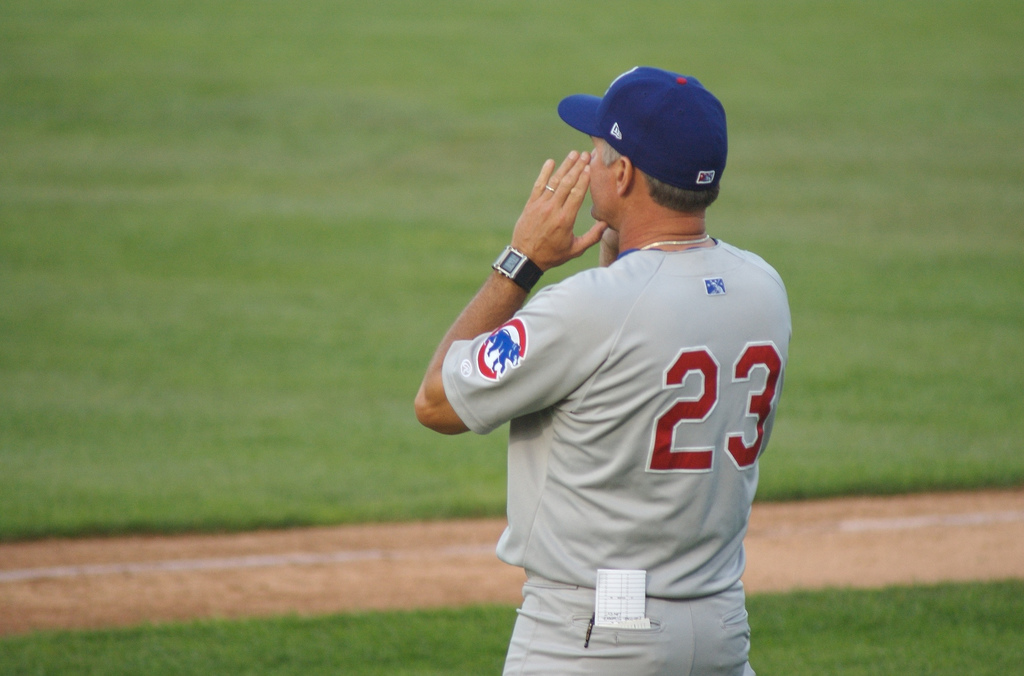
Angel Hernandez, Bryce Harper, Umpire Relations

Harper Learning the Rookie Ropes, by Hook or by Crook

Harper reacts to a called strike three.

This was to be the year of Trout and Harper, Harper and Trout, wonderkind rookies primed to change the face of baseball—and in late spring and early summer, it was.

It’s still the year of Mike Trout, of course. Bryce Harper, though: not so much. His high-water mark was a .307 batting average on June 12; three games later he went 0-for-7 against the Yankees, with five strikeouts, and has hit .210 over the 49 games since, with only three homers. Since the All-Star break, he’s batting .176.

Harper has been baseball’s most touted prospect since he was 16 years old, and now, for what may be the first time in his life, he’s scuffling in a significant way.

In the fourth inning of Wednesday’s game against the Astros, he took a two-strike pitch, low and outside from Armando Galarraga—“catcher Carlos Corporan’s mitt nearly scraped the dirt,” reported the Washington Post—so certain it was a ball that he stepped back into the box. Plate ump Angel Hernandez called it strike three.

Harper got into Hernandez’s face, shouting and pointing, and had to be physically removed by first base coach Trent Jewett.

It was a reaction borne of frustration, likely as much about Harper’s own struggles as Hernandez’s strike zone. The ump didn’t come close to ejecting the rookie (“Let him have his say—nothing wrong with that,” Hernandez told a pool reporter after the game) but it’s possible that the display affected his outlook toward Harper’s ensuing at-bats.

Umpires vociferously reject the notion that they ever test rookies in creative ways—denying them close calls as a means of putting them into their place, letting them know from the get-go who holds the power on a baseball diamond—but their ranks have long been accused of doing exactly that.

Former catcher Randy Knorr tells a story about Wade Miller’s first major league start, with the Houston Astros in 1999. He was struggling against the Arizona Diamondbacks, and plate umpire Rich Rieker wasn’t giving him any close calls. Miller was 22 years old, and was becoming increasingly frustrated at his inability to get a break from Rieker.

“[Miller] throws one pitch right down the middle and it’s called a ball,” said Knorr. “I throw the ball back out there and he’s looking in at the umpire. I say, ‘Hold on,’ and I call time out and run out to the mound. I said, ‘Wade, man, just get through today. If you get through today, you’ll be fine. Just don’t show up the umpire. He’s testing you. I’m trying to work him back there, so don’t be snapping the ball on him or anything like that.’ ”

Miller did as instructed, and though his day didn’t go well—he gave up seven runs in three innings and took the loss—when he walked past Rieker on his way off the field, the arbiter said, “Good job, Wade.”

In the sixth inning Wednesday, when Hernandez called a strike against Harper on another low, outside pitch—which would have been ball four from reliever Xavier Cedeno—it smacked of a similar type of rookie baiting. Harper had showed up the ump in the fourth by so publicly questioning his strike zone. This time the bases were loaded, and Harper had already started jogging to first; when he heard Hernandez’s strike call, he was sufficiently disbelieving as to take a few more steps.

Now the count was full, and Cedeno’s next pitch was again low and away. Again Harper watched it. Again it was called a strike. From the Post:

Harper cocked his bat with one hand, as if he was going to throw it, then restrained himself. He chucked his helmet and tossed his bat, and as he ripped his batting gloves off in the middle of the diamond he shook his head.

The calls were so questionable, and Harper so visibly upset, that Nationals first baseman Adam LaRoche checked in with Hernandez after the inning, the obvious on his mind. “I said, ‘What’s going on? From where I’m at, those balls are down.’ ” he said. “[Hernandez] assured me that they were good pitches. He said he would never do that to Bryce, he loves him, he loves the way he plays and that there’s no kind of initiation there. He called it the way he would call it to anybody.”

La Roche, a 9-year vet, has seen this kind of thing before. Without saying as much, he made it obvious that he felt like he recognized exactly what was going on.

“I’ve been in that position,” he said after the game. “I’ve talked to Bryce a lot about it. I said, ‘You’ve got to keep your mouth shut, but at some point, if it gets really bad, you’ve got to stand up for yourself and not sit there and take it.’ ”

Harper is still trying to figure that one out. Speaking the following day about Hernandez’s expanded zone, he said, “When you have to chase a 2-1 fastball two inches off, it’s not fun.”

The Post cited FanGraphs.com stats showing that only 40 percent of the pitches Harper has seen since the All-Star break have been in the strike zone (27th lowest in the majors), and he’s swung and missed at fewer than 30 percent of those (and at 8.5 percent of his pitches overall). These are good numbers, not usually aligned with a guy who’s striking out more than 22 percent of the time.

An umpiring conspiracy to deliver some humility to the guy who wore gold cleats in the All-Star Game as a teenager? A longshot, at best. But the notion that individual umps view Harper just a bit differently than they do other players around the league is not so far-fetched, especially considering the media hype that followed him through the first half of the season. Knowing one’s place in the baseball hierarchy has always been of vital importance to many of those involved in the game, and umpires are no exception.

If such calls are indeed intentional, each is only a small factor in putting Harper in his place. Cumulatively, however, they’re having an effect. Whether or not they’re just, there’s little doubt that the lessons Harper is learning today will be of use later in his career.

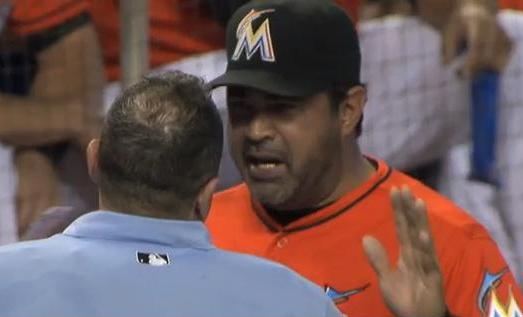
Cheating, Pine Tar

‘To My Hero, Ozzie. Love You,’ Sincerely, Bryce Harper

After Sunday’s Ozzie GuillenBryce Harper Hey, Are You Showing Me Up? staredown, some members of the Nationals brought a touch of levity to the situation.

On Monday, Edwin Jackson and Adam LaRoche had Harper sign a bat (not an unusual request in a big league clubhouse), then, without his knowledge, added the phrase “To my hero, Ozzie. Love you.” After slathering it with pine tar, and also without Harper’s knowledge, they sent it down the hall to the Marlins clubhouse as a sort of twisted peace offering.

(Why those two players? Jackson played under Guillen with the White Sox, and LaRoche—whose father, Dave, was a White Sox coach when Guillen played for them—has known the Miami manager since childhood. Both obviously harbor some fondness for the guy.)

Guillen received the bat with a laugh. The incident had already started to fade, but this was as happy a bow as one could have put on it. Still, not every such gesture is taken so lightly.

In 1987, after Mets slugger Howard Johnson had homered twice against St. Louis in two days, Cardinals manager Whitey Herzog suggested that corked bats might be involved. Johnson was in the midst of a breakout year—he had never hit more than 12 homers in any of his five major league seasons to that point, but his second blast against the Cardinals, on July 31, was his 26th in about four months. Herzog had the umpires check Johnson’s bat, which they determined to be clean.

It took just three days before Johnson found the perfect opportunity to respond. The Mets had wrapped up a series in Montreal, leaving town on Aug. 2. The next team to visit Olympic Stadium was none other than the Cardinals.

Knowing this, Johnson conspicuously left a bat in the visitors’ clubhouse, adorned with 20 wine corks dangling from strings. St. Louis pitcher Bill Dawley, who had served up one of Johnson’s home runs the previous week, wasn’t laughing.

“Very funny,” he said when the bat was discovered. “He’s going to get drilled.”

Cheating, Pine Tar

Pine Tar Gate 2.0: Ozzie Strikes Back

When Ozzie Guillen is positioned as a paragon of tact, it’s usually because one of two things has happened: we’ve entered bizarro world, or he’s being compared to somebody completely off the rails.

Sunday, it was the latter. Guillen’s managerial opponent was Davey Johnson of the Nationals, and the issue of the day was pine tar.

Apparently, Bryce Harper likes to use a lot of the stuff on his bats—more than the legal, 18-inch limit. The eyeball test puts that mark at about the bat’s logo, which makes the infraction relatively easy to spot from a distance.

Guillen noticed. Unlike Johnson, however—who just under a month ago got Rays pitcher Joel Perralta kicked out of a game and subsequently suspended for using the stuff—Guillen showed some restraint. After Harper’s first-inning at-bat, he quietly requested that the umpires make sure the problem was taken care of, in a way that nobody in the viewing audience would even notice.  (Short of embarrassing Harper, it’s largely a moot point; unlike Perralta’s situation, the worst penalty Harper could have incurred had he been officially checked was being forced to get a new bat, which is ultimately what he did, anyway. This is partly because pine tar on a bat has less effect than it does on a ball, the theory being that the extra tack could add backspin, leading to extra distance on flyballs.)

The umpires followed through, much to the disgruntlement of Washington’s young superstar. When the left-handed-hitting Harper came to the plate in the fourth inning, he pointed his new bat toward the third-base dugout—something he does as a matter of course when settling into his stance—which happened to be where Guillen and his team were sitting. This time, though, Harper stared daggers as he did it. It was a clear message, and Guillen took it as such, although because nobody’s really talking, the context remains muddled.

Guillen, clearly feeling disrespected after having gone out of his way to keep his initial criticism low-key, spent the next few moments informing Harper about new ways he could violate his own anatomy, while waving a bat of his own. Johnson shouted right back from Washington’s bench. (Watch Guillen taking his grievances to the umps here.)

“Ozzie complained that the pine tar was too high up on Harper’s bat, so we changed it,” said Johnson after the game in an MLB.com report. “Then, he was still chirping about it. It got on the umpire’s nerves. It got on my nerves.”

Davey Johnson as the voice of well-intentioned reason. Bizarro world, indeed.

Johnson guessed that Guillen was trying to intimidate Harper, which could well have been the case. Of course, he’d have to have willfully ignored the 19-year-old’s history with such tactics, lest he consider that Harper tends to respond to bullying by taking extra bases as a runner, then stealing home.

After the game, Harper rose above the fray. “Yeah, I switched bats,” he said, “but I just didn’t feel comfortable with the first one, so I moved to the second one.” (Also, this: “[Guillen] is a great manager to play for, and he’s going to battle for you no matter what. That’s a manager you want to play for.”)

Guillen, for perhaps the first time, kept some of the details to himself. “I was just telling him how cute he was,” he said.

Left to break it all down was Marlins outfielder Logan Morrison.

“Ozzie did it the right way,” he said. “He said, ‘I don’t want to make a big deal about it,’ and he told him to watch out about that pine tar. . . . [Ozzie] did him a favor by not going out there and saying, ‘Hey, your pine tar is too high,’ to the umpire. . . . He did it in a way that wouldn’t show Harper up, and Harper showing him up was kind of a slap in the face, I guess.”

Ultimately, Morrison’s right. Fault Guillen for his response to Harper’s bat pointing, a display that seemed benign and would have been a simple matter to ignore, but when it came to handling the initial situation, he was the antithesis of Billy Martin having George Brett’s bat checked, or Johnson with Perralta’s glove. In other words, tone perfect.

Update (7-16): Guillen says that if Harper keeps this kind of thing up, “he might not make it.” I love Ozzie Guillen—love him—but from where I sit, however, Harper doesn’t have much to worry about in that regard, having consistently taken the high road through the course of whatever big league tests have come his way. Except for maybe his All-Star spikes. Not much humble-rookie about those.

Cheating, Joel Peralta, Pine Tar

The Question is Raised: How Much Inside Information is Too Much?

Not to beat on the Maddon-Johnson pine tar affair too much (it may already be too late), but it’s given rise to at least one more interesting point. From Buster Olney’s column at ESPN.com:

When a player is traded and later faces his old teammates, his old team will change its signs, as a matter of course. It’s considered fair game to ask an incoming player for information about his previous team’s signs, or about how to pitch to batters on his old team, or about some other elements of that club. I’ve heard of teams specifically acquiring a player recently dumped by a rival largely for the information—especially catchers, who are the information highways of the sport.

But where is the line about what information you can use?

The key here, at least to me, is in a team’s ability to adjust. Catcher Bengie Molina went from the Giants to Texas in mid-season 2010, and when the teams met just over three months later in the World Series, the discussion was raised about how much advantage the Rangers might gain from his insider knowledge.

To judge by San Francisco’s five-game victory, not much. There’s a simple reason for that, at least as far as signs are concerned: They’re astoundingly simple to switch up. For all the gyrations a third-base coach goes through in delivering coded instructions to a baserunner, they typically don’t mean a thing until he hits his pre-designated indicator signal (such as, say, wiping across his belt buckle or touching his left shoulder), at which point the actual directive will follow. In this situation, changing signs can be as easy as switching the indicator.

Catchers’ signals are similar, in that many of the signs put down are subterfuge; the trick is knowing what to look for. It can be based on the count (a 3-1 count added together means the hot sign is the fourth one the catcher drops) or the number of outs or whether it’s an even- or odd-numbered inning. Sometimes the signs themselves are meaningless, and the pitcher is simply reading the number of pumps, or times the catcher flashes something. There are myriad possibilities, and for most players, changing from one to another is sufficiently simple to do multiple times during the course of a single game.

There’s also the reality that because many pitchers are particular about the signs they use, catchers have individual sets for different members of the pitching staff. This means that if a pitcher is traded, there’s a real possibility that he has little clue about what’s being used by any number of his former teammates.

This is a simplistic overview, of course, and teams can bring far more nuance to the practice—about which inside information may prove useful. Ultimately, though, I think there’s a straightforward answer to Olney’s question of whether sharing an ex-team’s signs is comparable to sharing intel about a pine tar habit: It isn’t. In Joel Peralta’s case, the fact that his pine tar was okay for the Nationals when he used it in Washington, but not okay for them once he left town, speaks to some hypocrisy. When it comes to signs, however, all teams use them, all players learn them, and they’re introduced with the understanding that, while they’re to be protected as closely as possible, they will inevitably have to be changed at some point.

If a former player hastens that inevitability, it’s simply part of the game.

Cheating, Joel Peralta, Pine Tar

Pine Tar Madness Grips Nation’s Capital!

What more fitting place than our nation’s capital for baseball’s latest incident involving high crimes and espionage, which we might as well call Pine Tar-gate right from the start because, well, somebody had to do it.

At one end of last night’s shenanigans was Rays reliever Joel Perralta, supplier of pine tar; at the other was Nationals manager Davey Johnson, who didn’t much care for the extra edge the substance may have afforded the opposing pitcher.

When Peralta came in to pitch the bottom of the eighth, Johnson asked plate ump Tim Tschida to check his glove. And with that, the right-hander was ejected before he even threw a pitch, for what Tschida later said was a “significant amount” of pine tar—a prelude to a likely 10-game suspension. On his way off the field, Peralta tipped his cap toward the visitors’ dugout, a sarcastic display that he later phrased in a Washington Post report as “Good for them.” (Watch it here.)

The moment held intrigue on several levels. One is the fact that the pitcher not only played for the Nationals, but absolutely blossomed for them, as well. At age 34, Peralta went from ERAs of 5.98 (with Kansas City in 2008) and 6.20 (with Colorado in ’09) to a splendid 2.02 mark for Washington in 2010. That season he led the team in WHIP, hits-allowed-per-nine-innings and strikeout-to-walk ratio.

We may now know the reason. Somebody in the Nationals organization obviously had inside information they were willing to share about Peralta’s extracurricular habits; on the coaching staff alone, Nationals bench coach Randy Knorr served as the team’s bullpen coach in 2010, and first base coach Trent Jewett managed Peralta in the minor leagues that same season.

Were either of these people—the Nationals insider who dropped a dime on Peralta, or the manager who was willing to exploit it—playing within the boundaries of the unwritten rules? The short answer is no, but comes with the caveat that Johnson clearly doesn’t care.

Davey Johnson

For proof of this, look no further than Game 3 of the 1988 National League Championship Series, when Johnson—then managing the Mets—asked the umps to check Dodgers reliever Jay Howell. Like Peralta 24 years later, pine tar was found on the laces of the right-hander’s glove. (Darryl Strawberry said that the extreme break on Howell’s pitches tipped Johnson off, but other sources fingered Mets minor league manager Tucker Ashford, who had played against Howell some years earlier.)

Unlike Tuesday’s game, that move appeared to be tactical; Johnson waited until Howell was trying to protect a 4-3, eighth-inning lead, with a full count on leadoff hitter Kevin McReynolds. Howell was summarily ejected, and his replacement, Alejandro Pena, quickly served up ball four, helping ignite a five-run Mets rally.

The Nationals organization also has a history with the topic. In 2005, then-manager Frank Robinson had umpires—oddly, Tschida was behind the plate in that game, as well—check Angels reliever Brendan Donnelly. He was tipped off by his outfielder, Jose Guillen, who had recently left Anaheim under acrimonious terms.

“There’s etiquette and there’s lack of etiquette,” said Donnely at the time, in a Washington Post report. Robinson’s behavior, he said, was “the latter.” Angels manager Mike Scioscia was furious, and threatened to “undress” Nationals pitchers in response. His reaction was not so far removed from that of Rays skipper Joe Maddon—who happened to be Scioscia’s bench coach at the time.

Maddon was peeved enough yesterday to order a retaliatory examination of his own; at the manager’s request, Tschida checked Washington pitcher Ryan Mattheus a half-inning after tossing Peralta, and found nothing amiss.

“Heads up,” Maddon sarcastically told reporters after the game, according to a MASN report, as he wiped his unblemished desktop with a paper towel. “The desk is a little sticky right there.”

His follow-up comments were pointed.

“Insider trading right there,” he said. “It’s bush. It’s bogus, man. That’s way too easy right there. If you had done some really good police work and noticed something, that’s different. But that’s way too easy. That was set up on a tee for them.”

Much of Madden’s disconcert concerns the substance in question. Pine tar is as benign a material as can be illegally found on a ballfield; it is so common that a bag of its powdered form, rosin, is kept atop every major league mound.

Unlike lubricants such as Vaseline or K-Y Jelly, which increase a pitch’s movement by decreasing friction as the ball rolls off a pitcher’s fingers—in effect, allowing it to squirt out rather than roll, with minimal backspin—pine tar adds tack. It’s primarily used by pitchers to get a feel for the ball on cold, wet nights, but—as may have been the case with Peralta, who was pitching in near-70-degree swelter—it can also add snap to a breaking ball.

Said 1997 AL Cy Young Award winner Jack McDowell: “The only [illegal substance] I ever saw was pine tar, and I guarantee 80 percent of the pitchers still use it.”

Apparently, Maddon agrees.

“You’re going to see brand new gloves throughout the major leagues, starting tomorrow—pitchers on every Major League ballclub,” he said after the game, suggesting that pitchers everywhere will be inspired by Tuesday’s events to lay low for a while.

“It’s kind of a common practice—people have done this for years,” he said. “To point one guy out because he had pitched here a couple of years ago, there was some common knowledge based on that. I thought it was cowardly. . . . It was kind of a (expletive) move. I like that word. (Expletive) move right there.”

Ultimately, Maddon is right: If Johnson wanted to play by the unwritten rules, he would either have ignored the pine tar on Peralta’s glove or handled the situation in a far less obvious manner. It’s a stretch to think that having the pitcher tossed even served to level the playing field, because it’s likely that both teams have one or more pitchers who search beyond the rulebook for a similar edge. (“Before you start throwing rocks,” said Maddon to Johnson, through the press, “understand where you live.”)

The standard bearer for Code-based reactions in this category is Tony La Russa, who, when confronted with the fact that Tigers pitcher Kenny Rogers clearly had a clump of pine tar on his left palm during the 2006 World Series, opted against having the pitcher checked—which would have almost certainly led to ejection and suspension—instead requesting only that the umpires make the pitcher wash his hands.

La Russa’s comment at the time: “I said, ‘I don’t like this stuff, let’s get it fixed. If it gets fixed, let’s play the game.’ . . . I detest any B.S. that gets in the way of competition.”

Johnson nailed his man on Tuesday, but it’s easy to feel like a touch too much of La Russa’s B.S. got in the way of Tampa Bay’s 5-4 victory. Then again, it is Washington D.C., a city whose political culture appears to have been built on the stuff.

Update (6-18): Johnson thinks Maddon is a “weird wuss.”

Update (6-20): Peralta got eight games.

Bryce Harper, Cole Hamels, Retaliation

All Quiet in Philly: Hamels-Harper Drama Reaches Accord

So the big showdown happened. Nearly three weeks after his drilling of Bryce Harper renewed baseball’s fascination with the unwritten rules, Cole Hamels stepped to the plate three times against Edwin Jackson, once with first base open, and didn’t even get brushed back.

People seem almost disappointed.

The Phillies, of course, got their retaliation back in the same game that Harper was first hit, when Jordan Zimmerman drilled Hamels in the leg. That effectively closed the book for both parties. There was a chance that Hamels’ after-the-fact admission could have earned him some extra attention, but that never came to pass.

Hamels said that it wasn’t “even in the back of my mind.”

Harper said everything was behind him, and that he didn’t think “anybody really cares about it anymore.”

Well, then. Movin’ on.

Bryce Harper, Rookie Etiquette

Harper Homers, High-Fives, Handles History

For a young player with a history of attitude, Bryce Harper did a lot right upon hitting his first home run Monday. After crushing a slider from Padres right-hander Tim Sauffer to dead center field, well beyond the 402 marker, Harper didn’t watch the ball, didn’t pirouette in the box, didn’t skip his way toward first and didn’t toss his bat.

What he did do: He put his head down, and he ran. (Watch it here.)

Perhaps it was the excitement of his first big league homer, but according to Tater Tot Tracker, the only guy this season to circle the bases faster than Harper’s 17.07 seconds was Milwaukee’s Carlos Gomez, who ran a 16.46 primarily because he didn’t realize the ball had cleared the fence until he was already at third base.

“I don’t want to show up that pitcher,” Harper said in the Washington Post. “The only time I would do that [would be] if they were messing with my team.”

After a few moments in the dugout, Harper emerged for a curtain call. Some might take issue with a rookie taking such a liberty—especially after all of one career homer—but the crowd was clamoring and the Nationals’ broadcast crew called it “a for-sure curtain call” before Harper even made a move.

“Everyone started cheering and whatnot, and I was just standing there waiting like, should I go? Nah, I better not. Don’t do it,” said Harper in a MASNSports.com report. “Then (Jayson) Werth was like, ‘Go, get up there, kid.’ ”

All in all, well-played for the rookie, who didn’t even have to face the silent treatment in the dugout, unlike some other notable players of late. After taking the highest of high roads against Cole Hamels last week, this is another indication that, even though he’s only 19, this kid gets the game on pretty much every level.

Bryce Harper, Cole Hamels, Retaliation

Message Sent: Hamels Drills Harper, Floodgates Open

This is the Code, at its deepest and most ingrained levels. It is the confluence of ability and pride and hype and the concept that all men must earn their successes. It is the old guard welcoming the new—player and team alike—with an unmistakable challenge: Welcome to the big time. Let’s see if you can hack it.

It was Cole Hamels, burying a fastball into the small of Bryce Harper’s back in the first inning Sunday (watch it here), partly to warn the 19-year-old phenom that life at this level will be harder than expected, partly to provide a physical component to the opinion that the Nationals’ 18-win, 9-loss, NL East-leading start—5.5 games ahead of last-place Philadelphia—was still at least 75 victories short of actually meaning something.

Just in case there was any leeway in possible interpretations, Hamels made things clear after the game, telling the world that the pitch was laden with meaning.

“I was trying to hit him,” the left-hander said in a Philly.com report. “I mean, I’m not going to deny it. It’s something that I grew up watching. I’m just trying to continue old baseball, because I think some people get away from it. I remember when I was a rookie, the strike zone was really, really small and you didn’t say anything, because that’s the way baseball is. But I think unfortunately sometimes the league is protecting certain players and making it not as that kind of old school, prestigious way of baseball.”

Whether Hamels was annoyed by Harper’s questioning the strike zone in an earlier game—even as the Phillies pitched around him—remains unclear; the pitcher declined to discuss the point at which he decided to plunk him. Little matter—this is how veterans handled rookies for generations, and was as retro an act as could be imagined in the modern game.

Frank Robinson was hit 20 times during his rookie season—the most of his career—a result, he said in the Sporting News, of “those guys . . . trying to test me. They were trying to see what I was made of.” Don Drysdale did much the same thing when he buzzed Orlando Cepeda in the future Hall of Famer’s first major league at-bat. In 1939, Browns manager Fred Haney ordered that Ted Williams be knocked down twice in a game, after the rookie had gone 7-for-16 against St. Louis over the previous four contests. Williams got up twice, and put a stop to the tactic with a homer, a double and six RBIs.

Which, to Harper’s credit, is not dissimilar from what Washington’s rookie ended up doing on Sunday. After Harper was drilled, he didn’t hesitate in taking third when the next batter, Jayson Werth, singled to left. The moment Hamels threw to first to keep Werth close, Harper broke for the plate, sliding in easily under the tag of Carlos Ruiz. (Watch it here.)

Harper’s skills have never been questioned. With displays like Sunday’s, his mental toughness will probably soon reach that point as well (if it hasn’t already). “If he continues to do that, he’s going to make a really good name for himself,” Hamels said afterward, admiringly.

The circle was closed in the top of the third, when Washington starter Jordan Zimmerman responded by hitting Hamels in the leg. (Unlike Hamels, Zimmerman denied intent. Also unlike Hamels, nobody believed him.) For his part, Hamels considered it an appropriate response.

“That’s the way it should work,” he said.

Hamels lost the battle but won the war. Harper aside, the Phillies’ left-hander shut down the Nationals over eight innings, allowing just five hits and Harper’s stolen run in a 9-3 victory. With as clear a message as Hamels delivered to the rookie, there appeared to be just as much intent toward an increasingly confident Nationals team that, Hunter Pence said in the Washington Post, was playing like they had “a chip on their shoulder.”

Which brings up one more possibility when dissecting Hamels’ mindset. The act brings to mind the time in 1974 when Dock Ellis tried to knock the swagger out of the upstart Cincinnati Reds, using the revolutionary tactic of hitting every batter he faced. Ellis opened the game by drilling Pete Rose, Joe Morgan and Dan Driessen in succession, then walked Tony Perez on four pitches after the first baseman—in clear recognition of imminent danger—bailed out as soon as each pitch was released. The right-hander was removed by befuddled Pirates manager Danny Murtaugh after going 2-0 on the next hitter, Johnny Bench, but by that point it didn’t matter—Ellis’ message had been sent. And here’s the key point: The most important recipients weren’t even members of the Reds, but Ellis’ own Pittsburgh teammates. Intimidating Cincinnati was an obvious bonus, but the pitcher’s primary goal was to jolt what he increasingly viewed as a complacent Pirates clubhouse.

It worked. Having won only six of 18 before the game, Pittsburgh went 82-62 the rest of the way and won the National League East for the fourth time in five years.

The Phillies, by contrast, have won the National League East five years running. Hamels hasn’t shared his views on his team’s toughness (or lack thereof), but as one of only two pitchers remaining from the beginning of that run (Kyle Kendrick is the other), it would not be surprising if Hamels wanted to send a message to a club struggling to maintain its position atop the National League’s pecking order.

Hamels’ act has drawn scorn from various circles, not least of them Washington’s front office. “I’ve never seen a more classless, gutless chickenshit act in my 30 years in baseball,” said Nationals General Manager Mike Rizzo in the Washington Post. “[Hamels] is the polar opposite of old school. He’s fake tough.”

Rizzo continued: “He thinks he’s going to intimidate us after hitting our 19-year rookie who’s eight games into the big leagues? He doesn’t know who he’s dealing with.”

In one capacity, at least, Rizzo is dead wrong. Hamels knows a lot about the guys he’s dealing with. At least the ones he’s dressing next to each day.

The pitcher’s message couldn’t have been more clear. Now it’s up to the rest of us to figure out its intended recipients.


Note: A version of this post just went up at Sports Illustrated.com.

Update (5/07): Hamels was just suspended for five games—a predictable result after his admission. He won’t appeal, which essentially just pushes him back a day, for a Sunday start.

Update II (5/07): Phils manager Charlie Manuel put into words what we all already knew (at least as it relates to punishment from the league): If nothing else, Hamels should have kept his mouth shut.

Update II (5/08): Jim Leyland has weighed in, and feels that Hamels’ suspension was too light. In a burst of counter-intuitive blogging, I tend to agree with him. The fact that he admitted it gave MLB little choice but to punish him. A five-game suspension for a starting pitcher, however, has negligible effect—especially when it comes, as it did for Hamels, immediately following a start. Specifics of this case aside, forcing a pitcher to miss action, rather than simply delaying his start by a day or two, would hold far more weight.

Update III (5/09): Apparently Hamels isn’t the only one who talks too much. Rizzo has picked up a fine for his comments.

Esmerling Vasquez, Jason Marquis, Jayson Werth, Justin Upton, Retaliation, Wilson Ramos

You Talk too Much, you Trot too Slow: Wilson Ramos, Come on Down!

Wilson Ramos approaches home plate.


A lot of things happened last week between the Diamondbacks and Nationals. Jayson Werth was hit three times, and made scary eyes at pitcher Ian Kennedy after the last one. An inning later, Washington’s Jason Marquis drilled Justin Upton for the fourth time in the series, and was tossed—as was his manager, Jim Riggleman. (Watch it here.)

In the eighth, Arizona reliever Esmerling Vasquez hit Danny Espinosa with a clearly intentional fastball (watch it here), bringing Werth to the top step of the dugout with a look that said he wanted nothing more than one more provocation to charge the mound.

It’s can all be dissected down to its core. Marquis denied intent, and while it certainly seemed like he meant it, it must be noted that a 1-0 game is not the time to settle scores. Also, it would have been entirely reasonable for plate ump Rob Drake to give Marquis one shot at response (or even acknowledge that the pitcher probably didn’t want to put anybody else on base) before bringing down the hammer. Still, Marquis drew a five-game suspension.

(To Drake’s benefit, Kennedy hit Michael Morse two batters after he hit Werth, and was not tossed out because it was clearly unintentional.)

Riggleman and D-Backs skipper Kirk Gibson were also suspended. Vasquez drew a three-game ban of his own, which seems well worth it for the third-year pitcher in light of the fact that his teammates appreciate him for having done something others on the staff have shied away from.

Still, despite the drama, it was all very straightforward stuff—you-hit-me, I-hit-you. A standard retaliatory dance.

Wilson Ramos, however, raised the stakes one batter after Espinosa was hit, when he slowed down his home run trot after blasting an eighth-inning bomb, and then slowed it down some more—all the way into the realm of clownishness. (Watch it here.)

Larry Granillo’s Tater Trot Tracker pegged Ramos’ journey at 28 seconds (despite the fact that he ran hard most of the way to first)—more than 20 percent slower than his usually glacial pace.

From Granillo:

My first thought, as I watched the home run the first time, was that it looked like Ramos had slowed down into his final walk—you know how trotters tend to slow down those last 10 or 15 feet before home plate—about 250 feet too early.

But it only got worse. At both second and third base, you can see Ramos go into an even slower trot before essentially strolling the last 45 feet.

The truly crazy part? After the game, Ramos said this:

“I didn’t feel bad. I wanted to see those guys angry.”

Admitting one’s sins  is a cardinal Code violation (although even in the best circumstances it’s difficult to deny ownership over one’s own jogging pace.) Unlike a pitcher who admits to hitting a batter intentionally, this is not an actionable violation as far as the league office is concerned. It is, however, a stratospheric level of trash talk. And Ramos got his wish in seeing them angry, at least as far as Matt Williams was concerned.

Williams, Arizona’s third-base coach, is one of the premiere Code warriors of his generation. He is the standard-bearer when it comes to circling the bases properly after hitting a homer—head down and quickly.

Also, he’s never been shy about informing players—teammates and opposition alike—should they be so foolish as to violate an unwritten rule in his presence. As Ramos circled the bases, Williams visibly steamed.

(Dan Steinberg has some great screenshots of it over at the Washington Post. He also passes along this quote from TV analyst Mark Grace: “If that look is directed towards you, folks? Go home. I suggest you go home when Matt Williams looks at you like that.”)

Ramos got his reward (his trot) and then got it again (his comments), but he’ll almost certainly pay the price. The teams next meet on Aug. 22. The question now seems less about whether Ramos will be drilled, but when—and maybe even how many times.

Considering that Werth, Upton and their teammates already have a short fuse for this type of thing when it concerns this matchup, there’s plenty to look forward to.

– Jason

Don't Showboat

Hey, Pitcher: Bryce Harper Sends his Love

At this point, the minor leagues are a mixed bag for Bryce Harper. On one hand, he has to deal with long bus rides and crappy clubhouse food.

On the other hand, accounts of the firestorm he ignited yesterday by blowing a kiss to the pitcher who had just served him up a home run are inevitably concluded with a caveat along the lines of, “It’s the minor leagues; this is all part of the learning process.”

(Of course, were he in the majors, the video of his little discrepancy wouldn’t be embeddable, and thus watched across countless Web pages this morning.)

After Harper smacked his homer against Greensboro’s Zach Neal, he stood in the box, then slowly—slooooowly—walked up the line as he watched it clear the fence. That alone would have earned him a drilling at the big league level, but as he crossed the plate he upped the ante, turning his head toward Neal and puckering his lips.

It was stupid. It was juvenile. But ultimately those caveats were right: it is what the minor leagues are for. Harper is 18 years old. His actions indicated neither class nor respect, but those things are not necessarily inherent in teenaged humans.

Duane Kuiper was on the radio in San Francisco yesterday, before this story broke, talking about the MLB draft. Had he signed a pro contract straight out of high school, he said, moving from his family’s Wisconsin farm directly to the minor leagues, he would have ended up right back on that farm inside of two seasons. Some kids are ready at that age to make such leap, but by his own admission, Kuiper (who ultimately graduated from Southern Illinois University) of was not one of them.

Harper might not be one of them, either. Going back to the farm, however, is not an option. The $9.9 million contract he signed has placed him higher on the food chain than peers and coaches alike. He was on the cover of Sports Illustrated at age 16, and has had his ass kissed on a fairly consistent basis for the bulk of his teenage life. This is not his fault (nor is it even necessarily a bad thing), but it hardly encourages appropriate development of socialization skills.

He’s clearly aware that a quick ascension to the big leagues is all but assured, no matter how boorish his behavior.

Greensboro’s response—in Harper’s next at-bat he was backed up by an inside fastball—had about as much teeth as anything else the guy will face as long as he’s the biggest fish (by a wide margin) in a comparatively small pond. He will become socialized some day—when veterans whose status and contracts exceed his own put him in his place.

“At some point the game itself, the competition on the field, is going to have to figure out a way to police this young man,” said Mike Schmidt on SportsCenter. “If indeed his manager won’t, the game will end up taking care of it.”

That’s the way of the Code. Until Harper reaches the big leagues, however, let’s see him for what he is: a clueless 18-year-old who deserves a chance to figure things out.

– Jason

Update (June 8): Oh, my. Now there’s this.