Pickoff Throws

Moderation is a Virtue, Right? Or: Did Bruce Chen Really Throw to First 10 Straight Times?

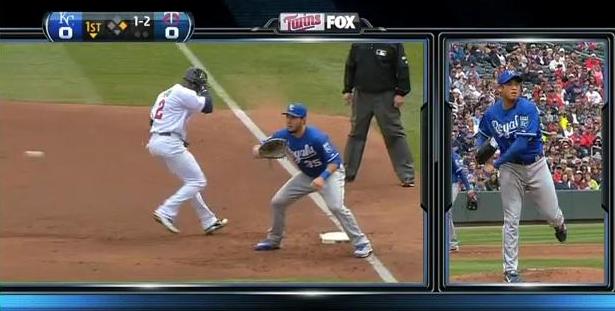
Yesterday, Bruce Chen threw to first 10 consecutive times in an effort to keep Minnesota’s Denard Span close to the bag. (Watch them all here.) Span never ended up taking off, and Yahoo’s Kevin Kaduk wondered whether there might be an unwritten rule to cover situations like this.

The short answer: Not that I know of. Winning is paramount, and if it makes sense to a pitcher to go nutty in his efforts to keep a runner from stealing, he’s entitled to it. Had it happened in the middle of a blowout, of course—as opposed to the first inning of a scoreless game, as was the case for Chen—then the pitcher would have to field angry questions from his own dugout, as well as that of the opposition.

Because we’re on the topic, here are some unwritten rule incidents involving pickoff throws, which have nothing to do with the frequency of attempts.

  • Former Giants manager Roger Craig would occasionally order an abundance of pickoff attempts to give guys on his bench additional opportunities to decode the other team’s signs. “I had pitchers shake off pickoff moves,” said catcher Bob Brenly, in the Fort Lauderdale Sun-Sentinel. “I had to give [pitchers] the ‘thumb’ sign—Roger called it—to get them to throw the ball over there.”
  • In a 1997 game, the Mets called for extra pickoff attempts when Roger Clemens, then with the Blue Jays, was on second. Their strategy: wear him out on the basepath. Clemens didn’t take long to figure it out, and warned shortstop Rey Ordonez that the next throw to second would put a target on a New York hitter in the ensuing inning.
  • While pickoffs are generally verboten late in blowout games, Dave Righetti felt justified in picking off Brett Butler in the ninth inning of a game in which the Dodgers led the Giants, 12-1. It was the final day of the 1993 season, and although San Francisco had won 103 games, they needed one more win to tie Atlanta atop the NL West. By the ninth inning, it was clear they weren’t going to get it. So when Butler led off the frame with a single, then took an enormous lead, Righetti was particularly sensitive, reading it as an indicator that the runner was about to take off. “A guy has no business running at that point in a game like that, and it ticked me off that he was even thinking about it,” said Righetti. “Well, his lead was so big that I picked him off—but if he had tried to steal second, I would have gone out there and we would have brawled.”  

Fight pre-emption via Code violation. Seems like as good a reason as any.

Don't Call Out Teammates in the Press, Teammate Relations

Angels Sink Lower, Take Verbal Swipes at Each Other, Meet to Clear Things Up, Lose Again

Remember how last week Bobby Valentine declared, for no apparent reason and on TV, no less, that Kevin Youkilis was not “as physically or emotionally into the game as he has been in the past”? One of my ensuing conclusions was that, had Valentine seen said comment as his final line of recourse in reaching a problematic Youkilis, it would have been entirely justified.

It wasn’t, of course. Youkilis appears merely to be scuffling, not mentally checked out, and Valentine was just popping off, as he’s known to do.

Still, the sentiment holds. Yesterday, it might have held in the visitors’ clubhouse at Tropicana Field, where Torii Hunter alluded to the press that some people may have some problems with Angels manager Mike Scioscia.

With Los Angeles in last place, having just lost their third in a row and sixth of their last eight, Hunter handed a barely veiled reference to the Los Angeles Times. “I don’t think we believe we’re trying that hard,” he said. “We’re just going through the motions. We have to do what we’re capable of doing. That’s everybody, not just the players.”

Scioscia is a pretty clear target for the phrase, “not just the players.” What did Hunter mean? The Times’ Mike DiGiovanna led his story with it:

Not only are the Angels not hitting, they’re not stealing bases, bunting, executing hit-and-run plays and pushing the envelope offensively, all trademarks of Mike Scioscia-managed teams.

They’re not scratching and clawing or sacrificing themselves enough for the team, and those deficiencies, as well as an inability to hit in the clutch, were evident again Wednesday night . . .

DiGiovanna’s guess was that Hunter was referring specifically to Sciocia’s failure to have Macier Izturis bunt Hunter and Vernon Wells over, after they led off the second with singles. Izturis ended up flying to left, and both runners were eventually stranded.

Asked if the game could have changed with some early execution, Hunter said, “You mean if we bunted in the second? What can we do? All we do is play the game.”

The Angels held a pre-game, players-only meeting today, following a previous meeting eight days ago, in which Scioscia apparently told his charges they had to “grind it out.” The wagons are officially being circled.

Whatever was said by Angels players today, one thing is clear: By this point in his career, Scioscia has earned the right to be above public scrutiny by his players, frustrated as they may be. Hunter is one of the few in the game who can get away with something like that, owing to his own reputation and veteran status. Still, it speaks to some serious fractures among the ranks, which is just what today’s meeting was designed to address.

Such is the nature of this kind of thing that it did not present early returns. The Angels scored only three runs against Tampa Bay Thursday, and lost, 4-3,  on a game-ending, two-run homer by Brandon Allen.

(DiGiovanna weighed in on Sciocia’s in-game machinations with a ninth-inning tweet —”Unconventional move by #Angels MRG… and I like it. For a change”—after reliever Scott Downs opened the frame instead of closer Jordan Walden, with the Angels holding a one-run lead. Walden came in after Downs retired Matt Joyce. Two batters later, the game was over.)

These are the kinds of things that happen on losing ballclubs—especially those predicted by many to reach the World Series. Still, it’s only April, and nobody knows how much time is left in the season better than a roster full of veterans. Now we’ll see how much longer they can keep their mouths shut.

(Via Hardball Talk.)

Buster Posey, Retaliation, Sam LeCure

A Time and a Place for Everything, or: What Was it You Were Retaliating for, Again?

Buster's revenge: Posey takes Sam LeCure deep in the ninth.

In baseball, it’s not difficult to determine what constitutes a retaliation-worthy offense, and what does not. Intent behind that HBP? Retaliate away. Nobody should say a word.

On Tuesday, however, Reds reliever Sam LeCure apparently didn’t care for the fact that Joey Votto was drilled in the backside by San Francisco’s Dan Otero during what would become a six-run inning. What he failed to consider: Otero is a rookie with all of 6.2 innings to his name this season, and was in the midst of a full-throated meltdown—all six runs were his, in fewer than two innings—that saw his ERA rise from 2.70 to 8.64. The guy was clearly not hitting his marks.

Which didn’t keep LeCure from putting a ball behind Buster Posey’s knee in the ninth.

Giants manager Bruce Bochy was seen to mouth the words, “That’s fucking bullshit” in the dugout, and was more than happy to expound on that theme after the game.

“The kid (Otero) has got two weeks in the big-leagues,” he told the press. “He’s trying to get through an inning. He’s trying to survive. He’s not trying to hit anybody. He was scuffling out there. I’m sure he was nervous. . . . That’s how people get hurt. Here’s a guy (Posey) we lost for a long time last year and he gets a ball thrown at his kneecap.”

Henry Schulman of the San Francisco Chronicle had an interesting take on LeCure’s rationale, going back to Daniel Hudson’s preseason proclamation that Arizona pitchers would no longer tolerate shots at their teammates:

During spring training, Arizonastarter Daniel Hudson articulated a warning to all the pitchers in the National League. Justin Upton is the Diamondbacks’ best player and he was hit by 19 pitches last year, most in the National League. So Hudson made it clear that if Upton continued to get hit, the Diamondbacks would retaliate.

I get that. I also get that sometimes it’s OK for a team to retaliate for a hit batter even if it was accidental, if it keeps happening over and over. At some point, the batter’s team needs to show it will not let opponents continue to use a guy as a dartboard, and there will be consequences.

Thus, when Reds reliever Sam LeCure threw behind Buster Posey in the ninth inning of tonight’s 9-2 Reds win, in obvious retaliation for Dan Otero’s equally obvious accidental drilling of Joey Votto in the seventh, I initially thought it was OK. I figured Votto had been a target lately and LeCure was just doing with the baseball what Hudson did with his language in spring training. So I grabbed the stat sheet to see how many times Votto had been hit this season.

Zero.

The part that makes the least sense is that the Giants’ leadoff batter the following inning was none other than Dan Otero (who was left in to mop up what was by then a hopeless game). Holding an eight-run lead, Reds reliever Jose Arredondo proceeded to strike him out. That was Cincinnati’s best—and some would say, only, as far as justification is concerned—shot at retaliation. That it took another inning and a different pitcher to get it done speaks to darker things. There’s a chance that Arredondo was influenced by Reds starter Matt Latos—so outspoken in his dislike of the Giants that before the game he handed a ball to the Cincinnati broadcasters inscribed with the phrase, “I hate the Giants.” (Latos and San Francisco built up no shortage of animosity in 2010, when the right-hander pitched for San Diego.)

The dugouts were warned, after which Posey got the best kind of revenge: He hit a two-run homer that ended Cincinnati’s bid for a shutout.

Teams play again today. Stay tuned.

No-Hitter Etiquette, Philip Humber

Man, There are a Lot of Things One is Supposed to do During the Course of a No-Hitter

In the wake of Philip Humber’s perfect game on Saturday, the Code-chronicling community (we’re small, but mighty) was left to look for peculiarities in the action. While there have so far been no earth-shattering revelations, assorted items have been mentioned in passing in various accounts of the action:

  • White Sox players did indeed give the pitcher some space on the bench as the game unfolded, moving “farther and farther away from Humber as he approached history, leaving him alone,” according to the Associated Press.
  • Some on the bench, however, did mention the deed, though not to Humber directly. From the Chicago Sun-Times: After the eighth inning, A.J. Pierzynski turned to Sox pitcher Jake Peavy and said, ‘Man, I’m nervous.’ ” (The man already had some history with no-hitter etiquette.)
  • Humber’s not one to buy into the silence-is-golden rule. From his post-game press conference: “I don’t believe in superstitions or anything like that, so when guys were getting hits or scoring runs, I was shaking their hands, and when they’d make plays in the field I was telling them, great job. I don’t like to be isolated like that. I like to stay in the game, and be relaxed, and be a teammate.”
  • White Sox manager Robin Ventura does not necessarily agree. Also from the post-game presser: “I still haven’t talked to him—I still have that superstition. I was staying away from him.”
  • Which doesn’t mean that superstition rules all of Ventura’s decisions. While some feel that nothing should be changed during the course of a no-hitter, Ventura inserted Brent Lillibridge in left field in the bottom of the eighth as a defensive replacement for Dayan Viciedo. With one out, Kyle Seager laced a drive down the line, which Lillibridge—significantly speedier than Viciedo—caught up to without much effort.
  • At which point it should be noted that the White Sox’s previous perfecto—tossed by Mark Buehrle in 2009—was saved by a ninth-inning circus catch by Dewayne Wise against the center field wall. Wise had been inserted for defensive purposes in the top of the inning.
  • Munenori Kawasaki tried to bunt his way on with two outs in the sixth and a 3-0 score. Kawasaki is in his first season in the big leagues after a lengthy career in Japan. I am unclear about how this type of thing is viewed over there.
  • Finally, Mariners broadcaster Dave Sims was hardly shy about mentioning the words “no-hitter” and “perfect game” through the later innings. Granted, Sims doesn’t work for the White Sox, but he has precedent on his side when it comes to his stance in such situations. (Funny how broadcasters take heat if a pitcher blows a no-hitter after they’ve talked about it, but the broadcast jinx is rarely mentioned if the pitcher completes his gem under similar circumstances.)

If more arises from this in coming days, I’ll tack it on here.

Update (4-24): Larry Stone has a column up over at the Seattle Times, in which he speaks with five people who were at the game. No real new information, just another measure of awe from one of the best in the business.

Matt Moore, Pitch Tipping

Big Tipper: Rays Worry About Moore Giving Away Too Much Information

In Tampa, hopes are high for pitcher Matt Moore. The 22-year-old is one of the top prospects in all of baseball, and a rotation anchor—they hope—for years to come.

Which is why when things started to go wrong for him early this season, especially after Sunday’s 6-4 loss to Boston, in which Moore gave up six runs and eight hits in 6.1 innings. Even as that game unfolded, team brass tried to figure out what was going wrong.

Their first thought: Tipping. As in, Moore was telegraphing the type of pitch he was about to throw, just before he threw it. From the Tampa Bay Times:

In acknowledging how “locked-in” [the Red Sox] were, Rays manager Joe Maddon mentioned, open-endedly, that “it’s like they know what’s coming almost.” He noted how “they’re on everything right now,” no matter what type of pitch it was, and how they were “spitting on”—taking—certain borderline pitches.

What raised the specific pitch-tipping concerns about Moore were the aggressive swings the Red Sox were taking, particularly unexpected given their limited previous exposure to him.

By the fifth inning, pitching coach Jim Hickey was meeting with Moore and catcher Chris Gimenez to try to figure things out. Gimenez said they thought that Moore might be “tapping his glove on his fastball.”

To guard against the possibility that it was something else entirely—like Boston hitters peeking at signs—Gimenez began setting up as late as possible, just before Moore was ready to pitch.

Their concerns were assuaged after reviewing video of the game, which showed that the hammered pitches were all out over the plate—hittable because they were bad, not tipped. Moore seemed all too relieved to eliminate tipping as a cause of his woes.

“Maybe [I tipped some pitches] years ago when I was in rookie ball or something like that,” he said in the Times. “But not as far as I can remember.”

The thing is, such frailties can manifest even in veteran pitchers with no such history. In the last couple of seasons alone, we’ve seen similar issues with Tim Lincecum (who quickly corrected things), Johan Santana and Ben Sheets. From The Baseball Codes:

Tells can be as simple as a pitcher keeping his glove snapped tight when throwing a fastball but flaring it out for a breaking ball, or coming set with his glove at his belt for one type of pitch but at his chest for another. Matt Morris, for example, was lit up by the Braves during his rookie season in St. Louis after they noticed that the exposed index finger on his glove hand pointed upward whenever he threw a fastball, but lay flat for curves. Once he pinpointed the trouble, Morris quickly fixed it by attaching a flap to his glove that covered the finger.

Examples like this litter the game’s history. When Babe Ruth first came to the American League as a pitcher with the Red Sox, he curled his tongue in the corner of his mouth whenever he threw a curveball—a habit he was forced to break once enough hitters became aware of it. Kansas City’s Mark Gubicza was cured of his tendency to stick out his tongue when throwing a breaking ball under similar circumstances. Ty Cobb reg­ularly stole bases against Cy Young, abetted, said the outfielder, by the fact that Young’s arms drifted away from his body when he came set before throwing to first; when he was preparing to pitch, he pulled his arms in.

Pitcher Todd Jones dished similar dirt on several competitors in an article he wrote for Sporting News in 2004: “When Andy Benes pitched, he always would grind his teeth when throwing a slider. In Hideo Nomo’s first stint inL.A., he’d grip his split-finger fastball differently than his fastball. Randy Johnson would angle his glove differently on his slider than on his fastball. I’ve been guilty of looking at the third-base coach as I come set when gripping my curveball. When hitters see this, word gets around the league. In fact, my old teammate Larry Walker was the one who told me what I was doing. He said he could call my pitches from the outfield.”

We’ll see tonight if all this deliberation has made a difference, when Moore makes his first start since Boston, against the Twins.

Deke Appropriately, Jimmy Rollins

The Power of Suggestion: How to Clear the Bases with a Wave of the Hand

Josh Thole in the midst of disbelieving that he's actually been snookered quite as badly as he actually was.

When Jimmy Rollins held up his hand toward Mets baserunner Josh Thole last week, it meant by every indication that the ball was no longer in play–in this case, a bunt gone foul. Thole, who had steamed into second base on R.A. Dickey‘s sacrifice attempt, started jogging back to first.

The problem, at least as far as Thole was concerned, was that Dickey’s ball was still live, having been laid down perfectly inside the line. Cliff Lee threw the ball to Rollins, who relayed it to first baseman Jim Thome just ahead of a desperately diving baserunner. (Watch it here.)

“Jimmy put his hands up, like ‘Come in easy. You can come in easy,’ ” said Thole after the game in the Newark Star-Ledger. He later continued: “I looked at the umpire, and got a weird stare from him, and then I looked back and the ball was on his way to first. I didn’t know what else to do. I just kept running.”

If Rollins’ gesture was intentional (and with the shortstop failing to address the issue after the game, there is little reason to think that it wasn’t; see a screen grab at Philly.com), he added an entry to a sizeable section of Code dealing with gamesmanship. At its core: Get every advantage you can, in any way possible. Such plays are known as dekes (short for “decoy”), and although Rollins’ example wasn’t typical of the genre, it wasn’t quite original, either. From TheBaseball Codes:

In a 1972 game between the Giants and Padres, Johnny Jeter stole a base so easily that there was no throw. He dived headfirst into the base anyway, a clear sign that he hadn’t looked in to follow the action. See­ing this, San Francisco shortstop Chris Speier pounced. “Hold up, hold up—foul ball,” he said nonchalantly. Astonishingly, the ploy worked. Jeter started back to first base, Giants catcher Dave Rader fired the ball to second, and Jeter was tagged out. “Oh shit, was he pissed,” said Speier, grinning at the thought more than three decades later.

This gets to the heart of the issue. Had Jeter—or Thole, 40 years later—been paying attention, neither would have gotten snookered.

“I don’t think any baserunner should fall for a deke,” said Rangers manager Ron Washington. “There are things I’m supposed to be doing when a ball is put in play, so how can you deke me? A ball is hit, and I’m supposed to know where that ball is at all times. And if I run blind and get deked out, whose fault is that? Is that the infielder who deked me out, or is that my fault for not knowing what’s going on?”

The problem for Thole was that he had been paying attention.

“I knew the ball was fair,” he said in the Star-Ledger. “I even looked down. You can go watch the video. I checked in. The ball was on the floor. I just took off running back to first. I’ve got no other explanation . . . I don’t know what I was thinking.”


Umpire Relations

How to Make Friends and Influence People (or Not): Umpire Edition

Things got testy for Denard Span Tuesday.

We know already that there are different ways to deal with umpires—some effective, some not so much. We know already that superstars have more leeway in this regard than the average player. And if we didn’t know already that you may as well go ahead and vent once you have nothing left to lose in a game—say, if you’ve just been rung up on three pitches out of the strike zone as your team’s final out in the ninth inning—we learned about it on Monday.

We’ve learned a lot about umpire relations since Monday, in fact. Three examples (at least), in three different situations, with three different kinds of player. Whether these examples set any sort of precedent when it comes to understanding player-umpire relations is less clear than the fact that they were all wildly entertaining, and gave some insight into the psyches of those involved, players and umpires alike.

Start with Monday’s game in San Francisco, in which Roy Halladay walked Aubrey Huff in the fifth inning on an 88 mph cutter with two outs and a runner on first. Trouble was, Halladay didn’t agree that the pitch was a ball. (To his credit, neither pitch-tracking service Brooks Baseball; thanks to Hardball Talk for the link.)  From the Philadelphia Inquirer’s Matt Gelb:

Halladay snatched the throw from Carlos Ruiz and didn’t flinch. His eyes were focused on (Marty) Foster, the home-plate umpire . . . Foster noticed the death stare. He said something to Halladay, who barked back. Then Halladay pointed to make his anger totally clear. It was a brief exchange, one Halladay later claimed was not directed at Foster. But that was the pitcher’s way of being diplomatic.

The result: Five pitches later, Halladay threw another cutter to Brandon Belt, this one well off the plate. It was called a strike, Belt’s third of the at-bat. Inning over.

“His demands had been heard,” wrote Gelb. Halladay had “conquered the umpire.”

Across the country, more balls were being called strikes, including three of Fernando Rodney’s five pitches to Cody Ross, Boston’s final batter in the final frame of a 1-0 loss to Tampa Bay.  (See them in another chart from Brooks Baseball, also via Hardball Talk.)

Ross, suffice it to say, was less than pleased, going off later in the Boston Herald about the ignominy of what had just occurred, calling the judgement of plate ump Larry Vanover “unacceptable.”

“If I’m going up there and striking out every at-bat, I’m going to get benched,” he said. “But it’s not that way with (umpires). They can go out there and make bad calls all day, and they’re not going to be held accountable for it.”

Confronting an umpire apparently made a difference for Halladay. The same might be said for Ross (who did it through the press), but not in a way that held any appeal for the player. It could be coincidence, but the following day, three Rangers pitchers struck out a total of 11 Boston hitters—a team high since opening day, when they struck out 13 White Sox—as Texas cruised, 18-3.

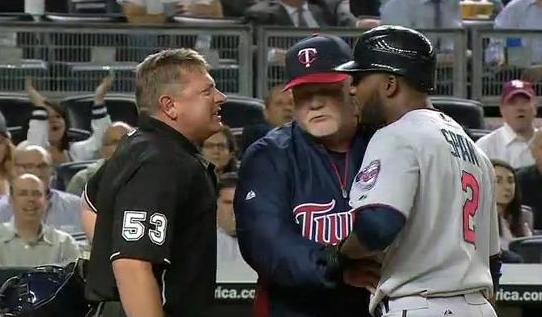
On Tuesday in New York, Minnesota’s Denard Span was tossed by plate ump Greg Gibson for arguing balls and strikes. Actually, he was tossed for the fact that he did so in an obvious fashion, swiveling his head backward as he stood in his batting stance to face the ump during the course of the conversation. (See it all here.)

It’s well-known that such a move is widely taken as disrespectful by umpires, and few are willing to tolerate much, if any, of it. This became clear when Span was caught by on-field microphones saying, “I didn’t disrespect you,” shortly before he was tossed.

Said Span in the Minneapolis Star Tribune, “It went from Level 1 to “Level 10 in like two seconds.”

“You don’t want to turn on an umpire, to show him up,” said longtime catcher Ron Hassey, discussing the general concept, not Span specifically. “If you’re going to talk, talk straight out. He knows what’s going on. He can hear you.”

Ultimately, what do all these interactions tell us? Unfortunately, not a heck of a lot. Every ump is different, as are players’ relationships with them. Halladay’s ability to stare down an umpire certainly had no bearing on Span’s inability to try to talk sense to one.

None of the three players, of course, had anything on former Yankees pitcher Ryne Duren, long noted for his combination of blazing fastball and lack of control. Jim Bouton recounted in his book, I’m Glad You Didn’t Take it Personally, the time that Duren walked three straight hitters on 12 neck-high fastballs. Wrote Bouton:

Finally he walked across a run and he stormed up to the home-plate umpire. “Goddammit, where the hell are those pitches?”

“Right up here, Ryne,” the umpire said, pointing to his neck.

“Well, goddammit,” Duren said, “I’ve got to have that pitch.”

Bobby Valentine, Kevin Youkilis, Managers Protect Their Players, Sports Illustrated.com

Now at SI.com: Bobby Valentine Sometimes Says Stupid Things

My latest is up over at Sports Illustrated.com, involving Bobby Valentine‘s recent comments about Kevin Youkilis. You can click over there to see a full-color photo of Bobby V during game action, or you can save your mouse-clicking finger and just scroll down. (Bonus points for reading it here: The original, un-edited ending!)

One update: Between the time I turned in the copy yesterday and this morning, video of Valentine’s press conference, in which he discusses the situation, has been posted on the Red Sox Web site. In it, the manager says that he talked to Youkilis “during the game” (this after an earlier apology did not appear to go well), and that, instead of everything being fine, “it is what it is.”

If things don’t get better in a hurry over there, it’s pretty clear they’re going to get a lot worse.

On to SI:

Bobby Valentine was brought to Boston as a knee-jerk reaction to a perfect storm of last year’s late-season collapse, wild accusations about allegedly dispassionate players, and a clubhouse culture that allowed such accusations to surface in the first place.

Blaming Terry Francona is one thing, but expecting a guy like Valentine — long on baseball acumen but short on verbal filters — to provide a calming influence to a team in turmoil was, at best, a crapshoot. Not yet two weeks into the the 2012 regular season, Valentine is embroiled in his first controversy.

It may seem innocuous, going on television as Valentine did and saying that Kevin Youkilis is not “as physically or emotionally into the game as he has been in the past.” It was a phrase amid an otherwise complementary comment; Valentine is obviously invested in Youkilis’ success, and he made sure to note that his third baseman’s slow start appears to be turning around.

None of that matters, of course. In baseball, a manager’s primary duty away from the field is to protect his players at any cost, usually from the media, at least until the point that a player leaves him no other option. If Youkilis has somehow already reached that point with Valentine, if his manager felt that calling him out in a local television interview was the only recourse left to reach him, well, that would constitute a newsworthy story. Other than his manager’s off-the-cuff banter, however, there is no indication that this is the case.

Instead, Valentine and the Red Sox are left to deal with the fallout, which serves to illustrate precisely why managers are expected to be measured in public statements about their players. Now, instead of coming to the ballpark and focusing on the game at hand, Youkilis has to answer questions about his manager’s lack of confidence, in addition to questions about his slump. Now, Dustin Pedroia has to step back from his own preparations in order, as a team leader, to defend his compatriot. Now, the rest of Boston’s players have to wonder what it might take before their manager publicly questions them, as well. Now, Valentine, the man brought in to help manage a media circus, has added a ring to the big top, and — inadvertently or not — is forcing his players to dance through hoops before they reach the field.

The unwritten rule to protect your players is why Whitey Herzog refused to admit that Keith Hernandez’s drug use (and his subsequent untruths when discussing it) were motivating factors in his being dealt to the Mets in 1983, even as the manager took considerable grief for the deal.

This rule is why Joe Torre, after Roger Clemens threw a bat shard at Mike Piazza during the 2001 World Series, refrained from storming out of his postgame interview amid a battery of leading questions. He knew Clemens was to follow him in front of the press, and wanted to absorb the difficult queries himself.

This rule is why Tony La Russa defended Jose Canseco long after steroid accusations against him became part of the public dialogue, and it is likely why he continued to defend Mark McGwire against similar charges after even many of his staunchest defenders had long since given up.

This rule is why Arizona manager Bob Brenly so vociferously attacked Ben Davis in the press following the Padres catcher’s bunt single that broke up Curt Schilling‘s perfect game in 2001. It was less because Brenly was angry at Davis, he said, and more because he wanted his pitcher to know that he “was looking out for his interests.”

For a clear comparison, consider two baseball stories, both of which involve pitchers being pulled from games in which their teams led by identical 4-2 scores. In one, A’s manager Ken Macha discussed with the press the fact that Barry Zito removed himself from the penultimate game of the 2004 season, with the division on the line against the Angels, after 114 pitches. Zito logged seven full innings, but Oakland’s bullpen gave up three quick runs, and Anaheim went on to win the game and a spot in the postseason. There was heat for pulling an effective pitcher, and Macha wanted no part of it.

In the other, Tigers manager Mayo Smith opted in 1969 to keep quiet about the fact that he pulled his own starting pitcher, Denny McLain, with one out in the sixth inning, after McLain warned him that he was tiring. Reliever Darryl Patterson came on and gave up, in order, a single, a walk, a sacrifice fly and a three-run homer; Detroit lost, 6-4.

Afterward, with media speculation raging about Smith’s decision to remove his star pitcher so early, the manager refrained from divulging the fact that McLain had effectively removed himself, not to mention that he had left the park altogether by the eighth inning. Smith kept quiet even when telling the truth would have deflected criticism. Valentine didn’t even have that for motivation.

Valentine has publicly apologized to Youkilis, but a question for players in the Boston clubhouse may soon arise—if it hasn’t already—about what kind of manager they want to play for. If the answer is less Ken Macha and more Mayo Smith—or less Bobby Valentine and more anybody—but anybody—else, then the manager has far bigger things to worry about than Kevin Youkilis’ early-season hitting woes.
 

Jonathan Sanchez, Retaliation, Shin-Soo Choo

Royal Rumble: Choo Revisits Old Times with Sanchez

Baseball has an early clubhouse leader in on-field sensitivity, by his own admission no less, a particularly notable event considering that we’re barely a week into the schedule. Ladies and gentlemen, Mr. Shin-Soo Choo.

Choo’s sensitivity training began on opening day, when he explained his angry steps toward the mound in response to Toronto reliever Luis Perez buzzing him with a head-high, inside fastball as being a lingering function of having his thumb broken by a pitch last season.

“Maybe that’s why I’m sensitive right now,” he said at the time. “But I know it’s part of the game.”

It came full circle on Saturday, when the pitcher who had broken his thumb, lefty Jonathan Sanchez—then with the Giants, now with the Royals—faced the Indians for the first time since the incident. In the third inning, he hit Choo again, this time above his right knee. Choo shouted at the pitcher and, he said in a Cleveland.com report, “told him to throw it over the plate.” (Watch it here.)

It was enough to empty the benches, at which point crew chief Gary Darling issued warnings to both teams.

Choo later confronted his sensitivity in the Kansas City Star, admitting that, especially as it concerns getting drilled by Sanchez, “maybe I am a little bit sensitive.”

In this case, so too were the rest of the Indians. Cleveland starter Jeanmar Gomez drilled the next member of the Royals to come to the plate, Mike Moustakas, again drawing the benches onto the field. Both Gomez and manager Manny Acta were ejected, as was third baseman Jack Hannahan, who tried to get at Moustakas in the scrum.

(Afterward, Gomez insisted that he was “trying to open the inside corner” so as to “work the outside part of the plate.” Of course he was. In the other clubhouse, Sanchez issued a similar—though more plausible—denial: “I’ve got a guy on first—why am I going to hit somebody? You’ve got to be a professional and take your base. He knew it wasn’t on purpose.”)

This is where the balance between appropriate teammate protection and game consideration comes into play. Choo was likely delighted by Gomez’s strike; Hannahan clearly was. Because Gomez chose to stand his ground with a warning hanging over him in the third inning, however, he forced his team into emergency maneuvers. “He was trying to protect his teammates, but I think he went overboard a little,” said Acta. “There was a warning in place. Once you hit a guy, you’re going to be thrown out. That early in a game, you tax the bullpen.”

Ultimately, the best retaliation came from Choo himself, when he laced a two-out, two-run double off the center-field wall in the 10th inning, providing the difference in Cleveland’s 11-9 victory. In so doing, he also proved that he is not prone to being sidetracked by extracurricular distractions.

After the game, Indians reliever Chris Perez—who earned the save on Saturday—kept things alive on Twitter, referencing Kansas City’s team slogan, “Our Time,” in a Tweet: “Huge team win tonight; time for a sweep to tell the Royals it’s not “Our Time”, it’s #TribeTime. P.S. You hit us, we hit you. Period.”

“We’re tried of watching our guys wear it,” Perez said the following day in the Kansas City Star. “It happened (too much) last year, and we’re not going to stand for it this year.”

These are fine claims for a blustery pitcher seeking to send a message, but for Cleveland’s closer—who will virtually never have the chance to follow up on his threat, based on the fact that he appears almost exclusively in close games—such claims set an unenviable precedent for his teammates to follow up on his behalf.

Cleveland won a 13-7, incident-free series finale on Sunday, but the teams face each other 15 more times this season, presenting a very good likelihood that Jonathan Sanchez starts at least one of those games. He should by now recognize the increased combustion factor should he come anywhere close to Choo; for a guy who’s built significant amounts of success on being affectively wild, it’ll be interesting to see how this reality affects him.

Related: Opening Day + Extra Innings = Baseball Drama in Cleveland.

Update (4-18): Gomez has drawn a five-game suspension for his actions. Seems that hitting a guy intentionally is one thing; doing so after an umpire specifically told you not to is something else.

Update (4-20): Perez has been fined for his tweet, .75 large.

Robert Andino, Russell Martin, Sign stealing, Willie Bloomquist

Are You Looking at Me?: Basepath Espionage Breaks Out Across the Land

Pablo Sandoval and Willie Bloomquist get acquainted.

Less than a week into the season, and we already have sign-stealing controversies breaking out on both sides of the country. The more prominent of the two came in Baltimore yesterday, when Yankees catcher Russell Martin lit into Orioles second baseman Robert Andino as the final out of New York’s victory was being recorded.

Andino had been a runner at second, which led to speculation that he was either tipping signs or location, or was doing something that looked remarkably similar to tipping signs or location.

Andino was quick to temper following Martin’s accusation, screaming toward the Yankees as they proceeded through their post-game handslaps. (Watch it here.) He later denied everything, calling it a misunderstanding, and came up with the line of the young season when, asked whether the Yankees might retaliate against him, he said, “I ain’t a future teller.”

Martin, of course, is no stranger to ferreting out this type of shenanigan. Last year, he went public with accusations that the Blue Jays were stealing signs at the Rogers Centre during the course of an eight-run first inning against Bartolo Colon. (Joe Girardi backed him up a day later by continuing to mandate the use of complex signs, even with nobody on base.)

Meanwhile, on Sunday in Phoenix, Giants third baseman Pablo Sandoval took exception to some of the movements of Diamondbacks shortstop Willie Bloomquist, at second base with one out in the seventh, as the Giants clung to a 6-5 lead. His ideas about Bloomquist’s motives appeared to closely mirror those Russell Martin held about Andino. During a mid-inning visit to the mound, Sandoval turned toward Bloomquist and let fly with some choice sentiments. (Watch it here.)

Bloomquist had a chance to argue his side of things only moments later, when a walk to Justin Upton loaded the bases, forcing him to third. Sandoval didn’t want any part of an argument and immediately waved away his previous accusation, but by that point it didn’t matter—if Bloomquist had been signaling pitches, he’d already been caught, and his approach was going to have to change.

Which is the thing about sign stealing: Were Bloomquist stealing signs, his actions mandated little more than a brief warning (and a new set of signs), which is precisely what was delivered. (Arizona did go on to score twice in the inning to take the lead, but both runs came on infield errors; if D’Backs hitters continued to be tipped off after Sandoval’s discussion with Bloomquist, they certainly didn’t do much with the information.)

Things will get particularly interesting should such accusations persist the next time these sets of teams meet, or if other clubs begin lobbing similar indictments toward the O’s or D’Backs. Until then, they’ll likely continue to take ’em as they can get ’em—just like always.

– Jason