No-Hitter Etiquette, Philip Humber

Man, There are a Lot of Things One is Supposed to do During the Course of a No-Hitter

In the wake of Philip Humber’s perfect game on Saturday, the Code-chronicling community (we’re small, but mighty) was left to look for peculiarities in the action. While there have so far been no earth-shattering revelations, assorted items have been mentioned in passing in various accounts of the action:

  • White Sox players did indeed give the pitcher some space on the bench as the game unfolded, moving “farther and farther away from Humber as he approached history, leaving him alone,” according to the Associated Press.
  • Some on the bench, however, did mention the deed, though not to Humber directly. From the Chicago Sun-Times: After the eighth inning, A.J. Pierzynski turned to Sox pitcher Jake Peavy and said, ‘Man, I’m nervous.’ ” (The man already had some history with no-hitter etiquette.)
  • Humber’s not one to buy into the silence-is-golden rule. From his post-game press conference: “I don’t believe in superstitions or anything like that, so when guys were getting hits or scoring runs, I was shaking their hands, and when they’d make plays in the field I was telling them, great job. I don’t like to be isolated like that. I like to stay in the game, and be relaxed, and be a teammate.”
  • White Sox manager Robin Ventura does not necessarily agree. Also from the post-game presser: “I still haven’t talked to him—I still have that superstition. I was staying away from him.”
  • Which doesn’t mean that superstition rules all of Ventura’s decisions. While some feel that nothing should be changed during the course of a no-hitter, Ventura inserted Brent Lillibridge in left field in the bottom of the eighth as a defensive replacement for Dayan Viciedo. With one out, Kyle Seager laced a drive down the line, which Lillibridge—significantly speedier than Viciedo—caught up to without much effort.
  • At which point it should be noted that the White Sox’s previous perfecto—tossed by Mark Buehrle in 2009—was saved by a ninth-inning circus catch by Dewayne Wise against the center field wall. Wise had been inserted for defensive purposes in the top of the inning.
  • Munenori Kawasaki tried to bunt his way on with two outs in the sixth and a 3-0 score. Kawasaki is in his first season in the big leagues after a lengthy career in Japan. I am unclear about how this type of thing is viewed over there.
  • Finally, Mariners broadcaster Dave Sims was hardly shy about mentioning the words “no-hitter” and “perfect game” through the later innings. Granted, Sims doesn’t work for the White Sox, but he has precedent on his side when it comes to his stance in such situations. (Funny how broadcasters take heat if a pitcher blows a no-hitter after they’ve talked about it, but the broadcast jinx is rarely mentioned if the pitcher completes his gem under similar circumstances.)

If more arises from this in coming days, I’ll tack it on here.

Update (4-24): Larry Stone has a column up over at the Seattle Times, in which he speaks with five people who were at the game. No real new information, just another measure of awe from one of the best in the business.
No-Hitter Etiquette

No-Hitter Etiquette Picks Up Steam in Spate of May Games

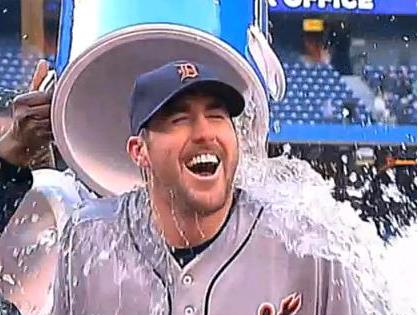
Justin Verlander, enjoying the fruits of his accomplishment.

Last week we heard about the superstitious behavior of the Twins as Francisco Liriano worked through his no-hitter against the White Sox.

This week: An additional spate of such behavior as pitchers around the league flirted with their own no-no’s—and in the case of Justin Verlander, actually completed it.

Which seems like a good place to start.

A primary piece of no-hitter etiquette has to do with avoiding the pitcher in any way possible and under no circumstances mentioning the fact of the no-hitter. This happened during Liriano’s feat, but not in Verlander’s—at least as far as the pitcher was concerned.

This is where already having a no-hitter on his resume came in handy. As evidenced by Verlander’s post-game calm, the right-hander felt little of the pressure normally associated with such feats. He went so far as to dissipate dugout nerves himself, seeking out teammates with whom to interact. (No report yet about how those teammates handled it.)

A secondary rule holds that those in the dugout maintain whatever it is they’re doing—sitting in the same seats, flipping a ball up and down, & etc.—since that action is clearly responsible for the events on the field. (In The Baseball Codes, Bob Brenly talks about spending innings on end rapping on the knob of Matt Kata’s bat during Randy Johnson’s perfect game, despite the increasing rawness of his knuckles.)

In Toronto, Verlander’s teammate, Alex Avila, took things a step further, refraining from using the restroom despite an increasing need from the sixth inning on. “I was too afraid to go,” he told the Detroit Free Press.

Even after Verlander completed his feat, Avila was compelled to take part in the celebration, both on the mound and in the clubhouse. It wasn’t until 10 minutes afterward that he was finally able to hit the head.

On the air, Tigers broadcasters Mario Impemba and Rod Allen refused to reference the feat during the game. This is a contentious point, as many in the business feel that a broadcaster’s primary job is to inform the audience about what is going on.

The Detroit duo had at least one defender—Free Press columnist Terry Foster, who wrote about being “stunned” when a fellow parent at his kid’s soccer game told him of Verlander’s feat, in progress. Ultimately, though, he did come around. A little. “I forgive those parents . . . only because it worked out,” he wrote. “We know who to blame if Toronto managed a cheap hit at the end.”

A quick rundown of other would-be no-hitters that didn’t quite reach completion:

  • Jamie Garcia vs. Milwaukee, May 6 (broken up in the eighth): The left-hander was alone by the sixth inning. “What are you going to say? ‘Ain’t this great?’ ” said Tony La Russa in the St. Louis Post-Dispatch. “We all had our thoughts.”
  • Yovani Gallardo vs. St. Louis, May 7 (broken up in the eighth): Same teams as Garcia’s game, different outcome one day later. Gallardo had thrown 104 pitches through seven innings, raising substantial concerns that Brewers manager Ron Roenicke might remove him. In response, fellow starters Randy Wolf and Shaun Marcum stood guard in the dugout. “The other starting pitchers wouldn’t let me take him out,” said Roenicke in the Milwaukee Journal-Sentinel. “They put a block on me. I really didn’t have a choice.”
  • Anibal Sanchez vs. Washington, May 8 (broken up in the seventh): Sanchez was over 100 pitches in the seventh, putting Marlins manager Edwin Rodriguez in much the same position as Roenicke. “We were paying a lot of attention to the pitch count,” Rodriguez said in the Miami Herald.

Save for Verlander, of course, none of these pitchers was able to finish what he started—developments that had nothing to do with the perpetuation of superstition in their own vigilant dugouts.

Then again, it’s not like it would have mattered.

“If a pitcher tells you he’s not thinking about it, it’s not true,” said Gallardo in reference to people trying to avoid the subject with him. Which is entirely the point.

– Jason

Francisco Liriano, Gamesmanship, No-Hitter Etiquette, Ron Gardenhire

Liriano’s No-Hitter Rife with Unwritten Rules

As you may have heard, Franciso Liriano threw a no-hitter this week. And of course, the Code was involved—because the Code is always involved in no-hitters.

Like many of his no-hit-pitching brethren, the Twins left-hander insisted that he wasn’t even aware that he hadn’t allowed a hit until late in the game. It was only when he became a dugout pariah in the eighth inning, he said, his teammates avoiding him at any cost, that he grokked what was going on.

“When everybody was walking away from me and nobody was talking to me, I was like ‘What’s going on?’ ” he said in USA Today.

(When told that Liriano said he didn’t realize he had a no-hit bid until the eighth inning, Twins catcher Drew Butera said, in the Minneapolis Star Tribune, “He’s lying. I think they all realize it.”)

* * *

Elsewhere on the field, Twins manager Ron Gardenhire stuck to the unwritten rule mandating ultimate respect for a feat like Liriano’s. Despite the fact the right-hander’s pitch count was at 116 with one out to go, and despite the fact Liriano hadn’t thrown more than 97 pitches in a game this season, and despite the fact that he had never thrown a complete game in more than 200 professional starts, and most of all despite the fact that the winning run was at the plate in a 1-0 game and Liriano was clearly tiring, Gardenhire left him in.

“I wasn’t walking out there to the mound, I’ll tell you that,” he said in the Star Tribune. “He looked like he was doing fine. It was cool night. It was his ballgame the whole way.”

Asked if he was prepared to stick with Liriano all the way, Gardenhire said: “How far is all the way? He can only load the bases and then probably something’s gotta happen.”

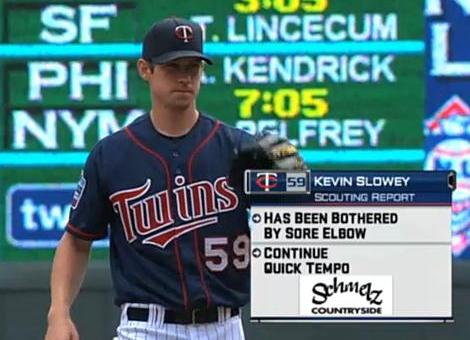
Gardenhire didn’t show nearly that much restraint last season, when he pulled Kevin Slowey from a game in which he had similarly given up no hits. The difference: Slowey was battling an elbow so sore that he had missed his previous start, and after seven innings had already thrown more than Garendhire was comfortable seeing. Eight days later, Rangers manager Ron Washington did something similar with Rich Harden.

Also last year, Yankees manager Joe Girardi said that he was ready to pull C.C. Sabathia from his early-season start even before he gave up his first hit of the game, in the eighth inning.

The standard-keeper for yanking pitchers from the midst of perfection is Preston Gomez, who did it twice, with two different teams. If nothing else, the guy was clearly a man of conviction.

* * *

One more Code-based moment occurred during Liriano’s gem, when umpire Paul Emmel ruled that Minnesota first baseman Justin Morneau tagged Chicago’s Gordon Beckham as the White Sox second baseman raced by him in an effort to beat out a double-play grounder.

Had Morneau tagged him? Of course not. Did he sell it as if he had? Of course he did. That’s what ballplayers do. If the game is willing to tolerate the great lengths to which players will go to gain an advantage—bat corking and ball scuffing and sign stealing and etc.—it’d be a tall order to expect a player to give up a free out granted him by an unsuspecting umpire.

It’s why diving outfielders act as if they’ve caught balls that they know they trapped, why hitters facing three-ball counts will sometimes lean toward first after the next pitch, trying to influence ball four even if they felt it was a strike.

It’s all part of baseball. Now enjoy that no-hitter.

– Jason

No-Hitter Etiquette

Halladay Brings No-Hitter Etiquette to the Postseason

Needless to say, there were some no-hitter superstitions observed—or not—during Roy Halladay’s no-hitter against Cincinnati on Thursday.

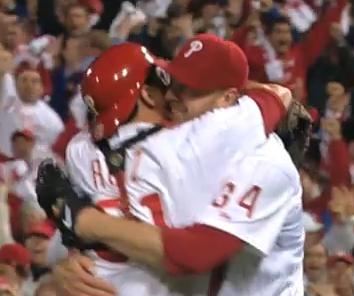
Things got quiet in the Phillies dugout at about the sixth inning. “People stayed in their seats and sat there and watched the game,” said Charlie Manuel in the Philadelphia Inquirer. “[Halladay] came in and went down to the end of the dugout, sat in his chair, and didn’t say a word.”

In the bullpen, the relievers stayed seated and attentive. Ryan Madson, even though he needed to use the restroom in increasingly desperate fashion, did not move to do so until after the game.

The same even held true for team executives in the owner’s box, who stayed put through the final innings.

The same can’t be said for those in the broadcast booth. On ESPN Radio, Dave Campbell and Jon Sciambi wasted no time referencing the no-hitter, once it became apparent, with Campbell going so far as to “wonder if Don Larsen is watching?”

“I said something going to break at seven and eight,” said Sciambi in the Milwaukee Journal-Sentinel. “My first job is to serve the listener. On radio, specifically, they wouldn’t have the first clue if I didn’t fill them in on it. It’s my responsibility to tell them what is going on.”

Brian Anderson and Joe Simpson did likewise on TBS.

“There’s a responsibility there to make sure you catch audience,” said Anderson, the TV voice of the Milwaukee Brewers. “My nightmare is for people to be flipping through the channels and not know what’s going on in this game because I’m trying to follow some baseball etiquette.”

No-Hitter Etiquette

Don’t Talk During a No-Hitter—a Rule That Never Gets Old

In this, the Year of the No-Hitter, there’s been an awful lot of talk about appropriate etiquette during the course of one.

In this space alone, we’ve discussed pulling a pitcher (not once, but three times); changing things up, and in more than one way; sending a pinch-hitter to break one up, even when the game’s out of hand; bunting to break one up (twice); umpires’ roles—particularly as they pertain to robbing a pitcher of a perfect game; and what constitutes appropriate behavior, up to and including extra efforts. Mostly, however, we’ve discussed discussing them—in broadcasts, on message boards (in various permutations), on blogs and on Twitter.

This week, the concept came up again, twice. In the aftermath of Rich Harden being pulled from his own no-hitter, HardballTalk’s D.J. Short took serious grief on his own message boards for posting entries as the game unfolded, thus inexorably jinxing the efforts of the Rangers pitching staff.

Or so certain posters would have us believe. A small sampling:

So you’re a professional baseball writer, huh? And you use that hyphenated word while the event is still in progress?

Changing the title after the fact doesn’t undo the jinx you laid on the Rangers with your irresponsible use of the term “no-hitter” during the game. There are a thousand or so ways to dance around the term and still get the point across. Maybe someday, after you’ve been around a while, you’ll understand that the people who care enough about this game to read this blog know that, and respect and honor that tradition, and fear the consequences of violating it.

I would say that anyone that says jinxes don’t exist should probably be writing about somehing other than baseball.

Short took it in stride, publishing a good-natured screed about why, exactly, such things are essentially a bunch of hokum.

“My apologies if you hate it, but I just refuse to believe that if I mention the event in progress—as I did here on the blog on Tuesday night—it will have some cosmic effect on the actual game on the field,” he wrote. “That’s positively bananas.”

To back up his point, Short mentioned that similar HardballTalk coverage was offered for the five no-hitters already in the books this season, none of which were broken up. Add in MLB Network’s breakaway live coverage when no-hitters reach the late innings, and Twitter, and the panoply of message boards, and the possibilities for a jinx are manifold.

Short: “We live in a world where no-hitters in progress are mentioned more frequently than ever before, yet we have had more no-no’s this season than there have been since 1990.”

It’s a great point, and it’s clearly on the writer’s mind for personal reasons.

Not so for FanHouse’s Ed Price, who dropped nearly 1,000 words on no-hitter etiquette based on nothing more timely than the fact that it’s an interesting story.

On one hand, he wrote, John Flaherty of the YES Network, a former big league catcher, mentioned Javier Vazquez’s would-be no-hitter on the air (something Flaherty admits he would never have done from the dugout).

On the other hand, Tampa Bay Rays broadcaster Dewayne Staats refrained from using the phrase during the entirety of Matt Garza’s no-no on July 26.

“I framed it in every way possible without actually saying it,” he told the St. Petersburg Times. “Fans start to catch on that something is happening. At one point, I said, ‘Garza has faced the minimum and has allowed only one baserunner and that came on a walk.’ So I’m essentially saying it without saying it.”

The reasons for not mentioning it are clear: Listeners respond to the concept of jinxes, much like the readers of HardballTalk. This goes all the way back to Red Barber, who, broadcasting the first televised World Series in 1947, mentioned on the air that Yankees pitcher Bill Bevens was working on a no-hitter.

“There was a hue and cry that night,” said the broadcaster. “Yankee fans flooded the radio station with angry calls and claimed I had jinxed Bevens. Some of my fellow announcers on sports shows that evening said I had done the most unsportsmanlike broadcast in history.”

For those broadcasters who do mention it, however, the reasoning is even more simple.

“If you want people to stay tuned, you should probably mention, ‘Hey, hang in there, don’t go anywhere—guy’s throwing a no-hitter,’ ” said player-turned-broadcaster Steve Lyons.

Of course, points out FanHouse, that doesn’t always work. Two batters after Flaherty mentioned the phrase “no-hitter” on June 6, Vazquez allowed his first hit of the night—a home run.

“People get fired up—’Oh, you jinxed it . . .’ ” said Flaherty. “But I’m not that powerful.”

– Jason

No-Hitter Etiquette, Rich Harden, Ron Washington

No-Hitter in Hand, Harden Pulled

Removing pitchers in the middle of no-hitters is getting to be downright commonplace these days.

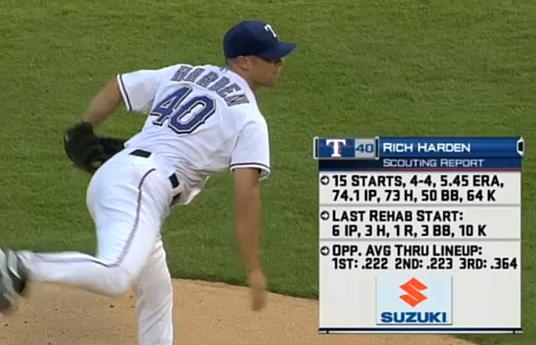
Eight days after Twins manager Ron Gardenhire raised eyebrows for removing pitcher Kevin Slowey after 106 pitches over seven no-hit innings, Rangers manager Ron Washington did something similar with Rich Harden yesterday.

In Slowey’s case, he had recently been shelved due to elbow soreness, and his long-term effectiveness was more important to his manager than a longshot chance at finishing a no-hitter with an elevated pitch count.

Harden did Slowey one better, throwing his gem in his first start off the disabled list. A seventh-inning walk to Michael Cuddyer raised his pitch count to 111, with Jim Thome at the plate and the tying run on deck. It was all Washington needed to see.

Harden had no chance of throwing 150 pitches on the day—which is what it would have taken to complete the game at the pace he had set—and already possessed a storied injury history.

As pointed out in the Wall Street Journal, oddities about the moment were plentiful.

•  Slowey was watching the action from the Minnesota bench.
•  The plate umpire was Jim Joyce, himself at the center of a no-hitter controversy earlier this year when he incorrectly ruled that what would have been the final hitter of Armando Galarraga’s would-be perfect game reached base safely.
•  New Rangers owner Nolan Ryan—he of seven (full) no-hitters—was watching the game from the front row.

There may be no more prominent opponent of strict pitch counts than Ryan. Ron Washington is acutely aware of this. That he made the move anyway speaks to his conviction about the subject.

“He threw 111 pitches,” Ryan said of Harden in an MLB.com report. “He kept his stuff the whole time, but Ron didn’t have a choice but to take him out. You have to protect the player and do what’s best for the team. Ron did the right thing and Rich knew it.”

The no-hitter was broken up in the ninth, when Joe Mauer singled against close Neftali Feliz. If Harden needed a shoulder to cry on, Kevin Slowey was just down the hall.

– Jason

Kevin Slowey, No-Hitter Etiquette, Ron Gardenhire

Pulling Slowey Nothing to Get Worked Up Over

It was a big deal Sunday, in a novelty kind of way, when Ron Gardenhire pulled Kevin Slowey from his start, despite the fact that his pitcher had not given up a hit to the A’s.

By almost all counts, it was the correct thing to do. It was Slowey’s first start since being skipped in the rotation due to elbow soreness, and he was on a short leash from the outset. He had thrown 106 pitches when he was pulled.

Some decry the concept of pitch counts in the modern game, but Slowey’s removal was not without precedent.

In 1997, Pittsburgh’s Francisco Cordova was lifted after 121 pitches and nine innings of no-hit ball against the Astros; reliever Ricardo Rincon worked one hitless frame and the Pirates won it in the 10th.

In the first combined no-hitter in National League history, Atlanta’s Kent Mercker was pulled after six innings in a 1991 game. It was just his second start of the year, after 44 relief appearances, most of which lasted just a single inning and none of which stretched beyond two. (Mark Wohlers and Alejandro Pena combined to shut down the Padres over the final three frames.)

Pitchers have been pulled from no-hitters because it’s early in the season (Anaheim’s Mark Langston was allowed only seven innings and 98 pitches against the Mariners in his first start of the 1991 campaign, which was reasonable after he got in only 16 innings of spring training work due to a lockout) and late (A’s pitcher Vida Blue threw five frames of no-hit ball against the Angels on the final day of the 1975 season before being removed to stay fresh for the playoffs.)

Then there was San Diego’s Clay Kirby, who was pulled from his 1970 no-hitter by manager Preston Gomez for a pinch hitter, because the Padres were losing and needed an offensive boost.

Gardenhire is in good company. If anyone still doubts his strategy, the bottom line is this: Slowey is still healthy enough to give it another go in his next start, and that counts more than anything.

– Jason

– Jason

Jim Leyland, Matt Garza, No-Hitter Etiquette

How to Respect Your Local No-Hitter: A Brief Primer

On May 12 1984, with two outs in the ninth inning, the only thing that stood between Cincinnati’s Mario Soto and a no-hitter was Cardinals slugger George Hendrick. Soto’s first pitch to him was a fastball that split the plate. Hendrick watched it for strike one.

Soto’s second pitch was identical to the first. Again Hendrick watched it. Strike two.

Soto, however, inexplicably wanting something more from his experience, decided to buzz Hendrick with his 0-2 pitch, knocking him to the dirt. Hendrick took it calmly, returned to the batter’s box, and hit the next pitch for a home run. No-hitter over.

“I don’t know why he did that,” Hendrick said when he got back to the bench. “I was going to let the man have his no-hitter.”

It’s a matter of course for many in the game; no-hitter etiquette mandates a degree of respect for extraordinary feats. Hendrick might be more of an exception than a rule—hitters rarely want to stop hitting—but if a game is out of hand (as was Soto’s, with a 5-0 score), managers tend to leave the status quo alone, and let the inevitable play itself out.

This isn’t what happened on Monday, when, with two outs in the ninth inning of Matt Garza‘s no-hitter against Detroit, Tigers manager Jim Leyland called for Ramon Santiago to pinch-hit for Danny Worth. Like Soto’s gem, the score was 5-0, too steep a hill for the Tigers to realistically climb.

In Boston tonight, I talked to Leyland about his decision.

With two outs in the ninth inning of a 5-0 game, did you realistically think you had a chance to come back?

Probably not. Probably not. But that doesn’t mean that you don’t have a chance. The thing in that situation, the one big difference, is the five instead of four. If you’re down four runs, it’s okay to bunt in that situation for a hit. He gets on, someone else gets on, somebody walks, you send the tying run to the plate. With a five-run lead, not as much.

So it’s beyond the reach of a grand-slam. Knowing you’re not going to win, at what point do you let the guy have his no-hitter?

I don’t think you ever say that. I don’t ever say that.

No matter what the score, you’d send up your pinch-hitters?

Yeah, absolutely. I don’ think you ever say, “Let the guy have his no-hitter.” That’s not the way the game is played. If I’m going to say that, I might as well go home. That sends the wrong message to the people  who paid for a ticket. I learned that from my parents—you get what you earn.

We play every game and compete until the end. There are 27 outs in a game, and you try to utilize all of them. It doesn’t matter what the score is. You have to understand the situation. Even if it’s 10-1 in the ninth inning, you might send someone up there to save a guy a tough at-bat against a tough pitcher, or a bench guy might be playing in the game the next day, so you want to get him an at-bat to help him track the ball a little bit. A lot of things go into it—it’s not cut-and-dried.

At this point, Leyland launched into a mini-soliloquy that beautifully summed up his position.

We’re paid to compete until the last out, regardless. That’s what we do for a living. Garza pitched a no-hitter, and I tip my cap to him. But when Verlander pitched his no-hitter against Milwaukee, he earned it, and he was supposed to earn it. That’s just the way things go.

You don’t want a no-hitter pitched against you. Everybody’s talking about how you should just let him have it. Well, no you shouldn’t. Nobody wants to be that team. Detroit hadn’t had a no-hitter pitched against it in years. I didn’t want to be the guy from Detroit who finally got no-hit.

One of the beautiful aspects of baseball’s Code is that two people can see things from opposite perspectives, and each can make a convincing argument as to why he’s correct. I disagree with Leyland’s opinion; if a game like that is out of hand, things should be left to run their course.

Take, for example, the instance in 1932, when Detroit curveball specialist Tommy Bridges took a perfect game into the ninth inning against Washington. With two outs and facing a 13-0 deficit, Senators manager Walter Johnson sent pinch-hitter Dave Harris to the plate, primarily because Harris was an adept curveball hitter. Sure enough, he connected for a single, ruining Bridges’ feat. For his move, Johnson was roundly condemned by pundits around the country.

Bridges, however, took up a stance that would make Leyland proud. “I would rather earn it the competitive way,” he said, “than have it handed to me.”

– Jason

No-Hitter Etiquette

Don’t Change Anything During a No-Hitter–Especially the Pitcher

In this, the year of the no-hitter (and the perfect game that wasn’t) it seems only fitting to mark the anniversary of another gem that got away due to forces entirely beyond the reach of the pitcher at the center of it all.

Forty years ago today, Padres pitcher Clay Kirby took a no-hitter into the eighth inning against the Mets. Unlike Armando Galarraga, who was robbed by a bad call, Kirby was robbed by a questionable decision—by his own manager.

Baseball etiquette mandates that nothing change in a team’s dugout during a no-hitter: seating arrangements, nervous tics (which is to say, if you’re doing something when the no-no becomes apparent, keep doing it) and, especially, the lineup. Defensive substitutions are frowned upon as a matter of course (although they do sometimes work, as in the case of the game-saving catch by Dewayne Wise during Mark Buehrle’s 2009 perfect game), and the notion of having relievers warm up in the bullpen is virtually unheard of.

(“We were asking ourselves on the bench, should we get somebody up in the bullpen, just playing catch?” said Bob Brenly, the manager of the Diamondbacks in 2001, during Randy Johnson‘s perfect game. “In case he gives up that first hit we want somebody ready to go, so that by the time he gives up the second hit, we can go to the bullpen if we need to. But we didn’t want Randy to turn around and see a relief pitcher warming up in the bullpen. What should have been one of the easiest games to manage, I was losing my hair. . . . I didn’t want to do anything to screw up a perfect game.)

In 1970, the Padres were managed by Preston Gomez, who shared none of Brenly’s sentiments.

As Kirby, just 22, spun his no-hitter through eight, Gomez had another matter to consider: a walk, two stolen bases and a fielder’s choice had deeded the Mets a first-inning run, and the Padres trailed 1-0.

When, with two outs and nobody on, Kirby’s turn to bat came up in the bottom of the eighth, Gomez didn’t hesitate. His team needed to score.

“(Ed) Spiezio and (Bob) Barton were ahead of (Kirby),” said Gomez in the Los Angeles Times. “If Spiezio hits a home run or if one of them gets on and I can bunt with Kirby, then he stays in. But my mind was made up to hit for him if neither one of them got on.”

This didn’t keep the 10,373 fans at San Diego Stadium from booing at the site of pinch-hitter Cito Gaston, who, hitting in Kirby’s place, struck out. (The North County Times offers a robust retrospective on the affair.)

“My father was there,” said Kirby in the St. Petersburg Times. “It was the first game he’d ever seen me pitch in San Diego. He was madder than I was.”

A shouting match erupted in the dugout between pitcher and manager, and Kirby stormed to the clubhouse before Gaston even got to the plate. Jack Baldschun replaced Kirby in the ninth, and on his fourth pitch did what Kirby had spent eight innings not doing—giving up a hit, when Mets shortstop Bud Harrelson singled to left. That was followed by a sacrifice, a walk and two singles. The Mets won 3-0, and Kirby’s record fell to 5-12.

“It’s not that I’m bitter,” Kirby told the Times, 20 years after the fact. “But with a chance to do it again, I’d like to look back and say a baseball I pitched is in the Hall of Fame. When I try to look back at the logic behind it, I don’t see it. We were 20 or 30 games behind and we needed something to drum up interest in the ballclub. A no-hitter would have given the franchise a much bigger boost than one more victory. If it had been the seventh game of the World Series, I could understand it, I guess. But we were in last place.”

As if to prove it wasn’t a strategic fluke, Gomez did the same thing four years later while managing the Houston Astros, pulling Don Wilson after eight no-hit innings for a pinch-hitter with his team trailing the Reds, 2–1. (The reliever he inserted, Mike Cosgrove, gave up a leadoff single.)

Never has a man been more inclined to prove the theorem that winning takes precedent over the Code, even for a team that would lose 99 games, as the Padres did that year.

– Jason

Gaylord Perry, No-Hitter Etiquette

Perry’s No-Hitter Aided by Fan in Blue

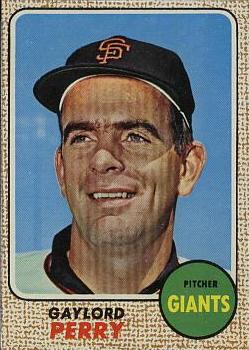
Gaylord Perry recently discussed his 1968 no-hitter, thrown against St. Louis when he played for the Giants. Perry brought a new layer to the discussion about how players (and, in this case, officials) react to significant accomplishments as they unfold on a ballfield.

“After seven innings, I saw the umpire (Harry Wendelstedt) as I was coming out of the dugout and he said, ‘You don’t have to get it so close,’ ” Perry told the San Jose Mercury News. “And I didn’t really pay attention. He started giving me the outside, and after eight innings he said, ‘You don’t have to get it so close’ again, and I realized that guy has never called a no-hitter and he wants to call one. So I didn’t come close that ninth inning.”

The final hitter he faced, Curt Flood, struck out looking. Of course he did.

As with Wendelstedt, most everyone appreciates greatness. They’d also like their appreciation of it returned. From The Baseball Codes:

The more a pitcher mows down the opposition, the more the opposition is expected to respect the feat. Cardinals outfielder George Hendrick did exactly this in 1984, when he stepped to the plate with two outs in the ninth inning against Reds ace Mario Soto, who had yet to allow a hit. Hendrick stood passively and watched the first two pitches of the at-bat split the plate for strikes. Rather than go for the kill, however, Soto inexplicably used a third-pitch fastball to buzz Hendrick’s chin, knocking him to the ground. The slugger got up, slowly returned to the box, and knocked Soto’s next offering over the fence in left field. “I don’t know why he did that,” Hendrick said afterward. “I was going to let the man have his no-hitter.”

Players aren’t always so generous. When Detroit pitcher Tommy Bridges was within an out of a perfect game against the Senators in 1932, Washington manager Walter Johnson—despite trailing 13–0—sent up curveball-hitting specialist Dave Harris as a pinch-hitter, to try to figure out the bender with which Bridges had baffled Washington all afternoon. Harris connected for a single, and Johnson absorbed criticism from around the league. Bridges himself abstained, however, saying, “I would rather earn it the competitive way than have it handed to me.”

– Jason