Oakland A's, Retaliation

1972: On Making Moon Mad

Blue Moon OdomResearch for my next book, about the Oakland A’s dynasty of the 1970s, to be published by Houghton Mifflin in 2015, has turned up boundless examples of unwritten rules from that bygone era. The latest, from Oakland Tribune beat writer Ron Bergman,  July 10, 1972: 

Jim Longborg threw a pitch in the first inning that bounced in back of Reggie Jackson. Blue Moon Odom retaliated by throwing behind Dave May, the first batter in the Milwaukee second. The ball nicked him in the back.

On the way to first, May exchanged words with Odom. Later in the inning, with May on third, Odom picked up Rick Auerbach’s attempted squeeze bunt and ran down May. A few more words were heard.

“Odom was saying that he didn’t think he hit May,” said plate umpire Don Denkinger. “At that point, I said if anything more happened, I’d have to warn both managers.”

Jackson said he thought Longborg was throwing behind him deliberately, and added, “It’s no fun, a pitch like that. It pleased me what Odom did. We like to play behind a guy like that.”

Longborg said he wasn’t throwing behind Jackson deliberately. Odom wouldn’t say that.

“That pitch didn’t get away from him that much,” Moon said. “He’s got pretty good control. It was intentional. They asked me why I threw behind May. I told them to ask their pitcher. It didn’t matter who’d been up first the next inning — my mother, or the manager — I still would’ve thrown at him. I meant to throw behind him. I didn’t try to hit him. I didn’t think I hit him until [A’s catcher Dave] Duncan told me later that I ticked his shirt. I told [Brewers first baseman] George Scott that I would’ve thrown at him if he’d been the first up. And he’s one of my big buddies.”

Over in the Milwaukee clubhouse, Scott shook his head from side to side.

“Man throw behind you, you got to throw at somebody else,” Scott said. “I’m glad I wasn’t the first one up.”

May walked in from the shower and said that “I definitely will remember this. It will stick in my mind. Lonborg wasn’t throwing at Jackson. I told Odom after he threw at me that I was coming out to get him. I went out to see what he was going to say. He didn’t have anything to say. When a guy throws behind you, he’s got something in mind.”
Oakland A's, Retaliation

Reggie: ‘You Got to Throw at Someone on the Other Team and Hurt Them’

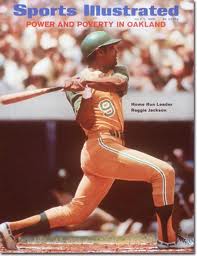
Reggie Jackson, 1969As means of explaining the relative lack of frequency of posts to this site recently , I figure it’s time to announce my latest project: a book about the championship Oakland A’s teams of the early 1970s, to be published by Houghton Mifflin in spring, 2015. Suffice it to say that I’ve been fairly well inundated.

I bring it up here because during the course of my research I’ve encountered any number of unwritten rules-related issues from back in the day, covering all manner of topics. Referencing them regularly through the off-season seems like a decent way to pass the time until pitchers and catchers report in February. They might not mean much now, but boy are they fun.

For now, it seems like the best way to approach it is offer up entire excerpts—from game stories, mostly, primarily from the Oakland Tribune’s beat writer par excellence, Ron Bergman. This one is from July 18, 1969.

Even before the game, Reggie Jackson was ticked off.

“I’m telling you,” he said, spitting on his hands, “if they try that stuff on me when Chuck’s pitching, somebody’s going to get hurt.”

It just so happens that Jackson’s roommate, Chuck Dobson, is pitching tonight for the Oakland Athletics in the opener of a three-game series against the California Angels.

For the second game in a row and the seventh time this season, Jackson was hit by a pitch last night during the A’s 8-2 victory in Seattle. This one, thrown by loser Marty Pattin (7-9), struck him on the right forearm.  …

“What they’re trying to do,” said Reggie, “is make a good pitch inside for a strike or miss.”

What the inflamed major league home run leader meant was miss by hitting him.

“That’s one base,” Reggie continued. “That’s better than four. I don’t mind. It’s all part of the game. But all I ask is protect me. A man’s got 35 homers for you, you got to throw at someone on the other team and hurt them.”

Someone reminded Reggie that [A’s pitcher] Lew Krausse threw at Don Mincher Wednesday night after Jackson was hit by Gene Brabender.

“Yeah,” snapped Jackson. “Throw the ball and holler ‘watch out.’ ” When they throw at me they don’t holler watch out. Look, someday I’m going to be hit on the hand and it’s going to break. [Jackson was referring to the hand he threw up when protecting his head.] Then what? I’m going to have to go out there with shin guards on my arms. ”

Catfish Hunter, who won his third in a row with a six-hitter, said he would have retaliated had he thought the Pilot pitchers were throwing close to Jackson deliberately.

“If they start throwing at his head, then I’ve got to brush them back,” said Hunter, referring to Seattle’s Don Mincher, who homered off the A’s for the third straight game.

Of the seven times Jackson had been hit over the team’s first 92 games to that point, most had been on his aforementioned hand. The aforementioned Mincher, who led Seattle with 25 homers in 1969, would be acquired by the A’s for the 1970 season, and again led his team in homers, with 27.

Also worth noting: Reggie’s prescience in envisioning Barry Bonds’ body armor, three decades before it actually came about.

Kevin Towers, Retaliation

When Hot Talk Radio Blows Up: D-Backs GM on the Softness of His Pitchers

Kevin TowersKevin Towers did a lot of things with his weekly show on KTAR 620AM in Phoenix on Tuesday.

He showed why open discussion of baseball’s unwritten rules from an insider’s perspective can a bad idea.

He illustrated the gap between a normal response to a situation, and a baseball response.

And, in case any doubt remained, he proved conclusively that he holds some old-school opinions when it comes to this kind of thing.

In discussing the team’s lack of retaliation last season when provoked—on the same day that he fired D-Backs pitching coach Charles Nagy, no less—Towers intoned that he expected more from his pitchers when it comes to keeping the opposition honest.

“Come spring training, it will be duly noted that it’s going to be an eye for an eye and we’re going to protect one another,” he said. “If not, if you have options, there’s ways to get you out of here and if you don’t follow suit or you don’t feel comfortable doing it, you probably don’t belong in a Diamondbacks uniform.”

Towers referenced his team’s 8-1 loss to the Dodgers on Sept. 9, specifically the behavior of some Los Angeles players as they celebrated a six-home-run game in their dugout. It did not make him feel respected.

“I was sitting behind home plate that game and when it showed up on the Diamondvision of stuffing bananas down their throats, I felt like we were a punching bag,” he said. “Literally, if I would have had a carton of baseballs, I would have fired them into the dugout from where I was sitting behind home plate.”

Because, you know, in his sport, justice is meted out by throwing baseballs at a guy.

He went on to describe a moment later in the month when first baseman Paul Goldschmidt was drilled, but Arizona pitchers did not respond. Towers: “Goldy gets dinged, and no retaliation. It’s like, ‘Wait a minute.’ If Goldy’s getting hit, it’s an eye for an eye. Somebody’s going down or somebody’s going to get jackknifed.” (As noted by Hardball Talk, Wade Miley was the pitcher all three times Goldschmidt was drilled last season.)

It made for captivating radio. It also earned the GM national attention, and not in a good way. Yesterday he circled back to clarify that “going down” and getting “jackknifed” are distinct from getting drilled. (Which is true, even if it’s difficult to square with his personal inclination to throw baseballs at the Dodgers.)

“I’m not saying hit players on purpose,” he said in an MLB.com report. “I’m saying if our hitters are being made uncomfortable at the plate, we need to be the same way; we need to make the opposing hitters uncomfortable at the plate and pitch in with purpose and take that inner third away.”

He cited an instance in which the Padres retaliated for a batter hit by Arizona closer Heath Bell by throwing inside to Aaron Hill.

“The bat went up in the air and it knocked him off his feet,” Towers said. “I said, ‘You know what, that’s baseball.’ They weren’t trying to hurt Aaron Hill. They were protecting their player. It was pitched in with purpose to send a message. I applaud that, and that was from the other club. It’s the way baseball is played. He ended up getting him out on the outer half because he took away the inner half.”

Ultimately, it’s a stretch for an old-school baseball guy to expect that most people outside the game will understand his perspective on the subject (especially if he devolves into prattle about throwing knockdown pitches from the stands). One of Towers’ problems, of course, is that even the people within his own organization didn’t seem to understand him. He wasn’t pleased with Kirk Gibson’s lack of response when players were thrown at this season, and the topic played a role in his dismissal of Nagy.

The idea of retaliatory pitches can be debated all day and into tomorrow, but Towers’ comments planted him within the baseball mainstream. The unwritten rule he broke was in talking about it in anything other than platitudes to begin with. 

Jayson Werth, Retaliation

Darling on Werth Drilling: ‘Boy, Was That Obvious’

Werth drilledWhy Frank Francisco drilled Jayson Werth on Thursday is not yet clear. That it was intentional—and stupid—was obvious to at least three people: Werth, Bryce Harper and Mets broadcaster Ron Darling.

It came with no outs in the eighth inning, on a 3-0 fastball, after Francisco had already allowed doubles to the first two batters he faced, extending Washington’s lead to 5-2. (The Nats ended up winning, 7-2. At this point, frustration is as good a guess as any when it comes to pinpointing Francisco’s motivation.)

Werth knew it was intentional when it happened. So, apparently did plate ump Anthony Recker, who, despite the fact that Werth made no move toward the mound, grabbed the barrel of his bat as he lingered near the plate, staring at Francisco.

“Boy, was that obvious,” said Darling on the broadcast. “For you folks at home—and you hear me all the time say, ‘That wasn’t intentional’—well, this one was intentional.”

Darling was then asked by broadcaster Gary Cohen why Francisco would drill a batter in that situation.

Darling’s reply: “Because he’s a fool.” (Watch it here.)

Werth wouldn’t comment after the game, but handled things in the moment, taking out shortstop Reuben Tejada moments later with an aggressive slide at second base. Harper, who reached on a fielder’s choice, did something similar to second baseman Daniel Murphy.

(The idea was summed up by Bob Brenly in The Baseball Codes: “I’ve gotten on first base when I’ve been hit by a pitch and told the first baseman, ‘If there’s a ground ball hit I’m going to fuck up one of your middle infielders, and [pointing to the mound] you can tell him that it was his fault.’ That’s a way you can get them to police themselves. A pitcher drills somebody just because he feels like it, and if one of the middle infielders gets flipped out there he’s going to tell the pitcher to knock it off. Ultimately, that’s all we want anyway—just play the game the right way.”)

“That was total B.S. what Francisco did there,” said a scout in attendance, in a Washington Post report. “Almost got his shortstop’s ankle broken.”

Sure enough, Nationals pitchers never retaliated. If Werth’s slide wasn’t enough for them, they’ll have to wait until next year to address the issue, because the teams don’t meet again this season.

Update (9/16): At least one Mets pitcher wasn’t too pleased.

(H/T BLS)

Retaliation

The Fine Line Between Pimping and Confusion, Pittsburgh Edition

Morneau drilledPerception is everything.

In the fifth inning in Milwaukee on Wednesday, Andrew McCutchen hit a home run to left. He didn’t get it all—it just cleared the fence—and he managed to lose it in the lights before he knew where it was ending up.

As such, he loitered in the batter’s box to try and get a read on it.

Ignore for a moment the horrific strategy of hedging one’s bet that a ball may not have left the ballpark by failing to leave the batter’s box. The pitcher who gave up the shot, Wily Peralta, either did not know about McCutchen’s confusion, or didn’t care. With his next pitch, he drilled Justin Morneau on the hand, near head-level. (Watch it here.)

“The catcher knew I was looking for the ball, the umpire knew—everybody knew it,” said McCutchen after the game, in an MLB.com report. “You could see the guys in the infield smirking as I was going around the bases. They know I’d lost the ball.”

Peralta offered up the standard denial of intent, saying “Yeah, you know, it wasn’t on purpose,” before detailing how he missed his spot while trying to go up and in.

“I know it looks bad, because right after a homer, you don’t want to hit people,” he said.

Unless, of course, hitting people is exactly what you want to do. Morneau reacted angrily, and even though he never approached the mound, benches cleared. After the game, Pittsburgh’s first baseman wasn’t ready to level blame with any degree of certainty.

“I think usually when a guy hits a home run, and they don’t like the way he reacts, they wait until the guy comes around [again],” he said in USA Today, questioning whether a more proper approach would have seen the Brewers waiting for McCutchen’s next turn in the lineup, rather than going after Morneau so quickly afterward. “It’s one of those things in that gray area. You don’t know if it’s intentional or not.”

Not to disagree too wholeheartedly with an experienced big leaguer or anything, but it seemed pretty intentional. Add the wrinkle that Morneau’s career was derailed and diminished by concussion-related symptoms, and the idea that Peralta came anywhere near his head in a misinformed fit of retaliation is unconscionable.

That was the final meeting between the teams this season so any personal retribution will have to wait, but there are no such constraints on the commissioner’s office, which may opt to hand down some discipline of its own.

Alex Rodriguez, Retaliation, Ryan Dempster

Why Does Dempster Hate A-Rod So? Let Us Count the Ways

A-rod plunkedThe reason the unwritten rules dominate baseball like in no other sport is the space within the game for messaging. The idea that if somebody wants to communicate an idea through action, there is sufficient opportunity to do so—be it a well-timed stolen base, some styling to start one’s home run trot or an intentionally hit batter.

The thing about the latter category is that we are rarely certain when a batter has been intentionally hit.

On Sunday, however, we were offered about as much certainty as can be reasonably expected, short of admission from the pitcher. Boston’s Ryan Dempster, facing Alex Rodriguez in the second inning, threw a knee-high fastball behind the batter. He followed that with two waist-high inside pitches, then planted a fastball into A-Rod’s elbow. Not even a hint at subterfuge—Rodriguez was marked. (Watch it here.)

Which is where the messaging comes in.

The immediate assumption was that Dempster, an old-school red-ass if ever there was one, was making a statement about PEDs, expressing his displeasure both at Rodriguez’s usage and his subsequent refusal to accept the punishment handed down by Bud Selig. Just two days earlier, after all, Boston players John Lackey and Jonny Gomes discussed their displeasure with the fact that Rodriguez was being allowed to play while appealing his 211-game, PED-related suspension.

If that’s what Dempster was doing, he has some precedent. In 1990, Bert Blyleven hit Baltimore’s Phil Bradley because of Bradley’s hard-line stance in labor negotiations which, in Blyleven’s opinion, prolonged settlement of the 32-day lockout that delayed the start of the season. Blyleven was concerned about pension time, did not appreciate tactics which stood to cost him financially, and expressed his displeasure from the pitcher’s mound.

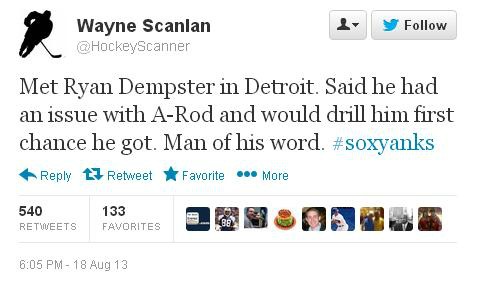
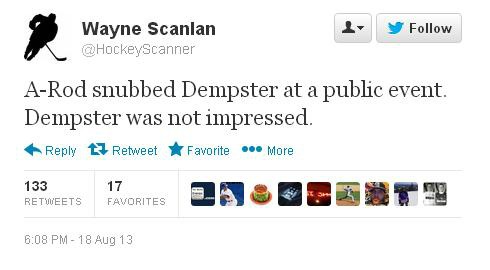
Would it be so peculiar for another pitcher to take a similar tack? Maybe not, but then we hear this, courtesy of Yahoo’s Big League Stew: A Canadian hockey writer says that Dempster had different priorities.

A-Rod tweet I

A-Rod tweet II

This may seem so much more petty than PED grandstanding, but it’s also more feasible—and it, too, has precedent. 

One of Tommy Lasorda’s go-to stories is about how, as a star-struck 14-year-old, he approached New York Giants outfielder Buster Maynard after a game in Philadelphia and asked him for an autograph. Maynard brushed him off.

Eight years later, Lasorda was a promising pitcher with the Triple-A Montreal Royals, in the Brooklyn Dodgers chain, when to his surprise he found himself facing a fading former big leaguer trying to hold his job with the minor-league Augusta Yankees: Buster Maynard. Lasorda’s first pitch knocked him down. His second pitch did the same. When Maynard came up again later in the game, Lasorda decked him a third time.

This time it was Maynard waiting for Lasorda after the game, asking what the heck was going on. Lasorda told him the story of saving up his money to go to a baseball game, only to be ignored by his hero. He concluded the sentiment with, “I wish I had hit you, you busher!”

Girardi argues
Joe Girardi: angry.

If this was Dempster’s motivation, it was not apparent from field level at Fenway Park. Yankees manager Joe Girardi lit into plate ump Brian O’Nora for not ejecting Dempster—he was upset that the pitcher was given four pitches with which to work—and then warning both benches, precluding retaliation. Soon, he was himself tossed. On his way back to the dugout he shouted toward Dempster, “Somebody’s going to get hit.”

(In the middle of this came a highly unusual moment, in which the Red Sox bullpen came streaming onto the field as if to fight, despite no indication that Rodriguez would do anything other than take his base.)

Dempster denied everything, of course, and Rodriguez ratcheted up the best possible response when he took Dempster deep for a sixth-inning homer at the center of a four-run rally that proved to be the difference in a 9-6 New York victory. (Watch it here.)

Rodriguez also provided the quote of the night, when asked about whether Dempster should be suspended for his actions. “I’m the wrong guy to ask about suspensions,” he said in the Boston Globe. “I’ve got a lawyer I can recommend.”

The teams play seven times in a 10-game span in September. If there’s more to be said about this, it’ll be said then.

Update (8-20): Dempster has been handled, five games’ worth.

Intimidation, Retaliation

Inside the Mind of Miggy – Cabrera Buzzed, then Fanned, then Steams

Cabrera unhappyIt was a classic misdirection. With an 0-2 count on Miguel Cabrera to open the 10th inning on Saturday, Fernando Rodney sent a 100-mph pitch so outside the strike zone that catcher Jose Molina could not get a glove on it. Wildness thus established, he followed it up with a pitch near Cabrera’s head.

In many respects, the pitch was perfectly placed. It tailed in at the last moment, but was easily trackable by the batter and was never in danger of hitting him. Cabrera leaned back to avoid it, but it would not have made contact even had he remained still.

The strategy was also sound. The previous day, Cabrera had homered twice (and didn’t help matters by celebrating that game’s final out by performing what appeared to be an imitation of Rodney’s archer pose, which the closer strikes following saves). Cabrera leads the major leagues in batting average, RBIs and OPS, and is second in home runs. It was without doubt in Rodney’s best interest to make him as uncomfortable at the plate as possible.

And it worked. Cabrera flailed at the next pitch, a down-and-in changeup, for strike three.

Perhaps Cabrera’s displeasure was compounded by the result of his at-bat, but upon reaching the dugout he spent a considerable amount of time gesturing toward, and yelling at, Rodney. (Watch it all here.)

The pitcher was obviously not trying to hit Cabrera during extra innings of a 3-3 game. Even if he was, it is given wisdom that such a strike is far easier to execute when aiming at the torso than at the head, which is a smaller and more maneuverable target. Much more likely was that Rodney wanted to crimp Cabrera’s style—get him out of the dangerous space in which he’s resided all season—and either A) misjudged the height of his inside pitch, or B) didn’t care.

Cabrera didn’t comment afterward, but his manager, Jim Leyland, did.

“I don’t care about throwing inside but I don’t like it up there,” Leyland said in an MLB.com report, referring to Cabrera’s head. “We will not tolerate that. You can take that to the bank. We won’t tolerate that up to the head to anybody. … That will cause a lot of problems for people.”

It caused problems for Ben Zobrist on Sunday, when, with two outs and nobody on base in the first inning, Tigers starter Rick Porcello drilled him in the back with a 94-mph fastball. It was intentional and it was expected. Plate ump Vic Carapazza quickly warned both benches.

Cabrera got his own measure of revenge three innings later, when he crushed a homer into the Rays Touch Tank—only the second such blast in the ballpark’s history.

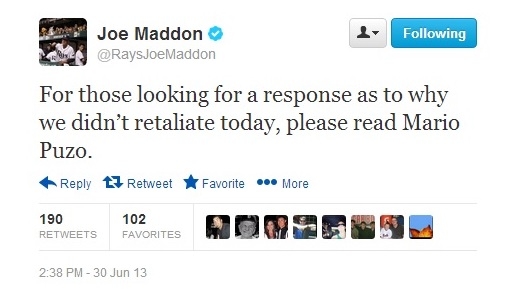
Despite Cabrera being “a little sensitive,” according to Zobrist, the Rays left it at that. Except of course, for the final explanation offered by Maddon for their lack of further response. Via Twitter:

Maddon tweetTo gauge it by the wisdom of the author of The Godfather, the Rays, apparently, will not forget this slight. Considering that they won’t face Detroit until next season (or in the playoffs), however, their memories will have to hold for a while.

Don't Showboat, Juan Guzman, Retaliation

Guzman Takes a Spin Down the Line, Giants Respond

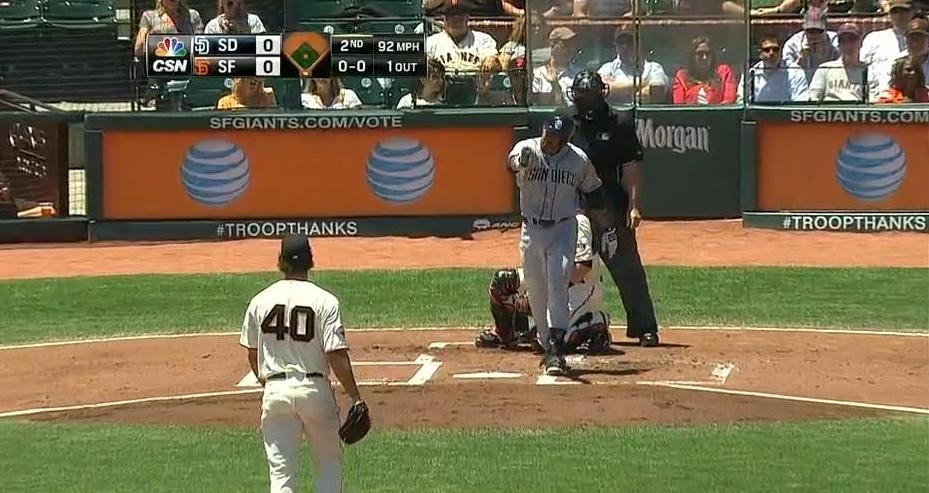
Guzman drilleOn Tuesday, Jesus Guzman belted an eighth-inning, two-run, pinch-hit homer against Giants reliever Jeremy Affeldt to give the Padres a 4-3 lead. This excited him.

He watched the blast. He walked down the line. He held his bat. Eleven steps from the plate he spun 180 degrees, still moving toward first, and, with his back to the pitcher, bellowed toward his teammates in the first-base dugout.

Clearly, the Giants were not amused. How clear became evident during Guzman’s first at-bat on Wednesday, when Madison Bumgarner threw his first pitch waist-high and behind the batter. Guzman shouted toward the mound and pointed his bat at Bumgarner, all while taking the slow steps of a man with no intention of trading punches. (Bumgarner, however, veritably tore down the mound to establish a closer confrontation, and was restrained by on-deck hitter Yasmani Grandal and plate ump Tony Randazzo.)

Although dugouts emptied, each bench was warned and order was quickly restored. (Watch it all here.)

“I was enjoying the home run with my teammates,” Guzman said of his Tuesday night blast, in an MLB.com report. “I wasn’t trying to be disrespectful of their team.”

That may well be true, but even the greenest big leaguer, let alone a guy with four years’ experience—who, by the way, came up with the Giants in 2009 and was a teammate of Affeldt’s—should realize that such a display will almost inevitably be taken poorly.

Bumgarner’s response—a warning shot across the bow, as it were—got the point across: Think for a moment before doing something like that against us again. (Bumgarner, for his part, left his postgame response to the phrase, “There’s no need to comment on that.”)

Ultimately, however, it was Guzman who held the retaliatory trump card. Leading off the seventh against Bumgarner in a 1-1 game, he crushed a home run deep down the left field line. (Watch it here.)

This time he faced the appropriate direction, and ran every step of the way.

Retaliation

Kontos Takes Aim, MLB Response is Swift

McCutchen drilledIt’s almost as if the commissioner’s office was warming up for Dodgers-Diamondbacks fallout from Tuesday night’s throwdown at Chavez Ravine.

On Wednesday baseball suspended Giants reliever George Kontos for three games, and manager Bruce Bochy for one, following an incident in Pittsburgh on Tuesday in which Kontos hit Andrew McCutchen with a pitch after benches had been warned.

With the Giants down 8-2 in the eighth inning, Kontos threw a ball behind Starling Marte. It was likely a response to an incident an inning earlier, when Marco Scutaro was knocked from the game (and, as was found out later, from the lineup for an extended period) by a Tony Watson pitch, and was enough to draw a warning from plate ump Wally Bell

The lack of contact may not have been enough to satisfy the pitcher, who drilled McCutchen in the backside two hitters later. With warnings in effect, Bell didn’t hesitate to toss him. (Watch it here.)

It was a reasonable response by the umpire. Then again, the pitch in question was a tailing sinker that drifted right, hardly a laser-guided bullet. From MLB.com:

The genesis of McCutchen’s plunking occurred one inning earlier, when he singled leading off against Kontos.

“First pitch of the seventh inning, he put a really good swing on it,” Kontos said, “and they were hacking early and out over the plate, so I was trying to pitch inside. A sinker got away from me a little bit.” 

(To add to Kontos’ woes, he was sent to Triple-A Fresno after the game; he’ll serve his suspension upon being recalled. Also, it was his 28th birthday. Still, wrote CSN Bay Area’s Andrew Baggarlyit could have been worse: Kontos tore his elbow ligament while pitching on his birthday four years ago.)

It’s difficult to fault Bell for his decision, though it’s fair to ask whether Kontos’ actions were suspension-worthy. Ultimately, it’s irrelevant: Between this incident, the one in Los Angeles on Tuesday and Monday’s Red Sox-Rays dustup, MLB must be freaking out just a little bit, and responded accordingly.  

Retaliation

How Not to Approach the Concept of Retaliation: L.A. Story Ends Very, Very Badly

Dodgers-DBacksSome will blame baseball’s unwritten rules, the sport’s ingrained system of on-field justice, for last night’s disgraceful display at Chavez Ravine. They will decry the eye-for-an-eye mentality, the brutal delivery of fastballs and the ugly results of the punch-throwing scrum in the seventh-inning.

What they will not acknowledge is that baseball’s unwritten rules exist precisely to avoid this kind of confrontation. Because Tuesday night’s throwdown between the Dodgers and Diamondbacks was a study in what not do during the course of a baseball game as it pertains to baseball’s Code.

  • Retaliation for an incidental drilling—especially one so incidental that it required umpire intervention to confirm that it even happened—is simply not necessary. This was the state of affairs after Cody Ross was grazed by a Zack Greinke pitch in the fifth inning.
  • Even if what happened next was retaliation for Ross, it would at least give Ian Kennedy a reason for his actions, no matter how insufficient. In the sixth inning, the D-Backs right-hander ignored the tenet mandating that one never drill a batter intentionally above shoulder level, and hit Yasiel Puig in the nose with a 92-mph fastball. Puig remained on the ground for several minutes while trainers attended to him.  (Watch it here.)
  • Greinke responded an inning later by hitting Miguel Montero between the numbers. Usually, when catchers are hit in a retaliatory fashion, it is because they called for the pitch that made the retaliation necessary in the first place. In Montero’s case, had Kennedy’s pitch to Puig hit the catcher’s glove it would have ended up below the knees. (Watch it here.)
  • Regardless, that blow should have ended hostilities. Kennedy drilled a Dodger in a wildly inappropriate manner, and Greinke responded according to the Code. It wasn’t enough to settle Kennedy down, however. In the bottom half of the seventh, he threw his first pitch to Greinke—another 92-mph fastball—directly for the head. Greinke ducked and the ball glanced off his upper shoulder.
  • Usually, benches clear when an aggrieved hitter—somebody who has just been hit or knocked down—takes issue with the pitcher. Ron Washington once described the situation this way, back when he was the third-base coach for the A’s and Frank Thomas, the team’s designated hitter, had been drilled by Ted Lilly. “We all saw what happened, but Frank took it calmly, so we took it calmly,” he said. “If Frank had taken it with an uproar, we’d have taken it with an uproar. We have to wait for the reaction of the guy who it happened to. If Frank had charged him, there would have been a fight. If Frank had raised some hell going down to first base, we’d have raised some hell. But Frank took it calmly and went on down there, the umpire checked everything, and we played baseball.”

On Tuesday, Greinke did take it calmly. It was his teammates—led by Puig—who escalated things from that point, racing from the dugout and quickly getting physical. (Watch it here.) The rest of the action was described succinctly by Nick Piecoro of the ArizonaRepublic:

Reliever J.P. Howell charged at Diamondbacks assistant hitting coach Turner Ward and nearly flipped him over a railing near the on-deck circle. Puig appeared to land a tomahawk swing on Diamondbacks’ bench player Eric Hinske. Dodgers hitting coach Mark McGwire looked apoplectic as he exchanged words with Diamondbacks manager Kirk Gibson and third-base coach Matt Williams. Even Dodgers manager Don Mattingly got in on the action, wrestling Diamondbacks bench coach Alan Trammell to the ground.

Only two things happened as they should have. First was Dodgers catcher Tim Federowicz jumping in between Montero and Greinke after the former was drilled in the seventh. (It was the inability of the Dodgers’ other catcher, A.J. Ellis, to do that very thing that allowed Carlos Quentin to reach the mound during the April brawl that ended with Greinke’s collarbone broken.) The other was Greinke, on first base after being drilled, responding by trying to take out Arizona shortstop Didi Gregorius with a hard slide at the front end of an attempted double-play—just like they used to do in the old days. (Greinke ended up getting a no-decision in the Dodgers’ 5-3 victory. Watch it here.) Ultimately, the primary takeaway from this unfortunate state of affairs was that Ian Kennedy threw two pitches at opponents’ heads in a two-inning span. The guy has already proven willing to harbor ill-will against the Dodgers, throwing two pitches at Clayton Kershaw last season in response to a year-old grudge. Even more pertinent is the fact that he seems to enjoy this kind of thing. Last year he led the National League with 14 hit batters, even with otherwise good control—he walked only 55 over more than 200 innings. The Dodgers will get theirs, at some point. In the interim, MLB will certainly  step in and get some of its own. Had the unwritten rules worked as intended, none of it would have been necessary.

Update (6/14): Suspensions have been handed down. As expected, Ian Kennedy got the worst of it.