Retaliation, The Baseball Codes

The Best Revenge Can Be Found On the Scoreboard

Posey avoids pitch

I’ve long claimed in this space that the best kind of retaliation is the kind that hurts figuratively, on the scoreboard, rather than literally, in, say, the ribcage. In San Francisco, Bruce Bochy seems to be a proponent of the former.

A few days prior to the All-Star break, the Diamondbacks got into it with San Francisco, starting when Jean Segura homered on Jeff Samardzija’s first pitch of the game. When Segura came to the plate an inning later, the right-hander drilled him with a fastball.

Intent was speculative, and highly unlikely. The Giants trailed 2-0, there was a runner on first and only one out. Still, a hit batter is a hit batter, and in the land of Tony La Russa, hit batters frequently merit response.

The first Giant to bat in the bottom half of the inning was Buster Posey. Diamondbacks starter Patrick Corbin nearly hit him in the knee. When Corbin sailed another pitch behind him, warnings were issued.

Bochy roared from the dugout, wondering at top volume why the hell Corbin was being allowed to stay in the game. The skipper was ejected for his protest (watch it here), but it hardly mattered. Posey walked, and the very next batter, Brandon Crawford, tied the score with a home run—the first of what became six unanswered for the Giants, who went on to win, 6-2.

Crawford’s shot, he said afterward in a San Francisco Chronicle report, was borne of motivation: “I don’t want to sugarcoat it—that’s what I went up there to do. I don’t know what they were thinking throwing at Buster twice. That kind of fired me up. When he walked, I wanted to make them pay for doing it.”

More pertinent to the big picture are the divergent approaches taken by the teams. The Diamondbacks, first under guys like Kirk Gibson and GM Kevin Towers, and now under La Russa and manager Chip Hale, have a storied history of exacting revenge at the slightest of provocations. Under Bochy, the Giants tend to approach things with leveler heads.

San Francisco outfielder Gregor Blanco neatly summed up the mindframe after the game, saying that Arizona’s strategy “was not smart baseball right there.”

“When something like that happens,” he said, “we feed off that anger. It shows what we’re capable of.”

That’s the sort of thing that ballplayers are expected to say, but in this case it appears to be true. Samardzija retired 12 of the next 13 batters he faced after the warnings, and the Giants closed the first half with the best record in baseball. (Arizona, perhaps coincidentally, is in last place, 19 games back.) Talent has a lot to do with it, of course, but it’s also a decent example of what a baseball team focusing on the right things actually looks like.
Retaliation, Rookie Etiquette, The Baseball Codes

On the Importance of Occasionally Embracing the Silence

Frenchy fights

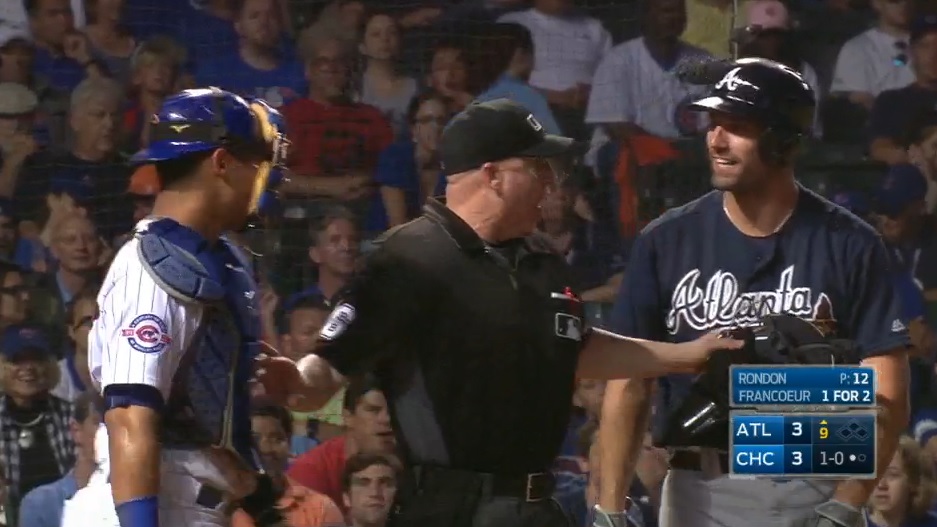
This is what happens when catchers start talking to hitters about their retaliatory instincts.

The reason we don’t frequently hear about this situation is that most catchers, based upon some combination of smarts and seasoning, understand that such banter is rarely productive. The brainpower of Cubs catcher’s Willson Contreras is entirely speculative, but his lack of seasoning is beyond question—last night was only the 24-year-old’s 20th game as a big leaguer.

So when, in the eighth inning of Chicago’s game against Atlanta, Contreras followed an inside fastball from reliever Hector Rondon with a lecture to the hitter, Jeff Francoeur, things took a turn, and benches emptied. (Watch it here.)

Some backstory:

It was a long night for Cubs hitters, with Chicago’s Kris Bryant twice being plunked by Lucas Harrell, on a full-count fastball in the fourth, and on a 1-2 curveball in the eighth. The latter, which hit Bryant on the knee and led to his precautionary removal from the game, was Harrell’s final pitch of the night.

Chicago’s problem, if Chicago had a problem, was that right-hander Hunter Cervenka, in relief of Harrell, drilled the first batter he faced, Anthony Rizzo. Every one of the hit batters came with Atlanta trying to protect a 2-0 lead. Intent did not appear to play a part in any of them.

The actual issue wasn’t that Rondon responded with a message pitch to Francouer in the bottom half of the frame—a pitch that, for not coming close to connecting with the hitter should have been entirely unobjectionable—but that Contreras decided to harp about it.

Nobody discussed what was actually said with reporters—the incident’s principals declined to talk, and Cubs manager Joe Maddon said only that “Francouer took exception, which he should not have”—but it’s clear from the video that Contreras had some things to get off his chest before allowing Francouer to get back to hitting.

The entire point of message pitches, as I’ve been led to believe, is that they’re just that: pitches that bear meaning. Francouer was not upset at Rondon’s inside heater, nor should he have been. It was only when the catcher, young buck that he is, decided to lecture him about it that things grew heated. (It’s possible, but far from certain, that Francouer would have accepted a lecture from a more seasoned player.)

Had Contreras let the pitches do the talking—which is, again, their purpose—all would likely have ended calmly. Another lesson in what’s certain to be a season full of them for a young player.


Retaliation, The Baseball Codes

Cueto Goes Gunslinger: A Lesson on the Merits of Retaliation

Cueto-Franco

We’ve been thinking a lot about baseball retaliation this season—what it means in the modern landscape, and when (and if) it’s ever justified. We’ve thought about it so much, in fact, that one of our most noted bat-tossers had to clarify the idea of “a baseball play,” distinguishing between game action and sideline stupidity, and how a hard slide into a red-ass Rangers infielder should not lead to fisticuffs.

On the other end of the spectrum is Diamondbacks exec Tony La Russa, noting that retaliation is merited even in some cases of unintentional HBPs, should a pitcher with shaky command insist on working the inside edge—a tactic he decried as “intentionally careless.”

Which brings us to Johnny Cueto.

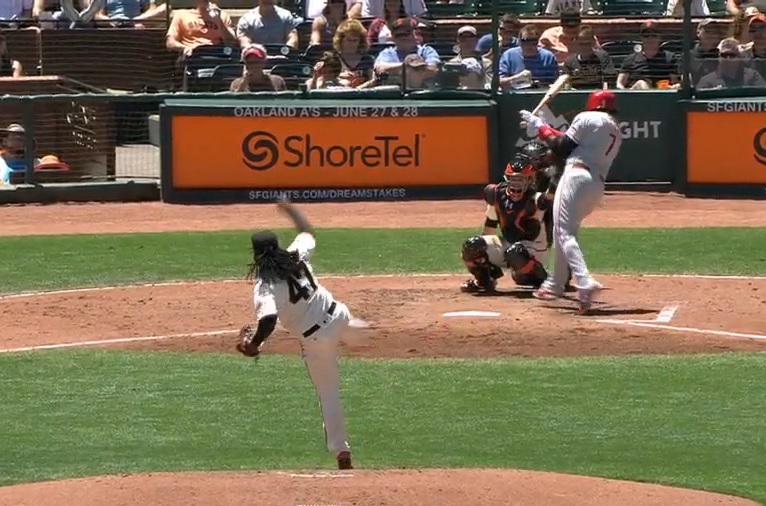
Yesterday in San Francisco, Phillies starter Aaron Nola was terrible, giving up 10 hits and five earned runs over 3 1/3 innings. Also, he hit three batters along the way. Nola is known for his outstanding control (indeed, he didn’t walk a batter against the Giants), but, given his awful June (he became the first Phillies pitcher since 1982 to go four straight starts with fewer than four innings pitched, during which he put up a 15.23 ERA), it’s difficult to mistake any of his mistakes as intentional.

His first and second HBPs, in the first and third innings, each loaded the bases. His third came one batter after his second, and drove in a run. Two of the three came on curveballs.

It mattered little to Cueto. Granted a 5-1 lead with two outs in the top of the fourth, the right-hander planted a fastball into the ribs of cleanup hitter Maikel Franco. Intent was obvious, and plate umpire Doug Eddings immediately warned both benches against further hijinks. (Watch it here.)

We can debate the merits of Cueto’s actions (while making note that the guy has some history with this kind of thing), but more pertinent to this conversation are the consequences.

Cueto, who had allowed one hit prior to drilling Franco, walked the next batter and then gave up back-to-back singles, scoring two runs. An inning later he gave up two singles, a double and a walk, leading to two more runs and a 5-5 score. In the sixth, the Giants having taken a 6-5 lead, Cueto gave up a leadoff homer to Odubel Herrera, costing himself a decision in what otherwise could have been his 12th win. It was his worst start of the season.

Did hitting Franco have anything to do with it?

After the game, Cueto denied intent, then blamed his downturn on Eddings having shrunk the strike zone. Giants manager Bruce Bochy was more clear-eyed, noting that Cueto looked rattled after the warning.

If there is an enduring lesson here, it is that any pitcher who decides to take up for his teammates in such a fashion—whether or not his teammates actually desire such a thing—must be able to withstand whatever repercussions come his way.

On Sunday, that was not Johnny Cueto, who by every reasonable interpretation should have known better.

Retaliation, The Baseball Codes

The Best Kind of Revenge

Panik mashes

On Saturday, Rays starter Matt Moore put a 92 mph fastball directly into Joe Panik’s helmet. (Watch it here.)

It was, without question, unintentional. It came in the top of the fifth, there was nobody out, and Tampa Bay was clinging to a 3-1 lead. Also, the bases were loaded.

That is how Panik came to drive in San Francisco’s second run of the game.

The blow was severe—as is any head shot—but wasn’t enough to knock Panik from the game. It also wasn’t severe enough to merit a retaliatory fastball from any of the six Giants pitchers who followed. (That the DH was in play to protect Moore may have been a factor, but given San Francisco’s general reticence when it comes to that type of behavior, a payback HBP wouldn’t have been expected anyway.)

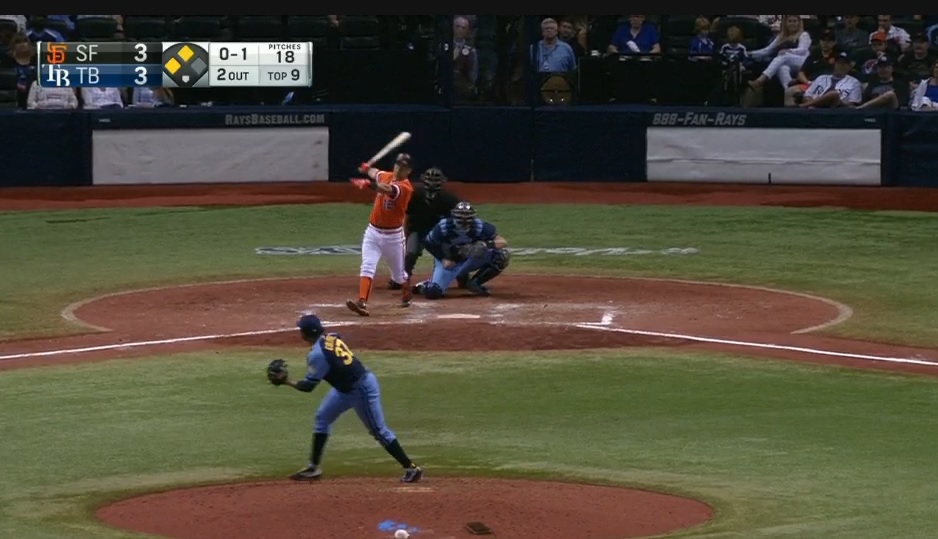
Panik authored his team’s response himself, hitting a tie-breaking homer in the ninth against Tampa Bay’s previously unhittable closer, Alex Colome, which won the game for the Giants. (Watch it here.)

Now that’s what retaliation is supposed to look like.