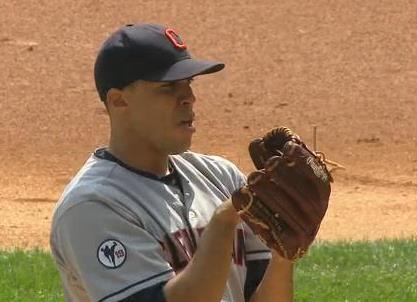
Anybody wondering why the Colorado Rockies never considered Ubaldo Jimenez to be in the same stratosphere as Troy Tulowitzki and Carlos Gonzalez got their answer today.
Turns out the guy is hot-headed, and possibly a touch delusional.
Jimenez, who publicly steamed last week about the lack of respect shown him by the Rockies when they traded him to Cleveland rather than sign him long term, got his first chance to face his former team on Sunday. Before long, he had sent Tulowitzki to the hospital.
The right-hander’s first move was to drill Colorado’s All-Star shortstop in the elbow (test results came back negative). His second was to race toward the plate, daring an enraged Tulowitzki to come at him. After at first refusing to speak to the media after the game, Jimenez said that his post HBP histrionics were merely a reaction to Tulowitzki’s anger. “He was calling me out,” he said in a Denver Post report. “I mean, I’m a man. If somebody calls me out, I have to go.”
Tulowitzki’s drilling follows a time-tested tradition of players being punished for their teammates’ actions, be it the next hitter in the lineup dodging fastballs following a home run, or a slugger going down as part of a pitcher protesting a big inning.
Those tactics, however, are long outdated, and Jimenez knows it. Tulowitzki might have worn it because he’s the face of theRockies—not to mention the guy who got a big contract when Jimenez did not. (Tulowitzki and Gonzalez both signed monster deals after the 2010 season, the former for $134 million, the latter for $80 million, both over seven years. Jimenez signed for $10 million over four years prior to the 2009 campaign.)
Or he might have worn it for the statement he made in response to Jimenez’s initial cries of disrespect. “(Jimenez) had signed his deal and had years left on it,” the shortstop said. “Why would we give him something new when we didn’t see anything out of him?”
Jimenez said that his pitch was unintentional (it “got away,” he said), but that’s clearly not the case. Rockies pitcher Jeremy Guthrie—in his first season with Colorado—said he knew what was coming based on where the catcher was setting up.
The umps, clueless, did not issue an ejection.
Two things worth noting:
Jimenez was 6-9 with a 4.46 ERA when the Rockies traded him last season.
Jimenez is 1-4 with a 7.43 this spring.
The guy gave the Rockies scant reason to lock him up last season, let alone rework his contract long before it was set to expire. He currently appears to be working his way out of the Cleveland rotation altogether. He should focus on things other than misplaced anger directed at guys who don’t deserve it.
Colorado and Cleveland don’t face each other this season, so the two won’t meet again short of the World Series. Should Jimenez face his old mates next year, however, it’s pretty certain that today’s activities will be revisited, with vigor.
Usually, pitchers can unbunch their panties via well-placed fastballs aimed at or near the player responsible for said bunching. It’s time-honored and it’s effective and, if it’s executed properly, it allows adequate venting with no long-term damage.
The long-term nature of the damage Mike Napoli suffered yesterday is up for debate, but there’s little question that he’ll be feeling this particular pinch far longer than he would a baseball to the thigh.
Napoli apparently riled pitcher and former teammate C.J. Wilson by saying, upon Wilson’s signing with Anaheim during the off-season, that he was looking forward to taking the left-hander deep.
Were Wilson truly miffed, he could have called Napolito talk it over. Were he baseball miffed, he could have drilled him the next time the two faced each other. Wilson, however, appears to have been more provoked than angry, gladly looking for an excuse to execute what can only in baseball and frat-house circles qualify as a “prank.”
He tweeted Napoli’s phone number. (That’s what Wilson considers a prank? No, this is a prank.)
Sure, there’s long been a place for off-field retaliation in baseball. Before there was Twitter, Ty Cobb and Buck Herzog fought in Cobb’s hotel room, some hours after Cobb had spiked the second baseman during a game. In this modern age of mass communication, however, it seems that one can do far worse deeds digitally than with one’s fists.
Wilson’s prank—again, we use the term loosely—may have been marginally appropriate had he and Napoli possessed a relationship strong enough to sustain such shenanigans. Napoli, however, told the Fort Worth Star-Telegram that this is not the case.
“I don’t even know why he did it,” he said. “You don’t do that. I am not taking it as a prank. You know, I haven’t even talked to him since the end of last season. We don’t have that type of relationship.”
So Napoli has to deal with the inconvenience of getting a new phone number. Wilson has to defend himself from the outraged masses. And the rest of us get to consider what may yet happen when these guys meet during the regular season (never mind the two spring training contests left between the teams, on March 24 and 25).
Looks like Diamondbacks starting pitchers learned a lesson. In talking to Arizona radio station Sports 620, Daniel Hudson touched upon the fact that Justin Upton was hit by 19 pitches last season—second most in baseball.
“If it’s a starting pitcher [who hit Upton], remember, he’s got to hit,” Hudson told the station, according to ArizonaSports.com, the station’s Web site. “They either have to hit their spots, or expect something in return.”
Okay, that makes sense. What’s interesting is how Hudson and the rest of the staff came upon this realization. The right-hander said that the subject was raised “halfway through the year.”
There are some obvious follow-up questions: Who brought the subject up with him, and how? Was it an order (or at least a suggestion) from manager Kirk Gibson, or somebody else on the staff? Was it Upton himself, or another of the hitters? Were the pitchers called out in a group setting, or did it happen through individual conversations on the side?
This is all interesting stuff. The way a team communicates information like this can be as vital—if not more so—than the information itself. It should be noted that, for a staff chided halfway through the season for the dearth of protection it offered its own hitters, Diamondbacks pitchers drilled either nine or 10 batters in every month of the season, save for September, when they hit only six; they actually declined in that category in the second half. Even so, their total of 53 HBPs—28 by starters, 25 by relievers—ranked fourth in the National League.
There’s also the fact that Upton stands notoriously close to the plate, which certainly had something to do with the frequency of his drillings. (The next closest Arizona player was Miguel Montero, who was hit eight times; nobody else was touched more than four times.) Upton intoned at the team’s FanFest earlier this month that he’ll continue to stand atop the dish, so one can reasonably expect the frequency of his drillings to continue.
Was Hudson just blustering to try to make opposing pitchers a little more wary of pitching inside to Arizona’s best hitter? When the D-Backs make their way to San Francisco later this season, I’ll see if I can’t track down some answers.
Last week I got an e-mail from Tyler Hinman, the five-time American Crossword Puzzle champion, who co-designed the crossword that was the basis of my Brian Wilson feature in the New York Times back in March.
“If you haven’t done this,” he wrote, “you should.”
I had rediscovered crosswords as I reported the Times piece, with Hinman, Times crossword editor Will Shortz and others providing newfound inspiration. The Times’ Sunday crossword has since become an essential part of any given week.
Acrostics, however, were new to me.
Suffice it to say, it was tough. One fills in answers to clues, then correlates those answers to a crossword-like grid to spell out, in this instance, a quotation. It took me the better part of three days to get it all, but I finally decoded an interesting remark about inside pitching.
Cool, I thought. This is why Tyler sent it to me.
SPOILER ALERT. If you’re an acrostic devotee working through a backlog of Wall Street Journal back issues, continue reading at your own risk.
Only then did I turn to the final part of the puzzle. “When you’re finished,” read the instructions, “the initial letters of the answers in the word list will spell the author’s name and the source of the quotation.”
Working my way down, my eyes got increasingly wider. T-U-R-B-O-W-T-H-E-B-A-S-E-B-A-L-L-C-O-D-E-S.
I guess this means I’ve officially arrived. (Seriously, how cool is that?)
I dashed off a note to acrostic editor Mike Shenk, asking how he came upon li’l old me as a subject.
His response: “I thought it would be nice as the baseball season wound down to run a baseball quote in the acrostic, so I headed to the sports section of the bookstore looking for possibilities. There are a few constraints on the quotation itself. The author’s name and title must contain about 20 to 26 letters, the quotation must contain about 250 letters and spaces and must of course include all the letters of the author’s name and title. . . .
“With those restraints in mind, I started looking for good quotes—and quickly discovered that most writers of baseball books aren’t very lively writers. Needless to say, I was happy when I discovered that your book was an exception, with just the sort of attitude I was looking for.”
(Okay. It just got even cooler.)
After having written an entire story about one man’s quest to become a crossword puzzle clue, I’ve now received a similar honor. And it might just be the best review I’ve received.
Edinson Volquez, in a moment of not saying anything.
It’s been a bad week for baseball types to talk, with every talker doing his darndest to deflect blame that he incontrovertibly deserves.
In Cincinnati, Edinson Volquez continued his season-long meltdown on Sunday by giving up seven runs to Cleveland over 2 2/3 innings. The right-hander has a 6.35 ERA and leads the National League with 38 walks.
Volquez’s problem, according to Volquez: the Reds’ offense.
“Everybody has to step up, start to score some runs,” he said in the Cincinnati Enquirer. “In the last five games, how many runs have we scored? Like 13? That’s not the way we were playing last year. We’re better than that.”
This is a terrific way to further alienate teammates who are already undoubtedly upset with the pitcher’s inability to keep Cincinnati in games. It’s even more infuriating than Gaylord Perry’s habit of physically showing frustration on the mound when his teammates made errors behind him in the field. At least Perry took the blame when he deserved it. Plus–unlike Volquez–he was a winner.
Cincinnati’s response was swift; on Monday, Volquez was optioned to Louisville. It was a dramatic move–the right-hander was their opening day starter, a former All-Star who went 17-6 in 2008. Of course, the guy has long battled maturity issues, being kicked by the Rangers all the way down to Single-A from the big leagues in 2007, shortly before they shipped him to Cincinnati (in exchange for Josh Hamilton).
If Volquez jeopardized his own spot in a major league clubhouse, Brian Fuentes jeopardized that of his manager. After Oakland’s interim closer gave up the lead yesterday against the Angels, he used his time in front of the post-game media to light into Bob Geren.
As with Volquez, it was primarily a matter of frustration. Fuentes has picked up losses in four straight appearances; his seven on the season already stand as a career high. He’s on pace to lose more games than any reliever in history.
At issue: how Fuentes has been used. He hasn’t had a save opportunity since May 8, coming primarily into tie games as of late. It happened again on Monday, when Fuentes walked one of the two hitters he faced before being pulled in favor of Michael Wuertz, who promptly let his inherited runner score, tagging Fuentes with the loss.
MLB.com’s Jane Lee posted the entire transcript of the reliever’s bluster:
What did you think of the situation you were placed in tonight?
It’s surprising yet not surprising all at the same time.
How do you feel with the way the manager has handled you as a reliever?
Pretty poorly.
How much communication do you have with him?
Zero.
Why is it pretty poorly?
There’s just no communication. Two games, on the road, bring the closer in a tied game, with no previous discussions of doing so. And then, tonight, in the seventh inning, I get up. I haven’t stretched, I haven’t prepared myself. If there was some communication beforehand I would be ready to come into the game – which I was, when I came into the game, I was ready. Just lack of communication. I don’t think anybody really knows which direction he’s headed.
How much different is this compared to past managers?
It’s a pretty drastic difference.
What goes through your mind when the phone rings in the seventh tonight?
I thought he misspoke. I thought it was some sort of miscommunication, but he said, ‘No, you’re up,’ so I got up and cranked it up. You can’t try to guess along with them. Very unpredictable.
At the beginning of the season, did he tell you that you were the closer?
Yes, from get go, I’ve been closing.
In regards to communication, is that something that ought to change?
It should. It’s not my decision. I can’t predict the future. If he decides to take that step, then there will be communication. If not, I’ll make sure I’m ready from the first.
Does there need to be a “clear the air” meeting?
Some people might think so. At this point I have nothing to say.
Has this been boiling up or is it just recent?
Just recent, really. I think the games in San Francisco were some unorthodox managing. I thought it was maybe the National league thing, that maybe that had something to do with it, but tonight was pretty unbelievable.
“Unbelievable” is an appropriate term. Fuentes has some validity with his points, but going public with them makes him look like a half-bit pitcher searching desperately for excuses. In the process, he completely undermined his manager and potentially damaged team chemistry. Today saw calls for Geren to resign, and questions have been raised about how the team will communicate moving forward.
This is a lot of damage for a pitcher who has been with the A’s for all of two months to inflict over the course of a five-minute interview.
The Reds sent Volquez to the minors. Fuentes doesn’t have to worry about that, but his position in the bullpen is certainly in danger. (Geren said that would have been the case even had Fuentes kept his mouth shut.) A’s closer Andrew Bailey is due back soon from the DL, and the return to health of Joey Devine and Josh Outman makes Fuentes expendable; shuffling him out of sight until he can be dealt to a contender should not be too difficult. (Fuentes came back tonight, and, without backing down from his statements, apologized to Geren—assumedly for the public nature of his discourse.)
* * *
Most noteworthy of all talkers was Mets owner Fred Wilpon, who set New York atwitter as soon as the New Yorker published Jeffrey Toobin’s profile of him. Amid what is otherwise a sympathetic story, Wilpon spent a few choice paragraphs disparaging his players. Jose Reyes, he said, will never get “Carl Crawford money” when he hits free agency after this season, because he’s too frequently injured. (The direct quote: “He’s had everything wrong with him.”)
Carlos Beltran was given a seven-year, $119 million deal by “some schmuck” (that would be Wilpon referring to himself), which the owner has come to regret. David Wright, he said, while a very good player, is not a superstar.
And the team as a whole: “Shitty.”
Yikes. In one brutal volley, Wilpon inadvertently undermined his financial recovery from the Bernie Maddoff fallout, at least as far as the Mets are concerned. (This despite the fact that, like Fuentes, Wilpon probably didn’t say anything that was inaccurate). He’s not going to re-sign Reyes, that much is now clear; what leverage the Mets held in trade talks regarding their shortstop has been radically diminished. Beltran, too, is on the trading block, but what kind of bargaining position will the Mets be in after their owner proclaimed the center fielder to be “sixty-five to seventy percent of what he was?” Will Wright—or any other player, for that matter—want to stick around a dysfunctional ballclub once free agency comes calling?
Most of all, Wilpon wants to sell part of the team, which may be harder to do after he’s publically acknowledged that it’s shitty. Not to mention that whoever buys in would have to defer to a proven loose cannon.
Other players on all three teams—the Reds, A’s and Mets—have done a good job avoiding additional conflict, opting against saying anything to further inflame their situations. Dennis Eckersley, however, let loose on Fuentes during an interview on the A’s flagship radio station (as tweeted by Chronicle columnist John Shea and compiled by Hardball Talk). Eck was talking about Fuentes, but conceptually he could have be referring to any one of the three:
“Weak. If you fail, you fail. You don’t throw the manager under the bus. . . . He makes a ton of money, and he’s not the greatest closer in the universe. So zip it … It makes him look bad. It just does. At the same time, it doesn’t show a lot of respect for the manager … If I’m the manager, he’s in my office. If that was La Russa, are you kidding me? He’d chop my head off. I would make a formal apology … Geren’s got to do something.”
Geren does have to do something. As do the Reds (Volquez can’t stay in the minors forever) and the Mets.
Update 2: For Geren, the piling on has officially begun. The latest: Huston Streetweighed in on his ex-manager’s shortcomings from Colorado. Plus, a tale about Mike Sweeney not getting along with the guy, which really doesn’t look good considering that if there was a Nicest Man in the History of Baseball Award, it’d likely go to Sweeney. Unless the A’s experience extraordinary success into October, the chances of Geren returning next year are at this point minimal. If he makes it even that long.
Well, I put out a call and people responded. Unfortunately, it seems that nobody really knows what happened, because that sort of thing happened all the time.
From SABR member Pete Palmer:
Although RBI were first officially recorded in 1920, there were no rules about them until 1930. The bases loaded walk was specifically noted as an RBI then. In the 1920s, some scorers gave RBI for a bases loaded walk and some didn’t. Since there were no rules, you can’t really fault the scorers for what they did. After all, in the 1880s a walk was counted as an error for the pitcher. The modern encyclopedias subtracted these as well as the assists on a strikeout for pitchers.
It would make sense to go back and dig these bases loaded walks up and credit an RBI for them. Of course, we don’t have a complete set of play-by-plays, but we do have a lot. The whole compilation of RBI especially in the 20s, had hundreds if not thousands of errors besides this type, so it is better to assume the posted number is an approximation.
Elias recently changed some stats, although we don’t know which ones except for the league leaders shown in their record book. In 1921, George Kelly had 122 RBI. Elias changed him to 127 which led the league, but Retrosheet found 131.
It’s as good an explanation as I’ve yet heard. In the course of reporting his book 1921, Steve Steinberg reports that he uncovered a number of statistical discrepancies, essentially confirming Palmer’s account.
It might not be entirely satisfying, but it is an answer.
A reader named Robert contacted me today with a fascinating question. I can’t say it any more concisely than he did, so I won’t try:
In Baseball Codes, page 74, it is stated that Mel Ott was walked with the bases loaded. On the day in question, October 5, 1929, second game of doubleheader, Ott was walked five times. If we go back to September 24th we find that Ott drove in three runs, bringing his total for the year to 151. That (151) was his final RBI total for 1929. Ott did not get credit for an RBI in the game of October 5th. Why?
Sure enough, Ott received no RBI for his five-walk day, which included one with the bases loaded. The Giants scored 12 runs that Oct. 5 but were only credited with 10 RBIs.
My instinct tells me that rules at the time disallowed RBIs being awarded for bases-loaded walks, but that’s strictly hypothesis.
And so I ask you: Any ideas about why this might be?
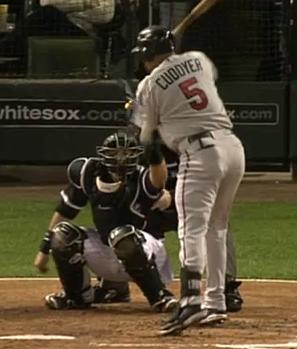
That Mark Buehrleintentionally drilledMichael Cuddyer yesterday is hardly unusual. White Sox first baseman Paul Konerko had been hit on the upper lip by Carl Pavano in the first, and Cuddyer was Minnesota’s leadoff hitter in the second.
Umpire Jerry Crawford delayed his warnings, Buehrle hit Cuddyer in the shoulder blade, and, as is proper when this sort of thing happens, everybody moved on. (Watch it here.)
Until after the game, anyway, when Buehrle actually talked about his motivation.
“When I’m told to do something I try to go out there and do it to the best of my ability,” he told reporters. “Obviously you got to protect your guys.”
Rare is the instance when a pitcher admits to something like this, even in as roundabout a way as Buehrle. It’s tantamount to public confession, and, although Buehrle’s statement is probably too vague to fall into this category, frequently leads to discipline from the league.
Of course, Buehrle knows a thing or two about following Ozzie Guillen’s orders when it comes to things like this. I’ve excerpted this section before, but it bears repeating. From The Baseball Codes:
In 2006, Ozzie Guillen quickly identified Texas’s Hank Blalock as a target for retaliation after Rangers pitcher Vicente Padilla twice hit Chicago catcher A. J. Pierzynski during a game. That was the plan, anyway. Filling the space between conception and exe¬cution, however, was Guillen’s choice of executioner: rookie Sean Tracey.
The right-hander had appeared in all of two big-league games to that point and was understandably nervous. Even under optimal circumstances he didn’t have terrific control, having led the Carolina League in wild pitches two years earlier, while hitting twenty-three batters. When Tracey was suddenly inserted into a game at Arlington Stadium with orders to drill the twentieth major-league hitter he’d ever faced, it was hardly because he was the best man for the job. To Guillen, Tracey was simply an expendable commodity, a reliever whose potential ejection wouldn’t much hurt the team, especially trailing 5–0, as the Sox were at the time. . . .
When the right-hander’s first pitch to Blalock ran high and tight but missed the mark, Tracey did what he’d been taught in the minors, sending his next pitch to the outside corner in order to avoid suspicion. Blalock tipped it foul. When Tracey’s third effort was also fouled back, for strike two, the pitcher altered his strategy and decided to go after the out, not the batter.
According to his manager, it was the wrong decision. After Blalock grounded out on the fifth pitch of the at-bat, Guillen stormed to the mound and angrily yanked Tracey from the game. He didn’t let up after they returned to the dugout, berating the twenty-five-year-old in front of both his teammates and a television audience. With nowhere to hide, Tracey sat on the bench and pulled his jersey up over his head, doing his best to disappear in plain sight. Two days later, without making another appearance, he was returned to the minor leagues, and during the off¬season was released. . . .
Ultimately, Tracey shouldered the responsibility for his actions, saying he “learned from it,” but the lesson was lost on his more tenured teammate, Jon Garland, a seven-year veteran en route to his second consecutive eighteen-win season. Before Padilla’s next start against the White Sox, Guillen launched a pre-emptive verbal sortie, positing to members of the media that if the Rangers right-hander hit any Chicago player, retribution would be fast and decisive. His exact words: “If Padilla hits somebody, believe me, we’re going to do something about it. That’s a guarantee. I don’t know what’s going to happen, but something’s going to happen. Make sure [the Rangers] know it, too.” Padilla did, in fact, hit Chicago shortstop Alex Cintron in the third inning, at which point it didn’t take much predictive power to see that a member of the Texas lineup would soon be going down. The smart money was on the following inning’s leadoff hitter, second baseman Ian Kinsler.
The smart money was correct, but the payoff left something to be desired. Garland’s first pitch sailed behind Kinsler, a mark clearly missed. Plate umpire Randy Marsh, well versed in the history between the clubs, opted against issuing a warning, effectively granting Garland a second chance. The pitcher didn’t exactly seize the opportunity, putting his next pitch in nearly the same place as the first. At this point, Marsh had no choice—warnings were issued and hostilities were, willingly or not, ceased. Guillen rushed to the mound for a vigorous discussion about the merits of teammate protection. Kinsler ultimately walked, and after the inning Guillen reprised his dugout undressing of Sean Tracey, spewing invective while Garland listened and the White Sox batted.
Buehrle was with the White Sox at the time, and is all too aware of the repercussions that come with failing to follow his skipper’s orders. (Not that he wouldn’t have done it on his own, anyway.)
He still has to work on keeping these things to himself, but at least Guillen— the league’s poster child for saying far more than he should—has little to hold over him in this regard.
Reluctance to be pulled from a game is the hallmark of any quality starting pitcher, no matter how he’s actually feeling. If he’s tired, or if his stuff isn’t popping like he feels it should, he’s forced to walk the fine line between becoming a detriment to his team and essentially giving up.
Few in baseball want to see perceived cowardice in action from their teammates, even if it’s ultimately for the collective good. Said David Cone about being in that situation: “If you don’t say the right thing, it’s perceived as a lack of heart.”
Mets fans have a lot to grumble about this season, but a lack of heart from R.A. Dickey isn’t part of it. He made that much clear on Sunday.
Having shut out the Dodgers on two hits through five innings, Dickey injured his leg on a follow-through while pitching to the first hitter of the sixth, Russell Martin. (He claimed it was because he landed awkwardly in a hole created by Dodgers starter Clayton Kershaw.)
Dickey stayed in the game to retire Martin and the next hitter, Kershaw, both on comebackers to the mound. At that point, however, Mets manager Jerry Manuel opted for caution, and removed the pitcher, mid-frame.
That much is standard procedure. An injury to one of their better pitchers would be devastating to the Mets, and watching Dickey pounce off the mound to field consecutive grounders undoubtedly left Manuel’s head spinning.
It’s how Dickey responded that stood out. In a discussion that lasted the better part of two minutes, the pitcher vociferously lobbied Manuel to stay in the game. When that failed to take, he turned his efforts toward trainer Mike Herbst. (Watch the entire affair here.)
Here’s what Dickey knew: the Mets had used seven pitchers in Saturday’s 13-inning loss to Los Angeles, and another seven in Wednesday’s 14-inning loss to Arizona, and he wanted to protect the bullpen.
Here’s what Dickey didn’t know: Manuel had already made the call for a reliever by the time the pitcher turned to plate umpire Dana DeMuth and said, according to the New York Times, “I’m not going anywhere.”
“It’s frustrating because I felt I let my team down,” said Dickey afterward, in the New York Post.
Manuel’s reply: “He was adamant about staying in the game, but I didn’t feel we could risk a guy like that going down.”
The episode calls to mind a conversation held during Game 4 of the 1977 World Series, when Dodgers manager Tommy Lasorda went to the mound to remove his starter, Doug Rau. It’s memorable (and available) because Lasorda was wearing a microphone for the TV broadcast. Also, as Lasorda admitted to one of his coaches in the dugout, his goal was to stall for time and allow reliever Rick Rhoden additional warm-up tosses.
Lasorda made the decision to remove Rau before he even left the bench, but the pitcher, not privy to his manager’s thinking, lobbied to remain in the game—which was exactly what Lasorda didn’t want to hear. (Warning: baseball language—in no way family appropriate—ensues.)
Rau: I feel good, Tommy.
Lasorda: I don’t give a shit you feel good. There’s four motherfucking hits up there. [There were actually only three.]
Rau: They were all fuckin’ hit the opposite way. . . .
Lasorda: I don’t give a fuck.
Rau: Tommy, we got a left-handed hitter. I can strike this mother¬fucker out.
Lasorda: I don’t give a shit, Dougie.
Rau: I want to get out of this myself.
Lasorda: I may be wrong, but that’s my goddamn job.
Rau: I ain’t fuckin’ hurtin’.
Lasorda: I’ll make the fuckin’ decisions here, okay?
Rau: [Tommy John] gave up three runs on the fuckin’ board yesterday.
Lasorda: I don’t give a fuck! Don’t give me any shit, goddamn it! I make the fuckin’ decisions. Keep your fucking mouth shut—I told you.
Second baseman Davey Lopes, interjecting on behalf of the sport’s image: “Hey, hey, hey. This looks bad up here. Just back off the mound. You want to talk about it, talk about it inside.”
Lasorda: We’ll talk about it in my fucking office.
Rau: If I felt bad, then I wouldn’t say nothing.
Lopes: I’m just saying, talk about it inside. This is not the place to be talking about it, okay? That’s all I’m trying to say. I’m just trying to avoid a fucking scene out here, that’s all.
Lasorda: That’s right. It’s fucking great for you to be out here talking to me like that.
Rau: If I didn’t feel good, I wouldn’t say nothing.
Lasorda: I don’t give a shit, Doug. I’m the fucking manager of the fucking team. I gotta make the fucking decisions. And I’ll make them to the fucking best of my ability. They may be the fucking wrong decisions, but I’ll make it. Don’t worry about it. I’ll make the fucking decisions. I gave you the fucking chance to walk out here. I can’t fuck around—we’re down two games to one. If it was yesterday, it’s a different fucking story.
Rau: We got a left-handed hitter coming up, why—
Lasorda: I don’t give a shit! You got three left-handed hitters and they all got hits on you. Rivers, Jackson, and that fucking other guy. That guy who just hit the ball was a left-hander, wasn’t he? [Chris Chambliss, who had doubled, was indeed left-handed.]
Rau: I jammed him. I pitched it on the inside part of the plate. . . .
Lasorda: I don’t give a shit whether you jammed him or not—he didn’t get out. I can’t let you out there in a fucking game like this—I’ve got a fucking job to do. What’s the matter with you?
For what it’s worth, Rau’s tenacity helped earn him an increased role in the Dodgers rotation the following year.
As for R.A. Dickey, his own determination will do doubt help endear him to hard-to-please Mets fans. Still, it should be noted that Hall of Fame manager Sparky Anderson had a rule with his pitchers. “I don’t want to hear you,” he said. “Just give me the ball. I have no desire to hear a pitcher’s feelings, because if something goes wrong I’m the one who’s going to get fired, not the pitcher.”
Remember Fredi Gonazlez’s spat with Hanley Ramiriez? Gonzalez was praised for publically calling out his superstar for lackadaisical play and a bad attitude, and Ramirez eventually returned, contrite.
It’s been almost exactly a month since Ramirez returned from a one-day benching; he’s since batted .292 with four homers, 23 RBIs and 10 stolen bases.
While there were reasons for the firing that had nothing to do with Ramirez, it’s clear who ultimately got the better of that confrontation.
Update: Buster Olneypoints out another unwritten rule in this situation: “If you’re going to fire the skipper, do it while you’re playing a really, really bad team so that when you win, it looks like the players responded.”
 Anybody wondering why the Colorado Rockies never considered Ubaldo Jimenez to be in the same stratosphere as Troy Tulowitzki and Carlos Gonzalez got their answer today.



 The Baseball Codes