 It’s difficult to say for sure, but it appears as if John Tesh (or at least one of his interns) likes The Baseball Codes.
The guy wrote the theme song for the NBA on NBC. Perhaps he’s branching out.
– Jason
It’s difficult to say for sure, but it appears as if John Tesh (or at least one of his interns) likes The Baseball Codes.
The guy wrote the theme song for the NBA on NBC. Perhaps he’s branching out.
– Jason
Random House just ordered up another batch of The Baseball Codes. To all of you who have bought a copy (and especially to those who have bought more than one): thank you.
It’s truly been overwhelming.
– Jason
 In honor of the mothers in my life, I offer a brief selection of day-appropriate quotes:
To the three of them, and mothers everywhere, I hope your days are as grand as Hallmark suggests they should be. Happy Mother’s Day to one and all.
– Jason
The lack of retaliation by Pirates pitcher Zach Duke when it was so clearly mandated has raised some interesting questions. For example, why didn’t Pirates manager John Russell—who by multiple accounts was enraged at Duke’s inaction—simply order his pitcher to get the job done?
Once, this would have been a no-brainer. In the 1940s, Leo Durocher was known to leave hundred-dollar bills in the locker of Whitlow Wyatt as a reward when the pitcher threw at players’ heads. Numerous opponents recall longtime manager Gene Mauch shouting for his pitcher to “spin his helmet.”
Heck, when Casey Stengel managed the Boston Braves, he was once so upset when one of his rookie pitchers—appearing in just his second big-league game—failed to retaliate according to expectations that he sent the guy back to the minors. It was four more years before Warren Spahn returned to the big leagues (although the U.S. Army also had something to do with his delay), a turn of events that Stengel later called the biggest blunder he ever made as a manager.
Modern managers, though, are different. Now that players constitute multi-million-dollar investments, nobody wants to take responsibility should a fastball go awry.
Pitchers are occasionally encouraged in vague terms (“Do what you have to do”), but rare is the order to actually drill somebody.
(One noteworthy exception to this trend is Ozzie Guillen, who ordered his own rookie pitcher, Sean Tracey, to hit a batter in 2006. When, like Spahn, Tracey failed to carry out his manager’s wishes, he was, like Spahn, banished to the minors.)
Instead, pitchers are expected to understand this responsibility. Should a young player fail to appropriately read a situation, a good talking-to will usually do the trick. For a veteran like Duke, however, significantly more is expected.
Another question involves the window of opportunity. Duke had the chance to directly retaliate against the pitcher who twice threw at McCutchen—Ramon Ortiz came to the plate for the first time this season in the sixth inning—and didn’t do anything about it.
The following inning, when Pirates reliever Jack Taschner sent a ball behind the head of the first hitter he faced, Andre Ethier, it was a clear message sent.
So is the case closed, especially if Ortiz manages to hit against the Pirates again? The vagaries of scheduling make this a mostly moot point; as of May 2, the Pirates and Dodgers had faced each other six times, and will not meet again until 2011. (We’re putting our money on them failing to square off in October.)
Not that it would have mattered. Duke had his chance and completely whiffed; Taschner got a measure of revenge with his message pitch, even though he didn’t actually hit anybody.
If the Pirates respond next season, it will open old wounds in a hurry. As in the wrong as the Dodgers were in this instance, Pittsburgh would be just as guilty if they choose to pursue this into 2011—and the smart money’s on them staying far, far away from even the appearance of vengeance.
That is, unless Zach Duke decides he has something to prove.
– Jason
I was already thanking Alex Rodriguez and Dallas Braden for sending so much attention this way before I heard the most recent news: The Baseball Codes is currently No. 36 on all of Amazon, and is tops among sports books.
It’s kind of overwhelming. Thanks to all for the support.
– Jason
The Baseball Codes is the official Book of the Day in the Bergen County Cooperative Library System today. Thanks, librarians!
Update: It’s a new day, so our book-of-the-day moment has passed. Don’t worry librarians, we love you none the less.
– Jason
Michael sends news from San Luis Obispo, where he stopped on the way home from spring training to sign some books at the local Borders. The staff there was apparently so tickled to have them that they put the copies in a special display, displacing — and this pleased my collaborator to no end — the recent release by Karl Rove.
Hey, it’s baseball season. Why not?
– Jason
Lowell Cohn is not your ordinary newspaper writer – he has a PhD. in English Literature and has been an instructor at the world-famous Stanford Creative Writing Program, and he has won numerous national awards for his work.
So, when Lowell says nice things about the book, we proudly blush — and encourage you to read his kind words. He liked it so much, he not only wrote his Sunday column on the subject, he also posted an interview with Michael in his blog, The Cohn Zone.
The article can be found here: Sunday Column
The blog can be found here: The Cohn Zone
The book can be found everywhere — on line, or at your local bookseller. Support local folks if you can.
-Michael-
Word just came down that Random House is issuing a third printing. I certainly don’t claim to know much about the book business, but this seems like a good sign, just three weeks in.
– Jason
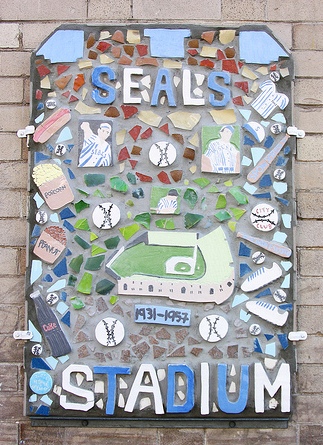 Okay, this doesn’t have much to do with the unwritten rules, unless one wants to view it from the perspective that the essence of the Code is to preserve the essential tenets of baseball’s past. In that case, so too does this page, in a way.
Todd Lappin took the time to examine aerial photos of Seals Stadium—the Giants’ first home in San Francisco, and the ballpark where Joe DiMaggio played as a member of the San Francisco Seals before he joined the Yankees—to figure out where, exactly, home plate would have been amid the shopping center that now stands on the site.
It’s essentially trivia at this point, but for people like me, who love the history of the game, from statistics and stories all the way to real estate, it’s a labor of love that’s utterly appreciated.
– Jason
 The Baseball Codes