Slide properly

Simmons Steams Over Odor’s Ardor For Impact

Odor slides

Another crappy slide, another pissed-off middle infielder, another dustup on a big league diamond. This is almost becoming routine.

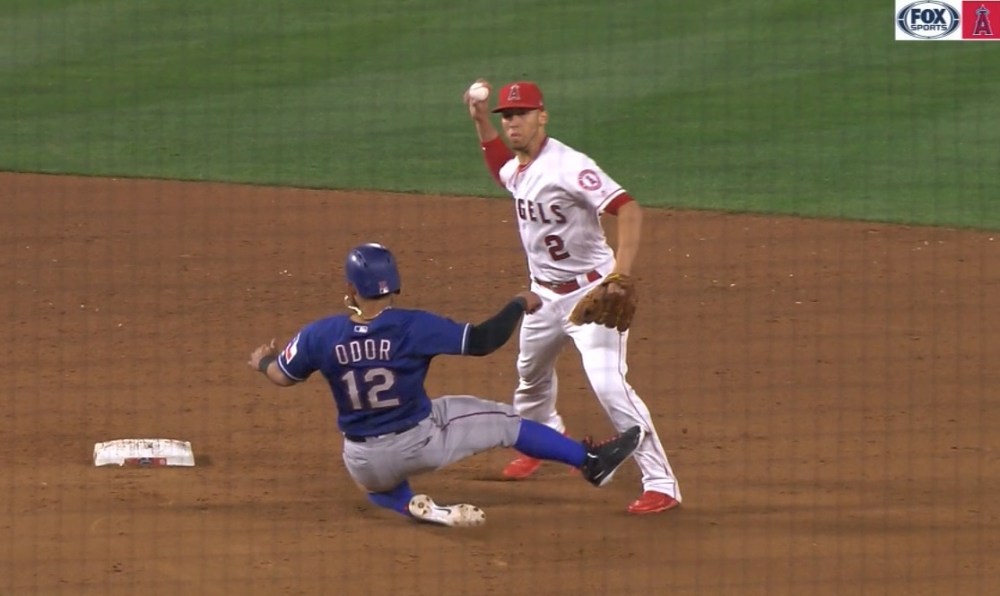
On Saturday, Rangers second baseman Roughned Odor tried to take out Angels shortstop Andrelton Simmons on the final play of of LA’s 6-0 shutout. On one hand, it’s up to Odor to do whatever he can to break up the double play and extend the inning. On the other, there’s this pesky document put out by Major League Baseball called “Official Baseball Rules,” by which Odor’s tactics should be judged a bit more harshly.

Odor swung well to the outside of second base in an effort to disrupt the play, but not wide enough. To reach Simmons, who’d cleared the base by some four feet, Odor had to jut out his right leg in the exact opposite direction of the bag. In so doing, his cleats tore into Simmons’ shin.

The effort was not enough to disrupt the throw, but it did manage to empty the dugouts. No punches were thrown.

Odor was clueless after the game. “He pushed me,” he told reporters about Simmons’ response. “I was surprised because I made a good slide. It was not a dirty slide. I tried to break up the double play with a good slide. That’s why I was surprised he pushed me like that. He was angry, but I was like, ‘What are you talking about?’ I made a good slide. It was not dirty.”

Rangers Jeff Bannister stood up for his player, because that’s what managers do, calling the slide “appropriate.”

“I didn’t see anything I thought should warrant the reaction we got,” he said in an MLB.com report. “Situation where we are going to continue to play hard baseball. Situation where Rougned made contact with the bag. Not sure why the anxiety.”

Why the anxiety might be because, for Odor, this kind of slide is old hat.

Following Anthony Rizzo’s disputed slide in Pittsburgh a week ago today, and the Pirates’ revenge slide two days later, the Rangers should be up on what constitutes “not dirty.” In the modern, safety-first era, what Odor did—even if, as seems likely, he did not intend to spike Simmons—was unequivocally dirty.

The rule he broke, 6.01—which we’ve referenced an awful lot over the previous seven days—specifically mandates that a runner can’t change his pathway for the purpose of initiating contact with a fielder. The rule’s current iteration was devised following Chase Utley’s slide in the 2015 National League Division Series that broke Ruben Tejada’s leg. (Utley also did something similar to Tejada, with less-disastrous results, in 2010.)

The rule is there for a reason. Simmons ended up with a gash on his leg, but did not miss any time. Also, he didn’t want to talk about it. “Nothing,” he told reporters in response to a question about what he said to Odor following the slide. “I was trying to tell him, ‘You forgot to say hello to your family for me.’ He’s like, ‘No, I didn’t forget, I told them.’ I was like, ‘No, they told me you didn’t tell them.’ He wasn’t very happy about it, so it’s OK. … I’m gonna eat my gelato and sleep well at night.”

Simmons was eating gelato at the time.

On Sunday, Angels pitchers opted against retaliation, but Simmons had a chance to seize his own pound of flesh with a wide slide into Odor to break up a double play in the fourth. He did it—Odor’s relay to first baseman Ronald Guzman was not in time to catch Shohei Ohtani—but umpires ruled that Simmons had deviated from his path, and called Ohtani out.

(To be fair, regarding the commentary in the above tweet, Simmons completed his double play on Saturday, so there was no need to review the slide.)

Questionable slides have led to all sorts of confrontations over recent seasons. Recently, of course, they’re supposed to be regulated out of existence, something that has yet to happen. Given Odor’s track record with this kind of thing, unless the league office intervenes, expect it to continue.
No-Hitter Etiquette

No Hits, No Runs, No More Pitching For You: The Not-So-Lonely Tale Of Nathan Eovaldi

Eovaldi

The first time I ever posted about a manager pulling a pitcher in the middle of a no-hitter, back in April 2010, a month after The Baseball Codes was released, it was a bit of a novelty.

Since that time, I’ve written about it again and again and again and again and again and again and again and again. The novelty has worn off.

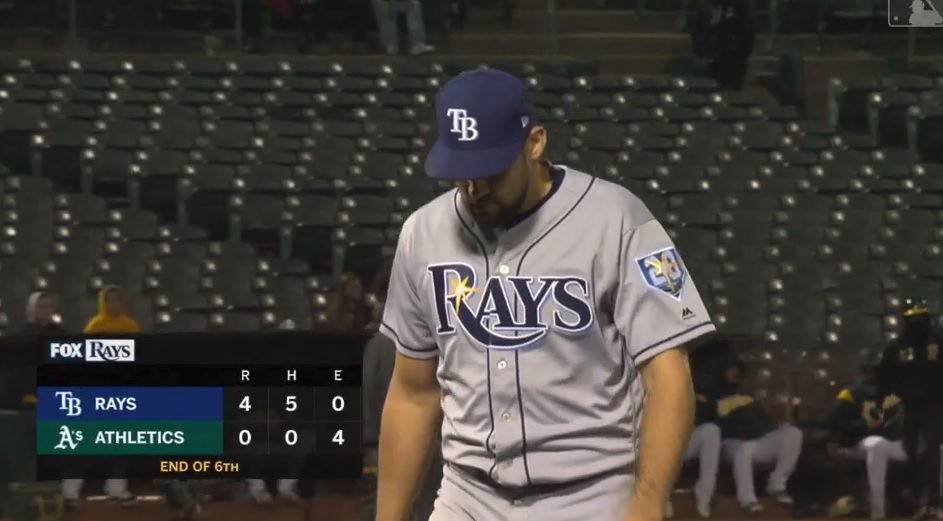
It’s still kinda noteworthy when it happens though, and it happened again on Wednesday, when Tampa Bay’s Nathan Eovaldi tossed six hitless innings against the A’s before being pulled by manager Kevin Cash. (As it happens, his opponent, Sean Manaea, was pulled from his own no-hitter last season—the fifth “again” in the above link list.)

The right-hander had thrown only 70 pitches to that point, but was making his first start in nearly a year and a half, having only recently returned from his second Tommy John surgery. The last time the seven-year vet went seven innings was in August, 2016. The last time he went eight was the previous May. The last time he’d thrown a complete game was never. That Cash wanted to take no chances with the pitcher’s long-term health was entirely understandable, but didn’t do much to make the decision more palatable for Eovaldi.

“He just kind of stared at me,” Cash told the Tampa Bay Times, about the moment he informed Eovaldi that the pitcher wouldn’t be heading back out for the seventh.

“I just tried to stay in there,” Eovaldi responded. “I didn’t want to shake his hand. He said, ‘Come on, you’ve got to shake my hand.’ I’m like, ‘All right …’

Tampa Bay’s first reliever, Wilmer Font, gave up a hit to the second batter he faced, but the Rays held on to win, 6-0, while Eovaldi is on track to make his next start, healthy (one hopes) as ever.

***

In a semi-related item to the above story, the A’s did their part to throw a wrench into Eovaldi’s outing.

Basepath Retaliation, Collisions, Retaliation

Pittsburgh Responds To Rizzo Takeout: You Slide Into Mine, I’ll Slide Into Yours

Musgrove slides

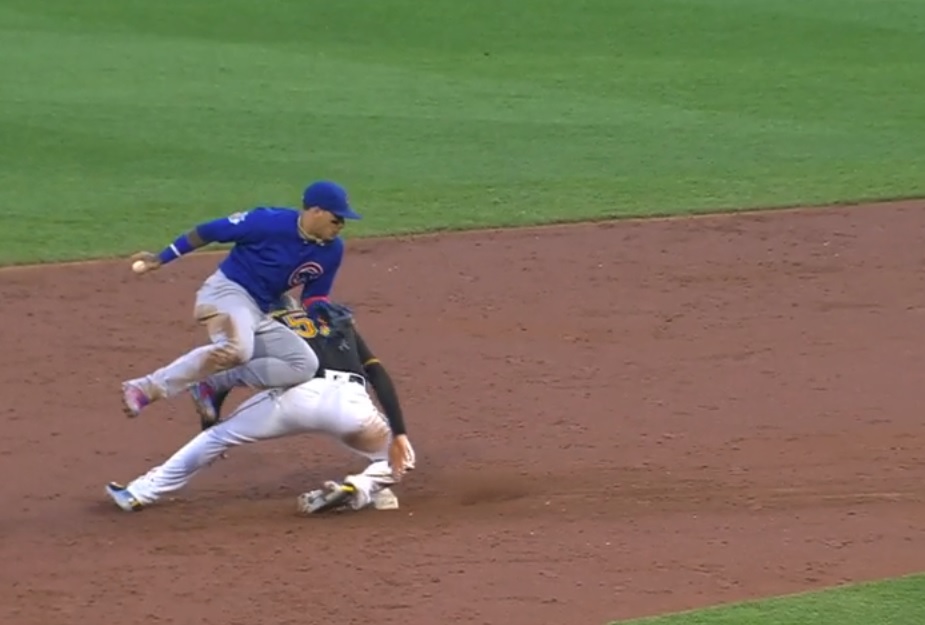
They were back at it in Pittsburgh on Wednesday, the Cubs and Pirates coming to a head over the second questionable slide in a three-game span. This time it was the Pirates hitting the dirt, as pitcher Joe Musgrove powered into second with a blatantly late slide in an effort to disrupt a double play. (Watch it here.)

This time it was Javy Baez on the receiving end, and though the slide did no damage, he wasn’t pleased. Musgrove leaped so late that he landed virtually atop the bag, his momentum carrying him straight past it. In so doing he violated two of the four tenets of Rule 6.01(j), which we’ve heard an awful lot about recently. It reads:


If a runner does not engage in a bona fide slide, and initiates (or attempts to make) contact with the fielder for the purpose of breaking up a double play, he should be called for interference under this Rule 6.01. A “bona fide slide” for purposes of Rule 6.01 occurs when the runner: (1) begins his slide (i.e., makes contact with the ground) before reaching the base; (2) is able and attempts to reach the base with his hand or foot; (3) is able and attempts to remain on the base (except home plate) after completion of the slide; and (4) slides within reach of the base without changing his pathway for the purpose of initiating contact with a fielder.


Baez knew that Musgrove’s slide wasn’t by the book, and as the pitcher started back toward Pittsburgh’s dugout, let him know about it. Things hardly grew heated—Baez gently put a hand on the Musgrove’s hip in a “there, there” kind of way—and though benches cleared, players never came close to fighting.


For a blog about unwritten rules, we’ve sure spent a lot of time recently on the written ones. Still, there’s an awful lot of subtext here. Musgrove’s slide was about much more than hard-nosed baseball—it was about retaliation for Anthony Rizzo’s disputed takeout of Pittsburgh catcher Elias Diaz on Monday. Musgrove admitted as much, telling reporters after the game: “I was trying to go in hard like their guy did. [Baez] should’ve got out of the way, I guess.”

Not enough? The pitcher elaborated.

“We’re not trying to fight anybody here,” he said in an MLB.com report. “We’re not trying to cause any problems, but you blindside our catcher when he’s got no chance to defend himself … That’s something that I feel like is part of baseball. I don’t think he was happy that I went after their guy or anything like that, but yeah, you try to pick up your teammates where you can. I didn’t hurt him. I easily could have made a dirty slide, but I feel like I made a clean slide and went in hard.”

It’s a simple message. The cleanliness of Musgrove’s slide is up for debate, but his claims about not wanting to injure anybody are valid. Baez himself believed them, telling reporters after the game: “I’m not saying it was a bad slide, but he just went hard. I asked him, ‘What was that about?’ He said, ‘Sorry,’ and the conversation was over.”

Musgrove sent a message, to the Cubs and his own team alike, that plays like Rizzo’s will be answered. It was a canny decision. As a pitcher, Musgrove easily could have conveyed the sentiment with a message pitch, but by going slide-for-slide, he was able to provide tangible support for his teammates in an aboveboard fashion.

Musgrove—a third-year pitcher trying to establish himself after coming over from Houston in the Gerrit Cole trade—earned a measure of clubhouse standing with seven innings of one-run ball on Wednesday. He may have earned even more with his slide.

Collisions

Rizzo’s Romp: Old-School Play In A New-Era Sport Leaves Many People Angry

Rizzo slides

In this kinder, gentler MLB, we’re facing what has become a string of uncomfortable conversations about basepath etiquette, delineating not only what is legal, but what is right. It started in April, when a wide slide into second by New York’s Tyler Austin took out Red Sox shortstop Brock Holt and, after a retaliatory strike, led to a full-fledged brawl on the Fenway Park infield.

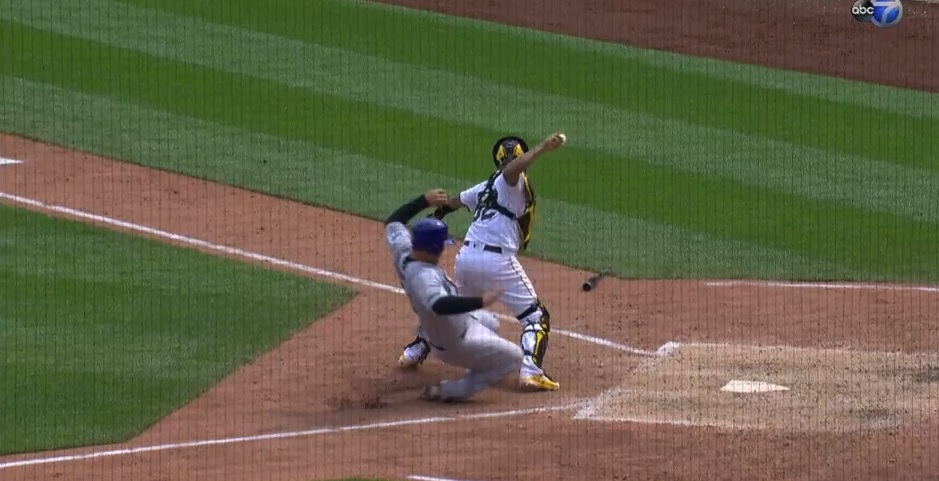
Monday’s slide into the plate by Anthony Rizzo was quieter than that, if only because the Pirates chose not to retaliate. Rizzo had come home on a bases-loaded grounder to shortstop, and took out the right ankle of Elias Diaz, despite the catcher having already made the putout and cleared the box as he prepared to fire the ball to first base to complete the double play. The ensuing throw went wild, allowing Javier Baez and Kyle Schwarber to score on the error. Diaz remained on the ground for a while, clutching at his leg, but did not leave the game.

On the one hand, this is classic baseball. Double-plays are meant to be broken up, and Rizzo did nothing untoward in terms of raising his spikes or barreling into the catcher. His slide kept him within easy reach of the plate and was textbook clean. It unfolded exactly as intended, impacting Diaz enough to disrupt the throw.

On the other hand, Rizzo had only one reason to be where he was: taking out the catcher. Because Diaz had cleared out appropriately, ceding the entire plate to the runner, Rizzo had to deviate from his route (defined as the path taken by a runner directly to the next base) to force impact. Rizzo had been approaching the plate from the foul side of the baseline before veering toward the catcher. This is in direct violation of Rule 6.01(j), which says that a runner must “slide within reach of the base without changing his pathway for the purpose of initiating contact with a fielder.”


After initial review, the slide was ruled to be within the boundaries of the rulebook, but MLB announced yesterday that it should have been interference, which would have wiped the runs from the play off the board. (Given that the Pirates were shut out in what became a 7-0 game, it was hardly the difference in victory and defeat.)

What we’re left with is the gray area between rules and interpretation of those rules. Catcher safety came to the forefront with Scott Cousins’ collision with Buster Posey back in 2011, and has only grown more pronounced since then. Why does it keep happening?

In this case, the answer appears to reside with the Cubs themselves. Rizzo’s slide was clearly illegal—MLB itself said as much—but was it dirty? Various members of Chicago’s roster and front office seem to think otherwise. “The catcher’s gotta clear the path,” Cubs manager Joe Maddon told reporters. “You have to teach proper technique. He’s gotta get out farther, he’s gotta keep his foot on the plate clear, because that’s absolutely what can happen.”

There is no way to deny that the catcher cleared out. It’s right there on video. Even Rizzo did not dispute that Diaz ceded the entire baseline. It’s part of a manager’s job to take heat for his players, and maybe that was Maddon’s endgame, but his comment makes no sense.

Also, it was only his opening salvo. Later, the manager tried to shift the conversation from player safety to Rizzo’s reputation.

“For that group out there that believes Anthony is dirty in any way, shape or form, that’s my biggest concern about this rule,” Maddon said on Tuesday. “Because all of a sudden, either it’s an announcer or a fan base or somebody that believes Anthony did something dirty. It’s only because the catcher fell down. I mean, seriously, that’s all that was about. And that’s such a bad interpretation of all of that.”

It’s only because the catcher fell down is among the most ludicrous pieces of baseball analysis ever presented in earnest by an informed source. Diaz fell down because Rizzo went out of his way to take him down. Feel free to debate the merits of Rizzo’s slide, but don’t blame it on Diaz.

Maddon’s comments might be more easily taken as defense of his player had the slide been a lone blip on Rizzo’s radar. Instead, it seems to be a pattern. Last year, he took out San Diego catcher Austin Hedges in similar fashion (while trying to score, not to break up a double play), and encountered similar sentiments about dirty play from the viewing public—but not from his team’s management. Maddon went on record, repeatedly, defending the slide.


Which cuts to the heart of the issue. Rizzo’s takeout of Diaz was called dirty by people all the way up to the league office, yet he earned support for it from both Maddon and Cubs GM Theo Epstein. Unless the league steps in with penalties (unlikely) or the Pirates step up with retaliation (also unlikely, despite calls for it from the local press), why on earth would Rizzo change this facet of the game, especially when he’s lauded for it inside his clubhouse?

Maddon went so far as to call baseball’s catcher-safety rule “nebulous with regards to interpretation,” but there’s nothing nebulous about Rizzo drifting from his baseline to take out Diaz. Any team that encourages its players in that direction is treading a dangerously ignorant line.

Adherents to baseball’s unwritten rules are frequently labeled as out of touch with modern culture. This, though, is an instance of an old-school acolyte going out of his way to be anachronistic. Joe Maddon really ought to know better.

Respect Teammates, Showing Players Up

Attention Astros: Do Not Show Each Other Up On Jose Altuve’s Watch

McCullers glares

What with baseball’s Code being all about respect, and what with the topic frequently having to do with showing players up (see, bat flips, pitcher gesticulations and even the occasional kiss), it’s easy to overlook that the players a guy shows up don’t have to be on the other team.

Take Saturday’s game in Cleveland, for example. Lance McCullers, pitching for the Astros, had allowed runners at the corners with nobody out in the second, when Melky Cabrera smacked a ground ball right through first baseman Yuli Gurriel, playing in, for an error. McCullers did not take it well, showing visible frustration as he spun from the play, while screaming what looks on replay like an expletive.

The right-hander didn’t think any more of it until after the inning, when, approaching the dugout, he stuck out his glove for an attaboy from Jose Altuve. Instead, Altuve swatted McCullers’ glove away, spiked his cap, and proceeded to give the 24-year-old an impromptu etiquette lesson, at volume.

As it happens, ballplayers have a low tolerance for this kind of thing. The guy with perhaps the most pronounced reputation for such behavior is Hall of Famer Gaylord Perry, whose competitive instincts and take-no-prisoners attitude helped him win 314 big league games over 22 seasons. Those same attributes also helped  alienate scores of teammates.

“He’d glare at you,” said Dave Nelson, Perry’s teammate with the Texas Rangers. “Glare at you. And that bothered me, because nobody glared at him if he gave up a home run or something like that. I always felt like I deserved the same respect because I’m out there busting my butt just like he is. It wasn’t like I made that error on purpose.”

Oscar Gamble, Perry’s teammate in Cleveland, San Diego and with the New York Yankees, recalled a game in which Perry was throwing a shutout in Milwaukee. “The batter drilled it all the way to the wall,” he recalled in an interview for The Baseball Codes. “It was a little bitty guy, one of the infielders—he wasn’t supposed to hit the ball that far. And I ran about a mile to get to the ball. It seemed like I ran forever. I almost got to it, but if I’d caught the ball I’d have gone straight into the brick wall out there, and I ended up pulling up. Gaylord was going, ‘Oh, no,’ because he wanted his shutout so bad. He threw his hands up in frustration.”

The difference between Gamble’s story and others told about Perry in this context is that Gamble understood where the pitcher was coming from.

“Gaylord just loved to win so much,” he said. “You know, a lot of guys like to win, but he was one of those guys who, if you slacked on a ball, he would let you know about it. He was hard-nosed. He wanted every ball caught when he was pitching. Nothing wrong with that. I had so much respect for him because he just hated to lose. If you don’t do right, if you miss a ball you should have caught, you expect the fans to boo you. And this fan—Gaylord—was a player. That’s the way I looked at it. Some of the guys didn’t look at it like that.”

***

In reviewing McCullers’ play, the broadcast crew referenced an incident that occurred between Derek Jeter and David Wells, but omitted many pertinent details. The play in question occurred in 1998, after Wells elicited a popup from Baltimore’s Danny Clyburn, which fell between Jeter and outfielders Ricky Ledee and Chad Curtis (the latter two players serving as defensive substitutes in a blowout). The Yankees already held a six-run lead, but that didn’t stop the pitcher from staring down the trio—all of whom had played the ball too tentatively—from aside the mound, hands on hips. Wells proceeded to give up three more singles, and was yanked from the game. It culminated a stretch in which he gave up 13 earned runs over 19.1 innings across three starts.

Frustration aside, it didn’t take the pitcher long to recognize the error of his ways. “It was totally unprofessional on my part, and I plan on apologizing to all of them for it,” Wells told reporters after the game, according to a New York Daily News report. “These guys have been making plays behind me all year and don’t deserve that.”

Because Wells handled it expediently, and because he was a veteran on a veteran team, the slip-up did no lasting damage. Wells went on to win 18 games, and the Yankees won the World Series.

(Then again, New York traded him to the Blue Jays during the off-season as part of a package for Roger Clemens.)

(That said, the Yankees signed him again three years later as a free agent.)

Wells and Perry are hardly alone in their actions. Bob Gibson tells a story about throwing a fastball to Jim Pendleton of the Houston Colt .45’s during a game in 1962—not because he wanted to throw a fastball, but because Cardinals catcher Carl Sawatski demanded it, first by ignoring Gibson’s shake-offs, and then through a direct confrontation on the mound. Sawatski was 34 years old and a 10-year veteran, and Gibson, a decade younger, deferred to the veteran’s wisdom. Pendleton crushed the pitch deep over the left field wall.

In the aftermath, Gibson stood on the mound, hands on hips, and pouted. Sawatski wasn’t about to let it slide. “Goddamn it, rook”—Gibson was actually in his fourth season and on the cusp of making his first All-Star team, but the catcher wasn’t about to give him that much credit—“don’t you ever show me up like that again!”

Gibson, who possessed one of the hardest edges major league baseball has ever known, immediately saw Sawatski’s point.

“He was absolutely right,” the pitcher theorized in his book, Stranger to the Game. “That was the last time I ever expressed any emotion on the field. From that day on, I never showed anybody up.”

Whether McCullers has it in him to make a similar adjustment has yet to be seen, but to judge by the pitcher’s comments after the Cleveland game, he’s well on his way.

“I was real immature and let my emotions get the best of me,” the pitcher—who is the same age now that Gibson was at the time of his incident—told the Houston Chronicle. “I showed my frustration and Altuve was letting me know that we’re beyond that. I’m not 21 anymore. I’ve been around for enough—this is my fourth season with this team—and I know how hard they work and I know how hard they try. I feel really bad about letting my emotions get the best of me and I spoke to them, I apologized and it won’t happen again. He was just letting me know that, if I’m going to pitch with emotion like I do, which is great—that’s part of what makes me good—channel it for the right things.”

Being that the pitcher’s father, Lance McCullers Sr., himself played in the big leagues for seven seasons, Junior has a wealth of experience from which to draw. It’d be surprising if this was an issue again.

Celebrations, Showing Players Up

Javier Baez Is In No Mood For Your Gesticulations, Mr. Pitcher

Baez v Garrett

Turnabout is fair play. The shoe’s on the other foot. Something about geese and ganders. When a player like Javier Baez takes exception to an opponent’s display of emotion on the field, one can’t help but think about such phrases. Also, hypocrisy.

On Saturday, Reds reliever Amir Garrett whiffed Baez to close out the top of the seventh, and grew somewhat animated on his way down the hill, loosing what Cubs manager Joe Maddon later called “a Lion King’s type of roar.”

There is, of course, some history. On May 18, 2017—one day short of one year earlier—Baez touched Garrett for a grand slam at Wrigley Field, and did just a touch of home run pimping.

As is the way of big leaguers, Garrett has a long memory and an overt willingness to respond in kind. Baez didn’t appreciate it. Following his strikeout, he and the pitcher had words, and benches emptied. The surprising part about it is that Baez, the guy behind this:

… and this:

… and oh hell yeah this:

… even took the time to consider his opponent’s reaction.

Baez (and some of his teammates) pointed out after the game that Cubs celebrations are strictly intramural, and not in any way directed at the opposition. So how about Garrett, a guy also known to occasionally show some emotion on the mound? Even if the pitcher’s Lion Kinging was directed at Baez (which it was probably was), there’s plenty of gray area when it comes to Baez’s own roaring. At some point, when a player is simply howling into the wind, it becomes difficult to draw too many distinctions.

Mostly, this seems like protracted frustration drawn quickly to the surface. At the time of the incident, Baez was 2-for-his-last-22, with nine strikeouts. The slugger has hit only .226 since April 26, watching his batting average fall from .310 to .265 in the process, with a meager .410 slugging percentage. He hasn’t drawn a walk since April 11. Suffice it to say that he’s in no mood for these types of shenanigans.

None of that, however, is particularly relevant. Javier Baez has rightly become a prominent face in the Let Ballplayers Celebrate movement, which is predicated on playing with emotion. Even if some of his points about Saturday’s game have merit, the overall optics of a guy like that calling out a response like Garrett’s doesn’t do much to further the cause.

Garrett himself said it perfectly after the game, in a Chicago Tribune report: “You dish it, you have to take it.”


Retaliation

K.C.’s Baltimore Jacks Leave Bundy With Hungry Heart

Bundy jacked

I’d like to recall something that happened a couple weeks ago, which serves as a barometer for where baseball is, in relation to where it used to be.

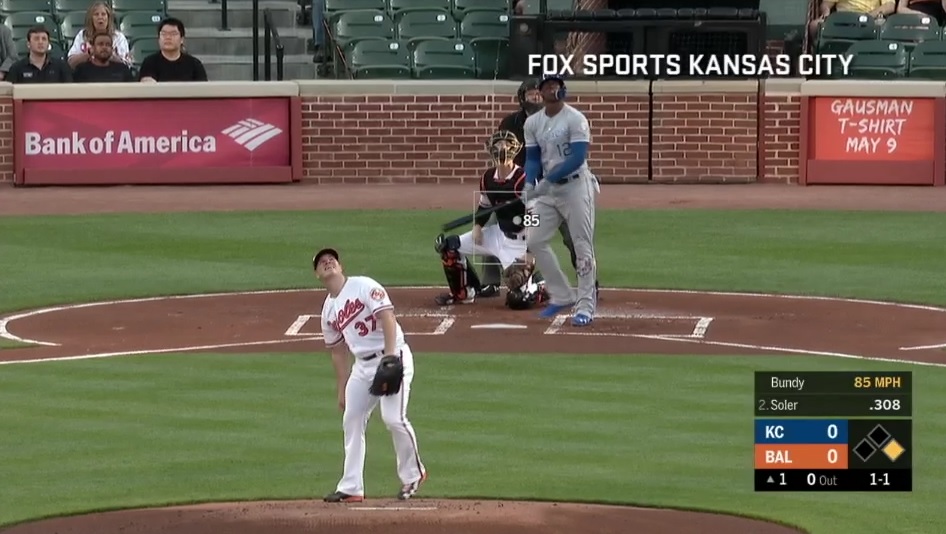
On May 8, Baltimore starter Dylan Bundy gave up a single to Kansas City’s first batter of the game, then coughed up three straight homers, walked two guys, and gave up another jack. Seven hitters, seven runs and 15 total bases surrendered without recording an out. It was by any measure among the worst performances in baseball history.

The question here: Beyond simply pitching better, should Bundy have done anything differently?

Once, the obvious response would have been for Bundy to knock a hitter or two down—if not drill them outright— somewhere amid that chain of carnage. Some small examples:

  • 1944, St. Louis vs. Cincinnati. Walker Cooper, Whitey Kurowski and Danny Litwhiler hit consecutive homers against Clyde Shoun. Shoun knocked the next batter, Marty Marion, on his backside with an inside pitch.
  • After Cleveland scored three runs in the first inning and eight in the second against three Twins pitchers in 1975, Minnesota reliever Mark Wiley opened the third by drilling Rick Manning in the leg.
  • In 1985, Bob McClure gave up two homers to the A’s in the span of six batters, which struck the southpaw as especially egregious given that both were hit by left-handers. His first pitch sent the next batter, Dave Kingman, sprawling.

There was a point to those reactions beyond simple frustration. If a team is clearly comfortable in the batter’s box—as was the case against Bundy, and in all three examples above—it behooves the pitcher to disrupt the emerging pattern. This doesn’t mandate hitting anybody, of course, so much as making an opponent move his feet to avoid an inside pitch. In two of the above examples, this is precisely what happened. Marion’s at-bat ended with a popup to shortstop, Kingman’s with a popup to short right field. The hitter after Manning, George Hendrick, struck out. Bundy, however, kept pumping strikes, even as those strikes were getting hammered, and the result was self-evident.

Hell, Manning’s manager back in ’75 was the man with the reddest ass in the history of baseball, Frank Robinson. What did he think of Wiley plunking his guy? “When you’re getting your ass kicked, you’ve got to do something like that,” Robinson said in Making of a Manager.

That era has passed. Intentionally placed inside fastballs are frowned upon like never before. It does not even occur to many pitchers that disrupting a hitter’s comfort zone is actually a viable strategy. We saw it last year when the Nationals went deep four times in the span of five batters against Milwaukee. We saw it in 2010, when four straight Diamondbacks homered against Brewers right-hander Dave Bush.

For the clearest distinction between then-and-now responses, look to 1963, when Angels pitcher Paul Foytack gave up four consecutive jacks to Cleveland in a game that inspired a passage cut from the final draft of The Baseball Codes:

In a 1963 game, Foytack, a Los Angeles Angels pitcher in his 10th big league season, allowed consecutive home runs to Cleveland’s Woody Held, Pedro Ramos and Tito Francona. They were the fourth, fifth and sixth homers the right-hander had given up on the day. To make matters worse, Ramos was the opposing pitcher, sported a .107 batting average, and it was his second round-tripper of the game. Foytack had had about enough, and decided to knock down the next batter, rookie Larry Brown. But even that didn’t work out too well.

Foytack’s first offering tailed over the plate, and Brown hit the Indians’ fourth straight homer. It was the first of his career, and made Foytack the first pitcher in major league history to give up back-to-back-to-back-to-back home runs.

“Today,” said Foytack a few years back, “if you throw close to a guy, they want to take you out.”

There’s a lot to be said for this latest, gentlest iteration of baseball. Some of the things that are getting lost, however, are actually pertinent to the playing of quality baseball. 

Unwritten-Rules

More Tweets From Gregg Olson About The Unwritten Rules

A month ago today I posted about Gregg Olson’s Twitter feed (@GreggOlson30), which the former closer was using to compile a list of baseball’s unwritten rules. He’d tweeted 14 of them at that point, and since then has tweeted 15 more. Here are the rest in all their glory, with the occasional addendum from me. (Gregg, if you haven’t yet read The Baseball Codes, it’s right up your alley. DM me and I’ll get you a copy.)

This goes without saying. It didn’t necessarily stop Rob Dibble, of course, or the occasional lunatic who brought a gun into the clubhouse, but those guys weren’t the norm.

With an exception made for Elvis Andrus and Adrian Beltre, this one is solid … though it can also be utilized for nefarious purposes. In a story told by Bill Lee, for example, Orioles shortstop Luis Aparicio took advantage of the sometimes-extreme religious leanings of St. Louis shortstop Julio Gotay by making crosses out of tongue depressors atop second base before an an exhibition game in the early-1960s. Gotay didn’t notice them until the first inning, when, with a runner on first, he fielded a grounder and took the ball to second base himself. Upon spying Aparicio’s handiwork, he let out a shriek and immediately backed away from the play. Both runners ended up safe on what had appeared to be a certain double-play, then scored on an ensuing triple. (“I asked Aparicio if he ever tried that trick again,” Lee wrote in The Wrong Stuff. “He told me no, explaining that he he wanted to save it in case he played against Gotay in a World Series or All-Star game.”)

This one is true all the way down to travel ball. Warmups for tournament games can only take place on the sideline or in the outfield. If there’s a reason for this beyond keeping the dirt pristine till first pitch, I have no idea what it is.

Peeking = bad. Alex Rodriguez liked to do this. Do not imitate Alex Rodriguez.

Unwritten rule #20(a): Do whatever Verlander says.

For generations, veterans used this one to put any big-mouthed rookie in his place. “[Veterans] wouldn’t even speak to you,” said Lefty Grove about his own rookie experience, in Baseball When The Grass Was Real. “They figured you were coming there to take away somebody’s job. I was there about two weeks before they let on they knew I was around—and I’d already won three or four games by then. Oh, boy.” Part of it had to do with earning one’s place in the clubhouse, but part of it was strictly pragmatic: Guys with little life experience are better off absorbing what they can than trying to impart semi-formed opinions. Now that rookies earn more money than some veterans via outlandish signing bonuses , however, and can possess significant star power before ever playing an inning of big league ball, Rule No. 21 is not nearly as germane as it once was.

This is true for meals, for wardrobes, for nights on the town. When catcher Bill Schroeder was a rookie with the Brewers in 1983, he ended up in the hotel bar after a game in Kansas City. The veterans in the room wouldn’t let him pay for a drink all night, so in a token of appreciation, he approached a waitress toward the end of the evening and ordered a reciprocal round for them. Mike Caldwell stood up, asked who had purchased the drinks, and jumped into action. “Caldwell came over to me, and brought all six beers with him,” recalled Schroeder. “He said, ‘You’re not leaving here until you drink all these beers, and don’t you ever pull your wallet out again this year. You are not to buy another beer this season. You’re a rookie, and that’s our job.’ ” Yes, Schroeder finished the beers. No, he didn’t buy another round until 1984.

There’s an entire chapter in The Baseball Codes about mound conference etiquette, which pays specific attention to a moment in which Giants pitcher Jim Barr opted to refute this rule with the one guy least likely to tolerate insubordination: Frank Robinson. (It almost ended up in fisticuffs in the dugout.) In another incident, from 1974 (as detailed in Dynastic, Bombastic, Fantastic), A’s pitcher Vida Blue showed displeasure with manager Alvin Dark by leaving the mound before the skipper even arrived, then flipping the ball into the air as he blew past him. (Blue paid the resulting $250 fine in nickels.)

Hitters going to the batter’s box on the opposite side of the field from their dugout must similarly circle behind the catcher and umpire. The path between pitcher and catcher is sacrosanct territory.

Especially true with a 3-0 count during a blowout.

It goes without saying that the most effective method of communication between batter an umpire (or between catcher and umpire) occurs while the player in question is facing away from the ump, toward the field, in a low-key conversation that goes largely undetected save for those in the immediate vicinity. Umpires who feel shown up in front of a stadium full of people are less likely to be flexible in their opinions about a given subject.

Superstitions, man.

This is along the same lines as a pitcher waiting for his manager on the mound. You got your team into this mess; it’s the least you can do to stick around until one of your teammates gets you out of it.

This is the biggest and most important of all unwritten rules, the one from which most of an esoteric and sometimes baffling code book is derived. Dusty Baker said it best, in my favorite quote from The Baseball Codes: “I honestly believe that what you learn in this game is not yours to possess, but yours to pass on. I believe that, whether it’s equipment, knowledge, or philosophy, that’s the only way the game shall carry on. I believe that you have to talk, communicate, and pass on what was given to you. You can’t harbor it. You can’t run off to the woods and keep it for yourself, because it isn’t yours to keep. And what you teach other guys is the torch you pass. I don’t make this up—it was passed to me.”

Here’s to you, Gregg. Nice work.

Bat Flipping, Evolution of the Unwritten Rules

Hüsker Dön’t: Nebraska Coach Sets Tone For Plate Celebrations

Husker points

For those who can’t stand the acceptance of bat flipping and related celebrations into major league baseball’s mainstream, I give you Darin Erstad.

Erstad, a two-time All-Star over his 14-year big league career, has been head baseball coach at the University of Nebraska since 2011. He is decidedly old school.

So when one of his players, junior infielder Angelo Altavilla, did this against Indiana on Friday …


… Erstad was not happy about it. (As evidenced in the video, neither was Indiana catcher Ryan Fineman.)

Erstad greeted Altavilla in the dugout with no small amount of displeasure—“Don’t do that again,” were his exact words, according to the Lincoln Journal Star—and then pulled him from the game.

Altavilla had been slumping, as had Nebraska, so they had reason to celebrate. Such details did not matter to Erstad.

It’s one thing to accept that players set the tone for Major League Baseball’s unwritten rules. When a critical mass accepts bat flipping as the norm, well, that’s what it is. In college ball, however, there’s an emphasis on learning unlike anything found in the major leagues. NCAA coaches are shaping ballplayers, but, given that only a tiny percentage of the collegiate ranks go pro, they’re also shaping people. And if a guy like Erstad wants to pass along lessons about respect and decorum that his players can take with them into civilian life, more power to him.

Succeeding with grace is in increasingly short supply in this country. Here’s hoping for an infusion of the stuff from Lincoln.

Collisions, Evolution of the Unwritten Rules, Slide properly

Collision Course: The State Of Baseball, 2018

Dietrich dustup

This is a story about baseball’s rulebook, and also about baseball’s unwritten rulebook. One, it turns out, feeds the other.

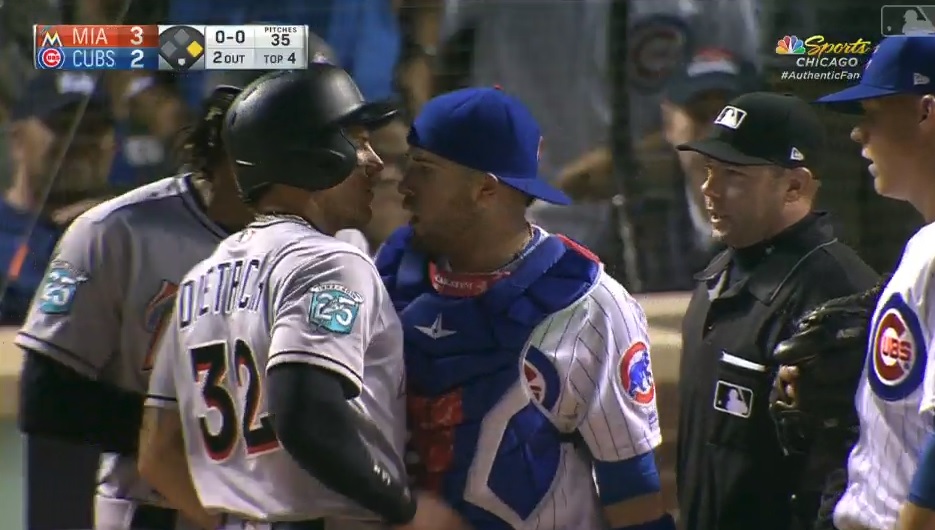
Yesterday, Marlins left fielder Derek Dietrich, racing home on a single, was easily beaten by the throw from Cubs right fielder Ben Zobrist. With his only hope at scoring being to dislodge the ball from the catcher, Dietrich plowed into Victor Caratini, just as generations before him have done.

Actually, it was a fair step milder than in previous generations, the collision being mostly arms, not even forceful enough to knock Caratini from his feet. Still, this is the no-contact era of major league baseball, a place where, following Scott Cousins’ takeout of Buster Posey back in 2011, the target on catchers’ backs was institutionally removed. This is a time in which a late slide from Tyler Austin—a slide that once wouldn’t have so much as raised an eyebrow in the opposing dugout—led to fisticuffs in New York.

So, when Dietrich took liberties with Caratini, Caratini responded in kind. The dugouts quickly emptied, and though the most significant moment of the resulting skirmish involved Kris Bryant tickling former teammate Starlin Castro, the event is worthy of exploration.

MLB rule 6.01(i)(1) instructs that any catcher ceding the baseline—standing in front of the plate and relying on a swipe tag to make the putout—is in safe waters: “A runner attempting to score may not deviate from his direct pathway to the plate in order to initiate contact with the catcher (or other player covering home plate), or otherwise initiate an avoidable collision.”

Dietrich did not deviate from his pathway because he did not have to: Caratini was planted firmly atop the line while awaiting the throw—going firmly against Rule 6.01(i)(2), which clarifies that “unless the catcher is in possession of the ball, the catcher cannot block the pathway of the runner as he is attempting to score.”

In this case, it appeared to be unwitting: Upon receiving the ball, Caratini turned to make the requisite swipe tag before realizing that he had overshot his positioning and was reaching into foul territory, away from the plate. He quickly drew his glove back into the runner.

It left Dietrich little choice about contact. The runner’s ensuing shove was purely elective, of course, though it was a far cry from the devastation possible had he opted to lower his shoulder. Dietrich even tried to make nice by tipping his cap to the catcher before Caratini got into his face.

We’re left with this: Victor Caratini is 24 years old and was playing in his 51st big league game. Posey-era rules are all he’s ever known. With little basis from which to understand the rationality of Dietrich’s decision, the catcher reacted angrily at being shoved, and a play that should barely have registered soon bordered on fisticuffs.

The sport’s unwritten rules can be seen in similar light. Take the aforementioned Yankees-Red Sox brawl back in April. On one hand, the Red Sox were overly sensitive about a slide that a generation earlier wouldn’t have drawn much notice. On the other, the slide was clearly outside of baseball’s recently established parameters, and Austin should have been prepared for the response that he received.

Ultimately, neither side had much clue about how to handle what was, before now, a fairly standard baseball situation, and things ended badly. They ended badly because many players no longer understand the intentions behind much of the Code, and react instinctively rather than rationally. It’s what enables sensitivity about the personal nature of an action that is not at all personal.

These are the unintended consequences of the sanitation of the sport. There are clear benefits—fewer collision-based injuries and a decline in retaliatory beanballs—but there are also growing pains. Yesterday’s collision was only one of them, with more certain to follow.