Don't Call out Opponents in the Press, Retaliation

Pham, Bam, Thank You Ma’am: Cards Slugger Upset Over Cub Comments, HBP (Maybe Not in That Order)

Phammed

Losing to the Cubs offers indignities aplenty for St. Louis.

Yielding the pennant-clinching victory to Chicago, as the Cardinals did on Wednesday, is downright mortifying. Doing so at home only makes the suffering worse. Having what seemed like half the stadium cheering for the visitors was downright brutal.

Hearing Ben Zobrist talk beforehand about how the Cubs “intend to clinch there” and how “it’s going to be very satisfying” was enough to make at least one player angry.

Cardinals outfielder Tommy Pham was especially pointed in his response to Zobrist’s comments. “He better not ask me how I’m doing on the field,” Pham told reporters. “I don’t want to be his friend. He said he’s going to come here and pop bottles or all that stuff. Don’t say hi to me on the field then.”

It would have been easier to brush aside as surface drama had Pham not been drilled in the ribs on Tuesday, then talked after the game about how “it was definitely on purpose.” The HBP had less to do with his comments, he said, than with Kris Bryant being drilled earlier in the game by a Carlos Martinez fastball that approached 100 mph. (The only thing keeping him from charging the mound, Pham said in a CBS report, was that “I don’t make enough money right now to face a suspension.”


He might be right about the motivation. Pham himself had hit a monster homer an inning earlier to give St. Louis a 5-1 lead, and when Bryant came up, two were out with a runner at third. Avoiding the reigning NL MVP with a base open is rarely a bad option.

Then again, Bryant was hit with a 2-2 pitch, which brought Anthony Rizzo to the plate. Moreover, Martinez was all over the place. The pitch before the one that drilled Bryant went wild, allowing Mike Freeman to advance. Then Martinez walked Rizzo to load the bases. Then he walked Wilson Contreras to bring home a run.

The teams played yesterday with little drama beyond Chicago’s champagne celebration (as Zobrist had predicted). With St. Louis battling for the NL’s final wild-card spot, nothing funky should go down when the teams meet tonight for the final time this season, except maybe in the case of a blowout.

Still, drama sure is fun.

[H/T: Christopher C.]

Intimidation, Retaliation, The Baseball Codes

Carlos Gomez Heard Somthing, Maybe, And Now He’s Mad at Collin McHugh

McHugh confused

Backstory plays an important part in most major league drama, and it’s possible that there’s some we don’t yet know about regarding Monday’s intra-Texas incident between the Astros and Rangers.

Then again, Carlos Gomez was at the center of things, so all bets are off.

Here’s what we do know: Gomez got angry at an inside pitch from Collin McHugh that didn’t come close to hitting him. He got angrier after the next pitch, a strike that he fouled off, staring down McHugh even while stumbling from the batter’s box on his swing. (Watch it here.)

Here’s what we also know: Back on Aug. 31, McHugh drilled Gomez with a first-pitch fastball. It was unintentional—Gomez was leading off the second inning of a 1-1 game—but the batter has apparently held on to it. Or maybe it was the Aug. 12 game, in which Gomez was hit by Francisco Liriano and Mike Fiers. Or maybe it was that benches-clearing incident between the teams on May 1, when Mike Napoli overreacted to a Lance McCullers message pitch that didn’t come close to hitting him.

Or maybe it’s just that the Astros were busy knocking Texas out of the wild-card race. Whatever the answer, Gomez has been hit by 19 pitches this season, putting him on pace to lead the league in any category for the first time in his 11-year career. McHugh didn’t drill him on Monday. He didn’t come close.

https://twitter.com/SWolston/status/912477692133601281

According to Gomez’s postgame comments, it was all a game of telephone, with McHugh telling some guy with the Astros that he was going to drill Gomez, and that guy either telling Gomez about it, or telling someone else who told Gomez about it, and … aren’t these adults we’re talking about?

Then again, Gomez is the guy who got into it with current Astro and then-Brave Brian McCann, and with Gerritt Cole. It’s also not the first time he pissed off a team for which he used to play. It clearly doesn’t take much to set him off.

It could even have started here:

Ultimately, it’s difficult to ascribe wide-reaching unwritten-rules themes to somebody who has repeatedly gone off his rocker over the years. Is Carlos Gomez a bit nutty? Probably. Does he have legitimate beef with Collin McHugh? Who knows?

The Rangers close their series with Houston tonight, and end their season on Sunday. Gomez’s contract with the Texas expires after this season, and for all we know he’ll re-sign with Houston.

Don’t count on it, though.


Bat Flipping, Retaliation

Newsflash: Bat Flips Are a Thing Now

Bat flip

A retaliatory story in nine bullet points:

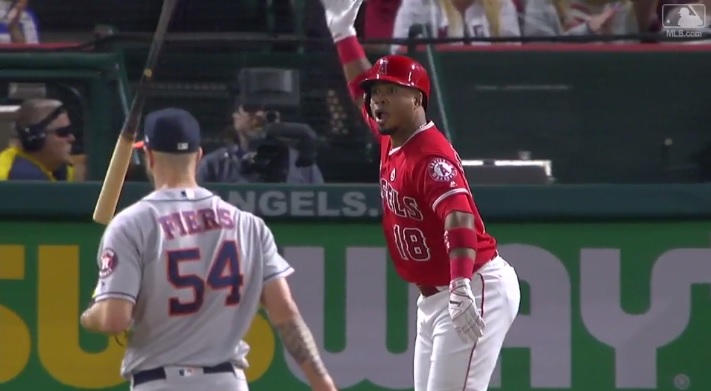
  • Luis Valbuena flipped his bat after a home run.

Fiers high ball

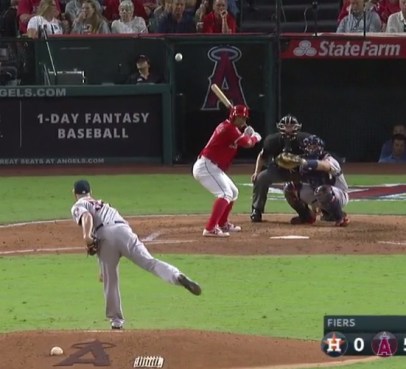
  • Fiers got suspended five games for it.
  • Fiers should have better things to care about in the modern game than an exuberant home run hitter.
  • Such as his 5.22 ERA, which, let’s face it, is enough to make anybody ornery.
  • The umpires were hasty in issuing warnings following Fiers’ purpose pitch, which precluded the Angels from responding.
  • Not that the Angels had much to respond to, since Fiers clearly wasn’t trying to hurt Valbuena so much as put his own cranky pants on display.
  • Which calls his suspension into question, since drilling the hitter was never part of his intent.

Also: Valbuena keeps on flipping. Were it not for the preceding kerfuffle, it would not even be noteworthy. It’s 2017, the Era of Puig. Time to move on.


Retaliation, Umpire Relations

Memo to Pitchers: ‘Kill the Ump’ is an Axiom, Not a Suggestion

Ump drilled

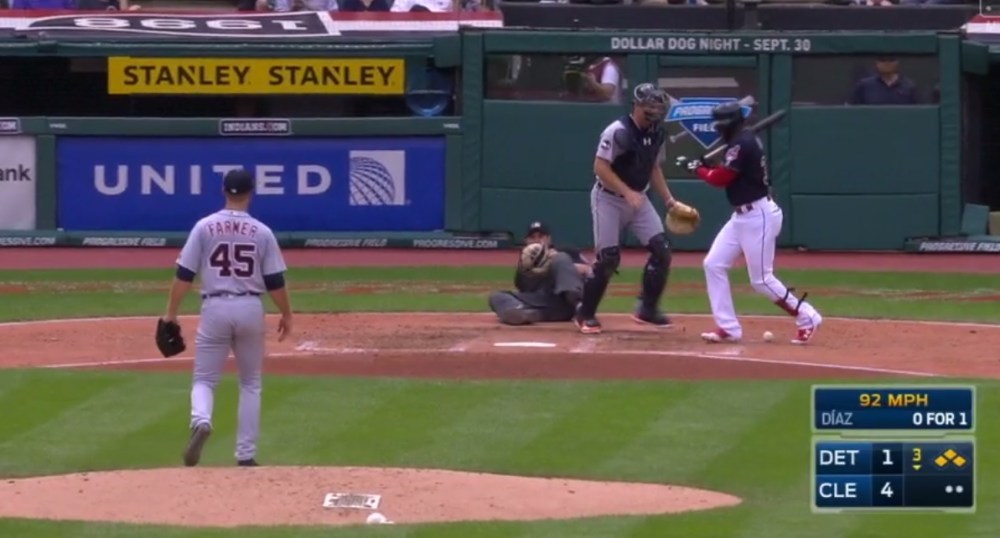
Shortly after Tigers manager Brad Ausmus and catcher James McCann were ejected by plate ump Quinn Walcott on Wednesday for arguing balls and strikes, Detroit pitcher Buck Farmer crossed up catcher John Hicks and drilled Wolcott in the chest with a fastball.

Cleveland TV broadcasters immediately implied that he did it on purpose.

Is intentionally hitting an umpire even a thing? There are many ways to think about this, primary among them being that no player wants to permanently find himself on the bad side of a given ump. Close calls can go either way, and just like their ballplaying counterparts, umpires have been known to carry grudges. To show up an umpire during an argument is one thing. To intentionally injure him is guaranteed to sour things not only with the umpire in question, but with the guy’s colleagues. Umpires are a tight-knit bunch, after all.

After the game, Hicks explained away the pitch as coincidental. “Obviously, it looks bad right after Brad and Mac get tossed, but it’s bases loaded, we’re trying to win a baseball game,” Hicks said in an MLB.com report. “Any thoughts of us trying to do that on purpose are just ridiculous.”

Ausmus, who heard the TV broadcast from the clubhouse after being ejected, agreed. “To imply that was intentional is, first of all, a lie,” Ausmus said. “If any player intentionally tried to hurt an umpire on this team, we’d deal with that severely. … But for anyone to imply that was intentional, it’s just completely wrong. And they’re out of line saying that, quite frankly.”

The denials from Detroit are likely valid, but there’s no getting around how bad it looks. Also, this kind of thing does happen from time to time.

In just one instance, from 1999, Tampa Bay was trailing the Angels 7-1 in the third inning, when Anaheim catcher Mike DiFelice failed to get his glove on a pitch that ended up rocketing into the facemask of plate ump John Shulock with such force that it bent the bars. It didn’t help that Tampa Bay’s starter, Wilson Alvarez, had been questioning Shulock’s calls all afternoon.

Shulock was irate, needing to be restrained from charging the mound by DiFelice.

“I know in my heart [he] meant to hit me, but I can’t prove it,” said the umpire after the game, in an AP report. “The catcher set up for a curveball outside, and he drilled me with a fastball inside. The more I think about it, I do think he did it intentionally.”

Alvarez, who was removed from the game immediately afterward, denied everything, because what else could he do?

“He’s going to get his,” Shulock said in the Los Angeles Times. “Things have a way of evening out in this game, and one of these days somebody is going to hit a line drive off the side of his head and I’ll be the first guy laughing.”

Shulock was certainly not the last guy laughing. Based on the fact that he had stormed the mound after being hit, and possibly because of his postgame comments, the umpire was suspended for three games.

Beyond that, there appears to be little aftermath. Alvarez injured his shoulder and missed the following two seasons, and never again had Shulock behind the plate for a start. (It’s interesting that during Shulock’s last season as an umpire, he worked the Tampa Bay-Oakland game the day before Alvarez pitched, and was immediately transferred to Arlington for a series against the Royals. The last game he called was on July 18 of that season.)

Buck Farmer’s pitch was far less suspicious than that, and Quinn Wolcott took it a lot better than Shulock did. That might be the end of things, but it’ll be interesting to see how and if Wolcott reacts the next time he calls balls and strikes against the Tigers.

Don't Peek, Sign stealing

The Pitcher Is That Way, Sir, Out Toward The Middle of The Diamond

Chapman peeks

While accusations continue to fly in Boston about high-tech sign-stealing espionage, similar gripes arose in Oakland on Wednesday that appear mainly to do with batters peeking at the catcher. Apparently, Moneyball budgets don’t cover Apple watches.

In the second inning, Angels catcher Juan Graterol began a discussion with the hitter, Oakland outfielder Mark Canha, that grew animated enough for plate ump Mike Everitt to separate them. TV cameras picked up Everitt informing LA’s dugout that the catcher suspected A’s players of stealing signs. Canha said later that Graterol told him to quit looking back at his signals, and that the catcher had already delivered a similar message to infielder Chad Pinder.

“I’ve never [peeked] in my career,” Canha said in a San Francisco Chronicle report. “I thought it was just a Scioscia-Angels-Graterol tactic to make young players get uncomfortable, just get in my head. I was just like, ‘OK, play your little games and I’m just going to focus on the task at hand.’ ”

The issue came to a head in the fourth inning, shortly after Oakland’s Matt Chapman stepped into the batter’s box, when he and Graterol went nose to nose. According to Chapman, the second-inning exchange was only the latest example of LA accusing Oakland players both relaying signs from second base and peeking back at the catcher pre-pitch to pick up additional information.

“The catcher kept staring at the hitters as they were digging into the box,” Chapman said. “That’s not a very comfortable feeling having the catcher staring at you. It’s a little disrespectful. So when I got into the box, I just let them know we were not stealing signs and there was no need to be staring at us. He obviously didn’t take too kindly to that.”

It’s a thin argument. Just across the bay, Giants catcher Buster Posey—one of the sport’s headiest players—looks up from the squat at batters’ eyes all the time. Nobody has yet accused him of making them feel bad by it.

Angels manager Mike Scioscia offered a straightforward assessment. “They have a habit of glancing back,” he said about A’s batters. “On a day game or a night game when you can see shadows and a catcher’s head, it’s easy to look back and pick up some locations. So, Juan was just saying, ‘Hey, man, don’t look back.’ ” Given that Scioscia was among the best defensive catchers of his generation, it’s safe to assume that he knows whereof he speaks.

Graterol offered his own version of his conversation with Chapman. “I told him, ‘Don’t peek at the signs,’ because I saw him,” he said. “Chapman told me, ‘We don’t peek at the signs.’ I said, ‘Yes, you did.’ ”  At that point, Everitt stepped between them. When Chapman continued to chirp, he was ejected for the first time in his big league career.

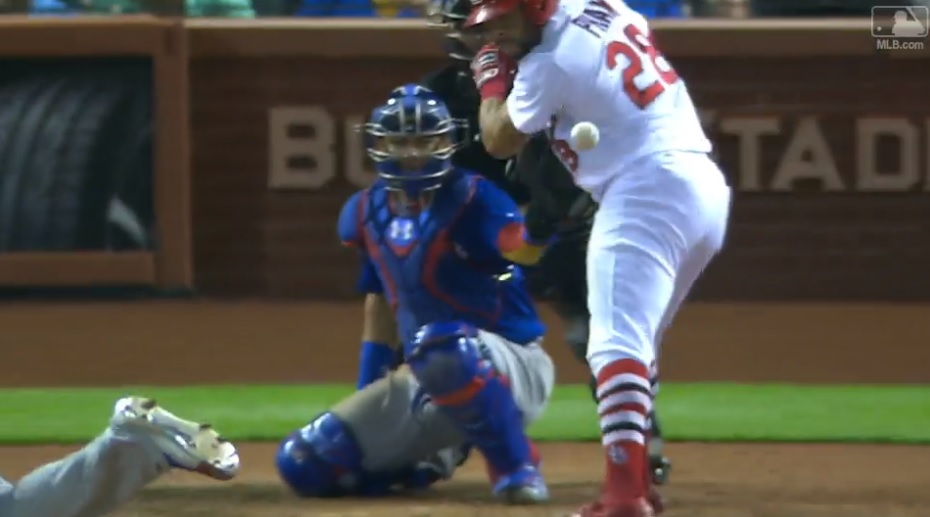
To gauge by the clip above, Chapman was indeed looking backward when he stepped into the box. Maybe it was in response to chatter from his teammates about Graterol giving hitters the evil eye, and he wanted to check it out. Maybe he was peeking for signs or location. Ultimately, it doesn’t matter—because Chapman offered the appearance of malfeasance, he left the Angels little recourse but to believe that was his intent.

Just as the primary responsibility for a team that’s getting its signs nabbed is to change the signs, Graterol had a number of options. He could have set up late in the sequence, once the hitter’s full concentration was on the pitcher. He could have set up early in one spot, and then shifted. He could have slapped his glove on one side of the plate while setting up on the other. Or he could have utilized the most surefire—and dangerous—peeker deterrent: calling for something away while he and the pitcher both understood that the next pitch would be high and tight. The Baseball Codes discussed a 1979 incident in which Rangers pitcher Ed Farmer gave suspected peeker Al Cowens just such a treatment, throwing a high, inside fastball after catcher Jim Sundberg had set up outside. Farmer caught Cowens leaning over the plate, with disastrous results:

The ball crashed into Cowens’s jaw, crumpling him instantly. Pete LaCock, who had been standing in the on-deck circle, was the first member of the Royals to arrive. “His glasses were still on and his eyes were bouncing up and down and I didn’t know if he was still breathing or not,” said LaCock. “I reached into his mouth and grabbed his chew, and right behind it came pieces of teeth and blood. It was an ugly scene.”

“I have to say he was throwing at me, maybe not in the face, but it was intentional,” Cowens said angrily after the game through a wired-together jaw. “That was his first pitch, and the two times before, he was throwing outside. He pitched me so well before. I can’t figure out why he pitched on the outside corner, struck me out, and then hit me.”

Farmer’s reply was equally pointed, though he avoided a direct accusa­tion. “[Cowens] thinks I’m guilty of throwing at him,” he said shortly afterward. “I think he’s guilty of looking for an outside pitch and not moving.” It may not have been the result he intended, but the pitcher felt justified in protecting his own interests. “It’s a fine line out there,” he said. “You don’t want to hurt anybody, but you don’t want anybody to take advantage of you.”

In that regard, Graterol’s handling of the situation was downright genteel. Regardless, even though it was the final meeting between the teams this season, it’s unlikely that Chapman & co. will take similar liberties—or anything that resembles them—in the future.
 

Sign stealing

Red Sox and Binocs and Smart Watch, Oh My

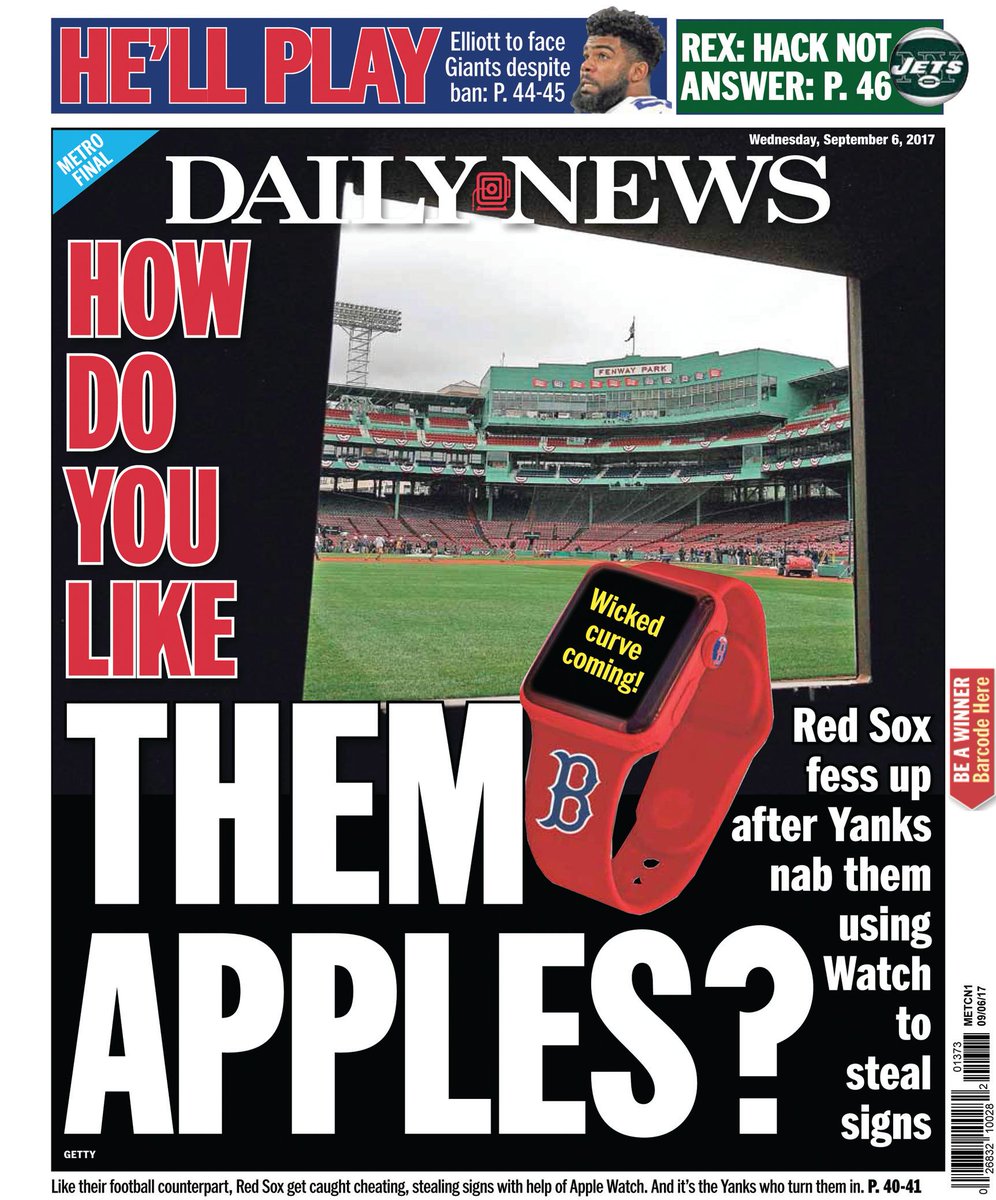
Them Apples

Three facts as pertain to today’s news:

  • Sign stealing in baseball is ages-old. It’s why signs exist in the first place: Teams constantly attempt to get the drop on the opposition’s communication.
  • Sign stealing in baseball is tolerated. Pretty much every team does it to some degree, with the understanding that if somebody breaks your code, the appropriate response is more or less to simply change your signs.
  • Sign stealing in baseball, as meets the above definitions, is a pursuit undertaken strictly from the field of play, with the naked eye. When teams branch out to video feeds and spyglasses in scoreboards it becomes an entirely different beast. At that point, the thievery is breaking not just the players’ unwritten code, but actual MLB rules.

As detailed in The New York Times, the Yankees recently filed a complaint with the league office—complete with video evidence—which began an inquiry into Boston’s sign-stealing practices at Fenway Park. What investigators found: the Red Sox had a clubhouse-bound employee pick up opposing catchers’ signals via a video feed, then transmit them to assistant trainer Jon Jochim in the dugout via an Apple watch. Jochim relayed the information to players.

The first piece of evidence New York cited occurred during the first game of a series in August, when Boston went 5-for-8 with runners at second base. Whereas players in that position are generally seen as having a good vantage point to peer into a catcher’s signals on their own, in this case they were relaying signs from the bench.

Where this story takes a turn away from the legions of similar such pursuits across baseball history is that the Red Sox admitted culpability (while insisting that manager John Farrell and GM Dave Dombrowski knew nothing about the scheme).

For those who might interpret this as a symbol of illegitimacy to Boston’s lead in the American League East, well … it’s complicated. Stolen signs haven’t helped Chris Sale or Drew Pomeranz become dominating starters, and they didn’t help Rick Porcello win the Cy Young Award last year. Without knowing exactly when the Red Sox started the practice (the Times reported that it had been in place for “at least several weeks”), they are just about league average when it comes to batting average, and are dead last in home runs. They actually average more runs on the road than they do at home (4.79 per game vs. 4.66). There’s also the fact that, even though Boston went 5-for-8 with runners at second on Aug. 18 to arouse New York’s suspicions, Red Sox hitters subsequently went 4-for-16 in identical situations over the series’ final two games, hardly the stuff of intrigue.

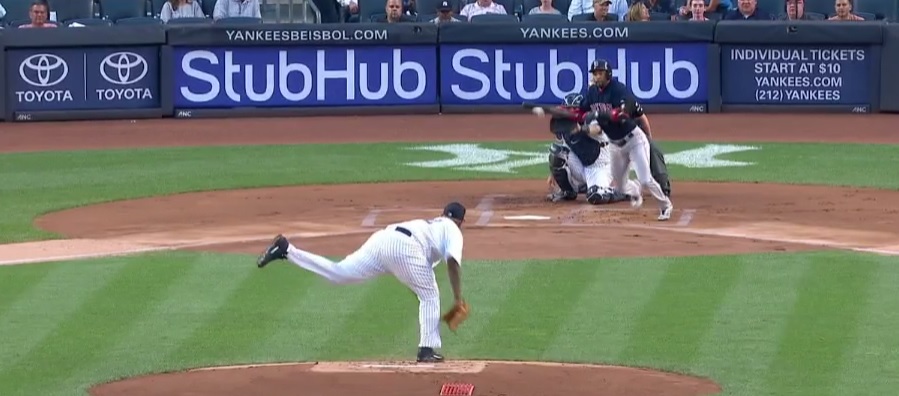
My own lingering question is that, with New York’s signs available in the dugout, why the Red Sox waited until a runner was at second base to relay them. Not only did this limit Boston’s opportunities, but placed the Red Sox at far greater risk of being caught. Much simpler would have been a verbal system such as the one Hank Greenberg enjoyed in Detroit in the 1940s, in which “All right, Hank” indicated a fastball, and “Come on, Hank” meant a curve. Other iterations have included shouts of encouragement using either a player’s first name or last name to mean different things, or a simple whistle, which Yankees pitcher Bob Turley used to notify his teammates that an upcoming pitch would be different than the one preceding it.

The Red Sox responded by filing their own complaint against the Yankees, who they claimed were stealing signs at Yankee Stadium via a TV camera from the YES Network.

The history of such pursuits is legion:

  • In the 1950s, the “exploding scoreboard” at Comiskey Park housed not only a platform from which an employee with binoculars could spy on the opposing catcher, but a hidden light—visible from the plate and the home dugout, but not from the visitors’ side of the field—that flashed in accordance with the upcoming pitch.
  • Pitchers Bob Feller and Bob Lemon, Hall of Famers both, helped set up a relay system in Cleveland in 1948 using a military-grade gun sight that Feller brought back from World War II. With it, the Indians won 19 of their final 24 games (all but four of them at home) to force a one-game playoff with the Red Sox for the AL pennant (which the Indians also won, even though it was played in Boston).
  • In 1959, the Cubs placed traveling secretary Don Biebel and a pair of binoculars inside the Wrigley Field scoreboard. Biebel would signal hitters by placing his feet into an open frame.
  • Also, of course, the Shot Heard ’Round the World.

More recently, the Blue Jays were accused repeatedly, by numerous opponents, of similar activity at the Rogers Centre, to the point that ESPN commissioned an expansive expose on the practice.

The Phillies drew the ire of multiple teams—including the Yankees, in the World Series—for their alleged ballpark shenanigans. It didn’t help that, in 2010, their bullpen coach was caught on the field with binoculars.

In 2014, Chris Sale accused Victor Martinez and the Tigers of having somebody in center field.

The Padres have had (probably baseless) accusations thrown their way, as have the Marlins.

All of which is to say that this is nothing new. If you haven’t heard about repercussions from those other incidents, you likely won’t remember the fallout from this one either. Assuming that the Red Sox knock it off, you can expect it to quietly disappear.


Earning respect

Point and Shoot: Do Not Take Liberties With Trevor Bauer

Bauer points

Considering that the majority of baseball’s unwritten rules have to do with showing respect on the field, and considering that inside fastballs are the response of choice for too many pitchers should said respect insufficiently materialize, what Trevor Bauer did yesterday was downright delightful.

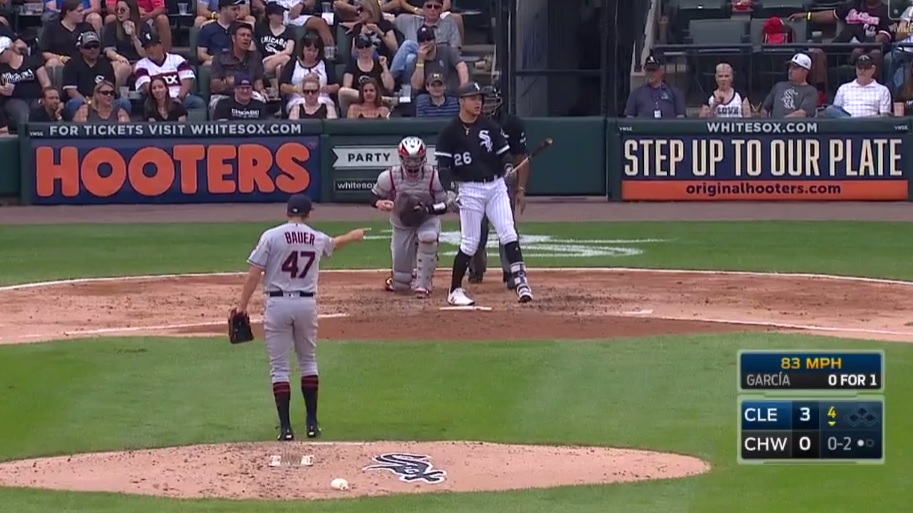
Consider: After Chicago’s Avisail Garcia yapped at the pitcher upon fouling off a curveball, Bauer yapped right back. There was nothing inciting to his conversation, just a public urging for the hitter to step back into the box, the better to settle things like men. Once the battle was won, Bauer concluded with a dismissive point toward the dugout.

After the game, the pitcher described the incident:

He likes to run his mouth. You start sitting there talking, ‘Oh, they don’t throw me fastballs. Why do they just throw me breaking balls?’ He’s said it before. Not sure he knows that the rules of this game say you can throw whatever pitch you want. He started yapping at me. I threw him a first-pitch slider. He fouled it off, stared right at me, said something while he was nodding his head, like I’m right on you or something. I told him, ‘If you’re that confident, step back in the box. Let’s go. Get back in the box. And then he fouled off a pitch—another one that he should have hit. It was right down the middle and he missed it. And then he looked at me and started nodding again. So I threw him a curveball. He swung and missed. I decided to remind him of the rules of the game. Three strikes, you’re out. You can go sit back in the dugout. To his credit, he took it like a champ. He put his head down, he shut his mouth and he walked himself back to the dugout. Good for him.

The upshot: Victors—especially those who didn’t fire the first shot—get to dictate terms. There’s no shame in not being able to hit Trevor Bauer’s curveball. If that’s the case, however, don’t go out there and act like you can.

Bunt appropriately, Bunting for hits, Gamesmanship, Taking Advantage of Injury

CC Sabathia Still Has Issues With Boston’s Bunting

Nunez bunts

America is a place where people in prominence can claim ludicrous things and then, after others have pointed out said ludicrousness, double down on their bad ideas. Freedom.

On Thursday, it was CC Sabathia’s turn. Remember just last week when he made the specious, if not downright addled claim that because he was returning from a knee injury, the Red Sox had no right to bunt against him?

If anybody tried to explain to him what a flawed position he was taking, they did a poor job of it. Yesterday, Sabathia again faced the Red Sox, and again the Red Sox did some bunting—starting with the game’s second hitter, Eduardo Nunez, who laid one down in front of the plate, which Sabathia pounced upon … and then threw wildly for an error. “That’s my game,” said Nunez, who also bunted against the pitcher last week, in a Providence Journal article. “You can’t take away my game.”

The strategy proved effective beyond the reach of the bunt itself, when a rattled Sabathia walked the two guys following Nunez in the order, throwing only two strikes in the span of 10 pitches. The pitcher buckled down to escape the jam, then yelled toward the Red Sox dugout as he left the field, explaining in R-rated terms how he felt about their strategy. After the game he said, via a New York Daily News report, that the Red Sox were “scared,” and that “they just think I’m a bigger guy who can’t field my position.”

Well, yes. To which an appropriate response could entail multiple suggestions, primary among them: Figure out how to field your position, or learn to deal with the consequences. Sabathia’s knee is “not my problem,” said Nunez, adding, “If I have to bunt four times in a row, I’d do it. I don’t care if he’s mad or not.”

With last week’s round of complaints, the pitcher effectively offered an open invitation for opponents to get inside his head by bunting. When the Red Sox took him up on it, he responded by channeling a senior citizen chasing neighborhood kids off his lawn.

“I’m an old man,” groused the 37-year-old. “They should want to go out and kick my butt.”

Yes and no. The problem with kicking the butt of an effective pitcher is that alternative paths are sometimes the best route to success. Sabathia earned the victory on Thursday with six innings of one-run ball, and has now won all four of his starts against Boston this season. The Red Sox are obligated to find more effective methods against him.

During the Revolutionary War, the British complained that American forces wouldn’t fight them in formation—a tactic that almost certainly would have led to defeat. With this in mind, why would any team approach Sabathia in his own chosen manner, unless they concurred that it was the best approach?

The Red Sox are being paid to win baseball games, and satisfying the skewed morals of a crotchety pitcher has nothing to do with winning baseball games.

Freedom. Get off my lawn.


Retaliation

Corey Kluber Is No Fan Of Hard Swings, and Doesn’t Care How Hard He’s Hit in Order to Prove It

Kluber

Maybe when you’re as good as Corey Kluber, you think you can get away with questionable activities.

Maybe when you’re as good as Corey Kluber, you think that your prodigious skill will help you escape any jam—even those of your own devising.

Maybe when you’re as good as Corey Kluber, it doesn’t matter to you whether or when you put opposing players on the basepaths, because you’re Corey Kluber and you’re good enough to handle your business.

Right up until the moment that you’re not.

Heading into the eighth inning of last Wednesday’s game against Boston, Kluber was pitching a gem: four hits, one run, 11 strikeouts, one walk. That Cleveland was losing 1-0 had very little to do with his performance.

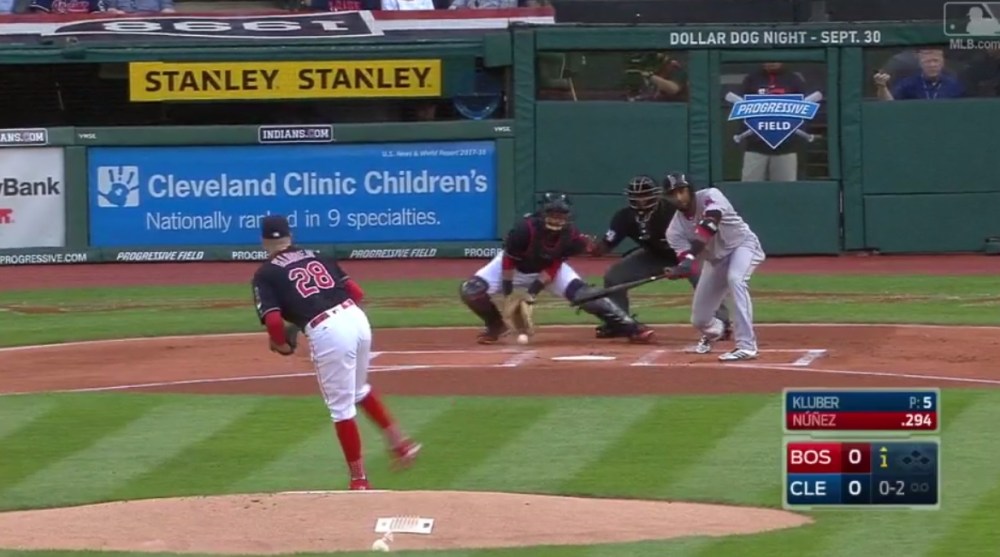
Kluber got Mitch Moreland to fly out for the first out of the eighth. He whiffed Christian Vazquez—making it an even dozen on the day for the right-hander—for the second out. After a walk to Brock Holt, Eduardo Nunez came up and, with a 2-0 count, took a mammoth swing, spinning himself into the dirt as he futilely chased a 90 mph cutter. Kluber didn’t like it. With his next pitch, he drilled Nunez.


Maybe the pitcher thought it was a safe move with two outs, but Nunez bats leadoff in a high-powered offense. The next batter, Mookie Betts, drilled a single off the glove of third baseman Giovanny Urshela, bringing home Holt and padding Boston’s lead. Out came manager Terry Francona, and that was it for Kluber. Before the game ended the Red Sox had tacked on four more runs against Cleveland’s bullpen in a 6-1 victory.

From the Boston Herald:

Asked on Thursday if there was any reaction in the dugout when Nunez got hit, Red Sox manager John Farrell said, “For (a guy with) pinpoint control, you know, I think that was fairly obvious, the message (that was sent).”

Is it against the unwritten rules of baseball to swing too hard?

“No, I don’t think so,” Farrell said.

It was a perfect example of the line between confidence and cockiness. Kluber perceived Nunez’s swing as some sort of slight—never mind that the vast majority of his colleagues would have brushed it off as being of little consequence—and felt invincible enough to act on it in the moment. Baseball has long had an unwritten rule regulating swings at 3-0 pitches (only the reddest of asses in big league history even considered 2-0), but that applies only in blowouts, which this game decidedly was not.

Perhaps it was a lesson that no pitcher, Kluber included, is as invincible as he might occasionally think. Or maybe it was just karma. Either way, it did not end well for the Indians.

[H/T WEEI.]