No-Hitter Etiquette, Rookie Hazing

Yu Who? Backpack Season is Upon Us

Rangers backpackWith Yu Darvish’s near-perfect game Tuesday came the inevitable cries of jinx. It didn’t hurt that the TV broadcast included the comment, “Darvish looking for number six, and the second perfect game …” precisely as the right-hander released the two-out, ninth-inning pitch that Marwin Gonzalez would slap to center for Houston’s first hit.

Sure, there were those who tried to jinx it, and those who decried it being jinxed. Of semi-related interest, however, Darvish’s gem allowed the Mickey Mouse backpack worn by Texas reliever Joe Ortiz to be put on televised display as the game ended.

The backpack, of course, is a tradition in which the least-tenured member of a team’s relief corps is forced to lug around the bullpen’s candy supply, as well as finger fixers like nail clippers, frequently in as humiliating a satchel as possible.

If Ortiz thinks he has it bad, however, he has nothing on A’s reliever Sean Doolittle.

I was in the Oakland clubhouse yesterday, where Doolittle was fixing up the greatest candy bag I have encountered in many years on the Rookie Embarrassment beat.

Doolittle is the one doing the toting. That the left-hander appeared in three postseason games for the A’s last year counts for little; he’s still some 80 games behind teammate Evan Scribner when it comes to big league seniority. And he was sick of last season’s beat-up Hello Kitty bag.

Teammate Jerry Blevins acquiesced and purchased a new one—a fuzzy white, google-eyed unicorn, with pink hooves and a gold horn. Unfortunately, the new bag was far too small to hold the necessary supplies. Solution: affix old bag to new. Blevins began the process with safety pins, but left it to Doolittle himself to finish the job—akin, I thought, watching Doolittle struggle with the task, to having a victim dig his own grave. (See the bag in action here.)

“What can I say?” Doolittle said, affixing super glue just so. “I’m just doing what has to be done.”


 

WBC

Celebracion Dominicano Muy Malo for Some Members of U.S. Squad

Dominicans in the WBCSo the Dominicans like to party. They play hard on the field, and they celebrate wins—hell, they celebrate runs—like they just won the lottery. It’s downright un-big league of them, causing their opponents no end of concern.

Following the DR’s 3-1 victory over the United States on Thurday, Brandon Phillips went so far as to say that some American players were less than pleased, and promised to “show out” in a rematch—I assume this is akin to hot dogging—if he got the chance.

Well, the U.S.’s 4-3 loss to Puerto Rico on Friday assured that Phillips will not get his moment, but that’s beside the point. Like many of their brethren from Latin America, DR players have celebrated their achievements with outsized displays on the field. When Erik Aybar drove in the go-ahead run in the ninth inning on Thursday, his team came streaking onto the field in celebration, despite the fact that the game had not yet ended. When Jose Reyes plated another run moments later, they did it again. And the scene after Fernando Rodney closed out the Americans in the bottom half of the frame put the previous displays to shame. (Emma Span has a collection of highlights in her Sports on Earth column.)

In Major League Baseball, it would all be seen as showing up the opposition, with the offending parties criticized (correctly so), and possibly made an example of by a willing pitcher with a wandering fastball.

This, however, is not Major League Baseball. It is the World Baseball Classic, and the Dominicans are not playing with foreign teammates on the Yankees, Dodgers or Rangers—they’re playing with each other. Representing a country in which such emotional displays are the norm, they have every right to their celebrations.

Baseball is an American game, but it’s long been known that its code doesn’t necessarily translate overseas, be it the Caribbean, Japan or locations in between. When players from there play on teams over here, it is incumbent upon them to learn the local mores, and abide by them. When it comes to national teams, however, not to mention national pride, these players have earned the right to celebrate with enthusiasm.

Should be a heck of a final series.

Media

‘Baseball Forever!’ Debuts on the Audio Charts


Baseball Forever II

A project I worked on this winter just came out this week. It’s an audio book called “Baseball Forever,” for which I mined the game tape, dating back to the 1930s, assembled by the country’s preeminent collector of such things, John Miley. My goal was to present the collection in a somewhat unusual way; where many highlights packages offer little more than the moment in question (“Here’s the swing, it’s hit hard … and gone!”), I endeavored to allow space for as many plays as possible to breathe, using entire at-bats and even full innings to present classic moments more comprehensively than they are commonly heard. Bob Costas narrates.

(To see the alternate cover demanded for reasons beyond my comprehension by Amazon, click directly to their page. You can also find it on iTunes.)

Bunt appropriately, Foreign players, WBC

The Most Appropriate Inappropriate Bunt Ever Sparks WBC Brawl

WBC brawlLuis Cruz thought he understood baseball’s unwritten rules. So did Arnold Leon. The former, playing third base for Mexico in the World Baseball Classic, responded to a bunt by Canadian catcher Chris Robinson—whose team held a six-run, ninth-inning lead on Saturday—by gesturing for his pitcher to drill the next batter. Leon, the pitcher, did just that.

Within moments, punches were flying and Alfredo Aceves had Satan in his eyes. (Watch the prelude here. Watch the main event below.)

Cruz, however, did not understand the unwritten rules, nor did anyone else on Team Mexico who supported Leon’s retaliation. Because winning trumps any possible Code violation, the WBC’s consideration of run differential matters. The more a team scores, the more likely it is to advance, and, facing the possibility of a three-way tie with the U.S. and Mexico, Canada needed every run it could get. (Also consideration-worthy: Canada was knocked out of the 2006 tournament when coming out on the wrong side of a run-differential tiebreaker.)

It’s undoubtedly tough for players steeped in a certain way of approaching the game—who may well have embraced the Code throughout their entire professional lives—to ignore what is likely second-nature, but there is little excuse for not knowing the rules by which one is playing.

Plate ump Brian Gorman warned both benches after Leon’s first two pitches to Rene Tosoni, the batter following Robinson, sailed inside. On the verge of elimination, however, Leon opted for pride above victory, and drilled Tosoni in the back. Benches emptied, with the brawl starting when Cruz threw a punch at Canada’s Scott Mathieson.

If there is irony in this situation, it is that players coming out of Latin leagues have long been accused of possessing less-than-sufficient understanding of the unwritten rules. This is generally in respect to flair, however—reaction to making a play, not the play itself. Blue Jays slugger Jose Bautista—who has a toe in each pool, playing in Toronto and hailing from the Dominican Republic—backed this up, saying from spring training camp in Florida that the structure of the WBC is not enough to merit such strategy.

“I believe in the unwritten rules of the game,” he said in a Toronto Star report. “They should be respected. It’s a code amongst players and everybody who plays baseball at a level higher than Little League knows what it is and there’s no excuse.”

Except that there is an excuse. Ultimately, Canada won both a moral victory and an actual one, its 10-3 win eliminating Mexico from the tournament. It’s fair to question, as Canadian manager Ernie Whitt did after the game, the wisdom of implementing a run-differential system that runs counter to an ingrained facet of baseball, but that’s a discussion for the future.

As long as the WBC—or any other professional baseball outfit—has rules, players can not be knocked for trying to best position their teams to succeed within them.

Update, 3-11: Who knows if or how much the WBC had to do with it, but Leon, a 24-year-old who has never pitched in the big leagues, was just demoted to minors by the A’s.

Media

On Outside the Lines

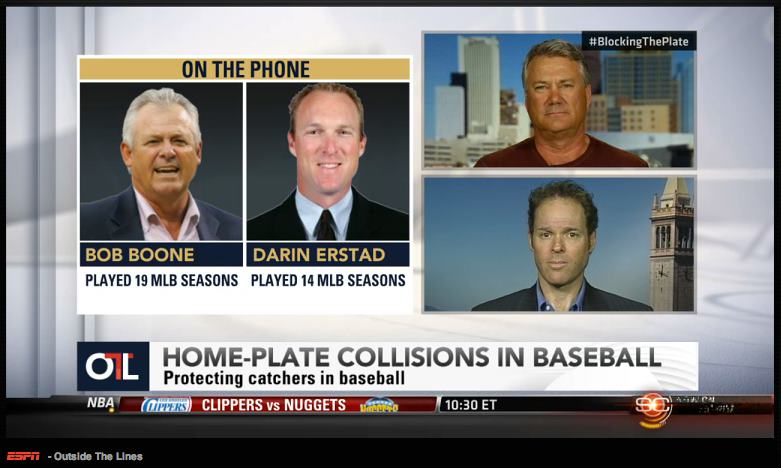
So I was on ESPN’s Outside the Lines yesterday, talking catcher collisions. They asked, I said yes. Then I found out I’d be on alongside Terry KennedyBob Boone and Darin Erstad, each of whom … how best to say this … has just a touch more experience with the subject than myself.

Especially the two longtime catchers.

Still, I tended to agree with what they had to say, and Bob Ley kept on throwing to me, so I kept on returning it. Aside from the fact that my studio in Berkeley had no monitor with which to see the clip he referenced, all went very well.

If I find the video, I’ll post it. In the meantime, hear it here.

(Thanks to Steve Stein for the screen grabs.)

OTL 3

OTL 1

Retaliation, spring training

Welcome to Spring Training: Phils and Nats Get Testy Early

HalladayGiven that spring training is the prime time for ballplayers to catch up on outdated retribution—the games don’t count, and who really cares if somebody gets tossed—it’s a bit surprising we haven’t seen more of it this month. Then again, we’re only a week in.

The concept managed to hit its stride yesterday in Clearwater, when the Nationals and Phillies continued what has been a cycle of mutual antagonization that started last year, when Cole Hamels happily drilled Bryce Harper in a welcome-to-the-big-leagues moment, then confessed as much afterward.

Nothing was done about it last season (Hamels batted three times in his next start against Washington, once with first base open, and wasn’t so much as brushed back), but relations between the clubs are still running sensitive. Under normal circumstances, Stephen Strasburg hitting Chase Utley in the back ankle wouldn’t elicit much protest—it’s hardly the location to do any sort of damage, not to mention that Strasburg is still working out winter kinks. That it came from the Nationals, however, seemed to strike a chord.

Roy Halladay subsequently threw a pitch behind Tyler Moore (not ordinarily a prime target but by that point in the game the most veteran player remaining for the Nats). Afterward, the right-hander offered the usual platitude about having lost his grip, but then went into a fairly extended dialog about just what that kind of pitch can mean to a club.

“We do need to protect our guys to an extent,” he said in a Phillies.com report. “I’m not saying that’s what happened. It slipped, but I think that’s important. We’ve had a lot of guys hit over the years. I think as a staff we need to do a good job of protecting those guys. Spring training, I don’t think you’re necessarily trying to do it, but it wouldn’t have been the worst thing had it got him after getting one of our good guys.”

There’s also the fact that, according to a deadpanning Halladay, “Chase suggested drilling a few guys this year so I might mix that in.”

It may have been a joke, but it was rooted in reality, as Utley confirmed.

“I think we’re all fighting for the same thing,” he said. “We all want to win. I think, as a hitter, the more uncomfortable you are the more difficult it is to hit. But getting hit is part of the game.”

As for Halladay’s motivation, the action may have served two purposes. One was to reinforce to the defending division champs that the Phillies will not be pushed around this season. Another, even more likely, was to send a message to his own clubhouse, especially after the comments he and Jonathan Papelbon made about Philadelphia’s lack of leadership.

Agree or disagree with his plan of attack, Halladay is, without doubt, leading. The message has been sent; the next six months will tell us whether it’s been received.

(Via Yahoo.)

Deke Appropriately, WBC

Oh, China: Runner Dekes Himself in WBC Action

WBCAs a method of last resort, dekes can be an infielder’s best friend. They’re most frequently enacted in an attempt to slow a baserunner’s progress by making him think that the ball is somewhere on the diamond other than where it actually is–and can end up saving runs .

They are deceptive by nature, but, done right, are entirely by the book. (They’re especially by-the-book if the fielder plays no part in deking a baserunner who has clearly just been deked.)

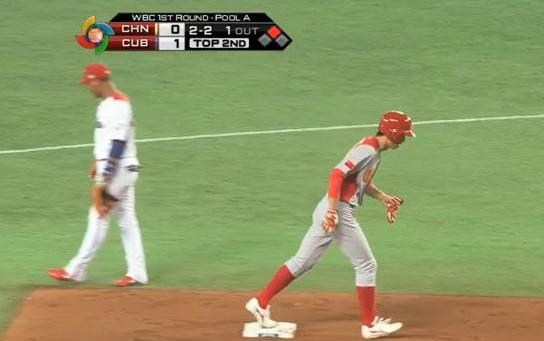
Some explanation: In WBC action on Monday in Japan, Chinese baserunner Fujia Chu swiped second base following Cuban catcher Eriel Sanchez’s botched transfer of the ball to his throwing hand. Chu pulled into second as Sanchez was trotting toward the backstop to corral the ball, then, near the end of the play, inexplicably started jogging back toward first. (Watch it here.)

The initial impression: One of the Cubans told him it was a foul ball.

The more likely scenario, especially given the language barrier: Chu caught a glimpse of the ball in foul territory and made the assumption all on his own.

These are the kinds of things that happen to an inexperienced squad. (China was mercy-ruled, 12-0, in this game. Say no more.) The reason one never sees this happen in the big leagues is that runners are trained to look in to the catcher mid-stride to see the result of the play. Had he been aware of his surroundings, Chu might even have tried for third.

As it was, Cuba gets credited for a heads-up baseball play it likely had nothing to do with.

Intimidation, Pedro Martinez

Et Tu, Pedro? Well, Yeah, of Course Et Tu.

First, Lance Armstrong admitting to doping, and now this. Remember all those guys Pedro Martinez intimidated with inside fastballs over the years? (He hit 141 hit batters over 18 seasons, finishing in the top three in the category five times; only one man ahead of him on the career HBP list from the modern era, Jamey Wright, hit more batters per nine innings.)

Turns out that he meant almost every one of them.

Pedro Martinez

Yesterday, Peter Abraham of the Boston Globe tweeted that “Pedro just admitted that 90 percent of the guys he hit were on purpose.”

Well, of course they were. During Martinez’s heyday, no American League pitcher was close to him in terms of command. He complemented a darting fastball with the game’s best changeup and an array of devastating breaking pitches—and didn’t stop there. He also took a page from Nolan Ryan’s playbook, turning the brushback, the knockdown and the hit batter into valid parts of his repertoire. As if trying to adjust from a low-90s fastball to a changeup in the mid-70s wasn’t tough enough, hitters also had to deal with the idea of staying light on their feet.

Sometimes, of course, this reputation was detrimental—Martinez engendered no shortage of opponents who much didn’t care for him, as this excerpt from The Baseball Codes will attest:

Take Reggie Sanders, who charged the mound in 1994 after being hit by Pedro Martinez. That the pitcher was trying to protect a 2–0 lead in the eighth inning was one clue it might have been unintentional; that it was an 0-2 count was another. That Martinez was in the middle of throw­ing a perfect game should have put to rest any lingering doubts. Without a shred of hyperbole, Sanders was the most obviously unintentionally hit batsman in the history of the game.

Still, it wasn’t enough to keep him in the batter’s box. Martinez had been brushing back Cincinnati batters, including Sanders, all afternoon. After one such pitch in the fifth inning, Sanders gave the pitcher a long, angry glare, which Martinez returned in kind. After he plunked Sanders three innings later, Martinez even went so far as to raise his arms in frus­tration before realizing that it would be a good idea to defend himself.

It takes a special kind of pitcher to pull off something like that. Martinez has just rejoined the Red Sox as a special assistant to General Manager Ben Cherington, where he will hopefully continue to lend insight into the machinations that made him such a force of nature. Welcome back to the big leagues, Pedro.

(Via Yahoo.)

Bunting for hits

Retiring Schneider Brings to Mind a Small Slice of Baseball Mayhem

Brian SchneiderBrian Schneider retired yesterday. A backup for most of his 13-year career, he was never a star, but saw enough action to make an impression.

The following excerpt from The Baseball Codes was reported primarily because I watched it unfold from the press box at AT&T Park, and was duly amazed. The moment involved Schneider, in the on-deck circle, being drilled by a foul ball and knocked out of the game.

That, in itself, is unusual, but the story surrounding it—including the aftermath—brought increasing levels of intrigue. Schneider was only a bit player, but it bears retelling:

In 2006, the Washington Nationals limped into San Francisco with a MASH unit where their catching corps should have been. Starting catcher Brian Schneider suffered a debilitating lower-back strain in Los Angeles a day earlier, and backup Matt LeCroy had been released eleven days previous. That left only one player on the roster with catching experience—Robert Fick, primarily a first baseman who had caught in 132 games over eight previous big-league seasons.

In the fourth inning, however, it all came apart. Fick, on first after sin­gling, tore rib cartilage diving back to the bag on a pickoff throw. Had there been another catching option for Nationals manager Frank Robin­son, Fick would have come out of the game immediately. As it was, Fick’s injury prevented him from swinging a bat, but he was still able to squat and catch, so he stayed in.

The single had been part of a five-run rally that gave Washington a 6–1 lead. But after catching the bottom of the fourth, Fick was in such serious pain that Schneider volunteered to come off the bench, bad back and all, to take over. He made it as far as the on-deck circle, where he was prepar­ing to bat in Fick’s spot with two outs in the fifth. Within moments, how­ever, Nationals hitter Damian Jackson lined a foul ball directly into Schneider’s right wrist, giving him injuries in two places and sending him back to the dugout. There was no other option—Fick had to bat for him­self. Which leads to a question: What does a hitter do when he can’t swing a bat?

The answer: He bunts. It was Fick’s only alternative, short of watching every pitch he saw. There were two problems, however. One was that Fick pushed his first bunt attempt foul, leaving him standing at the plate and awaiting the next pitch from San Francisco starter Noah Lowry. The other was that neither Fick nor anyone else in the Nationals dugout told the Giants what was going on. All Lowry saw was a player bunting after a five-run rally that broke the game open. He drilled Fick with his next pitch.

“I thought it was unbelievable, ridiculous,” said Lowry. “Sometimes during a game, emotions take over. The emotions were already there, and to add that icing on the cake. . . . There comes a point where you have to draw the line and say, ‘Hey, have respect for me, have respect for the game.’ ”

It wasn’t until afterward that the left-hander found out about Fick’s ribs (the injury was enough to send the would-be catcher to the disabled list the next day) and the various maladies of Washington’s other catchers, and he felt terrible. Had there been some communication—Fick telling Giants catcher Todd Greene about his predicament, and Greene relaying that information to Lowry, perhaps—might it have made a difference?

“Yeah, of course,” said the pitcher. “Knowing he was hurt would have been a completely different story. . . . When I heard about why he was doing it I felt like a jerk. But, not knowing, you just play the game the way you know how to play it.”