Clubhouse meetings

When Teams Meet to Beat the Heat

We’ve reached the point in the season at which good teams are looking toward the playoffs—and, to their horror, find themselves imagining some combination of absence or failure. Which is why managers have recently taken to the time-tested strategy of the closed-door meeting.

Last week it was the NL East’s turn. Monday afternoon, Braves skipper Freddi Gonzalez insisted that his team merited no such tactic, despite losing three in a row and 11 of 17. That very night, however, after watching his players go 3-for-20 with runners in scoring position during a 12-inning loss to Florida, he about-faced, closing the doors after batting practice on Tuesday, and gave his team a talking to.

The question, of course, is whether this type of thing has any affect. Overall, the results are decidedly mixed, but the tactic seems to be effective for Atlanta.

According to the Atlanta Journal Constitution, the Braves last met after a loss to the Mets on June 5, then won six in a row.

“It’s almost like therapy,” said Chipper Jones in the AJC. “You knew what was going to be said, but it still helps to hear it, to say it, to look in your teammates’ eyes and let them see your conviction and know that you can’t help what happens next year. This might be your only opportunity.”

For a historical reference, take the 1980 Philadelphia Phillies, who had an August loaded with meetings. After a 7-1 loss to the Pirates in the first game of a doubleheader that Aug. 10, manager Dallas Green tore into his players with such fury that reliever Ron Reed had to be restrained from going after him.

“What Dallas was saying went right to the core,” wrote Tug McGraw in Ya Gotta Believe. “Sometimes it’s not what’s being said as much as it is who’s saying it and when they’re saying it. By this time of the year, Dallas had earned a lot of respect. We all knew he was real and wasn’t just a blowhard. So after the meeting, we went out and won eight of nine, including five in a row from the pitiful Mets.”

Less than two weeks later, however, the team lost the final two games of a series at San Diego, earning another dressing-down—this time by general manager Paul Owens, who singled out Larry Bowa and Garry Maddox for their poor play. Rather than let a player come after him, Owens got proactive, offering to fight whoever was up for the challenge. Philadelphia, 5-7 since that Mets series, went 23-11 to close the season (including 12 one-run victories) and went on to win its first World Series in nearly 100 years of existence.

This year’s version of the Phillies has recently had its own challenges. The same night Gonzalez addressed the Braves, Phillies skipper Charlie Manuel “had a little talk” with his players following a poorly played 5-2 loss to the Astros, Philadelphia’s second straight defeat.

Manuel downplayed the incident afterward, but according to Comcast SportsNet Philadelphia, “he rattled some cages pretty soundly.”

Not that it did much good. Nearly every Phillies player who took the field the following day was utterly ineffective, as they managed just four hits against Houston starter Bud Norris and two relievers. Luckily for Manuel and the good people of Philadelphia, one guy rose to the occasion: Roy Halladay, who spun a complete-game shutout.

It’s not like this is a new tactic; May alone saw at least four such meetings. (Only one of them was unusual, when the Mets closed the clubhouse doors to discuss the inflammatory comments made by owner Fred Wilpon in a New Yorker profile.)

On May 16, Cubs manager Mike Quade lectured his team after Carlos Zambrano blew a four-run, sixth-inning lead in a loss to the Reds. (The message delivered, according to Quade, via the Chicago Tribune: “That was embarrassing. That (stuff) has got to stop. And it’s everybody that was in that room for that meeting. Myself, the players and the coaching staff. It’s just not going to cut it right now.”)

The Cubs lost their next game. After going 6-and-6 over the next two weeks, they then lost eight in a row.

On May 16, Rockies manager Jim Tracy tried to end a 4-11 streak by addressing his club. (The message delivered, according to Tracy, via the Denver Post: “We need to get back to playing the game the way we did in spring training and the early part of the season.”)

The Rockies won their next two games, then went 3-11 over the following two weeks.

On May 22, Padres manager Bud Black called a meeting after his team was swept by Seattle. (The message delivered, according to Heath Bell, via the San Diego Union-Tribune: “We’re major league ballplayers. That no matter who we’re facing, we need to have a chip on our shoulders to go out there and win every single day.”)

San Diego lost three of its next four.

Heck, Mariners manager Eric Wedge closed his clubhouse doors on April 16—two weeks into the season—to berate his hapless club, which had just gone 0-for-9 with runners in scoring position against the Royals to drop its 11th game in 13 contests. (The message delivered, according to Wedge, via the Seattle Times: “I want them to have the mindset that’s aggressive and such to where we’re up there ready for anything.”)

Unlike the above teams, the Mariners actually responded, splitting their next eight games before winning five in a row on the road against Detroit and Boston.

* * *

It goes without saying that struggling teams call such meetings with significantly more frequency than those that are winning. One trick to a successful meeting, according to the New York Daily News, is to “always hold your clubhouse meetings the day before your best pitcher is pitching.” That was written in 2000, in response to Mets manager Bobby Valentine, who aired out his team after a 12-4 loss to the Braves—one day before Al Leiter took the hill. (Sure enough, Leiter was perfect into the sixth, and the Mets beat Atlanta, 6-3, making Valentine look like a genius.)

Of course, not all such meetings are simply about playing better. They also serve as a forum for players to air out grievances. (In a 1990 meeting, San Diego’s Jack Clark, Mike Pagliarulo and Garry Templeton verbally ganged up on Tony Gwynn, accusing the star outfielder of caring more about his own statistics than the team. In 1997, Dodgers Eric Karros and Ismael Valdez had to be separated after Karros criticized the pitcher during a meeting.)

Occasionally, management will get involved. (During a meeting in 2006, for example, Blue Jays skipper John Gibbons challenged Shea Hillenbrand to a fight after the third baseman allegedly wrote “This is a sinking ship” on a clubhouse whiteboard.)

In 1983, Yankees manager Billy Martin called a team meeting—reporters included—so he could chew out New York Post writer Henry Hecht with extremely lively language for what he felt was inflammatory reporting. (In Martin’s defense, he was correct in his assessment.) The manager threatened to dump Hecht in the whirlpool if he so much as stepped foot in the manager’s office again.

“It was probably the best clubhouse meeting we ever had,” wrote Graig Nettles in Balls.

In 1971, Cubs manager Leo Durocher called a closed-door meeting in which he encouraged players to open up about what they thought was going wrong with the season. As it turned out, many of them thought the answer was Durocher himself; Ron Santo, Joe Pepitone and Ken Holtzman all criticized Durocher’s managerial style. Things got so heated that Santo had to be restrained by Billy Williams and Jim Hickman from going after the skipper. Team owner Phillip Wrigley responded by taking out a full-page ad in all four of Chicago’s daily papers, saying that it was Durocher’s team, and that anybody who didn’t like it could be moved in the off-season. He ended with the statement, “If only we could find more players like Ernie Banks.”

Durocher was fired midway through the following season.

Still, not all such gatherings are so morose. When Frank Robinson managed the Giants in 1984, he responded to an early-May slump by gathering the team for a talking to by “Dr. Johnson,” a local psychologist, with the message that “she will give you a good pep talk.”

When the “doctor” began to peel off her business suit in time to music pouring from a boombox in her briefcase, the skipper’s true intention became very clear.

“We still went out and lost that night,” said pitcher Mark Grant, “but we certainly had more fun.”

– Jason
Umpires Knowing the Code

And Like That—Poof—he’s Gone. Kershaw Tossed Without Warning

Bill, Clayton. Clayton, Bill.

Call it bad umpiring, if you must, but many will disagree with you.

Legions of fans, in fact, consider it to be horrible umpiring.

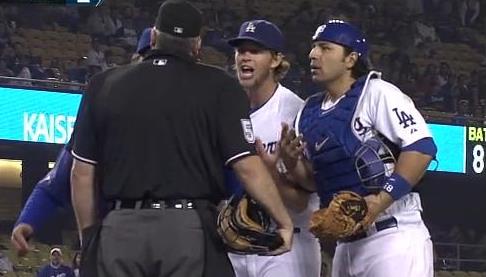
It’s inaccurate to say that umpire Bill Welke’s ejection of Clayton Kershaw Wednesday night came from nowhere, but, considering the circumstances, it kind of did.

Those circumstances began Tuesday, when Dodgers reliever Hong-Chih Kuo sent an inside pitch buzzing past the head of Arizona’s Gerardo Parra. It was inside, but not dangerously so; that it came close at all was mostly a function of Parra’s squaring around to bunt.

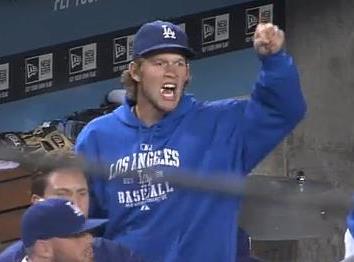
Parra responded by staring down the pitcher. Moments later, he connected for a home run, then loitered in the batter’s box for several long beats. That raised the hackles of both catcher A.J. Ellis, who had words for Parra as he crossed the plate, and the Dodgers’ bench at large—with the leader of the agitated appearing to be Kershaw, who appeared to deliver a message along the lines of “Just wait ’till tomorrow, Gerry.” (Watch it all here.)

When Kershaw faced Parra to start the sixth inning yesterday—having already surrendered a double to him in the third—he sent an 0-1 fastball spinning inside, and clipped Parra’s right elbow. Wrote Steve Dilbeck in the Los Angeles Times, “[It] hardly appeared like Kershaw was intentionally trying to hit him.”

Still, it was enough for Welke, who ejected the pitcher on the spot. (Watch it here.)

Tuesday night: Kershaw gets fiery.

Never mind that the pitch only grazed Parra. Never mind that it was a 2-0 game, and that Kershaw is chasing 20 victories on the season. Never mind that 29,799 people paid good money to see one of the National League’s best pitchers square off against the presumptive NL West champions.

Never mind all that, if you’d like, but make sure to pay attention to an umpire who refuses to let baseball’s Code play out on its own terms—if that’s even what was happening. Kershaw had every right to send a message to Parra after the previous night’s display, and the only guy in the stadium who seemed oblivious to the notion was Welke. If ever there was a spot to warn the benches, this was it.

Or, as it turned out, not.

Perhaps Kershaw learned a lesson about stifling any animated displays in the dugout. Maybe he spent the rest of the evening thinking about how and when he can next come inside to a guy with whom he has history. Or maybe he just spent a few hours poking pins into his Bill Welke doll.

He shouldn’t have had to any of this. It was a display of over-umpiring at its most blatant, and Kershaw—hell, any major league player—deserves better.

– Jason

Gamesmanship, Nyjer Morgan

Big League Chew: Morgan Pulls Out All the Stops (Among Other Things) to Get into Carpenter’s Head

This is what happens when baseball’s premier red-ass butts heads with one of the game’s loosest cannons. As if there wasn’t enough tension built in to St. Louis’ desperate chase of the Brewers in the waning days of the NL Central, Nyjer Morgan threw decorum—and his chew—to the winds Wednesday, shouting down Chris Carpenter as the Cardinals ace tried to finish a complete-game shutout.

After the right-hander struck out Morgan for the first out of the ninth inning, he directed an inflammatory comment toward the plate (at least according to Morgan), to which the hitter replied—and I lean here on my decades of experience reading lips via sports telecasts—“fuck you.” (Watch it here.)

Morgan, it seems, had been swiping at low-hanging fruit throughout the game, trying to rattle a pitcher who’s proved susceptible to such tactics in the past. To Carpenter’s credit, he didn’t cave.

“He was yelling at me at second base,” said the pitcher in an MLB.com report. “He was yelling at me down the line when he hit the double. The whole game he’s screaming and yelling, the whole game. I’m not going to allow it to happen. I don’t know if that’s the way he plays, to try to get guys out of their game or what. But I’ve been around too long to allow that to happen, I can tell you that much.”

As Morgan strode purposefully back to the dugout following his at-bat, he dismissively tossed his wad of chewing tobacco toward the mound. It didn’t come anywhere close to Carpenter, but that wasn’t Morgan’s intention. It was simply as dismissive a message as he could send in that moment.

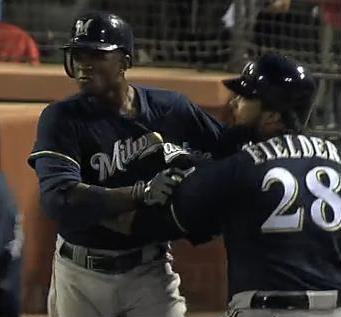
Albert Pujols responded by charging in from first base, Prince Fielder raced to restrain Morgan, and the benches emptied. (No punches were thrown or shoves exchanged.) Morgan was eventually tossed by the umpires, at which point he could be heard on the telecast saying, “He said it first, he’s got to go, too.”

Were it only that simple. Morgan knows—and was likely trying to exploit—a history with the Cardinals that dates back to August, 2010, when the outfielder—then with Washington—went out of his way to senselessly collide with Cardinals catcher Bryan Anderson in a non-play at the plate.

That was followed this spring by an exchange that started when Morgan ran into Pujols in a play at first. Morgan and Carpenter got into a verbal spat during a series at Miller Park earlier this season. The teams also had tension over a tit-for-tat hit-batter exchange involving Pujols and Ryan Braun.

Ultimately, Morgan is either genuinely off-kilter or wildly canny, using the tactic of supreme annoyance to get his opponents off their collective game. (The former was bolstered by his recent run-in with fans in San Francisco. The latter has been ably demonstrated for years by A.J. Pierzynski.)

No matter the answer, it comes down to Nyjer being Nyjer. He said after the game that the confrontation “was over with”—but he wasn’t quite telling the truth.

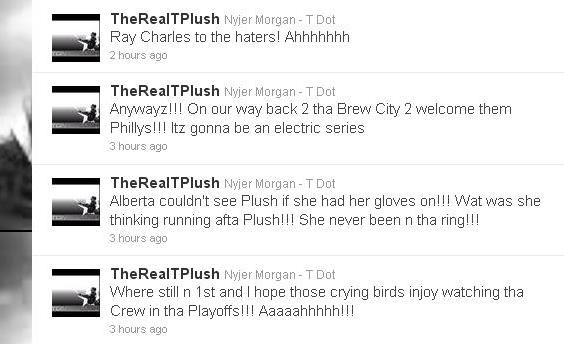
Not long afterward, Morgan sent out a series of tweets referring to Pujols as “Alberta” and saying “She never been n tha ring.” (See below.)

Ozzie Guillen once described Pierzynski this way: “If you play against him, you hate him. If you play with him, you hate him a little less.”

Through Morgan’s tenures in Pittsburgh and Washington, that appeared to be the case with him, as well. The Brewers, however, seem to love the guy.

He’d be well-advised to keep it that way.

Update: Morgan is headed in the wrong direction. Brewers management is not taking kindly to his act.

– Jason

Francisco Cervelli, John Lackey, Retaliation

Cervelli-abration: How Much is Too Much, and What to do About it?

So Francisco Cervelli hit a big home run and clapped his hands in celebration as he stepped on the plate, directly under the nose of Red Sox catcher Jarrod Saltalamacchia.

The next pitch Cervelli saw hit him square in the back.

It certainly looked incriminating, and although pitcher John Lackey denied all intent, that’s what he’s supposed to do. The Yankees broadcast crew jumped on it immediately, with Michael Kay not missing a beat after Cervelli was drilled before saying, “I’m going to tell you why Cervelli just got hit. I will tell you why. Because when he hit the home run he celebrated at home plate and clapped his hands right in front of Saltalamacchia.” The telecast then cut to a pre-queued clip of the moment. (Watch it, preceded by the home run itself, here.)

Kay was hardly the only one to see it in this light. Another example, from the Boston Globe, which structured its use of quotes to paint a particular picture:

“He was pumped for that [third] home run of his career,” Lackey said. “I thought it was a little excessive, honestly.”

Said Saltalamacchia: “He’s done a lot of that stuff. … He likes to get excited. That’s fine. As far as the clapping goes, yeah, it could have been a little much. You don’t show anybody up. You play the game the way you play it. You’ve got to stay in your boundaries.”

Seems pretty cut and dried. There are some compelling arguments to the contrary, however.

Start with the fact that the Red Sox trailed 4-2 at that point in the seventh, and Lackey’s primary job was to keep that deficit static. The last thing he’d rationally want is to put the leadoff hitter on base with the lineup about to turn over. (Sure enough, Cervelli came around to score New York’s final run.)

Said Lackey in the Boston Herald, “I’ve been fined twice for hitting guys this year and I’ve paid them because they were right. But this one, I’m not afraid to tell you if I’m trying to hit somebody. I would’ve told him to his face.”

The statement that rang truest from Lackey, from the New York Daily News, pointed out in stark terms every truth of the situation. The Globe excerpt above utilized part of it, but cut out the key final sentiment.

“(Cervelli) was pumped for that ninth home run of his career (third actually), yeah. I don’t know. I thought it was a little excessive, honestly, but that’s not a spot you handle something like that.”

Naysayers can start their counter-arguments with the fact that this game doesn’t mean anything because Boston and New York are both going to the playoffs, then talk about Boston wanting to avoid facing Justin Verlander twice in the ALDS.

But those who think a starting pitcher in the midst of a pennant race is willing to compromise a victory in order to take care of some vendetta—especially with five games remaining between the teams during which to drill Cervelli at a more opportune moment—must ignore an awful lot of reality to do so.

More of an affront to the Code than anything Lackey did was Cervelli’s celebration—specifically, where it took place. Had he clapped his hands upon seeing the ball leave the yard, the Red Sox would not likely have noticed. Had he waited for several steps after crossing the plate, on his way back to the dugout, same thing.

As Craig Calcaterra wrote over at HardballTalk, “Cervelli pumps his fist when he gets a good sandwich. He woops it up if he tosses a wadded up piece of paper into a trash can on the first try. If Cervelli gets one more home run in his career it’ll be a gift from the friggin’ gods, so let him have his little moments.”

Done and done. The guy has to measure those moments, however, to ensure they occur somewhere than directly in front of his opponent. Otherwise, he can expect more of the same kind of treatment he received from Lackey.

Perhaps next time it’ll even be intentional.

Update (9-1-11): MLB didn’t buy it. Lackey’s been fined.

– Jason

Brad Penny, Thin Skin

Brad Penny Demonstrates his Love of Yelling. Again

Gif via Rays Index.

Being a known red-ass will occasionally work in a player’s favor. That’s because displays of jerkitude, should they fit a pattern of self-involved outbursts, are difficult to mistake for disrespect. “It’s just Bill being Bill,” an opponent might say, should such a red-ass be named Bill.

Tuesday, it was Brad being Brad.

Brad Penny, of course, is one of the most temperamental bastards in the game—and that’s not necessarily an insult. Fire has fueled him through a mostly successful 12-year career, but so too has it put him on the periphery of acceptable behavior.

As he pitched against the Rays, Penny drew attention for his response to Sean Rodriguez, Tampa’s second baseman who, on a seventh-inning popup, ran so hard he nearly reached second by the time left fielder Delmon Young caught the ball.

Penny, apparently upset at the audacity of hustle, first scowled at Rodriguez, then yelled at him. Rodriguez, sufficiently affronted, yelled right back. Rays manager Joe Maddon saw fit to call it out the following night, after another bit of Rodriguez hustle—he beat a two-out force play at second as the winning run crossed the plate in the 10th—was the difference in a Tampa Bay victory.

“For anybody to bark at another player for . . . hustling is absolutely insane, ludicrous,” said the manager, in a St. Petersburg Times report. “And if Sean had just charged the mound, I’d have been fine with that at that particular moment.”

Penny was being ridiculous, of course. Only a special kind of maniac can fault a guy for playing too hard—especially on a non-impact play. The thing is, according to Penny, he’s not that kind of maniac. He was getting on Rodriguez for yelling and cursing, of all things. “To me, that’s a sign of disrespect if you’re screaming that loud,” he said a day later in the Times. “All these kids can hear you; it’s not too loud in here. So to me, that’s not really professional.”

Really.

The problem with this logic is that a concern for the potential corruption of western Florida’s youth does not equal disrespect. And if Penny did feel disrespected, trying to justify his actions by hiding behind an it’s-all-about-the-children excuse is just sad.

But that’s the thing about Brad Penny. It was just last month that he got into an argument with his own catcher, Victor Martinez, about pitch selection, visibly berating him on the mound before a stadium full of people. (Watch it here.) He’s also been known to enforce legitimate tracts of Code when the mood strikes. (With the Marlins in 2001, for example, he drilled New York’s Tsuyoshi Shinjo for having swung at a 3-0 pitch while the Mets held an 11-3 lead a day earlier. While denying intent, he said afterward that Shinjo “did deserve to get hit.”)

Even if Penny was offended by Rodriguez’s choice of language—offered as it was toward nobody in particular, likely out of the hitter’s frustration at his own inability to execute—that’s okay because he seems to be offended by most of the things the people around him do on a regular basis.

It is, after all, just Brad being Brad.

– Jason

Rick Porcello, Umpire Warnings

When Umpires Strike, Blatant-Retaliation-for-Questionable-Offenses Division

There are two directions an umpire can go in instances of retaliation that occur under his watch.

He can let the situation play out, offering the other team a chance to respond before bringing down the hammer with warnings.

Or he can go quick-draw in an effort to immediately tamp down further inflammatory actions.

In the latter scenario, the offended party will inevitably be displeased about being handcuffed in its response. Which is exactly what happened to the Indians over the weekend.

It started with Asdrubal Cabrera mashing a ball down the line, an an all-or-nothing shot certain to clear the fence. He watched it fly, to see whether it went fair or foul.

It went foul. As did Tigers pitcher Rick Porcello, who by appearances felt shown up by Cabrera’s lingering presence in the batter’s box. He put his next pitch behind Cabrera’s back.

The Cleveland shortstop glared toward the mound, but his progress in that direction was stopped by plate ump Paul Schrieber, who issued quick warnings to both benches. Indians manager Manny Acta was not pleased. (Watch it here.)

“When that happens, you don’t need a warning to throw the guy out of the game,” he said in a Fox Sports report. “If you do not throw the guy out of the game then you should not issue a warning because then we’re not getting our shot.”

If only everyone was so clear, concise and correct. The manager has every right to expect a chance to respond to such a blatant Code violation—or, alternatively, have the ump collect a pound of flesh on his behalf. This doesn’t happen every time, of course; ever since umpires were instructed to tighten their trigger fingers, countless players and managers have been upset at lost retaliatory opportunities.

Acta, however, verbalizes his frustration better (read: more candidly) than most.

He was forced to specifically instruct pitcher Ubaldo Jimenez to avoid responding; it was still early in the game and he didn’t want to burn his bullpen. (His message was effective—Jimenez refrained from taking action, but that’s not always the case. Joe Torre recalls a time when he managed the Braves, in which he told pitcher Ray King Donnie Moore to leave well enough alone at the tail end of a volatile situation—before recognizing the situation for what it was. “‘I have no chance. I’m talking to a deaf man,” he said of the conversation. “I walked back to the dugout and he hit Graig Nettles. You can talk until you’re blue in the face, but it’s guys defending each other. That’s what it’s about.”)

Acta also talked about the nature of Cabrera’s blast (“The guy was just standing there looking at a foul ball. It was a foul ball. That was all”) and the blatant nature of the drilling (“Everybody, including the vendors in the stadium, knew that he threw at him”), but it was his touchstone summary of the Code and some of its modern interpretations that was truly impressive. The gems included:

  • A mini-treatise on the relative safety of retaliation for AL pitchers, as well as the inherent risks: “Guys who do that in the American League, all they’re doing is putting their team in jeopardy because they don’t hit. Guys in the National League who hit guys are the guys that show me something because they have to get up to the plate.”
  • A polemic on the inter-team chumminess of modern players: “None of these guys want to fight. The game has changed so much, it’s a joke. All we’ve got to do is watch BP (batting practice). They’re all hugging and laughing (with opponents). Look on the bases, how you’ve got three, four guys (on opposite sides) talking to each other.”
  • A sidebar on players’ softness (directed toward Porcello), pointing out one player who did not fit that bill—Francisco Rodriguez. While with the Mets, the closer took exception to comments made by Yankees pitcher Brian Bruney about his animated nature, and confronted him before a game. Acta: “You want to know who’s tough? Frankie Rodriguez is tough. He didn’t like what some guy did a couple years ago, he went out at stretch time. . . . That’s being tough, not throwing a ball at a guy and not even facing the guy. If you have to get up to the plate (to hit), then maybe I can see you being tough.”

Porcello offered standard denials about the pitch getting away from him, but if even the vendors could read his intent it doesn’t hold much water.  The teams meet again on Sept. 5. Hold onto your hats.

– Jason

Carlos Zambrano, Don't Quit on Your Teammates

Quitting Time on the North Side: Big Z Pitches Another Fit

There is only one purpose for the unwritten rule mandating that all players make an appearance during a baseball fight. Even those without intention of throwing a punch, who want only to serve as peacemaker or to pull bodies off the pile, prove their loyalty through their very presence in the scrum.

The inverse, however, can be catastrophic. Should a player remain on the bench or in the clubhouse as his teammates storm the field, the personal toll may be irreparable. It doesn’t happen frequently, but such players are seen as soft, at best, and disloyal, at worst. Their clubhouse standing is immediately shredded.

Last week we saw the inverse, as it related to a player whose standing with his teammates was apparently already in tatters.

On Aug. 12, Carlos Zambrano threw two pitches at Chipper Jones after giving up back-to-back homers (the fourth and fifth he’d surrendered on the night) and was promptly tossed from the game. Players came streaming out of the Atlanta dugout to defend their star.

From the Chicago side: nobody.

(Well, there was manager Mike Quade, who ambled out to chat with plate ump Tim Timmons. Watch it here.)

It’s difficult to say where Zambrano lost this clubhouse among the myriad possibilities. In 2007, he fought openly with teammate Michael Barrett. In 2009 he had an in-game meltdown so severe that MLB suspended him for six games; then he missed the team’s flight to Atlanta. In 2010 he screamed at teammate Derek Lee in the dugout, for which he was suspended by the Cubs and which precipitated his enrollment in anger-management therapy. Earlier this season he called the Cubs a “Triple-A team.”

After Zambrano’s meltdown against Atlanta (which also included drilling Dan Uggla after the first of his two home runs on the day), Alfonzo Soriano confronted him in the clubhouse. Shortly thereafter, the pitcher packed his bags, told people he was retiring and left the ballpark before the game ended.

“I’m really disappointed,” said Quade in the Chicago Tribune. “His locker is empty. I don’t know where he’s at. He walked out on 24 guys that are battling their (butts) off for him. . . . I can’t have a guy walking out on 24 guys, that’s for damn sure.”

Cubs GM Jim Hendry called Zambrano’s retirement bluff, saying, “We will respect his wishes and honor them and move forward.” (Hendry also apologized to the Braves for the pitches aimed at Jones. Of course, Hendry is the guy who signed Zambrano to a five-year, $91.5 million extension in 2007. The team fired him today.)

“I’ve never seen that before, someone just get (ticked) off and leave and retire,” said Aramis Ramirez. “I’ve been around for awhile. Even with him, players don’t do that.”

Even with him.

Before long, of course, the pitcher reconsidered, offering apologies and going on a mea culpa media tour. The fact that he’s owed $4.7 million for the remainder of this season, and $18 million next year, were likely motivating factors.

That’s the thing about losing the respect of teammates, however—returns are never easy. The Cubs placed Zambrano on the disqualified list, resulting in a 30-day suspension without pay. The players’ union filed a grievance on his behalf.

The Cubs’ next GM, whoever he is, is not likely to embrace the idea bringing back Zambrano, who by that point will be somebody else’s mistake. But even if the union wins, the Cubs fail to cut him and Zambrano returns to Wrigley, it won’t be an easy ride.

Beating management is one thing, but the guy can’t beat his teammates—he has to win them back.

And when quitting is concerned, we all know how that goes.

– Jason

Retaliation

How to Pick Your Battles and When: A Farewell to Logan Morrison

Baseball has seen its share of retaliation this season, lowlighted by Jered Weaver and Carlos Carrasco throwing at players’ heads after being offended on the field.

This week, however, saw a different kind of retaliation—less fiery, but more bureaucratic and far more profound. Logan Morrison offended members of the Florida Marlins front office, and they appeared to respond in kind.

In short: A charity bowling tournament in which Morrison was supposed to participate was canceled because the team’s community foundation failed to sell enough lanes in advance. Morrison, disappointed, responded by boycotting a subsequent photo session with season ticket holders.

The lesson: Don’t mess with management. Later that day, despite ranking second on the team with 17 homers and third with 60 RBIs, Morrison was optioned to Triple-A New Orleans. The team cited his .249 batting average as the reason.

There are a couple unwritten rules in play here, one of them stating that offbeat players must be truly established before unleashing the full force of their personalities. Morrison fits that bill.

He’s made enough waves on Twitter during his short career that team president David Samson suggested that he cool it down. Earlier in the season, the second-year player told reporters that the firing of hitting coach John Mallee had been ordered by team owner Jeffrey Loria (drawing a direct rebuke from Loria himself). Just last week, Morrison leveled another round of criticism at Marlins shortstop Hanley Ramirez—compounding his confrontation with the shortstop in June.

The same day Morrison was demoted, his clubhouse confidante (and fellow Ramirez critic) Wes Helms—who had advised his protege against attending the photo session—was released. (Helms was hitting just .191 in a very limited role, but the timing of the move was, at the least, curious.)

Case in point regarding the correlation between status and freedom of speech: team veep Jeff Conine, Mr. Marlin himself, said earlier this season that he’d “probably” trade Ramirez if given the choice. The repercussions (aside from an angry response from Ramirez): None.

For a lesson on how to abide by this particular piece of Code, turn to Giants closer Brian Wilson, who didn’t come by his quirks recently—he just knew how to hide them as a younger player.

“I had the beard in 2007, but they made me shave it when I had to go to Triple-A . . .” he said in an interview late last season. “I wasn’t allowed to have the mohawk in the minor leagues. I got it two weeks after I was called up in ’06, and the full-on one came in 2009.”

By which point he was coming off an All-Star season in which he finished second in the National League in saves. Soon thereafter came the beard as we now know it.

Marlins catcher John Buck, among others, suggested that Morrison tone things down. Another of Morrison’s teammates had it exactly right when he suggested, in a Palm Beach Post article, that the outfielder’s timing was off.

“In five years, when you’re a stud, that’s when you can get away with that,” said the player, who went unnamed. “It was a perfect time for (the Marlins to demote Morrison) because we’re out of (the race). I’ll tell you what, though: If we’re close to the Braves right now, I’ll bet you they don’t make that move.”

The other unwritten rule in play here—and this goes for all walks of life, not just baseball—is to be careful with whom one picks one’s battles. Team management is rarely a good place to start.

For a historic lesson, look to Chicago in 1939, when recently acquired Cubs shortstop Dick Bartell, arriving for a spring training game, insulted an overweight man struggling to get through a ballpark turnstile.

Bartell didn’t know it at the time, but the man, Ed Burns, was one of the team’s official scorers, and made life miserable for Bartell—a starter in the first ever-All-Star Game six years earlier—by charging him with questionable errors throughout the season, and charging errors on the other team that could have gone for hits for Bartell. From The Baseball Codes: “The error parade got to be such an institution that at that winter’s baseball writers’ dinner, a baby bootie was brought onstage with the pronouncement ‘A boot for Bartell.’ Throughout the evening, a parade of shoes was pre­sented for the audience, each slightly larger than the last, and all with the same statement: ‘Another boot for Bartell.”

Bartell hit .238 that season, 48 points below his career mark, and for the first time in eight years his fielding percentage was below the league average. Although Burns later apologized, Bartell was shipped out following the season for spare parts.

Morrison is young enough and talented enough to avoid that fate, but—no matter how correct he may actually be—he clearly has some stark lessons to learn.

– Jason

Brett Lawrie, Rookie Etiquette

Lawrie Draws Buzz: One Kind from Teammates, Another from Opponents

Brett Lawrie celebrated, and Yunel Escobar was drilled as a result. (At least that’s the way it seems.)

In Wednesday’s game against Oakland, Lawrie hit the first grand slam of his nascent big league career, and was met with enthusiasm from teammates both as he crossed the plate and once he returned to the dugout, where he emphatically gave high fives and flung his helmet. (Watch it here.)

A touch too exuberant? Perhaps, but the kid is entitled to his moment. Even the A’s recognized that much, and let it go uncontested.

Two innings later, however, when Lawrie scored from second on a single to make it 8-4, then exulted as he crossed the plate, it appeared to cross the A’s line. Oakland reliever Jordan Norberto drilled Escobar with his next pitch, and dugouts emptied, though no punches were thrown.

The likely root of the problem is not so much the celebrations themselves as the tenure of the guy at their center. Lawrie has been in the big leagues less than a week, and the Code stipulates that players earn whatever leeway they’re given—a process that takes time. (Cincinnati’s Jordan Smith learned this lesson last year, as it pertains to umpires.) The fact that Lawrie is one of the game’s more heralded prospects probably works against him in this regard.

“I probably wouldn’t have chosen to celebrate it that way,” said reliever Craig Breslow, whose pitch Lawrie hit for the grand slam, in the San Francisco Chronicle.

It’s one of those things that doesn’t make much sense from the outside, and occasionally doesn’t make sense from the inside, either.

Steve Lyons recalls playing center field early during his rookie season, and calling off the right- and left-fielders on various fly balls, only to have them step in front of him to make the catch. Lyons was abiding by the rule of thumb that corner outfielders defer to the center fielder, but teammate Reid Nichols set him straight, telling Lyons that he had to “gain their respect.” Said Lyons: “I’m like, ‘While I’m gaining their respect, are we going to fuck up a few balls in left and right field?”

During Sparky Lyle’s rookie year with the Red Sox, he twice shook off catcher Elston Howard en route to walking a batter, and was promptly removed by manager Dick Williams. Recounted Lyle in “The Bronx Zoo”:  “After the game (Carl Yazstrzemski) cornered me in the locker room and said, ‘I want to know one thing. How can a guy who’s been in the big leagues two weeks shake off a guy who’s been catching fourteen years?’ ”

These are examples featuring teammates. When it’s an opponent who sees a rookie overstepping his bounds . . . well, suffice it to say that Yuni Escobar doesn’t end up all that pleased. Lawrie takes pride in his enthusiasm, and it’s certainly worked in his favor in his ascension through the minors.

Part of his initiation into the big leagues is learning that not everybody he encounters shares that view.

– Jason