Posts to this site have been fewer in frequency lately. This is partly due to the limited number of games offering fewer chances for the unwritten rules to crop up.
More so, however, is ongoing playoff coverage. As the Giants continue to win, I’ve been busy covering them for a number of news outlets.
I’ve had two articles in the New York Times recently, one—which came out online today, in advance of tomorrow’s Sunday print edition—details what’s happened to Pablo Sandoval this season in terms of his diminished success.
Another, which came out a couple weeks ago, talks about Buster Posey, and the Giants’ decision to keep him in the minor leagues to start the season.
Because I’m awful at self-promotion, I haven’t managed to get this out until the last minute. Still, if you’re in San Francisco tonight, don’t have tickets to the Giants game, and want to check out a fabulous panel of sportswriters, stop by the Hemlock Tavern for Litquake’s It’s All Over but the Crying: A Night of Authors on Sports.
I’ll be reading along with ESPN’s Howard Bryant (The Last Hero: A Life of Henry Aaron), Dan Epstein (Big Hair and Plastic Grass: A Funky Ride Through Baseball and America in the Swinging ’70s), David Henry Sterry and Alan Black (co-authors of The Glorious World Cup) and old pal Dan Fost (Giants Past & Present), along with iconic A’s photographer Michael Zagaris.
Having listened to him opine on several occasions, I can honestly say that giving Zagaris the mic for an hour would itself be worth the price of admission.
The event will be at 1131 Polk St. in San Francisco at 7 p.m. Tickets are $10, and can be purchased here.
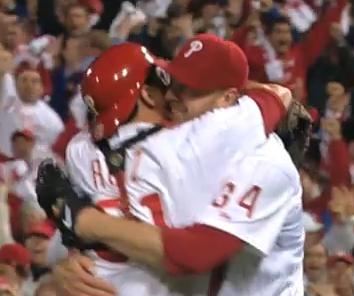
Needless to say, there were some no-hitter superstitions observed—or not—during Roy Halladay’s no-hitter against Cincinnati on Thursday.
Things got quiet in the Phillies dugout at about the sixth inning. “People stayed in their seats and sat there and watched the game,” said Charlie Manuel in the Philadelphia Inquirer. “[Halladay] came in and went down to the end of the dugout, sat in his chair, and didn’t say a word.”
In the bullpen, the relievers stayed seated and attentive. Ryan Madson, even though he needed to use the restroom in increasingly desperate fashion, did not move to do so until after the game.
The same even held true for team executives in the owner’s box, who stayed put through the final innings.
The same can’t be said for those in the broadcast booth. On ESPN Radio, Dave Campbell and Jon Sciambi wasted no time referencing the no-hitter, once it became apparent, with Campbell going so far as to “wonder if Don Larsen is watching?”
“I said something going to break at seven and eight,” said Sciambi in the Milwaukee Journal-Sentinel. “My first job is to serve the listener. On radio, specifically, they wouldn’t have the first clue if I didn’t fill them in on it. It’s my responsibility to tell them what is going on.”
Brian Anderson and Joe Simpson did likewise on TBS.
“There’s a responsibility there to make sure you catch audience,” said Anderson, the TV voice of the Milwaukee Brewers. “My nightmare is for people to be flipping through the channels and not know what’s going on in this game because I’m trying to follow some baseball etiquette.”
When the Phillies played Atlanta on the season’s final day, there were questions about whether Philadelphia manager Charlie Manuel would go all out for a victory. It was a must-win for the Braves, but not for the long-since-clinched Phillies, and he had the clear option of resting his roster in advance of the playoffs.
In the end, he did a little of both. Manuel started his regulars, and left his entire starting outfield in for the game’s duration. Even though every infielder was pulled early, they each got at least three at-bats. Manuel even pulled off a double-steal in the eighth inning, and his team battled back from an 8-2 deficit (thanks largely to its bench) to pull within 8-7.
Still, that Cole Hamels went only two shutout innings (followed, though not consecutively, by an inning each from fellow starters Roy Oswalt and Joe Blanton) could be openly criticized. Manuel, however, did what he felt was best for his team.
He also brought to the fore an unwritten rule that’s valid only in the season’s final days (or sometimes weeks): teams with nothing left to play for should give their best efforts down the stretch against teams that still have hope.
It’s why in 1991, the fourth-place Giants trotted out a series of young players when facing the sixth-place Astros in their second-to-last series of the season, but utilized their starters against the Dodgers in their final three games. Los Angeles was battling the Braves for the N.L. West crown, and after the Giants won two of three, had to settle for second, one game back.
In 2004, Rockies manager Clint Hurdle paid no attention to the Code, trotting out lineups with as many as six rookies for Colorado’s season-ending series against Houston. San Francisco would have taken the wild card had the Rockies won a single game in that series, but the Astros swept, winning it for themselves.
“We were sitting there watching that, yelling, ‘This is a joke,’ ” said Giants closer Matt Herges. “We couldn’t stand Clint Hurdle after that.”
The counter to that opinion comes from no less an authority than Tigers manager Jim Leyland, a man whose track record of putting his team before any sort of moral convention is unmatched.
“My first concern is my organization,” he said. “If I have to play some younger players because I’m looking at them for next year, well, goddammit, if I’m that far out of the pennant race, the players I was playing weren’t worth a shit anyway. . . . That’s the one trump card the manager has. I’ve got the lineup card. I decide who goes to work today.”
In Atlanta, Charlie Manuel had the best of both worlds. His pitchers are rested, his regulars gave it their best, and nobody, really, is complaining.
It’s the last weekend of the regular season, which means one thing: rookies all around baseball spent an awful lot of time recently commuting through airports and on busses in something other than their normal wardrobe. It’s a time-tested tradition, an irrevocable unwritten rule, serving as another tool to put rookies in their place.
They haven’t always been so creatively attired, however. It started decades ago with gaudy footwear, frequently purchased at a particularly funky shoe emporium in Atlanta. Occasionally rookies’ pants would be trimmed at the shins to better show off their new kicks.
Slowly it developed into the circus act we know today, with rookies being forced into costumes, dresses, dainty undergarments … and worse. The Rockies are known to dress their rookies in Hooters outfits, then stop the team bus at the local Hooters and put them to work.
“In Montreal, we had to go through customs, and then we’d get dropped off in different spots where we lived,” said Jamey Carrol. “I lived a block over from one of the main dropoff spots, so I had to walk in a French maid outfit with purple hair, pulling my suitcase, at 10 pm. That was definitely something I remember. You never know, in Montreal, what you’ve got going on the streets, you know.”
Here’s a sampling of this year’s offerings, from around the league.
Chase Utley plays hard. On this count, he has been exceedingly consistent throughout his career.
On Friday, he played hard. The Mets should have expected it. Instead, they offered barely-veiled threats of retaliation.
The play in question was a slide into second base in the fifth inning, as Utley tried in vain to break up a double-play, taking out second baseman Ruben Tejada in the process. (Watch it here.)
The slide was far from perfect; it was late, it was a touch awkward and Utley didn’t begin to slide until he was virtually atop the base, leaving him to land well beyond the bag, at Tejada’s knees.
Fault the execution, but not the intent or the intensity.
This is not the tack the Mets took. Jose Reyes called it “a little dirty.” David Wright said the Mets would “have to reevaluate the way we go into second base,” a not-so-subtle reference to retaliatory basepath tactics. “If he doesn’t mind guys coming in like that when he’s turning a double play,” said Wright in the New York Post, “we don’t have any problem with it.”
These, of course, are Tejada’s fellow infielders, and they might feel obliged to stick up for their own. Their own manager, however, had a different take.
“That’s a style that needs to get back into the game of baseball,” said Jerry Manuel. “You’re not trying to hurt anybody, but you have to go hard.”
Sure enough, Utley was not hit by a pitch through the remainder of the series. One of his saving virtues might have been that he’s so consistent with his intensity. Infielders will put up with considerably more abuse from guys who play all out, all the time, than from those who pick their spots.
From the Baseball Codes:
“When I was playing second base in Pittsburgh and we were running for the pennant,” said Phil Garner, “(Bill) Buckner absolutely smoked me on a double play— damn near broke both my legs.” Garner wasn’t ticked off at the play itself, which was clean and not unlike the treatment he regularly received from players like Don Baylor and Hal McRae (who was so consistently ferocious on the base paths that the 1978 rule disallowing the hindrance of a fielder who has just made a play is known informally as the “Hal McRae Rule”). Garner was angry because he’d never seen it before from Buckner. “This sumbitch slides thirty feet short for 160 ballgames, and now, in the 161st he’s going to slide in hard?” said Garner. “Fuck that. Play the game hard in Game 1 just like you did that day.” Buckner hadn’t violated any of baseball’s written rules—his play wasn’t dirty, just devious—but in Garner’s mind he’d clearly violated the Code. The next time Garner had the chance to turn Buckner into the lead out of a double play, he aimed his relay throw directly between the baserunner’s eyes. Buckner threw up a hand in self-defense; he deflected the ball but broke a finger in the process. Message sent.
Or take Carlos Delgado, who, while on base as a member of the Toronto Blue Jays in 2004, took out Red Sox first baseman Doug Mientkiewicz with a forearm shiver. One problem with the play, at least to Mientkiewicz, was that he wasn’t playing first base at the time but had volunteered to man second after Boston experienced an unforeseen shortage of players at the position. The infielder had, at that point, played all of one inning there in his seven-year major-league career and was by no means comfortable.
Also, in Mientkiewicz’s opinion, such takeouts weren’t a regular part of Delgado’s repertoire. “I’d seen him veer off on double plays for five years and not even slide into second,” he said. “Yet he sees somebody playing second who’s never played there before and he takes full advantage of it. If Aaron Rowand had knocked me on my ass I don’t think I’d have been that mad, because Aaron goes full tilt from the word ‘go.’ . . . If I were to always see Carlos taking guys out at shortstop, I never would have said a word.”
When Mientkiewicz got up screaming, the pair had to be separated. Red Sox pitcher Derek Lowe drilled the Toronto All-Star during his next at-bat, and Delgado was forced to avoid several other pitches during the course of the three-game series. (“Curt Schilling missed him once and came to me and apologized,” said Mientkiewicz.)
At least Utley hasn’t had to face that level of response. Yet.
Q: Are the Rockies cheating? Does it matter? Should they stop?
A: Don’t know, not really and, if applicable, yes.
The rumors took root nationally in July, when Giants broadcaster Jon Miller asserted that whispers around the league said the Rockies selectively delivered baseballs to the umpires at Coors Field—balls from the humidor when the opposition was hitting, dry balls when the Rockies were at the plate.
(The team took to storing game balls in a humidor several years back to help them retain moisture. As is evidenced by the early years of baseball in the altitude of Denver, dry baseballs travel a very, very long way when hit.)
The story got new legs over the weekend, when Tim Lincecum, on the mound in the opener of a crucial three-game set between the Giants and the Rockies, got a new ball from plate umpire Laz Diaz, rubbed it up, then tossed it back while uttering a phrase that could clearly be seen on the TV broadcast: “Fucking juiced balls. It’s bullshit.”
If that’s what the Rockies are doing, it’s just baseball.
It’s the same theory behind select home bullpens being much nicer than their counterparts on the visitors’ side, with perfectly sloped mounds as opposed to misshapen inclines that hinder the preparation process.
It’s why a grounds crew will occasionally manicure a field to suit the home team’s strength, be it speed (bake the ground in front of the plate to facilitate high chops), lack of speed (water the basepaths into mush, to slow down the opposition), bunting ability (Ashburn’s Ridge in Philadelphia sloped the baseline slightly inward, to help Richie Ashburn’s offerings stay fair) or preference of the starting pitcher (mounds can be slightly raised or lowered, depending on the stature of the guys using them).
If the Rockies are, indeed, cheating, they wouldn’t even be the first team to use a humidor to its benefit—although the 1967 Chicago White Sox did the reverse of what the Rockies are accused of. Because they had good pitching and an awful offense (they scored almost 200 runs fewer the league-leading Boston), the White Sox took to storing game balls in a humidified room, adding as much as a half ounce of water weight to each one. This hindered visiting hitters, but didn’t much affect the White Sox, who couldn’t hit, anyway.
There’s no reason to condemn Colorado for trying, but if they are cheating, there’s plenty of reason to put a stop to it—which is precisely what MLB did, ordering umpires to intervene in the process that delivers balls from the humidor to the field. (Up until now, it was handled entirely by Rockies employees.)
Which pretty much settles the score. Most cheating in baseball is fine, but if you get caught, you have to stop. Based on the 10-9 score the day after Lincecum’s “juiced balls” performance, it would appear that they have.
Javier Vazquezhit three batters in a row last night against the Rays, and didn’t draw a peep of protest.
Why? Well, despite decent control (he’d previously hit only four batters this season, over nearly 150 innings), Vazquez isn’t good right now.
Also, because he’s been demoted to the bullpen and desperately needed a good outing.
Also, because he’s in danger of not making the playoff roster, let alone the starting rotation.
Also, because two of the pitches in question were breaking balls, one at 67 mph, and the other thrown softly enough that it bounced off the helmet of Kelly Shoppach and didn’t even stagger him.
Also, because the first two HBPs (Desmond Jennings and Willie Aybar) followed a leadoff walk to Ben Zobrist, so the third HBP (Shoppach) drove in a run. (Watch it here.)
Clearly, this wasn’t what Vazquez had in mind.
He became the first Yankee to hit three straight batters, and only the eighth player in history to do so. (Jeff Weaver did it last, pitching for the Dodgers in 2004.)
How do we know the Rays didn’t take it personally? Alex Rodriguez led off the following inning for New York; despite Tampa Bay’s 10-3 lead (a perfect situation for retaliation, if that’s what one’s after), reliever Mike Ekstrom put his first pitch over the plate, and A-Rod grounded to short.
Maybe he was just trying to take some heat off his captain. More likely, this kind of thing happens more often than we think, but we’re paying attention now.
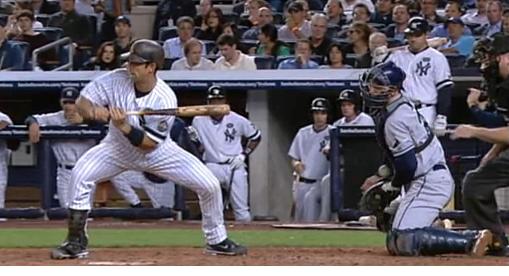
Of course, the sum of Posada’s histrionics involved taking off his shin guard and offering a slight grimace, not hopping around and wincing to the point that medical intervention was necessary. (Watch it here.)
It was an 0-2 pitch from Tampa Bay’s James Shields that skipped on the ground in front of Posada’s feet. He hopped back, never indicating that the pitch did anything but hit him. The relative lack of outcry compared to the recent Derek Jeter incident could have also had to do with the fact that there were already two outs, Posada never scored, and the Yankees won handily anyway, 8-3.
Still, it’s a reminder to all those who bandied about the phrase “Derek Cheater” this week that this is something heady ballplayers do.
 Posts to this site have been fewer in frequency lately. This is partly due to the limited number of games offering fewer chances for the unwritten rules to crop up.




 The Baseball Codes