Showboating

Hush Little Baby, Don’t Say a Word: Junior Lake Goes Librarian on the Marlins

Lake shhhhh

People put differing amounts of credence into baseball’s unwritten rules, with a vocal faction consistently decrying their very existence. It takes an act of unusual persuasion to convince people on both sides of that aisle that somebody has crossed the line. Ladies and gentlemen: Junior Lake.

Lake’s actions after homering Wednesday against Florida not only had the Marlins outraged, but his own team, too. If we don’t hear more about this, it’s only because Cubs manager Joe Maddon made it known that he would handle the situation personally.

The preamble: Starlin Castro homered against Florida on Monday, then watched it, then delivered the season’s third-slowest trot. (Watch it here.) Last night, Dan Haren hit him in what can only be assumed to be response.

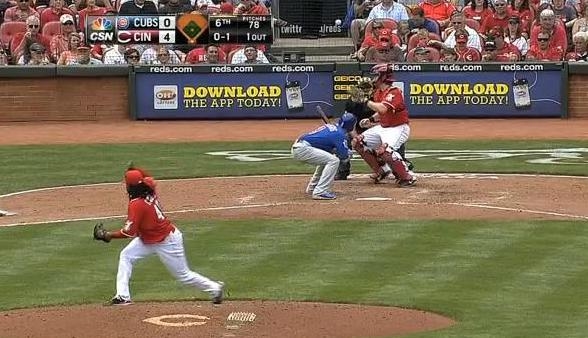
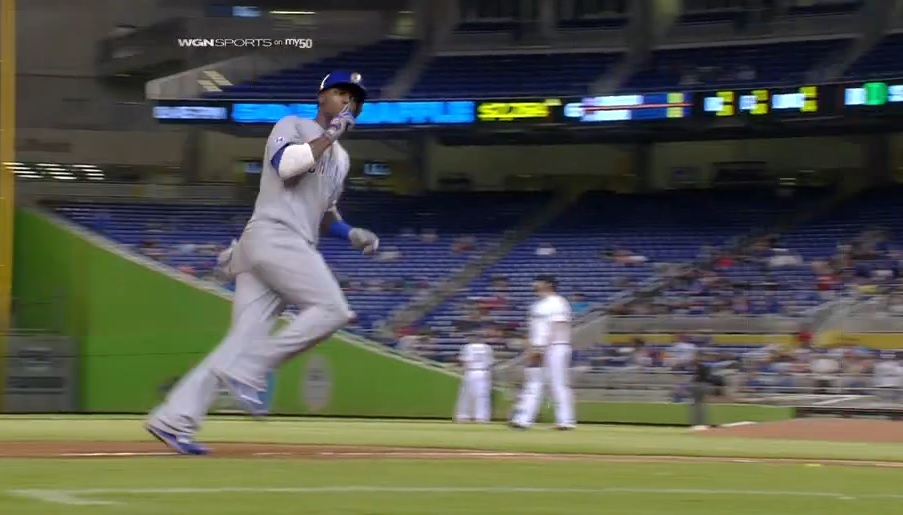
The main event: Lake homered off of Haren in the sixth inning last night. There’s little doubt that he had Castro on his mind when he watched the ball for five full steps toward first, then nonchalantly flipped his bat behind him as he began to jog. There were several things wrong with this scenario, beyond even the pimping and the flip.

  • It was Lake’s first homer of the season, and pimping in the big leagues is a meritocracy, something that must be earned. David Ortiz could maybe get away with it. Junior Lake can not.
  • It wasn’t like the homer won the game. Or even brought the Cubs close. Chicago was losing 6-0 when he hit it.
  • In response to the grief he was getting from the Marlins bench as he circled the bases, Lake put his finger to his lips in a Shhhhh motion after rounding third, while looking directly into Florida’s dugout.
  • Yep, he actually did that. (Watch it all here.)

Marlins catcher J.T. Realmuto delivered some words when Lake crossed the plate. Lake fired back, and within moments benches emptied. The primary reason things did not get out of hand was Maddon, who assured Marlins pitching coach Chuck Hernandez that the matter would be taken care of internally.

“I just spoke to [Lake] and spoke to him during the game,” Maddon told reporters after the game, via an MLB.com report. “We don’t do that here and that will be the last time you see it. I did tell them at home plate during the scrum. I told Chuck Hernandez because that’s who I saw. I said, ‘It’s our fault and we’ll take care of it.’ ”

It was reminiscent of a scene from The Baseball Codes:

In a game in 1996, the Giants trailed Los Angeles 11–2 in the ninth inning, and decided to station first baseman Mark Carreon at his normal depth, ignoring the runner at first, Roger Cedeno. When Cedeno, just twenty-one years old and in his first April as a big-leaguer, saw that nobody was bothering to hold him on, he headed for second—by any interpretation a horrible decision.

As the runner, safe, dusted himself off, Giants third baseman Matt Williams lit into him verbally, as did second baseman Steve Scarsone, left fielder Mel Hall, and manager Dusty Baker. Williams grew so heated that several teammates raced over to restrain him from going after the young Dodgers outfielder.

The least happy person on the field, however, wasn’t even a member of the Giants—it was Dodgers hitter Eric Karros, who stepped out of the batter’s box in disbelief when Cedeno took off. Karros would have disap­proved even as an impartial observer, but as the guy who now had a pissed-off pitcher to deal with, he found his thoughts alternating between anger toward Cedeno and preparing to evade the fastball he felt certain was headed his way. (“I was trying to figure if I was going to [duck] for­ward or go back,” said Karros after the game. “It was a 50–50 shot.”) …

In the end, it was Karros who saved Cedeno. When he stepped out of the box, as members of the Giants harangued the bewildered baserunner, Karros didn’t simply watch idly—he turned toward the San Francisco bench and informed them that Cedeno had run without a shred of insti­tutional authority, and that Karros himself would ensure that justice was administered once the game ended. Sure enough, as Cedeno sat at his locker after the game, it was obvious to observers that he had been crying. Though the young player refused to comment, it appeared that Karros had been true to his word. “Ignorance and youth really aren’t any excuse,” said Dodgers catcher Mike Piazza, “but we were able to cool things down.”

Maddon, who has proven that there are some unwritten rules about which he simply does not care, did not treat this one with such nonchalance. Nor did he limit his lesson to the confines of the clubhouse. “I don’t want us to take a page out of ‘Major League’ and flamboyantly flip a bat after a long home run,” he said after the game, ostensibly referring to Castro as well as to Lake. “I don’t want that at all. That has nothing to do with us ascending. I would even like to use this moment for our Minor League guys, that [flipping the bat] doesn’t play. For our kids watching, it doesn’t play. Don’t do that. That’s not cool. It’s very, very much not cool. If you’re watching the game back home in Chicago tonight, don’t do that.”

Then again, this wasn’t the first time he tried to impart this edict since taking over on the North Side. Perhaps it’s not taking.

The Marlins have little need for recourse. Maddon’s gauntlet toss against his own player handled it, as did Lake’s own comment afterward that “I recognize that it wasn’t right. It was part of the emotions and part of the game and I want to apologize to Haren for that, because I respect him and didn’t mean it.”

More interesting than Florida’s response will be the response of Chicago players to their manager’s new directive. Is a new quick-trot era in Chicago upon us?
Showboating

Maddon Preaches in Cubs Camp: Thou Shalt Not Pimp

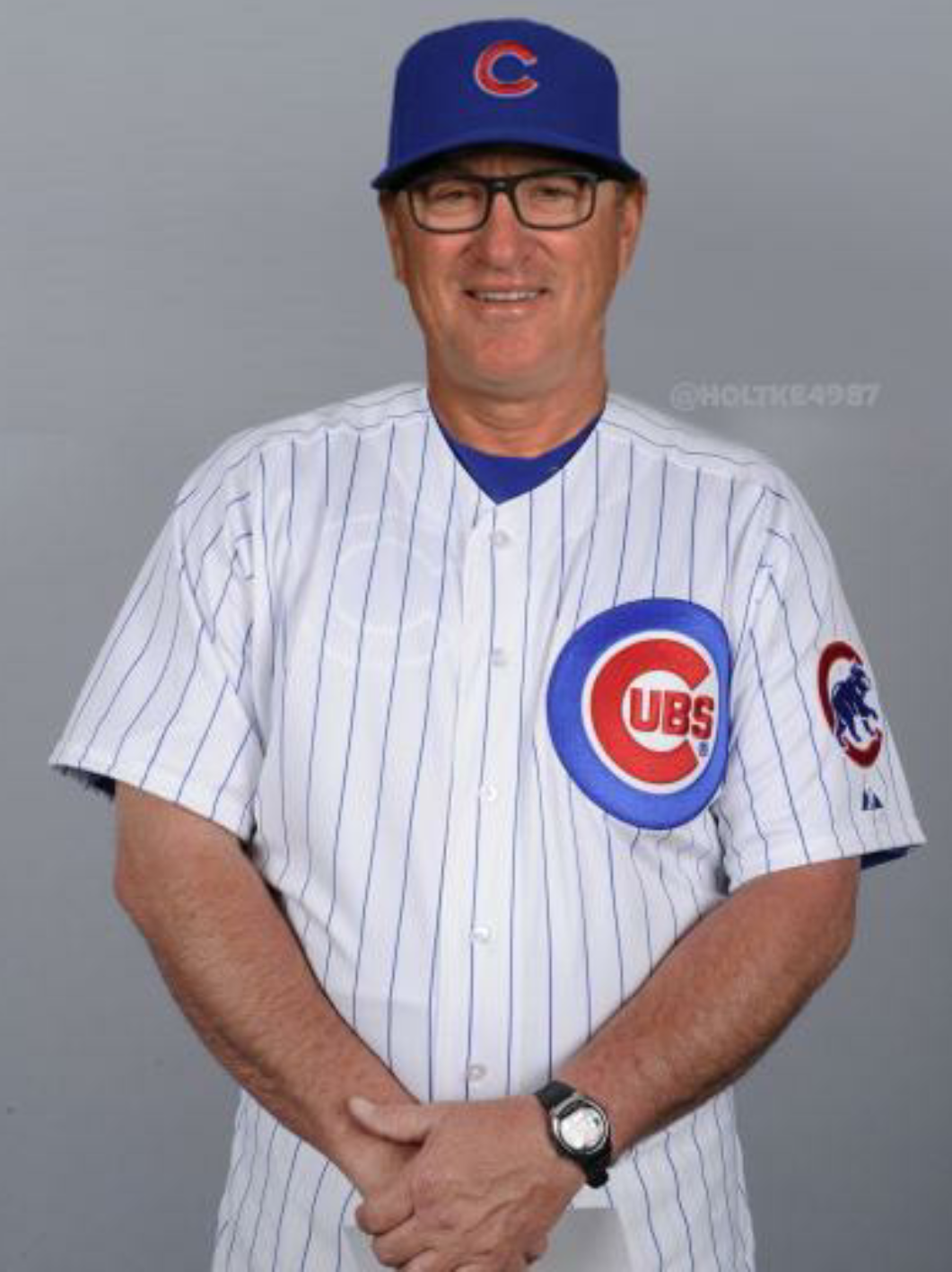
Joe MaddonWelcome to the North Side, Grandpa Maddon.

The new Cubs manager was quoted in the Chicago Sun Times expressing the antiquated notion that he’d, you know, prefer his players not take excessive pimping liberties following home runs. Doesn’t he know that such actions are now the status quo?

“Act like you’ve done it before and you can do it again,” the manager said. “The touchdown celebration, all that stuff, pounding your chest after dunking a basketball, all this stuff that’s become part of today’s generation of athletes – whether you agree with it being right or wrong doesn’t matter. I would just prefer that our guys would act like they’ve done it before and that they’re going to do it again.”

At question was third-string catcher Welington Castillo, who not only admired his homer from the batter’s box on Tuesday, but upon returning to the dugout sought out coach Manny Ramirez, saying, according to Javy Baez, “”Where’s Manny? I pimped that one.”

Joe Maddon: Not pleased.

Just because the game has embraced a look-at-me ethos to a greater degree at any time in its history, it does not mean that there is no room for those pushing back against it. Hell, it’s better cause than ever for the traditionalists to speak up.

Maddon might be the perfect guy for the job. Being soft-spoken, widely respected and wildly successful is great, but even better is that the guy has a track record of having fun with his team. This isn’t Connie Mack we’re talking about. So when Maddon intones that these types of celebrations are beneath his sensibilities, it carries some weight.

Over recent seasons with the Rays, of course, Maddon let guys like Yunel Escobar (be it celebratory gestures or ill-timed base thefts) and Fernando Rodney do their thing. But as Craig Calcaterra correctly points out over at Hardball Talk, those guys were veterans, on veteran teams. Now Maddon has a batch of youngsters, and the lessons he imparts can go a long way.

So accept the fact that baseball has changed, and that not only are the overly showy inmates running the asylum, but that the asylum isn’t all that much worse for it. As you do so, however, appreciate the likes of Joe Maddon all the more, because the guys who let their success speak for them—no matter how diminished their numbers—seem to end up speaking the loudest.

Bench Jockeying

Big Talkers Not Welcome: Fastballs in Cincy Lead to Words, and Players are Sensitive Creatures

Cubs-RedsIf you throw as hard as Aroldis Chapman, you must expect that your opponents will, on occasion, get squirrely. Should a ball get away from you and fly toward somebody’s head, this matter becomes especially prevalent. Should it happen twice in an inning—watch out.

Thursday, it happened twice to a single batter, Nate Schierholtz of the Cubs, and Chicago was not pleased. The pitches were obviously unintentional: The game was tied in the ninth inning, which is when closers pitch, which is why we so infrequently see closers carrying out any form of retaliation. The Cubs let Chapman know about it anyway, from the dugout at top volume. Things could have ended there, but for Chapman’s subsequent dismissal of the entire Chicago dugout—delivered with an insouciant wave of his glove toward their bench as he was leaving the field after recording the inning’s final out.

When Cubs first baseman Anthony Rizzo took the field in the bottom half of the inning, it was time for the Reds dugout to weigh in. Rizzo had already been hit by a first-inning pitch from Homer Bailey, and was one of the primary Cubs to heap verbal abuse on Chapman. Somebody wearing Red said something with which he disagreed, and, throwing down cap and glove, he headed for the Cincy bench. Only a fool would have started a fight at that point, facing a line of guys in the other team’s uniform, and Rizzo is no fool. He did some shouting, however, and the Reds shouted back and the dugouts emptied. (Watch it here.)

It’s easy to ask what could have been done to avoid all this. It’s yet unknown what Cincinnati players yelled at Rizzo, but a ballplayer has little business approaching the opposing bench like that. It’s unknown what Cubs players yelled at Chapman, but he has to be aware enough to realize that multiple top-speed, head-high pitches at the same batter are going to elicit a response.

There’s something else at play here, as well: the disappearance of the quality bench jockey from the modern game. Once, players freely ragged each other from across the field in a back-and-forth patter designed to build unity on one side of the field and to get into players’ heads on the other. There were terrible aspects to the practice, such as what Jackie Robinson had to deal with on a fairly continual basis during the early part of his career, but there was also good to come from it. The patter between ballplayers took on a language of its own, and even as one side figured out just what to say to somebody in a given situation, players learned how to absorb the abuse without letting it get to them. The best bench jockeys performed verbal kung fu, turning the abusers’ words back on them with additional heft.

Stories of bench jockeys are ages old:

  • Schoolboy Rowe, a newly married pitcher for the Tigers, made the mistake during the 1934 World Series of concluding a radio interview with a question for his wife: “How’m I doing, Edna?” The St. Louis Cardinals made sure that the phrase was heard continuously and at top volume through all seven games.
  • During his early playing days, Leo Durocher went through a rough patch during which he was accused of stealing the pocket watch of his teammate, Babe Ruth. When Durocher took over as manager of the Dodgers years later, players from the Giants began waving Walker Cooper’s watch at him, saying, “Leo, look at the watch. Look at Ruth’s watch.”
  • The Washington Senators bench once rode Mickey Mantle so hard that he was distracted into thinking the fielder’s choice at second on a ball he hit was the inning’s third out, and didn’t even run to first to try to beat the double play.
  • After the publication of Ball Four, Jim Bouton took an abundance of abuse from around the league, from players shocked that one of their own would begin spilling secrets. The Reds, Johnny Bench and Pete Rose in particular, were particularly vocal, saying things like, “Shakespeare, you no-good rat-fink. Put that in your fucking book,” wrote Bouton in his follow-up, I’m Glad You Didn’t Take it Personally. The pitcher’s favorite line came when the count got to ball three: “What’s the tile of your book?” Later, Bouton wrote, he sat near Johnny Bench at a banquet and catcher told him, “I read where you said Pete Rose and I got on you from the dugout worse than anybody. Well, I want you to know we really weren’t that upset about the book. Pete and I got on everybody. So don’t worry about it.”
  • One of the most famous moments in baseball history, Babe Ruth’s called shot against the Cubs in the 1932 World Series, was a result of bench jockeying. According to Cubs second baseman Billy Herman, Ruth wasn’t pointing to center field but responding, after two quick strikes, to the verbally abusive Cubs bench that he wasn’t yet finished hitting. His motion, said Herman, was to quiet Chicago pitcher Charlie Root, not to indicate where he intended to hit the ball.

Perhaps the best summation of the process came in a tale about none other than Leo Durocher, told in Sport Magazine in April 1947:

Once last summer (Durocher) was abusing Murry Dickson, Cardinal pitcher, from the coaching box so violently that umpire Lee Ballanfant begged him to lay off.

“Please, Leo,” pleaded Ballantfant, “he’s a nice kid …”

“I don’t doubt it,” interrupted Durocher, “and after the game, I’ll be willing to buy Dickson a steak diner with champagne trimmings and take him to a show. But right now I want to beat him any way I can, see?”

Bench jockeying more or less died out in the 1980s, the victim of an evolving game. “I don’t know if it was just the teams not being teams for a long period of time together, a lot of player movement, playing with a bunch of different people, not having that team chemistry like that,” said Chris Speier, whose 19-year career ended in 1989, and who put up with a lot of it early in his playing days. “I don’t know when it stopped, but it definitely has stopped.”

Baseball diamonds are a more genteel place now, in many ways for the better. Still, when something comes up like what came up in Cincinnati yesterday, the downside of the disappearing bench jockey becomes clear. Modern players simply have comparatively little idea about how to deal with this kind of adversity.

Take the story of another Reds player, pitcher Mario Soto, who in 1982, rattled by heckling from Phillies third base coach Dave Bristol, walked six and gave up seven runs over 3.2 innings. He was so mad that after the game he called Philadelphia’s clubhouse and challenged Bristol to a fight. His manager, Russ Nixon, offered a different perspective. “That’s just something Mario is going to have to learn to deal with,” he said.

It was just as simple as that.


Fights, Johnny Cueto, Retaliation

Hot-Headed Ways For Hot-Headed Men to Behave Like Hotheads

Cueto-DeJesusJohnny Cueto believes in responding should an opposing player disrespect him.

The guy also possesses the unfortunate combination of thin skin and anger-management issues. The same man who kicked Jason LaRue into retirement with a ridiculous display during a fight in 2010 was at it again on Sunday. Apparently irked in the first inning by David DeJesus’ decision to step out of the batter’s box during an at-bat, Cueto responded by flinging a fastball over the outfielder’s head—like, three feet over his head—when he came to the plate five frames later. (Watch it here.)

Plate ump Bob Davidson quickly warned both benches, curtailing retaliatory activity for the rest of the game, but the discussion was just getting started. And most of it centered on baseball’s unwritten rules.

Start with Cubs pitcher Matt Garza, who lasted just four innings. His postgame diatribe to reporters was long and pointed. Excerpts, from a CSNChicago report:

  • “I think that’s kind of immature on his part and totally uncalled for. He’s lucky that retaliation isn’t in our vocabulary here.”
  • “That’s kind of BS on his part. Just totally immature. If he has something to say about it, he knows where to find my locker and definitely I’ll find his.”
  • “If Cueto has any problem, he can throw at me and I’ll definitely return the favor. I didn’t like that one bit.”
  • “I hope he hears this, because I really don’t care. If we want to retaliate, we could have and lost a bullpen guy, but we don’t need that. We play the game the right way.”
  • “He needs to cut it out, because I’ll stop it.”

This from a guy who claims to have no personal history with Cueto. The message was, essentially, play the game the right way, or we’ll take care of it—the right way, via the Code. Problem was, Garza’s use of the media to address Cueto was itself against the Code, and served to puzzle one of the unwritten rules’ greatest practitioners, Cueto’s manager on the Reds, Dusty Baker.

Cueto hasn’t spoken to reporters since the incident, but Baker quickly picked up the slack. Rather than limit the scope of his conversation to on-field retaliation (perhaps spurred by Garza’s “find my locker” comment), he took things straight to the back alley.

“Take care of it then,” he said in an MLB.com report. “I mean, [Cueto] couldn’t hit Wilt Chamberlain with that pitch. … You got something to say, you go over there and tell him. Johnny ain’t running. Know what I mean? A guy can say what he wants to say, but it’s better if you go over and say it to his face.”

The most interesting part of the situation was when Baker recalled how, during his own playing days, situations were resolved a bit more directly.

“I just wish, just put them in a room, let them box and let it be over with, know what I mean?” he said. “I always said this. Let it be like hockey. Let them fight, somebody hits the ground and then it’ll be over with. I’m serious about that. I come from a different school. Guys didn’t talk as much. You just did it.”

He wasn’t just talking, either. As a player, was at the center of just such a situation. During a game against Pittsburgh in 1981, his Dodgers teammate, Reggie Smith, grew increasingly riled over the inside pitching of rookie Pascual Perez (despite the fact that Smith wasn’t even playing, due to a shoulder injury). When Perez hit Bill Russell with a pitch in the sixth inning, then hit Baker four batters later, Smith really started barking.

Pirates third baseman Bill Madlock motioned to Smith as if to say that he’d have to get through him to reach the pitcher, but Perez was not looking for protection. After striking out Steve Garvey to end the inning, Perez pointed first at Smith, then toward the grandstand. The two quickly retreated to the tunnels of Three Rivers Stadium to settle things, followed closely by teammates and managers.

As the 16,000 fans in attendance watched a vacant ballfield, puzzled, and umpires raced in an effort to intervene, a baseball fight broke out. Which is to say that, for all the dramatic build-up, tempers quickly cooled and peacemakers in the crowd broke it up before a punch, apparently, could be thrown.

The ultimate point, however, said Pirates manager Chuck Tanner, was that there was no carry-over. “It was taken care of,” he said.

If that incident somehow did not meet Baker’s criteria of guys not talking as much, another of his teams was involved in an off-field fight—this one in which fighting actually occurred, with punches and everything. Except instead of involving opposing teams, it featured only participants from his own roster. It was 1973, and Baker played for the Atlanta Braves, under manager Eddie Matthews. From The Baseball Codes:

The way Davey Johnson, then a star second baseman for the Braves, tells it, after an initial verbal disagreement with Matthews, the manager invited him into his room and challenged him to a fight. Johnson, reluctant at first, changed his mind when Matthews wound up for a roundhouse punch, then knocked the older man down. Matthews charged back, and as the sounds of the scrape flooded the hallway, players converged on the scene. In the process of breaking things up, several peacemakers were soon bearing welts of their own.

“The next day at the ballpark we looked like we had just returned from the Revolutionary War,” wrote Tom House (a member of the team, who, true to the code of silence, left all names out of his published account). “Every­body had at least one black eye, puffed-up lips, scraped elbows, and sore hands. It had been a real knockdown battle.”

This was something that couldn’t be hidden from the press. Matthews called the team together, and as a unit they came up with a story about a game that got carried away, in which guys took good-natured beatings. Flimsy? Maybe. Accepted? Absolutely.

“You can ask Hank Aaron and others on that team,” Johnson said, laughing. “Eddie said his biggest regret [in his baseball career] was not having it out with me again. That one never got out. It never made the papers.”

The Cueto-Garza-DeJesus situation will probably never come close to that. But that’s kind of the point. The call-and-response nature of baseball’s unwritten rules—taking care of things on the field, as it were—exists to prevent this sort of thing. And, save for the occasional below-decks brawl every few decades or so, it works pretty well in that regard.

Don't Play Aggressively with a Big Lead, Jayson Werth, Swinging 3-0

Some Leads are Insurmountable; Others are Insurmountable Only for the Cubs

Opinions about when it is and isn’t appropriate to play aggressively—stealing bases, say, or swinging 3-0—vary widely. When you’re the Chicago Cubs and are in the midst of getting pummeled, repeatedly, by the best team in the National League, it only makes sense that sensitivities might be a bit raw.

The game in question was the capper following three straight Nationals victories over Chicago, by a cumulative score of 22-7—“one of the biggest butt-whippings” Cubs manager Dale Sveum said he’d ever received. Ultimately, it served mainly to add misery to a season which at that point had the Cubs on pace to lose 102 games.

In the series’ fourth game, on Thursday, it took only four innings for Washington to build another substantial lead, 7-2, so when Jayson Werth swung at a 3-0 pitch with the bases loaded and two outs in the fifth, it was enough to officially drive Cubs bench coach Jamie Quirk into an extreme state of annoyance.

From the dugout, he started “screaming out obscenities” toward Washington third-base coach Bo Porter, according to umpire Jerry Layne in the Chicago Tribune, a situation the umpire felt “was inappropriate” and “caused everything.”

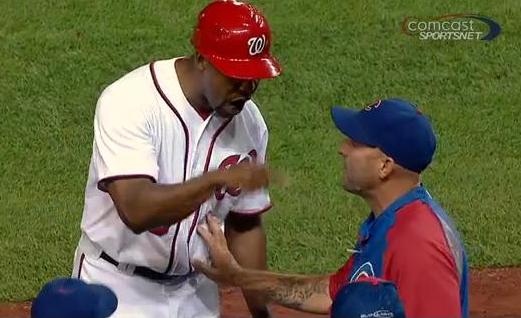
“Everything” began with Porter approaching the Chicago bench and screaming right back at Quirk. That escalated to both dugouts emptying onto the field. (Watch it here.)

“You’re up 7-2,” said Cubs catcher Steve Clevenger. “You don’t swing 3-0.”

There’s truth to the statement, but its timing is straight out of the 1960s. The last time the fifth inning was utilized as a yardstick for when to stifle an attack, it was a pitcher’s league. They were the days of Sandy Koufax and Bob Gibson, long before offenses exploded in a spate of expanded rosters and juiced balls and tiny ballparks and BALCO-fueled hitters. Today, the fifth inning sounds downright quaint.

Then again, this is the Cubs. The line for when to call off the dogs is malleable, depending on a team’s bench and bullpen, the freshness of its starting pitcher, the state of its offense. With the Cubs, for whom a two-run deficit might seem like an unbridgeable chasm, perhaps five runs, and only four innings to score them, is a  lot.

We’ve already established that their emotions are raw, which explains why reliever Lendy Castillo threw at Bryce Harper to lead off the the sixth. That set Harper off on his own shouting jag, and the dugouts emptied again. (Watch it here.)

Harper nailed it in his postgame comments, saying in the Tribune, “I’d be pretty ticked off if I was getting my teeth kicked in all week, too.”

Nationals manager Davey Johnson proved to be tone deaf earlier this season when it came to a different facet of the game’s propriety, but on this particular issue he was pretty much spot-on.

“We’re in a pennant race, we’re going to swing 3-0, we’re going to do everything,” he said in the Washington Post. “We ain’t stopping trying to score runs. Certainly a five-run lead at that time is nothing. I think it was the bench coach’s frustration in us handing it to them for a couple days. If they want to quit competing and forfeit, then fine. But we’re going to keep competing. I don’t know why they’re getting on about swinging 3-0. Their first baseman [Anthony Rizzo] swung 3-0 in the first inning. What’s the difference with the bases loaded in the fifth with only a five-run lead and two outs?”

At this point in the game’s history, not much. “Only” a five-run lead is exactly that, even against the Cubs. One would hope that next time they display a bit more pride.

The Baseball Codes

Weirdness at Wrigley: DeJesus hit by Pitch from Own Teammate

Pissing off an opponent badly enough to get drilled is one thing. When it’s your own team throwing baseballs at you, though, watch out.

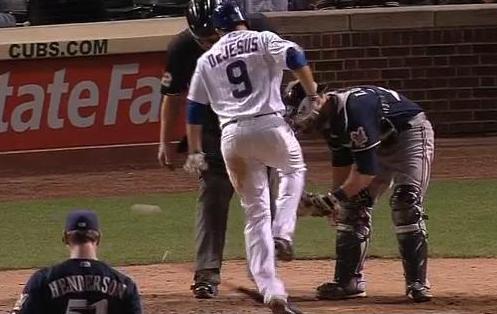
So says David DeJesus, who, barely a moment after watching ball four from Brewers pitcher Jim Henderson on Monday night, was plunked by a ball that got loose from the Cubs bullpen.

At this point, further details are extraneous. Just watch the video.

(Via Yahoo.)

Brandon Phillips, Deke Appropriately, Starlin Castro

Deke Softly and Carry a Big Stick: Castro Falls for Misdirection, Gets Himself Gunned

Contrary to Brandon Phillips’ actions, no ball was headed his way.

Starlin Castro has for the duration of his career been criticized for an ongoing failure to pay requisite attention during the course of a baseball game. From forgetting the number of outs in an inning (which kept him from attempting to turn what would have been an inning-ending double-play against the Giants), to failing to slide into second on a stolen-base attempt, to facing the wrong way as his pitcher was delivering the baseball, the guy’s career has been a laundry list of mental lapses that temper an exceptional skill set.

The latest came on Friday—though to be fair, this time the All-Star had some help in botching things up.

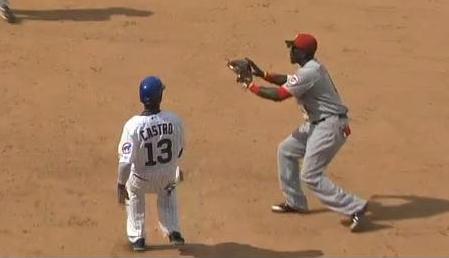
That assistance came courtesy of Reds second baseman Brandon Phillips. Castro, at first base, took off on a stolen-base attempt—itself a questionable move, what with the Cubs down five runs—as Josh Vitters singled to right. Phillips acted as if he were about to receive a throw from the shortstop for a play at second; despite Castro having the entire left side of the field in his direct line of sight, he somehow fell for it. (Watch here, at the 1:16 mark.)

Castro was deked into a full stop, and by the time he figured out what was happening and tried to motor to third, it was far too late. Xavier Paul threw the ball in to Phillips, who relayed it to third baseman Wilson Valdez, who tagged Castro for an easy out.

After the game, Alfonso Soriano said in an ESPN Chicago report that Castro “needs to concentrate more on the game.” This is undoubtedly true, but it also helps to understand the basics of Phillips’ misdirection.

“You know not to trust middle infielders—it’s their job to deke,” said longtime middle infielder Bip Roberts.

If Castro (a middle infielder himself) lost track of the ball between the plate and the spot in right field where it eventually landed, he always had third base coach Pat Listach (a former middle infielder) to clue him in. Then again, if a guy can’t be reliably counted on to face the game when fielding his position, it’s probably too much to ask that he pay attention to coaches when running the bases.

“A ball is hit, and I’m supposed to know where that ball falls at all times,” said Rangers manager Ron Washington. “If I run blind and get deked out, whose fault is that? Is that the infielder who deked me out, or is that my fault for not knowing what’s going on?”

Lonnie Smith, of course, was deked by Twins second baseman Chuck Knoblauch in the seventh game of the 1991 World Series—a play that likely cost Atlanta a vital run in a game they ended up losing, 1-0, in 10 innings. Smith, however, was 35 years old, a 14-year veteran and on the game’s biggest stage. Castro is only 22, and, one would hope, is still at the early end of his learning curve.

Still, said Cubs manager Dale Sveum after the game, according to MLB.com, “If you’re going to steal a base five runs down, you better [darn] well know where the ball’s hit.”

Don't Steal with a Big Lead, Retaliation

Lack of Respect in the Windy City? De Aza Pays for Rios’ Mistake

Alejandro De Aza contemplates just having been hit with a pitch.

There is a persistent debate about the point at which a team should stop playing aggressively—the lead size that constitutes a blowout, and when it begins to matter.

According the Cubs, those numbers are six runs and the seventh inning, respectively—at least if Alajandro De Aza is to be believed.

De Aza, the White Sox center fielder, was drilled by the first pitch from Cubs reliever Manny Corpas leading off the eighth inning on Wednesday. It wasn’t that he and Corpas had any beef—to the contrary, said De Aza in a CBS Chicago report, “we’re cool, we’re friends, I’ve known him for a long time.”

The inspiration for the pitch—which De Aza felt was intentional (it certainly looked that way; watch it here)—was likely White Sox right fielder Alex Rios’ decision, after he led off the seventh inning with a single, to take off for second while his club led, 6-0.

Rios never made it, getting forced out on A.J. Pierzynski’s grounder, but the action was unmistakable—as was the response. De Aza said he thought Corpas was told simply “to hit the first guy.” (Watch some of his comments here.)

After the game, Cubs manager Dale Sveum played coy. “I don’t know,” he said in an MLB.com report. “He hit him. It happens sometimes.”

Especially when somebody is paying scant attention to the score. Rios has stolen 171 bases across his nine-year career, so he should have a pretty good idea of what’s appropriate in that regard. It’s also possible that the order came from the bench, probably as a hedge against the double-play more than as a straight steal. If that’s the case, it’s less likely that Robin Ventura simply lost track of the score than that he was insufficiently comfortable with a six-run lead at that point in the game. (Why he would feel that way when facing a Cubs offense that ranks in the bottom five of the National League in hits, runs, doubles, homers, OBP, OPS and slugging is another question.)

Either way, it was the final meeting of the season for the Chicago clubs, so we won’t see a response any time soon. And if De Aza and Corpas meet up during the off-season—you know, like friends do—they’ll hopefully come to the conclusion that the incident was strictly the business of the unwritten rules.

Retaliation

Who to Target, and Why: Showdown at Wrigley Serves as Interleague Primer

For a vast majority of baseball’s history, much was made of the difference between the National and American leagues. AL: Based on the three-run homer. NL: Prefers to sacrifice. Recently, however, decades after the adoption of the designated hitter amplified these stereotypes, uniformity slowly began to settle across baseball.

The positions of league president were discontinued after the 1999 season. League-specific umpiring crews were consolidated into a single unit, and interleague schedules devised. When Mike Scioscia led the Angels to a championship in 2002, much was made of his bringing a National League style of play to the Junior Circuit. Today, such a distinction is barely noticed.

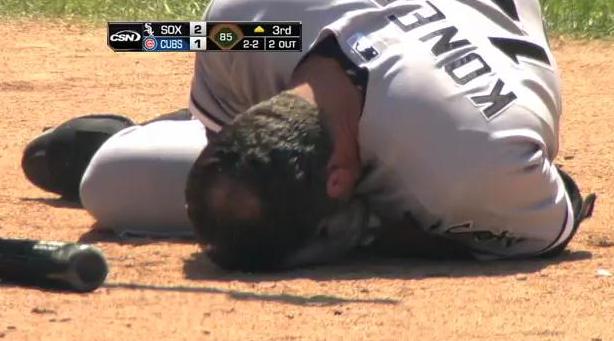
Usually. Wrigley Field and U.S. Cellular Field are located on opposite sides of Chicago, about 10 miles apart, but they may as well be on different coasts. At Wrigley on Friday, the clearest difference between the leagues was on full display, after a Jeff Samardzija fastball ricocheted off of Paul Konerko’s face, near his left eye, in the third inning. (Watch it here.)

Even though it came under suspicious circumstances—Konerko had homered in his previous at-bat—the pitch was a split-finger fastball that didn’t break, Samardzija claimed repeatedly that it was unintentional, and the White Sox believed him.

Nonetheless, there were reparations to be collected. Sox pitcher Jake Peavy put it succinctly in the Chicago Sun Times:

When our man gets hit, gets hit in the face, there’s something to be said about that. I know this is a sensitive subject with baseball, and I’m not trying to be disrespectful, but if your big guy is going down, intentional or unintentional, there’s got to be something done about it.

Something was done, and it perfectly illustrated the difference in mindset between the leagues. Samardzija expected to be targeted for retaliation, but drilling the opposing pitcher was not what Sox starter Philip Humber had in mind.

The reason is obvious. Because pitchers don’t hit in the AL, retaliatory strikes must be directed at the opposing club’s big hitters. Sure enough, the first pitch of the fourth inning sailed behind the Cubs’ biggest threat, Bryan LaHair. It was clearly intentional, and plate ump Tim Timmons quickly issued warnings to both benches. (Watch it here.)

Even if Humber intentionally missed LaHair, his choice of target was peculiar, because Samardzija had been the next Cubs batter in the bottom of the inning after Konerko went down. Not only wasn’t he targeted, but he reached base on an error by shortstop Alexei Ramirez.

Perhaps Humber failed to consider retaliation in that moment, and was reminded between frames that it might be a good idea. Or maybe he had his sights set on a bigger bat, but with a runner, Samardzija, on first and nobody out, he opted against putting anyone else on base, waiting a frame to go after LaHair.

Phil Rogers of the Chicago Tribune talked to Robin Ventura about the situation:

I asked the White Sox manager if there was a purpose to the 91-mph fastball that sailed behind LaHair’s head on its way to the Wrigley Field screen.

“No,” said Ventura, who then turned his brown eyes on me for what seemed a long time, not blinking.

I asked him if the pitch was one that just got away from Humber.

“Yeah,” he said.

Rogers also reported that Ventura said the White Sox would have hit Samardzija directly if they thought his pitch to Konerko had been intentional.

Either way, Peavy and A.J. Pierzynski were caught on camera after the fourth inning having an animated discussion in the dugout—possibly over retaliatory protocol. Peavy, of course, spent the bulk of his career in the National League; Pierzynski has spent 14 of his 15 big league seasons in the AL, and Humber has been an AL guy almost exclusively .

Did the discussion highlight differences of opinion and experience? Nobody’s talking of course, but the fact remained that at least one guy was expecting something a bit more severe.

“I was ready for it,’’ said Samardzija in the Sun Times. “No worries. Sometimes you deserve it.’’

Retaliation

North Side Slap Fight: Braves, Cubs Trade Drillings at Wrigley

David DeJesus takes some punishment.

All the people yelling about how Bryce Harper didn’t do anything to deserve his drilling from Cole Hamels on Sunday can rest a bit easier. Somebody in baseball finally merited retaliation, and retaliation was delivered.

We think.

Speculation begins in the second inning of Monday’s game between Atlanta and the Cubs, when Jason Heyward homered off Jeff Samardzija. Fast forward to the seventh, when, with one out and nobody on, Samardzija hit Heyward with a pitch. The Cubs trailed 2-1 at that point, so it makes sense that it was unintentional. Still, Heyward’s earlier homer raised some doubts, as did the fact that Cubs outfielder Reed Johnson had been hit up near the neck in the third inning by Braves starter Tommy Hanson.

“[Heyward] came out and hit a home run on a ball that was down and away,” Samardzija said in the Chicago Tribune. “[In the seventh] I just thought he was diving over the plate, and I wanted to throw one in there and go back away, but it just got in there too tight.”

No matter; in the bottom of the frame, Braves reliever Eric O’Flaherty drilled David DeJesus in the right tricep. (Watch it all here.)

Ump Chris Conroy quickly warned both benches, then tossed Fredi Gonzalez, after the Atlanta manager came out to discuss the matter.

“I just asked him for an explanation,” said Gonzalez in the Atlanta Journal-Constitution. “I asked him why would you think we’re throwing at people in a one-run game or they’re throwing at people in a one-run game, you know? It’s not like it’s a 10-run game or anything like that. It’s still a helluva game going on, and I’m talking to him like I’m talking to you, and I got thrown out of the game.”

As reasonable as Gonzalez’s explanation may be, Conroy did the right thing. Samardzija’s plunking of the seventh-place hitter in the Atlanta lineup didn’t exactly scream for vengeance, but if vengeance is the stance the Braves wanted to adopt in response, that’s their prerogative. It was indeed a one-run game, but if O’Flaherty did it on purpose, he picked just the right time—with two outs and nobody on base—and he hit DeJesus in nearly the same place as Heyward was drilled.

Ultimately, because none of the pitchers are talking (learn a lesson, Cole Hamels), it will likely end here. One shot, one response, situation over. (Sure enough, the only contentious issue in yesterday’s 3-1 Atlanta victory was between Kerry Wood and his own performance.)

Series finale today, just to make sure.