A.J. Ellis, Catchers Protect Pitchers

Greinke Takes the Blame for Catcher’s Lack of Action

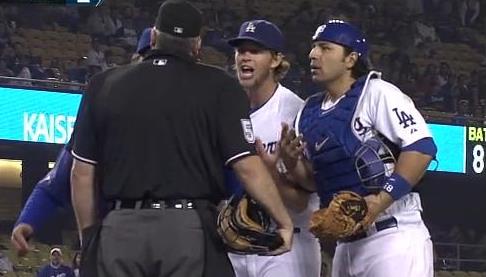
AJ EllisIn the aftermath of Zack Greinke’s shoulder injury at the hands of Carlos Quentin, some criticism arose of Dodgers catcher A.J. Ellis for not moving more quickly to step between the two—an essential part of a catcher’s job when it comes to such matters. Ellis was unprepared for Quentin’s sudden rush toward the pitcher—and by the time he caught up, it was too late.

Yesterday, Greinke absolved him of responsibility.

“Anyone with the White Sox has always labeled me as someone who does stuff,” Greinke said in a Los Angeles Times story, recounting his encounters with Quentin when he was a member of the Kansas City Royals and Quentin with the Chicago White Sox. “I didn’t think it would happen. Looking back, I should have warned him.”

Greinke also said that the eight-game suspension levied upon Quentin by Major League Baseball seemed appropriate. “To expect the league to do more than that would be pretty crazy,” he said.

(In related news, Padres President and CEO Tom Garfinkel blamed the incident on Greinke and compared the pitcher, who has dealt with social anxiety disorder, to Rainman. There’s an entire chapter of the unwritten rules dealing with restraint from calling out one’s opponent in the press—or even at a meeting of season ticket-holders, which is where Garfinkel made his remarks—although it usually pertains to players, not senior management.)

Don Mattingly, Retaliation

Waiting Game Begins for Dodgers, Padres

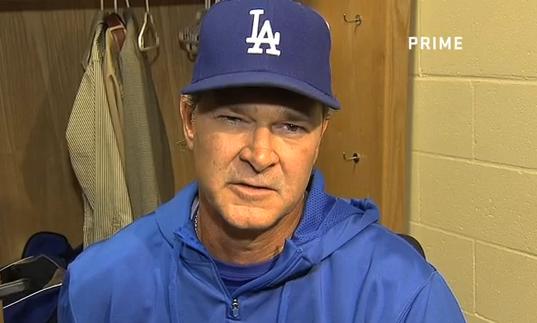
Don Mattingly IICredit Don Mattingly for his honesty.

Talking about the Dodgers’ series against San Diego, which starts today, the skipper said that his team will not be looking for retaliation regarding Zack Greinke’s broken collarbone. Then again, Padres outfielder Carlos Quentin will be elsewhere, having dropped his appeal of the eight-game suspension handed down for his role in the matter. One of Mattingly’s pitchers could make a perfunctory statement by drilling a random Padre (in Los Angeles, on Jackie Robinson day, no less), or they could wait until the teams meet later in the season and send a message directly to its intended target.

Which is precisely what Mattingly hinted might happen.

From the Los Angeles Times:

Asked if he expected the Dodgers to level the score down the road, Mattingly replied, “We’ll just play baseball. We’ll see how the games go. You’ll see.”

You’ll see?

“No, I mean, you can make decisions then,” Mattingly said. “I’m not going to sit here and talk hypotheticals like, ‘Yeah, we’re going to get him back.’ That’s not something you would talk about even if that was part of the deal. You never talk about that.

“We’re trying to win games and trying to win a pennant. Getting retaliation on something is different than protecting your guys.”

Besides, said catcher A.J. Ellis, “Our problem is with one guy, not with their team.”

The reality is that umpires will likely begin today’s series by warning both benches, preventing Dodgers starter Chad Billingsley from going after Padres hitters even if he wanted to, which he insisted he did not.

Billingsley, it should be pointed out, has been criticized in the past for failing to protect his teammates—specifically during the 2008 NLCS, after Philadelphia’s Brett Myers repeatedly came inside on Dodgers hitters.

He likely won’t have to worry about such a reputation following him regardless of what happens Monday. Once the guy the Dodgers want to see is in the lineup, the countdown will begin.

Carlos Quentin, Carlos Quentin, Fights, Retaliation, Zack Greinke

Know Thy Situation, Vol. 219: Quentin Charges Greinke for Reasons That Nobody Else can Quite Fathom, Yet

Quentin-Greinke IIIThe primary question after Carlos Quentin charged Zack Greinke yesterday was one of situational awareness: Was it incumbent upon Quentin to take action in response to a circumstance in which no right-thinking pitcher would intentionally drill an opponent?

Unless the primary question had to do with motivation: Was there something in the history between hitter and pitcher to inspire action in a situation which did not otherwise appear to call for it?

That is, unless the question we’re asking was one of provocation: Was it Greinke’s post-drilling stance—glove tossed, epithets hurled—that actually served as Quentin’s impetus?

In the end, because Greinke’s broken collarbone will extend the ramifications of this brawl for months, all these questions—and more—will continue to be asked for the forseeable future.

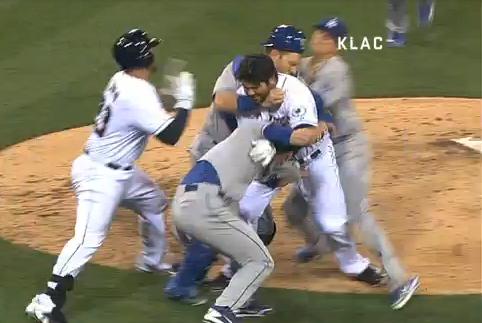
Pertinent details: Quentin, leading off the sixth inning of yesterday’s game in San Diego, was hit in the bicep with a Greinke pitch, dropped his bat, had a brief word with the pitcher, then charged. He threw Greinke to the ground; once the ensuing dogpile broke up, Greinke emerged with a broken collarbone. (Watch it here.)

More details: It was a full-count pitch, with the Dodgers holding a one-run lead, and, had Greinke not left the game, would have forced him to face San Diego’s four-five-six hitters from the stretch. Under no circumstances was this an appropriate situation for vendetta enforcement. (The closest thing to a response-worthy situation earlier in the game was the 0-2 pitch Padres starter Jason Marquis sent toward the head of Matt Kemp in the first inning, but it was easily avoided and tempers did not appear to flare.)

“We’re in a 2-1 game and on a 3-2 pitch to a guy that I see on the [score]board set a record for the Padres by getting hit, a guy who basically dives into the plate,” said irate Dodgers manager Don Mattingly after the game, in an MLB.com report. “In a 2-1 game, we’re trying to hit him, 3-2? It’s just stupid is what it is.”

Another pertinent detail pertains to what Greinke said between his pitch connecting and the batter charging. Quentin did not appear ready to head toward the mound until the pitcher responded to his bristling with what appears to be, based on the video, a solid “fuck you.” Regardless of Greinke’s innocence when it comes to the pitch itself, verbally provoking a guy who outweighs you by 45 lbs. is rarely somebody’s best option.

“It’s an unfortunate situation,” said Quentin. “Myself and Greinke have a history. It dates back a few years. You guys can look it up. It’s documented. It could have been avoided. You can ask Zack about that. For me, I’ve been hit by many pitches in my career. I think you guys know that. I can tell you I’ve never responded in that fashion, so you guys can do your homework on that.”

Because Quentin left the details vague, we can only assume that he’s talking about opening day in 2009, when Greinke, then with Kansas City, hit Quentin, then with the White Sox, in the back. Combined with a pitch earlier in the game that nearly hit Quentin in the head, it inspired the batter to step toward the mound, though not much came of it—until yesterday.

Greinke has hit Quentin three times, more than any other player, but Quentin is generally hit more than any other player—he led the National League in HBPs each of the last two seasons, with six top-5 finishes in his career. (From ESPN: Quentin has also been hit four times by Nick Blackburn, and three times each by Erik Bedard and Jon Lester. He’s also been hit twice by 18 guys. ) He didn’t quite lean into Greinke’s pitch, the topic should be well within his comfort zone.

“I’ve never hit him on purpose,” Greinke said. “I never thought of hitting him on purpose. He always seems to think that I’m hitting him on purpose, but, I mean, that’s not the case. I actually thought it was just a ploy to get people to not throw inside to him. I just feel like he’s trying to intimidate people to throw away. But I don’t know anyone who has hit him on purpose. I know I haven’t. Like I said, I hadn’t even thought about hitting him on purpose before.”

This isn’t the first time a pitcher has been injured in such a fashion. Red Sox pitcher Bill Lee was seriously injured after Yankees third baseman Graig Nettles dropped him on his shoulder during a brawl in 1976. (Lee didn’t even spark the fight—Lou Piniella did, by attempting to kick the ball out of Carlton Fisk’s glove in a play at the plate. Fisk responded by tagging the runner again, this time hard on the head, and things escalated from there.) Nettles picked up the pitcher on the outside of the scrum, but unlike Greinke’s injury it was Lee’s pitching shoulder that was injured; it took him years to recover fully. (Nettles was drilled by the Red Sox two days later, but because he was leading off the 10th inning of a scoreless game, it’d hard to think it was intentional.)

Tommy John suffered a similar injury while trying to fend off a charging Dick McAuliffe in 1968. John’s tweaked shoulder forced an alteration in his delivery that eventually led to an elbow blowout—which resulted in the pioneering surgery that still informally bears his name.

Details from Thursday’s fight—Quentin’s body slam, the Dodgers’ drawn-out anger, Kemp going after Quentin in the players’ parking lot after the game—are incidental.

What matters most to the Dodgers is the amount of time they’ll be without one of the game’s best pitchers, signed in the off-season to a six-year, $147 million contract. Mattingly suggested that Quentin be suspended for the duration of Greinke’s DL stay, but that almost certainly won’t happen. (A six-game suspension is likely, especially considering that Greinke’s injury could just as well have been triggered by the scrum of Padres on top of him in the aftermath as by Quentin’s initial throw-down).

The other question is how long this will linger, and to what extent. Quentin said that “for me, the situation is done,” but MLB is bound to have something to say on the matter.

So will the Dodgers. “There probably is [bad blood] now,” said Greinke. “I don’t know if there was before.” This despite the fact that numerous Padres players reportedly apologized to their Dodgers counterparts as the field cleared.

Also in the crosshair is San Diego’s backup catcher, John Baker, whose verbal delight following Greinke’s injury helped cause the skirmish to re-flare before all the players had even left the field.

San Diego visits the Dodgers on Monday for the first of what will be 15 more games between the teams this season.

Update (4-13): Quentin has drawn an eight-game suspension for his inability to read a game situation, or some such.

Don't Showboat, Hanley Ramirez

I See You, Too: Ramirez’s Antics Earn Notice

Thursday, the Dodgers should have known better when it came to dealing with umpires during their game against the Pirates. They didn’t, and it cost them.

In the fourth inning of that same game, Hanley Ramirez homered off of A.J. Burnett. Shortly after rounding second base, he made his by-now-patented “I See You” hand gesture—circles with the index finger and thumb of each hand, placed over his eyes like glasses—aimed at the Los Angeles dugout. (Watch it here.)

His sight line, of course, happened to pass close enough to the pitcher’s mound for one of two possibilities: Burnett misunderstood his intention and took the gesture personally, or the pitcher felt that an opposing player had no business participating in bush-league shenanigans while rounding the bases, intention be damned.

In either case, he’d have been correct.

“If you’re going to hit a homer, act like you’ve hit one before,” Burnett told reporters after the game. “The first batter, [James] Loney, hit one, was very professional about it. Ran hard the whole way.”

Ramirez concocted “I See You” as an update to the “Lo Viste” hand gesture he used in Florida, in which members of the Marlins hold a sideways V made with the index and middle fingers over their eyes (as seen here in a different environment.)

“When I got to the Dodgers, I did ‘Lo Viste’ for [former teammate Emilio] Bonifacio a couple times and it was cool,” Ramirez said in a Miami Herald report. “But then I spoke with [Dodgers shortstop]  Dee Gordon and he said, ‘Let’s do something different. You’re no longer in Miami.’ That’s when we tried to do something new and came up with this. It’s all for fun.”

At least until it ticks off a member of the opposition.

“That’s Hanley,” Ramirez’s former manager, Ozzie Guillen, said in an ESPN.com report. “[If] Hanley hit a home run down by 30 runs, he would pimp it. That’s the way he is . . . It surprised me A.J. didn’t drill him.”

Sure enough, Burnett faced Ramirez with two outs and the bases empty in the sixth, with the Pirates holding an 8-4 lead. There would not be a more opportune moment to make whatever statement he felt necessary, but he did not act.

Then again, Burnett also passed up a similar opportunity earlier this season, despite pointing toward the Reds dugout as a means of warning that just such a thing was imminent after Andrew McCutchen was drilled by Aroldis Chapman, and Josh Harrison was hit, then berated, by Mike Leake the next day.

Reaction, of course, is not the focal point of this subject. That would be “I See You,” which is cute and which keeps things loose and which builds morale on a team in a pennant race. All of this is beneficial. To break it out on the field, in game action, while facing an opposing pitcher, however, is nothing short of inane.

Ramirez left Florida in late July in dubious standing with many of his former teammates. Getting any of his new teammates drilled for an ill-considered on-field decision won’t do much to earn him new friends in Los Angeles.

Angel Campos, Matt Kemp, Umpire Relations

Know Your Umpires: Kemp Tossed Early, Dodgers Lose

Proper response to umpires is an essential component of survival as a baseball player. Some players go to lengths to learn names and details from umpires’ lives, then chat them up, as friends do, because it might buy some goodwill down the road.

Others have a more difficult time determining appropriate behavior.

That definition, of course, differs from ump to ump, and may even differ from day to day for the same guy, depending on his mood. Thursday in Pittsburgh, it appeared that plate umpire Angel Campos was a bit grumpy.

Things began in the second inning, with Matt Kemp—still upset over calls during his first-inning strikeout—chirping from the dugout toward the plate. As Andre Ethier stood in the batter’s box, Campos can be heard on the telecast saying toward the Dodgers dugout, “I don’t want to hear you again, I’m telling you that right now.” Somebody on the bench replies, “Just watch the game.”

“That’s all I’m telling you,” replies Campos.

“Just watch the game,” echoes the bench.

Talk from the dugout continued, though it can not be understood on the game audio, and a moment later Campos responded firmly, ejecting Kemp. (Watch it all here.)

According to Kemp, the phrase he used to break the Campos’ back: “Let’s go, Dre.” Manager Don Mattingly’s swift and outraged reaction to the ejection—he was tossed as well in short order—supports the statement.

“Matt got thrown out today for cheering for Andre,” Mattingly said after the game, as reported by MLB.com. “He was barking about the pitch to Dre, the second strike, but then Angel said, ‘That’s enough. I don’t want to hear another word.’ So the next thing that came out of [Matt’s mouth]—I heard it, clear as a bell—he said—because Matt knows where to stop—and Matt said, ‘Let’s go, Dre!’ And [Campos] looked over, and he threw him out of the game. It’s unacceptable.”

We’re left with the fact that an umpire has little reason to eject anyone over a statement of teammate support that can in no way be interpreted as an attack. We’re left with the fact that ejecting a team’s best player in the second inning of a game—especially a team in the heat of a pennant race—is an action that should only be utilized as a final resort, not a first one. We’re left with an outraged roster that, short its No. 3 hitter, ultimately fell to the Pirates, 10-6.

Something trumps all of that, however—a rule about which both Kemp and Mattingly should have been glaringly aware: Know Your Umps.

Campos clearly told them to zip it, and zip it they did not. Was it justified? Probably not. But to push things in such a manner when a directive has already been issued to refrain from said pushing isn’t the world’s greatest strategy. Kemp may feel like he backed down from a potential confrontation, but he clearly didn’t back down enough.

Umps don’t have to be just or reasonable or even correct. They’re hopefully held accountable for their actions at some point during or after the season, but in the moment, the wrongest-of-the-wrong umpires still has the power to toss a player for the smallest-of-the-small reasons. Kemp should never have given him that reason.

Pitcher Joe Blanton’s ejection in the fifth was another matter entirely. As the right-hander was heading for the dugout after being pulled from the game, he stared daggers at Campos until the umpire said something, then lit off toward him to engage in heated conversation. He knew what he was doing and he knew where it would end, and all went precisely according to plan. (Watch it here.)

Kemp: Not so much. His spot in the order came up three more times with runners on base—once with the bases loaded—and even though the Dodgers got a bunt single and a hit-by-pitch from his replacements to score runs in two of those situations, there’s little question that Kemp’s presence would have offered them significantly more.

The chance to win a game trumps nearly every one of baseball’s unwritten rules. When it comes to the one about knowing how to deal with umpires, however, the two go hand in hand. The Dodgers know this as well as anybody, but on Wednesday they ignored it—and it cost them.

Update (8/18): Mattingly, not Kemp, was suspended for his actions.

No-Hitter Etiquette

No-No-No-No-No-No in Seattle Leaves at Least a Couple People Confused

Remember all those conversations people were having just last week about whether one could justifiably pull a pitcher in the middle of his own no-hitter? Sometimes it’s a moot point.

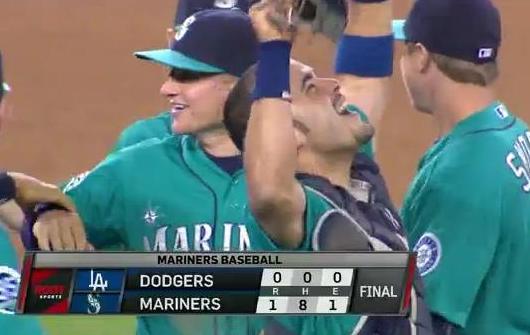
On Friday, Seattle’s Kevin Milwood tossed six no-hit innings against the Dodgers, then strained his groin while warming up prior to the seventh. Five Mariners relievers followed with three more innings of no-hit ball. (It was the 10th combined no-hitter in big league history; the latest—Houston’s defeat of the Yankees in 2003—also had six, and also had a starter, Roy Oswalt, depart early after an injury.)

Several noteworthy slices of Code cropped up in the process. One of the most popular refrains from those decrying the dreaded no-hitter jinx stipulation, which mandates that the feat must not be spoken about until it is completed, is that there’s no way a pitcher in the middle of a no-hitter has somehow failed to realize that he’s in the middle of a no-hitter.

Improbably, though, Seattle reliever Tom Wilhelmsen failed to realize exactly that. Wilhelmsen, who closed out the game for the Mariners, was eventually informed of the circumstances by his catcher.

“I told him, ‘Man, you threw a no-hitter!'” said Jesus Montero, in an ESPN report. “And he didn’t know! Unbelievable.”

Wilhelmsen tried to add some nuance to the claim. “Well, I mean, I knew what was going on,” he said. “But no, I have a brain fart every so often and just focused so hard on getting one thing done. It’s not like you forget, but it’s like you put it off to the side. And then it’s like, ‘Holy cow, we just did it,’ and Montero is in my arms.”

To be fair, five pitching changes can distract from the execution of a fairly unique feat; Wilhelmsen wasn’t the only one who lost track of things.

“Coming into the ninth, it wasn’t really on my mind . . .” said Seattle shortstop Brendan Ryan, who entered in the ninth as a defensive replacement. “It kind of took five seconds or so to sink in. ‘Wait a minute. Wait a minute. There were no hits. That’s a no-hitter!'”

That said, not everybody was so clueless. Reliever Stephen Pryor (who was credited with the victory after pitching to all of one batter recording all of one out), told the Seattle Times that, Wilhelmsen apparently aside, they were aware of it in the bullpen. “We knew, but we weren’t talking about it,” he said. “We didn’t want to jinx it.”

Someone who very clearly didn’t mind jinxing it was Dodgers shortstop Dee Gordon, who tried to bunt for a hit in the fourth inning. While some take this topic—breaking up a no-hitter with a bunt—very seriously, Gordon has facts on his side. For one, it was only the fourth inning—far to early to consider the deed sacrosanct, even for the likes of Bob Brenly. For another, speed makes up nearly the entirety of Gordon’s offensive game; beating out bunts is what he does, so to assume he’d suddenly table one of his strengths in a close game is far from reasonable. The score was only 1-0, so even if Gordon had tried it in the eighth, he would likely have not drawn much protest from the Mariners.

No word yet about whether Seattle players took it upon themselves to avoid all six pitchers in the dugout for fear of the mighty jinx. Seems like a tall order.

Clayton Kershaw, Ian Kennedy, Retaliation

Ask What You can Do for Your Teammates: Kennedy Avenges Parra, a Season Later

Kershaw responds.

Perhaps this is what Cole Hamels was talking about when he proclaimed his drilling of Bryce Harper last week to be “old-school baseball.”

Old-school baseball frequently involves long memories, and a willingness to respond to a situation even if it has long since passed. On Monday, Arizona’s Ian Kennedy did exactly that.

Kennedy was facing Dodgers ace Clayton Kershaw for the first time since last season, when Kershaw was unceremoniously ejected for hitting Diamondbacks outfielder Gerrardo Parra with a pitch. Parra’s drilling was itself a response to a home run he hit off Los Angeles reliever Hong-Chih Kuo, after which he loitered in the batter’s box as it left the yard. Parra’s loitering was in response to an earlier Kuo pitch that buzzed him as he was squaring around to bunt.

Cause and response. Response and cause.

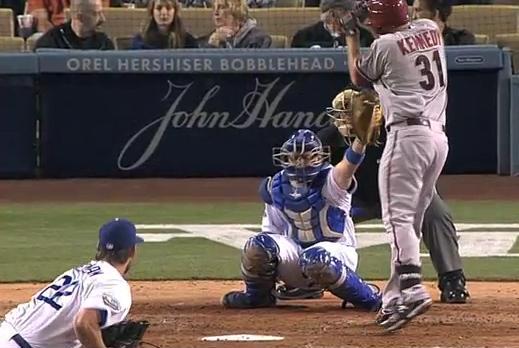
Fast forward eight months, to Monday night. When Kershaw stepped to the plate to lead off the third inning, Kennedy brushed him back with a first-pitch fastball. In case the message was still unclear, three pitches later Kennedy sent one behind Kershaw’s back. Kershaw stared into the Arizona dugout in disbelief, and, wrote Nick Piecoro in the Arizona Republic, “had no problem receiving the message the Diamondbacks were sending.” (Watch it here; for a fuller examination, see the recap.)

Kershaw’s turn came in the fifth, when Kennedy stepped to the plate and was greeted with a fastball, high and inside. That was enough for plate ump Marvin Hudson to issue warnings to both benches.

Was Kennedy trying to hit Kershaw? To judge by his follow-up effort, he was, but didn’t get it done either time. Did Kershaw handle things appropriately, dishing out as good as he got without escalating matters? Absolutely.

Also, unlike Hamels, blanket denials were the order of the day.

“[Kershaw] is a good hitter, so I had to throw inside on him,” Kennedy said in the Republic. “The second one I just pulled way too much.” (D-Backs shortstop Willie Bloomquist, however, admitted that “no one was trying to hurt anyone—it was just to prove a point.”)

“It’s pretty strange that he throws two up and in like that and one at my shins,” responded Kershaw. “His catcher is saying he’s missing his spots. It’s pretty obvious what they’re doing. I don’t really understand it. I know their manager over there likes old-school baseball, but old-school baseball means you don’t carry over things from last year.”

Actually, that’s exactly what old-school baseball means. It’s easy to say that Kennedy should have left well enough alone, and that renewing old hostilities ultimately does little good for anybody involved. The only real counter to that is the tenor of the Arizona clubhouse, and the unknown conversations that may have led to Kennedy’s action, be they with Parra, manager Kirk Gibson or some other aggrieved teammates. There is a palpable charge that a pitcher faces in standing up for his teammates, and those found to be derelict in that duty are quick to lose clubhouse support.

Ultimately, of course, nobody was hit, the fact that both pitchers ended up walking in their targeted at-bats didn’t end up hurting the opposition, several messages were sent, and everybody emerged unscathed.

Old-school baseball.

Umpires Knowing the Code

And Like That—Poof—he’s Gone. Kershaw Tossed Without Warning

Bill, Clayton. Clayton, Bill.

Call it bad umpiring, if you must, but many will disagree with you.

Legions of fans, in fact, consider it to be horrible umpiring.

It’s inaccurate to say that umpire Bill Welke’s ejection of Clayton Kershaw Wednesday night came from nowhere, but, considering the circumstances, it kind of did.

Those circumstances began Tuesday, when Dodgers reliever Hong-Chih Kuo sent an inside pitch buzzing past the head of Arizona’s Gerardo Parra. It was inside, but not dangerously so; that it came close at all was mostly a function of Parra’s squaring around to bunt.

Parra responded by staring down the pitcher. Moments later, he connected for a home run, then loitered in the batter’s box for several long beats. That raised the hackles of both catcher A.J. Ellis, who had words for Parra as he crossed the plate, and the Dodgers’ bench at large—with the leader of the agitated appearing to be Kershaw, who appeared to deliver a message along the lines of “Just wait ’till tomorrow, Gerry.” (Watch it all here.)

When Kershaw faced Parra to start the sixth inning yesterday—having already surrendered a double to him in the third—he sent an 0-1 fastball spinning inside, and clipped Parra’s right elbow. Wrote Steve Dilbeck in the Los Angeles Times, “[It] hardly appeared like Kershaw was intentionally trying to hit him.”

Still, it was enough for Welke, who ejected the pitcher on the spot. (Watch it here.)

Tuesday night: Kershaw gets fiery.

Never mind that the pitch only grazed Parra. Never mind that it was a 2-0 game, and that Kershaw is chasing 20 victories on the season. Never mind that 29,799 people paid good money to see one of the National League’s best pitchers square off against the presumptive NL West champions.

Never mind all that, if you’d like, but make sure to pay attention to an umpire who refuses to let baseball’s Code play out on its own terms—if that’s even what was happening. Kershaw had every right to send a message to Parra after the previous night’s display, and the only guy in the stadium who seemed oblivious to the notion was Welke. If ever there was a spot to warn the benches, this was it.

Or, as it turned out, not.

Perhaps Kershaw learned a lesson about stifling any animated displays in the dugout. Maybe he spent the rest of the evening thinking about how and when he can next come inside to a guy with whom he has history. Or maybe he just spent a few hours poking pins into his Bill Welke doll.

He shouldn’t have had to any of this. It was a display of over-umpiring at its most blatant, and Kershaw—hell, any major league player—deserves better.

– Jason

A.J. Ellis, Carlos Gomez, Don Mattingly, Don't Steal with a Big Lead, Mike Quade, Ron Roenicke

Cubs Skipper Quade Serving as One-Man Code Army

Mike Quade: Needing a copy of the Brewers' and Dodgers' unwritten rulebooks.

One thing we’ve learned for certain so far this young season: Cubs manager Mike Quade is a fan of the unwritten rules. He gets bothered when they’re broken on his watch, and he’s willing to call out those who diminish their importance or ignore them altogether.

First, it was Brewers skipper Ron Roenicke, who inserted pinch-runner Carlos Gomez into the eighth inning of a game in which his team led 5-0, then watched unapologetically as Gomez stole two bases.

“These unwritten rules—everybody has their own interpretation,” said Quade. Sometimes when interpretations differ, that’s when you run into trouble.”

Funny that “run into to trouble” is the phrase he chose.

Not two weeks later, Dodgers catcher A.J. Ellis did literally that when he tried to swipe a base with his team holding an 8-1 lead in the fifth.

This seems like a good place to get into Quade’s notion of differing interpretations. When Gomez ran against the Cubs, his team’s 5-0 lead was considered insufficient by Roenicke to shut down his running game, but the eighth inning is without question an appropriate timeframe to have done so.

When Ellis swiped his base, the criteria were reversed; there’s little argument that an 8-1 lead is well within the boundaries of “safe,” but the fifth inning might be considered a touch early for some managers to call off the dogs.

“I do think I probably need to get a copy of the Milwaukee and L.A. unwritten rules books, too, unless they missed a sign,” said Quade.

As it turns out, that’s precisely what happened. After the game, Ellis and Dodgers manager Don Mattingly both confessed as much; Mattingly said his sign to third-base coach Tim Wallach was “missed” (whatever that actually means), and off went Ellis, possessor of zero prior steals over parts of four big league seasons.

The play was somewhat mitigated by the fact that Ellis was thrown out. It may also have been mitigated when the Dodgers sent Ellis to Triple-A Albuquerque days later.

Still, said Mattingly, “We knew when it happened, we figured they’d be irritated.”

Ellis’ steal brought to mind another Dodgers youngster who stole another base in an inappropriate situation. In the case of Roger Cedeno, however, there was no missed sign. From the Baseball Codes:

In a game in 1996, the Giants trailed Los Angeles 11–2 in the ninth inning, and decided to station first baseman Mark Carreon at his normal depth, ignoring the runner at first, Roger Cedeno. When Cedeno, just twenty-one years old and in his first April as a big-leaguer, saw that nobody was bothering to hold him on, he headed for second—by any interpretation a horrible decision.

As the runner, safe, dusted himself off, Giants third baseman Matt Williams lit into him verbally, as did second baseman Steve Scarsone, left fielder Mel Hall, and manager Dusty Baker. Williams grew so heated that several teammates raced over to restrain him from going after the young Dodgers outfielder.

The least happy person on the field, however, wasn’t even a member of the Giants—it was Dodgers hitter Eric Karros, who stepped out of the batter’s box in disbelief when Cedeno took off. Karros would have disap­proved even as an impartial observer, but as the guy who now had a pissed-off pitcher to deal with, he found his thoughts alternating between anger toward Cedeno and preparing to evade the fastball he felt certain was headed his way. (“I was trying to figure if I was going to [duck] for­ward or go back,” said Karros after the game. “It was a 50–50 shot.”) Giants pitcher Doug Creek, however, in a display of egalitarian diplo­macy, left Karros unmarked, choosing instead to let the Giants inflict whatever retribution they saw fit directly upon Cedeno. (Because it was the ninth inning, nothing happened during that particular game.)

At second base, Scarsone asked Cedeno if he thought it was a full count, and the outfielder responded that, no, he was just confused. “If he’s that confused, somebody ought to give him a manual on how to play baseball,” said Baker after the game. “I’ve never seen anybody that con­fused.”

In the end, it was Karros who saved Cedeno. When he stepped out of the box, as members of the Giants harangued the bewildered baserunner, Karros didn’t simply watch idly—he turned toward the San Francisco bench and informed them that Cedeno had run without a shred of insti­tutional authority, and that Karros himself would ensure that justice was administered once the game ended. Sure enough, as Cedeno sat at his locker after the game, it was obvious to observers that he had been crying. Though the young player refused to comment, it appeared that Karros had been true to his word. “Ignorance and youth really aren’t any excuse,” said Dodgers catcher Mike Piazza, “but we were able to cool things down.”

– Jason

Retaliation, Ted Lilly

There’s a New Sherrif in Town … and his Name is Lilly

Through the array of baseball’s frontier justice so far this young season, the game has seen one unquestioned king of bad-assery, one primary purveyor of retaliation.

Raise your hand if the first name that came to mind in that regard was Ted Lilly.

Lilly has taken the lead from the No. 3 slot in the Dodgers rotation to single-handedly ensure that nobody takes liberties with his ballclub.

Tim Lincecum hit ex-teammate Juan Uribe twice, on separate occasions. (The second time, during the sixth inning of a tie game, was Lincecum’s final pitch of the night and was clearly unintentional.)

Lilly’s response: Pitching the following day, he hit Buster Posey in his first two at-bats the following day.

Warnings were issued after the second one, and although Giants manager Bruce Bochy had to be ordered back into the dugout by umpire Greg Gibson, no retaliation was in the offing. Posey had no comment afterward on the intent of the pitches; Lilly said he was just trying to pitch “hard in on (Posey’s) hands.” Of course he was.

(For what it’s worth, Lilly didn’t walk a hitter that night, and has averaged only five hit batters per season over the course of his career. Posey opted for legal retaliation after the second drilling, swiping second base for the first regular-season steal of his career.)

Last Monday, Braves pitcher Tim Hudson put a 91 mph fastball behind Jerry Sands’ head, after Sands had doubled and hit a sacrifice fly in his first two at-bats of the game—and his career—all the while serenaded by Dodger Stadium chants of “Je-RRY, Je-RRY.”

Braves manager Fredi Gonzalez later admitted that the pitch was meant to send a message to the surging rookie, but came in higher than intended. Hudson gestured apologetically toward the Dodgers dugout after throwing it.

Lilly’s response: The next inning, he threw a ball behind Nate McLouth. Still, after the game, Hudson sent Sands a make-peace offering—a signed baseball. Sands accepted it, calling it a “classy move.” Lilly was hardly so forgiving.

When asked if he was protecting Sands, he said, via MLB.com: “More than that, I guess, I was disappointed with the pitch Huddy threw. All of you guys know he’s as good as it gets keeping the ball down.”

Lilly’s making $33 million over three years from the Dodgers. He was brought in to stabilize the rotation. Looks like he’s giving it some guts, as well.

– Jason