No-Hitter Etiquette

Baseball Etiquette 2010: Never Post to a Message Board About a No-Hitter in Progress

Yovani Gallardo took a perfect game into the sixth inning for the Brewers on Thursday, which, as it turns out this season, isn’t all that rare a feat.

Still, it led to some message-board hilarity, as it relates to jinxes and the sort.

The following are all taken from a string on the HF Boards.

A user named Ixcuincle started things off at 2:33 p.m.:

Gallardo allegedly has a perfect game

This drew a sharp retort from STEVE HOLT, at 2:36 p.m.

WTF? You should never, under any circumstances, mention a perfect game as it is in progress. It’s baseball etiquette.

– Jimmy

Jiri Bicek weighed in a minute later:

Now we know that if Gallardo doesn’t get it, it’s because of that post on HF

But really, it was MD23Rewls who decided to go crazy, at 2:38 p.m.:

It has no effect on whether someone pitches a perfect game. You really believe that? I don’t agree with you, that’s not a professional attitude. Why shouldn’t he say it? Tell me Jimmy. Tell me why. Why? Why? Don’t tell me it’s etiquette, you know it used to be etiquette to have black people as slaves. Tell me why. Tell me exactly why. Jimmy, tell me why. That’s a stupid, stupid thing to say. You’re not giving me reasons. That’s why there was Nazi Germany. Why did they march people into ovens? Well, that’s just what they did. That’s what they were told to do. That’s a stupid, stupid reason. “Oh, its baseball etiquette.” That’s ridiculous. “I was just following orders.” But, why? “Well they told me to.” But, why? “Well they told me to.” That’s asinine. People actually believe this. They actually believe this. Mind boggling. It’s just mind boggling. You make no sense. You know how dumb you sound when you think a poster can affect the game? How stupid you sound? How infantile?

It takes some sort of chutzpah to compare talking about a no-hitter in progress to slavery and the Holocaust, but MD23Rewls managed to pull it off.

Rather than address him directly, STEVE HOLT took the most effective measure possible, at 2:39 p.m.:

You see what you people did?

Perfect game over.

Classic.

– Jason

Gary Cederstrom, Joe Maddon, Umpire Relations

Maddon Vents to Garza, Gets Cederstrom’s Goat

There is a protocol to addressing umpires. Players and managers usually have a wide berth to say what they want, so long as they don’t publically show up the ump with whom they’re arguing. For hitters and catchers, this means not turning around to face him as they speak. For managers, it’s overt displays of anger during the course of a discussion.

Tampa Bay manager Joe Maddon hewed closely to these rules yesterday, and was tossed anyway—to the delight of his players.

Maddon was angry that, for the second straight day, a Rays pitcher was called for a balk in a critical situation. Because managers are not allowed to argue balk calls, Maddon instead went to the mound and made his case to his pitcher, Matt Garza, loudly enough for the ump in question—Gary Cederstrom, who was manning second base, and who during the course of dialog circled around behind Maddon—to hear. (Watch it here.)

Maddon, surrounded by his infielders, looked just like he would if he was arguing with an umpire, arms waving, finger pointing and volume high—only facing his own pitcher.

It wasn’t enough. Cederstrom quickly tossed him.

“The umpire said, ‘Are you talking to me, or are you talking to your pitcher?’ ” said second baseman Reid Brignac in the St. Petersburg Times. “Joe said, ‘I’m talking to my pitcher.’ Then Joe started again. ‘That’s the second damn day in a row, yada, yada, yada.’ It was definitely amusing.”

One of Maddon’s goals was to vent anger over what he felt was a pattern of bad calls. (Before Wednesday’s balk call on James Shields, pointed out the Times, the pitcher had faced more than 3,600 batters in his career and been called for only one balk; Garza’s last balk was more than 1,300 batters ago.)

He also wanted to give Garza a moment to get his head back in the game. It worked; Garza worked out of the jam and ended up going eight innings.

Maddon accomplished both items while sticking to the Code. He didn’t show up the umpire so much as the umpire showed up himself.

Ultimately, he proved the point that it’s not just how you say something that can get you tossed—it’s what you say, as well.

– Jason

Michael Saunders, Unwritten-Rules

Finding the Code in Unexpected Places

In most instances, baseball’s unwritten rules come in a proscribed package, ready for review every time a pertinent incident crops up on the field.

Sometimes, however, they’re made up on the fly.

After all, the underlying tenet behind the vast majority of the Code is respect, and that respect can take any number of forms.

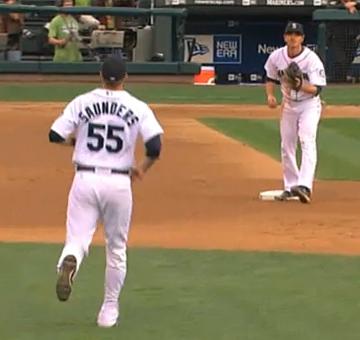
Tuesday in Seattle, Mariners left fielder Michael Saunders exhibited it in spades, after catching a fly ball off the bat of Chicago’s Tyler Colvin. Alfonso Soriano had been at second base, and, thinking the ball would drop, had already rounded third when the ball was caught.

Saunders was about 70 feet from second and charging directly toward the bag when he made the catch. He could have jogged in and doubled off Soriano, unassisted, without any threat of arriving too late. (Watch the play here.)

For an outfielder, turning an unassisted double-play could be a once-in-a-career moment. As FanHouse pointed out, the all-time career record for major leaguers is six, set by Hall of Famer Tris Speaker.

Why not do it? In the words of Saunders, “I didn’t want to rub their faces in it. There was no need for anything like that. I just needed to get the outs.”

Franklin Guttierez urged Saunders to do it from his position in center field. After the game, Mariners manager Don Wakamatsu said that a more experienced outfielder (Saunders is in just his second season) might feel more comfortable about making such a play without offending the opposition.

But this isn’t about whether Saunders would have stirred up the Cubs had he doubled up Soriano on his own. He almost certainly wouldn’t have made a ripple.

It’s about a player being cognizant enough of the spirit of the game, and holding enough respect for his opponent, to maintain a strict set of ideals. Saunders saw a high road to take, and he took it.

And for that, he gets our kudos.

– Jason

The Baseball Codes

Gonzalez Out in Florida; Ramirez Assumed to be Gloating

Remember Fredi Gonazlez’s spat with Hanley Ramiriez? Gonzalez was praised for publically calling out his superstar for lackadaisical play and a bad attitude, and Ramirez eventually returned, contrite.

It’s been almost exactly a month since Ramirez returned from a one-day benching; he’s since batted .292 with four homers, 23 RBIs and 10 stolen bases.

Gonzalez: fired yesterday.

While there were reasons for the firing that had nothing to do with Ramirez, it’s clear who ultimately got the better of that confrontation.

Update: Buster Olney points out another unwritten rule in this situation: “If you’re going to fire the skipper, do it while you’re playing a really, really bad team so that when you win, it looks like the players responded.”

Yesterday: 7-5, Marlins over the Orioles.

– Jason

Don't Swing on the First Pitch After Back-to-Back Home RUns, Gabe Gross

Don’t Swing at the First Pitch After Back to Back Homers: RIP

Earlier this month, a reader pointed out that Oakland’s Gabe Gross had swung at the first pitch after Jack Cust and Kevin Kouzmanoff hit back-to-back home runs against the Red Sox, and wondered about the propriety of the action.

My initial response was that it was a 9-6 game, the ball was clearly flying at Fenway, and Gross had the leeway to take liberties.

Then I realized just how long I’ve spent with my nose in the Code. Much more important than Gross’ leeway is the fact that this rule barely exists anymore, if at all.

It serves as a great example of the evolution of the Code; in the 1970s, Sparky Anderson lived by the rule, as did many of his disciples. Now that power numbers play such a vital part in contract negotiations, however, it’s fallen into such disuse that finding a player who has even heard of it is a feat.

Gross certainly hadn’t.

“If I have a 3-0 count in a blowout game, I don’t swing,” he told me recently. “That, I understand. But the first pitch thrown over the plate after back-to-back homers . . . With all respect to Sparky, I don’t see any reason to be taking it. I’d never heard of that before.”

The swing in question—Gross fouled the pitch off—was not meant to disrespect the pitcher, Manny Delcarmen, nor did Delcarmen take it that way.

Heck, just across the bay, it recently happened with the Giants—twice. Both times, Aubrey Huff and Juan Uribe went back-to-back; both times, the next hitter (Pat Burrell and Pablo Sandoval, respectively) swung at the next pitch.

Let’s have a moment of silence. As charming as this rule may be, I officially pronounce it deceased.

– Jason

This Week in the Unwritten Rules

This Week in the Unwritten Rules, Video Edition

Going to the ballpark to talk to players and ex-players about the unwritten rules is an invigorating process. Sometimes, however, interviews turn out differently on the page than they do in person.

That’s why we’ve decided to bring you This Week in the Unwritten Rules, a semi-regular video segment we’re hoping to produce for the rest of the season. With video, we’re able to bring you some of the sport’s key characters, discussing the Code directly.

Enjoy.

– Jason

Adam Jones, Changing a Ruling, Teammate Relations

A Change is Gonna Come – Just Not at the Expense of Your Teammate

Buster Olney, in his ESPN blog today, relates the following:

The concern among rival talent evaluators about the Orioles is that constant losing is shaping the mindset of the team’s young players. For example, after the Orioles lost an early lead Sunday in San Diego and wound up getting crushed 9-4, sources say Baltimore center fielder Adam Jones directly lobbied for his first-inning bouncer to be changed from an error to a hit. The scoring on the play was changed, hours after the fact, and Jones got his hit, but for a player to make a direct appeal — especially in the aftermath of a one-sided loss — isn’t exactly conventional.

At issue, of course, is players becoming more concerned about their own numbers than the success (or, in Baltimore’s case, lack thereof) of their respective teams. (Scorers have a 24-hour window during which to alter a ruling.)

Should the inverse circumstance be invoked—a fielder lobbying to turn an error into a hit—the unwritten rules come into play on an especially prominent level. Maintaining respect among teammates can be vital, but such a decision, while it helps the fielder, offers nothing positive for a pitcher.

Take an instance in 1992, when Boston’s Wade Boggs—upset at what had been ruled his 16th error of the season—lobbied the official scorer to change the play to a hit, which he did. Boggs helped his own cause, but in the process turned the table on his pitcher, Roger Clemens, boosting the Rocket’s ERA as he gunned for the AL’s lowest mark in that category.

Needless to say, Clemens and a number of other Boston players did not take it well.

On the flip side of the equation, after a 1984 game against the Red Sox, Dave Stieb lobbied for opposition hits to be changed to errors. It was Stieb’s second-to-last start of the season, and he had given up six runs in a single frame. He was battling Mike Boddicker for the league’s ERA title, and the outing crippled his chances.

Such post-fact success, of course, would have come at the expense of his teammates’ fielding percentages. (Stieb’s request was denied, and Boddicker beat him, 2.83 to 2.79.)

“One thing I’ve noticed over the years, when a team is going badly, that’s when players get extremely selfish and want everything to go their way,” said longtime Red Sox official scorer Charlie Scoggins, in a Baseball Digest article by Larry Stone from 2004. “I find that when a team is in a pennant race, they hardly ever question my calls.”

Jones may well be innocent of all charges (at the very least, his lobbying did nothing to hurt the record of a teammate), but Scoggins description could fit the Orioles pretty well.

– Jason

Don't Showboat, Don't Call out Opponents in the Press, Jose Valverde, Miguel Montero

War of Words Brews in Motown Following Valverde’s Dramatics

Valverde in action, back when he was with the Diamondbacks.

We got a Code twofer this weekend, with on-field actions drawing a response that is itself governed by baseball’s unwritten rules.

It started with Tigers closer Jose Valverde, whose antics atop a pitcher’s mound are well established. He spins, spits, hops, jumps and pumps his fists at regular intervals. It’s an ongoing display that has earned its own Facebook fan page, but still doesn’t seem to bother the likes of Nick Swisher and Mark Teixeira, who claimed after facing him last week that they had bigger things to worry about than Valverde’s body language. (Watch his routine against the Yankees here.)

Not everyone in baseball agrees.

Arizona catcher Miguel Montero decided on Friday that he had seen enough of Valverde’s act, following the right-hander’s celebratory gesticulations during and after shutting down the Diamondbacks in the ninth inning. (This included a strikeout of Montero, after which Valverde bent over, then hopped off the mound.)

“He’s a (bleeping bleep),” Montero told the Arizona Republic after the game. “The way he acts, it’s not right, you know?”

Montero’s knowledge, of course, goes deeper than being insulted on the field. The two were D-Backs teammates in 2007, and for the handful of games that Montero was in the big leagues in ’06.

“You’ve got to be professional,” added Montero. “I’ve always felt that way, and I’ve always told him. That’s the way he is. I guess he thinks it’s right, but I don’t care.”

He also added that Valverde didn’t have the “kind of brain” to be smart enough to throw three straight splitters to strike him out.

Children are taught that two wrongs don’t make a right, but in this case, Montero adding a public lambasting of his opponent to said opponent’s initial theatrics made for some quality entertainment.

That’s because by the end of the weekend, Valverde shot back.

“Tell Montero he’s a freaking rookie and I can do whatever I want to,” Valverde said in Sunday’s Arizona Republic. “Tell him that. Put it in the papers. If he wants to do something, tell him to come to my locker and let me know. I never liked Montero. He’s a (bleeping) piece of (bleep). Tell Montero he has two years (in the majors) and I have eight.”

Montero responded quickly, saying that “it doesn’t matter if he’s got eight years. I don’t think he’s got eight years because he got sent down seven or eight times. That really doesn’t count. When you get sent down your major league service stops counting. He got called up in ’02 and he got sent down in ’02 and ’03 and ’04 and ’05 and ’06. I guess this year he was a free agent so that let me know he got six years. In four out of six years he’s given up 100 runs a year. He’s only had two good years in his career. So what? He’s still a (bleep) to me.”

These are baseball players, of course, not mathematicians. Montero is in his fourth season, and, reported the Republic, only one of Valverde’s minor league stints from 2003-06 was due to demotion, rather than to injury rehab assignments.

During his initial blast, Montero said that at the earliest possibility against Valverde, he was “going to pimp it”—assumedly talking about showboating at the plate to a similar degree that Valverde does on the mound.

This would have been an appropriate response. Taking one’s beef to the press: not so much.

But entertaining. Always entertaining.

– Jason

This Week in the Unwritten Rules

This Week in the Unwritten Rules

June 14
Mound conference etiquette says that a pitcher waits for his manager after getting yanked from a game. Compared to some, Tony Sipp got off easy.

June 15
Another bunter tries to break up another no-hitter. Nobody seemed to mind.

June 16
Adam Dunn taught a painful lesson to a rookie catcher who found himself in the wrong place at the wrong time.

June 17
As evidenced by Casey McGehee’s takeout of Erick Aybar, what might seem like clear Code violations aren’t necessarily so.

June 18
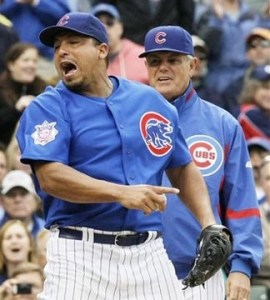
A war of words heated up between Carlos Zambrano and Jerry Blevins.

– Jason

Carlos Zambrano, Don't Call out Opponents in the Press, Jerry Blevins

Zambrano: Blevins ‘Lucky’ to Retire Me

While players are expected via the unwritten rules to refrain from slamming each other in the press, this particular piece of Code can offer wild entertainment when ignored.

Jerry Blevins and Carlos Zambrano gave us a brief taste this week, with a mini-war of words that played out on the pages of various newspapers.

It started when Zambrano claimed that Blevins—a left-handed reliever who had been inserted into Tuesday’s Cubs-A’s contest one batter earlier—“got lucky” by inducing him to pop out to second base to end the sixth inning.

Cubs manager Lou Piniella had let Zambrano hit for himself with two on, two out and the Cubs down, 5-2. The portly pitcher admitted that he was going after a home run.

Blevins didn’t appreciate the disrespect—especially coming from a guy who had given up five runs in six innings, and whose ERA stood at 5.66. Given the chance, he fired back.

“I did get lucky,” he said the following day in the San Jose Mercury News. “Any time they don’t pinch-hit for a pitcher to face me, I’m lucky. I’ve gotten a lot better hitters out than him. He’s a good hitting pitcher, but he’s still a pitcher. Yes I’m lucky—for them not pinch-hitting.”

In the pantheon of verbal battles, this is just a mild case of banter—although it did draw a rebuke from NBC Sports’ Hardball Talk, which asked, “What is it with A’s pitchers that make them so damn defensive? Is Blevins from the 209 too?”

When it’s done right, this sort of disrespect through the press can have disastrous results. Perhaps the most noteworthy incident occurred during the 1988 NLCS, when Mets pitcher David Cone published a bylined article in the New York Daily News (ghost-written by Bob Klapisch) that he quickly regretted.

The Mets had just touched Dodgers reliever Jay Howell for two runs in the ninth to take a 3-2 victory in Game 1. In describing the comeback to Klapisch after the game, Cone intoned that Howell kept going back to his best pitch, the curveball, again and again, failing to mix up his repertoire to a degree that would throw Mets hitters off balance. The strategy, Cone said, reminded him of when he was a high school pitcher, throwing curve after curve after curve.

From The Baseball Codes:

The sentence that made it to print read slightly differently: “Seeing Howell and his curveball reminded us of a high school pitcher.” Cone has never denied uttering those words, but has long stressed that the context was skewed. One lesson he learned when the paper came out the next day was that context doesn’t count for a hell of a lot in the face of opponents spitting fire over your sentiments. “All of a sudden,” said Cone, “it was me calling Jay Howell a high school pitcher.”

Just as suddenly, the Dodgers had new life. Manager Tommy Lasorda brought a copy of the Daily News—not so easy to find on the streets of Los Angeles—into the clubhouse and ran it through a copy machine. Before the game, he rallied the team around him and exploded. “When we got to the clubhouse that day, the article was posted all over the place—we couldn’t miss it,” said Dodgers catcher Mike Scioscia. “We had our pre-game meeting, and Tommy used it for all it was worth. He kept saying that [Cone] was calling all of us a bunch of high-schoolers, not just Jay Howell. He kept saying that they thought we were a bunch of high school kids, on and on. He was pretty emotional, of course, as only Tommy can be.” . . .

When Cone took the mound, the Dodgers bench, fired up by Lasorda’s speech, started riding him hard, offering up, said the pitcher, “bench-jockey insults that were as bad as I have ever heard.” It was vicious, it was loud, and it was relentless. “Everybody, right down to the trainer, was screaming at me,” said Cone, whose father, Ed, was sitting next to the Dodgers dugout and heard every word.

It worked. Cone, whose 2.22 ERA during the regular season was second in the National League, lasted just two innings, giving up five runs before being removed for a pinch-hitter in the third. It was the shortest outing he had ever made as a big-league starter.

Blevins v. Zambrano is a comparative blip, with no likely repercussions; barring a change of team for either pitcher, they won’t face each other again for years.

Still, it offers fabulous entertainment when watching from the outside.

– Jason