Gamesmanship, Jorge Posada

Posada Enrolled in Classes at Derek Jeter Acting Academy

Maybe he was just trying to take some heat off his captain. More likely, this kind of thing happens more often than we think, but we’re paying attention now.

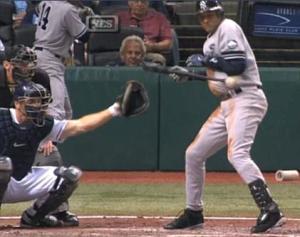
Either way, Jorge Posada took first base last night after not being hit by a pitch.

Sound familiar?

Of course, the sum of Posada’s histrionics involved taking off his shin guard and offering a slight grimace, not hopping around and wincing to the point that medical intervention was necessary. (Watch it here.)

It was an 0-2 pitch from Tampa Bay’s James Shields that skipped on the ground in front of Posada’s feet. He hopped back, never indicating that the pitch did anything but hit him. The relative lack of outcry compared to the recent Derek Jeter incident could have also had to do with the fact that there were already two outs, Posada never scored, and the Yankees won handily anyway, 8-3.

Still, it’s a reminder to all those who bandied about the phrase “Derek Cheater” this week that this is something heady ballplayers do.

– Jason

Derek Jeter, Gamesmanship

Jeter Just Doing What Ballplayers Do

The sports world is absolutely fascinated with Derek Jeter right now, the golden-boy Yankees captain-cum-cheater who acted gravely wounded by a ball that didn’t hit him during a game last night against Tampa Bay. (Watch it here, complete with commentary from each team’s broadcast crew.)

I don’t get the criticism. This is what ballplayers do.

Sure, they’re not often caught en flagrante to the degree that Jeter was, but at heart, they’re all the same in this regard. You’d be hard-pressed to find a single example in the history of the game in which a player willfully informed an umpire that a call had been incorrect in favor of the opposition. It doesn’t happen on balls or strikes or plays at the bases. It doesn’t happen on difficult fair-foul calls.

And it certainly doesn’t happen on hit-by-pitches.
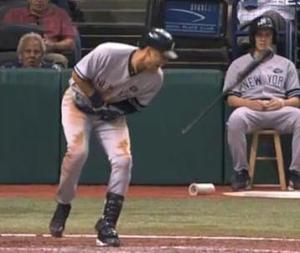
Sure, Jeter went overboard with his Shakespearian dramatics. If you want to make a distinction between benefitting from an umpire’s bad call and influencing an umpire into making a bad call, that’s fair. But the underlying tenets are the same: in baseball, every advantage counts; you get ’em where you can.

“He told me to go to first base. I’m not going to tell him I’m not going to first, you know,” said Jeter, afterward. “It’s part of the game. My job is to get on base. Fortunately for us it paid off at the time, but I’m sure it would have been a bigger story if we would have won that game.”

Nobody ever called out an outfielder for acting as if he caught a ball he actually trapped.

“Play it off—that’s not cheating if the umpire lets you get away with it,” said longtime outfielder Von Joshua. “Any means you can to win a baseball game. . . . Sometimes you get it, sometimes you don’t. That’s just part of the game.”

Even Rays manager Joe Maddon was impressed by Jeter’s effort. “I thought Derek did a great job, and I applaud it,” he said in an MLB.com report, “because I wish our guys would do the same thing.”

Heck, is it really so different than A.J. Pierzynski sticking his elbow into the path of a pitched ball in order to get on base? Neither are admirable, but both are accepted. (Of course, when Pierzynski did it with the bases loaded and a 9-2, eighth-inning lead in 2004, he insured himself a future drilling.)

HardballTalk points out similar displays from Yunel Escobar and Pierzynski, again.  It’s pure gamesmanship.

Jeter even has precedent on his own team. In a 1928 game between the Yankees and Browns, with two outs and Lou Gehrig the baserunner at first, second-base umpire George Hildenbrand turned to watch the play on the lead runner when Bob Meusel hit a ground ball to shortstop Red Kress.

Except that Kress threw to first, and Hildenbrand was caught with his back to the play.

Meusel had been thrown out cleanly, but Hildenbrand hadn’t seen it. Instead, he appealed to Meusel’s honesty.

“Everybody knows you’re out, Bob. Everybody saw it . . .” he said, according to the Baseball Hall of Shame, Vol. IV. “Be a sport and call yourself out.”

Meusel’s response: “George, you’ve been getting nine thousand bucks a year for a long time as an umpire. Now’s a good time to start earning it.”

Hildenbrand had no choice. The runner was safe, and Browns pitcher Al Crowder had to seek his fourth out of the inning.

So wnough with the calls of “Derek Cheater.” The guy was just doing what big leaguers do.

Update (9-22-10): Jorge Posada did kinda sorta the same thing.

– Jason
Don't Showboat, Jose Bautista, Retaliation

Bautista’s Game-Winning Homer Conveys Message, then he Conveys it Again

Jose Bautista’s first home run Monday meant little on its own, save for being the slugger’s major league-leading 39th of the season.

His second home run Monday meant a lot more, at least to him.

The difference: What happened in between.

That would be the sixth-inning fastball that Yankees starter Ivan Nova sent spinning toward—and ultimately over—Bautista’s head.

The hitter took it as a response to his earlier bomb. Nova was more likely just wild, considering that it was his first start as a big leaguer. Bautista had words for the right-hander as he approached the mound, Nova didn’t back down at all and benches and bullpens quickly emptied onto the field.

Although no punches were thrown, the incident served as a prelude for an interesting response from Bautista after he hit another home run, in the eighth.

Baseball will tolerate a degree of showboating, so long as it’s in response to a Code violation. Bautista’s reaction to his second home run (the eventual game-winner, hit off of reliever David Robertson) started with a bat flip in conjunction with a glare toward the mound. It ended with one of the slowest home-run trots in the big leagues this season, and some fist pumping upon reaching the plate. (Watch it here.)

In addition is the notion that rookies must be tested, which, admitted Bautista, is what motivated his sixth-inning outburst, at least in part.

“I was just trying to see what kind of reaction I was going to get from him,” he said in the Bergen Record. “I was surprised to see he was pretty defiant. He was walking up toward me and flashing his hands up and started yelling.”

Part of Bautista’s motivation was to use Nova’s response to gauge intent. Despite the pitcher’s repeated assertion (in Spanish) that “I don’t want to hit you,” that, said Bautista, was “when I felt that the pitch was intentional.”

Bautista might have already been angry at a Toronto Star columnist who suggested that his power surge might be artificially fueled, using exactly zero pieces of evidence to back up his claim. (Bautista denied everything.)

Blue Jays fans can only hope that he continues to take out his anger on baseballs across the league.

– Jason

Don't Help an Opponent, Francisco Cervelli, Vince Coleman, Willie McGee

Stop! In the Name of Glove

There was a bit of hubbub in New York last week when Francisco Cervelli, normally a catcher for the Yankees, showed up at third base.

The clamor had less to do with Cervelli’s ability to make plays than the tools he used to make them. Midway through the game, TV cameras homed in on his Wilson model glove, smartly embroidered with the words “Wright No. 5.”

There is a Wright who wears No. 5 and plays third base in New York with a Wilson glove, but his home games aren’t at Yankee Stadium. It’s David Wright, the longtime third baseman for the Mets.

What, asked reporters later, was Cervelli doing with that glove?

“We have the same [glove] company,” Cervelli said in an MLB.com report. “That’s what they sent me, so I’ve got to use it. That’s my glove. I don’t know, maybe later when I’ve got more years in the big leagues, they’ll put my name on it. I don’t really care.”

It’s a far cry from Vince Coleman, whose actual glove was once used by an opponent. It was 1991, and Giants outfielder Willie McGee had his equipment stolen from the visitors’ locker room at Shea Stadium, so he turned to ex-teammate Coleman for backup. Using one of Coleman’s gloves, he recorded three putouts on the day.

(McGee was significantly happier with the result than were Coleman’s teammates on the Mets, who later fined him $10 per catch in kangaroo court.)

Cervelli’s tale also ended up in the Mets clubhouse, albeit a more circuitous route. Although he’s only played three innings at third base so far this season, he regularly takes ground balls there before games. When he left his glove on the turf when the Yankees plaed at Citi Field earlier this year, clubbies mistakenly returned it to Wright’s locker.

“He got confused and said, ‘I’m so sorry,’ ” said Cervelli. “I want him to sign my glove when the season’s done. I’m going to send it to him.”

– Jason