Retaliation

Hey, Kevin Towers: the Pursuit of Justice Doesn’t Always Make You Right. Sometimes it Just Makes You a Bully

McCutchen drilledSince taking over the Diamondbacks in 2010, general manager Kevin Towers has aimed to turn his franchise into the rootinist, tootinist, unwritten rules followingest team in the land. He installed noted red-ass Kirk Gibson in the manager’s seat. He went on the radio  and claimed  that “it’s going to be an eye for an eye, and we’re going to protect one another,” adding that “ if you don’t follow suit or you don’t feel comfortable doing it, you probably don’t belong in a Diamondbacks uniform.”

Well, Randall Delgado belongs in a Diamondbacks uniform. And that’s not necessarily a good thing.

Delgado has barely earned his keep when it comes to good pitching (5.61 ERA over 34 games in relief), but he has to be in Towers’ good graces after Saturday night’s performance. The gap between pleasing one’s superiors and appropriate behavior is where the crux of this story lies.

It started on Friday, when Pirates closer Ernesto Frieri inadvertently hit Arizona’s Paul Goldschmidt on the hand. It was unquestionably a mistake—a fastball that sailed inside and barely clipped the batter, who flinched backward a hair too slowly. If D’Backs brass hadn’t decided to retaliate yet at that point, they probably gained clarity when the diagnosis came in: Goldschmidt’s hand was fractured and he’d miss significant time.

The Pirate to bear the retaliatory target was Andrew McCutchen—you hit our best player, we’ll hit yours—and Delgado drilled him in the ninth, after missing with his first offering (which came up and in, but not up and in enough), then sending a decoy breaking ball away. His third pitch, at 95 mph, hit McCutchen sqare in the spine. The outfielder gave no notice to the macho piece of Code saying that drilled batters should act like it didn’t hurt, instead going down as if he’d been shot. (A heater into the backbone will do that to a guy in ways that being drilled in the thigh will not.) On his way to first, he spiked his bat in anger. (Watch it here, including video of the leadup.)

For those who need further proof of intent, when Towers went on his radio diatribe last year, he specifically called out his team’s lack of response when Goldschmidt was hit: “Goldy gets dinged, and no retaliation. It’s like, ‘Wait a minute.’ If Goldy’s getting hit, it’s an eye for an eye. Somebody’s going down or somebody’s going to get jackknifed.” So there.

(Worth noting: Goldschmidt was hit three times in 2013, all without response, all with Wade Miley on the mound for Arizona. Was Miley talked to? To judge by his egregious use of force this spring, yes.)

After the game, McCutchen took issue less with the drilling itself than with its details. “Retaliation is going to happen in this game, but there is a right way to do it,” he said in an MLB.com report. “They had plenty of chances. First inning, do it. Perfect time: one out, guy on second base. Get it over with. But they wanted to wait it out, wait until the ninth, second and third.”

Indeed, Arizon had first base open with one out and McCutchen at bat in the first inning. It is a tailor-made circumstance for those with pain on their minds. Trouble is, Gibson had a similar situation in June—first base open against the Brewers—and when he used it to drill Ryan Braun, it ended up costing his team the game.

So he waited. Even if Arizona’s need to retaliate is highly questionable, the method of execution Gibson chose is not. The game was tied in every one of McCutchen’s preceding at-bats, when allowing a baserunner in the name of vendetta would not just be wrong, it would have been even stupider than what the D’Backs ended up doing.

Gibson’s act might have played well when he was starring for the Tigers in the 1980s, but the game has changed. That kind of response to a clearly benign situation is no longer acceptable. McCutchen gets huge credit for not charging the mound, but that’s a possibility—if now a downright likelihood, and not just with the Pirates—if Arizona pitchers continue their reckless ways.


Bat tossing, Carlos Gomez, Don't Showboat

Go-Go Gone-Gone: Gomez Pimps, Explodes Over Tongue Lashing

CarGo

Pimping is a ballplayer’s prerogative. But if one chooses to style in the batter’s box after hitting a long fly ball, one must be prepared should the opposition cry foul. (One must also make sure the ball leaves the ballpark.)

Oh, Carlos. Did Brian McCann teach you nothing?

In the third inning at Pittsburgh yesterday, Milwaukee outfielder Carlos Gomez sent a ball to deepest center field. Thinking it gone, he flipped his bat and trotted to first, picking up speed only upon seeing his drive bounce off the fence. By that time, of course, he was rounding first base. Because he’s fast, and because the ball caromed away from a leaping Andrew McCutchen, Gomez still made it to third without much trouble.

It’s after he reached third that the trouble started.

Pirates pitcher Gerrit Cole, backing up the play, had some words for Gomez as he walked back to the mound. Rather than absorbing them and moving on, however, Gomez stalked toward Cole, shouting all the while. When the Pirates bench emptied in response, he started swinging at anybody wearing a yellow cap. (Watch it here.)

Said Cole in an MLB.com report: “I grabbed the ball from [third baseman Josh] Harrison and I said, ‘If you’re going to hit a home run, you can watch it. If you’re going to hit a fly ball to center field, don’t watch it.’ ”

Gomez got pushed to the ground in the melee. Pirates outfielder Travis Snider—the first one out of the dugout—ended up with a cut on his face after being hit by Milwaukee’s Martin Maldonado (an attack upon an unaware player, to judge by the reaction in the Pittsburgh clubhouse after the game, which the Pirates did not appear inclined to forget).

In the immediate aftermath, the first thing to pop to mind was Gomez’s confrontation last year with McCann, then the Braves catcher. Earlier, Gomez had been drilled by Atlanta pitcher Paul Maholm, and subsequently didn’t just pimp a homer—he shouted at Maholm all the way around the bases. If you don’t remember McCann’s wild reaction, it’s worth reading about, here.

(You can go even farther back, to 2010, to see Gomez acting similarly against the Twins. At least the guy’s consistent.)

It is the right of Cole and every other pitcher to offer verbal warnings to those who they feel are showing them up. It is Gomez’s right to respond in kind—verbally—which is what he insists he was doing, right up to the point that the Pirates’ dugout emptied.

“[Cole tells] me something, I tell him something back, everything is normal, I talk to the umpire,” Gomez said. “And then Snider comes like a superhero and tries to throw punches at everybody. I just tried to protect myself.”

Judging by the videotape, however, Gomez appears to have thrown the first punch … not to mention the part where he approached Cole rather than shouting from his station upon third. One can hardly fault the Pirates for responding to a guy charging their pitcher, even he did it in slow motion.

(Amid it all, Gomez broke another unwritten rule—not just of baseball, but of life: Throwing the first punch when surrounded by friends of the guy you’re swinging at rarely ends well for you. Aside from his third base coach, Gomez was encircled by Pirates at the time of the incident.)

If nothing else, Gomez reinforced a notion that had become apparent during last year’s incident with McMann: It’s not too tough to get inside his head. Yesterday, all it took were a few stern words from Cole, and Gomez over-reacted himself right into an ejection. This would matter less if Gomez was a marginal player, but the guy is a centerpiece of his team’s offense.

Getting his goat is now officially on the table as a legitimate strategy; don’t be surprised to see it enacted once the games really start do matter down the stretch.


Retaliation

The Fine Line Between Pimping and Confusion, Pittsburgh Edition

Morneau drilledPerception is everything.

In the fifth inning in Milwaukee on Wednesday, Andrew McCutchen hit a home run to left. He didn’t get it all—it just cleared the fence—and he managed to lose it in the lights before he knew where it was ending up.

As such, he loitered in the batter’s box to try and get a read on it.

Ignore for a moment the horrific strategy of hedging one’s bet that a ball may not have left the ballpark by failing to leave the batter’s box. The pitcher who gave up the shot, Wily Peralta, either did not know about McCutchen’s confusion, or didn’t care. With his next pitch, he drilled Justin Morneau on the hand, near head-level. (Watch it here.)

“The catcher knew I was looking for the ball, the umpire knew—everybody knew it,” said McCutchen after the game, in an MLB.com report. “You could see the guys in the infield smirking as I was going around the bases. They know I’d lost the ball.”

Peralta offered up the standard denial of intent, saying “Yeah, you know, it wasn’t on purpose,” before detailing how he missed his spot while trying to go up and in.

“I know it looks bad, because right after a homer, you don’t want to hit people,” he said.

Unless, of course, hitting people is exactly what you want to do. Morneau reacted angrily, and even though he never approached the mound, benches cleared. After the game, Pittsburgh’s first baseman wasn’t ready to level blame with any degree of certainty.

“I think usually when a guy hits a home run, and they don’t like the way he reacts, they wait until the guy comes around [again],” he said in USA Today, questioning whether a more proper approach would have seen the Brewers waiting for McCutchen’s next turn in the lineup, rather than going after Morneau so quickly afterward. “It’s one of those things in that gray area. You don’t know if it’s intentional or not.”

Not to disagree too wholeheartedly with an experienced big leaguer or anything, but it seemed pretty intentional. Add the wrinkle that Morneau’s career was derailed and diminished by concussion-related symptoms, and the idea that Peralta came anywhere near his head in a misinformed fit of retaliation is unconscionable.

That was the final meeting between the teams this season so any personal retribution will have to wait, but there are no such constraints on the commissioner’s office, which may opt to hand down some discipline of its own.

Retaliation

Kontos Takes Aim, MLB Response is Swift

McCutchen drilledIt’s almost as if the commissioner’s office was warming up for Dodgers-Diamondbacks fallout from Tuesday night’s throwdown at Chavez Ravine.

On Wednesday baseball suspended Giants reliever George Kontos for three games, and manager Bruce Bochy for one, following an incident in Pittsburgh on Tuesday in which Kontos hit Andrew McCutchen with a pitch after benches had been warned.

With the Giants down 8-2 in the eighth inning, Kontos threw a ball behind Starling Marte. It was likely a response to an incident an inning earlier, when Marco Scutaro was knocked from the game (and, as was found out later, from the lineup for an extended period) by a Tony Watson pitch, and was enough to draw a warning from plate ump Wally Bell

The lack of contact may not have been enough to satisfy the pitcher, who drilled McCutchen in the backside two hitters later. With warnings in effect, Bell didn’t hesitate to toss him. (Watch it here.)

It was a reasonable response by the umpire. Then again, the pitch in question was a tailing sinker that drifted right, hardly a laser-guided bullet. From MLB.com:

The genesis of McCutchen’s plunking occurred one inning earlier, when he singled leading off against Kontos.

“First pitch of the seventh inning, he put a really good swing on it,” Kontos said, “and they were hacking early and out over the plate, so I was trying to pitch inside. A sinker got away from me a little bit.” 

(To add to Kontos’ woes, he was sent to Triple-A Fresno after the game; he’ll serve his suspension upon being recalled. Also, it was his 28th birthday. Still, wrote CSN Bay Area’s Andrew Baggarlyit could have been worse: Kontos tore his elbow ligament while pitching on his birthday four years ago.)

It’s difficult to fault Bell for his decision, though it’s fair to ask whether Kontos’ actions were suspension-worthy. Ultimately, it’s irrelevant: Between this incident, the one in Los Angeles on Tuesday and Monday’s Red Sox-Rays dustup, MLB must be freaking out just a little bit, and responded accordingly.  

Bat tossing, Don't Showboat, Retaliation

Valdespin Pimps, is Plunked by Pittsburgh, Pouts

Valdespin 3Jordany Valdespin likes it flashy. The guy who made waves last year for comportment unbecoming of a rookie was at it again on Friday, hitting a second-deck homer at Citi Field, watching it, watching it some more, slowly sauntering toward first while dismissively flipping his bat, and only then settling into his home run trot.

The blast came in the ninth inning and served only to bring the Mets to within a 7-2 deficit against Pittsburgh. This may not have mattered when it came to the Pirates’ disdain for Valdespin’s display … but it sure didn’t help.

“When you hit the ball, you got to enjoy your hit,” Valdespin told the New York Daily News afterward. “Every time I hit the ball, homer or something, I enjoy that. Every hit, I’m enjoying, my family’s enjoying, my friends enjoying.”

Enjoyment, of course, comes at a cost. An evening of slurping whiskey sours can lead to dry heaves the next morning. An evening of pimping one’s meaningless homer can lead to Bryan Morris throwing a 94-MPH fastball into your arm the following day. (Watch it all here.)

Prior to Saturday’s game, Mets manager Terry Collins professed no idea of what was in store for Valdespin, although he told the New York Daily News that “fifteen years ago, the answer would’ve been yes [Pittsburgh would have thrown at Valdespin in retaliation]. … A lot of teams have long memories.”

To judge by his actions, however, Collins seemed certain of Pittsburgh’s response. He  inserted the targeted 25-year-old as a pinch-hitter with two outs in the seventh inning of a game in which the Mets trailed, 10-1—almost certainly to allow the Pirates a chance to respond directly, enabling both teams to move on without this particular dark cloud overhead.

When it happened, nobody in the Mets dugout appeared to take much issue (unlike Pittsburgh’s bench, which offered Morris hearty congratulations). Valdespin himself, however, was disgusted. He loitered near the plate (though he made no semblance of a move toward the mound) and sauntered slowly toward first. Afterward, he threw a fit in the dugout, hurling his helmet into a corner.

“Whether you like it or not, it’s just the way it is now,” David Wright told the Daily News, after Valdespin’s pimp, but before Pittsburgh’s retaliation. “I’d probably prefer a different way, but each guy has their own individual thing. I’m always with the theory that you don’t want to show anyone up. With that said, it is done a lot by a lot of people, not just by one individual.”

It is safe to assume that Wright is speaking for the team on this point. Valdespin has been causing organizational headaches since he was a minor leaguer—including issues with teammates at Single-A Savannah that led to a two-month exile in extended spring training, and a benching by Binghamton manager Wally Backman for a “lack of intensity,” according to a Metro WNY report.)

It is of particular organizational concern because situations like Friday’s can put Valdespin’s teammates in the crosshairs. (Because Valdespin did not start Saturday’s game, speculation had Wright becoming Pittsburgh’s target in his absence.)

In Newsday, David Lennon wrote that “Not once Saturday did any of the Mets say they don’t like to see one of their own get hit by a pitch—on purpose, no less. The discussion mostly involved talk about lessons learned and growing pains.” Collins was quoted as saying that “if nothing else, he grew by it, and that’s the most beneficial thing that could happen.”

In the New York Post, Wright soft-pedaled the message that, for Valdespin, “toning some of it down might be appropriate.”

Many in the sports world decry this form of baseball justice as unnecessary and brutal. Many of these same voices also bemoan the modern sporting landscape as having become too ego-focused, with too many look-at-me, eye-rolling moments to palate.

No matter how one feels about it, the dance done by the Mets and Pirates over the weekend is the best hope for professional American sports in this regard, a system of players keeping each other in check—no league mandates or threatened fines involved.  The game is to be played pride and respect, and players themselves ensure that this is so.

Whether Valdespin changes his behavior going forward is no sure thing. In 2011, his manager at Triple-A Buffalo, Tim Teuffel, said this about the outfielder: “Sometimes he looks at the ball when he hits it, doesn’t run as fast as his body will allow him. But I think he’s going to learn how to play the game a little bit more up here.”

For some people, information takes time to sink in. The lesson has been delivered; what Valdespin does with it is up to him. 


Jonathan Sanchez, Retaliation, The Baseball Codes, Umpire Warnings, Umpires Knowing the Code

Toss Him Out! Let Him Play! The Importance of Understanding that not Every Situation is Exactly the Same

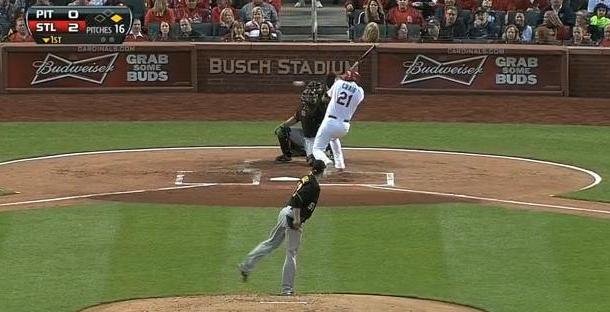
rsz_jonathan_sanchez (1)Jonathan Sanchez insists that the fastball he threw Friday—which nearly hit Cardinals first baseman Allen Craig in the head—was accidental. Sanchez was pitching inside, he said, quoting verbatim from the unofficial handbook of pitcher denials. The ball rose, he said. That was all.

Of course, given the pitcher’s recent struggles, not to mention his history with hot-headedness, questions abound. MLB certainly thought so, suspending him for six games on Saturday.

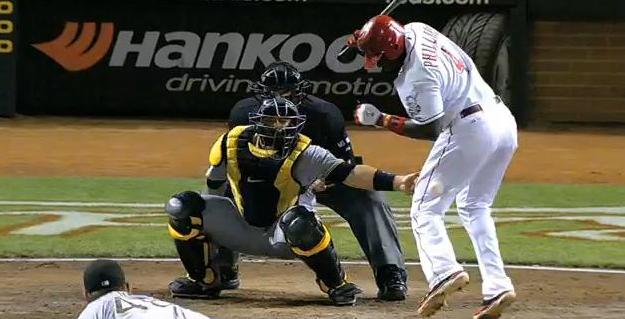
Sanchez opened Friday’s game against St. Louis by giving up back-to-back home runs to Matt Carpenter and Carlos Beltran, followed by a single by Matt Holliday. Sanchez sent his next pitch—apparently out of frustration—toward Craig’s head. (The ball ended up connecting with the spinning hitter’s shoulder.) Plate ump Tim Timmons didn’t hesitate, ejecting Sanchez without so much as a warning.

It was an abhorrent string of hitters in an abhorrent season of starts for Sanchez, who has thrown a total of only 11.3 innings over four outings, with a 12.71 ERA. Twenty-one hits and eight walks. He’s made it to the fifth inning only once. Well, of course he’s frustrated.

“You’ve got two home runs, and then you’ve got a line-drive single up the middle, and then the very first pitch is up around the shoulder and head area,” Timmons told a pool reporter at Busch Stadium. “He threw intentionally at him, and in that area I deemed that intentional, and he’s done. Very dangerous.”

“It surprised me,” Sanchez said in a Pittsburgh Tribune-Review report. “(Timmons) said it was obvious I wanted to hit him. I said no, I just missed my spot.”

Pirates manager Clint Hurdle was outraged at the quick hook, arguing vociferously enough to get tossed himself. After the game he said he was bringing his complaints to the commissioner’s office, although Sanchez’s ensuing suspension gave a pretty good indication about how much attention the commissioner was paying.

Any umpire who feels that a pitcher is intentionally head-hunting is justified in leveling ejections, with or without prior warnings. Timmons earned extra credit by keeping quiet after Cardinals pitcher Lance Lynn later hit Pirates outfielder Starling Marte not once but twice—each almost certainly incidental—even after warnings were issued. (One barely clipped Marte’s hand, the other sailed into his arm, just off the plate; the hitter barely tried to avoid either one.)

Lynn himself was brushed back by Pittsburgh reliever Jared Hughes in the eighth, avoiding a pitch that, because he was squatting while squared to bunt, came in head-high. Lynn ducked backward out of the way, ending up on his back in the batter’s box. Again, Timmons let it slide.

In the eighth, Cardinals pitcher Mitchell Boggs drilled Gaby Sanchez in the back. (This, too, may have been unintentional, given Boggs’s recent struggles and the fact that all three hitters he faced reached base.)

Watch a compendium of the action here. (In an unrelated Code note, watch Pirates catcher Russell Martin jump to get between batter and pitcher in the first clip, as A.J. Ellis wishes he had recently done.)

One takeaway from all this is that an umpire on top of his game can go a long way toward stemming future disturbances. Timmons and MLB seem to agree upon that even one head-hunting incident is too many, and there’s no better way to tamp down the practice than by making examples of pitchers who stray from the proscribed course.

By letting the rest of the game play out as it did—even what appeared to be an obvious message from Hughes to Lynn—Timmons further defused lingering resentment between the clubs. Neither of the weekend games between the team featured much of anything resembling Code-based drama, even with the ample opportunities presented by Pittsburgh’s 9-0 blowout on Sunday.

Ultimately, the situation appears to have been handled just right. The power of positive umpiring. 

Retaliation

Delayed Gratification: Pittsburgh Strikes Back, a Month Later

The hubbub surrounding Brandon Phillipsaccusations of racism helped obscure a profound truth about baseball’s unwritten rules: Teams will wait as long as is necessary to respond to events in which they feel they’ve been significantly wronged.

Phillips getting drilled Monday was at the heart of it, but had little to do with the genesis of the situation. It began on Aug. 3, when Reds closer Aroldis Chapman drilled Andrew McCutchen with a 101-mph fastball. The following day, Reds starter Mike Leake hit Josh Harrison, then descended the mound toward him to deliver a follow-up message.

Of concern to the Pirates was the fact that umpire Brian Gorman issued warnings after the latter incident. It was, I wrote at the time, “an unfortunate development that precluded—correction, delayed—any type of Pittsburgh response.”

The delay is now over. In the eighth inning Monday, Pittsburgh reliever Jared Hughes placed a fastball into Phillips’ left leg. It certainly looked intentional, although the surrounding factors—a 3-3 tie with one out in the eighth is not the prototypical moment for retaliation; a hitter like Phillips, who can run, is not an ideal target, especially with Joey Votto lurking two batters later; and catcher Rod Barajas reached out as if to catch a wayward pitch—suggest otherwise.  (Watch it here.)

Phillips got in some jabs of his own, first picking up the baseball and tossing it toward Hughes—this is the act that is widely assumed to have precipitated Phillips’ post-game tweet claiming racism—then stealing second. (He did not score, and the game went 14 innings.)

As McCutchen jogged toward his dugout following the Reds’ half of the eighth, a clearly perturbed Phillips engaged him with a clear message for somebody on the Pittsburgh bench. That turned out to be Hughes, but by Tuesday the feuding participants reached an accord. Nobody was hit in last night’s game, and no fireworks are anticipated for the teams’ four meetings through the end of the season.

Josh Harrison, Running Into the Catcher

When is the Baseline Not the Baseline? When it’s Your Team’s Catcher Blocking it, Apparently

Cardinals catcher Yadier Molina understands the concept of blocking the plate. So does his manager, Mike Matheny, a big league catcher for 13 seasons. Which is what makes their professed confusion over the propriety of a play in which Molina was bowled over during Tuesday’s 9-0 loss to Pittsburgh so confusing.

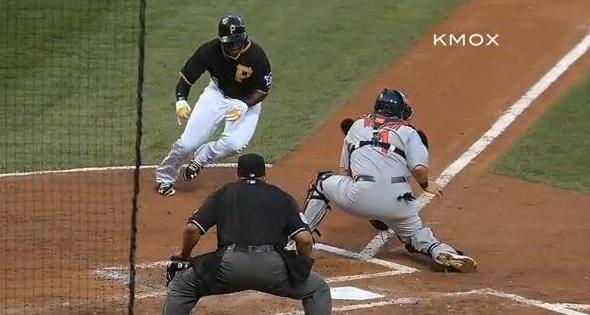
As Josh Harrison rounded third on a second-inning single by Jose Tabata, Molina positioned himself in the baseline, awaiting the throw from right fielder Carlos Beltran.

The catcher’s positioning left Harrison little choice. A slide would have put him into the catcher’s shinguards. A wide-slide-and-swipe-tag combo was also out of the question. So Harrison—only 5-foot-8, but 190 pounds—took what was clearly his best option, and lowered his shoulder.

Molina held onto the throw and tagged Harrison out, but lay in the dirt for several long moments and had to leave the game. (Afterward, his back, shoulder and neck were sore, but he reported no concussion symptoms. Watch the play here.)

A clean, legal play resulted in an out on the basepaths. This didn’t stop Cardinals pitcher Jake Westbrookfrom meting out retaliation in the bottom of the fifth. A 3-0 Pirates lead coming into the frame had grown to 5-0 courtesy of four straight hits to open the inning, and Westbrook faced a first-and-third situation with Harrison at the plate. With second base open and the pitcher frustrated, he acted, drilling the batter in the leg. (Watch it here.)

Plate ump Adrian Johnson showed an unfortunately quick trigger, immediately warning both benches—a decision that elicited an anmiated conversation with infuriated Pittsburgh manager Clint Hurdle, whose team had been stripped of an opportunity to respond to what had effectively been the first shot fired.

A well-blocked plate.

“A baseball play was made at home plate,” he said after the game in the Pittsburgh Tribune-Review. “They decided to pitch Josh Harrison inside and tight. That’s a baseball play. What I was disappointed in is we didn’t have an opportunity to make a baseball play. If (Johnson) thought there was intent to hit him, throw the pitcher out and let’s move on.”

Had Molina given Harrison a lane to the plate—like the one Buster Posey gave to Scott Cousins last season when he was nonetheless knocked over and out for the year—St. Louis would have had a legitimate gripe. As it is, their confused post-game comments seemed unusually pointed. A sampling, from the St. Louis Post-Dispatch:

  • Molina: “I would love for him to slide, but this is baseball. It’s one of those things that is going to happen.”
  • Matheny, on the legitimacy of the play: “What do you mean by legitimate? Everybody has the option to slide. He had an option to slide and he didn’t.”
  • Unnamed Cardinals player: “He probably would have been safe if he had slid. That was not the play.”
  • Carlos Beltran: “A runner has a choice — to slide to home plate or hit the catcher. . . . It’s not a dirty play, but, like I say, you have the choice. Go for the base or try to hit the guy.”

Beltran made the point perfectly, only in reverse. By positioning himself where he did, Molina left Harrison no choice about what to do. The only way to get to the plate was through the catcher.

“When I was about (30 feet) from the plate, I saw him slide his feet back,” said Harrison. “The whole plate was blocked; there was no way to slide around him.”

Perhaps the Cardinals’ players were covering for Westbrook, who likely acted on his own. Maybe they really meant it. Either way, Johnson’s warning delayed until today—the final game between the teams this season—any response for which the Pirates may have opted. If matters are to be further settled, it will happen tonight.

Don't Showboat, Hanley Ramirez

I See You, Too: Ramirez’s Antics Earn Notice

Thursday, the Dodgers should have known better when it came to dealing with umpires during their game against the Pirates. They didn’t, and it cost them.

In the fourth inning of that same game, Hanley Ramirez homered off of A.J. Burnett. Shortly after rounding second base, he made his by-now-patented “I See You” hand gesture—circles with the index finger and thumb of each hand, placed over his eyes like glasses—aimed at the Los Angeles dugout. (Watch it here.)

His sight line, of course, happened to pass close enough to the pitcher’s mound for one of two possibilities: Burnett misunderstood his intention and took the gesture personally, or the pitcher felt that an opposing player had no business participating in bush-league shenanigans while rounding the bases, intention be damned.

In either case, he’d have been correct.

“If you’re going to hit a homer, act like you’ve hit one before,” Burnett told reporters after the game. “The first batter, [James] Loney, hit one, was very professional about it. Ran hard the whole way.”

Ramirez concocted “I See You” as an update to the “Lo Viste” hand gesture he used in Florida, in which members of the Marlins hold a sideways V made with the index and middle fingers over their eyes (as seen here in a different environment.)

“When I got to the Dodgers, I did ‘Lo Viste’ for [former teammate Emilio] Bonifacio a couple times and it was cool,” Ramirez said in a Miami Herald report. “But then I spoke with [Dodgers shortstop]  Dee Gordon and he said, ‘Let’s do something different. You’re no longer in Miami.’ That’s when we tried to do something new and came up with this. It’s all for fun.”

At least until it ticks off a member of the opposition.

“That’s Hanley,” Ramirez’s former manager, Ozzie Guillen, said in an ESPN.com report. “[If] Hanley hit a home run down by 30 runs, he would pimp it. That’s the way he is . . . It surprised me A.J. didn’t drill him.”

Sure enough, Burnett faced Ramirez with two outs and the bases empty in the sixth, with the Pirates holding an 8-4 lead. There would not be a more opportune moment to make whatever statement he felt necessary, but he did not act.

Then again, Burnett also passed up a similar opportunity earlier this season, despite pointing toward the Reds dugout as a means of warning that just such a thing was imminent after Andrew McCutchen was drilled by Aroldis Chapman, and Josh Harrison was hit, then berated, by Mike Leake the next day.

Reaction, of course, is not the focal point of this subject. That would be “I See You,” which is cute and which keeps things loose and which builds morale on a team in a pennant race. All of this is beneficial. To break it out on the field, in game action, while facing an opposing pitcher, however, is nothing short of inane.

Ramirez left Florida in late July in dubious standing with many of his former teammates. Getting any of his new teammates drilled for an ill-considered on-field decision won’t do much to earn him new friends in Los Angeles.

A.J. Burnett, Retaliation

Reds Push Pirates, Pirates Bide Their Time. Slugfest in the NL Central, Anyone?

Clint has his say.

It’s on in Pittsburgh.

Friday, Reds closer Aroldis Chapman drilled Andrew McCutchen with a 101-mph fastball. (Watch it here. Note: No rubbing.) On Saturday, Reds starter Mike Leake hit Josh Harrison, then walked toward him to deliver a follow-up message. (Watch it here.)

Umpire Brian Gorman warned both benches after the latter incident, an unfortunate development that precluded—correction, delayed—any type of Pittsburgh response. (When Pirates manager Clint Hurdle questioned the decision, Gorman promptly tossed him.) It was enough to lead Sunday’s starter, A.J. Burnett to point toward various Reds players from the dugout, the message being that accountability can sometimes be a painful thing, and he was willing to wait to enforce it.

Warnings may have been issued prior to Burnett’s Sunday start, or perhaps it was because it ended up being a close game until the ninth, or maybe it was because the Pirates had already dropped the first two games of the series to their NL Central rivals and were desperate for a victory, but the right-hander went 8 2/3, giving up only three hits and two runs in a 6-2 victory without hitting anybody (and despite two more Pirates, Rod Barajas and Starling Marte, getting hit themselves).

“No one in here has forgotten about what happened to ‘Cutch,” Burnett said in the Pittsburgh Post-Gazette. “We needed a big ‘W’ today.”

“There is a time and a place for [retaliation],” added Barajas. “Today was the time to win. We got that done.”

Pittsburgh did figure out one warning-proof way to make a statement, however. On Saturday, 6-foot-7, 245-pound reliever Jared Hughes tagged out baserunner Dioner Navarro (all 5-foot-9 of him) with a marked shove—a move that Dusty Baker later called “a bully move” in the Cincinnati Enquirer.

The notion of bullying is prominent in these teams’ shared history. It was raised Saturday by Pittsburgh bench coach Jeff Banister, who took over as manager after Hurdle’s ejection. “This is their turf, and they’re trying to bully us,” he said in an MLB.com report.

We’ve heard this story before. From The Baseball Codes:

[Dock Ellis] possessed a clear understanding of the power of intimidation, having seen it in action as his Pittsburgh Pirates teams terrorized the rest of the National League, bullying their way to three division titles and one World Series between 1970 and 1972. In ’73, though, things began to change—the Pirates inex­plicably lost their bravado and many more games than expected, finishing below .500 and in third place in the National League East. When they opened 1974 by lurching into last place with a 6-12 record, Ellis took it upon himself to spur a roster-wide attitude adjustment.

He chose as his victims the Cincinnati Reds, themselves coming off two straight division titles and on their way to ninety-eight wins. If Pittsburgh’s new timidity tipped the balance of swagger in the National League against them, the prime beneficiary was Cincinnati. Ellis wanted to reverse that trend.

“[Other teams used to] say, ‘Here come the big bad Pirates. They’re going to kick our ass.’ Like they give up,” said Ellis in Donald Hall’s book, Dock Ellis in the Country of Baseball. “That’s what our team was starting to do. When Cincinnati showed up in spring training, I saw all the ballplayers doing the same thing. They were running over, talking, laughing and hee-haw this and that. Cincinnati will bullshit with us and kick our ass and laugh at us. They’re the only team that talk about us like a dog.”

When Ellis took the mound against Cincinnati on May 1, 1974, he had only one strategy in mind: to drill every batter that stepped in against him. The first was Pete Rose, who ducked out of the way when a first-pitch fastball sailed toward his head, then jumped forward to avoid the second pitch, which flew behind him. The third pitch, aimed at his rib cage, found its mark. Man on first, nobody out.

The second batter, Joe Morgan, caught Ellis’s first pitch with his kid­ney. First and second, nobody out. Third up: Dan Driessen. Ellis’s open­ing shot sailed high and inside for a ball. The second pitch found the middle of Driessen’s back.

The bases were now loaded, but the pitcher was hardly deterred. Cincinnati’s cleanup hitter, Tony Perez, took stock of the carnage and realized his only possible salvation was to stay light on his feet. He pro­ceeded to dance around four straight offerings—including a near wild pitch that flew behind him and over his head—to draw a walk and force in the game’s first run. When Ellis went 2-0 to Johnny Bench, Pirates man­ager Danny Murtaugh couldn’t take any more and removed the pitcher from the game.

“[Ellis’s] point was not to hit batters,” wrote Hall. “His point was to kick Cincinnati ass.” His point was also to inspire his teammates, to instill a measure of toughness in a languor-prone Pittsburgh squad. It might be coincidence, but after that game—which the Reds won, 5–3—the Pirates went 82-62 and won the National League East for the fourth time in five years.

Trying to intimidate an upstart is hardly new in the pantheon of baseball—just ask Cole Hamels. How the upstart responds is what really matters.

The teams meet again for three in Cincinnati starting Sept. 10, and three more in Pittsburg two-and-a-half weeks later for the season’s final game. Mark your calendars.