A.J. Ellis, Catchers Protect Pitchers

Greinke Takes the Blame for Catcher’s Lack of Action

AJ EllisIn the aftermath of Zack Greinke’s shoulder injury at the hands of Carlos Quentin, some criticism arose of Dodgers catcher A.J. Ellis for not moving more quickly to step between the two—an essential part of a catcher’s job when it comes to such matters. Ellis was unprepared for Quentin’s sudden rush toward the pitcher—and by the time he caught up, it was too late.

Yesterday, Greinke absolved him of responsibility.

“Anyone with the White Sox has always labeled me as someone who does stuff,” Greinke said in a Los Angeles Times story, recounting his encounters with Quentin when he was a member of the Kansas City Royals and Quentin with the Chicago White Sox. “I didn’t think it would happen. Looking back, I should have warned him.”

Greinke also said that the eight-game suspension levied upon Quentin by Major League Baseball seemed appropriate. “To expect the league to do more than that would be pretty crazy,” he said.

(In related news, Padres President and CEO Tom Garfinkel blamed the incident on Greinke and compared the pitcher, who has dealt with social anxiety disorder, to Rainman. There’s an entire chapter of the unwritten rules dealing with restraint from calling out one’s opponent in the press—or even at a meeting of season ticket-holders, which is where Garfinkel made his remarks—although it usually pertains to players, not senior management.)

Don Mattingly, Retaliation

Waiting Game Begins for Dodgers, Padres

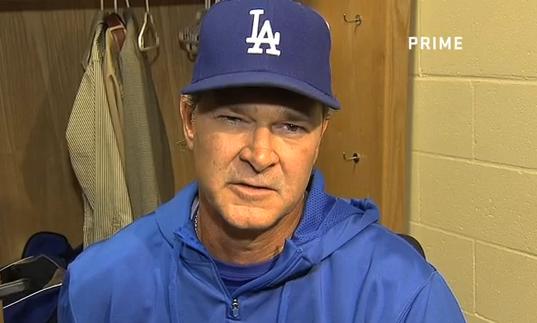
Don Mattingly IICredit Don Mattingly for his honesty.

Talking about the Dodgers’ series against San Diego, which starts today, the skipper said that his team will not be looking for retaliation regarding Zack Greinke’s broken collarbone. Then again, Padres outfielder Carlos Quentin will be elsewhere, having dropped his appeal of the eight-game suspension handed down for his role in the matter. One of Mattingly’s pitchers could make a perfunctory statement by drilling a random Padre (in Los Angeles, on Jackie Robinson day, no less), or they could wait until the teams meet later in the season and send a message directly to its intended target.

Which is precisely what Mattingly hinted might happen.

From the Los Angeles Times:

Asked if he expected the Dodgers to level the score down the road, Mattingly replied, “We’ll just play baseball. We’ll see how the games go. You’ll see.”

You’ll see?

“No, I mean, you can make decisions then,” Mattingly said. “I’m not going to sit here and talk hypotheticals like, ‘Yeah, we’re going to get him back.’ That’s not something you would talk about even if that was part of the deal. You never talk about that.

“We’re trying to win games and trying to win a pennant. Getting retaliation on something is different than protecting your guys.”

Besides, said catcher A.J. Ellis, “Our problem is with one guy, not with their team.”

The reality is that umpires will likely begin today’s series by warning both benches, preventing Dodgers starter Chad Billingsley from going after Padres hitters even if he wanted to, which he insisted he did not.

Billingsley, it should be pointed out, has been criticized in the past for failing to protect his teammates—specifically during the 2008 NLCS, after Philadelphia’s Brett Myers repeatedly came inside on Dodgers hitters.

He likely won’t have to worry about such a reputation following him regardless of what happens Monday. Once the guy the Dodgers want to see is in the lineup, the countdown will begin.

Carlos Quentin, Carlos Quentin, Fights, Retaliation, Zack Greinke

Know Thy Situation, Vol. 219: Quentin Charges Greinke for Reasons That Nobody Else can Quite Fathom, Yet

Quentin-Greinke IIIThe primary question after Carlos Quentin charged Zack Greinke yesterday was one of situational awareness: Was it incumbent upon Quentin to take action in response to a circumstance in which no right-thinking pitcher would intentionally drill an opponent?

Unless the primary question had to do with motivation: Was there something in the history between hitter and pitcher to inspire action in a situation which did not otherwise appear to call for it?

That is, unless the question we’re asking was one of provocation: Was it Greinke’s post-drilling stance—glove tossed, epithets hurled—that actually served as Quentin’s impetus?

In the end, because Greinke’s broken collarbone will extend the ramifications of this brawl for months, all these questions—and more—will continue to be asked for the forseeable future.

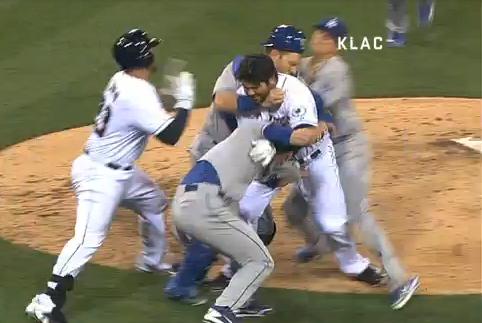
Pertinent details: Quentin, leading off the sixth inning of yesterday’s game in San Diego, was hit in the bicep with a Greinke pitch, dropped his bat, had a brief word with the pitcher, then charged. He threw Greinke to the ground; once the ensuing dogpile broke up, Greinke emerged with a broken collarbone. (Watch it here.)

More details: It was a full-count pitch, with the Dodgers holding a one-run lead, and, had Greinke not left the game, would have forced him to face San Diego’s four-five-six hitters from the stretch. Under no circumstances was this an appropriate situation for vendetta enforcement. (The closest thing to a response-worthy situation earlier in the game was the 0-2 pitch Padres starter Jason Marquis sent toward the head of Matt Kemp in the first inning, but it was easily avoided and tempers did not appear to flare.)

“We’re in a 2-1 game and on a 3-2 pitch to a guy that I see on the [score]board set a record for the Padres by getting hit, a guy who basically dives into the plate,” said irate Dodgers manager Don Mattingly after the game, in an MLB.com report. “In a 2-1 game, we’re trying to hit him, 3-2? It’s just stupid is what it is.”

Another pertinent detail pertains to what Greinke said between his pitch connecting and the batter charging. Quentin did not appear ready to head toward the mound until the pitcher responded to his bristling with what appears to be, based on the video, a solid “fuck you.” Regardless of Greinke’s innocence when it comes to the pitch itself, verbally provoking a guy who outweighs you by 45 lbs. is rarely somebody’s best option.

“It’s an unfortunate situation,” said Quentin. “Myself and Greinke have a history. It dates back a few years. You guys can look it up. It’s documented. It could have been avoided. You can ask Zack about that. For me, I’ve been hit by many pitches in my career. I think you guys know that. I can tell you I’ve never responded in that fashion, so you guys can do your homework on that.”

Because Quentin left the details vague, we can only assume that he’s talking about opening day in 2009, when Greinke, then with Kansas City, hit Quentin, then with the White Sox, in the back. Combined with a pitch earlier in the game that nearly hit Quentin in the head, it inspired the batter to step toward the mound, though not much came of it—until yesterday.

Greinke has hit Quentin three times, more than any other player, but Quentin is generally hit more than any other player—he led the National League in HBPs each of the last two seasons, with six top-5 finishes in his career. (From ESPN: Quentin has also been hit four times by Nick Blackburn, and three times each by Erik Bedard and Jon Lester. He’s also been hit twice by 18 guys. ) He didn’t quite lean into Greinke’s pitch, the topic should be well within his comfort zone.

“I’ve never hit him on purpose,” Greinke said. “I never thought of hitting him on purpose. He always seems to think that I’m hitting him on purpose, but, I mean, that’s not the case. I actually thought it was just a ploy to get people to not throw inside to him. I just feel like he’s trying to intimidate people to throw away. But I don’t know anyone who has hit him on purpose. I know I haven’t. Like I said, I hadn’t even thought about hitting him on purpose before.”

This isn’t the first time a pitcher has been injured in such a fashion. Red Sox pitcher Bill Lee was seriously injured after Yankees third baseman Graig Nettles dropped him on his shoulder during a brawl in 1976. (Lee didn’t even spark the fight—Lou Piniella did, by attempting to kick the ball out of Carlton Fisk’s glove in a play at the plate. Fisk responded by tagging the runner again, this time hard on the head, and things escalated from there.) Nettles picked up the pitcher on the outside of the scrum, but unlike Greinke’s injury it was Lee’s pitching shoulder that was injured; it took him years to recover fully. (Nettles was drilled by the Red Sox two days later, but because he was leading off the 10th inning of a scoreless game, it’d hard to think it was intentional.)

Tommy John suffered a similar injury while trying to fend off a charging Dick McAuliffe in 1968. John’s tweaked shoulder forced an alteration in his delivery that eventually led to an elbow blowout—which resulted in the pioneering surgery that still informally bears his name.

Details from Thursday’s fight—Quentin’s body slam, the Dodgers’ drawn-out anger, Kemp going after Quentin in the players’ parking lot after the game—are incidental.

What matters most to the Dodgers is the amount of time they’ll be without one of the game’s best pitchers, signed in the off-season to a six-year, $147 million contract. Mattingly suggested that Quentin be suspended for the duration of Greinke’s DL stay, but that almost certainly won’t happen. (A six-game suspension is likely, especially considering that Greinke’s injury could just as well have been triggered by the scrum of Padres on top of him in the aftermath as by Quentin’s initial throw-down).

The other question is how long this will linger, and to what extent. Quentin said that “for me, the situation is done,” but MLB is bound to have something to say on the matter.

So will the Dodgers. “There probably is [bad blood] now,” said Greinke. “I don’t know if there was before.” This despite the fact that numerous Padres players reportedly apologized to their Dodgers counterparts as the field cleared.

Also in the crosshair is San Diego’s backup catcher, John Baker, whose verbal delight following Greinke’s injury helped cause the skirmish to re-flare before all the players had even left the field.

San Diego visits the Dodgers on Monday for the first of what will be 15 more games between the teams this season.

Update (4-13): Quentin has drawn an eight-game suspension for his inability to read a game situation, or some such.

Brandon Belt, Retaliation

How You Know You’re No Longer Slumping, Lesson 129: The Other Team Wants to Drill You

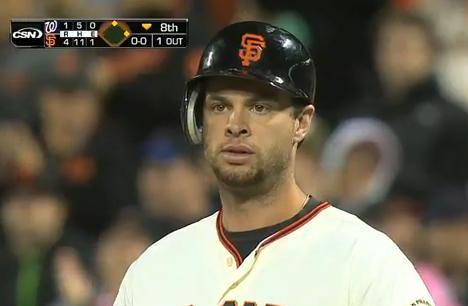
Brandon Belt: Tickled to be so esteemed.

Sometimes it’s okay to be drilled.

When you’re a hitter who as recently as July 24 was batting just .229 and slugging well south of .400, it can feel good to hold target-worthy status, justification be damned.

At least it did for Brandon Belt, who was by every indication hit intentionally by Padres lefty Clayton Richard on Sunday, in response for a Ryan Vogelsong pitch that ran into Carlos Quentin two innings earlier.

After the game, Belt was sporting a sizable welt above his hip, but he didn’t mind. “It’s kind of a compliment, I guess,” Belt, by that point having raised his average to .267, told the San Jose Mercury News. “It’s okay, it’s part of baseball sometimes.”

His picher didn’t agree.

“Go look at the video,” Vogelsong said in a San Francisco Chronicle report. “It was a two-seamer that ran off the plate. That guy hammers balls over the plate, then gets pissed when you throw the ball inside. It doesn’t make sense. Every time you hit a guy in this game, they think you did it on purpose. It’s tired.”

It’s worth noting that Quentin is tied for the league lead with 14 HBPs this year, led the American League last season with 23 for Chicago, and has collected 20 in two other seasons, so it shouldn’t have come as much of a shock.

Still, for some pitchers a hit teammate is a hit teammate, intention aside. The Giants and Padres next meet on September 20, in San Francisco.

Rookie Hazing, Yasmani Grandal

Ice Ice, Baby: Grandal, Frozen Out, Doesn’t Miss a Beat

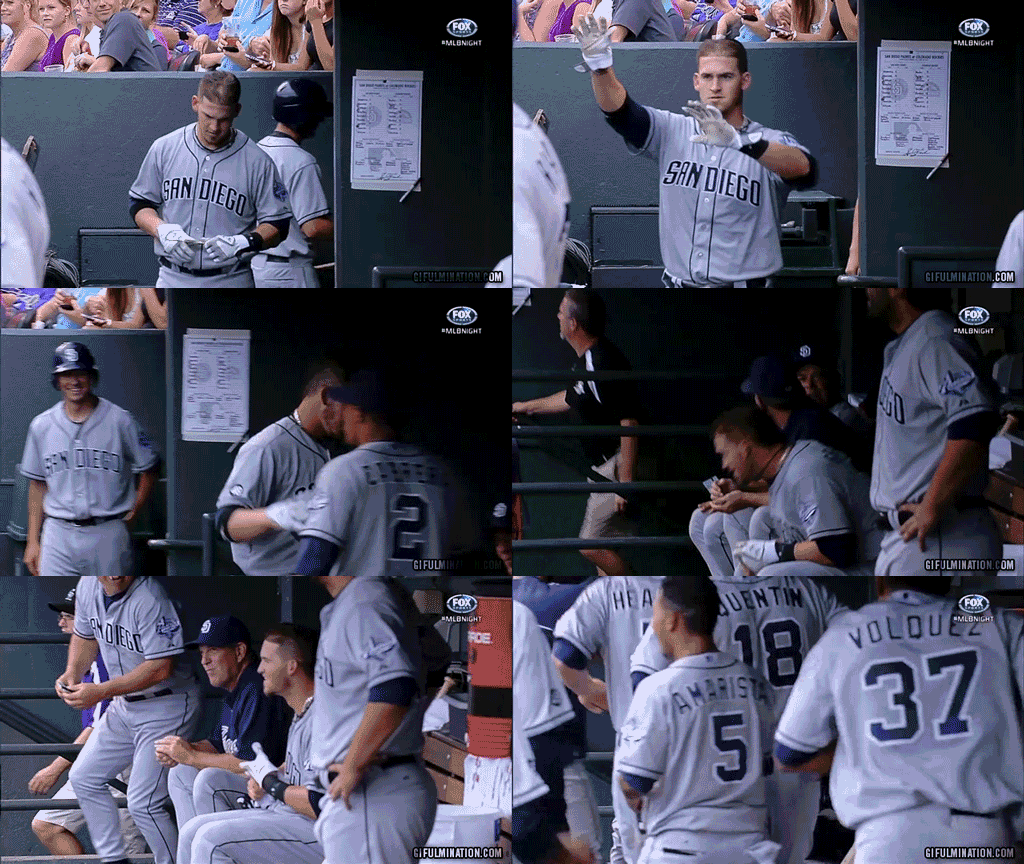
Click for GIF.

There are a lot of reasons to like Padres rookie catcher Yasmani Grandal. His first three hits as a big leaguer have been home runs, including one yesterday. He became the first player in Major League history to homer from both sides of the plate in the same game for the first two hits of his career.

If you think those homers showed composure, they were nothing compared to the rookie’s reaction to the silent treatment he received in the dugout following his first longball. Faced with a shortage of actual teammates to congratulate him, the guy high-fived imaginary Padres instead. (Watch the whole thing here.)

(New York’s Daniel Murphy did something similar last week after snapping a 352-at-bat homerless streak dating back to last season, pumping his fists in the air after his teammates similarly iced him out.)

After all, why wait for others to come through when you can provide for yourself?

(Thanks to reader Steve Kelley for the heads-up. GIF via Gifulmination.)

Andres Torres, Chad Qualls, Showing Players Up

One Man’s Celebration is Another Man’s Disrespect, Chad Qualls Edition

The play that started it all.

There’s a reason that baseball doesn’t have the chest-thumping of the NBA, or the equivalent of a football player leaping up after a two-yard carry with a first-down signal.

Baseball doesn’t have much tolerance for that kind of thing. Save for game-winning plays, look-at-me moments are nearly universally frowned upon.

Which is part of the reason that Andres Torres and the Giants aren’t looking at Chad Qualls in a friendly light today.

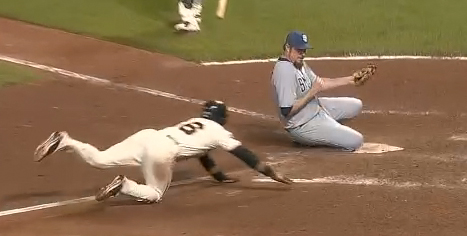
With the Giants trailing 5-3 in the seventh, Torres won his first battle with Qualls, working back from a 1-2 count to see 16 pitches—fouling off 11 of them in an at-bat that took more than eight minutes—before drawing a base on balls. He then stole second, and advanced to third on an infield grounder.

That’s where he was when a Qualls pitch squirted away from catcher Nick Hundley; after delaying to assess the situation, Torres belatedly broke for home.

Hundley’s toss to Qualls, covering the plate, was in plenty of time. Qualls went into a bit of a slide while making the tag and essentially sat on the plate to keep Torres from touching it; the putout ended the inning with San Francisco’s best hitter, Pablo Sandoval, up to bat and the tying run at second. (Watch it here.)

It’s understandable that Qualls was pleased with the development, especially in light of the frustration he must have felt after Torres’ marathon at-bat. Which doesn’t diminish the fact that he spiked the baseball and yelled at Torres on his way back to the dugout.

“That’s not professional,” Torres told reporters after the game. “I don’t believe in making a show on the field.”

Torres talked about respect, both for the game itself and for one’s opponents. He got passionate when discussing his own protracted path to the big leagues, intoning that he’s come to far, at too great a price, to be disrespected like that on the field. (Watch the entire exchange here.)

Direct payback for Qualls is unlikely, since, as a reliever, it’s a longshot that he’ll come to bat against the Giants. Retaliation against one of the Padres’ hitters isn’t out of the question but is similarly unlikely unless San Francisco breaks through with a passel of early runs today, giving their pitchers a bit of leeway when it comes to things like settling scores.

Then again, these teams face each other 14 more times this year. There is, as the saying goes, a lot of baseball yet to be played.

Update: This just in from Dan Brown of the San Jose Mercury News, who tracked down Qualls before today’s game: The reliever doesn’t feel good about what he did. “I’m sorry that it happened,” he said. “I meant no disrespect. That’s not what I intended. I play this game with passion and to, me, that situation was as elevated as it gets for my type of inning.”

– Jason

Clint Hurdle, Dusty Baker, Gamesmanship, Jim Tracy, Kevin Towers, Tony La Russa

Lights, Rain and Radar: How to Get into your Opponent’s Head, an Introductory Course in Gamesmanship

When the lights go down in St. Louis . . .

When the lights went out in St. Louis last night, there were two outs in the 11th inning and San Francisco’s Brian Wilson was on the verge of closing out a 7-5 victory.

Instead, the teams sat for 16 minutes while the sound guy at Busch Stadium played Journey’s “Lights” and somebody tried to deal with the electrical system.

The chatter after Wilson finally returned to record the game’s final out had to do with the possibility of malfeasance on the part of Tony La Russa. Did the Cards’ manager manipulate the power grid in an effort to cool down the opposing closer?

Of course he didn’t. Or at least he probably didn’t. Still, the coincidental timing was enough for Bruce Bochy to quip afterward that it was “pretty good gamesmanship” on La Russa’s part.

The Giants’ skipper was joking, but there’s a reason La Russa’s name comes up during moments like this.

Earlier this year, for example, he was accused of selectively distributing weather information when the Cardinals were hosting Cincinnati, then pitching reliever Miguel Batista instead his scheduled starter, Kyle McClellan. Batista threw all of six pitches before rain halted the game for more than two hours.

Afterward, McClellan, fresh, took his rightful place on the mound.

Dusty Baker, meanwhile, claiming an information inequity between the teams, had his starter, Edinson Volquez, warm up from the get-go. The right-hander never got a chance to pitch, however; when play resumed, Baker had to turn to Matt Maloney rather than risk having Volquez get hot twice.

“It’s really a tough start,” Baker said in an MLB.com report. “The information that we received was probably not the same information they received, or else we wouldn’t have started [Volquez] in the first place. We were told there was going to be a window of opportunity there. That window lasted about three minutes.”

Maloney gave up three runs in three innings, and the Cardinals won, 4-2.

La Russa, of course, is hardly alone when it comes to gamesmanship. In April, Livan Hernandez accused the Pirates of doing much the same thing.

Weather reports, however, are far less interesting than the other tally on Pittsburgh’s gamesmanship scorecard. That came when Clint Hurdle appeared to dupe Rockies skipper Jim Tracy with two outs in the 14th inning of a tie game. With a runner on first, Andrew McCutchen stepped into the on-deck circle as Jose Tabata batted.

That had been McCutcheon’s spot in the order earlier in the game, but the outfielder was removed as part of a double-switch. The guy actually scheduled to hit next was relief pitcher Garrett Olson, whose last plate appearance had come in 2009, and who has collected all of one hit in his five-year career.

Had Tracy been paying better attention, he might have realized that the Pirates’ bench was empty, leaving Olson to fend for himself at the plate.

It never came to that. Seeing McCutchen, Tracy had reliever Franklin Morales pitch to Tabata—who promptly lashed a game-winning double. (Watch it here.)

From the Pittsburgh Post-Gazette: “Asked if the move was a decoy to get the Rockies to think McCutchen was up next … ‘No, come on, why would we do that,’ Hurdle said with a sly chuckle.”

* * *

Rain delays and decoys are one way for a home team to gain an advantage. Radar guns are another.

Earlier this season, Diamondbacks GM Kevin Towers admitted to the Arizona Republic that when he held the same post with San Diego, the Padres took to manipulating their ballpark’s radar gun to get into the heads of opposing pitchers.

“I know for a fact that every time Brad Penny pitched for the Dodgers in San Diego it was probably the lowest velocities he ever had,” he said. “He liked velocity. He’d stare at the board. He was throwing 95-96, but we’d have it at 91 and he’d get pissed off and throw harder and harder and start elevating.”

Hardball Talk’s Aaron Gleeman checked, and—lo and behold—Penny is 1-5 with a 6.47 ERA in 10 career games pitched in San Diego.

(The subject was initially raised when fireballing Aroldis Chapman, after topping out at 106 mph earlier in the season, dropped nearly 15 mph off his fastball in San Diego, then magically regained his velocity during Cincinnati’s next series. Towers’ comments could themselves have been a form of gamesmanship, as his new club uses the non-manipulatable Pitch-f/x system, and the Padres—and all their secrets—are now the enemy.)

The tactic works both ways. During the 2002 postseason, when Robb Nen was throwing pus with a shredded shoulder during what would be the final innings of his career, the folks at AT&T Park shut off the radar gun altogether when the Giants’ closer entered the game. It might not have fooled anyone on the opposing team, but it certainly didn’t hurt.

– Jason

Ben Davis, Curt Schilling, Don't Bunt to Break Up a No-Hitter

Tenth Anniversary of an Unwritten Rule Violation People Still Delight in Referencing

Today marks a decade since Ben Davis bunted on Curt Schilling. If that reference fails to ring a bell, you clearly have some catching up to do. Might I suggest your nearest copy of The Baseball Codes, from which the following passage is excerpted:

Davis came up in the eighth inning as the twenty-third hitter to face Curt Schilling, entirely cognizant that his team was 0-for-22 to that point. Because swinging the bat against the big right-hander had not yet paid dividends, Davis switched gears and, noting the deep positioning of third baseman Craig Counsell, laid down a bunt. Although the execution was lacking—Davis popped the ball up, just over Schilling’s head—the hit nonetheless fell between the mound and second baseman Jay Bell, who was also stationed deep. Davis safely reached base with his team’s first hit.

The Arizona bench exploded at the audacity, calling the player gutless and intoning that he was afraid to take his hacks like a man. To judge the play by the unwritten rules, the Diamondbacks had a point. “The first hit of a no-hitter is not a bunt,” said Kansas City Royals pitcher Danny Jack­son fifteen years earlier, in 1986, after Angels rookie Devon White attempted to break up his own no-hitter with a failed eighth-inning bunt attempt. “I don’t know how long he’s been around,” Jackson said about the outfielder, “but he’s got to go down.” Arizona manager Bob Brenly felt the same way about Ben Davis, calling the play “chickenshit” and saying that Davis “has a lot to learn about how the game is played.”

“It wasn’t the heat of the pennant race in September, or something like that,” said Diamondbacks left fielder Luis Gonzalez. “They say every game counts, but when a guy’s doing something masterful like that, if you get a hit you want to earn it in the right way.” Third baseman Matt Williams said he wouldn’t have done it. First baseman Mark Grace said that, although he didn’t fault Davis, if it was him he wouldn’t have had the balls. Schilling was “a little stunned” at the move; his experience taught him that players should earn their way on base in that type of situation.

There was, however, a mitigating factor. The score of the game was 2–0, and when Davis reached base it brought the tying run to the plate. The Padres clearly hadn’t been getting it done against Schilling in any other regard, so from a strategic standpoint Davis’s approach worked. “I don’t know if you saw my swings against him . . . ,” the catcher said. “I’m just trying to get on base any way I can right there, and I did.”

“What if it’s the seventh game of the World Series? Would they or any­body be upset?” asked Padres manager Bruce Bochy. “No, because that’s a huge game and you’re trying to win.” Arizona, he said, wanted the Padres to “drop our weapons and raise our hands.”

Even Schilling grasped both sides of the argument. Though stopping short of taking Davis’s side, he expressed understanding for those who did. “Whether I agree with it being the right thing to do or not is not really relevant,” he said. “It was a 2–0 game. . . . If it’s 9–0, yeah, I think it’s a horseshit thing to do. But it was a 2–0 game and the bottom line is, unwritten rules or not, you’re paid to win games. That’s the only reason you’re playing in the big leagues.”

One interesting aspect of the play was that even among the ranks of baseball’s old guard—guys who lived for and played by the Code—there was hardly unanimity of opinion. Cases were made both for and against Davis, with precedents cited from every generation—like the bunt by Milwaukee catcher Bill Schroeder that broke up a 1987 no-hitter by Roy­als left-hander Charlie Leibrandt in the sixth inning. Nineteen years after that, when Tampa Bay rookie Ben Zobrist bunted for his team’s first hit in the sixth inning of a game against Seattle’s Jerrod Washburn, the pitcher himself agreed that nothing improper had transpired. “If it was the eighth or ninth, maybe that would have rubbed me the wrong way,” Washburn said, “but bunting is just part of the game, and he was just trying to make something happen.”

The Schilling-Davis affair, however, was full of gray area. Some base­ball people will accept a no-hitter-spoiling bunt if bunting is an estab­lished part of the hitter’s offensive repertoire—but Ben Davis was hardly a bunter. In fact, said Brenly, “That was the only time Ben Davis ever tried to bunt for a base hit to my recollection. . . . For a backup catcher who had never bunted for a base hit before in his life to do it, I thought that was unnecessary to begin with, and disrespectful, to top it off.”

The notion of disrespect stems from the fact that Davis clearly took advantage of Counsell’s extra-deep positioning, as the infielder attempted to protect against hard-hit balls that might otherwise have shot by him. Counsell felt safe at that range because he thought there was little chance that a runner as slow as Davis would so blatantly violate the unwritten rules.

Part of the problem was that Davis’s bunt wasn’t even good enough to benefit from Counsell’s positioning. “I was mad that it was such a bad bunt and was still a hit,” said Schilling. “He bunted as bad a ball as you can bunt, to the most perfect spot in the infield to bunt it. . . . I never said it was a horseshit play. I thought it was a horseshit bunt.”

Once the dust settled a bit, the last man standing at the center of the controversy wasn’t Schilling or even Davis—it was Brenly, who, as the most outspoken critic of the play, was left in its aftermath to defend his initial anger. He has since softened his stance, even going so far as to admit that much of his posturing was simply a matter of standing up for his pitcher, to make sure that “Curt Schilling knew that I was looking out for his interests.”

Still, years after the fact, he had a question for which he says he never received an adequate answer: “If it’s such a good fuckin’ play, why didn’t he do it every time?”

– Jason