Rookie Hazing, Umpire Relations

Rookie Tossed, Manager Tight, Tradition the Same as it Ever Was

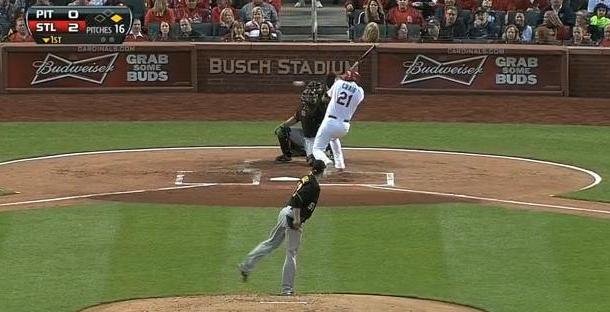
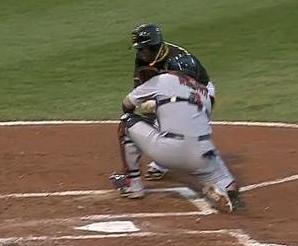
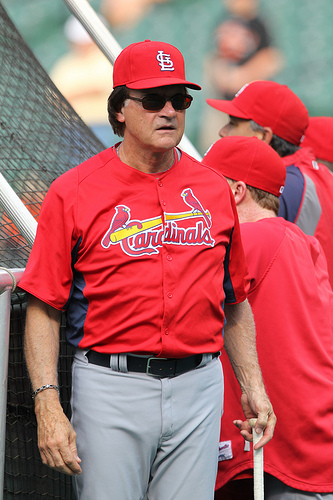
Matheny tossedMike Matheny is apparently not a fan of rookie treatment, at least when it comes to umpires. On Thursday, St. Louis’ first-year first baseman Matt Adams struck out in the ninth inning, on what he considered to be a high, inside pitch. He questioned plate ump Dan Belino, then, on his way back to the dugout, turned around and questioned him again.

Belino shooed him away. The gesture was more than Matheny was willing to tolerate. Once closer Kevin Gregg had sealed the Cubs’ 3-0 victory moments later, Matheny raced toward Belino, to the point of necessitating restraint from the rest of the umpiring crew. (Watch it here.)

His frustration, he told reporters after the game, had less to do with the strike call than “with the umpire and how he mistreated one of our players, Adams.”

“It’s ridiculous,” Matheny said. “You can’t take your mask off and motion somebody away. We had not had any trouble. We hadn’t been complaining all game long. He wanted to be seen, so now he’s going to be seen.”

There is, however, something else at play: If the unwritten rule that labels such a display disrespectful constitutes one side of the coin, the other side is covered by the notion that rookies must earn their place in the game. This is true within clubhouse hierarchies, and it is true when it comes to umpires. Although it is generally less prevalent now than in past generations, umpires throughout the game’s history have taken the position that young players must earn their respect, and will test them accordingly to push the issue.

Last year Bryce Harper felt it with Angel Hernandez’s strike zone. If it was a test, Harper failed, badly.

A similar story comes to us courtesy of Hall of Famer Catfish Hunter. In his autobiography, Catfish: My Life in Baseball, he described a confrontation during his rookie season in 1965:

One of the biggest lessons I learned came courtesy of senior umpire Ed Runge. “You’ll like this guy, Cat,” my teammates told me the first time Runge was behind the plate. “He gives you everything.”

Great. A friend in high places. I fired my first pitch, a fastball, right down the middle.

“Ball,” screamed Runge, yanking off his mask like someone had just yelled “Fire!” He stared out at the mound, begging me to argue. I didn’t say a word.

Another pitch. Another fastball right down Main Street.

“Ball two!”

Same yank. Same look. Still I don’t say boo.

We play the same game a couple of more times—me throwing strikes, Runge playing hard to please—and still I don’t let out a peep. A few weeks later Runge is set to go behind the plate again. Before the game, we happened to meet.

He gives me a quick once-over. “I see you don’t argue with umpires, kid.”

“No, sir,” I said.

A smile. “It’s a good thing.”

From then on I was a card-carrying member of the Ed Runge Club. Anything close was a strike. I’d passed the test.

Credit Matheny for protecting his players, but if Belino was hoping to see from Adams something similar to the deference that Runge got from Hunter, he’s going to have to wait a while.
Retaliation

Matt Carpenter, Drilled Three Times: ‘I Wouldn’t Expect Anything Different.’ St. Louis Responds Accordingly

3When a pitcher clearly has no intention of hitting a batter, the act is unlikely to draw much in the way of rebuke. When it happens three times in the same game, however, to the same batter, you better believe that an eyebrow will be raised.

On Tuesday, Cardinals second baseman Matt Carpenter hit the trifecta against Arizona. More appropriately, Arizona hit the trifecta against Carpenter. None of the pitches came close to looking intentional.

* First time: Seventh inning,  St. Louis trailing by one run and a man on first with one out. Not a situation for a pitcher to make a statement, not to mention that the ball hit Carpenter’s hand as he was squaring to bunt.

* Second time: Ninth inning, one out in a tie game. Again, not a situation for a pitcher to make a statement.Carpenter was hit on the forearm with a pitch that darted inside at the last moment.

* Third time: This looked like the most intentional of the bunch, but drilling somebody on purpose in the 13th inning of a tie game is simply not done. (Watch them all here.)

There was no lingering disagreement between Carpenter and an angry D’Backs pitcher, because each of his HBPs came against a different guy. For each of the pitches the catcher was set up inside.

“That’s what they wanted to do to me and a couple of other left-handers,” said Carpenter, who was hit three times all last season, in the St. Louis Post-Dispatch. “I wouldn’t expect anything different. You miss in two spots. Either you miss over the plate or you miss and hit somebody. It’s just the way it is when you pitch inside.”

Still, a three-pack of HBPs is a three-pack of HBPs. The Cardinals, however, were walking a fine line when it came to payback on Wednesday. St. Louis already had a short bullpen due to a doubleheader last week; the 14 innings on Tuesday added additional strain. Also, Yadier Molina dropped his suspension appeal following his recent ump-bumping incident (itself laden with unwritten rules) and sat out Wednesday (which he would have done anyway, following Tuesday’s marathon).

All of which is to say that St. Louis, already undermanned, could hardly afford to have a pitcher or a catcher tossed in the name of fulfilling retaliatory expectations. Were there going to be payback, it had to be subtle.

And it was, right there in the first inning. When Carpenter’s second-base counterpart on the Diamondbacks, Willie Bloomquist, came up for his first at-bat on Wednesday, he was buzzed—a fastball came in just under his armpits—not drilled. The Cardinals left little doubt that they were paying attention.

Cardinals broadcasters Dan McLaughlin and Ricky Horton (a former big league pitcher himself) summed it up nicely on the telecast:

DM: There’s someone from Arizona who needs to properly, professionally get one in the ribs or the back, because Matt Carpenter was hit three times last night.

RH: I think that we just saw it.

DM: That’s not enough if I’m Matt Carpenter. What did that prove? You pitched inside. So what?

RH: Well, he came in way inside, with the idea. I think the message was sent. There was no pain to it, if that’s what you’re looking for.

DM: I want pain. [Laughs]

RH: I thought that’s where you were headed with that.

DM: Pain, Rick.

RH: Well you have the message and you have pain, Dan. You’ve sent the message and maybe you were a little light on the pain.

McLaughlin clarified that he was kidding about the pain, Horton added that a subtle message worked just fine in this situation, and everybody appeared to be happy to move on.

(St. Louis pitchers did hit Bloomquist in the seventh, and shortstop Didi Gregorius twice, but all seemed to lack intent. Gregorius was hit by a 74 mph slider with a runner on second and nobody out in a one-run game, Bloomquist was hit later that inning with two men on in a tie game, and Gregorius was hit again in the eighth with a splitter.)

Questions about delayed payback were answered on Thursday, when the Cardinals faced a 12-2 deficit in the sixth, and opted not to drill any Arizona hitters.

It all adds up to a lot of thought devoted to a series of unintentional events, but that’s the way the game is played.


Serious thanks to Cards fan Chris C. for the heads-up and broadcast transcription.

Unwritten-Rules

To Bunt or Not to Bunt, That is the Question—Even if it Doesn’t Make Much Sense

Kyle LohseWe may have found a new unwritten rule in Busch Stadium on Sunday. Either that, or Kyle Lohse is completely off his rocker.

Lohse allowed six singles to the first seven batters he faced in the fourth inning (including a bases-loaded squeeze beaten out by Pete Kozma), during which time he allowed four runs. That left runners at first and second, with one out, for pitcher John Gast.

Gast squared to bunt, but pulled the bat back at the last moment to swing away. This is not an unusual baseball move, especially for a pitcher, when the opposing third baseman is charging hard. Lohse, however, was irate, and threw three consecutive pitches high and inside. Gass eventually bunted into an out.

The act might have been explainable as an anti-bunt strategy had Lohse not immediately thereafter shared some heated thoughts with Cardinals third base coach Jose Oquendo, then continued the conversation with catcher Yadier Molina when he came to the plate the following inning.

“They know what I had to say,” Lohse said in an MLB.com report. “It had nothing to do with the squeeze or anything like that. It was something that happened after that. … I’ll leave it at that. They know.”

Ultimately, St. Louis Post-Dispatch columnist Bernie Miklasz may have offered the clearest-eyed viewpoint, speculating that Lohse was ticked that after five seasons in St. Louis A) the Cards didn’t keep him on their roster in favor of going with young pitchers, which B) left him first in free-agent purgatory and C) then with the last-place Brewers. There’s also D) the notion that Lohse is 1-5, despite pitching well this season, and that E) three of those losses have come at the hands of two of the young pitchers chosen by St. Louis to take his place—Shelby Miller and, last night, Gast. With that in mind, it makes sense that the pitcher’s fuse is a bit short. (Miller also did the square-to-bunt-and-pull-the-bat-back move against Lohse earlier in the season.)

On strictly baseball terms, given the information that’s currently available, Lohse doesn’t have a leg to stand on. (He also positioned himself as the anti-Nolan Ryan, who was known for drilling guys who tried to bunt on him. Lohse, it seems, was perturbed that a guy tried to not bunt on him.)

Lohse didn’t hit Gast, so no harm was actually done, but he was clearly pitching angry. It does not appear to be a retaliation-worthy offense, but stay tuned—these teams play each other nine more times this year.

(H/T Bill Ivie of I-70 Baseball.)

Jonathan Sanchez, Retaliation, The Baseball Codes, Umpire Warnings, Umpires Knowing the Code

Toss Him Out! Let Him Play! The Importance of Understanding that not Every Situation is Exactly the Same

rsz_jonathan_sanchez (1)Jonathan Sanchez insists that the fastball he threw Friday—which nearly hit Cardinals first baseman Allen Craig in the head—was accidental. Sanchez was pitching inside, he said, quoting verbatim from the unofficial handbook of pitcher denials. The ball rose, he said. That was all.

Of course, given the pitcher’s recent struggles, not to mention his history with hot-headedness, questions abound. MLB certainly thought so, suspending him for six games on Saturday.

Sanchez opened Friday’s game against St. Louis by giving up back-to-back home runs to Matt Carpenter and Carlos Beltran, followed by a single by Matt Holliday. Sanchez sent his next pitch—apparently out of frustration—toward Craig’s head. (The ball ended up connecting with the spinning hitter’s shoulder.) Plate ump Tim Timmons didn’t hesitate, ejecting Sanchez without so much as a warning.

It was an abhorrent string of hitters in an abhorrent season of starts for Sanchez, who has thrown a total of only 11.3 innings over four outings, with a 12.71 ERA. Twenty-one hits and eight walks. He’s made it to the fifth inning only once. Well, of course he’s frustrated.

“You’ve got two home runs, and then you’ve got a line-drive single up the middle, and then the very first pitch is up around the shoulder and head area,” Timmons told a pool reporter at Busch Stadium. “He threw intentionally at him, and in that area I deemed that intentional, and he’s done. Very dangerous.”

“It surprised me,” Sanchez said in a Pittsburgh Tribune-Review report. “(Timmons) said it was obvious I wanted to hit him. I said no, I just missed my spot.”

Pirates manager Clint Hurdle was outraged at the quick hook, arguing vociferously enough to get tossed himself. After the game he said he was bringing his complaints to the commissioner’s office, although Sanchez’s ensuing suspension gave a pretty good indication about how much attention the commissioner was paying.

Any umpire who feels that a pitcher is intentionally head-hunting is justified in leveling ejections, with or without prior warnings. Timmons earned extra credit by keeping quiet after Cardinals pitcher Lance Lynn later hit Pirates outfielder Starling Marte not once but twice—each almost certainly incidental—even after warnings were issued. (One barely clipped Marte’s hand, the other sailed into his arm, just off the plate; the hitter barely tried to avoid either one.)

Lynn himself was brushed back by Pittsburgh reliever Jared Hughes in the eighth, avoiding a pitch that, because he was squatting while squared to bunt, came in head-high. Lynn ducked backward out of the way, ending up on his back in the batter’s box. Again, Timmons let it slide.

In the eighth, Cardinals pitcher Mitchell Boggs drilled Gaby Sanchez in the back. (This, too, may have been unintentional, given Boggs’s recent struggles and the fact that all three hitters he faced reached base.)

Watch a compendium of the action here. (In an unrelated Code note, watch Pirates catcher Russell Martin jump to get between batter and pitcher in the first clip, as A.J. Ellis wishes he had recently done.)

One takeaway from all this is that an umpire on top of his game can go a long way toward stemming future disturbances. Timmons and MLB seem to agree upon that even one head-hunting incident is too many, and there’s no better way to tamp down the practice than by making examples of pitchers who stray from the proscribed course.

By letting the rest of the game play out as it did—even what appeared to be an obvious message from Hughes to Lynn—Timmons further defused lingering resentment between the clubs. Neither of the weekend games between the team featured much of anything resembling Code-based drama, even with the ample opportunities presented by Pittsburgh’s 9-0 blowout on Sunday.

Ultimately, the situation appears to have been handled just right. The power of positive umpiring. 

Matt Cain, Matt Holliday, Matt Holliday, Retaliation, Slide properly

Holliday’s Had It: Calls out Cain for ‘Less Than Tough’ Retaliation

For those who think that Matt Cain waited to long to retaliate against Matt Holliday—the outfielder’s questionable slide into Giants second baseman Marco Scutaro occurred in Game 2 of the NLCS, and he was drilled a week later, in Game 7, once the series was salted away—Holliday put that timetable to shame.

Precisely one month after his slide, and three weeks after Cain drilled him, Holliday addressed the topic in an Insidestl.com report, calling it, among other things, “less than tough”:

[The pitch] seems on purpose. I wish that if he wanted to hit me, he would’ve just done it on the first pitch in the next game he had pitched. You know, if you’re going to do it, do it, get it out of the way. But to do it, I don’t remember what the score was but it was out of hand, that’s about it. I thought the timing of it was….I don’t want to get into it. I wasn’t thrilled about it. . . .

If you’re going to do it, I think that is when you do it. I wouldn’t be happy about it anytime. I just thought that in the situation that it actually did happen it was less than tough.

It might seem odd for Holliday to express displeasure with Cain’s delay weeks after the fact, when he could have done it immediately following the game in which it happened. To be fair, he was answering a question, not promoting an agenda, and it’s not like Cardinals players had much media time once they’d packed their bags for the winter upon returning to St. Louis.

It’s unlikely that this will further ill feelings come 2013, but also serves to remind us that another incident—one of Cain’s pitches slips, perhaps, or Holliday again takes out a middle infielder—will not be easily digested by the other side.

(Via HardballTalk.)


Matt Cain, Matt Holliday, Retaliation

Holliday on Ice: Giants Finally Exact Revenge

Good things come to those who wait.

Determined to avoid compromising NLCS victory by retaliating for Matt Holliday’s Game 2 slide into Marco Scutaro—which was called everything from illegal (by Bruce Bochy) to dirty (by all manner of Giants fans)—Matt Cain waited until it would hurt the Cardinals most, and the Giants least, to respond.

St. Louis, trailing 7-0 in the sixth inning of Monday’s deciding Game 7 on an electric San Francisco night, appeared too stunned by the score to be able even to fully absorb the intent behind the pitch. Before the ball connected with Holliday’s left tricep, it had long since been assumed that the Giants would let his slide go unanswered.

Cain, we now know, has a longer memory than the Cardinals anticipated. (Watch it here.)

St. Louis players were already wearing long faces as they counted down outs toward what already appeared to be an inevitable, inexorable slide from the postseason. Before the drilling—as sure an intentional pitch as has been thrown all season—it seemed impossible that the Giants or their home crowd could be any more pumped up than they already were.

As soon as ball bounced off batter, however, it was clear that such a notion was folly. AT&T Park, we found out, does indeed go to 11—especially when the frontier justice runs in their favor.

Matt Holliday, Slide properly

Slide, Baby, Slide: Holliday Hammers Home Controversy in Game 2

The Giants said all the right things Monday about Matt Holliday’s slide. Although they universally questioned its timing, placement and function, to a man they denied feeling like Holliday intended to injure Marco Scutaro.

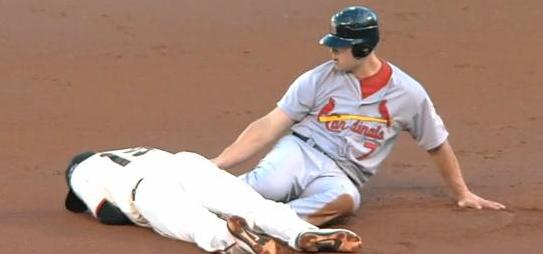
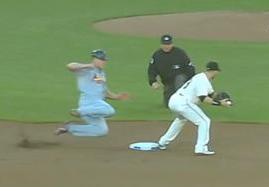
Unfortunately, he did injure Scutaro. After Holliday took San Francisco’s second baseman out, breaking up a double-play with a chop block to the knees, Scutaro responded with two hits in three at-bats before being removed from the game and taken to the hospital for tests. (Watch it here, or a gif of the play here.)

The Giants, hewing to propriety, said all the right things. Hall of Famer Craig Biggio, however, summed up the parameters fairly neatly in an interview for The Baseball Codes.

“The only time I have a problem with any opponent is if you slide on the back side of the base—if you jump over the base and then slide,” he said. “If you slide in front of the base, even you end up against the wall in left field, I could care less—as long as you start in front of that base. But if you jump slide on the back side of that base, that shows intent to separate somebody’s knees or legs, and that’s dirty play.”

Holliday’s slide met that description perfectly: He left the ground in front of the base and landed on the back side of the bag—directly into Scutaro’s legs. Bruce Bochy called the slide “illegal.”

A counter opinion comes from Mike Krukow, the ex-Giants pitcher who called Holliday’s slide as a member of the team’s broadcast crew. From The Baseball Codes:

Low barrel rolls [are] acceptable. When A-Rod took out Jeff Kent and sprained Kent’s right knee in 1998, he [low] barrel-rolled him. On TV that night, Kuip [Krukow’s broadcast partner, Duane Kuiper, a twelve-year major-league second baseman] and I said, That’s a legit play. After the game, Kent was pissed about it. He said that was a horseshit slide. No, it’s not. Basically, a low barrel roll— anything within arm’s distance of the bag—is acceptable. (Acceptable or not, the following night, Giants pitcher Orel Hershiser drilled Rodriguez in the shoulder.)

The Giants did not respond on Monday—Holliday went 0-for-3 against Ryan Vogelsong and Jeremy Affeldt the rest of the way—even with first base open in the third, and a four-run lead in the fifth and eighth. Bochy said that Scutaro is probable for tonight’s Game 3, and downplayed any talk of retaliation, but if it’s determined that Scutaro will miss time, it wouldn’t be shocking to see some fireworks. (“If one gets away,” Matt Cain told Andrew Baggarly, “one gets away.”)

Even Cardinals manager Mike Matheny seems to understand this. “We do play hard and we understand that they play hard,” he said in a San Jose Mercury News report. “That’s the way the game goes.”

For his part, Holliday responded appropriately after the fact, checking with catcher Buster Posey about Scutaro’s well being prior to his next at-bat (asked if he scolded Holliday during the exchange, Posey laughed and said no), and calling the clubhouse after the game. (Scutaro had already left to have tests done.)

Holliday has a reputation for going in hard to bases, so Monday’s slide was not out of character in that regard. Hal McRae had a similar reputation, but he took things to such an extent that legislation was enacted to counter his tactics. McRae’s takeout slide of New York’s Willie Randolph in the 1978 playoffs helped lead to the “Hal McRae rule,” stipulating that a runner must have at least a pretense of reaching the base while taking out an opposing fielder.

At least Holliday touched the bag.

Until Game 3 tonight, settle for the below clip of Joe Morgan taking out Dick Green in the 1972 World Series (It’s the second play in the clip.), which has been making the rounds. It’s primarily valuable to help illustrate the fact that baseball has toned down its act, and that—partly thanks to things like the Hal McRae rule—significant amounts of basepath violence have been removed from the action.

Josh Harrison, Running Into the Catcher

When is the Baseline Not the Baseline? When it’s Your Team’s Catcher Blocking it, Apparently

Cardinals catcher Yadier Molina understands the concept of blocking the plate. So does his manager, Mike Matheny, a big league catcher for 13 seasons. Which is what makes their professed confusion over the propriety of a play in which Molina was bowled over during Tuesday’s 9-0 loss to Pittsburgh so confusing.

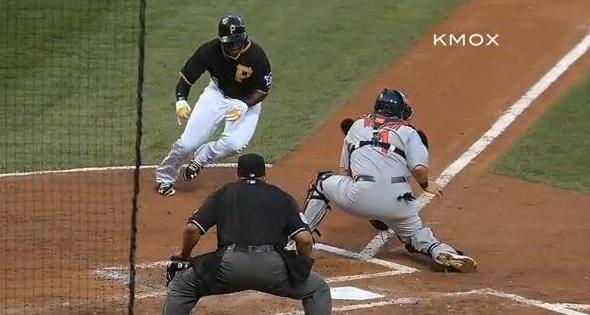
As Josh Harrison rounded third on a second-inning single by Jose Tabata, Molina positioned himself in the baseline, awaiting the throw from right fielder Carlos Beltran.

The catcher’s positioning left Harrison little choice. A slide would have put him into the catcher’s shinguards. A wide-slide-and-swipe-tag combo was also out of the question. So Harrison—only 5-foot-8, but 190 pounds—took what was clearly his best option, and lowered his shoulder.

Molina held onto the throw and tagged Harrison out, but lay in the dirt for several long moments and had to leave the game. (Afterward, his back, shoulder and neck were sore, but he reported no concussion symptoms. Watch the play here.)

A clean, legal play resulted in an out on the basepaths. This didn’t stop Cardinals pitcher Jake Westbrookfrom meting out retaliation in the bottom of the fifth. A 3-0 Pirates lead coming into the frame had grown to 5-0 courtesy of four straight hits to open the inning, and Westbrook faced a first-and-third situation with Harrison at the plate. With second base open and the pitcher frustrated, he acted, drilling the batter in the leg. (Watch it here.)

Plate ump Adrian Johnson showed an unfortunately quick trigger, immediately warning both benches—a decision that elicited an anmiated conversation with infuriated Pittsburgh manager Clint Hurdle, whose team had been stripped of an opportunity to respond to what had effectively been the first shot fired.

A well-blocked plate.

“A baseball play was made at home plate,” he said after the game in the Pittsburgh Tribune-Review. “They decided to pitch Josh Harrison inside and tight. That’s a baseball play. What I was disappointed in is we didn’t have an opportunity to make a baseball play. If (Johnson) thought there was intent to hit him, throw the pitcher out and let’s move on.”

Had Molina given Harrison a lane to the plate—like the one Buster Posey gave to Scott Cousins last season when he was nonetheless knocked over and out for the year—St. Louis would have had a legitimate gripe. As it is, their confused post-game comments seemed unusually pointed. A sampling, from the St. Louis Post-Dispatch:

  • Molina: “I would love for him to slide, but this is baseball. It’s one of those things that is going to happen.”
  • Matheny, on the legitimacy of the play: “What do you mean by legitimate? Everybody has the option to slide. He had an option to slide and he didn’t.”
  • Unnamed Cardinals player: “He probably would have been safe if he had slid. That was not the play.”
  • Carlos Beltran: “A runner has a choice — to slide to home plate or hit the catcher. . . . It’s not a dirty play, but, like I say, you have the choice. Go for the base or try to hit the guy.”

Beltran made the point perfectly, only in reverse. By positioning himself where he did, Molina left Harrison no choice about what to do. The only way to get to the plate was through the catcher.

“When I was about (30 feet) from the plate, I saw him slide his feet back,” said Harrison. “The whole plate was blocked; there was no way to slide around him.”

Perhaps the Cardinals’ players were covering for Westbrook, who likely acted on his own. Maybe they really meant it. Either way, Johnson’s warning delayed until today—the final game between the teams this season—any response for which the Pirates may have opted. If matters are to be further settled, it will happen tonight.

Retaliation, Tony La Russa

Yes, There’s a Chance that Tony La Russa, Baseball’s Resident Expert on Retaliation, May Soon Get Even More Verbose on the Topic

They say retirement softens people. It remains to be seen whether Tony La Russa might fall into this category, but in the short term, his newfound freedom seems to have loosened his lips.

While managing the Cardinals last season, La Russa was in no position to discuss the detailed merits of various incidents that were widely construed to be retaliation on the part of the St. Louis pitching staff. Now that he’s beyond repercussions from the commissioner’s office, however, state secrets may be beginning to spill.

It started Friday, when La Russa opened up a bit about a game last year in which Cardinals reliever Jason Motte drilled Ryan Braun, an inning after the Brewers had—unintentionally, by all indications—hit Albert Pujols. Looking back, the ex-manager said, according to the St. Louis Post-Dispatch, that it had been his “responsibility” to respond.

It shouldn’t be all that surprising, really. Even at the time of the incident, La Russa pressed the boundaries of what he could get away with, saying, “We threw two balls in there real good just to send a message. If he ducks them, it’s all over and we don’t hit him.” If anybody in baseball has a deeper love of eye-for-an-eye on-field justice, he has yet to be found.

Heck, an entire book—Buzz Bissinger’s Three Nights in August—is devoted to intricate detail about La Russa’s inner machinations as he pondered whether or not response was merited in various situations. To believe the book, the guy likes to ponder. A lot.

La Russa has yet to go into too much detail about anything untoward, and his consideration for a VP post within Major League Baseball could well change everything, but at the very least, Friday gave us an inkling about what it could be like should the reigning master of retaliation ever decide to truly speak freely on the topic.

We can only hope.

– Jason

Jeffrey Leonard, Jeffrey Leonard, Retaliation, Showing Players Up

We Must Be in the Front Row: Not First Time for Ticket Mixup at Busch

The view shared by members of the Brewers' traveling party?

Between the name-calling and the occasional hit batter and the Beast Mode, this Brewers-Cardinals NLCS has not been short on tempestuous fun.

Wednesday, however, things took a bit of a different turn. Whether it’s a bizarre form of institutional retaliation or simply shoddy planning, St. Louis’s decision to forgo the standard seating section for the families of Brewers players and staff—opting instead to spread them out around the ballpark—has been met with considerable anger.

“It’s bush,” said Nyjer Morgan in an ESPN.com report. “Our families, they’ve got to be secured. It’s kind of garbage. We put their [families] in a secure section and then they want to spread ours out. I don’t know why they play the mental games, but that right there, they shouldn’t play the games right there because that’s our family and our family has got to be secure. But that’s just them, that’s how they operate right there I guess.”

Leading to the theory that the decision was directly influenced by the team’s dislike for the Brewers is the fact that St. Louis reserved precisely such a section for its opponent in the NLDS, the Phillies. Cardinals GM John Mozeliak denied that gamesmanship was behind the decision, but at the very least, the club has some precedent on which to build.

During the 1987 NLCS against San Francisco, Giants players were dismayed to find out that their families had been relegated to the far reaches of the ballpark. The incident was referenced briefly in The Baseball Codes; here’s a more robust version of the story:

Giants slugger Jeffrey Leonard introduced the phrase “one flap down” into the American lexicon during the playoffs in 1987. That was the name of the peculiar home-run trot he had devised (but rarely used) the previous season, during which he let his left arm dangle limply at his side while dipping his inside shoulder into the turn at each base. The slugger decided to resurrect the practice after he and teammates noticed that the Cardinals organization placed Giants family members and friends in nosebleed seats for the first playoff game in St. Louis.

“We peeked out of the [Busch Stadium] dugout and saw where they were sitting, and we all got angry,” he said. “So I said to myself, if I hit a home run I’m just going to clown this fool out there.”

Leonard had plenty of opportunities to clown plenty of fools in the coming days, as he hit four homers over the seven-game series—a performance so dominating that he was named series MVP, even though his team lost. For each of those homers, his arm hung low to his side, which infuriated the Cardinals and their fans. (As did the fact that Leonard’s teammate Chili Davis called St. Louis a “cow town” to the press, a comment that got considerable run near the Gateway Arch.)

Leonard had come upon his trot by accident during a 1986 game, after he hit a home run against Chicago’s Scott Sanderson. First base coach Jose Morales, who usually met passing runners with an arm raised for a high-five, this time had his hands at his sides. It wasn’t until Leonard was atop the bag, ready to turn toward second, that Morales’ arm shot into the air in a belated attempt at congratulation. Leonard’s instinctive response was to duck under it, dropping his left shoulder in the process and letting his arm dangle as he rounded the base. Then, for reasons he can’t much explain, he held the pose as he continued the circuit.

The Brewers have plenty of ready-built responses of their own to call upon, starting with various permutations of Beast Mode and ending with Morgan’s T-Plush signs.

They should be wary, however: Leonard was drilled for his actions by Bob Forsch in Game 3 back in ’87; a similar response from Tony La Russa’s Cardinals would hardly be unusual.

Update (10-18): Apparently that wasn’t all of it. Now that the NLCS is complete, we hear that Zack Greinke‘s wife, Emily, was none too pleased with her seats, tweeting during a game in St. Louis that she’d been relegated to a spot down the left-field line. The tweet has since been deleted, but Larry Brown Sports saved the accompanying picture, allegedly shot on location.

– Jason