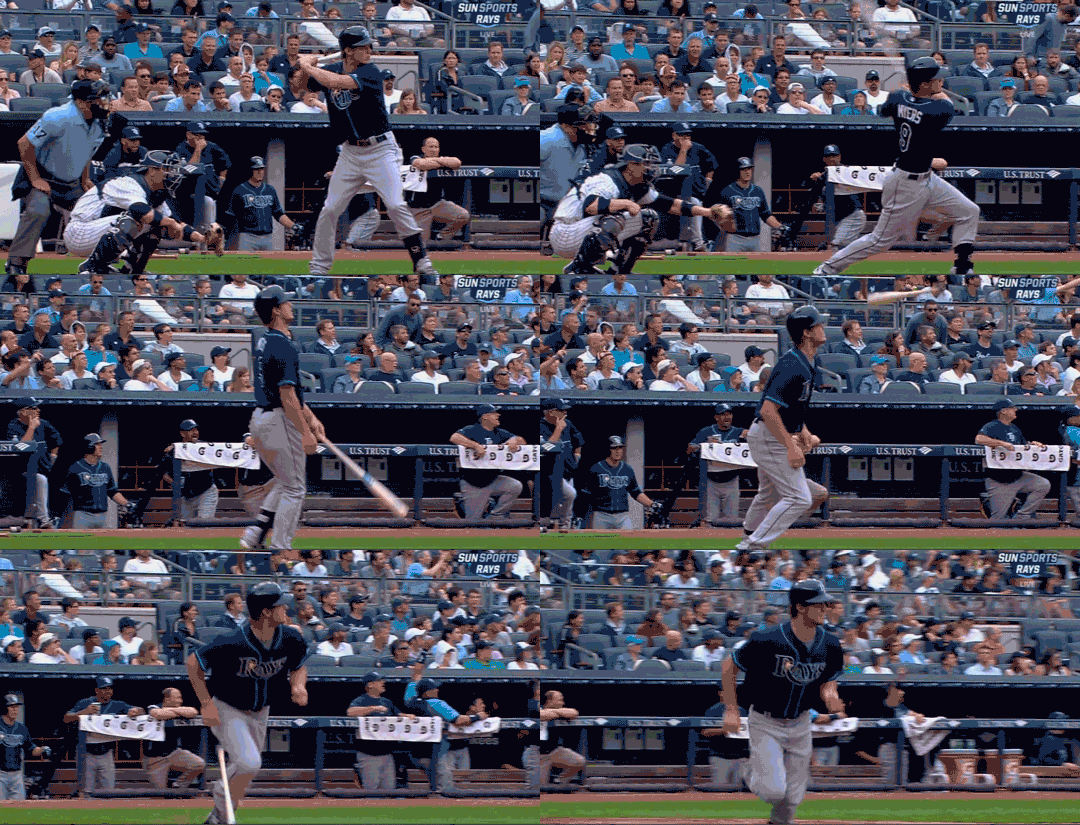
We’ve already discussed Tampa Bay rookie Wil Myers‘ predilection for styling after he hits a home run. Nobody’s has responded as of yet. Which might be the reason that not only is he continuing to do it, but he seems to be one-upping himself with every effort.
During the decade spanning 2000 to 2010, they were involved in a series of skirmishes significant enough to merit an entire section in The Baseball Codes.
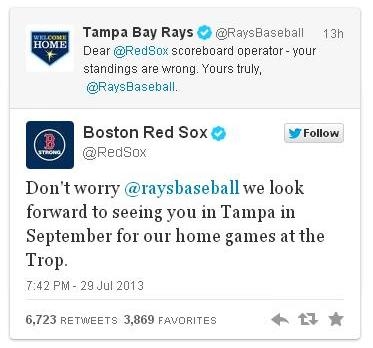
At least yesterday the hostilities were limited to Twitter.
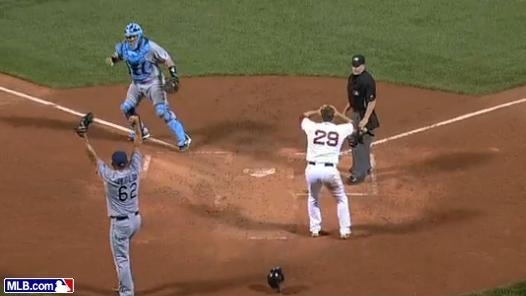
It started with a blown call—Daniel Nava appeared to score what would have been the tying run on a sacrifice fly with two outs in the eighth, but was called out at the plate by umpire Jerry Meals—a decision that helped Tampa Bay to a 2-1 victory over the Red Sox in Boston. The win pushed the Rays into first place by half a game.
When Phillies rookie Jimmy Rollins flipped his bat after hitting a home run off St. Louis reliever Steve Kline in 2001, the Cardinals pitcher went ballistic, screaming as he followed Rollins around the bases. “I called him every name in the book, tried to get him to fight,” said Kline. The pitcher stopped only upon reaching Philadelphia third baseman Scott Rolen, who was moving into the on-deck circle and alleviated the situation by assuring him that members of the Phillies would take care of it internally.
I bring this up because of Wil Myers’ reaction to the first of two home runs he hit Sunday against Yankees starter Phil Hughes. There’s no mistaking the rookie’s bravado, and the fact that he did it against a seven-year vet struggling to find his way in the game certainly didn’t help matters. (It’s also not the first time for him.)
The Yankees opted against making it a public issue, but place Kline’s commentary after Rollins’ blast—which was only the third of his career—within the mainstream:
“That’s fucking Little League shit. If you’re going to flip the bat, I’m going to flip your helmet next time. You’re a rookie, you respect this game for a while. . . . There’s a code. He should know better than that.”
Kline never responded from the mound, because he faced Rollins only five more times over the course of his career, all with the game on the line. The Yankees visit Tampa Bay in late August. The convictions of New York’s pitching staff will be made apparent then.
It was a classic misdirection. With an 0-2 count on Miguel Cabrera to open the 10th inning on Saturday, Fernando Rodney sent a 100-mph pitch so outside the strike zone that catcher Jose Molina could not get a glove on it. Wildness thus established, he followed it up with a pitch near Cabrera’s head.
In many respects, the pitch was perfectly placed. It tailed in at the last moment, but was easily trackable by the batter and was never in danger of hitting him. Cabrera leaned back to avoid it, but it would not have made contact even had he remained still.
The strategy was also sound. The previous day, Cabrera had homered twice (and didn’t help matters by celebrating that game’s final out by performing what appeared to be an imitation of Rodney’s archer pose, which the closer strikes following saves). Cabrera leads the major leagues in batting average, RBIs and OPS, and is second in home runs. It was without doubt in Rodney’s best interest to make him as uncomfortable at the plate as possible.
And it worked. Cabrera flailed at the next pitch, a down-and-in changeup, for strike three.
Perhaps Cabrera’s displeasure was compounded by the result of his at-bat, but upon reaching the dugout he spent a considerable amount of time gesturing toward, and yelling at, Rodney. (Watch it all here.)
The pitcher was obviously not trying to hit Cabrera during extra innings of a 3-3 game. Even if he was, it is given wisdom that such a strike is far easier to execute when aiming at the torso than at the head, which is a smaller and more maneuverable target. Much more likely was that Rodney wanted to crimp Cabrera’s style—get him out of the dangerous space in which he’s resided all season—and either A) misjudged the height of his inside pitch, or B) didn’t care.
Cabrera didn’t comment afterward, but his manager, Jim Leyland, did.
“I don’t care about throwing inside but I don’t like it up there,” Leyland said in an MLB.com report, referring to Cabrera’s head. “We will not tolerate that. You can take that to the bank. We won’t tolerate that up to the head to anybody. … That will cause a lot of problems for people.”
It caused problems for Ben Zobrist on Sunday, when, with two outs and nobody on base in the first inning, Tigers starter Rick Porcello drilled him in the back with a 94-mph fastball. It was intentional and it was expected. Plate ump Vic Carapazza quickly warned both benches.
Cabrera got his own measure of revenge three innings later, when he crushed a homer into the Rays Touch Tank—only the second such blast in the ballpark’s history.
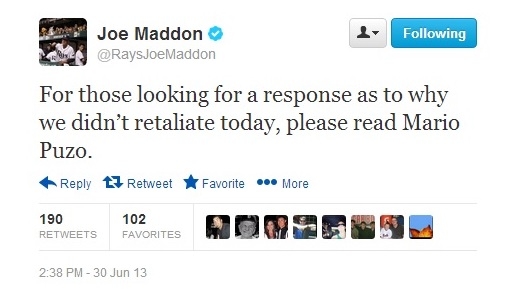
Despite Cabrera being “a little sensitive,” according to Zobrist, the Rays left it at that. Except of course, for the final explanation offered by Maddon for their lack of further response. Via Twitter:
To gauge it by the wisdom of the author of The Godfather, the Rays, apparently, will not forget this slight. Considering that they won’t face Detroit until next season (or in the playoffs), however, their memories will have to hold for a while.
As soon as John Lackey drilled Matt Joyce in the back with a 90-mph fastball in the sixth inning of Monday night’s game, people were already speculating how far back the antagonism ran.
Did it date back to the second inning, when Joyce connected for a mammoth foul ball to right, then dropped his bat—“styled,” in the words of MassLive writer Evan Drellich—as if he’d just homered?
Did it date back to the first inning, when Joyce actually did homer?
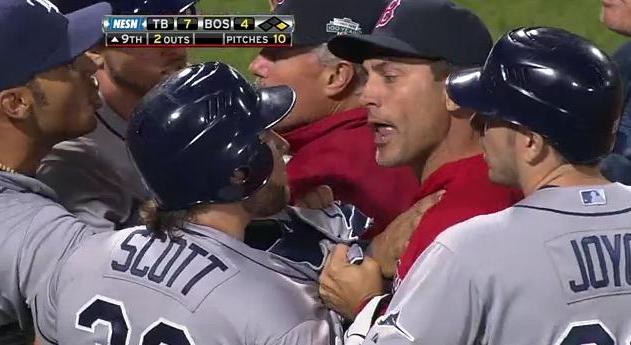
Lackey did some yelling toward the Rays dugout after Joyce’s second-inning pimp show. After being hit, Joyce pointed toward Lackey amid a slurry of what is safe to assume was epithets, then got into a pushing match with Jarrod Saltalamacchia when the catcher cut off his path to the mound. That was when benches emptied, although no punches were thrown. (Watch it discussed on MLB Tonight, complete with clips.)
Joyce actually thought that it was none of the above.
“As far as I understood, he was pretty upset that I dropped my bat on that 3-0 swing,” Joyce said in a Tampa Tribune report, describing the count when he pulled his second-inning ball foul. There is indeed an unwritten rule about restraint from swinging at 3-0 pitches, but it only applies late in blowout games—never in the second inning.
In case there was doubt about Joyce’s personal view of possible impropriety, it was cleared up by what he said next: “I was actually pretty upset myself I had such a good pitch to hit and missed it. I usually never drop the bat.”
In a close game (the Red Sox would win, 10-8, in 14 innings), Tampa Bay settled for a low-impact response—in the seventh inning, reliever Joel Peralta threw his first pitch, to Dustin Pedroia, high and tight. (Even that is up for interpretation; it was a 79 mph curveball.)
Beyond that, Lackey denied intent and was alternately defended by one manager (his own) and criticized by the other.
While the easy answer is that hostilities started with Joyce’s second-inning swing, the reality is that whenever something happens between these teams it’s almost expected. Their relationship over the last decade-plus has been testy enough to have inspired an entire section in The Baseball Codes; between 2000 and 2008, it seemed like every one of their meetings added another chapter to their collective book of spite, and things have hardly slowed from there. A condensed excerpt:
* August 2000: Boston’s Pedro Martinez hits Gerald Williams on the hand with his fourth pitch of the game. Williams charges the mound, shoving the much smaller Martinez to the ground and lands a glancing blow to his face. Benches empty, during which Boston’s Brian Daubach dives into the scrum, where Tampa players accuse him of taking cheap shots. The commissioner’s office eventually rules that Daubach acted appropriately, but by the time the game ends, Daubach has been thrown at by a succession of Devil Rays pitchers, starting with Dave Eiland—who wants to hit him so badly that, with two on and nobody out in the third inning, he sends his first pitch spinning toward Daubach’s head. The hitter manages to avoid that one, but can’t get out of the way of Eiland’s next pitch, which drills him in the body. Shortly therafter Eiland hits Nomar Garciaparra and is tossed from the game. His replacement, Cory Lidle, is himself ejected after throwing a pitch behind Daubach. Lidle’s replacement, Tony Fiore, lasts all of two pitches before finishing the job, drilling Daubach with his third offering and spurring another confrontation between the teams.
* September 29, 2000: Tampa Bay eliminates the Red Sox from the AL East race with an 8–6 victory. From the mound, Rays closer Roberto Hernandez waves a sarcastic bye-bye to the Tropicana Field visitors’ dugout.
* 2001: Over the course of the season, Devil Rays pitchers hit eleven Boston batters; Red Sox pitchers tag nine Tampa hitters.
* May 5, 2002: Devil Rays pitcher Ryan Rupe hits both Garciaparra and Shea Hillenbrand in the first inning, a day after each was instrumental in helping Boston overcome a 5–2, ninth-inning deficit. Boston’s Trot Nixon lets go of his bat on a swing, sending it flying toward the mound. Red Sox pitcher Frank Castillo responds by hitting Tampa’s Randy Winn. Both Castillo and Nixon are suspended.
* July 18, 2002: The day after Manny Ramirez scorches the Devil Rays with a home run and a double, he’s hit by Tampa starter Tanyon Sturtze. Boston’s Frank Castillo hits Tampa Bay second baseman Brent Abernathy in the third, and reliever Tim Wakefield hits him again in the fifth. In the ninth, Devil Rays reliever Esteban Yan just misses Ramirez’s head as the slugger ducks, and the ball glances off his shoulder. “You can’t act like what happened never happened,” says Derek Lowe in the Boston Herald. He also says, “Every year, why is it always this team?”
* September 9, 2002: Lowe keeps wondering after being ejected for hitting Devil Rays shortstop Felix Escalona with a pitch. The following night, Tampa Bay reliever Lee Gardner, pitching in the eighth inning of an 11–1 Boston runaway, is ejected for hitting second baseman Lou Merloni.
* September 27, 2004: Red Sox starter Bronson Arroyo keeps relations testy by hitting both Aubrey Huff and Tino Martinez in the third inning. Devil Rays pitcher Scott Kazmir retaliates by hitting Manny Ramirez and Kevin Millar in consecutive at-bats an inning later, emptying the benches. Kazmir is ejected.
* April 22–24, 2005: Five batters are hit in the first two games of a three-game series between the teams. In the third game, Arroyo hits Huff—7-for-10 lifetime against him—for the second time in as many seasons. An inning later, Devil Rays reliever Lance Carter throws a pitch behind Ramirez’s head, eliciting warnings for both benches. One pitch later, Ramirez belts a home run. Carter then throws at the head of the next hitter, David Ortiz, who has to be restrained by catcher Toby Hall. Dugouts empty, and Carter, Trot Nixon, Tampa Bay manager Lou Piniella and pitcher Dewon Brazelton are ejected. In the seventh, Arroyo hits leadoff batter Chris Singleton on the thigh, earning his own ejection. In a radio interview on WEEI after the game, Boston pitcher Curt Schilling blames Piniella: “Players on that team are saying, ‘This is why we lose a hundred games a year, because this idiot makes us do stuff like this.’ ” A day later, also on the radio, Piniella says, “I have forgot more baseball than this guy knows.”
* March 27, 2006: After tagging out Tampa’s Joey Gathright at the plate during a spring-training game, Boston reliever Julian Tavarez stands on the baserunner’s arm, he says, so that Gathright couldn’t “throw a punch at me right away.” Tavarez then hits Gathright in the jaw while the outfielder is down on one knee. Gathright later says that Tavarez “hits like a woman.” Devil Rays outfielder Carl Crawford subsequently challenges the pitcher to a post-game fight in the parking lot.
* June 5, 2008: The highlight of five hit batters on the night is Boston outfielder Coco Crisp’s charge of the mound after being drilled by right-hander James Shields of the Rays, who by this time have dropped the “Devil” from their name if not their attitude. Shields is responding to Crisp’s hard slide into second baseman Akinori Iwamura the previous night, which was itself a response to Tampa Bay shortstop Jason Bartlett using his leg to block Crisp’s headfirst slide into second. Shields misses with a roundhouse right, and Crisp— with 17 knockouts to his credit in 17 amateur boxing matches as a youth—is able to land one shot of his own before being overwhelmed by a scrum of Rays, primary among them Crawford and Johnny Gomes, who shower blows upon him. (After the game, Crisp says that the Rays were like “little girls, trying to scratch out my eyes.” Shields had already hit Dustin Pedroia in the first inning, and Boston’s Jon Lester responds by hitting Crawford, then Iwamura. Tampa Bay reliever Al Reyes closes the festivities by drilling Kevin Youkilis in Boston’s final at-bat.
* October 10, 2008: In Game 1 of the ALCS, Rays reliever Grant Balfour sends a fastball toward the face of Boston outfielder J. D. Drew, which catches the slugger’s shoulder as he spins to avoid it. Barking ensues, and the seven-game series is so tight that even four more hit batters (two from each team) over the remaining games do little to raise the tension.
Things hardly ended there. There were the three times Tampa Bay’s Luke Scott was hit by Boston pitchers over a three-game span in 2012—the last of which ended up in a brawl. (Red Sox reliever Franklin Morales threw a fastball behind Scott’s back, then two inside, then finally drilled him in the leg. Earlier, Pedroia had been drilled, and a pitch thrown over Daniel Nava’s head.)
There were words last March, when Alfredo Aceves drilled Sean Rodriguez in the shoulder, one at-bat after he had homered.
All of which gives some context to Monday night’s dustup. Just another day at the office, it seems.
Not to beat on the Maddon-Johnson pine tar affair too much (it may already be too late), but it’s given rise to at least one more interesting point. From Buster Olney’s column at ESPN.com:
When a player is traded and later faces his old teammates, his old team will change its signs, as a matter of course. It’s considered fair game to ask an incoming player for information about his previous team’s signs, or about how to pitch to batters on his old team, or about some other elements of that club. I’ve heard of teams specifically acquiring a player recently dumped by a rival largely for the information—especially catchers, who are the information highways of the sport.
But where is the line about what information you can use?
The key here, at least to me, is in a team’s ability to adjust. Catcher Bengie Molina went from the Giants to Texas in mid-season 2010, and when the teams met just over three months later in the World Series, the discussion was raised about how much advantage the Rangers might gain from his insider knowledge.
To judge by San Francisco’s five-game victory, not much. There’s a simple reason for that, at least as far as signs are concerned: They’re astoundingly simple to switch up. For all the gyrations a third-base coach goes through in delivering coded instructions to a baserunner, they typically don’t mean a thing until he hits his pre-designated indicator signal (such as, say, wiping across his belt buckle or touching his left shoulder), at which point the actual directive will follow. In this situation, changing signs can be as easy as switching the indicator.
Catchers’ signals are similar, in that many of the signs put down are subterfuge; the trick is knowing what to look for. It can be based on the count (a 3-1 count added together means the hot sign is the fourth one the catcher drops) or the number of outs or whether it’s an even- or odd-numbered inning. Sometimes the signs themselves are meaningless, and the pitcher is simply reading the number of pumps, or times the catcher flashes something. There are myriad possibilities, and for most players, changing from one to another is sufficiently simple to do multiple times during the course of a single game.
There’s also the reality that because many pitchers are particular about the signs they use, catchers have individual sets for different members of the pitching staff. This means that if a pitcher is traded, there’s a real possibility that he has little clue about what’s being used by any number of his former teammates.
This is a simplistic overview, of course, and teams can bring far more nuance to the practice—about which inside information may prove useful. Ultimately, though, I think there’s a straightforward answer to Olney’s question of whether sharing an ex-team’s signs is comparable to sharing intel about a pine tar habit: It isn’t. In Joel Peralta’s case, the fact that his pine tar was okay for the Nationals when he used it in Washington, but not okay for them once he left town, speaks to some hypocrisy. When it comes to signs, however, all teams use them, all players learn them, and they’re introduced with the understanding that, while they’re to be protected as closely as possible, they will inevitably have to be changed at some point.
If a former player hastens that inevitability, it’s simply part of the game.
It’s one thing to listen to voices outside the clubhouse maintain or refute the propriety of Davey Johnson’s decision to have Rays reliever Joel Perraltaejected from a game last week because he had pine tar on his glove.
Tampa Bay manager Joe Maddon publicly questioned the wisdom of the move, but his is obviously a biased opinion. Now we have some clarity from an unaffiliated source: Cleveland closer Chris Perez.
“If before every game if they stopped and checked everybody’s gloves or something there would be one or two guys on every team that would just get popped,” he said in an Associated Press report.
Which is exactly the point. Washington’s No. 4 starter, Edwin Jackson, spent three seasons in Tampa Bay under Maddon. Does he have any secrets Maddon might be able to exploit? Jonny Gomes was a member of the Nationals last season, but spent six years prior to that with the Rays. If he has any dirt on Washington, he could well have passed it along to his friends in Tampa. Would it be appropriate for Maddon to use this information punitively?
Of course not.
“It’s probably sticking in their craw a little bit,” said an anonymous former manager and executive in the Washington Post. “They love the guy. He pitched on short rest for the Nationals. They grew to respect him. Then the plug gets pulled on him
“I think the Rays are more mad about somebody calling them out,” said Perez. “It had to be somebody that knew—that used to play with them. I have old teammates that I could tell (manager) Manny (Acta) to call out, but I’m not going to. It’s not bush league, but it’s still not on the up and up.”
Perez clarified that he was not speaking specifically about the habits of any of his former Cardinals teammates, who were nonetheless quizzed in the AP story. The most outspoken of them was Kyle Lohse, who mirrored Perez’s opinions. “If you’re going to start throwing guys under the bus, then you’d better be sure there’s nobody on your own team doing it,” he said. “That’s all I have to say.”
What more fitting place than our nation’s capital for baseball’s latest incident involving high crimes and espionage, which we might as well call Pine Tar-gate right from the start because, well, somebody had to do it.
At one end of last night’s shenanigans was Rays reliever Joel Perralta, supplier of pine tar; at the other was Nationals manager Davey Johnson, who didn’t much care for the extra edge the substance may have afforded the opposing pitcher.
When Peralta came in to pitch the bottom of the eighth, Johnson asked plate ump Tim Tschida to check his glove. And with that, the right-hander was ejected before he even threw a pitch, for what Tschida later said was a “significant amount” of pine tar—a prelude to a likely 10-game suspension. On his way off the field, Peralta tipped his cap toward the visitors’ dugout, a sarcastic display that he later phrased in a Washington Post report as “Good for them.” (Watch it here.)
The moment held intrigue on several levels. One is the fact that the pitcher not only played for the Nationals, but absolutely blossomed for them, as well. At age 34, Peralta went from ERAs of 5.98 (with Kansas City in 2008) and 6.20 (with Colorado in ’09) to a splendid 2.02 mark for Washington in 2010. That season he led the team in WHIP, hits-allowed-per-nine-innings and strikeout-to-walk ratio.
We may now know the reason. Somebody in the Nationals organization obviously had inside information they were willing to share about Peralta’s extracurricular habits; on the coaching staff alone, Nationals bench coach Randy Knorr served as the team’s bullpen coach in 2010, and first base coach Trent Jewett managed Peralta in the minor leagues that same season.
Were either of these people—the Nationals insider who dropped a dime on Peralta, or the manager who was willing to exploit it—playing within the boundaries of the unwritten rules? The short answer is no, but comes with the caveat that Johnson clearly doesn’t care.
Davey Johnson
For proof of this, look no further than Game 3 of the 1988 National League Championship Series, when Johnson—then managing the Mets—asked the umps to check Dodgers reliever Jay Howell. Like Peralta 24 years later, pine tar was found on the laces of the right-hander’s glove. (Darryl Strawberry said that the extreme break on Howell’s pitches tipped Johnson off, but other sources fingered Mets minor league manager Tucker Ashford, who had played against Howell some years earlier.)
Unlike Tuesday’s game, that move appeared to be tactical; Johnson waited until Howell was trying to protect a 4-3, eighth-inning lead, with a full count on leadoff hitter Kevin McReynolds. Howell was summarily ejected, and his replacement, Alejandro Pena, quickly served up ball four, helping ignite a five-run Mets rally.
The Nationals organization also has a history with the topic. In 2005, then-manager Frank Robinson had umpires—oddly, Tschida was behind the plate in that game, as well—check Angels reliever Brendan Donnelly. He was tipped off by his outfielder, Jose Guillen, who had recently left Anaheim under acrimonious terms.
“There’s etiquette and there’s lack of etiquette,” said Donnely at the time, in a Washington Post report. Robinson’s behavior, he said, was “the latter.” Angels manager Mike Scioscia was furious, and threatened to “undress” Nationals pitchers in response. His reaction was not so far removed from that of Rays skipper Joe Maddon—who happened to be Scioscia’s bench coach at the time.
Maddon was peeved enough yesterday to order a retaliatory examination of his own; at the manager’s request, Tschida checked Washington pitcher Ryan Mattheus a half-inning after tossing Peralta, and found nothing amiss.
“Heads up,” Maddon sarcastically told reporters after the game, according to a MASN report, as he wiped his unblemished desktop with a paper towel. “The desk is a little sticky right there.”
His follow-up comments were pointed.
“Insider trading right there,” he said. “It’s bush. It’s bogus, man. That’s way too easy right there. If you had done some really good police work and noticed something, that’s different. But that’s way too easy. That was set up on a tee for them.”
Much of Madden’s disconcert concerns the substance in question. Pine tar is as benign a material as can be illegally found on a ballfield; it is so common that a bag of its powdered form, rosin, is kept atop every major league mound.
Unlike lubricants such as Vaseline or K-Y Jelly, which increase a pitch’s movement by decreasing friction as the ball rolls off a pitcher’s fingers—in effect, allowing it to squirt out rather than roll, with minimal backspin—pine tar adds tack. It’s primarily used by pitchers to get a feel for the ball on cold, wet nights, but—as may have been the case with Peralta, who was pitching in near-70-degree swelter—it can also add snap to a breaking ball.
Said 1997 AL Cy Young Award winner Jack McDowell: “The only [illegal substance] I ever saw was pine tar, and I guarantee 80 percent of the pitchers still use it.”
Apparently, Maddon agrees.
“You’re going to see brand new gloves throughout the major leagues, starting tomorrow—pitchers on every Major League ballclub,” he said after the game, suggesting that pitchers everywhere will be inspired by Tuesday’s events to lay low for a while.
“It’s kind of a common practice—people have done this for years,” he said. “To point one guy out because he had pitched here a couple of years ago, there was some common knowledge based on that. I thought it was cowardly. . . . It was kind of a (expletive) move. I like that word. (Expletive) move right there.”
Ultimately, Maddon is right: If Johnson wanted to play by the unwritten rules, he would either have ignored the pine tar on Peralta’s glove or handled the situation in a far less obvious manner. It’s a stretch to think that having the pitcher tossed even served to level the playing field, because it’s likely that both teams have one or more pitchers who search beyond the rulebook for a similar edge. (“Before you start throwing rocks,” said Maddon to Johnson, through the press, “understand where you live.”)
The standard bearer for Code-based reactions in this category is Tony La Russa, who, when confronted with the fact that Tigers pitcher Kenny Rogers clearly had a clump of pine tar on his left palm during the 2006 World Series, opted against having the pitcher checked—which would have almost certainly led to ejection and suspension—instead requesting only that the umpires make the pitcher wash his hands.
La Russa’s comment at the time: “I said, ‘I don’t like this stuff, let’s get it fixed. If it gets fixed, let’s play the game.’ . . . I detest any B.S. that gets in the way of competition.”
Johnson nailed his man on Tuesday, but it’s easy to feel like a touch too much of La Russa’s B.S. got in the way of Tampa Bay’s 5-4 victory. Then again, it is Washington D.C., a city whose political culture appears to have been built on the stuff.
Robin Ventura and Mark Wegner discuss current events at the Trop.
What’s being talked about is the spectacle. What the spectacle entails is raw, flashing emotion, unconstrained by things like logic or reason. The emotion’s place of origin was the mouth of Ken Harrelson, White Sox broadcaster. Yesterday, it absolutely captivated the baseball-viewing public.
What are you doing? He threw him out of the ballgame? You’ve got to be bleeping me. What in the hell are you doing? What are you doing, Wegner?
The money shot involves Harrelson’s homer-centric howls, directed at plate ump Mark Wegner in response to White Sox starter Jose Quintana’s fourth-inning ejection, after the left-hander threw a pitch behind Tampa Bay’s Ben Zobrist. Like many money shots, of course, it feels kind of empty without some relevant prelude to bring it alive.
Why, for instance was Hawk so riled up?
The answer is somewhat involved, and begins in the sixth inning of Tuesday’s game, also between the White Sox and Rays. A.J. Pierzynski, at first base with one out, was forced at second on a ground ball by Dayan Viciedo. It’s standard procedure for runners in that situation to go in hard at second, trying to prevent a double play. Pierzynski, however, went in late and spikes high, spearing second baseman Zobrist well behind the bag.
“There was no chance for a throw to first base, and he came way over the bag to try and get me,” said Zobrist. “I don’t know what his motivation was in doing that.”
The two shared some choice sentiments after the play, but each eventually went peaceably on his way, and the issue appeared to die there. Pierzynski batted three more times in the game, once with nobody on and two out, another time as the leadoff hitter while his team held a 6-2 lead, and wasn’t so much as brushed back.
You gotta be kiddin’ me. That is so bad. That is absolutely brutal. That is unbelievable. I’ll tell you what—they have got to start making guys be accountable.
Given an evening to think it over, however, the Rays apparently decided that they wanted a piece of Pierzynski after all. In the third inning Wednesday, with one out and first base open, Rays starter Alex Cobb drilled the catcher in the right shoulder blade. According to the Code, Pierzynski offered cause, Cobb retorted with effect, and things should have ended right there.
Except that they didn’t. The next time Zobrist came to the plate—six batters after Pierzynski was hit—Quintana threw his first pitch so far behind him that Zobrist didn’t even have to move his feet to avoid it. This is where Wegner delivered ejections—one each for Quintana and manager Robin Ventura—and Harrelson temporarily lost control of his senses. (Watch it here.)
That is totally absurd! That just tells you—here’s an umpire in the American League that knows nothing about the game of baseball. That’s unbelievable.
When it comes to bloviation such as Harrelson’s, details matter. And in this case, the details validate Wegner. Quintana was making just his second career start, and by appearances had been coached in his actions. Prior to the pitch, Pierzynski set up almost mindlessly over the middle of the plate, and as the fastball sailed wildly inside, the catcher didn’t so much as make a stab at it—almost as if he knew in advance where it was headed. Pitchers usually miss by inches; Quintana’s shot was close to four feet from Pierzynski’s target. Zobrist called it “painfully obvious” in a Tampa Bay Times account.
Ventura expressed shock at the ejection, less for the causality than the lack of warning from Wegner. Quintana offered some odd detail about Pierzynski having changed signs on him and not wanting to mix things up. Pierzynski said he had set up away, but Quintana threw it in. Difficult as it is to believe them, at least it’s the type of thing they’re supposed to say.
Ultimately, the White Sox had taken an extra, unnecessary shot, and a warning from Wegner at that point would have validated their strategy, giving them a freebie by stifling the Rays.
They have got to do something about this, I’ll tell you. They have got some guys in this league who have no business umpiring. They have no business umpiring because they don’t know what the baseball is about. And he is one of them. . . . He ought to be suspended and if they want to keep him as an umpire, send him back to school and teach him what this game is about.
Even as Harrelson ranted, Zobrist simply stood in the batter’s box, a slight smile tracing his lips. It could have been relief at avoiding what might otherwise have been a painful message. Or perhaps he was delighting in the fact that Chicago would be going to its bullpen earlier than expected. Maybe it was simply that justice had been served, and he knew it.
It’s certainly more than one could say for the Hawk at that moment.
This article also appeared, in slightly different form and with an actual photo of Pierzynski’s questionable slide, at Sports Illustrated.com.
Jeez. You go away for a long Memorial Day weekend, and all heck breaks loose. The nice thing about looking at situations like this in retrospect is the clarity afforded by the long view, in which the reactions to a given kerfluffle end up being more entertaining than the kerfluffle itself.
If there was smart money laid down on a weekend eruption, it would have been on the Rays and the Red Sox, two teams with no love lost, who just last week seized headlines when Adrian Gonzalez promised to hit a homer, and was by appearances drilled for it, by Rays rookie Matt Moore. (Retaliation was collected by Boston’s Felix Doubront, who drilled Luke Scott—a playerwhose name will be featured again prominently in this report, only two sentences from now.)
This latest round came in the sixth inning Friday, when Rays righty Burke Badenhop hit Dustin Pedroia. It was a stretch to consider it intentional, given that it brought David Ortiz to the plate as the tying run, but that didn’t keep Sox pitcher Franklin Morales from hitting Scott in the knee three innings later, two pitches after putting an offering behind his head. It might merely have been the spot in the order—Morales waited until there were two outs in the ninth, with nobody on—or it could have been Scott’s comments last month in which he called Fenway Park “a dump.” (Heck, maybe it’s that Morales, despite being from someplace other than the United States, is an Obama supporter.)
Or perhaps good fortune handed Morales the guy he wanted, precisely when he wanted him.
Players streamed from the dugouts, did a bit of shoving and tugging—Boston coaches Bob McClure and Tim Bogar, as well as manager Bobby Valentine, appeared to be more agitated than most players—and went on their ways. (Watch it here.) The Red Sox held on to win, 7-4.
Afterward, each manager had choice words for the other.
Rays skipper Joe Maddon, in addition to calling it a really weak, cowardly effort on the part of the Red Sox:
I’m kind of curious regarding who put out the hit, because I know it wasn’t one of their players. By the way their players reacted to the entire situation, I knew it did not come from them. It’s kind of incompetent behavior, it’s the kind of behavior that gets people hurt on your own side by choosing to do something so ridiculous.
Pedroia gets hit, not because we’re trying to hit him, he just got hit. We don’t want Papi coming up there with two guys on, are you kidding me? I don’t care who’s pitching for us. That’s truly somebody flexing their muscles on the other side that really needs to put them in their back pocket and understand that they can’t hurt their own team by doing something like that. . . .
To be really carelessly incompetent on their side, to truly, intentionally hit somebody, throwing behind somebody, then hitting them in the leg, for all the wrong reasons, whereas eventually they can get their own guys hurt with that kind of behavior . . . I think it’s ridiculous, I think it’s absurd, idiotic, I’ll use all those different words.
Maddon later tweeted, “Very proud of our effort 2nite. What occurred in the 9th reeked of intent. Was ridiculous, absurd, idiotic, incompetent, cowardly behavior.’’
Valentine, in addition to suggesting the culprit to blame for Morales’ fastball was the Ghost of Fenway, guiding the ball in response to Scott’s “dump” comment:
I thought their coaches were really aggressive; as a matter of fact, I took offense to the aggressiveness of their coaches. I thought it was really unprofessional. . . . [Rays coaches] seemed very immature and out of control. Coaches are supposed to stop those things from happening and their coaches were aggravating, agitating, and instigating the situation.
Given all of this—plus the fact that Scott offered the warning, “At the end of the day, you reap what you sow”—it was a bit surprising that umpire Ed Rapuano declined to issue warnings prior to Saturday’s game. Turns out he didn’t need it; nothing incendiary happened. On Sunday, in fact, Matt Joyce wiped out Mike Aviles on a double play, and received a pat on the back for his efforts as he got up.
The Rays-Red Sox rivalry dates back to 2000, when Pedro Martinez hit Gerald Williams, and has since been fierce enough and consistent enough to merit its own section in The Baseball Codes. The teams meet again in July; we’ll see if we can’t add another chapter then.







 The Baseball Codes
