Marlon Byrd, Retaliation, Vicente Padilla

Padilla’s Lesson: Selfish Retaliation Doesn’t Make Friends

The ability to appropriately retaliate is a vital part of a pitcher’s resume, giving his teammates confidence that not only will he offer support should they be thrown at, but that he’ll do his darndest to make sure it doesn’t happen again.

While this is generally considered a positive attribute, last year we learned that in this regard, there can be too much of a good thing.

Vicente Padilla has long been considered baseball’s loosest cannon when it comes to hit batsmen. He drills hitters at will; that he appears to use raw emotion rather than baseball’s Code as his source of motivation makes this a dangerous tack to take.

Padilla spent most of the last four years with the Texas Rangers, where he was an unquestionably valuable member of the rotation, leading the team’s starting pitchers in either wins or winning percentage in two of his three full seasons with the team.

He also led the league in hit batsmen once, and drilled guys with such frequency that his teammates developed a distaste for the practice; Padilla’s recklessness was continually putting them in the crosshairs of retaliatory strikes.

It came to a head for him during a game in June 2009, when he hit Mark Teixeira of the New York Yankees twice. New York’s A.J. Burnett threw a response pitch that nearly hit Nelson Cruz in the head, and Padilla was placed on waivers the following day. It was a clear message; while Padilla wasn’t kicked off the team outright, the process to trade or release him had been initiated. Were he to stay with the Rangers, he needed to change his ways.

On Aug. 5, however, Padilla imploded, in typical fashion. After giving up a two-run homer to A’s outfielder Scott Hairston in the first inning, he drilled Kurt Suzuki two batters later. Sure enough, the A’s retaliated by hitting Michael Young.

“I have a lot of good friends on the Yankees, and they were like, ‘One of you guys is going to get hurt one day,’ ” Young said in the Dallas Morning News after the Teixeira incident. “No one wants to see that happen, obviously, but it’s the nature of the game. A lot of time times we felt like we had a bull’s-eye on our back.”

Three days after the A’s incident, the Rangers designated Padilla for assignment.

The pitcher had apparently burned so many bridges within his own clubhouse that his dismissal led to widespread celebration. General manger Jon Daniels portrayed Padilla as a bad teammate, and received handshakes and congratulations from relieved members of the Rangers when they heard the news. (Among those celebrating was Ian Kinsler, who had been targeted for retaliation in 2006 after Padilla hit White Sox second baseman Alex Cintron.)

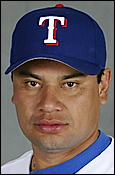
The player to offer the greatest level of detail to the press was outfielder Marlon Byrd, who had also played with Padilla in Philadelphia.

“About time,” he said in the Morning News. “It’s absolutely a positive for this team. We have to get rid of the negatives to make a positive, and I believe this is a huge positive for this team. . . . You have to be a good teammate. You have to help teach younger guys the right things. He wasn’t a positive influence on the young guys. You started questioning his character and about how much he cared.”

The primary problem with being publicly frank about a head-hunting former teammate, of course, is the possibility that you’ll end up hitting against him someday.

Just over a week ago, on July 10, Padilla, now with the Dodgers, faced Byrd, now with the Cubs, for the first time since leaving Texas. Needless to say, he drilled him in the back.

This led to another retaliatory cycle, the type of which helped lead to Padilla’s banishment from Texas. Cubs pitcher Andrew Cashner responded by drilling Los Angeles second baseman Blake DeWitt an inning later, and subsequently received high-fives in the dugout, and congratulations in the clubhouse after the game (despite the fact that the Cubs lost, 7-0).

(Afterward, Cashner upheld the Code, claiming in the Chicago Tribune that the pitch to DeWitt “slipped.” Byrd’s praise of Cashner’s “pinpoint accuracy,” however, seems to counteract that.)

It’s a complex tale of intertwined codes, which go to show how one rule can affect another, and another and another.

Primary among them, of course, being to avoid angering pitchers who will be only too delighted to respond.

Update: He wasn’t ejected from the game, but Cashner was eventually fined by the commissioner’s office for his action.

– Jason

Appearances

Midwest: Hot but Fruitful

My mini Midwest swing is coming to a close, and it’s been a bit of a whirlwind.

In St. Louis on Wednesday I did morning TV (they wanted to discuss Steinbrenner), late-morning phone-in radio (to Tennessee), in-person radio on KTRS (the Cardinals flagship), phone-in radio (to Milwaukee), in-person radio (KMOX) and a reading at Left Bank books.

It’s enough to tire a guy out. (Also that day, the Richmond Virginian-Pilot’s Style Weekly published a lovely review of The Baseball Codes. It all set the stage for Baseball Digest’s launch of I-70 Baseball, focusing exclusively on the Cardinals and Royals.)

Milwaukee was beautiful (great reading at Boswell Books), Detroit was hopping (on Fox there, as well; also took in the Motown Museum), and Des Moines (in studio at KXNO-AM, and on both Fox and NBC TV), and packed the house at Beaverdale Books.

Thanks to all of you who came out. I’ll be heading to Boston and New York at the end of the month. More details soon.

– Jason

David Wright, Deke Appropriately, George Brett, Robinson Cano

All-Star Deke

It wasn’t much heralded during the All-Star Game broadcast, but Robinson Cano pulled off a potentially instrumental play in the fifth inning. With nobody out and David Wright taking off from first base on a steal attempt, Twins catcher Joe Mauer threw the ball well over Cano’s head, and into center field.

Cano, however, even in mid-leap, managed to put his glove down in an effort to throw Wright off the scent of what had really taken place.

It worked. By the time Wright located the baseball, it was far too late for him to take third. Sure enough, Wright failed to score in the inning. (Watch it here. The play happens at the :37 mark.)

The deke (short for “decoy”) is an integral part of infield play. Fielders act as if the ball is somewhere it’s not, and runners grow confused. The most famous deke in history was Chuck Knoblauch‘s fake-out of Lonnie Smith in Game 7 of the 1991 World Series, which kept Smith from going to third and likely saved a run (and the game, and series) for the Twins.

Lesser-known examples happen all the time. A few years ago, White Sox shortstop Juan Uribe acted as if a base hit was actually a foul ball, and was so convincing that the base runner returned to first base—and was thrown out.

“It’s a gentleman’s game at times, but if you don’t have your head on your shoulders, things can happen,” said Frank Thomas, who made the tag at first for Chicago.

There is a potential downside. Had Wright gone into a late slide because of Cano’s machinations (not a real possibility in this instance, since he was going to slide anyway), he could have injured himself. Take an example from The Baseball Codes:

A number of players have been injured by ill-timed or unnecessary dekes, which leads to an unwritten rule about when it is and isn’t appropriate to use the maneuver. Infielders throwing down phantom tags at the last possible moment can cause awkward slides, and the potential for damage is very real. “If a guy is stealing, you don’t pretend the throw is coming,” said second baseman Craig Grebeck. “If he’s coming in standing up and you all of a sudden look like the catcher is throwing the ball, a late slide can tear up an ankle or a knee.”

That’s exactly what happened to Gene Clines in 1973. Clines, a fourth-year outfielder with the Pirates, was on first base in a game against San Diego; with a full count on the hitter, he took off for second. The pitch was taken for ball four, but instead of simply strolling to second, Clines— who never peeked homeward to assess the situation—proceeded full speed ahead. Padres shortstop Derrell Thomas waited until Clines was nearly atop the base, then inexplicably threw his glove down as if a late throw were about to arrive. Clines, flustered, went into a hurried slide and badly injured his ankle. “That play right there cost me a lot of time,” he said, still angry at the thought more than three decades later. “I never fully recovered for the rest of that year.” Clines, batting .291 going into the game, missed three weeks, and hit just .227 in the two months thereafter.

All in all, a well-timed—and well-executed—deke is an under-appreciated thing of beauty.

There’s more than one reason, after all, that Robinson Cano is an All-Star.

– Jason

Cheating, Colorado Rockies

Baseball Imbroglio in Colorado?

We’ve already seen the fine line between acceptable and unacceptable cheating in baseball this year, when Phillies bench coach Mick Billmeyer pulled out some binoculars to home in on the signs being put down by Rockies catcher Miguel Olivo. Billmeyer crossed the line of propriety clearly drawn by the Code, leaving the field of play and using external devices to further his cause.

Something similar has allegedly been happening for some time in Colorado, only this time the Rockies are the perpetrators.

Last Thursday on San Francisco radio station KNBR-AM, Giants announcer Jon Miller asserted that Colorado may well be doctoring baseballs.  (Listen to it here.)

The Rockies employ a humidor to store their balls, for the purpose of keeping them moist and heavy, so as to help negate the thin-air effects of Coors Field. According to Miller, however, the team has possibly been integrating non-humidor balls into the late-inning selection, especially during games in which the Rockies trail.

“There’s a feeling that the Rockies are doing something with the humidor-stored baseballs, and sometimes late in games when the Rockies need help, that some non-humidor baseballs slip into the mix,” he said. “Nobody has been able to prove it.”

Central to Miller’s thesis is the July 6 game in which Colorado scored nine runs in the bottom of the ninth to beat the Cardinals, 12-9. Miller alleged that the Giants felt similarly last time they visited Coors Field. (The Rockies scored the final three runs of games against the Giants on July 1 and 2, both victories for Colorado.)

Still, this sort of home-field advantage (if that’s indeed what it is) is hardly new in baseball. In fact, if it happened at all, it wouldn’t even be the first illegally institutional authorized altering of baseballs.

In 1965, White Sox groundskeeper Gene Bossard stored baseballs in a humidified room, resulting in baseballs not unlike those found in the Rockies’ humidor. (Unlike the Rockies, Bossard was also known to freeze baseballs, to further deaden them.)

Whereas Colorado is trying to counteract the effects of its stadium, however, Bossard was looking to take advantage of the fact that the White Sox were a pitching-heavy team that could hardly hit dry baseballs, let alone wet ones, so deadening them hardly made a difference.

Bossard also kept the territory in front of the plate as bog-like as possible, the better to assist the array of grounders its sinkerball staff was bound to throw. (It was known, appropriately, as “Bossard’s Swamp.” If a sinkerballer was pitching for the visiting team, however, the White Sox grounds crew would actually mix gasoline with the clay around the plate and then set it on fire, the better to harden it.)

Bossard learned at the feet of his father, former Indians groundskeeper Emil Bossard, who was known to push back the portable fences at Cleveland’s Stadium by as many as 15 feet, depending on how much power the opposing team displayed.

“It’s gamesmanship,” said longtime manager Chuck Tanner. “It’s just what was done. You’d adjust to it. You’d bitch about it, but, you’d deal with it all the same.”

The Twins seized home-field advantage in the 1980s, by manipulating the air conditioning system in the Metrodome so that it blew out when the Twins batted, and in when the opposition came to the plate. (In 1987, remember, the Twins won the World Series without winning a single game on the road.)

This sort of list goes on and on. There was “Ashburn’s Ridge” in the 1950s, a sloped baseline that allowed Philadelphia’s excellent bunter, Richie Ashburn, to keep his offerings fair. (He won the batting title in 1955, hitting .338.)

Teams water down the infield to slow down fast opponents and alter the length of the grass to help or hinder a fast team (depending on whether they have one), among many other tricks.

The difference between most of these examples and what the Rockies allegedly did is that the field alterations are in play equally for both teams. Even though they might benefit the home club (or disadvantage the visitors), both teams must deal with the quirks equally.

Selectively feeding baseballs to the umpire hardly fits that bill.

It’s a difficult allegation to prove, but if the Rockies are doing it and know what’s good for them, they’ll adhere to the Code, which in this case says, once you’re caught cheating, stop.

– Jason

Articles

Welcome to the Wages of Wins

David Berri is a professor at the Southern Utah University, and has the power to work magic when it comes to the statistical analysis of basketball. He wrote the book, Wages of Wins, and maintains the Wages of Wins Journal, where he waxes continuous about the state of the NBA, viewed largely through the statistics it produces.

I interviewed David a few years back for a story I wrote for Popular Science, and he recently returned the favor, interviewing me for his Web site. You can find it here.

– Jason

All-Star Game

An All-Star Extravaganza to Celebrate the Mid-Summer Classic

In honor of the All-Star Game, I offer you three related stories, only one of which made the final draft of The Baseball Codes. Consider it as bonus material to help fill the downtime until games resume.

In the 1978 All-Star Game in San Diego, Pete Rose went so far as to import to the National League clubhouse cases of Japanese baseballs—smaller and more tightly wound than their American counterparts, which caused them to carry farther. Working the locker room like a politician, he garnered buy-in from his teammates on two counts: The National Leaguers agreed to use the balls during batting practice, and they also agreed that nobody would tell members of the American League team what was going on. Rose then sauntered over to the AL locker room and convinced many of the players to come out and watch their opponents take pre-game hacks.

Jack Murphy Stadium was vast in 1978, running 420 feet to center field, but Rose’s teammates for the day put on quite a show, hammering ball after ball over the fence’s deepest reaches. When they were done, the National Leaguers gathered all the balls and returned them to their locker room for safekeeping. Using standard major league baseballs in their own batting practice, the American Leaguers had a much rougher go of it.

It might not have meant much . . . or maybe it did. At the very least, it didn’t hurt. The National League went on to win its seventh straight contest, 7-3.

* * *

In the National League clubhouse prior to the 1968 All-Star Game, Dodgers catcher Tom Haller saw Houston’s Rusty Staub rummaging through Don Drysdale’s shaving kit, ostensibly to find evidence of the long-whispered rumor that Drysdale doctored the ball. When Haller told the pitcher about it, it wasn’t taken lightly.

Fifteen days later, Drysdale faced the Astros in Los Angeles. Trailing 1-0 with two outs and nobody on in the eighth inning, Drysdale buried a pitch into Staub’s ribs.

“That’s for looking through my goddamn shaving kit,” he yelled as the hitter stumbled down to first base. Staub might not have been the world’s best sleuth, but he was smart enough to not say a word.

* * *

Orioles skipper Earl Weaver was once sitting in the dugout when one of his pitchers gave up a home run. As the batter rounded third, he looked toward the Orioles bench, made eye contact with the manager and extended his middle finger. “What the hell was that?” a befuddled Weaver asked Billy Hunter, one of his coaches. Hunter knew exactly what the hell that was. “You didn’t select him for the All-Star Game,” he said.

– Jason

Gaylord Perry, No-Hitter Etiquette

Perry’s No-Hitter Aided by Fan in Blue

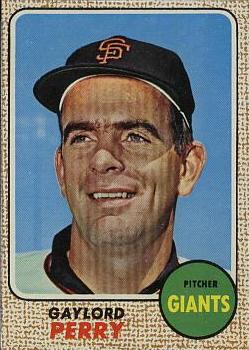
Gaylord Perry recently discussed his 1968 no-hitter, thrown against St. Louis when he played for the Giants. Perry brought a new layer to the discussion about how players (and, in this case, officials) react to significant accomplishments as they unfold on a ballfield.

“After seven innings, I saw the umpire (Harry Wendelstedt) as I was coming out of the dugout and he said, ‘You don’t have to get it so close,’ ” Perry told the San Jose Mercury News. “And I didn’t really pay attention. He started giving me the outside, and after eight innings he said, ‘You don’t have to get it so close’ again, and I realized that guy has never called a no-hitter and he wants to call one. So I didn’t come close that ninth inning.”

The final hitter he faced, Curt Flood, struck out looking. Of course he did.

As with Wendelstedt, most everyone appreciates greatness. They’d also like their appreciation of it returned. From The Baseball Codes:

The more a pitcher mows down the opposition, the more the opposition is expected to respect the feat. Cardinals outfielder George Hendrick did exactly this in 1984, when he stepped to the plate with two outs in the ninth inning against Reds ace Mario Soto, who had yet to allow a hit. Hendrick stood passively and watched the first two pitches of the at-bat split the plate for strikes. Rather than go for the kill, however, Soto inexplicably used a third-pitch fastball to buzz Hendrick’s chin, knocking him to the ground. The slugger got up, slowly returned to the box, and knocked Soto’s next offering over the fence in left field. “I don’t know why he did that,” Hendrick said afterward. “I was going to let the man have his no-hitter.”

Players aren’t always so generous. When Detroit pitcher Tommy Bridges was within an out of a perfect game against the Senators in 1932, Washington manager Walter Johnson—despite trailing 13–0—sent up curveball-hitting specialist Dave Harris as a pinch-hitter, to try to figure out the bender with which Bridges had baffled Washington all afternoon. Harris connected for a single, and Johnson absorbed criticism from around the league. Bridges himself abstained, however, saying, “I would rather earn it the competitive way than have it handed to me.”

– Jason

Bud Norris, Clubhouse pranks

Houston Outfield Turned into Parking Lot

It’s not difficult for a major league clubhouse to become a testy place. They’re populated with men facing enormous pressure, both externally and internally, to perform and win. When expectations fail to be met, tension can run high.

As a result, players have developed a variety of methods for keeping things loose. One of their primary tools in this regard is the practical joke. It can be directed at anybody on the roster, but three primary groups stand out as perpetual victims:

  • Rookies: The lowest men on any totem, a barrage of (mostly good-natured) abuse serves as standard initiation into the big leagues.
  • Those who don’t take it well: A negative reaction to being pranked will inevitably serve as inspiration for more of the same.
  • Those who fail to fit in: If you’re not like your big league brethren, it’s not a stretch to think that they’ll let you know about it.

Astros pitcher Bud Norris only recently escaped rookie status on an official level, but he’s still close enough for the purposes of some of his teammates. He also falls into the latter category, in at least one way: his car.

Major Leaguers expect each other to present themselves as such. Jeans and T-shirts serve as accepted wardrobe in most clubhouses, but when it comes to vehicles, a player’s ride must sparkle. Even a vehicle so simple as a pickup truck—found more frequently than one might think in players’ parking lots—must reflect a level of class not ordinarily found in the rides of regular folk.

With that in mind it’s easy to see that although Norris has no problem driving a 1997 Accura, some of his teammates possess different opinions.

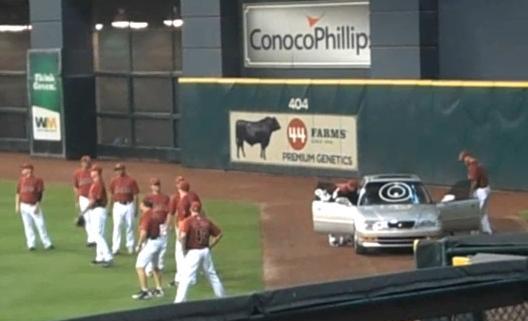
When Norris took the field for pre-game warmups on Wednesday, he was stunned to see, sitting on the center field warning track, his car. On the front windshield was a target, drawn in shaving cream, to give inspiration for players about to go through batting practice. Written on other windows were the sentiments “For sale,” and “$100.” (Watch footage here.)

“Bud’s been wanting to sell it for a while and the market’s been kind of low on him,” said Astros pitcher Tim Byrdak in the Houston Chronicle. “We thought he could use some free advertising.”

Byrdak went on, in an MLB blog post: “It’s got 116,000 miles to it. Fifteen hundred, or the best offer. The check engine light’s on, but that’s a mild thing.”

Astros players marked the situation by stretching out near the car in center field, rather than alongside their dugout, as usual. Brandon Lyon eventually started to hit fly balls toward the car, just missing with one.

If anything, Norris helped his own cause by refusing to get angry about it, and thus disqualified himself in at least one of the above three categories.

“I thought it was funny,” he said. “We’ll go with it. It’s fun.”

– Jason