Retaliation, The Baseball Codes

Odor Hit With Eight-Game Suspension

The suspension has been levied: eight games and $5,000 to Rougned Odor for his part in Sunday’s fisticuffs. (He says he’ll appeal.)

That part’s not surprising. Throwing a punch like is almost certain to merit a minimum of eight games.

What is surprising is that Odor threw it at all. Not because he doesn’t have the temperament for it. As Deadspin told us yesterday, “Rougned Odor’s been a shit for a long time.”

It’s surprising because of this:

Baseball’s unwritten rules are decried in some circles as juvenile and outdated, and in many cases those criticisms are valid. One thing that people on both sides of the aisle can agree on, however, is that blatant hypocrisy is rarely a good look. For a guy with a history of takeout slides to jump up swinging after receiving one himself doesn’t speak well to Odor’s character.

The main question is, as somebody who’s done this numerous times over the course of his short career, why didn’t anybody give him a dose of the same in response before now? (If they have, and if he reacted differently, that too is worth examination.)

One thing’s for certain: Every team in baseball now knows an express route into Odor’s head. All they need to do to get him off his game is go into second base a little bit hard. Don’t be surprised to see more of the same when the stage grows large.

Basepath Retaliation, Jose Bautista, Retaliation, The Baseball Codes

Does Anybody Even Know What Baseball’s Unwritten Rules Are, Anymore?

We’ll get to questions about propriety and merit and the very nature of baseball’s unwritten rules in good time.

First, though, why’d the Rangers wait so long to do it?

Before the season started, the enduring questions regarding the rivalry between Texas and the Blue Jays had to do with the Rangers’ response to Jose Bautista’s world-beating bat flip during the teams’ ALDS showdown last October, and whether retaliation was imminent.

Matters seemed to be settled after the teams went an entire series at Toronto’s Rogers Centre in early May without so much as a peep. In the series finale, Bautista came to bat—twice—with his team leading 11-1. Let sit for a moment whether retaliation was even merited; if ever there was a place to enact it, it was right there, with no concern about an extra baserunner affecting the game’s outcome.

Bautista emerged unscathed. That should have closed the book on the incident. Should have, but didn’t.

On Sunday, Rangers reliever Matt Bush—making only his second big league appearance after a decade-long career nosedive—may have been trying to earn credibility points with his new teammates when he planted a fastball into Bautista’s ribcage.

It makes little sense why that pitch would bear any degree of intent. Texas had its chances back in Toronto. Bush was not with the Rangers at the time of Bautista’s perceived slight. The score was 7-6, and Bautista, leading off the top of the eighth, represented the tying run. And yet.

It was the final meeting of the season between the teams, and likely Bautista’s final at-bat of the game. Drilling him then left virtually no chance for recourse. “To me, it was gutless,” said Jays manager John Gibbons afterward, in an ESPN report. “The other 29 teams, they come at you right away, but to wait until the end, it just sort of tells you something.”

At that point, Bautista’s primary tool was the one he ended up using: a message-laden slide.

Forced to run by Justin Smoak’s grounder, Bautista launched himself late, at the legs of second baseman Rougned Odor. It was textbook, Bautista landing on the base instead of in front of it, undercutting Odor’s feet. According to the Code, it was clean—spikes down and centered. A million guys have made a million similar retaliatory slides over the years, the vast majority of which have been accepted by the opposition as nothing more than the price of doing business.

We are, however, in a new era, even beyond the rise of the Let’s Make Baseball Fun Again generation. It is a time of basepath sanity, where fielders’ safety is the subject of rulebook legislation. Bautista’s slide had nothing to do with fielders’ safety.

It probably didn’t matter either way to Odor, who would likely have come up swinging, regardless.

The rest of the story involves details, mostly:

  • Bautista absorbed a solid right hook from Odor, definitely in the 99th percentile of effective baseball punches, but still managed to keep his feet.
  • It turns out that Odor is quietly (or not so quietly) one of the premiere red-asses in the game.
  • Ejections for Bautista, Odor, Josh Donaldson, and Rangers coach Steve Bueschele.
  • Bush was allowed to remain in the game, but when asked afterward about the pitch in question, offered a telling no-comment.
  • Toronto exacted retaliation of its own in the bottom half of the inning with the time-tested tactic of drilling Bautista’s counterpart on the Rangers, Prince Fielder. Again the benches emptied, though no punches were thrown.
  • Subsequent ejections for Toronto pitcher Jesse Chavez and coach DeMarlo Hale.

In the aftermath of it all, we’re left with numerous questions. Most pertinent to this space has to do with the unwritten rules themselves. Although Bautista’s slide fell well within the boundaries of traditional Code tactics, it’s difficult to tell anymore whether traditional Code tactics—especially as they pertain to takeout slides—are even viable. Before, it was primarily middle infielders who didn’t appreciate them. Now, the league office has officially taken steps to legislate them out of the game. This likely means that baserunners are going to have to find new methods of conveying their grievances … or, more pragmatically, will have to learn to get over their grievances more quietly.

There’s also a bit of hypocrisy at hand. In the game’s aftermath, Bautista unloaded with both barrels at Rangers management, saying in the Toronto Star that “It shows a little bit of the apparent lack of leadership that they have over there when it comes to playing baseball the right way.”

Only last October, Bautista himself sparked a play-the-right-way controversy, only then he was on the other side of the debate, baseball traditionalists decrying his bat flip and its ensuing acclaim. To play both sides like that—to demand propriety only when it suits you—seems disingenuous.

There is, however, more to it. “Baseball plays are supposed to be taken care of by baseball plays,” Bautista also said yesterday. And he’s correct. A bat flip is not a baseball play. Drilling a batter is. So is taking out a fielder. The latest version of the Code mandates that non-baseball plays are largely exempt from retaliation. This is not what happened on Sunday.

Perhaps we’re facing another sea change with all of this, which is something we won’t know until we see players’ responses to coming contentions. Water has a way of finding its level.

Ultimately, amid the philosophical hand-wringing, we’re left with one primary concrete question: Why’d the Rangers wait so long to do it?

Update (5/17): Odor’s been clipped for eight games and outed as a hypocrite.
Home run pimping, Retaliation, The Baseball Codes

John Lackey Making Baseball Fun Again for Old-School Pitchers With Anger Issues

Lackey

We’ve spent so much time recently with the concept of making baseball fun again that we seem to have lost sight of those old-school souls hell-bent on preserving on-field propriety and baseball decorum. (Members of the Goose Gossage Home for Aged Cranks, of course, carry with them their own brand of mania and are never far from view, but are rarely active players.)

On Wednesday, John Lackey reminded us that even to some who still play the game, the old school is still a thing.

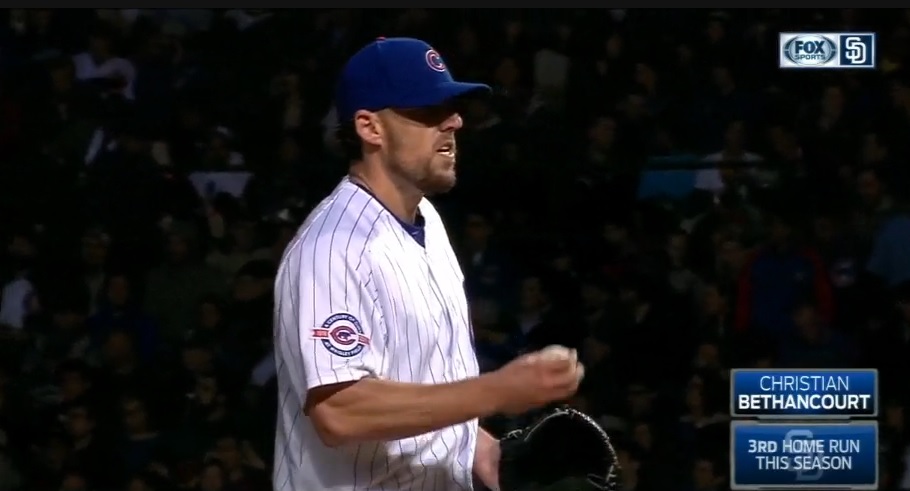
In the second game of a doubleheader against San Diego, the Cubs starter gave up only one run, on a fifth-inning homer to Christian Bethancourt. It was enough to lose 1-0, but what really irked the right-hander was when Bethancourt stood in the box and watched the ball fly.

“You better fucking run!” Lackey screamed as the hitter rounded the bases.

That’s some good drama right there. Lackey upped the ante after the game, when he referenced the teams’ next meeting, in late August. “How many home runs does he have?” Lackey asked reporters, via the Chicago Tribune. Told that the blow against him was Bethancourt’s third of the season, the pitcher was concise. “I have a long memory,” he said. “He’ll learn.”

(See Bethancourt’s pimp and Lackey’s reaction over at Deadspin.)

Lackey, of course, is no stranger to this type of reaction, drilling Tampa Bay’s Matt Joyce for similar reasons, for example, when Lackey pitched for the Boston Red Sox in 2013. Also, Francisco Cervelli in 2011. Also, Derek Jeter (for different retaliatory purposes) in 2010.

Lackey is 37 years old and in his 14th big league season. He’s set in his ways. He’s also one of the rare guys left in the game willing to talk openly about drilling somebody for the crime of bruising his ego.

That kind of move is increasingly dubious in the modern baseball landscape, but Lackey is old and ornery. And, odious as it may be to the public at large, for guys like that, plunking upstart youngsters may well constitute their own version of making baseball fun again.


Retaliation, The Baseball Codes

Internalizing a Horrible Outing Takes Different Shapes for Different People, or: Emotional Atunement Might Not Be For Everybody

Mariners Rangers

Two games in, and we got beef. For the Mariners, it’s entirely justified.

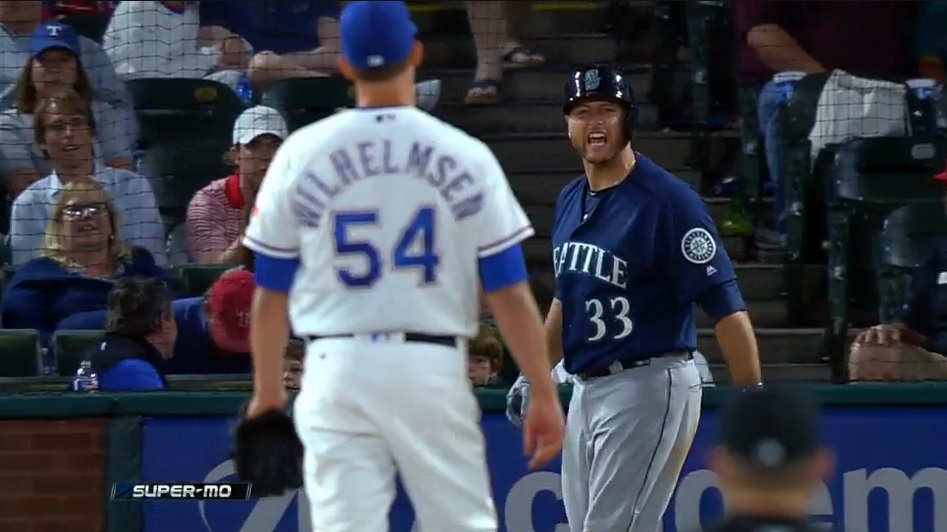
Reliever Tom Wilhelmsen—with Seattle for the first five seasons of his career, but as of last November a member of the Rangers—did not have a good game. After entering in the eighth inning with his team trailing, 4-2, he did this:

  • First batter, Robinson Cano: first-pitch homer.
  • Second batter, Nelson Cruz: double.
  • Third batter, Kyle Seager: double.
  • Fourth batter, Seth Smith: first-pitch homer.

For his encore, the frustrated right-hander drilled the inning’s fifth hitter, Chris Ianetta, with his first pitch. The 94-mph fastball, which ran straight into Ianetta’s hamstring, was as clear a message of frustration as can be delivered on a ballfield. (Watch it here.)

Ianetta stormed to first base, screaming toward the mound as Seattle’s dugout tentatively emptied. The most noteworthy part of the scrum was each team’s manager shouting F-bombs at the other.

This in itself is noteworthy inasmuch as Mariners manager Scott Servais is in his first year at the helm of a big league club and may well have seen this as an excuse to set tone, letting his team know that he’s looking out for them in every facet of the game. Texas skipper Jeff Bannister, even more fiery during the confrontation, is in his second year and likely felt similarly.

There’s little to justify Wilhelmsen’s action. It was once acceptable baseball practice to drill a guy for his teammates’ success. Hell, it took far less provocation than two homers and two doubles. The modern game, however, is less tolerant of violent  acts, and the weak sauce ladled out by Wilhelmsen has become patently unacceptable. (Umpire  Marvin Hudson agreed, ejecting the pitcher.)

At least Wilhelmsen handled things as well as he could after the game without crossing the line of actually admitting to anything. When he was asked whether anything in particular angered Ianetta, he managed to say, “Probably the fact that I hit him,” with a straight face.

Yep. Lotta baseball left to play this season.


Intimidation, Retaliation, The Baseball Codes

Do the Royals Really Want a Piece of Noah Syndergaard? Why the Hell Would They?

Up and in on Esco

When Newsday reported yesterday that the Royals were still harboring a grudge over Noah Syndergaard’s first-pitch fastball in Game 3 of last year’s World Series, it struck an awkward tone. The teams meet on opening day, and rumors that the Mets have something in store for their opponents (Syndergaard is scheduled to start the second game of the series) raised more questions than it answered.

It’s not that teams and players don’t have long memories, or that they aren’t willing to wait weeks, months and, in some situations, years for retribution. (In his final season as a pitcher—indeed, in his final game—Bob Gibson was unable to retaliate against Pete LaCock for the perceived slight of having hit a grand slam against him. So he waited 15 years until they met in an old-timers’ game, then drilled him in the back.)

The thing about the Royals allegedly being angry, though, is that Syndergaard didn’t do anything wrong.

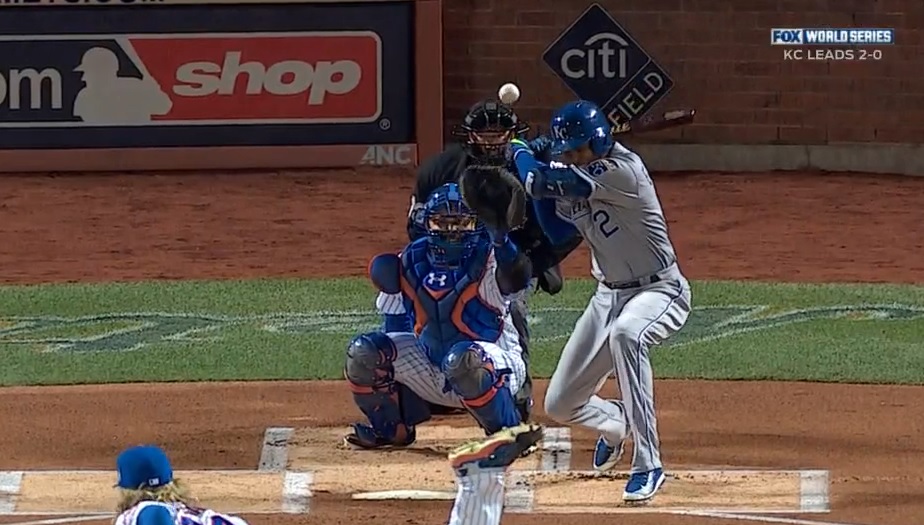
As a power pitcher, it is his right to establish tone, and the inside fastball is a valid weapon in any pitcher’s arsenal. With his first pitch of the game, the right-hander threw head-high at 98 mph to Alcides Escobar, one of Kansas City’s hottest hitters and a first-pitch swinger.

Thing is, the pitch didn’t come close to hitting Escobar. It didn’t even cross the line of the batter’s box. When catcher Travis d’Arnaud reached up to catch it, his glove shot straight into the sky, not toward the hitter.

And it worked. Escobar, shaken, struck out.

There’s no reason for the Royals to like this kind of tactic, but neither can they decry it as worthy of retaliation. (It’s their option to feed Syndergaard some of the same, but if that was the endgame there was little reason not to do it at the time.)

So why, one might ask, would the Royals still be holding on to it all these months later? The answer, at least according to K.C. manager Ned Yost, is, they’re not.

“Our retribution,” he said in the Kansas City Star, “was winning the World Series.”

Similar sentiments were echoed around the clubhouse.

Edinson Volquez: “There’s nothing wrong with what he did last year.”

Former Met Dillon Gee: “I’ve been here all spring, and I don’t think I’ve really heard anybody even bring up the Mets.”

The best reason to believe the Royals is because the report that sparked the controversy was so unbelievable in the first place. Newsday’s Marc Carig cited “multiple industry sources” as the basis of his report, whatever that means, but on its face the story was little more than shit stirring on a slow news day.

In this regard, Yost is already on his game, offering more pointed insight than any journalist could offer.

“Some buffoon writes something,” he said, “and you guys are gonna jump like little monkeys in a cage for a peanut.”


Bryce Harper, New York Yankees, San Francisco Giants, The Baseball Codes, Unwritten-Rules, Washington Nationals

Bryce Harper and Sergio Romo: Secretly Simpatico?

Keep calm

For a while, it seemed like yesterday would belong to Bryce Harper’s views about baseball’s unwritten rules.

Then Goose Gossage opened his mouth. In what appears to be coincidental timing, the Hall of Fame reliever unloaded to ESPN about noted bat-flipper Jose Bautista being “a fucking disgrace to the game,” among other choice sentiments that ran directly counter to Harper. Gossage, of course, is his generation’s It-Was-Better-When-I-Played standard-bearer, the guy to turn to for strident opinions.

His comments came in response to a benign question about new Yankees reliever Aroldis Chapman, and quickly veered not only to slamming Bautista, but to complaints about how “fucking nerds” who “don’t know shit” are ruining the game from front-office positions, that “fucking steroid user” Ryan Braun gets ovations in Milwaukee, and that modern relievers are too focused on pitch counts and not enough on the game itself.

Gossage, a world-class griper, was simply doing what he does best.

He would have been easier to dismiss had not Giants reliever Sergio Romo—one of the game’s free spirits, a guy loose enough to rock this t-shirt at the Giants’ 2012 victory parade—himself dismissed Harper later in the day.

“Don’t put your foot in your mouth when you’re the face of the game and you just won the MVP,” Romo said about Harper in a San Jose Mercury News report. “I’m sorry, but just shut up.”

In response to Harper’s comment that baseball “is a tired sport, because you can’t express yourself,” the reliever offered a succinct takedown.

“I’m pretty sure if someone has enough money,” he responded, “he can find another job if this is really tired.”

Thing is, Romo and Harper actually seem to agree about most of what they said. Romo is himself demonstrative on the mound, showing more emotion while pitching than perhaps anybody in Giants history. He took care to note, however, the difference between excitement and impudence.

“As emotional and as fiery as I am, I do my best not to look to the other dugout,” he said. “I look to the ground, I look to my dugout, to the sky, to the stands. It’s warranted to be excited. But there is a way to go about it to not show disrespect, not only to the other team but the game itself.”

With those four sentences, Romo cut to the heart of the issue. Contrary to those trying to position this as a cross-coast battle of wills, Harper did not say much to contradict that sentiment.

Baseball’s unwritten rules have changed markedly over the last decade. There is more acceptance of showmanship now than at any point in the sport’s history, and scattershot blasts from the likes of Goose Gossage will not slow that momentum. Because the Code has changed, however, does not mean that it is failing.

The real power of the unwritten rules lies in the maintenance of respect—between teams, within clubhouses and, as Romo went out of his way to note, for the game itself. This core value has not eroded at all.

What has changed over time is ballplayers’ ability to distinguish displays of emotion from displays of disrespect. When the mainstream decides  that bat flips are an acceptable form of self-expression, they no longer have the power to offend.

The reason this hasn’t already gained universal acceptance is that not all bat flips (used here as a proxy for any number of emotional displays) are equal. Bautista’s display during last season’s playoffs was magnificent. Some bats are flipped, however, not with celebration in mind, but in an effort to denigrate the opposition. It might, as Romo noted, include a staredown of the pitcher (as Harper himself has been known to do). It might be some extra lingering around the box, or a glacial trot around the bases. At that point, the method of the opposition’s response—which includes the option of not responding at all—becomes a valid concern.

Romo talked about this distinction, and its importance to the game. Surprisingly, so did Harper.

The MVP noted that Jose Fernandez “will strike you out and stare you down into the dugout and pump his fist.” Because Harper doesn’t take it as a sign of disrespect, Harper doesn’t care. And if Fernandez does not intend it as such, nobody else should, either. (Worth noting is that Fernandez learned an important lesson in this regard early in his career.)

The main fault with Romo’s diatribe was that he inadvertently piggybacked it atop Gossage’s inane old-man ramblings. Still, he lent some nuance to a discourse which sorely needs it, and perhaps inadvertently pointed out that he and Harper have more in common than either of them might otherwise believe.

Ultimately, the question seems to be less “Can’t we all just get along?” than “Why haven’t we figured out that we’re getting along already?”

Retaliation

On the Whys, Whens and Hows of Drilling an Ace

Arrieta drilled

Depending on one’s perspective, Tony Watson’s decision to drill Jake Arietta last night was either supremely rational or patently ludicrous, depending on which details you want to focus.

Watson’s Pirates were losing a do-or-die wild card game, the 4-0 score mattering far less than the fact that Arietta had meticulously dismantled their offense, batter by batter, pitch by pitch. The Pirates couldn’t touch him, and they knew it. This is a bad reason to throw a fastball at the opposing pitcher.

But …

Arietta had hit two batters himself—catcher Francisco Cervelli in the fifth, and Josh Harrison in the sixth. Neither was intentional, the former coming against the inning’s leadoff batter, the latter coming on an 85-mph breaking ball which put two men on with one out and Andrew McCutchen at bat.

The you-hit-my-guy-so-I’ll-hit-your-guy ethos is reptilian and outdated, especially when Arrieta went out of his way to explain to Cervelli that he had been hit accidentally. Also, intentionally gifting an opponent baserunners during an elimination game is usually a bad idea, pretty much regardless of the score.

But …

Arietta had twice come up and in to batters in addition to the two men he hit. Because his control was superb throughout the game (he walked nobody), this was a clear indication that he was taking excessive liberties with inside pitches, content with a margin of error that included an occasional hit batsman. (His postgame explanation that “balls were slick” was hogwash.) Pittsburgh had every right to dissuade him of this idea—especially when it comes to future meetings.

And …

The Pirates are still sore about the semi-dirty takeout slide Chicago’s Chris Coghlan laid on Pirates shortstop Jung Ho Kang last month, knocking him out for the season. If that was Watson’s primary motivation, Coghlan (who did not play Wednesday) is the guy who should have been in the crosshairs. Even for the revenge-minded, that’s the kind of thing that can wait for an appropriate time.

But …

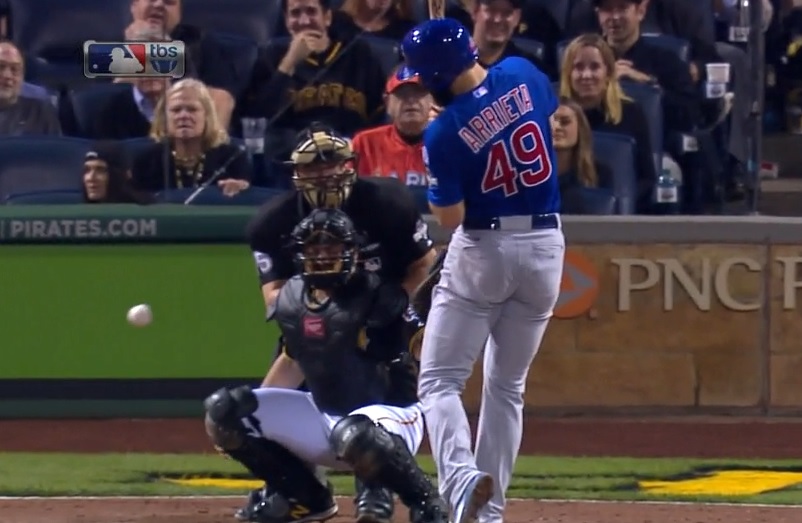
At least Watson did the deed properly, drilling Arrieta below the belt. “The butt’s perfect,” the pitcher said afterward in an ESPN report.

Also …

Ultimately, the benches would not have cleared had Arrieta simply headed to first base—which he should have done, given the circumstances. It was only when he stopped, stared down Watson and started to jaw—the point at which the chance of a physical confrontation rose to realistic levels—that his teammates streamed out to protect him. (As per usual, it was fairly uneventful … save for this.)

And …

Arrieta got his own dose of revenge, stealing second on the very next pitch. It was the first steal that Arietta had so much as attempted as a professional. “That was awesome,” he said in USA Today.

And so …

Ultimately, it’s all rubbish. Were the Pirates hell-bent on avenging Kang, they could have waited until next season. If they wanted to show Arrieta that they did not appreciate his liberties with the inside corner, the seventh inning of an elimination game was not the time to try to affect change. Ultimately, this was little more than frustration bubbling over in a way that does not reflect well on the Pirates.

The playoffs are not a time for vendettas. Pittsburgh now has about five months with which to consider that notion.

Bat flips, Retaliation, Showboating

On Measured Responses, and Why Every Slight Doesn’t Have to Equal Retaliation

Ration won the day again.

Wednesday, Cleveland second baseman Jose Ramirez homered against the Twins, admired it for a long while, then flipped his bat in the direction of Minnesota’s dugout. This was noteworthy less for the flip itself—which by now has become somewhat commonplace among the big league ranks—than for the reaction from the Twins dugout. Manager Paul Molitor stood on the top step and told Ramirez to “get the fuck off the field.” Catcher Kurt Suzuki lurked alongside, offering similar sentiments. (The gif above, via Deadspin, shows it all. Watch the full clip here.)

They had good reason to be angry. The balance of respect did not fall into Ramirez’s favor:

  • Ramirez celebrated his 23rd birthday only two weeks ago, while the guy he showed up, Ricky Nolasco, is 32 and a 10-year vet.
  • It wasn’t like he hit a bomb; his blast failed to clear the first row in right field and bounced back onto the grass.
  • Most importantly, the Twins Cleveland led 7-1 before he swung, and 10-1 afterward.

As best anybody could figure, Ramirez was upset with the fact that Minnesota had just intentionally walked Jason Kipnis to face him—a by-the-book move—and was letting off some steam.

Afterward, Nolasco threatened that Ramirez “will get his,” and the baseball media swarmed. Talk of retaliation has been at something of a fever pitch following last week’s episode of Papelbon Madness. Molitor himself was visibly pissed, and folks couldn’t wait to see what the manager would do.

Like Buck Showalter before him, however, Molitor sided with modern baseball reason. Instead of inflaming tensions by reacting to a perceived slight with tangible retaliation, he instead chose to do nothing. The Twins are a game back in the wild-card hunt, and have better things to worry about. Last night’s game—the teams’ final meeting this season—featured no hit batters.

Perhaps this is the new way of things, an enlightenment that dictates jackoff showboaters unworthy of undue attention.

Yesterday, Jeremy Affeldt announced his retirement with a bylined piece at SI.com in which he discussed the “recent trend of ‘look at me’ machismo,” writing, “Yes, let’s celebrate the game of baseball, and, if warranted, celebrate our on-field accomplishments with genuine shows of emotion. When you smack a double into the gap to take the lead in the eighth inning, by all means, pump your fist and praise your maker in the sky. But when you flash self-congratulatory signs after a meaningless first-inning single—or, even worse, a walk—you’re clowning yourself and not representing your club or your teammates very well.”

The notion is perfect—humble while acknowledging reality, accepting of changing times while refuting the kind of hubris that’s gained recent popularity. It’s noteworthy, however, for the fact that it followed something else Affeldt wrote: “I played the game the right way—not necessarily in compliance with some antiquated and silly ‘code.’ ”

Affeldt is right—the antiquated part of the Code is silly. But the stuff that governs the majority of big league ballplayers has evolved along with the rest of the game. It continues to mandate, as Molitor indicated from the top step of the visitors’ dugout in Cleveland, that respect be given an opponent. It also says now, in ways that would have been viewed as foreign a generation ago, that hard-line responses are not always necessary.

There’s always the chance that Molitor was simply abiding by game flow on Wednesday. The Twins didn’t lead by more than a run until the ninth inning, and could not afford to cede baserunners to their opponents. They always have the option of picking up the string against Ramirez again next season.

Here’s hoping that’s not the case.

Retaliation

Has Baseball Evolved? To Judge by the Response to Ham-Handed Intimidation Tactics, It’s At Least Getting There

Papelbon

By their inherent nature, sports are built to promote the concepts of good guys and bad guys. It’s them-vs.-us in tribal glory, where the opponent is the enemy simply by dint of wearing the wrong colors. This is why when we are provided an actual heel—Alex Rodriguez, Barry Bonds, John Rocker—we so revel in lambasting him.

The series of events that began on Wednesday with Jonathan Papelbon needlessly drilling Baltimore’s Manny Machado had all the makings for just such a scenario. Papelbon, the crotchety closer who’s pissed off opponents and teammates alike with three clubs over the last five years, was perfectly positioned as the foil, serving up behavior so outlandish that his own right fielder, Bryce Harper, publicly groused that he’d probably be the one to take the fall for it.

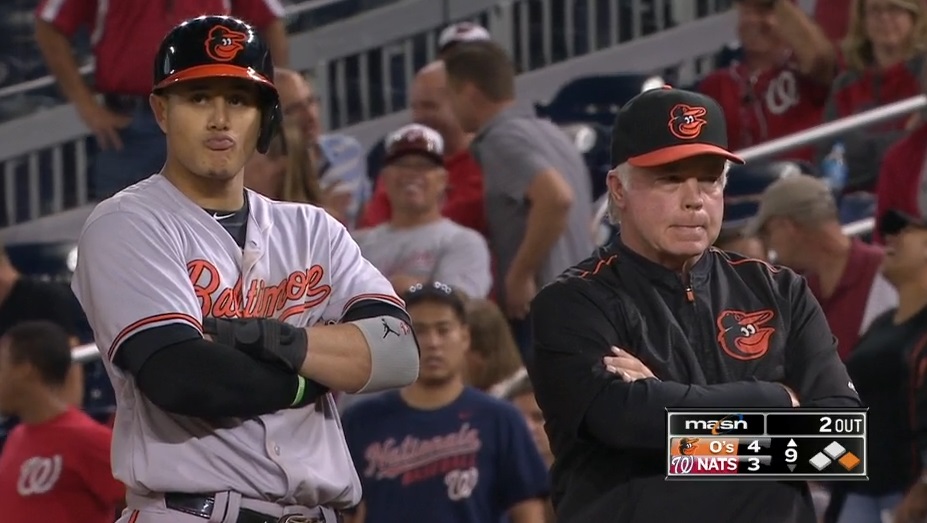
And then Buck Showalter stepped in. Finally, somebody who not only sees ludicrous things for what they are, but refuses to buy into a system that all but mandates senseless violence as an acceptable response mechanism.

The quick beats:

  • Machado hit a go-ahead homer off Nationals starter Max Scherzer in the seventh inning Wednesday, and admired it for a moment longer than Papelbon thought appropriate. Or maybe it was his pointing afterward, to the heavens, to the grandstand. Papelbon didn’t say.
  • Machado’s next at-bat came in the ninth, with the closer on the mound. Papelbon threw his second pitch up near Machado’s head; after it missed he did it again. Had Machado stayed in his crouch the ball would likely have connected with his cheek or ear. Because he stood up and spun toward the backstop, it merely ricocheted off the top of his shoulder. Papelbon was ejected immediately. (Watch it here.)

This goes beyond the simple etiquette of the unwritten rules. Once upon a time somebody like Papelbon could have gotten away with that kind of message pitch, informing the opposition that styling—even styling so slight as to have almost entirely evaded the TV replay—will not be tolerated, at risk of great physical peril. But baseball has moved on from that mindset, almost universally for the better. Machado did nothing outside the mainstream, his actions offensive only to the red-assed among us who cry that old-school retaliation is the only way to curb such offensive behavior.

Manny n BuckThe fact that Papelbon took things a step further, throwing two pitches near Machado’s head, is on its own merits worthy of a considerable suspension.

Modern-day baseball has graduated from making emotional slights physical. It’s not that skins have grown thicker over the years; it’s that as celebrations have become commonplace, most players just stopped caring about them. The question is no longer who thinks them worthy of retaliation, but who even notices.

On the other hand, Papelbon’s attack—an actual, physical assault with a baseball upon Baltimore’s best hitter—is the kind of thing that cries out for response. It would be easy to justify; when somebody goes full-bore loony, there are proven methods of getting his attention. Papelbon gave just such an opening to the Orioles, spurring Harper to grouse that the closer’s actions are “pretty tired,” and that “I’ll probably get drilled tomorrow.”

With that comment, Harper all but validated whatever response Showalter had up his sleeve. People filled the ensuing hours with discussion about when and how and on what part of the body Harper might wear one. And then we were surprised.

Showalter demurred.

“You’re not supposed to do that,” he said in a Baltimore Sun report. “The best retaliation would be to win another game, right? That’s usually how it works. … The greatest form of revenge is success, isn’t that what they say?”

Can it really be that simple? Yep. Thursday saw no retaliation of any sort, save for Machado calling Papelbon a coward. And sure enough, the Orioles won. Like Showalter himself said, “That hurts more, especially when you take the high ground.”

Showalter knows whereof he speaks. Machado himself spurred a similarly embarrassing affair only last year, and the O’s skipper appears to want no part in revisiting any part of that mindset. Wednesday, Papelbon proved himself again as a heel who it’s fun to root against, but that, in sports, is old hat.

In avoiding unnecessary conflict, Showalter gave us the opposite—not just somebody worth cheering, but somebody worth emulating, a clean-cut cat whose clear-eyed logic carried the day. With the Orioles still holding an outside shot at a wild-card spot, Showalter allowed his team to do the one thing that’s absolutely necessary for the good of its immediate future: concentrate on playing baseball.

Well played, Buck. Well played.

Update 9-25: Well, there it is: three games for Pap.

Retaliation

Carnage in Chicago, But it Ain’t Joe Maddon’s Fault

Rizzo drizzoThere are lots of ways to look at the weekend’s incidents in Chicago, which resulted in six hit batters, four ejections, an in-dugout apology, some strategic rethinking about ages-old Code courtesy that’s long been questioned but never usurped, and a one-sided war of words waged by Cubs manager Joe Maddon.

Start with Maddon, whose reasonable explanations for everything that happened did little to mask that he spent the weekend playing both sides of the debate, as aggrieved victim and as innocent perpetrator, depending on whether his team was being drilled or doing the drilling. Chicago’s Dan Haren plunking Matt Holliday in the helmet? An accident, and don’t dare insinuate otherwise. Cards reliever Matt Belisle drilling Anthony Rizzo? As clearly telegraphed a hit as a hit ordered by Tony Soprano, whose name Maddon dropped in his postgame press conference. Never mind that Rizzo leads baseball in being hit by pitches, or that Belisle was still knocking off rust in only his second appearance since June after returning from elbow issues. (Watch Haren and Belisle’s pitches here.)

Maddon, however, didn’t want to hear it. (“Of course not,” he said, when asked about Belisle’s pitch possibly being unintentional. “That is ridiculous.”)

There are facts to back up the manager’s viewpoint, of course. Haren obviously did not mean to drill Holliday, but these are the Cardinals, whose institutional need to settle scores is so ingrained as to have been described in detail in the book Three Nights in August. (The focus of that book, Tony La Russa, has since moved on, but Mike Matheny has maintained the brand in a reasonable fashion.)

And that pitch Belisle threw sure looked intentional, aimed directly at its mark from the moment it left his hand. Haren, in fact, spent two seasons under La Russa in St. Louis, and knew enough to apologize to Rizzo after hitting Holliday for the HBP he was all but certain was coming. “They always police things like that …” Haren said in an MLB.com report, saying that the Cardinals view retaliation as an intimidation tactic. “They might take it to the extreme a little bit with that stuff. I think everyone understands it. I guess at least they didn’t throw at his head.”)

The real intrigue became with the warning Maddon issued at the close of his diatribe: “We don’t start stuff, but we will finish stuff.”

That became clear on Saturday, when Cardinals second baseman Kolten Wong was hit twice (angrily spiking his bat after the second one, from reliever Fernando Rodney; watch it here). After warnings were issued, Cubs closer Hector Rondon furthered the tension by drilling pinch-hitter Greg Garcia to open the ninth, earning ejections for himself and Maddon.

“Obviously, we’re not trying to [hit anyone],” said Maddon, after the game.

Well, no. Not so obviously.

The denial of any intent for any action that can be justifiably read as antagonistic is part of the Code. But even were Maddon telling the truth, he had to realize that the chutzpah involved is overwhelming. Actually, he did.

“I know nobody wants to believe me,” he said. “You’re not going to believe me, all the Cardinal nation. God bless you, you’re not going to want to believe me, and I get it. There’s no way for me to sit here and even attempt to ameliorate your concerns. None of that was intentional, it just happens, it’s part of the game. Go ahead, lay it on me, man, I’m OK with it.”

Rondon drilled Garcia with a 96-mph fastball while his team held a four-run lead. Rodney is already known to go after people. It’s easy to explain away any one of Chicago’s three drillings that occurred after Maddon’s promise to “finish stuff,” but such blanket whitewashing is a stretch.

Perhaps it’s an indication that the Cubs are growing up as a franchise, that the mighty Cardinals finally see them as a threat and are responding in kind by breaking out big-boy tactics. It wouldn’t be a first. Chicago’s newfound success can be seen in Maddon’s own strategies; with his team in the heart of the wild-card chase the manager made clear his intention of placing the unwritten rules in a secondary position to winning games. In the eighth inning on Friday, he shut down his running game despite the Cardinals opting not to hold runners on first, on account of Chicago’s five-run lead. Maddon ended up having to warm up closer Hector Rondon in the ninth, on a day he would have liked to rest him entirely, and made it clear that he regretted the decision.

“The next time they [don’t hold our runners on base], we’re going to run,” he said. “I want everybody to know that. I never read that particular book that the Cardinals wrote way back in the day. I was a big Branch Rickey fan, but I never [read] this book that the Cardinals had written regarding how to play baseball. If you play behind us, and we’re up by five points in the ninth, we’re running. And you have every right to do the same thing.”

Sunday’s series closer featured no big leads for either team to exploit. It also featured no hit batters. For those of you scoring at home, it was the final time during the regular season that these teams will face each other. So be sure to mark your 2016 NL Central calendars for some quality Code-based action.