Retaliation

Actions and Consequences: The Importance Of Understanding What—And What Not—To Do

WarningOver at ESPN, Doug Glanville writes about baseball’s unwritten rules, and tells a story of charging the mound as a minor leaguer. He spells it out clearly: His actions toward the pitcher in question had little to do with anger or violence, and much to do with setting tone. Glanville wanted to send a message about what happens when one takes too many liberties with an opponent.

The story is a good one, but its upshot comes with the aftermath:

The next time I played the Greenville Braves at home, the team that I charged the mound against, they hit me in the back with the first pitch of the game. I walked to first and told the first baseman that I wanted to move on, so we could just play baseball again. I offered my olive branch. He seemed to accept, but neither of us had any say in what came next. My pitcher declared that he would get the opposing pitcher back, so he threw at him. Then the opposing pitcher threw back at him. My pitcher threw the bat at the pitcher, the managers got into a fight on the field and in between doubleheader games while exchanging lineup cards. It kept going well after I had accepted getting hit.

In many ways, baseball’s unwritten rules are fading from focus, and that’s just fine. The sport will be no less robust without many of the tenets that make little sense anyway (including the kind of ad nauseam tit-for-tat that Glanville describes). But such ignorance comes with a downside.

It was evident last week in Minnesota, when Miguel Sano could have simply gone to first base after being missed by a retaliatory pitch. Had he understood the system—that a cooler response would have effectively closed the book on the situation—all would have ended well. Instead, he argued, he fought and he ended up ejected and suspended.

It was evident in Baltimore, when, instead of neatly wrapping up a string of events with an appropriate purpose pitch, Matt Barnes inflamed tensions by putting a fastball near Manny Machado’s head. (To be clear: A purpose pitch does not have to hit a batter. It is simply a way for a pitcher to indicate that he noticed what the opposition did, that he does not approve, and that some actions have consequences. It is also a way for a pitcher to show his teammates that he’s overtly willing to guard their best interests. The latter detail is frequently far more important than the former. The stupidity of throwing at a guy’s head, though, negates whatever legitimate motivation the pitcher might have had.)

Had Glanville’s minor league teammates understood that as goes the victim, so go they, all would have been fine. Glanville was calm, so they should have been calm. Had Glanville started swinging his fists, they should have been right behind him, offering backup. The Code dictates as much.

Those were just kids, though, playing Double-A baseball, in a league where everything is a learning experience. By the time those players reached the big leagues, one would hope such lessons had settled.

As evidenced by last week’s mayhem, however, that’s not always the case. Decrying the unwritten rules as archaic and unnecessary is one thing, but failure to understand them can bear some unfortunate consequences.
Retaliation

Message Delivered: Detroit Baits Sano Into Disastrous Reaction

Sano-Boyd

It was obscured over the weekend by the Baltimore Slide Affair, but a moment in Saturday’s Twins-Tigers game slots into the same category. It also offers some lessons for whatever Red Sox player ends up wearing a retaliatory pitch from the Orioles, should such a thing be coming.

Whether or not one agrees with the concept of retaliatory pitches in baseball, one must accept the fact that such things exist, and understand that an appropriate response will go a long way toward maintaining general sanity on the premises. On Saturday, Miguel Sano did not offer an appropriate response, and ended up ejected, then suspended.

It began in the third inning, when Twins reliever Justin Haley drilled Detroit’s JaCoby Jones in the face, knocking him from the game. Jones was subsequently placed on the 10-day disabled list with a lip laceration.

Unlike the pitch in Baltimore, there was no noticeable intent, but—as will likely influence Boston when the Orioles next come to town—conventional tactics mandate a response to HBPs above the shoulders. Prevailing notion holds that even innocent pitchers who can’t control their stuff shouldn’t be throwing up and in. Should they do so, plunking a teammate in response issues a powerful deterrent for similar pursuits in the future.

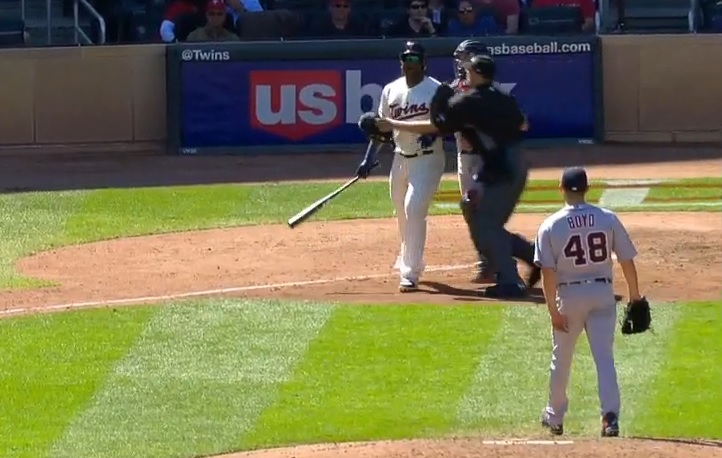
Which is precisely what happened in Minnesota. Two frames after Jones went down, Twins starter Matthew Boyd threw a fastball behind Sano—below the waist, as deterrent pitches are supposed to be. Had the hitter kept his wits, he would have recognized and accepted the nature of the message: a no-harm-done warning shot indicating the Twins’ displeasure with how things had gone down. Had the hitter kept his wits, he could have kept on hitting.

Instead, Sano took several steps toward the mound, pointing and shouting. When Twins catcher James McCann put him in a protective bear hug, Sano took a swing. (Watch it here.)

Never mind the lack of strategy behind throwing a punch at a guy wearing a catcher’s mask—Sano was quickly tossed. So, strangely, was Boyd, who hadn’t actually hit anyone with a pitch, who hadn’t received a warning to that point, and who likely wouldn’t have gone anywhere had Sano recognized the situation for what it was and calmly allowed the game to proceed.

“[McCann] touched me with his glove and I reacted,” Sano said after the game, in an MLB.com report. “It was a glove to the face. They were supposed to eject McCann, too, but I saw they didn’t eject him.”

Sure enough, McCann’s glove rose toward Sano’s face as the catcher drew him close. It wasn’t a swing though, and should hardly have been enough to spur Sano into the action he took.

Sano doesn’t need to like the concept of baseball retaliation. It is, in many instances, a brutal process. But the logic is impossible to miss: A pitch thrown at a team’s star in response to something one of his teammates did might inspire a conversation with said teammate about knocking it the hell off in the future. Had Sano recognized as much, he’d have saved himself a bunch of trouble.

The word “rules” is right there in the term “unwritten rules.” This weekend showed us the importance of players understanding them, if only for their own long-term benefit.


Retaliation

Boston Puts the ‘Harm’ in Charm City: Head-High Retaliation Draws O’s Ire

Machado headball

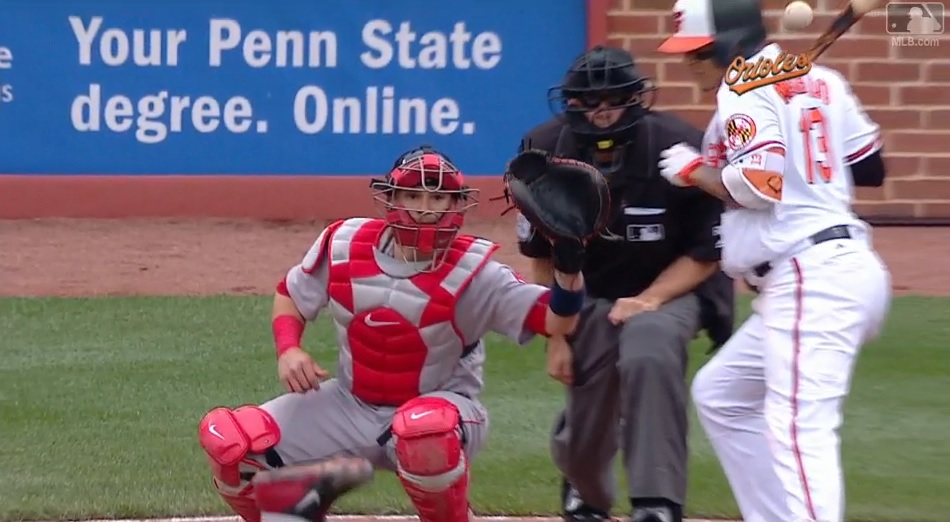
Baseball’s unwritten rules are pretty straightforward. When Manny Machado took out Dustin Pedroia with what many felt was a reckless slide on Friday, it seemed likely that the Red Sox would respond. A pitched ball into the ribcage or thigh, with Machado its probable target, would send a clear message to Baltimore and others around the league that taking liberties with Boston players comes at a price.

Then Matt Barnes threw at Machado’s head and sent the entire framework spinning on its axis.

Instead of closing the book on the incident, Barnes further inflamed some already raw feelings.

Instead of avenging Pedroia, Barnes forced his teammate into the uncomfortable position of having to shout across the field to Machado that the idea wasn’t his.

Instead of showing a unified clubhouse in which mutual accountability is paramount, where everyone has everyone else’s back, the Red Sox appear disjointed, unsure of what’s expected, who wants what, and how to execute when the time comes.

Orioles pitcher Zach Britton nailed it after the game when he told BaltimoreBaseballcom: “[Pedroia] is the leader of that clubhouse, and if he can’t control his own teammates, then there’s a bigger issue over there.”

The Red Sox actually tried to nail Machado earlier in the game, when in the sixth inning starter Eduardo Rodriguez threw three pitches toward Machado’s knees, all of which failed to connect. So two innings later, Barnes took things into his own hands. His head-high pitch just missed its mark, sailing across Machado’s shoulder blades, and ricocheted off his bat for a foul ball. (Watch it all here.)

The egregiousness of the pitch lent undue credence to those suggesting that the time for retaliation had already passed—never mind that in the two games between Machado’s slide and Rodriguez’s aborted response, neither team led by more than two runs, thus diminishing the Boston’s ability to freely cede baserunners to the opposition.

After the game, Pedroia went so far as to completely disavow his role. “That’s not how you do that, man,” he told reporters. “I’m sorry to [Machado] and his team. If you’re going to protect guys, you do it right away.” He then clarified: “It’s definitely a mishandled situation. There was zero intention of [Machado] trying to hurt me. He just made a bad slide. He did hurt me. It’s baseball, man. I’m not mad at him. I love Manny Machado.”

Boston manager John Farrell called it a dangerous pitch, but was it ordered? Possibly. Because Pedroia steered as clear as possible from the result doesn’t mean he wouldn’t have appreciated—or didn’t ask for—a better-placed retaliatory strike. Still, when he shouted across the field to Machado, Pedroia could clearly be seen saying, “It’s not me, it’s them.”

Who them are is of some interest, be it Farrell, a coach or a veteran pitcher offering guidance to Rodriguez and Barnes. Farrell’s statement in an MLB.com report—“Make no mistake, the ball got away from him. My comments are what they are”—leave open the possibility that he approved the message, if not the delivery.

It all serves as background in the face of a rapidly swinging pendulum. On Friday, it was Manny Machado playing the bad-guy role. To judge by his comments on Sunday—“I thought I did a good slide [on Friday]. Everyone knows. Everyone saw the replay on that side. That’s on them”—he has little interest in correcting the record.

Yet with one pitch, Barnes flipped the script for both clubhouses. It’s the Red Sox now wearing the black hats, and the Orioles with leeway to exact some retaliation of their own. (Machado got a measure of revenge after Barnes was kicked out of the game, tagging an RBI double off of the first offering from replacement pitcher Joe Kelly.)

What remains to be seen is how the Orioles respond. If they handle their business correctly, maybe everybody can put this affair behind them. If they do things like Matt Barnes and the Red Sox, however, we can count on things being dragged out even further.

The teams start a four-game series in Boston on May 1.

***

In  a related note, Zach Britton was unusually forthright in his description of how things work in this regard. As related to Rodriguez (in his third year in the league) and Barnes (in his fourth), Britton said this:

“As a player that doesn’t have the most service time in this room, when a guy like Adam Jones tells me to do something or not to do something, I’m going to do [what he says]. Same with Chris Davis or Darren O’Day, the guys in my bullpen. If they tell me, ‘Don’t do this or that,’ I’m going to listen to them because they’ve been around the game and they’ve seen things I haven’t seen. And you respect their leadership.”

As an institution, baseball has been drifting away from unwritten rules like these largely because the leadership Britton referenced features fewer old-school opinions with every year that passes. That doesn’t mean those opinions don’t still exist, however, more strongly in some clubhouses than others. It’s highly unlikely that anybody on the Red Sox suggested that Barnes go head-hunting, but given Pedroia’s response it’s a near-certainty that somebody suggested that a response to Machado was necessary.

Slide properly

Machado’s Spikes Spur Red Sox Rage

Machado slides

After Chase Utley broke the leg of Mets shortstop Ruben Tejada with a questionable slide in the 2015 playoffs, Major League Baseball implemented a rule to regulate that type of play, defining illegal slides—per the Baltimore Sun—as “those in which a runner doesn’t begin his slide before reaching the base, is unable to reach the base with his hand or foot, isn’t able to remain on the base after completion of the slide or changes the pathway of his slide to initiate contact with a fielder.”

On Friday in Baltimore, Manny Machado met at least three of the four criteria. He began his slide some five feet before second, and his path was aimed directly at the bag. As for remaining on the base, well, that’s up for interpretation.

Machado, clearly beaten by the throw, lifted his lead foot before reaching the base. Instead of popping up, he slid directly over, his spikes planting firmly into the left knee of Red Sox second baseman Dustin Pedroia. (Watch it here.)

This wasn’t a matter of breaking up a double play, or at least it shouldn’t have been. It had been a slow ground ball, and the throw from shortstop Xander Bogaerts arrived at the center-field side of the bag, forcing Pedroia to stretch like a first baseman to corral it. There was scant danger of a pivot.

Details that matter:

  • Pedroia had offseason arthroscopic surgery on the knee in question and continues to rehab it.
  • Pedroia limped from the field after the slide. The play ended his day … and maybe more.
  • Regardless of Machado’s intent—at the very least, he can be accused of recklenssness—the Red Sox were decidedly unhappy.

As the game (a 2-0 Baltimore win) ended, a number of Red Sox personnel—including pitchers Rick Porcello and David Price, pitching coach Carl Willis and bench coach Gary DiSarcina—looked on angrily as the Orioles departed the field. (Porcello and Price will not pitch in the series’ final two games.)

Afterward, Pedroia—noteworthy for downplaying injuries over his career—stopped short of assigning blame to Machado, but his frustration was unmistakable. When asked about baseball’s injury-prevention rule, he told reporters this:

“I don’t even know what the rule is. I’ve turned the best double play in the major leagues for 11 years. I don’t need the fucking rule, let’s be honest. The rule is irrelevant. The rule is for people with bad footwork, and that’s it.”

On one hand, bad footwork can lead to awkward moments. On the other hand, sometimes even capable fielders like Pedroia must achieve compromising positions in order to complete a play. Boston manager John Farrell described the slide as “extremely late.” When asked if it was dirty, he responded again: “It was a late slide.”

Even more telling, perhaps, was the cluster of Red Sox players and coaches gathered around a clubhouse computer screen to dissect the play in slo-mo, again and again. The teams face each other 14 more times this season.

Machado said all the right things afterward about how he didn’t want to hurt his opponent, said he texted Pedroia his regrets, even. Then again, this is the same guy who kept hitting catchers with his bat, threw his bat in response when opponents took issue with it, blew up over an ordinary tag and charged Yordano Ventura, so who the hell knows.

How this plays out over the next two days—or the rest of the year—will go a long way toward explaining just how forgiving a group the Red Sox might be.

Don't Cross the Pitcher's Mound, Infield Etiquette

Play Ball! … no, wait … okay, Play Ball!

Kershaw

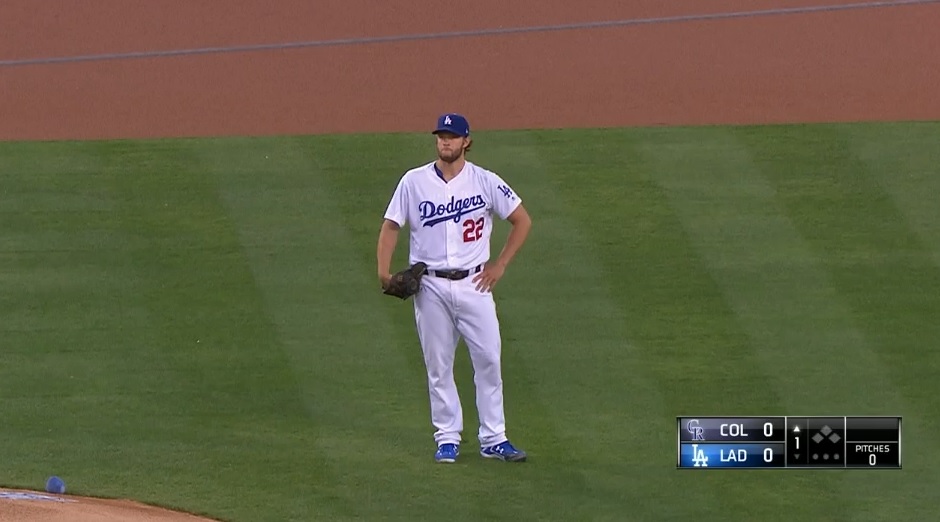
Clayton Kershaw called it “disrespectful,” but really it was more thoughtless than anything.

The lefthander was preparing to pitch to the first batter of yesterday’s game against Colorado, Charlie Blackmon, when plate ump Quinn Wolcott put up his hand to pause the action. Rockies starter Tyler Anderson had taken some extra warmup tosses in the bullpen and was slowly walking back to the dugout along the sideline. Wolcott wanted the field cleared before the game began.

Kershaw couldn’t believe it. He lifted his palms in disbelief, then paced his way off the back of the mound, standing in the infield grass, arms akimbo, while Anderson departed.

“That was one of the more disrespectful things I’ve been a part of in a game,” the pitcher said after the game. “I really didn’t appreciate that. The game starts at 7:10. It started at 7:10 here for a long time. Just go around or finish earlier. That wasn’t appreciated, for sure. Not going to say any more—I’ll get in trouble.”

If it seems like a high-strung reaction for a few seconds’ worth of delay, it might be—but it’s justified. Kershaw, like most great pitchers, is a creature of focus and timing. When he’s in the process of going through routines both mental and physical to begin a game, any interruption can present a derailment. Sure enough, the first three Rockies reached base, on a walk and two singles. Kershaw denied that Anderson’s sojourn had anything to do with it, and, after surrendering only one run in getting out of the jam, he settled down to give up only four hits and one run over the next six, striking out 10 in the process.

At issue is a ballplayer’s territory, and how decorum prevents opponents from encroaching upon it. Hitters, for example, never walk between the pitcher and the catcher en route to the batter’s box. When necessary, they walk around, behind the umpire. It’s an easy thing to overlook from the grandstand, but the sanctity of the space is inviolable. That path belongs to the pitcher, at least while he’s holding a baseball, and everybody understands it.

When Alex Rodriguez trod atop the mound on his way back to the dugout after flying out in 2010, the pitcher he crossed, Oakland’s Dallas Braden, gave him an earful. At the time, people wondered what the problem was, but for anyone paying attention the answer was obvious—the pitcher’s mound is sacred, and any invasion is insufficiently deferential to the guy trying to do his job there.

(Sidenote: I covered that very topic in The Baseball Codes, for a chapter that was cut prior to printing for space considerations. In it, Dodgers manager Dave Roberts—a Giants outfielder when I talked to him—said, “That’s his office, his domain To run across it is disrespectful.”)

Anderson denied intent, telling reporters that he “didn’t mean any disrespect” and that he was surprised that Wolcott didn’t allow the game to begin. But the delay interfered with Kershaw’s process, whatever it may have been. The pitcher was within his rights to be annoyed.

Kershaw expended 27 pitches in that first inning, which was almost certainly a factor in his failure to reach the eighth. That might have been one reason for his postgame rant. Even more so, I’m guessing, was Anderson’s simple lack of etiquette. The guess here is that retaliation of any sort will be unnecessary—we’ll never see something like that again from a Rockies pitcher, at least not at Dodger Stadium.


No-Hitter Etiquette

No-No No Mo’: On Yanking One’s Pitcher in the Middle of a No-Hitter

Manaea

The unwritten rule—not to mention conventional wisdom—is that one doesn’t pull one’s pitcher while he’s throwing a no-hitter. Managers have gone to great lengths to protect this credo, notably during Johan Santana’s 134-pitch no-no in 2012, which left him with an indelible mark on history … and ruined his arm forever. (Santana put up an 8.27 ERA in 10 more starts for the Mets that season before being shut down, and hasn’t pitched in the big leagues since.)

Santana’s manager in that game, Terry Collins, left him in for a variety of reasons, among which was the Mets having never thrown a no-hitter. Over the weekend, A’s skipper Bob Melvin and Marlins boss Don Mattingly were under no such constraints.

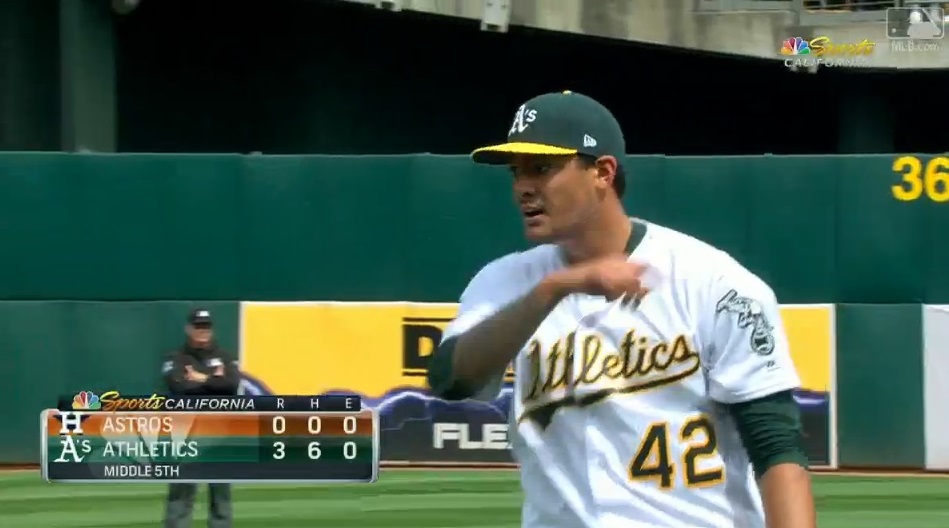
On Saturday in Oakland, 25-year-old Sean Manaea came hot out of the gate against the Astros, cruising through the first five innings, during which he struck out six, walked two and gave up no hits.

Then came the sixth. With the A’s holding a 5-0 lead, Manaea walked the first batter, then the second, then the third. It took him only 15 pitches to do so, the last eight of them balls. When Carlos Correa smoked a line drive that ricocheted off the glove of shortstop Adam Rosales, leading to two runs, Melvin had seen enough.

Manaea, in only his third start of the season, was at 98 pitches. Even if he stayed in, there was virtually no chance he’d be able to finish the game. Melvin pulled him.

This was nothing like Clay Kirby being pulled from a no-hitter in 1970 because his team was losing and his manager wanted a pinch-hitter. It was more like the moves made by Ron Gardenhire and Ron Washington, managers who, in the span of about a week in 2010, each yanked a no-hit pitcher whose workload was growing untenable.  Same with Dave Roberts, last year.

(It should be noted that Melvin had been primed to do the same thing five years ago—the day after Santana’s feat—as Jarrod Parker spun no-hit ball, but Parker gave up a hit before his manager could take action.)

On Sunday, Mattingly found himself in similar circumstances when Marlins pitcher Dan Straily entered the sixth without having given up a hit. After Straily walked consecutive batters, however—giving him five on the day and bringing him to 93 pitches—he was sent to the showers. Noteworthy was that Miami led only 1-0 at the time, and Mattingly’s maneuver was aimed as much toward securing a victory as it was protecting Straily.

That the Astros, after being no-hit into the sixth inning, ended up scoring 10 runs on the day, is interesting. So is the fact that in Miami, J.T. Riddle hit his first career homer only moments after the would-be winning run was thrown out at the plate, to salt the game away for the Marlins.

Neither detail, however, superseded the fact that Melvin and Mattingly pulled their pitchers in the middle of no-hitters, not to mention that both moves were the right thing to do.


Retaliation

Scratch Those Premature Obituaries, Baseball’s Unwritten Rules Are Alive and Well


RamosII

We’ve spent a long time—years now—wondering whether baseball’s unwritten rules, the sport’s code of conduct, were slowly meeting an inexorable irrelevance. Bats are flipped, celebrations are celebrated, and teams mostly go about their merry ways, unperturbed by the spectacle.

Fair enough. If that’s how big leaguers are playing it, that’s how things are. This blog isn’t bent on prescription of the sport’s unwritten rules so much as documentation of how they’re enacted by those who matter.

Then Monday happened. Fastballs flew at batters, some intentional, some not, some difficult to ascertain. But they elicited response. Oh, did they elicit.

In San Francisco, Diamondbacks starter Taijuan Walker drilled Buster Posey in the helmet. It was the first inning, there was a runner on second and Walker had already faced the Giants once this season without incident. So unless something happened back on April 5 that irked Walker something fierce while going entirely unnoticed by the media on hand, the pitch was clearly a mistake.

Still, it was a 94 mph fastball that knocked the Giants’ best player from the game and landed him on the 7-day disabled list.

Until recently, this would have unquestionably merited response, be it a pain-inducer (fastball to the ribs) or a warning shot (brushback). In the current version of Major League Baseball, of course, nothing is typical as regards the unwritten rules. Things are calmer, more relaxed. Vendettas are strictly an old-school affair.

So it seemed only normal when Walker escaped unscathed. Neither of his subsequent at-bats were ideal for retribution—with one out and nobody on in the third, he hit a fly ball to right field; in the fifth, with two outs, a runner on second and the Giants leading 3-0, he whiffed—but neither were they unacceptable.

From there, though, things grew interesting. In the eighth inning, Giants starter Matt Moore plunked David Peralta in the back. Then, in the first inning of yesterday’s game, Giants pitcher Jeff Samardzija plunked Arizona’s cleanup hitter, Paul Goldschmidt, in the backside—the ages-old response of “your best hitter for our best hitter.”

Bochy refused to discuss Samardzija’s pitch, and offered up an interestingly vague comment about Moore’s, saying in a San Jose Mercury-News report that “a pitch got away from him—I’ll leave it at that.”

Despite a pro forma post-game denial about wanting to pitch Goldschmidt inside, Samardzija had clear intentions for his target. Because the pitch was professionally delivered—into the posterior, nowhere near the head—the slugger took it without complaint. He knew the drill.

Why hadn’t it been Walker? Could be many reasons, though none resonate so firmly in a close game as not wanting to forgo an easy out by drilling the pitcher when one can send as firm a message against a far more dangerous hitter. Why Samardzija and not Moore? Might be a matter of personality, or the fact that the severity of Posey’s injury wasn’t known until after Moore’s game had ended.

***

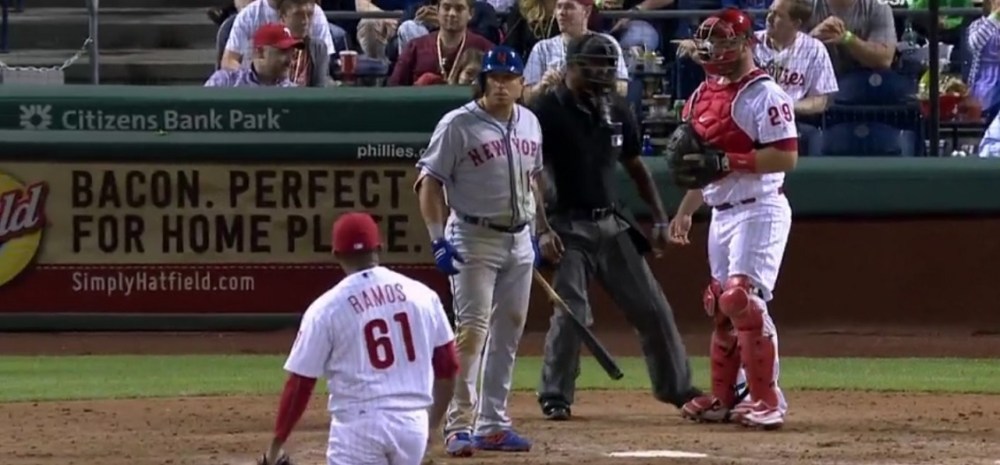
Across the country, Phillies pitcher Edubray Ramos entered a tie game in the eighth inning and threw a one-out fastball well over the head of Asdrubal Cabrera. It didn’t come close to making contact, but was enough to elicit warnings from plate ump Alan Porter, and the subsequent ejection of Phillies manager Pete Mackanin for arguing a hair too vociferously. (Watch it here.)

The backstory seems pretty obvious. Ramos last faced Cabrera in September while gunning for his first big league save. Cabrera wrecked it, then did this:

Retaliating for a game-winning celebration is some old-school mentality. And here’s the thing: for all the noise coming out of the World Baseball Classic about how Latin players like to celebrate their achievements on the field, Ramos—a native Venezuelan—was having none of the exuberance of one of his fellow countrymen. Or maybe that latter detail offers another wrinkle to their relationship about which we aren’t yet aware. Whatever it was, it stuck in the pitcher’s craw.

So there it is: On the West Coast, a passel of Americans participated in all-American retaliatory daisy chain; on the East Coast, two Venezuelans did the same. (Worth noting is that Ramos’s teammate, Odubel Herrera—another Venezuelan—is a bat-flipping savant, while Mackanin, Ramos’ manager, is himself no fan of the flips.)

The unwritten rules may be inexorably changing, but it all serves to show that one should never place too big a bet on who their champion might be.

Cheating, Pine Tar

Stick Around, Why Don’t You?: Yadi’s Magic Chest Protector Draws Attention in Unwanted Ways

Molina sticky ball

Pee Wee Reese would load up spitballs for Don Drysdale, away from the watchful eye of umpires.

Yankees catcher Elston Howard was said to have sharpened the buckles on his shin guards, which he used to gouge baseballs as he drew back his arm for return throws to the pitcher.

Dodgers shortstop Maury Wills kept an emery board in his glove with which to scuff balls before returning them to the mound. Reds shortstop Davey Concepcion was rumored to have a bent eyelet on his glove’s heel for much the same purpose.

There were first basemen who put tacks in their gloves and third basemen who put Vaseline on their palms to offer assistance in the same, surreptitious vein.

So should we be surprised, really, if Yadier Molina is doing something similar for his pitchers?

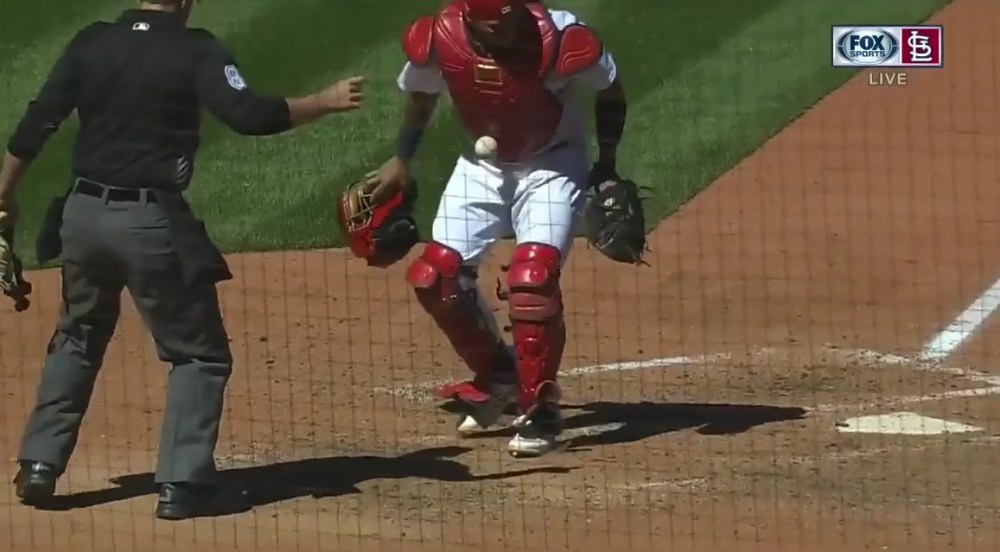
That’s the simplest explanation for what happened yesterday, when a pitch from Brett Cecil bounced in front of the plate and ended up adhered to Molina’s chest protector as the increasingly frantic catcher looked around for the lost baseball. Application of pine tar helps pitchers increase the movement of breaking pitches (which Cecil’s offering was), but it also tends to make things … sticky.

(Watch the whole thing here.)

Yadi knows exactly what happened. So does Cecil. So, likely, does Cardinals manager Mike Matheny, himself a former catcher. When asked about it after the game, however, they offered little more than a collective Huh?

Catchers can legally apply pine tar to their shin guards, the better to increase their ability to grip the ball. It’s legal because catchers have no interest in making their own throws do funky things, and on cold or wet nights grip can be vital. Salvador Perez was outed for this very thing during the 2015 World Series, and the news barely made a ripple. Had Molina offered an excuse somewhere along those lines it would have made some sense. Instead, he said this:

“Do I put anything on my chest protector? No. That’s a dumb question.”

Which leads to the clear impression that he’s covering something up on behalf of his pitcher. Cecil didn’t comment, because Cecil took off after the game without speaking to reporters.

Upon being removed from Molina’s chest the ball left a white smudge—a clear indicator for sleuths around the ballpark. But because Cubs manager Joe Maddon never requested that the ball, Molina or Cecil be checked by the umpires, the game continued apace and everybody went on their merry ways.

If Cecil was cheating, he has a rich history of pitchers to emulate. Over just the last two seasons, Mike Fiers was accused of using pine tar during a no-hitter, Brian Matusz was suspended for hiding a foreign substance on his arm and Brewers reliever Will Smith was busted for similar reasons. There was also, of course, the infamous Michael Pineda affair, which came in two parts.

What’s left now, mostly (unless somebody in the know decides to talk) is for Cecil to knock off any extracurricular activities until the heat dies down. Same for Molina. Because, really, nobody around baseball really cares about pitchers using pine tar (there are likely some on every team who do) until the moment that public attention forces them to decry cheaters cheaters and their cheating ways.

NBA

Unwritten Rules of the Hardwood

Basketball

With all the hoopla surrounding opening day, it seems improbable that the clubhouse leader for most prominent early-season unwritten rules story is coming not from a baseball diamond, but out of the NBA. It pertains to what should be done with the ball with time running out while holding a big lead.

On Sunday, Golden State’s JaVale McGee launched a 3-pointer in the final seconds of a game in which his team led Washington 137-115. The guy guarding him, Brandon Jennings, was so upset that he earned a flagrant foul for shoving McGee to the ground before the player landed.

“It’s just a rule—I learned it when I first came into the league not to do that,” Jennings said in an NBC report. “You’re already up 20 almost, and then for him to do it, it was like, ‘All right, come on. Chill out. Now you’re trying to embarrass us.’ ”

Jennings called the move “disrespectful,” and labeled himself “old-school.”

The Warriors’ response: there were 4.8 seconds left on the shot clock, but 6.9 seconds left on the game clock. “What’s JaVale supposed to do? Let the clock run out and get a turnover?” wondered Klay Thompson. “It’s basketball.” At the very least, the shot for which McGee opted was decidedly low-percentage.

Golden State coach Steve Kerr did admit that while he had no problem shooting in that situation—“I never understood why a team would be offended if there is a shot-clock deferential,” he said in an ESPN report—he’d rather not see a three-pointer be the shot of choice. “I guess [the 3-pointer is] what Jennings was upset about,” he said in an ESPN report. “I was uncomfortable with the way it ended.”

(To be fair, Jennings was also upset that Kerr left Stephen Curry and Draymond Green in the game until the end, regardless of the blowout. Green was chasing a triple-double, and Kerr may have wanted to make a statement to his team following the Warriors’ loss to Washington in February. Kerr did apologize to Wizards coach Scott Brooks.)

(Also to be fair, the Wizards have taken three such shots this season themselves.)

Yesterday the Pacers did the same thing, only with no shot-clock differential. With 10 seconds remaining against Toronto and holding a 15-point lead, Lance Stephenson jogged down the court and made an uncontested layup. The difference between this and McGee’s shot: there would have been no statistical repercussions had Stephenson chosen to hold on to it.

Once time expired, various Raptors had to be restrained from going after Stephenson.

The distinction between the two plays—an expiring shot clock—was clear. It’s a direct-line explanation that directly impacts a team’s stat line. In baseball blowouts, teams don’t stop trying to score, they just stop trying to score aggressively. Runners advance only one base on a single, two on a double, etc. Things like stolen bases and sacrifice bunts are curtailed. And though quibbles can be lodged over McGee’s choice of court spacing, even that is up for debate. Another thing Jennings said was, “Thank God he didn’t go to the rack. It probably would have been worse for him.” So who the hell knows?

Stephenson, on the other hand, had no reason to shoot. He wasn’t being defended. The game would have ended before the shot clock did. This is akin to a runner at first base, who’s not being held close in the late innings of a blowout, strolling into second simply because he can. MLB has a rule about this type of thing: It’s not outlawed, but neither is it rewarded. Defensive indifference is called and the runner is not credited with a steal. (Stephenson issued his own apology after the game.)

However one interprets them, these things do show us how universal these rules can be across sports. Both the Wizards and Raptors felt disrespected, and were reliant on a code—in whatever form that took or should have taken—to keep things in check. It all has a very familiar ring.