Home run pimping, Retaliation, The Baseball Codes

John Lackey Making Baseball Fun Again for Old-School Pitchers With Anger Issues

Lackey

We’ve spent so much time recently with the concept of making baseball fun again that we seem to have lost sight of those old-school souls hell-bent on preserving on-field propriety and baseball decorum. (Members of the Goose Gossage Home for Aged Cranks, of course, carry with them their own brand of mania and are never far from view, but are rarely active players.)

On Wednesday, John Lackey reminded us that even to some who still play the game, the old school is still a thing.

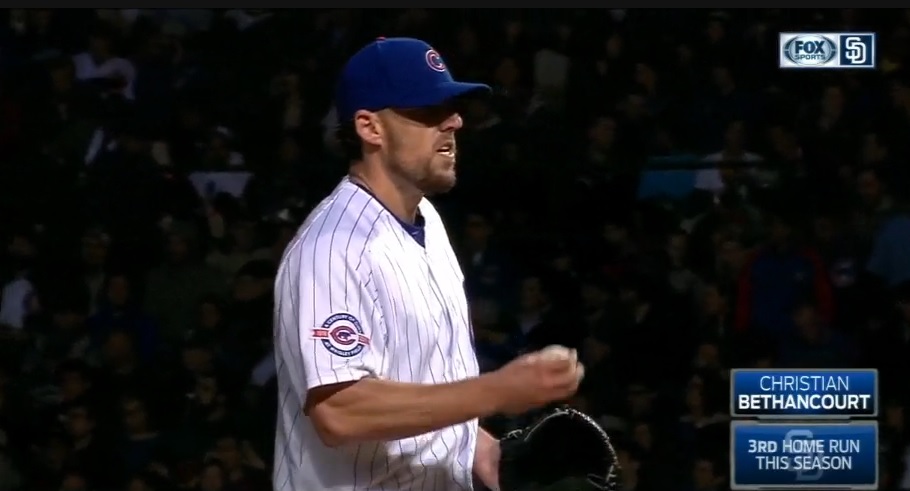
In the second game of a doubleheader against San Diego, the Cubs starter gave up only one run, on a fifth-inning homer to Christian Bethancourt. It was enough to lose 1-0, but what really irked the right-hander was when Bethancourt stood in the box and watched the ball fly.

“You better fucking run!” Lackey screamed as the hitter rounded the bases.

That’s some good drama right there. Lackey upped the ante after the game, when he referenced the teams’ next meeting, in late August. “How many home runs does he have?” Lackey asked reporters, via the Chicago Tribune. Told that the blow against him was Bethancourt’s third of the season, the pitcher was concise. “I have a long memory,” he said. “He’ll learn.”

(See Bethancourt’s pimp and Lackey’s reaction over at Deadspin.)

Lackey, of course, is no stranger to this type of reaction, drilling Tampa Bay’s Matt Joyce for similar reasons, for example, when Lackey pitched for the Boston Red Sox in 2013. Also, Francisco Cervelli in 2011. Also, Derek Jeter (for different retaliatory purposes) in 2010.

Lackey is 37 years old and in his 14th big league season. He’s set in his ways. He’s also one of the rare guys left in the game willing to talk openly about drilling somebody for the crime of bruising his ego.

That kind of move is increasingly dubious in the modern baseball landscape, but Lackey is old and ornery. And, odious as it may be to the public at large, for guys like that, plunking upstart youngsters may well constitute their own version of making baseball fun again.


The Baseball Codes

On Workplace Sanctity and the Digging of Holes, or: Hey Coco Crisp, Keep Your Cleats to Yourself

After walking in the first inning yesterday, Oakland’s Coco Crisp dug himself a little foothold near first base, to get a better jump should he decide to take off for second. Red Sox first baseman Hanley Ramirez immediately strolled over and rubbed it out with his cleat. (Watch it here.)

What in the name of Mo Vaughn was going on?

Ramirez may be all of 30 games into his initial season as a first baseman in 15 years as a pro, but he clearly has firm ideas about propriety surrounding his new position.

His reaction brings to mind the kerfuffle started by Alex Rodriguez in 2010, after he flied out against those selfsame A’s. On his way back to the visitors’ dugout at the Oakland Coliseum, he crossed atop the pitcher’s mound, a gesture that A’s starter Dallas Braden did not appreciate. The lefthander gave Rodriguez an earful as he trotted away.

The ensuing fallout was massive, the topic dominating national media conversation for weeks afterward—including the overwhelming sentiment that Braden had overreached, having little right to so much as notice Rodriguez’s actions, let alone grow irate over them.

I said then, and still believe, that Braden was justified. The mound is sacred space for a pitcher, and those who have no business atop it better treat it accordingly. Similarly, the area around first base is Hanley Ramirez’s office, and he’s entitled to enforce his own reasonable standards within its boundaries while on duty. Denying Crisp the slight advantage of digging a toehold falls well within those boundaries.

Had Crisp taken umbrage—had he gotten into Ramirez’s face and argued for his right to kick dirt around as he pleased—many more people would be paying attention right now. Instead, he laughed the whole thing off, and everybody moved right along.

Which is exactly as it should be.

Intimidation, The Baseball Codes

Yadier Molina Has a Message for You, Pitchers

molina_pushups_med_i7mol65c

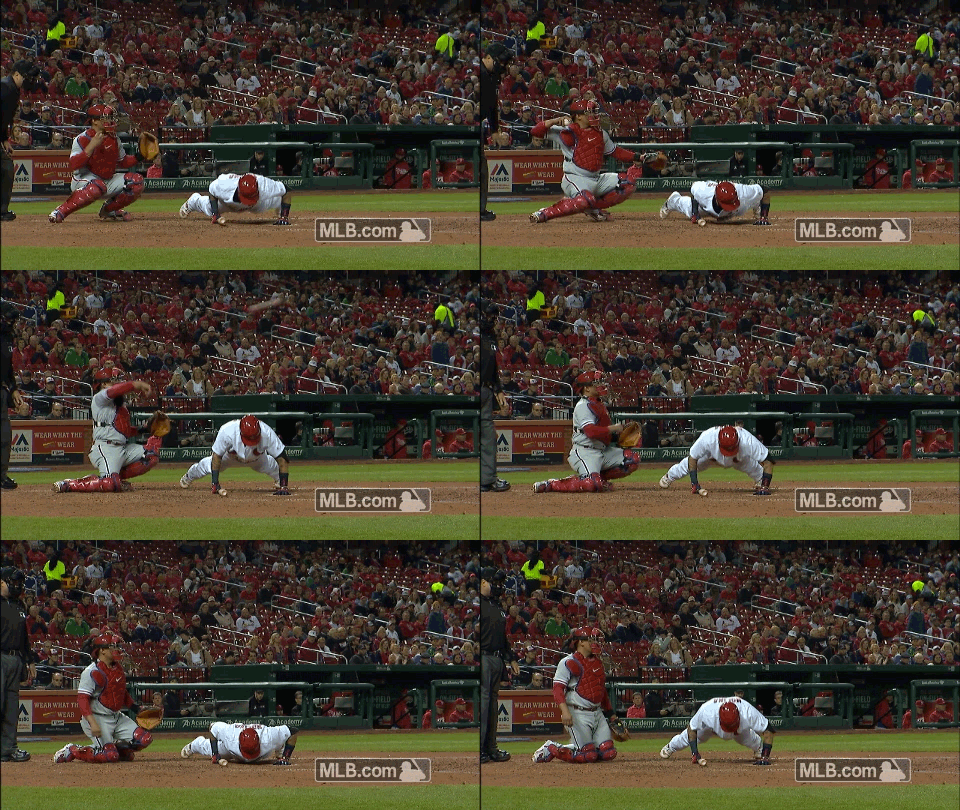
In St. Louis yesterday, Phillies reliever Brett Oberholtzer knocked down catcher Yadier Molina with an inside pitch at the knees. Molina, having pitched forward to avoid it, ended up face down in the dirt, over the plate, bat still in his hand. Then he did some push-ups. (Watch it here.)

You can’t intimidate me.

Most hitters opt for less representational manifestations of that kind of message, opting simply to get back into the batter’s box as if nothing had happened. Frank Robinson would actually move closer to the plate. But push-ups?

You can’t intimidate me.

Pete Rose made a point of sprinting to first base after being hit by a pitch, to prove that not only could he not be intimidated, he also couldn’t be physically hurt. Guys like Stan Musial and Ted Williams took pleasure in abusing pitchers who threw too far inside, following knockdowns with extra-base hits. Just last year Andrew McCutchen set precedent for Molina, doing push-ups of his own after being knocked down in a game against Cincinnati, and then hitting a double.

The notion of anti-intimidation has a rich history in baseball, never more prominently enacted than by Jackie Robinson early in a career in which opposing pitchers made him one of the most tested batters in big league history. In his excellent book, Baseball’s Great Experiment, Jules Tygiel described a game from 1946, when Robinson still played for the minor league Montreal Royals:

Paul Derringer, a thirty-nine-year-old former major league hurler who had won 223 games over his fifteen-year career, faced Robinson in an April exhibition game. The Kentucky-born player told [Montreal manager Clay] Hopper that he would test the black athlete. The first time Robinson came to the plate, Derringer hurled a fastball at his head. “He knocked him down all right,” said Hopper, “Forced him to put his chin right in the dirt.”

Robinson stepped back in and Derringer threw a second pitch that headed at him and then broke sharply over the inside corner. Robinson lashed the ball on a line over the third baseman’s head for a single.

Two innings later, Derringer again decked Robinson. This time the angry batter drove the next pitch into left-center for a triple. After the game Derringer confided to Hopper, one southerner to another, “Clay, your colored boy is going to do all right.”

And Molina? On the pitch following his batter’s-box calisthenics, he singled into center field. Even if Oberholtzer’s knockdown was unintentional, Molina sent a powerful message to the rest of the league.

You can’t intimidate me.


Sign stealing, The Baseball Codes

Did the Peeking, Pesky Padres Plant a Peeper in Their Park?

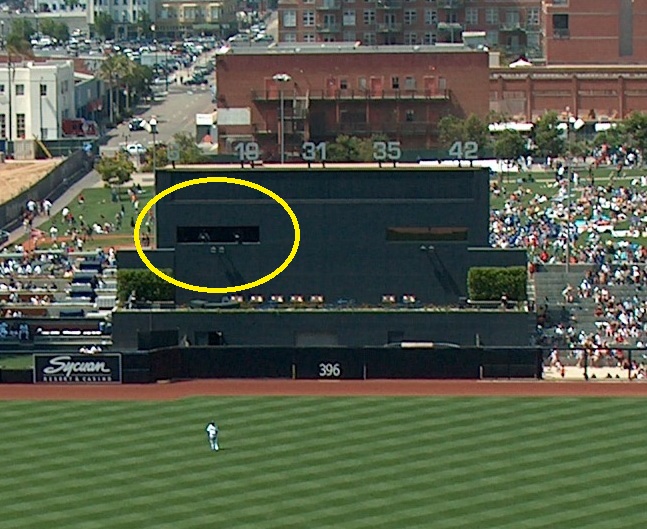
Who was the binocular-toting man in the center field batter’s eye at San Diego’s Petco Park yesterday?

A checklist of information:

  •  He was positioned with a direct view into the catcher’s signals.
  • He was spotted while the Padres were at bat, late in a close game against St. Louis.
  • He was wearing a Padres-logoed polo shirt.
  • He was holding GOSHDANG BINOCULARS.

Putting a spy  in the scoreboard would hardly place the Padres in unique company. Most of their peers in the sign-thievery business, of course, are a bit more suave about the endeavor, at least to the point that the visiting catcher doesn’t notice what’s happening from his post behind the plate, more than 400 feet away.

For their part, the Padres offered the only logical explanation short of outing themselves as signal felons, saying the man was part of their ballpark’s security apparatus. San Diego manager Andy Green went so far as to claim that he was the one who alerted plate ump Sean Barber to the guy’s presence, objecting to the possible distraction to hitters caused by his white shirt.

Never mind that Green appears to be telling the truth—the TV broadcast shows Barber and Cardinals catcher Yadi Molina looking toward the Padres dugout before turning their attention to the outfield. It’s much more fun to believe that something shady is going on.


Petco CF
The camera well in Petco’s center field.

Sign stealing, of course, carries different tenors within the game, depending on who’s doing it. A runner at second base has relatively free reign to peek in to the catcher’s signals and relay what he wishes to the batter. If he’s caught, the aggrieved team’s usual reaction is to simply change its signs. Occasionally the runner will receive a verbal warning, and even more occasionally an intentionally errant fastball might find its way toward the batter’s box.

That, however, is far different than a team utilizing technology and non-uniformed personnel to do its dirty work from beyond the field of play—a tactic that is against baseball’s actual rules in addition to those of the unwritten variety. Which doesn’t mean it doesn’t happen. Chicago’s old Comiskey Park was famous for signaling White Sox batters with its exploding scoreboard. Bobby Thomson’s Shot Heard Round the World benefited from pilfered signals.

More recent occurrences:

Some of my favorite sign-stealing stories are much older, and took place on the north side of Chicago. From The Baseball Codes:

In 1959, Chicago finished in fifth place even though the team had a spy in the Wrigley Field scoreboard for much of the sea­son. He was traveling secretary Don Biebel, who, armed with binoculars, signaled hitters by sticking his shoe into an open frame used to post scores. Even through the losing, however, the Cubs still managed to arouse suspicion. Most skeptical were the Giants, whose ace, Sam Jones—the runner-up in that year’s Cy Young voting—got lit up every time he pitched in Chicago. (Against the rest of the league that year, Jones was 21-12, with a 2.54 ERA, and struck out a hitter every 1.25 innings; at Wrigley Field, he was 0-3 with an 8.53 ERA, and struck out a hitter every six innings.) It wasn’t long before San Francisco players identified the cause of the discrepancy.

“We just got wise and looked up, and sure enough in the scoreboard there was a big empty square,” said pitcher Mike McCormick. “Same scoreboard they have today, where they hand-place the numbers. There was somebody sitting up there in an empty square—one foot in the win­dow was a fastball, two feet was a curveball, no feet was a changeup. You let a major-league hitter know what’s coming, and he might not hit it all the time, but it certainly makes him a better hitter.”

Jones was particularly affected by the Cubs’ system, said Biebel, because he had trouble handling anything but the simplest signs, which kept Giants manager Bill Rigney from stymieing would-be thieves with a more complicated system. Instead, he dealt with the matter in a different way: six-foot-four, two-hundred-pound outfielder Hank Sauer, who was sent to the scoreboard to get some answers.

“Between innings I saw [first-base coach Wes] Westrum and Sauer and Bill Rigney get over in the corner of the dugout, and they were chatting,” said Biebel. “Sauer went out of the dugout and up the ramp, and I told the groundskeeper who was in the scoreboard with me, ‘You better lock this thing up—I think we’re going to have some company.’ About ten or fifteen minutes later, here comes Sauer along the back fence of the bleachers. He walks all the way out there and he starts pounding on our little door, shouting, ‘Let me in!’ He pounded for a while, but when he finally knew he wasn’t going to get in, he turned around and left.”

Biebel was good for more than stealing signs, of course. He was also proficient in catching opponents who were doing it. In 1960, Braves pitchers Bob Buhl and Joey Jay were dressed in street clothes and sta­tioned in the Wrigley Field bleachers with a pair of binoculars, lounging in the sun as if they had just popped in from a North Side apartment. The pair vigorously waved their scorecards whenever a breaking ball was on its way, and Biebel caught them immediately. “It was easy to spot them,” he said. “I knew who they were. You have a good view in that scoreboard, and back then the bleachers were pretty empty.” Biebel informed the dugout of his discovery, and ushers soon escorted the pair from their seats.

Those Cubs, of course, were terrible. Stealing signs, it seems, only served them to lose by a few fewer runs than they might have otherwise.

Are the Padres in that kind of company? Who knows? It sure is fun to think about it, though.


The Baseball Codes

Feeling Bad When You Do Bad Things is a Sign of a Healthy Disposition

Wright concern

How can a hitter be certain that a pitch that just hit him wasn’t intentional? The pitcher’s reaction can play a reasonable role.

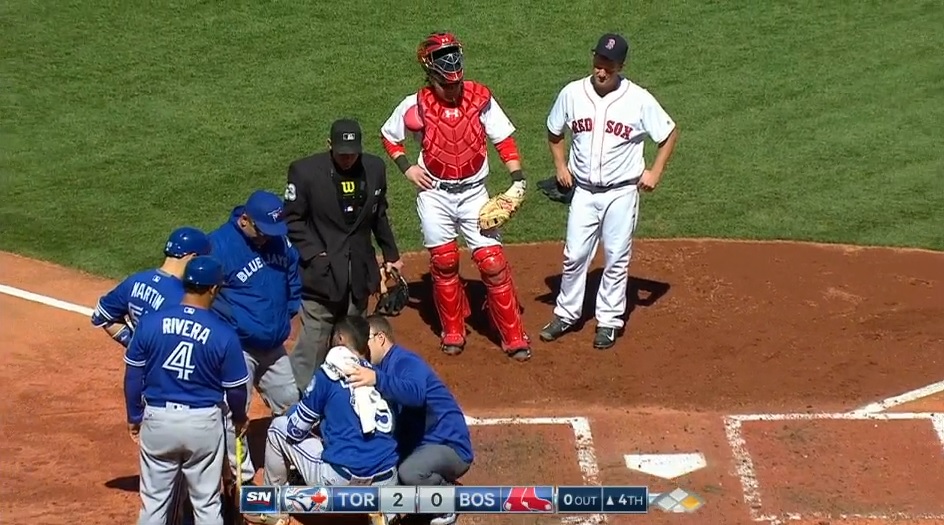
When Boston starter Steven Wright bounced an 87 mph floater off the side of Blue Jays first baseman Chris Colabello’s helmet on Sunday, he did nothing to hide his horror, immediately wincing, removing his cap and going into a shame-crouch on the side of the mound. He approached the plate, visibly distressed, as trainers tended to Colabello, and offered words of remorse to the hitter as he made his way to first base. (Watch it here.)

That was enough. Hell, it was more than many pitchers do—even pitchers who feel badly about similar situations. But Wright didn’t stop there.

When Colabello arrived at Fenway Park’s visitors clubhouse the following morning, he found a “large bottle of liquor” from Wright, per the Boston Globe.

“He didn’t have to,” Colabello said. “I’m sure that’s not cheap, too.”

It was a decent thing to do, however,  and when it comes to poorly placed fastballs (and potential associated retaliation), decency can go a long way.


No-Hitter Etiquette, The Baseball Codes

What Price Glory?

Stripling

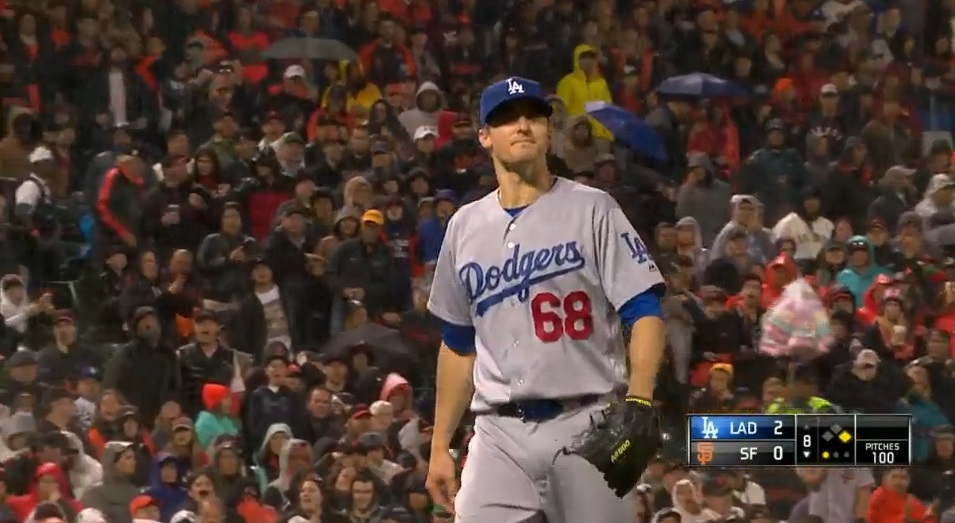
Talk surrounding the decision of Dodgers’ manager Dave Roberts to pull Ross Stripling from the middle of a own no-hitter on Friday was based largely on the fact that he was a rookie. Stripling, sure—but also Roberts.

Stripling was making his first major league start. He was at 100 pitches when pulled, after having maxed out at 78 pitches through spring training. He missed all of 2014 rehabbing from Tommy John surgery, and spent last season making his way back.

These are valid concerns. Perhaps if Roberts had more than four games under his belt as a big league skipper at the time, people wouldn’t have been quite so vociferous with their objections.

Then again, he did break an unwritten rule … or at least a portion of one. The overarching theory has to do with not changing anything during a no-hitter, from the defensive alignment behind a pitcher to the spots on the bench occupied by his teammates. This also covers the pitcher himself, although when a guy is going that well he is usually beyond consideration of being removed.

It’s all just superstition, of course, and it’s not like managers hadn’t done this kind of thing before.

In 2010, Twins manager Ron Gardenhire pulled Kevin Slowey after seven innings of no-hit ball after the right-hander , who had just skipped a start due to elbow soreness, had thrown 106 pitches.

Only eight days later, Rangers manager Ron Washington pulled Rich Harden from a no-hitter, in his first start back off the DL, after 111 pitches. Other instances abound:

  • 1997: Pittsburgh’s Francisco Cordova departed after 121 pitches and nine innings of no-hit ball against the Astros.
  • 1991: Atlanta’s Kent Mercker left after six no-hit innings, in his second start of the year following 44 relief appearances, none of which were longer than two frames.
  • 1991: Anaheim’s Mark Langston went seven innings (98 pitches) against the Mariners in his first start of the season, after throwing only 16 innings during spring training due to a lockout.
  • 1975: Oakland’s Vida Blue was removed after the fifth on the season’s final day, a timeframe predetermined by manager Alvin Dark in an effort to keep the pitcher fresh for the playoffs.
  • Manager Preston Gomez actually pulled the trick twice, once with the Padres in 1970 (removing Clay Kirby, who trailed, 1-0 at the time), and again in 1974 with the Astros, pulling Don Wilson (who also trailed, 2-1).

Those examples, however, carry less weight than one instance that should have been included on this list. On June 30, 2012, Mets manager Terry Collins succumbed to popular (and historical) sentiment, and allowed pitcher Johan Santana to complete an eight-inning no-hitter. Lending weight to his decision was that it was the first in Mets’ history. Unfortunately, it took the lefthander 134 pitches to do it.

Santana had missed the entire previous season after shoulder surgery, and Collins had him on a strict 115-pitch limit … right up until history came calling. Santana pulled it off, but at a cost: He made five more starts that season, losing them all while compiling an astounding 15.63 ERA. He was shut down that August and hasn’t pitched in the big leagues since.

In light of that detail, pulling Stripling was the logical choice. Perhaps Roberts could have left him in a few batters longer, but, with the guy’s control deserting him—he walked the final batter he faced—it seemed obvious that relief help would be needed at some point. And if that was the case, why keep him in any longer than necessary?

It wasn’t only Roberts who felt this way. Giants manager Bruce Bochy defended his counterpart, saying in an Associated Press report that “It’s the kid’s first start and they have to take care of him … You have to look after his health, and that’s what they were doing.” Even Stripling’s father offered up support for the decision.

Superstition is great, but players’ careers are far more important. Roberts made the right call.

Retaliation, The Baseball Codes

Internalizing a Horrible Outing Takes Different Shapes for Different People, or: Emotional Atunement Might Not Be For Everybody

Mariners Rangers

Two games in, and we got beef. For the Mariners, it’s entirely justified.

Reliever Tom Wilhelmsen—with Seattle for the first five seasons of his career, but as of last November a member of the Rangers—did not have a good game. After entering in the eighth inning with his team trailing, 4-2, he did this:

  • First batter, Robinson Cano: first-pitch homer.
  • Second batter, Nelson Cruz: double.
  • Third batter, Kyle Seager: double.
  • Fourth batter, Seth Smith: first-pitch homer.

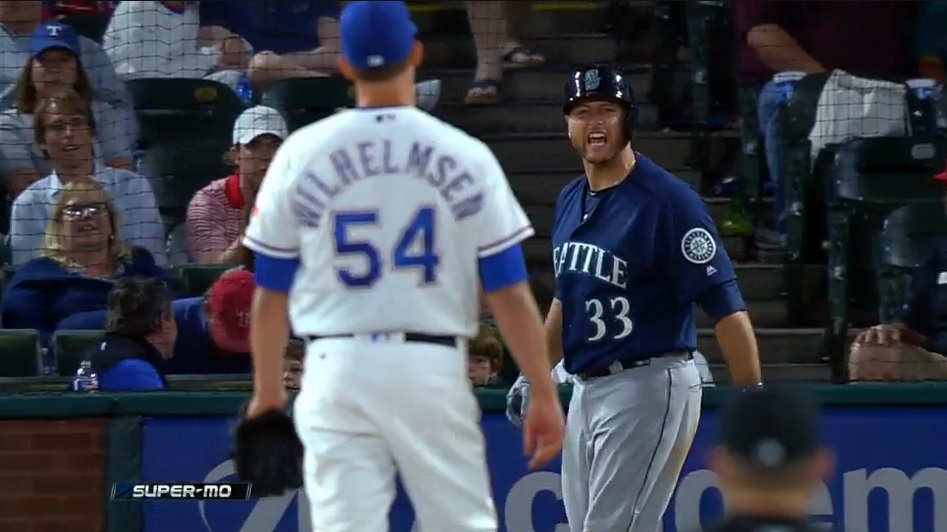
For his encore, the frustrated right-hander drilled the inning’s fifth hitter, Chris Ianetta, with his first pitch. The 94-mph fastball, which ran straight into Ianetta’s hamstring, was as clear a message of frustration as can be delivered on a ballfield. (Watch it here.)

Ianetta stormed to first base, screaming toward the mound as Seattle’s dugout tentatively emptied. The most noteworthy part of the scrum was each team’s manager shouting F-bombs at the other.

This in itself is noteworthy inasmuch as Mariners manager Scott Servais is in his first year at the helm of a big league club and may well have seen this as an excuse to set tone, letting his team know that he’s looking out for them in every facet of the game. Texas skipper Jeff Bannister, even more fiery during the confrontation, is in his second year and likely felt similarly.

There’s little to justify Wilhelmsen’s action. It was once acceptable baseball practice to drill a guy for his teammates’ success. Hell, it took far less provocation than two homers and two doubles. The modern game, however, is less tolerant of violent  acts, and the weak sauce ladled out by Wilhelmsen has become patently unacceptable. (Umpire  Marvin Hudson agreed, ejecting the pitcher.)

At least Wilhelmsen handled things as well as he could after the game without crossing the line of actually admitting to anything. When he was asked whether anything in particular angered Ianetta, he managed to say, “Probably the fact that I hit him,” with a straight face.

Yep. Lotta baseball left to play this season.


Don't Swing on the First Pitch After Back-to-Back Home RUns, The Baseball Codes, Unwritten-Rules

Swing, Battah Battah, and Don’t Be Deterred By Back-To-Back Bombs

Buster's blast

With all the recent talk about bat flipping and fist pumping and making baseball fun again for a generation of players more concerned with self-expression than how that expression might be interpreted, it’s easy to lose sight of some of the more nuanced facets of the Code.

Once upon a time, players were expected to feel empathy for a struggling opponent. It’s a direct relative of the don’t-pile-on ethos that leads football and basketball teams to pull their starters late in blowout games. Take your foot off the pedal when extra gas is no longer useful to your cause. Make things easy. Show some respect.

Pertinent to this story is the concept of not swinging at the first pitch following back-to-back home runs. The idea is to give a struggling pitcher a small window of opportunity—a freebie pitch with which to regain his bearings.

“Someone would always pull you to the side and say, ‘Look, there have been two consecutive home runs hit—the third batter doesn’t swing at the first pitch,’ ” said Hal McRae in an interview for The Baseball Codes, talking about his time coming up with Cincinnati’s Big Red Machine in the early 1970s. “Take the first pitch. Alert the pitcher that you’re not swinging, that you know he’s out there, that you respect him and you respect the job that he’s trying to do.”

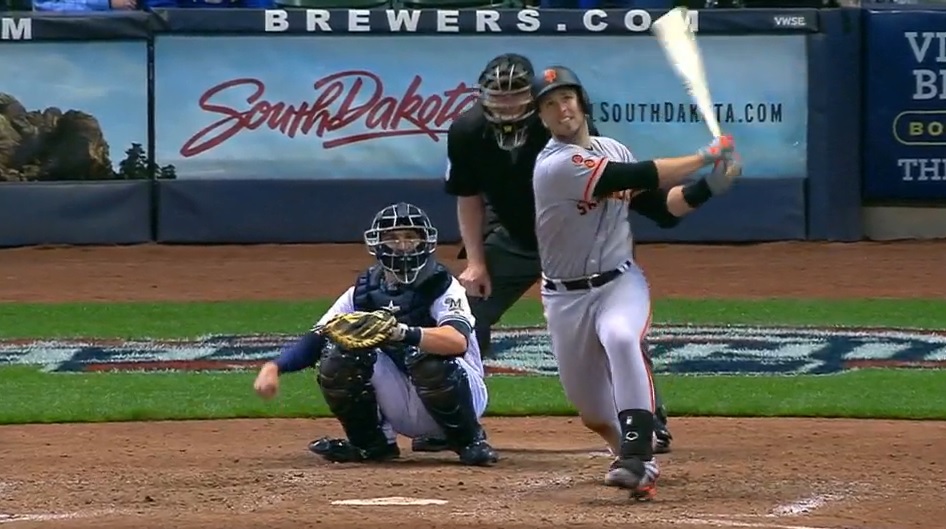
Which brings us to yesterday. The Giants led Milwaukee, 7-3, at the start of the eighth inning. Then Denard Span hit a three-run homer. The next hitter, Joe Panik, followed with a solo shot. With an 11-3 lead and the two guys ahead of him having just homered, Buster Posey got a first-pitch fastball from pitcher Ariel Pena, 92 mph and over the plate. He mashed it over the fence in center field, ending Pena’s night. (Watch it here.)

Was Posey wrong? Of course not.

The reality is that the aforementioned piece of Code, while among the noblest of baseball’s unwritten rules, had its detractors even during McRae’s day. Batters are paid to hit the ball, a status that does not change late in blowout games, and many did not want to be deprived of that opportunity. In the modern game, of course, with the Code so thoroughly diminished, the rule seems downright quaint … if it seems like anything at all.

The reality is that Posey didn’t break the rule because Posey probably didn’t know the rule. Nor should he have, necessarily. He intended no disrespect with his swing, and by all accounts none was taken in the Milwaukee dugout. (Hell, the next hitter, Hunter Pence, also swung at the first pitch he saw, although that was against a new pitcher.)

So what’s the point of a rule that few people know about, nobody follows, and which wasn’t universally popular even in its heyday?

Maybe it’s the simple act of knowing it. Knowing that it exists, and that once a time there were players who abided by it. It offers a window not only into baseball’s past, but into its soul, a reminder that even if the ideals that drove a different generation are no longer worth of imitation, they’re still worthy of veneration.

The game has moved on, and that’s okay. It sure is nice to remember where it came from, though.

[Thanks to @BaseballRuben for the heads-up.]

Intimidation, Retaliation, The Baseball Codes

Do the Royals Really Want a Piece of Noah Syndergaard? Why the Hell Would They?

Up and in on Esco

When Newsday reported yesterday that the Royals were still harboring a grudge over Noah Syndergaard’s first-pitch fastball in Game 3 of last year’s World Series, it struck an awkward tone. The teams meet on opening day, and rumors that the Mets have something in store for their opponents (Syndergaard is scheduled to start the second game of the series) raised more questions than it answered.

It’s not that teams and players don’t have long memories, or that they aren’t willing to wait weeks, months and, in some situations, years for retribution. (In his final season as a pitcher—indeed, in his final game—Bob Gibson was unable to retaliate against Pete LaCock for the perceived slight of having hit a grand slam against him. So he waited 15 years until they met in an old-timers’ game, then drilled him in the back.)

The thing about the Royals allegedly being angry, though, is that Syndergaard didn’t do anything wrong.

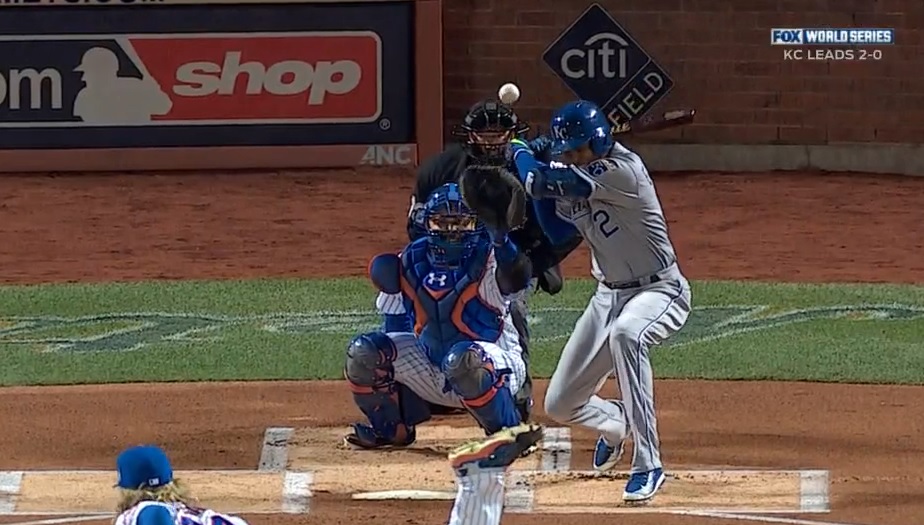
As a power pitcher, it is his right to establish tone, and the inside fastball is a valid weapon in any pitcher’s arsenal. With his first pitch of the game, the right-hander threw head-high at 98 mph to Alcides Escobar, one of Kansas City’s hottest hitters and a first-pitch swinger.

Thing is, the pitch didn’t come close to hitting Escobar. It didn’t even cross the line of the batter’s box. When catcher Travis d’Arnaud reached up to catch it, his glove shot straight into the sky, not toward the hitter.

And it worked. Escobar, shaken, struck out.

There’s no reason for the Royals to like this kind of tactic, but neither can they decry it as worthy of retaliation. (It’s their option to feed Syndergaard some of the same, but if that was the endgame there was little reason not to do it at the time.)

So why, one might ask, would the Royals still be holding on to it all these months later? The answer, at least according to K.C. manager Ned Yost, is, they’re not.

“Our retribution,” he said in the Kansas City Star, “was winning the World Series.”

Similar sentiments were echoed around the clubhouse.

Edinson Volquez: “There’s nothing wrong with what he did last year.”

Former Met Dillon Gee: “I’ve been here all spring, and I don’t think I’ve really heard anybody even bring up the Mets.”

The best reason to believe the Royals is because the report that sparked the controversy was so unbelievable in the first place. Newsday’s Marc Carig cited “multiple industry sources” as the basis of his report, whatever that means, but on its face the story was little more than shit stirring on a slow news day.

In this regard, Yost is already on his game, offering more pointed insight than any journalist could offer.

“Some buffoon writes something,” he said, “and you guys are gonna jump like little monkeys in a cage for a peanut.”


Bat Flipping, Showboating

Carlos Gomez: A Little Dab’ll Do Ya

Gomez dabs

Now that flipping a bat is no longer noteworthy, we might see new directions in personal expression being forced to the fore. And if ever there was a player to take self-salutation on a baseball diamond to unexplored levels, it’s Carlos Gomez. The guy was born for this stuff.

First, though, the bat flip. Those who do it, like Gomez, claim it’s within their celebratory rights as ballplayer, a virtual extension of their swing. There’s something to this. It’s what made Jose Bautista’s flip during last season’s playoffs so damn memorable.

There are limits, however, on what can reasonably be claimed as an extension of one’s swing. By the time a batter leaves the box, and certainly by the time he rounds first base, in-the-moment exuberance should be in the rear-view. Anything he does after that point can be viewed as a calculated act, and justifiably seen by the other team as beneath their dignity as opponents.

So what to make of the fact that Carlos Gomez dabbed as he crossed the plate following a spring training home run yesterday?

At this point, who knows?

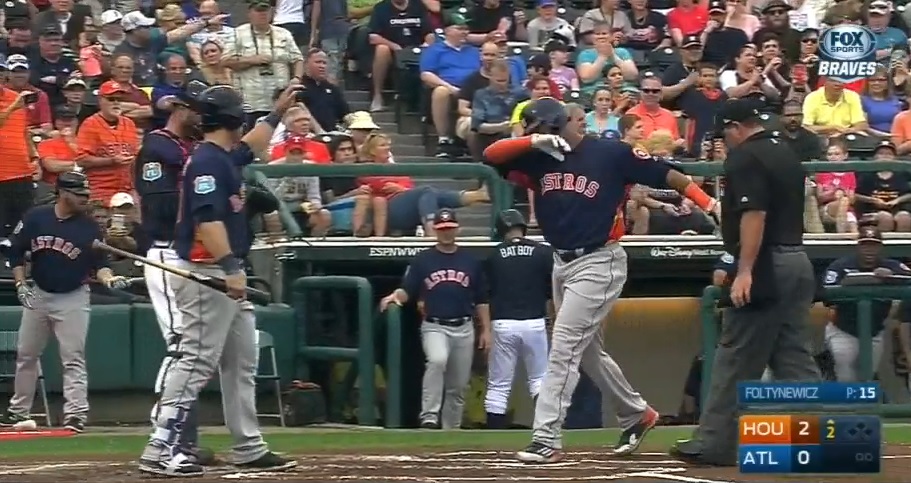
Sure, Gomez flipped his bat, though not in particularly grand fashion by modern standards. To his credit, he hustled his way around the bases. And then … the dab. (Watch it here.)

True, it took only a moment, and Gomez was gone back to the dugout. It was so quick as to be easily missed (the broadcasters didn’t mention it as it happened), and the same Braves who had a thing or two to say to Gomez about similar topics back in 2013 didn’t seem to mind, at least to judge by their reactions on the field.

Ultimately, it comes down to the question of what constitutes a celebration, and whether the baseball equivalent of a touchdown dance is making its way into the mainstream. While watching Gomez, it was impossible for me to not think about Cam Newton—and however one feels about Newton probably goes a long way toward informing how one feels about Gomez doing something similar.

Or not. I am a fan of Newton and his celebrations. They are perfectly at home on a football field, where personal celebration is pervasive for anything from a QB sack to a short burst for a first down at midfield.

Baseball, though, is different. Part of the beauty of the sport’s unwritten rules is that they’ve served as a perimeter defense for the look-at-me attitude that has come to dominate other sports.

This is not to say that there is no place for such a thing in baseball, but when celebrations become contrived, they grow trite. And when they grow trite, they quickly become tired. Which is something, since Bryce Harper recently used that very wordtired—to support the opposite viewpoint, in describing a sport that does not favor such displays.

Still, it can be used here in equal measures to describe whatever it was Gomez did. His action originated less in the moment than as locker room-hatched scheme, the endgame for one of baseball’s biggest spotlight hogs to elbow his way into just a little more screen time.

Gomez is an exciting player, and merits some leeway when it comes to celebrating his feats. As a critic, I’m happy to grant him that much. When he ignores those feats, however, in favor of celebrating the mere existence of Carlos Gomez—the baseball equivalent to two thumbs pointed backward to the name on the rear of his jersey—he displays a degree of narcissism to which I have a tough time subscribing.

Update (3-29): Gomez managed to earn some bonus points, because when you’re pissing off Rob Dibble, there’s a decent chance that you’re doing something right.