Literature

Jim Brosnan, Pitcher of Baseballs, Chronicler of Baseball

Pennant RaceJim Brosnan, for a time one of the better relief pitchers in the National League, a member of the pennant-winning Cincinnati Reds in 1961, passed away June 29 at age 84. More even than for his pitching, Brosnan was noteworthy for his forays into the baseball-book canon. Jim Bouton is widely considered the first insider to expose the true lives of ballplayers, but when Brosnan’s The Long Season was published in 1960, Bouton was a 21-year-old in the Carolina League and still more than a decade away from a literary career. Brosnan wrote openly about how it feels to be a major league baseball player, in a way that nobody had before attempted let alone pulled off with such panache. And he truly wrote openly; no ghostwriting services were used.

His follow up effort, Pennant Race¸ about Cincinnati’s run toward glory in 1961, was equally compelling. Part of his truth-telling, of course, included the game’s unwritten rules, passages which serve as a snapshot in time. They capture not just baseball as Brosnan played it, but show just how much things have changed in the modern game. It’s a time capsule, freezing attitudes just the way they were.

Even all these years later, the words jump from the page. There’s little doubt that, when it came to multiple skill sets, Brosnan could spin a phrase better than any writer could spin a curveball. In honor of Brosnan and his efforts, here are some passages from Pennant Race that discuss retaliation and intimidation. Things couldn’t be more different.

Hunt and Sanford, of the Giants, dueled for six innings, tied up 2-2. Mays tried to steal second in the sixth, spikes up, cutting Elio Chacon, our Venezuelan second baseman, as he tagged Mays out.

“Mays slid a little high, didn’t he?” asked Bevan. Chacon was carried past our bench to the clubhouse, his sliced thigh visible, bleeding from three spike wounds.

“Somebody’ll have to knock Mays down now,” I pointed out. “Can’t have any rough stuff this early in the year.”


After you knock a hitter down, you still have to throw strikes on the next pitches. Unless you hit him. And that’s not the idea at all. No pitcher wants the hitter to reach base; he just wants to loosen them up a little with a judiciously placed scare ball.


[Joey] Jay lined a bases-loaded double off Don Drysdale to break up the game and smash hell out of Drysdale’s disposition. Drysdale absorbed the shock of Jay’s double numbly, but well enough to retire the side. On the Dodger bench, he fumed, burned, and blew up.

To start the sixth he threw a fastball behind Blasingame’s head. Blazer popped up the next pitch, so Drysdale knocked Pinson down with consecutive pitches. Pinson hit the third pitch to left for a double, and Drysdale threw the rosin bag into the air in disgust. When it came down he dusted his fingers and threw three straight pitches at Robinson. The third one hit Robbie on the arm, and Boggess, the umpire, threw Drysdale out of the game.

“That’s enough throwing,” Boggess said to Alston and Hutchinson. “I’ve had enough.”

Drysdale’s tantrum had angered his own catcher, Roseboro, who said to Robinson, “you know I ain’t callin’ ’em.” (The catcher is subject to retaliatory pitches from the opposing side, which often can’t get at the pitcher.)


In the ninth [Joey Jay] threw two pitches over Amaro’s head in retaliation for a knockdown pitch that had bounced off Frank Robinson’s helmet in the eighth. Ed Vargo, the plate umpire, ran out to the mound to warn Jay not to throw at another hitter. And Hutchinson ran out to tell Vargo that he, Hutch, had told Jay to knock some Philly hitter down because “I’m not gonna stand by and see my boys hit in the head. I’ll do something about it. You umpires don’t seem to be able to!”

Hutch told Vargo to throw him out, not Jay, and when Vargo did just that, Hutch told him where he could stick the automatic fine that results from an umpire’s eviction order.


Sherman Jones shook his head at the suggestion that he picked the blue bill of a Cub’s cap as target number one.

“I can’t throw at a batter’s head. What if you would hit it? And killed him? How could you pitch again? Or live with yourself?”

His remarks sounded as if they came from a pitcher it less dedicated to Hutchinson then to his own conscience. Nice guys sometimes get hurt on the mound by line drives.


Don't Incite the Opposition

‘What an Idiot!’ Say, Mike Napoli, What do you Really Think?

Napoli's blastMike Napoli had come through with the heroics, but he didn’t seem to believe it. One out away from a complete-game shutout, Yankees pitcher Masahiro Tanaka fed the Red Sox first baseman a 1-2 fastball out over the plate instead of the pitch Napoli expected—a splitter low in the zone, which had already served to strike him out twice on the night. It was a gift. Napoli treated it as such, hammering it over the right-field fence at Yankee Stadium for a game-winning two-run homer.

Napoli’s problems began with his incredulty that Tanaka would throw him anything in that situation but the same unhittable pitch he’d already proven unable to hit. They manifested when he reached his dugout after rounding the bases. Even before he entered, he was shouting at his teammates, “What an idiot! What an idiot!” (Watch it here.)

The comments were picked up by TV cameras, of course, which is why this is a controversy. Napoli oviously did not intend to show up Tanaka; his comments were directed toward his teammates, not toward the field, and were made amid the rush of his success. Also, Napoli was right—Yankees catcher Brian McCann did all he could to have Tanaka throw the splitter, but was shaken off repeatedly. Still, any player in the modern era should know better—especially talking, as he did, from field level at the lip of the dugout, without even the cover of a position deep on the bench.

Such was the impact that Red Sox manager John Farrell was compelled to address it on Sunday.

“The one thing we don’t ever want our players to be is non-emotional,” he said in an MLB.com report. “I’m aware of the comment made last night. I didn’t hear it at the time. But I know this: We’ve got the utmost respect for Tanaka and I know Mike Napoli does.”

It’s reminiscent of a scene from The Baseball Codes, in which a youthful Eric Chavez was being interviewed before his A’s played the Yankees in Game 5 of the 2000 ALDS.

Responding to a press-conference question about his opponents, who had won the previous two titles, Chavez talked about how great the Yankees had been in recent years, what a terrific job they’d done, and how difficult it was to win as consistently as they had. He also added that they’d “won enough times,” and that it would be okay for somebody else to play in the World Series for a change. Chavez was twenty-two years old, wide-eyed and hopeful. There was nothing malicious in his tone.

Unfortunately for the A’s, the press conference at which Chavez was speaking was being broadcast live on the Oakland Coliseum scoreboard for early-arriving fans. Also watching were the Yankees, on the field for batting practice. “So he’s dropping the past tense on us? Did you see that?” spat third baseman Scott Brosius from the batting cage. One New York player after another—Derek Jeter, Paul O’Neill, Bernie Williams—took Chavez’s comments and blew them up further. The Yankees hardly needed additional motivation, but now they had it. Their first three hitters of the game reached base, four batters in they had the lead, and by the end of the frame it was 6–0. The A’s were in a hole from which they could not climb out before they even had a chance to bat.

The Yankees didn’t have any such swing of success against the Red Sox on Sunday—they lost, 8-5—but it underscores the importance of understanding where you are and who can hear you before speaking your mind with anything resembling too much impunity.

Basepath Retaliation

Takeout Order: One Second Baseman, With a Side of Sour Grapes

Desmond + GomezCarlos Gomez has taken heat in this space for everything from pimping to excessive pimping to his inability to handle criticism. Yesterday Gomez again managed to clear the bases over something he did … but this time he was in the clear. Maybe a guy’s reputation can precede him, after all.

In the eighth inning against the Nationals, Gomez was hit on the left arm by reliever Taylor Hill, making his big league debut. The next batter, Lyle Overbay, grounded a double-play ball to shortstop Ian Desmond, who tossed to second baseman Kevin Frandsen on the pivot. Frandsen just managed to get the throw off before Gomez, barreling in hard and fast, took him out with an aggressive slide. This is the kind of thing one does after one has been hit, a message to the other team that such liberties have not escaped notice.

The slide was clean. The message was sent. The inning was over.

Desmond, however, took offense. As his teammates headed toward their dugout, the shortstop stopped for a chat with an incredulous Gomez. Things got sufficiently animated for the benches to clear, though nobody came close to throwing a punch. To judge by the players on the field, Desmond was the only red ass among them. (Watch it here.)

“I just told him I didn’t agree with the way he slid into second base with a seven-run lead,” Desmond said after the game in an MLB.com report. “I’ve defended that guy in a lot of clubhouse arguments. I respect the way he plays the game, but I’ve got no respect for that. If he thinks he got drilled on purpose by our pitcher making his Major League debut … to take it out on a guy who’s grinded his butt off to make a Major League career in Kevin Frandsen … In a World Series game, you slide like that. In a seven-run-differential game, there’s no time for that.”

On that point, Desmond is nuts. Gomez was responding to being hit—a reaction that is independent of circumstance, lopsided score or not. He responded with a clean, aggressive play, in the way that baseball players have always responded to similar events with clean, aggressive plays. On the Nationals broadcast, in fact,  color man (and former player) F.P. Santangelo called it, even as Hill was delivering the double-play pitch to Overbay: “If I’m in the middle infield right now and I’m turning a double play on a ground ball, heads up Kevin Frandsen.”

As the field cleared, Gomez even earned a pat on the back from Washington manager Matt Williams, who knows a thing or two about playing the infield. Hardly the stuff of vendettas.

It’s Desmond’s right to get upset at seeing one of his teammates taken out, but it’s also his responsibility to know the rules of the game as they pertain to propriety. Hiding behind a 9-2 deficit as an excuse to vent frustration is just weak sauce.

Unwritten-Rules

On Successful Homecomings and Misread Grins: The Tale of the Trying Smile, by Ian Kinsler

GrinslerAh, respect. She is a vexing mistress.

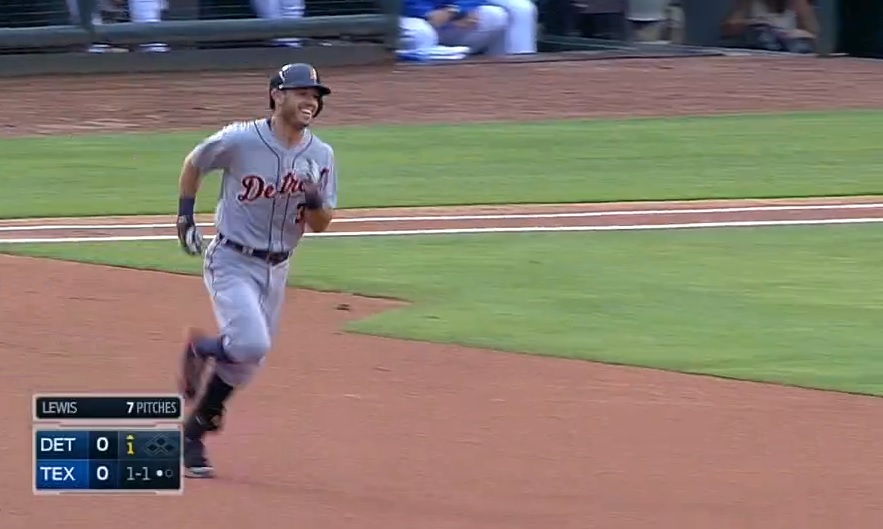
Ian Kinsler, reluctantly departed from his career-long home in Arlington after an off-season trade with Detroit, returned for the first time yesterday as a member of the visiting team. He promptly took former Rangers teammate Colby Lewis deep.

And what did he do? He gave a little wave to his pals in the Rangers dugout. He couldn’t suppress a smile as he went around the bases. There was no animosity here; this was friendly stuff—a we’re-in-different-uniforms-but-I-still-like-you-mooks moment. To everybody, it seems, but Lewis. (Watch it here.)

Give the pitcher some leeway—he had just put his team in a first-inning hole and ended up taking the loss with a mediocre outing, and now boasts a 5.94 ERA on the season after missing all of last year due to elbow and hip injuries. His team has as many wins as the Astros. He deserves to be frustrated. But to take that personally? (If anybody possibly could, it would be Rangers GM Jon Daniels. But Lewis?)

“I guess ‘disappointed’ is the best word to describe it,” the pitcher said after the game in an MLive report.

There are lots of legitimate gripes in baseball about improper displays of respect, which can be dealt with in any number of time-tested ways. Lewis obviously wants other players, particularly those he knows personally, to be sensitive to his struggles. But Kinsler himself described the trip to Arlington as “my return home” (which was more than metaphor: his house and family are still there), and talked after the game about being “lucky enough to square one up.” If he lacks any respect for Lewis, he did a pretty good job of hiding it.

There was no showboating here, nothing intended to call extra attention to Kinsler. It was just a guy soaking in a moment. Lewis should have let him have it.


Retaliation

Ron Roenicke Does Not Like Hitting Guys on Purpose

On Thursday, Ron Roenicke explained why his team did not seek to escalate the budding feud with Arizona that exploded two days earlier, after Arizona’s Evan Marshall drilled Ryan Braun to load the bases, followed by Jonathan Lucroy’s grand slam.

“How many times we get hit during a season and how many times we hit people, it should explain how we feel about it,” the Milwaukee manager said in an MLB.com report. “We do the right things. We try to play the right way, and I’m not in control of what happens on the other side.”

For those scoring at home, how many times they’re hit is “a lot,” and how many times they hit people is, “not so much.” (The actual numbers since Roenicke took over are 248 and 125, respectively.)

“We try to pitch the way we should pitch,” he said. “We don’t throw at people. There’s a time you have to pitch inside to get people out. Good hitters you have to pitch inside. So that’s what happens.”

This is a terrific ideal, with obvious upside: Because Milwaukee pitchers don’t risk extra baserunners put on in the name of vendettas, Milwaukee pitchers are almost never hurt by extra baserunners put on in the name of vendettas. The downside, however, is a little more nuanced, and has to do with people far darker than Roenicke.

Because as clean as the Milwaukee manager wants to live, he has to deal with people in opposing clubhouses who harbor no such virtuosity. These are pitchers and managers who are all too willing to throw inside with impunity, not just to establish the inner portion of the plate but to intimidate opponents. One way to control this type of reckless behavior is to respond in kind. They’re known as message pitches for a reason, and the ones that come in response to hit batsmen are the clearest sort. We’re not talking about drilling somebody who flipped a bat, but holding accountable opponents who intentionally put your batters into harm’s way. It’s more than just making a statement—it is a physical reminder to the pitcher who started it that such behavior will not be tolerated.

There will also be questions raised should Brewers position players feel that said accountability is not a part of their team’s game plan. It’s easy to imagine a player, or a faction of players, growing upset over passivity from their staff after a critical mass of their teammates has been drilled, unanswered. (It’s easy to imagine because it has been a regular occurrence over the years—players calling out their own pitchers, wondering when somebody is going to step up and do something about all the guys being abused.)

None of which is to say that this is the right way to go. (Or that Roenicke doesn’t play by any other of the unwritten rules. He does.) Baseball is constantly changing, and so is the Code. If Roenicke is at the vanguard of a movement in which the only batters hit are hit inadvertently, more power to him.  The game will be better for it.

Ideals and reality don’t always mesh however, and watching this play out over time will prove useful to those trying to figure out which way the wind is actually blowing.

Retaliation

On the Impracticality of Hitting Opponents Out of Anger, Arizona Diamondbacks Edition

Braun drilled

This is what it looks like when a plan doesn’t work out.

The Arizona Diamondbacks, angry with the Brewers for a variety of reasons, and with Ryan Braun for some very specific other reasons, finished a passel of business Tuesday in the span of two pitches. The first sailed behind Braun, the next drilled him in the backside.

Milwaukee’s response: Hit ’em where it hurts.

Things grew heated in the sixth, when Milwaukee right-hander Kyle Lohse hit Chris Owings in the upper back, the ricocheting ball knocking his helmet off his head. It did not bear the marks of an intentional pitch; it was about the slowest fastball in Lohse’s arsenal during a close game, and the right-hander visibly blanched when the pitch made contact. (Watch it here.)

By itself, this may not have been enough to fully rile the D-Backs. But when, two batters later, Lohse threw a slider over the head of pitcher Mike Boslinger—who was trying to bunt Owings to second—Arizona took note. This pitch, too, was almost certainly unintentional. Why would anybody want to drill the pitcher in a two-run game? Much more likely, Lohse was trying to put a pitch in a difficult-to-bunt location. (In that, at least, he succeeded.) Add to that the fact that he grazed Didi Gregroius with a slider in the first inning, and manager Kirk Gibson’s mind was almost made up for him.

The very next inning, he had what he must have felt was a tailor-made situation. Not only were there runners on second and third with one out, leaving first base open, but the batter was Ryan Braun. The same Ryan Braun who Gibson was not at all shy about slagging last year, in response to the fact that the 2011 NL MVP led the Brewers to a taut playoff win over Arizona, and later admitted to have been juicing at the time.

“If I get a chance to see Braun, I got a question for him, right to his face,” said Gibson last year, in an Arizona Republic report. “Is he about rehearsed by now? About ready to come out? He’s probably been practicing at theater school somewhere. Anyway, she was looking at how things like that can influence people’s opportunities and the opportunity to do something like that.”

So: Pissed-at-the-present plus pissed-at-the-past apparently equals send-your-reliever-out-for-some-dirty-work. Arizona pitcher Evan Marshall sent a 94-mph fastball behind Braun’s back, drawing a warning from plate ump Ted Barrett. His next pitch was even faster, and connected with the small of Braun’s back. Barrett ejected him on the spot. Not so oddly, Gibson seemed delighted when Marshall returned to the dugout. (Watch it here.)

The plan, of course, backfired. Gibson strategized as best he could, using his statement to set up the double play in an instance when he would have been justified in ordering an intentional walk to do the same. But his team’s 4-3 lead turned into a 7-4 deficit when the next hitter, Jonathan Lucroy, touched reliever Brad Ziegler for a grand slam. (Watch it here.)

Oops.

The Diamondbacks have talked a lot of late about the need to stick up for their own in ways just like this, and followed up in as overt a way as he could. That’s the thing about planning, though—without execution, it doesn’t amount to a whole hell of a lot.

The teams have two more games, today and Thursday, with which to continue sending messages. If Gibson’s astute, he’ll recognize not only that he took his best shot (two of them, in fact), and that it didn’t work out so well for him. His slate should be clean. If the Brewers are astute, they’ll recognize that Lucroy gave them the best response for which they could ever have hoped.

Even-steven, everybody. Now go play some ball.

Retaliation

Follow-Through Mania: When Swings Get Loopy, Things Get Touchy

Dickerson swingsSo Manny Machado isn’t the only guy around with a lethal backswing. At least there appears to have been no reason for Corey Dickerson to have unleashed his with intention.

During the follow-through of an eighth-inning swing Thursday, Dickerson’s bat collided with Braves catcher Gerald Laird’s mask with enough force to knock the catcher—in concert with a foul ball that had ricocheted off his head just two pitches earlier—from the game. (Watch it here.)

Maybe it’s Machado’s fault, and that folks around baseball are particularly keyed up about this subject, but on the very next pitch, Braves right-hander David Carpenter drilled Dickerson on the hip with a 95-mph fastball. Rockies manager Walt Weiss was upset enough by this to get thrown out for storming the field in anger toward the pitcher.  (Watch it here, from a Rockies broadcast crew with no small amount of bias.)

The bad feelings actually started Wednesday, when Braves right-hander Julio Teheran hit Josh Rutledge with a pitch that bounced off his shoulder and knocked the helmet from his head. After Carpenter hit Dickerson, Weiss was heard (and caught on video) shouting from his side of the field, “We owe you two.”

It is reasonable to be inspired to anger at the sight of a teammate laying face first on the ground, as Laird had been just moments earlier, but Carpenter needed to be more cognizant of the situation. There appears to be little chance that Dickerson intended to hit Laird; as Weiss said after the game in an MLB.com report, “If you think a guy can foul a ball off and at the same time hit the catcher on a backswing on purpose, you’ve got no clue.”

Plate ump Jordan Baker wasted no time ejecting Carpenter after Dickerson’s HBP, which should have been enough to mollify Weiss, at least for the time being. The Rockies had been victimized by a pitcher using an extremely loose interpretation of the unwritten rules, and that pitcher had been punished by the actual rules. Weiss, though, wanted more.

Colorado got back one of Weiss’ two in the following frame, when, with the Braves losing 10-3 and down to their final out, reliever Nick Masset hit Laird’s replacement, Evan Gattis. Masset was ejected, just moments before his replacement, Matt Belisle, closed things out.

The teams don’t see each other again this season, which would have almost certainly been occasion for further response. Now we’ll just have to see what kind of memory Weiss has when it comes to this sort of thing.

Update (6/17): Masset’s been docked three games.

Unwritten-Rules

Desmond Slams Bat, Wins Hearts and Minds With Response to Slamming Bat

Even as I have come to accept the new world order of bat flips and assorted other stylings, I now appreciate more than ever those who recognize their own decorum, even when—especially when—they haven’t done much of anything wrong. Ladies and gents, your anti-Machado: Ian Desmond.

Desmond, a home run away from the cycle last night in San Francisco, slammed his bat down in frustration after flying out to left field of Yusmerio Petit. Because the frustration was strictly personal—the Nats led 9-2 at the time—Desmond may have thought better of it, and apologized after the game.

“For the record, I probably shouldn’t have slammed my bat,” he said in a Washington Post report. “If Petit hears about this or sees this, I apologize. That was pretty bush league. But I was kind of caught up in the moment. You don’t get that opportunity often.”

Today’s lesson: A little cognizance goes a long way. Kudos to Desmond.

[Thanks to @lawrence_s for the tip.]

Retaliation, Unwritten-Rules

Machadope: On the Reckless Pursuit of Imaginary Justice


Machado swingsManny Machado is trying to rewrite the unwritten rulebook, virtually from cover to cover. One day the guy is inventing new things to get angry about, the next he’s figuring out new ways to retaliate for them.

In the process, he’s proved himself to be among the most reckless, hard-headed and downright dangerous players in the game, and should be harshly suspended for Sunday’s action.

Machado’s aggravation with the A’s began on Friday, when he took issue with an ordinary tag by Josh Donaldson, who was later thrown at by O’s reliever Wei-Yin Chen. On Sunday, the young shorstop took it to a new level stratosphere.

Hitters will occasionally come into contact with catchers on a backswing. It happens. That said, it is rare and inadvertent, and because it puts catchers into no small degree of peril—a bat is connecting with their head—hitters who do it are immediately apologetic.

Not reckless Manny Machado.

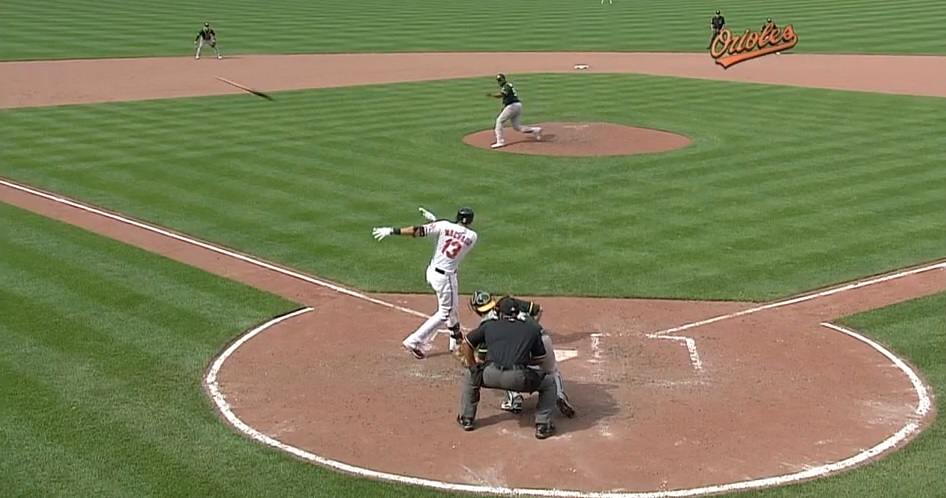
Machado hit A’s catcher Derek Norris with a backswing early in Sunday’s game, then connected again with significant force on an exaggerated follow-through in the sixth, his bat cracking the top of Norris’ helmet. The catcher, stunned, was immediately pulled from the game. Was it intentional? Judge it by Machado’s reaction. The guy didn’t so much as turn around. In fact, as a dazed Norris was being led into the A’s clubhouse, the Baltimore shortstop was caught on camera smirking. (Watch it here.)

“Usually most guys, it’s a, ‘You all right?’ Something,” said Norris after the game, in an MLB.com report. “But, if anything, I might’ve caught him smiling one time, which is kinda bizarre. Not really much [courtesy] coming from his side today. I don’t need a guy to ask me if I feel all right to feel good about a situation, but I think it is courteous for one ballplayer to another to ask if they’re all right. But yeah, nothing.”

This action is beyond the pale. Pitchers who throw at opponents’ heads are shunned by their peers—even those peers who believe in retaliatory pitches. Every one of them cites the idea that aiming a fastball above a player’s shoulders is the quickest way to end a career. Norris is no Tony Conigliaro in terms of long-term impact (at least from the looks of things so far), but a trip to the disabled list to deal with late-manifesting concussion-related issues is not out of the question. That the blow was leveled intentionally, under the scope of game play, is shameful.

Machado backswing
A normal backswing? You be the judge.

Machado compounded matters in the eighth when A’s pitcher Fernando Abad, on to protect a 10-0 lead, threw an inside fastball toward Machado’s knees—almost certainly a response to the backswing, but a mild one. It was not a difficult pitch for the batter to avoid, and it passed unimpeded to the backstop.

Machado waited until the next pitch, then swung and let go his bat—ostensibly to fly at Abad, though it sailed harmlessly down the third base line. It was obvious enough for the Orioles own broadcast crew to proclaim, “Manny Machado thought he was thrown at, and on that swing he let that bat go, intending it to go to the mound.”

A minor pass is given for the fact that Machado is coming off of knee surgery, and is obviously protective of that part of his anatomy. Then again, the reaction fits perfectly with everything we’ve learned about him this weekend. The 21-year-old hothead with the big ego has put some personal and indecipherable code of ethics above the safety not just of his opponents (it appears he’d have been happy to have hit two Oakland players with bats), but his own teammates, should the A’s opt to retaliate at some point in the future. Machado hasn’t yet spoken publicly of some irrational need to be respected, but his actions are those of somebody who feels strongly that he is owed something, despite a decided lack of merit.

O’s manager Buck Showalter pased the buck after the game, saying in the Baltimore Sun that he preferred to let players take care of this kind of thing on their own, and adding that “I thought Manny handled it better than someone with some experience [would]. It was also a good experience for him to have. He cares. It’s a learning experience for all of us.”

If it’s really a learning experience, Machado needs a voice of reason wearing orange and black telling him to knock it off. The Code dictates that one (or more) of Machado’s more senior teammates step in to corral what is looking increasingly like an out-of-control player. That said player is the most talented guy in Baltimore’s system complicates things, but not so much that the team’s veterans can’t bring their voices into the equation.

The A’s may well have a few things to say about the situation when the teams meet again in July, but if things haven’t been handled internally long before then, the Orioles will have far bigger things to worry about than Oakland.

Update (6-9-13): The talking to has happened, at least to some degree. Machado apologized via the team’s TV network.

Update (6-10-13): I can’t see any way this would actually happen, but the Orioles are presenting a serious front: Dan Duquette says that sending Machado to the minors is “an option.”

Update (6-10-13): Machado has been suspended five games, and will appeal. In a less sensible move, Abad has been fined for a pitch that did not hit a batter, after he was thrown out of a game for that same pitch, but only after throwing another, subsequent pitch.