Retaliation

The Fine Line Between Pimping and Confusion, Pittsburgh Edition

Morneau drilledPerception is everything.

In the fifth inning in Milwaukee on Wednesday, Andrew McCutchen hit a home run to left. He didn’t get it all—it just cleared the fence—and he managed to lose it in the lights before he knew where it was ending up.

As such, he loitered in the batter’s box to try and get a read on it.

Ignore for a moment the horrific strategy of hedging one’s bet that a ball may not have left the ballpark by failing to leave the batter’s box. The pitcher who gave up the shot, Wily Peralta, either did not know about McCutchen’s confusion, or didn’t care. With his next pitch, he drilled Justin Morneau on the hand, near head-level. (Watch it here.)

“The catcher knew I was looking for the ball, the umpire knew—everybody knew it,” said McCutchen after the game, in an MLB.com report. “You could see the guys in the infield smirking as I was going around the bases. They know I’d lost the ball.”

Peralta offered up the standard denial of intent, saying “Yeah, you know, it wasn’t on purpose,” before detailing how he missed his spot while trying to go up and in.

“I know it looks bad, because right after a homer, you don’t want to hit people,” he said.

Unless, of course, hitting people is exactly what you want to do. Morneau reacted angrily, and even though he never approached the mound, benches cleared. After the game, Pittsburgh’s first baseman wasn’t ready to level blame with any degree of certainty.

“I think usually when a guy hits a home run, and they don’t like the way he reacts, they wait until the guy comes around [again],” he said in USA Today, questioning whether a more proper approach would have seen the Brewers waiting for McCutchen’s next turn in the lineup, rather than going after Morneau so quickly afterward. “It’s one of those things in that gray area. You don’t know if it’s intentional or not.”

Not to disagree too wholeheartedly with an experienced big leaguer or anything, but it seemed pretty intentional. Add the wrinkle that Morneau’s career was derailed and diminished by concussion-related symptoms, and the idea that Peralta came anywhere near his head in a misinformed fit of retaliation is unconscionable.

That was the final meeting between the teams this season so any personal retribution will have to wait, but there are no such constraints on the commissioner’s office, which may opt to hand down some discipline of its own.
Practical Jokes

Rodney’s Bathroom Breather Hardly Breaks New Ground

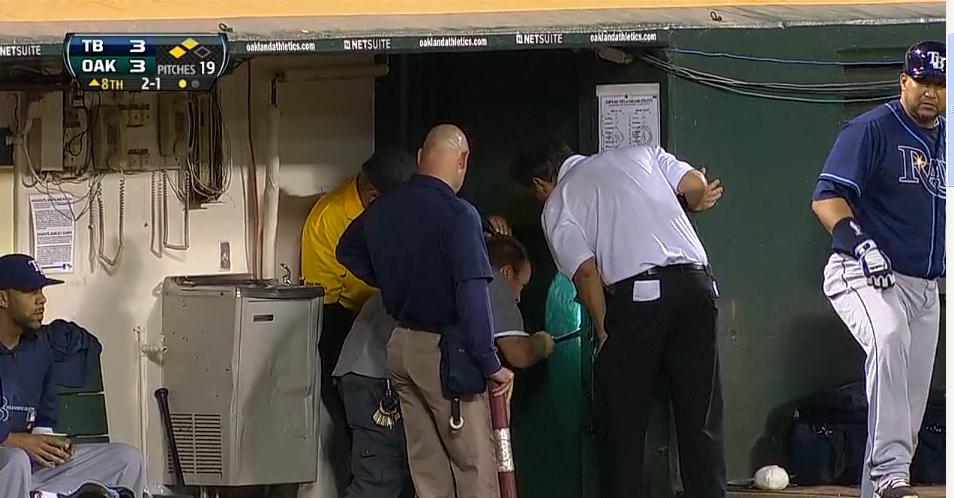
Rodney trappedRays reliever Fernando Rodney got stuck in the visitors’ dugout bathroom at Oakland’s O.co Coliseum on Sunday, and was trapped for about 15 minutes until a rescue crew could open the door.

He emerged triumphantly, met by jubilant teammates.

“They got two runs when I was locked inside,” Rodney said in an Associated Press report. “They broke the lock. It was hot inside. I can only hear the crowd but can’t see game. So I don’t know what’s going on. I let them know and tried getting a key but couldn’t. I kept yelling, ‘Get me out!’”

(Check it out at the bottom of the page, or watch the extended clip here.)

“It was a kind of a fun moment,” added Rays manager Joe Maddon. “We kind of rallied then—we should have kept him in there. A lot of the commotion in the dugout in the eighth inning and part of the rally was someone beating on the door. Finally someone broke the door knob with a bat to get him out. I don’t even know who the hero was getting him out.”

While there’s no unwritten rule to cover Rodney’s escapade, there was one involved in another locked-in-the-bathroom incident covered in The Baseball Codes. Unlike Rodney’s predicament, that one was all about practical jokes—keeping things loose in the clubhouse.

From TBC:

Bob McClure was a fun-loving reliever for the Brewers in the 1970s, some­one who proved, if nothing else, that he could take as good as he gave. The story started with his Sunday routine before day games, for which he holed up with a newspaper in the long cinderblock outhouse behind the outfield fence at Milwaukee County Stadium. It was a cool place for an American League pitcher to pass the morning in the shade of the bleach­ers, escaping the summer heat while his teammates took batting practice.

When the door slammed shut on McClure in the middle of one of these siestas, the pitcher attributed it to a gust of wind. But when he tried to exit, the door wouldn’t budge, even though it had no lock. With just a hint of panic, the pitcher pushed again . . . and again. Soon he was exert­ing so much energy in his frantic bid to escape that he had to stop for peri­odic breathers. The day was growing increasingly more sultry, and McClure worked up a sweat; eventually he kicked the air vents from the walls and stripped down to his underwear. “I bet I lost about seven or eight pounds in there,” he said. “It was hot.”

After a half-hour, the pitcher was able to wedge the door open just enough to squeeze through (“I still remember the scrapes across my chest”), whereupon he saw that someone had taken the rope from a flag­pole on the other side of the outhouse and pulled it so taut to reach the doorknob that the pole had bowed under the pressure. Once it was affixed to the handle, the rope’s tension kept the door from opening; it was only as the fibers started to give that McClure was able, finally, to free himself. (He found out later that members of the visiting Minnesota Twins, com­ing out for their own batting practice, had been told by his mystery assailant to watch the flagpole, that someone was locked in the lavatory and it would bounce every time he tried to get out.) He put on his clothes and returned directly to the clubhouse, as if nothing had ever happened. “I would say that, if someone gets you, never let them know that they got you,” he said. “I think it’s inappropriate, if someone really gets you good, to overreact. Don’t get mad, just get even.” The problem was that he had no idea upon whom to visit his revenge.

Before a game several days later, McClure got his answer. As the pitcher loitered in the outfield during BP, a fan called him over to the bleachers. “Do you want to know who locked you in that room?” she asked. His instinct was to play dumb, but when the woman told him she had pictures, he couldn’t resist. She handed them over in exchange for a ball autographed by Robin Yount, and McClure saw exactly what hap­pened: It had taken two men to pull the flagpole rope tight enough to trap him, and their uniforms were clearly visible. It was pitchers Mike Cald­well and Reggie Cleveland.

McClure immediately set to plotting his revenge. Six weeks later, when the Brew­ers had an off-day in Kansas City before a series with the Royals, he struck.

While many players, including Caldwell and Cleveland, spent the after­noon golfing, McClure opted for a hunting trip with a local friend. On the way back they stopped by a farm, where the pitcher bought a small, live— and exceptionally filthy—pig. “It had so much pig dung on it that you couldn’t even hardly tell it was a pig,” McClure said. “It was perfect. We put it in a burlap sack in the back of my buddy’s pickup.”

When the pitcher returned to the hotel, he saw that his teammates hadn’t returned, and figured they’d be out until the wee hours. McClure bribed his way into the room that Caldwell and Cleveland conveniently shared, and let the pig loose atop the bed. “When that pig hit the sheet, it looked up at me and started projectile shitting everywhere, like a shot­gun,” he said. “That pig was alive. It jumps off the bed, and it’s squealing and going nutty. There’s shit on the bed, on the floor, on the curtains. It was so loud that I had to get out of the room.”

He was staying just across the hall, and hours later was roused by the sounds of his returning teammates. Caldwell was the first to enter, and nearly as quickly lit back into the hallway, shouting, “There’s someone in there!” As McClure listened with delight, his teammates rushed the room, then spent the better part of an hour trying to corner the pig. Finally, the noise quieted and McClure went back to sleep.

The next morning, the pitcher veritably bounced across the hall to see how his victims had held up. He entered the room under the pretense of rounding up breakfast companionship, but wasn’t at all prepared for what he saw. The place was spotless. The walls, the drapes, the bedspread, and the carpet had all been cleaned. Caldwell was lying on his back in bed, shirtless. Also on its back, in the crook of Caldwell’s right arm, was a freshly washed pig. It sported a red dog collar. Caldwell was feeding it French fries dipped in ketchup.

Feigning ignorance, McClure asked why there was a pig in the room and was told the entire story, up to and including an early-morning trip to a nearby pet store, where Caldwell bought collar, leash, and industrial-grade pet shampoo. The pig joined the team at the ballpark that day, serv­ing as the Brewers’ mascot. It ended up living on Cleveland’s farm, of all places, dreaming recurrently, no doubt, of room service and burlap.

Alex Rodriguez, Retaliation, Ryan Dempster

Why Does Dempster Hate A-Rod So? Let Us Count the Ways

A-rod plunkedThe reason the unwritten rules dominate baseball like in no other sport is the space within the game for messaging. The idea that if somebody wants to communicate an idea through action, there is sufficient opportunity to do so—be it a well-timed stolen base, some styling to start one’s home run trot or an intentionally hit batter.

The thing about the latter category is that we are rarely certain when a batter has been intentionally hit.

On Sunday, however, we were offered about as much certainty as can be reasonably expected, short of admission from the pitcher. Boston’s Ryan Dempster, facing Alex Rodriguez in the second inning, threw a knee-high fastball behind the batter. He followed that with two waist-high inside pitches, then planted a fastball into A-Rod’s elbow. Not even a hint at subterfuge—Rodriguez was marked. (Watch it here.)

Which is where the messaging comes in.

The immediate assumption was that Dempster, an old-school red-ass if ever there was one, was making a statement about PEDs, expressing his displeasure both at Rodriguez’s usage and his subsequent refusal to accept the punishment handed down by Bud Selig. Just two days earlier, after all, Boston players John Lackey and Jonny Gomes discussed their displeasure with the fact that Rodriguez was being allowed to play while appealing his 211-game, PED-related suspension.

If that’s what Dempster was doing, he has some precedent. In 1990, Bert Blyleven hit Baltimore’s Phil Bradley because of Bradley’s hard-line stance in labor negotiations which, in Blyleven’s opinion, prolonged settlement of the 32-day lockout that delayed the start of the season. Blyleven was concerned about pension time, did not appreciate tactics which stood to cost him financially, and expressed his displeasure from the pitcher’s mound.

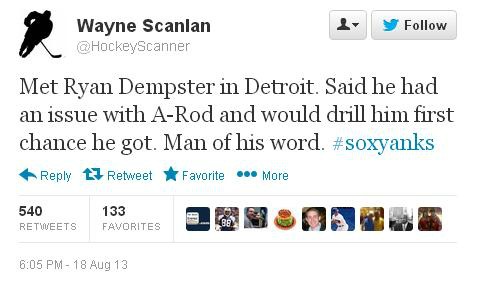
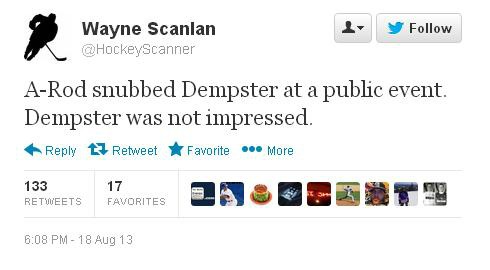
Would it be so peculiar for another pitcher to take a similar tack? Maybe not, but then we hear this, courtesy of Yahoo’s Big League Stew: A Canadian hockey writer says that Dempster had different priorities.

A-Rod tweet I

A-Rod tweet II

This may seem so much more petty than PED grandstanding, but it’s also more feasible—and it, too, has precedent. 

One of Tommy Lasorda’s go-to stories is about how, as a star-struck 14-year-old, he approached New York Giants outfielder Buster Maynard after a game in Philadelphia and asked him for an autograph. Maynard brushed him off.

Eight years later, Lasorda was a promising pitcher with the Triple-A Montreal Royals, in the Brooklyn Dodgers chain, when to his surprise he found himself facing a fading former big leaguer trying to hold his job with the minor-league Augusta Yankees: Buster Maynard. Lasorda’s first pitch knocked him down. His second pitch did the same. When Maynard came up again later in the game, Lasorda decked him a third time.

This time it was Maynard waiting for Lasorda after the game, asking what the heck was going on. Lasorda told him the story of saving up his money to go to a baseball game, only to be ignored by his hero. He concluded the sentiment with, “I wish I had hit you, you busher!”

Girardi argues
Joe Girardi: angry.

If this was Dempster’s motivation, it was not apparent from field level at Fenway Park. Yankees manager Joe Girardi lit into plate ump Brian O’Nora for not ejecting Dempster—he was upset that the pitcher was given four pitches with which to work—and then warning both benches, precluding retaliation. Soon, he was himself tossed. On his way back to the dugout he shouted toward Dempster, “Somebody’s going to get hit.”

(In the middle of this came a highly unusual moment, in which the Red Sox bullpen came streaming onto the field as if to fight, despite no indication that Rodriguez would do anything other than take his base.)

Dempster denied everything, of course, and Rodriguez ratcheted up the best possible response when he took Dempster deep for a sixth-inning homer at the center of a four-run rally that proved to be the difference in a 9-6 New York victory. (Watch it here.)

Rodriguez also provided the quote of the night, when asked about whether Dempster should be suspended for his actions. “I’m the wrong guy to ask about suspensions,” he said in the Boston Globe. “I’ve got a lawyer I can recommend.”

The teams play seven times in a 10-game span in September. If there’s more to be said about this, it’ll be said then.

Update (8-20): Dempster has been handled, five games’ worth.

A.J. Pierzynski, No-Hitter Etiquette

Darvish Nearly Perfect From the Mound. The Guys Behind the Plate, Not So Much

AJP tossedDon’t change anything during the course of a no-hitter. By now, that much should be obvious. Players don’t change spots on the bench between innings. Managers don’t make unnecessary substitutions (except for those who do). The mere appearance of a reliever warming up in the bullpen can be enough to send the superstitious into fits of nervous twitching.

Monday, however, brought us something entirely new in the realm of not mixing things up, and it only makes sense that the delivery person was A.J. Pierzynski.

Yu Darvish, working on a perfect game in the sixth, threw a 2-2 breaking ball to Jonathan Villar, which Pierzynski thought was strike three, but which plate ump Ron Kulpa judged to be too low. The fact that the catcher leapt from his crouch and took a step toward the dugout before hearing Kulpa’s ruling earned him no favors.

Darvish walked Villar on the next pitch, giving the Astros their first baserunner, and Pierzynski was none too pleased. After the game, Kulpa explained what happened. As reported by MLB.com:

“Pierzynski didn’t like the pitch that I [called for a ball]. We had words about the [2-2] pitch. And then [Darvish] walked [Villar] on the very next pitch and [Pierzynski] continued to argue on the pitch before. And so he got ejected.” (Watch it here.)

Talk about changing things up. Game action was interrupted while Ron Washington came out to argue and backup catcher Geovany Soto raced to put on his gear. Suddenly Darvish was throwing to a different target. The right-hander denied that any of this had to do with the home run he gave up to catcher Carlos Corporan two frames later (indeed, Soto has caught 10 of Darvish’s 22 starts this season, so lack of familiarity is not a problem), but history is not on his side: Only twice has a pitcher thrown to more than one catcher during the course of a complete-game no-hitter—Ken Holtzman in 1969 and Larry Corcoran in 1880.

The question now becomes one of blame. Did Kulpa have too quick a trigger finger, especially considering the enormity of the situation? Should Pierzynski have played it cooler, knowing what was at stake?

The answer to both questions is a resounding yes. Had either of them shown just a skosh more restraint, it’s possible that the baseball world would be celebrating Darvish right now even more than it already is.

“Absolutely, you feel bad for the guy,” said Pierzynski afterward. “You feel bad for the pitcher and you feel bad for everybody associated with it. Because they don’t happen a lot and when you get that close, you really want to try to get them done. Unfortunately, it didn’t work out.”

(For what it’s worth, Darvish came within one batter of a perfect game at the same ballpark in April. Some feel he was jinxed in that one, too.)

Hidden Ball Trick

The High Cost of Not Paying Attention, Juan Uribe Edition

Uribe picked offThe last time we saw two hidden ball tricks in a season was … well, who really knows? Evreth Cabrera tried it against the Giants in July, but was stymied by a lack of execution from his teammates and an ill-placed timeout call.

On Saturday, Tampa Bay was far less subtle in its efforts against the Dodgers—and far more effective.

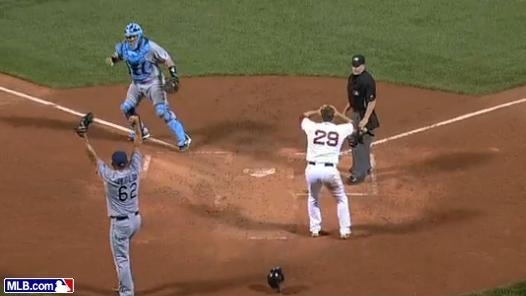
Shortstop Yunel Escobar, noting that Juan Uribe—who had just pulled up at third following a sacrifice fly—wasn’t paying attention, called for first baseman James Loney to throw him the ball. He then tossed it to third baseman Evan Longoria, who was standing behind the bag.

Longoria watched Uribe quietly, and waited, ball in hand. Despite warnings hollered from Zack Greinke in the on-deck circle, the moment Uribe pulled his foot off the base, Longoria pounced. Third-base ump Angel Hernandez was right on it, and a disbelieving Uribe was out. (Watch it here.)

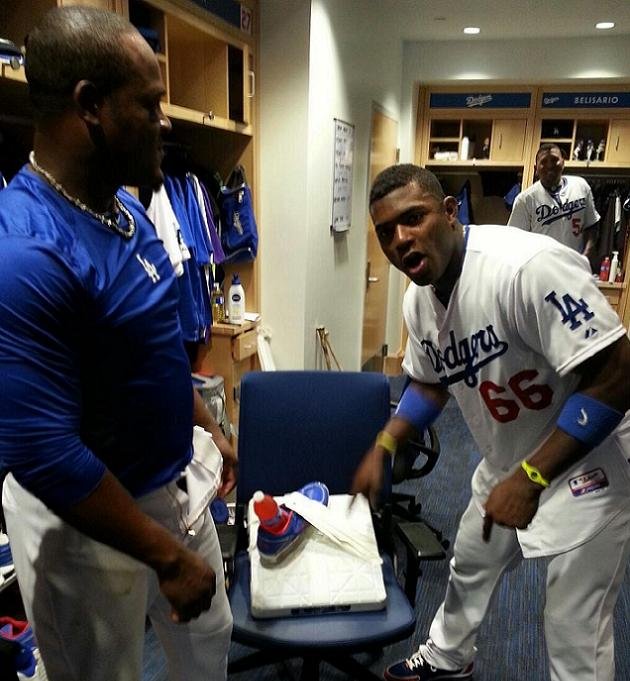
Thanks to a 5-0 victory, the Dodgers were able to have fun with it, Adrian Gonzalez presenting Uribe with third base—complete with a taped-on cleat—after the game. (See image below, courtesty of @yasielpuig.)

Escobar told reporters that he’d already tried the play four or five times this season, but that this was the first time in his seven-year career it’s actually worked.

No wonder we don’t see it more frequently.

Update (8-14): Even Los Angeles-area youth are getting in on the action.

UribeFoot

Don't Call out Opponents in the Press

Rays, Red Sox Bring Battle Online

Red Sox-RaysIn June, the Red Sox and Rays got into it when John Lackey drilled Matt Joyce.

Last year they got into it when Franklin Morales drilled Luke Scott (among multiple confrontations during a long Memorial Day weekend).

During the decade spanning 2000 to 2010, they were involved in a series of skirmishes significant enough to merit an entire section in The Baseball Codes.

At least yesterday the hostilities were limited to Twitter.

It started with a blown call—Daniel Nava appeared to score what would have been the tying run on a sacrifice fly with two outs in the eighth, but was called out at the plate by umpire Jerry Meals—a decision that helped Tampa Bay to a 2-1 victory over the Red Sox in Boston. The win pushed the Rays into first place by half a game.

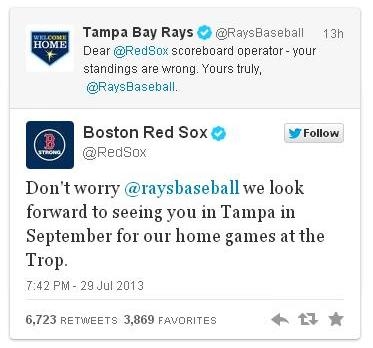
Afterward, the team’s official Twitter feed got into the action.

Rays tweet

Not willing to be outdone, the Red Sox shot right back.

Red Sox tweet

Welcome to retaliation in the digital age.

Update (7-31): Reader RoadDogRuss alerts me that this wasn’t the first digital tweaking between the teams.  (The tweet, of course, refers to this incident.)

(H/T Bleacher Report)

Bat tossing, Rookie Etiquette, Wil Myers

Flipping Out: Myers Makes the Most of His Sixth Career Homer

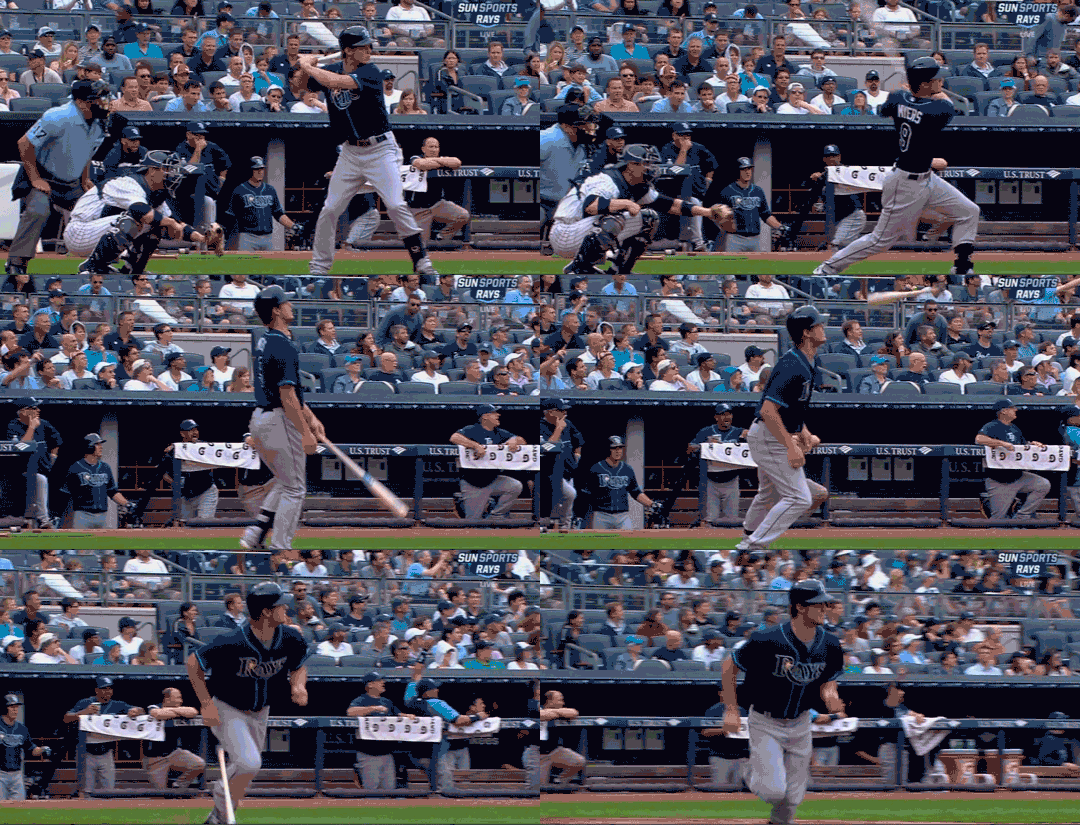
Myers flip
Click image for GIF.

From The Baseball Codes:

When Phillies rookie Jimmy Rollins flipped his bat after hitting a home run off St. Louis reliever Steve Kline in 2001, the Cardinals pitcher went ballis­tic, screaming as he followed Rollins around the bases. “I called him every name in the book, tried to get him to fight,” said Kline. The pitcher stopped only upon reaching Philadelphia third baseman Scott Rolen, who was moving into the on-deck circle and alleviated the situation by assuring him that members of the Phillies would take care of it internally.

I bring this up because of Wil Myers’ reaction to the first of two home runs he hit Sunday against Yankees starter Phil Hughes. There’s no mistaking the rookie’s bravado, and the fact that he did it against a seven-year vet struggling to find his way in the game certainly didn’t help matters. (It’s also not the first time for him.)

The Yankees opted against making it a public issue, but place Kline’s commentary after Rollins’ blast—which was only the third of his career—within the mainstream:

“That’s fucking Little League shit. If you’re going to flip the bat, I’m going to flip your helmet next time. You’re a rookie, you respect this game for a while. . . . There’s a code. He should know better than that.”

Kline never responded from the mound, because he faced Rollins only five more times over the course of his career, all with the game on the line. The Yankees visit Tampa Bay in late August. The convictions of New York’s pitching staff will be made apparent then.

Myers flip II

Don't Showboat

Today’s Lesson in Minor League Etiquette: Don’t Pimp if You Play for the Twins

Miguel Sano
Miguel Sano

Regardless of how you feel about baseball’s unwritten rules—and there are many who decry the eye-for-an-eye mentality of retaliatory HBPs—it is difficult to quibble with the sentiment at their core: enforcement of respect on a baseball diamond. Respect for one’s opponents. Respect for one’s teammates. Respect for the game.

In this regard, the Twins are proving to be an exemplary organization.

Big league ballclubs tolerate flashy displays by their players all the time, because picking one’s battles becomes an increasingly relevant pursuit when it comes to emotionally fragile superstars who are locked into multiyear deals. This leaves it up to the opposition to settle the score. Hence, the aforementioned retaliatory HBPs.

The period before these players reach multimillionaire status, however, presents a fertile time during which to instill appropriate work habits. Which the Twins appear to be doing.

On Tuesday, for example, Miguel Sano, playing for the team’s Double-A club in New Britain, hit a long home run, then watched it, then settled into a glacial home run trot that saw him take 29 seconds to round the bases. He did it against a Portland pitcher, Bobby Lanigan, who had until only recently been his teammate.

It was not the first time that Sano, the third-ranked overall prospect in the minor leagues according to the St. Paul Pioneer Press, has encountered such trouble. In April, he hit a grand slam while playing for Single-A Fort Meyers, then overtly flipped his bat. Later in the game, the opposing pitcher threw a fastball at his head in response. Sano reacted to that message with more of the same, homering during the at-bat, then pumping his fist and shouting toward his team’s dugout.

It seems that the Twins have seen enough. Sano was pulled from the game following his display against Portland, and has not seen the field since.

“Just a normal player-development decision,” said Twins farm director Brad Steil in the Pioneer Press. “We have discipline for all sorts of things that we do. This is one of them. He’s not going to play for a few games.”

Critics can decry the concept of retaliatory pitches ad nauseum, but if every organization approached things as proactively as the Twins have handled this situation, there would be far less call for them in the first place.

Update (7/28): After four games, he’s back.

(H/T Hardball Talk.)

Hidden Ball Trick

Now You See It, Now You Don’t: On Making Baseballs Disappear

hidden ballTim Lincecum no-hit the Padres on Saturday, but a day earlier the same teams showed us something that might be even more rare.

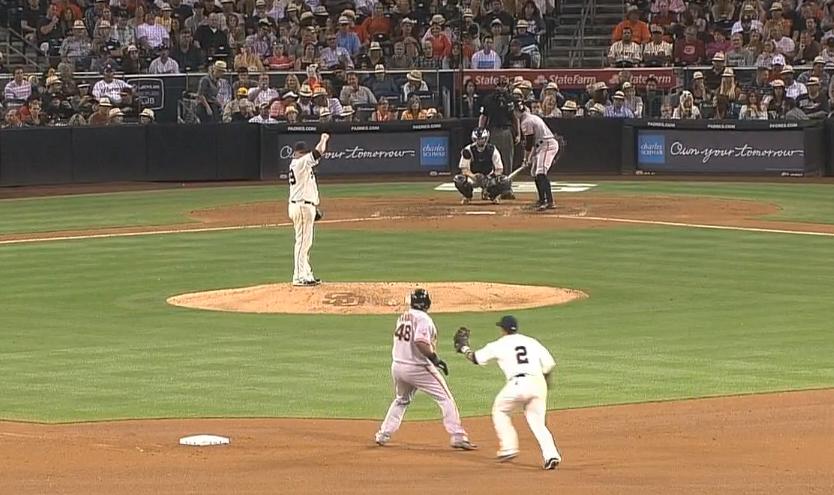
After Pablo Sandoval doubled with two outs in the top of the fifth, Padres shortstop Evreth Cabrera ended up with the ball, and while nobody was watching, tucked it away in his glove. Sandoval, preparing for the ensuing pitch, took his lead off second—and Cabrera pounced.

Hidden-ball trick!

Cabrera did everything right, catching Sandoval completely unawares. Problem was, second-base ump Laz Diaz had allowed a timeout request, so the ball was not actually in play. Also, because pitcher Sean O’Sullivan was standing on the mound at the time, the play would have been rendered illegal even had time not been called. Sandoval was allowed to remain at second.

Still, one can hardly fault Cabrera for his effort. “I’m trying to do something to get out of the inning, something different,” he said in an MLB.com report.

Said longtime big leaguer Rex Hudler: “The hidden ball trick is not against the unwritten rules. You’re trying to get an out. I never did pull it off in the big leagues, although I wanted to a few times.”

Cabrera’s effort called to mind a similar effort by Philadelphia shortstop Steve Jeltz in 1986. He had the ball, showed it to the nearest infield umpire, and picked the runner, Curt Ford of the St. Louis Cardinals, cleanly off second base. The only problem was that Phillies catcher John Russell, unaware of what was going on across the diamond, requested time out, which plate ump John McSherry granted just as the infielder was racing to apply the tag. Because the ball was no longer in play by the time Jeltz reached Ford, the runner, like Sandoval, was allowed to return to second.

In 1968, umpire Emmitt Ashford inserted himself even more firmly into a would-be play, obliviously calling time—of his own accord, not because anybody requested it—just as Baltimore first baseman Boog Powell was about to catch Yankee Joe Pepitone off the bag. When questioned by the upset Orioles about his motivation, he said, “Boog’s got the ball and he forgot to call time. I’m just trying to be helpful.”

More on the topic from The Baseball Codes:

“A lot of people thought the hidden ball trick was kind of a chickenshit play,” said longtime big leaguer Steve Lyons, “but my feeling always was, Pay attention.” Lyons’s favorite situa­tion in which to utilize the strategy was on tight double plays, when all eyes were on the first-base umpire to see whether he’d call the runner safe or out. Because many first basemen naturally hop off the bag toward the pitcher, said Lyons, “all you have to do is take three more steps, give [the pitcher] a little nod, hang on to the ball, turn around, and come back to first base. Guys get off the base too early all the time.”

Third baseman Matt Williams was one of his era’s foremost practition­ers of the trick, going so far as to induce runners off the base. With the Giants in 1994, Williams pretended to give the ball to pitcher Dave Burba, then returned to his position and asked the runner, Dodgers rookie Rafael Bournigal, if he “could clean the bag off.” The runner gra­ciously stepped aside, which Williams immediately made him regret. “The intent was not to embarrass anybody or to pick on anybody,” he said after pulling the trick against Royals rookie Jed Hansen three years later. “But you want to win, and we needed to win that game.”

At least he got that much out of it. Lyons said that in the minor leagues he once pulled off the play at first base on consecutive days, against the same baserunner, Carlos Martinez. “He was probably pissed off, but the embarrassment when you actually get caught overrules everything,” he said. “You get caught, you’re embarrassed, you start walking back to the dugout. He was big enough to pinch my head off if he wanted to.”

Lyons once hid the ball so well that baserunner Scott Fletcher wasn’t the only one completely snookered—so was the umpire, who called the runner safe on the play. “I got in a pretty good argument over that one,” said Lyons. “I said, ‘Do you think I’m stupid enough to pull the hidden-ball trick, have everybody in the entire ballpark not know that I have the ball, fool every player on both my team and their team, fool the guy who’s on first base, and then tag him before he’s off the bag? Do you think I’m that dumb?’ And what I didn’t realize until that point was that I didn’t really give the umpire a shot to know I had the ball. In fact, I fooled every­body. It’s a little unfair to have him make the right call on that play if he doesn’t know I have the ball, so after that I tried to make sure that they did. It’s pretty hard to try to hide the ball from everybody in the world and still show it to the umpire and say, hey, I’ve got it here, keep your eyes open—but that’s what I tried to do.”