Fraternization, Melky Cabrera

Reach Out and Touch Someone … or Not: On Cano’s (Temporary) Lack of Love for Melky

In 1933, National League president John Heydler issued a memo to team presidents recommending against inter-team fraternization. By the end of the decade, Commissioner Kennesaw Mountain Landis had turned it into law. Umpires were tasked with sitting in the stands before games and taking names of those players willing to converse across borders, with fines levied against the guilty.

Because those mores were in line with the unwritten rules, not many fines were needed. Heck, in the 1965 All-Star Game, Bob Gibson wouldn’t talk to his own catcher, Joe Torre, because they played for different teams during every other game of the season.

“When I had the uniform on, somebody with the other uniform, I wanted to choke them,” said 1993 AL Cy Young Award-winner Jack McDowell. “I wanted to kill them. I’m sure as hell not going to go shake their hands and talk to them, even warming up before a game.”

These days, that mindset has faded, for one primary reason. “There’s interaction now,” said Dusty Baker. “High school games, section games, college games, Area Code games, Junior Olympic team, Olympic team, Pan Am Games—most of these guys know each other, and for a long period of time before they even get to the big leagues.”

Even with that in mind, Melky Cabrera tried to push the envelope following his fourth-inning homer in Tuesday’s All-Star Game. As San Francisco’s center fielder rounded first, he spied one of his best friends in the game, Yankees second baseman Robinson Cano. The pair had come up together through New York’s minor league system, and remain close.

As Cabrera approached second, he held out his hand to slap five with his pal—who, it should be re-stated, was playing for the other team.

How did it sit? Not well in Cabrera’s own clubhouse, likely. His manager for the day, Tony La Russa, is known to have some feelings on the subject. From Buzz Bissinger’s Three Nights in August: “It drives [La Russa] crazy when a hitter gets a single and starts chatting it up with the first baseman as if they’re distant cousins at a family reunion. He shares the fan’s view that it simply doesn’t look good: Baseball is meant to be a game of competition, not a game of whassup dog?

Whassup dog, however,  seemed to be on Cabrera’s mind. Cano refused to play along. (Watch it here.)

“He tried to give me a high five, and I know this is the All-Star Game, but I don’t want to look bad out there,” Cano said in a CBS Sports report. “It was fun, and if it was a closer game I might be having fun. I didn’t want to upset my teammates. We’re playing to win.”

It’s doubtful that Cabrera would have tried such a thing anyplace but an exhibition, but it was still an odd and awkward sight.

“Take ’em out to dinner,” said pitcher Dick Bosman of such encounters. “Sit in the lobby of the hotel. But whatever you do, you’re not supposed to be doing it out there on the field.”

All-Star Game

Hey, it’s the All-Star Game. Let’s Revisit Some History

I ran this post back in 2010 (sans logo, of course), but it seems like an appropriate time to revisit things.

In honor of the All-Star Game, I offer three related stories, only one of which made the final draft of The Baseball Codes. Consider it bonus material to fill the downtime until games resume.

* * *

In the 1978 All-Star Game in San Diego, Pete Rose went so far as to import to the National League clubhouse cases of Japanese baseballs—smaller and more tightly wound than their American counterparts, which caused them to carry farther. Working the locker room like a politician, he garnered buy-in from his teammates on two counts: The National Leaguers agreed to use the balls during batting practice, and they also agreed that nobody would tell members of the American League team what was going on. Rose then sauntered over to the AL locker room and convinced many of the players to come out and watch their opponents take pre-game hacks.

Jack Murphy Stadium was vast in 1978, running 420 feet to center field, but Rose’s teammates for the day put on quite a show, hammering ball after ball over the fence’s deepest reaches. When they were done, the National Leaguers gathered all the balls and returned them to their clubhouse for safekeeping. Using standard major league baseballs in their own batting practice, the American Leaguers had a much rougher go of things.

It might not have meant much . . . or maybe it did. At the very least, it didn’t hurt. The National League went on to win its seventh straight contest, 7-3.

* * *

In the National League clubhouse prior to the 1968 All-Star Game, Dodgers catcher Tom Haller saw Houston’s Rusty Staub rummaging through Don Drysdale’s shaving kit, ostensibly to find evidence to support the long-whispered rumor that Drysdale doctored the ball. When Haller told the pitcher about it, it wasn’t taken lightly.

Fifteen days later, Drysdale faced the Astros in Los Angeles. Trailing 1-0 with two outs and nobody on in the eighth inning, Drysdale buried a pitch into Staub’s ribs.

“That’s for looking through my goddamn shaving kit,” he yelled as the hitter stumbled down to first base. Staub might not have been the world’s best sleuth, but he was smart enough to not say a word.

* * *

Orioles skipper Earl Weaver was once sitting in the dugout when one of his pitchers gave up a home run. As the batter rounded third, he looked toward the Orioles bench, made eye contact with the manager and extended his middle finger. “What the hell was that?” a befuddled Weaver asked Billy Hunter, one of his coaches. Hunter knew exactly what the hell that was. “You didn’t select him for the All-Star Game,” he said.

Rookie Etiquette, Trevor Bauer

Well, Duh: Miguel Montero probably knows the Padres’ hitters ‘a little bit better’ than Trevor Bauer

The Arizona Republic recently estimated that Diamondbacks pitchers shake off catcher Miguel Montero three or four times per game. Tuesday, however, was not like most games.

That’s because rookie Trevor Bauer—making only his second big league start—shook off the signs, said Montero, on “almost every pitch.”

That said, it was only 3 1/3 innings’ worth of almost-every pitches. Then again, giving up six hits, four walks and seven runs to San Diego necessitated 80 offerings from Bauer. Shaking off even a quarter of them would have made for an astounding number, for no reason more glaring than the fact that Montero is a seven-year vet with more than 4,000 innings behind the plate.

Bauer is unconventional, from his preparatory practices to his delivery, which is  all angles and torque. It doesn’t stop there. From the Republic:

While most pitchers try to pitch down in the strike zone, he prefers to work up in the zone. In the past couple of years, Bauer has worked to learn and incorporate a pitch-sequencing theory called “Effective Velocity,” a way of attacking hitters that aims to disrupt timing.

If there are benefits to Effective Velocity, they weren’t apparent Tuesday afternoon. In fact, Bauer might have inadvertently personified an ongoing disagreement between the old and new schools over whose methodoligy is more effective. It’s a tiny sampling, of course, but a  21-year-old just out of college appears to have put his think-tank strategy to the test at the expense of leveraging wisdom from a guy who knows the game.

There’s something to be said for execution (if Bauer doesn’t hit his spots, it doesn’t matter what kind of strategy he employs), but beyond that is the Code and its mandate that young players defer to veterans, at least until such time as they’re able to carry a significant portion of the load on their own.

Montero opted not to blast Bauer afterward, talking about the youngster’s talent and promise. Still,  he added, “I would like him to get a little trust in me. . . . I don’t have all the answers, but I probably know [the Padres’ hitters] a little bit better [than Bauer].”

For a guy carrying the old-school end of the argument, Montero’s response was anything but. For an example of real old-school when it comes to this stuff, turn to the the Red Sox clubhouse in 1967, after rookie pitcher Sparky Lyle, 22, shook off catcher Elston Howard—at age 38, a nine-time All-Star and the 1963 AL MVP—not once, but twice during the course of an at-bat, throwing sliders instead of fastballs, both out of the strike zone, en route to issuing a base on balls.

After the game, Carl Yazstrzemski cornered Lyle in the clubhouse. “I want to know one thing,” Yaz said to the rookie, as recounted by Lyle in The Bronx Zoo. “How can a guy who’s been in the big leagues two weeks shake off a guy who’s been catching fourteen years?”

To make sure the point wasn’t lost, manager Dick Williams then promised a $50 fine every time Lyle shook off Howard from that point on.

Bauer should be so lucky.

Dave Righetti, No-Hitter Etiquette

Yankee Doodle Dandy: Looking Back at Rags’ July 4 No-No

On Independence Day, it seems pertinent to reference the anniversary of one of the great feats to take place on this day, baseball-wise: Dave Righetti’s no-hitter, on July 4, 1983.

It’s pertinent to the unwritten rules, of course, in that Yankees broadcaster Mel Allen refused to mention the feat directly on the air.

“There have been five hits in this ballgame, for those who have turned in late, and the Yankees have had ’em all,” he said in the top of the sixth, conspicuously avoiding a certain two-word combination. As Wade Boggs settled in as the game’s final batter, Allen said, “Wade Boggs, standing between Dave Righetti and a pitcher’s dream.” (Watch it here.)

As it turned out, Allen was far more cognizant of the Code than at least one member of the Yankees. Righetti and Graig Nettles had been planning a trip to Atlantic City for the All-Star break, and Nettles wasn’t about to let some silly superstition get between him and his planning.

“In the sixth or seventh inning he came up and asked me who was driving,” said Righetti, who was a bit surprised to find any of his teammates willing to converse with him at that point. “He volunteered, even though he had pinkeye.”

He also had good sense. At ease talking about driving assignments, the third baseman never mentioned the no-hitter.

Happy July 4, everybody.

Rookie Hazing, Yasmani Grandal

Ice Ice, Baby: Grandal, Frozen Out, Doesn’t Miss a Beat

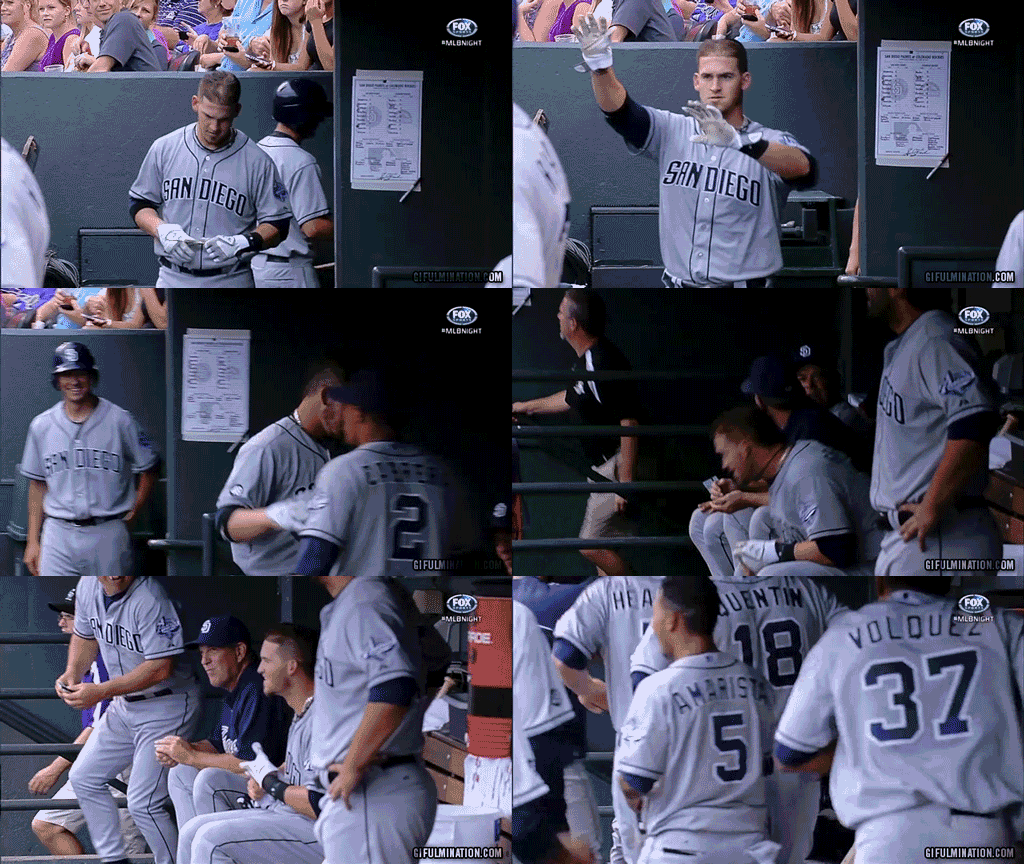
Click for GIF.

There are a lot of reasons to like Padres rookie catcher Yasmani Grandal. His first three hits as a big leaguer have been home runs, including one yesterday. He became the first player in Major League history to homer from both sides of the plate in the same game for the first two hits of his career.

If you think those homers showed composure, they were nothing compared to the rookie’s reaction to the silent treatment he received in the dugout following his first longball. Faced with a shortage of actual teammates to congratulate him, the guy high-fived imaginary Padres instead. (Watch the whole thing here.)

(New York’s Daniel Murphy did something similar last week after snapping a 352-at-bat homerless streak dating back to last season, pumping his fists in the air after his teammates similarly iced him out.)

After all, why wait for others to come through when you can provide for yourself?

(Thanks to reader Steve Kelley for the heads-up. GIF via Gifulmination.)

Retaliation, Tony La Russa

La Russa’s All-Star Snubs Have Cincy Clubhouse Crying Foul

Johnny Cueto: Still not an All-Star.

Remember when Brandon Phillips called the Cardinals “little bitches,” and in the ensuing fight Johnny Cueto kicked Jason LaRue onto the disabled list for nearly the final two months of the 2010 season, effectively ending his career?

So does Tony La Russa, who proved Sunday that baseball retaliation can take myriad shapes.

There’s no way to prove it, of course, short of La Russa admitting as much, but the ex-manager, picking reserves for the National League All-Star team, conspicuously left Phillips and Cueto off the roster.

Both are worthy of inclusion; then again, the guys La Russa ended up picking are also fine choices. That wasn’t good enough for Reds manager Dusty Baker.

“A snub like that looks bad,” he told the Cincinnati Enquirer. “Johnny and Brandon were at the center of a skirmish between us and the Cardinals. Some of the Cardinals who aren’t there anymore are making some of the selections.”

Joey Votto chimed in as well, saying that he was “frustrated” and “disappointed.” Cueto took things a step further, adding “I don’t if know the manager of All-Star Game is pissed at me because I went out with one of his girlfriends.” (Stay classy, Johnny Cueto.)

Snubs happen every year, of course—which is probably where this discussion would have ended had La Russa himself not spoken up, telling the Enquirer that Baker was “attacking my integrity” and that “no way am I going to penalize anybody for any kind of past history.”

Which would have been fine, except that La Russa then tried to justify his position by pointing out that Cueto will be pitching on the Sunday prior to the game. In 2010, MLB implemented a rule stating that pitchers who start on the Sunday before the All-Star break are to be replaced on the roster. This year, they changed it a bit. From the new collective bargaining agreement, as reported by the Enquirer: Any pitcher who starts a game the Sunday prior to the All-Star Game “shall have the option to participate,” but “will not be permitted to pitch for more than one inning” and can set his own pitch count.

Well, then. It’s difficult to believe that La Russa was not made aware of this.

The manager is within his rights to pick whoever he wants, and to leave off those players he’d rather avoid over several days in Kansas City. But like the pitcher who admits to hitting a batter intentionally, La Russa now has more questions to answer than he would have otherwise.

Part of me thinks this is all intentional, and that La Russa’s just looking for a little extra excitement now that he’s retired. Either way, it’ll be difficult for any of the Reds to respond once he’s returned to his post-career life promoting animal welfare. Which is probably just how he wants it.

Dewayne Wise, Gamesmanship

Wise Guy: Outfielder Accepts Ill-Gotten Gains

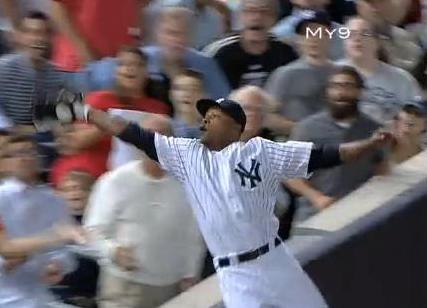
By now, you’ve probably seen the umpiring butchery that Mike DiMuro foisted upon Cleveland, when he ruled that Dewayne Wise caught a foul ball while tumbling into the stands that the right fielder very clearly did not catch. (Watch it here.)

The real question, as it concerns the unwritten rules, is one of gamesmanship. Wise knew that he didn’t catch the ball, but was more than happy to accept the out. Did he act appropriately?

Of course he did. It’s the same reasoning used by outfielders who have trapped flyballs but act as if they caught them. (Wise was even more innocent than that—he didn’t act in any way like he made the catch.)

“Everybody thought it was pretty funny,” he told the Westchester Journal News. “They’re just laughing about it, the way I got up smiling. What was I supposed to do? I’m not going to laugh and show up the umpire right there.”

He was also not going to willingly give up one of the 27 outs necessary for his team to win the game.

“Baseball is a game where you try to get away with anything you can,” said Hall of Famer Hank Greenberg in the Saturday Evening Post. “You cut corners when you run the bases. If you trap a ball in the outfield, you swear you caught it. Everybody tries to cheat a little.”

“It’s not cheating,” said former outfielder and minor league manager Von Joshua, ” if the umpire lets you get away with it.”

Wise’s action is less like his teammate Derek Jeter acting like he was hit by a ball that struck his bat, and more like Greg Maddux, a master at throwing scuffed baseballs. Maddux didn’t scuff them himself, however—he held onto ones that had acquired abrasions through the course of regular use, taking what was legally given to him during the course of the game and using it to his fullest advantage.

Tough to fault anybody for that.

Aroldis Chapman, Don't Showboat

Stop, Drop and Roll: Chapman’s Tumble Has Folks Talking

The evolution of self-congratulation in baseball has been long and storied. Reggie Jackson lingering in the batter’s box.  Barry Bonds’s twirls and Sammy Sosa’s bunny hops en route to first base. Earlier this season we had Yoenis Cespedes, who in his third major league game took some liberties while watching a mammoth shot off of Seattle’s Jason Vargas.

It’s that last one that holds the most relevance to today’s story, which features another recent Cuban émigré, in possession of perhaps not the firmest grasp of baseball mores, celebrating his own achievement with a literally over-the-top display that was well-received by neither opponents nor teammates.

When Aroldis Chapman tumbles, people pay attention.

After closing out a 4-3 victory over Milwaukee on Tuesday, Chapman celebrated by doing a double somersault toward the plate. The guy was delighted after getting back on track following consecutive blown saves and an 11.37 ERA over his previous seven outings, and his display of exuberance was unlike any baseball had yet seen. (Watch it here.)

It’s unlikely that Chapman intended to show up the Brewers, but there’s little gray area in baseball when it comes to this sort of thing; rarely is an example of unnecessary showboating so blatant.

“It’s about professionalism . . .” Joey Votto told the Cincinnati Enquirer. “It’s just not how you do things.”

Chapman, of course, has a bit of history when it comes to making curious decisions. There’s the ticket for driving nearly 100 mph with a suspended license. There’s the stripper girlfriend who may or may not have been involved with robbing his hotel room. Both are the mark of a young guy who hasn’t yet achieved full maturity. So, for that matter, is his tumble off the mound. One difference: The first two don’t inspire opposing pitchers to drill him.

Actually, since closers rarely bat, should the Brewers opt to take his celebration the wrong way it’ll likely be one of Chapman’s teammates who ends up paying for his mistake. Which is why members of the Cincinnati clubhouse were so quick to pile on following the game.

“We don’t play like that,” said manager Dusty Baker in an MLB.com report, adding in the Enquirer that “it’ ain’t no joke,” and that “it won’t happen again, ever.”

“You can’t be doing that,” said catcher Ryan Hanigan. Votto, Jay Bruce and pitching coach Bryan Price spoke with Chapman after the game. From John Paul Morosi’s report: “By the time Chapman returned to the clubhouse, the smile he wore on the field was gone. He rested his forehead on a bat as he sat silently at his locker. He declined comment through a team official, saying he was not ‘mentally ready’ to take questions from the media.”

This was important. It told the Brewers that, regardless of how they might respond the following day, the Cincinnati organization was on top of the matter. That kind of thing can make a difference, as evidenced by the fact that Wednesday’s game featured no hit batters. That could have been due to the fact that the score was too close to chance retaliation until the ninth, or that Brewers manager Ron Roenicke spent parts of three seasons as Baker’s teammate on the Dodgers, and understands how his counterpart feels about this kind of thing. Or maybe it’s just that Milwaukee has considerable recent history with its own displays of showboating.

Still, some comfort can be taken from knowing that a situation has been handled; Baker has seen it first-hand. From The Baseball Codes:

In a game in 1996, the Giants trailed Los Angeles 11–2 in the ninth inning, and decided to station first baseman Mark Carreon at his normal depth, ignoring the runner at first, Roger Cedeno. When Cedeno, just twenty-one years old and in his first April as a big-leaguer, saw that nobody was bothering to hold him on, he headed for second—by any interpretation a horrible decision.

As the runner, safe, dusted himself off, Giants third baseman Matt Williams lit into him verbally, as did second baseman Steve Scarsone, left fielder Mel Hall, and manager Dusty Baker. Williams grew so heated that several teammates raced over to restrain him from going after the young Dodgers outfielder. . . .

At second base, Scarsone asked Cedeno if he thought it was a full count, and the outfielder responded that, no, he was just confused. “If he’s that confused, somebody ought to give him a manual on how to play baseball,” said Baker after the game. “I’ve never seen anybody that con­fused.”

In the end, it was Eric Karros [who had been up to bat when this all went down] who saved Cedeno. When he stepped out of the box, as members of the Giants harangued the bewildered baserunner, Karros didn’t simply watch idly—he turned toward the San Francisco bench and informed them that Cedeno had run without a shred of insti­tutional authority, and that Karros himself would ensure that justice was administered once the game ended. Sure enough, as Cedeno sat at his locker after the game, it was obvious to observers that he had been crying. Though the young player refused to comment, it appeared that Karros had been true to his word. “Ignorance and youth really aren’t any excuse,” said Dodgers catcher Mike Piazza, “but we were able to cool things down.”

If there’s any ongoing resentment toward Chapman among the Brewers, we likely won’t know it until July 20, shortly after the All-Star Game, when the teams meet in Cincinnati. (Then again, if rosters hold, Votto and Ryan Braun will have all kinds of time to discuss the situation as members of the National League squad.)

Unlikely as the eventuality may be, should the Brewers decide to retaliate, and they do it in appropriate fashion, it would be shocking to hear a peep of protest from Baker.

Cheating, Joel Peralta, Pine Tar

The Question is Raised: How Much Inside Information is Too Much?

Not to beat on the Maddon-Johnson pine tar affair too much (it may already be too late), but it’s given rise to at least one more interesting point. From Buster Olney’s column at ESPN.com:

When a player is traded and later faces his old teammates, his old team will change its signs, as a matter of course. It’s considered fair game to ask an incoming player for information about his previous team’s signs, or about how to pitch to batters on his old team, or about some other elements of that club. I’ve heard of teams specifically acquiring a player recently dumped by a rival largely for the information—especially catchers, who are the information highways of the sport.

But where is the line about what information you can use?

The key here, at least to me, is in a team’s ability to adjust. Catcher Bengie Molina went from the Giants to Texas in mid-season 2010, and when the teams met just over three months later in the World Series, the discussion was raised about how much advantage the Rangers might gain from his insider knowledge.

To judge by San Francisco’s five-game victory, not much. There’s a simple reason for that, at least as far as signs are concerned: They’re astoundingly simple to switch up. For all the gyrations a third-base coach goes through in delivering coded instructions to a baserunner, they typically don’t mean a thing until he hits his pre-designated indicator signal (such as, say, wiping across his belt buckle or touching his left shoulder), at which point the actual directive will follow. In this situation, changing signs can be as easy as switching the indicator.

Catchers’ signals are similar, in that many of the signs put down are subterfuge; the trick is knowing what to look for. It can be based on the count (a 3-1 count added together means the hot sign is the fourth one the catcher drops) or the number of outs or whether it’s an even- or odd-numbered inning. Sometimes the signs themselves are meaningless, and the pitcher is simply reading the number of pumps, or times the catcher flashes something. There are myriad possibilities, and for most players, changing from one to another is sufficiently simple to do multiple times during the course of a single game.

There’s also the reality that because many pitchers are particular about the signs they use, catchers have individual sets for different members of the pitching staff. This means that if a pitcher is traded, there’s a real possibility that he has little clue about what’s being used by any number of his former teammates.

This is a simplistic overview, of course, and teams can bring far more nuance to the practice—about which inside information may prove useful. Ultimately, though, I think there’s a straightforward answer to Olney’s question of whether sharing an ex-team’s signs is comparable to sharing intel about a pine tar habit: It isn’t. In Joel Peralta’s case, the fact that his pine tar was okay for the Nationals when he used it in Washington, but not okay for them once he left town, speaks to some hypocrisy. When it comes to signs, however, all teams use them, all players learn them, and they’re introduced with the understanding that, while they’re to be protected as closely as possible, they will inevitably have to be changed at some point.

If a former player hastens that inevitability, it’s simply part of the game.