B.J. Upton, Carlos Zambrano, Derrek Lee, Evan Longoria, Teammate Relations

A Weekend of Dugout Scuffles Means Different Things to Different Teams

It wasn’t a great weekend for peace and harmony in major league dugouts, with spats and squabbles bursting into the open across the country.

The most replayed of them—and the one with the most lasting repercussions—blew through Chicago’s south side, when Cubs pitcher Carlos Zambrano, at risk of implosion even on a good day, unleashed a barrage of venom at the world, and at Cubs first baseman Derrek Lee, in that order.

Zambrano, only recently returned to the starting rotation following an unremarkable demotion to the bullpen, was on a short leash, and he knew it. The first batter he faced, White Sox leadoff hitter Juan Pierre, smoked a ball down the first base line, possibly playable by Lee although it was ruled a clean hit, and went for a double. The White Sox followed with another double, a single and a three-run homer by Carlos Quentin. By the end of the frame, it was 4-0.

Zambrano recorded the final out of the inning while covering first base, stomping down angrily on the bag. He started screaming before he even reached the dugout, and rampaged down the length of the bench until reaching Lee, at which point he tore into him at top volume. (Watch it here.)

(If nothing else, Zambrano’s no coward. The 6-foot-5, 245 lb. Lee is among the most physically intimidating men on the team.)

Lee didn’t back down, but neither did he seek to escalate the confrontation. Players quickly came between the two, at which point Zambrano punched a container holding paper cups, and was summarily dismissed by manager Lou Piniella. He was pulled from the game, thrown out of the stadium, and eventually suspended from the team.

(The fact that it might all have been premeditated doesn’t seem to carry much weight with the Cubs.)

This was due partly to the clearly disruptive nature of Zambrano’s outburst, and also to a pretty easy deduction that it wasn’t the first time something like this had happened. He has a history of failing to be “the best teammate,” said Cubs GM Jim Hendry in the Chicago Tribune, including other public outbursts.

In 2007, Zambrano pitched a similar dugout fit after Cubs catcher Michael Barrett’s throwing error helped lead to a five-run inning by the Braves. Where Lee was content to take the high road, however, Barrett followed Zambrano into the clubhouse to fight. How many blows Barrett managed to get in is unknown; he was, however, the only one hospitalized, to have his split lip stitched up.

This incident led to a valuable unwritten rule concerning baseball hierarchy. When it comes to intra-team squabbles, the bottom line rarely concerns right and wrong; it’s all about value to the roster. Although a public reconciliation was eventually staged, Zambrano—clearly the better player—eventually won the war when Barrett was traded to San Diego three weeks later.

What these situations have in common, aside from Zambrano, is frustrating streaks of losing.

* * *

Also last weekend but across the country, in St. Petersburg, Fla., more anger flowed following a play not made by a defender. Like the Zambrano affair, this one was also spurred by frustration over a losing streak.

Whereas Zambrano’s tirade helped establish his credentials as a nut job, Tampa Bay third baseman Evan Longoria was perceived to be taking a new level of responsibility in his role as a team leader.

It started when Tampa Bay outfielder B.J. Upton lazed after a ball hit to the wall—nothing as blatant as Hanley Ramirez‘s loaf earlier this season, but still plenty obvious—allowing Arizona’s Rusty Ryal to reach third base on what would have otherwise likely been a double.

Upton, having already earned a reputation for insubordination and something less than all-out play, was met by Longoria upon reaching the dugout and told in no uncertain terms that his example was detrimental to a winning atmosphere. Upton did not respond well, yelling and pointing at Longoria before being pulled away. (Watch it here.)

Longoria turned his back to the situation, and, to judge by the players’ post-game comments, it more or less ended there (although Upton was benched to start the following game). [Update: Upton was benched at the start of the following game as well. Rays manager Joe Maddon insisted that it had nothing to do with his behavior, but instead with a balky quadriceps. Then again, the Code dictates that’s precisely the type of thing Maddon is supposed to say, even if Upton was indeed benched to send a message.)

“B.J.’s an emotional player and when we’re not playing up to our potential, things get multiplied,” Longoria said in the St. Petersburg Times. “I don’t think it got that out of hand to be honest with you. Obviously it looks a lot worse from the outside. But what’s done is done, and we move on.”

These types of incidents, minus Zambrano’s particular brand of mania, aren’t uncommon in the big leagues—it’s just that they don’t ordinarily happen out in the open.

“It’s stuff about playing the game hard, playing it to win,” said 1993 Cy Young Award winner Jack McDowell. “I wasn’t afraid to say stuff like that to teammates; it was usually pretty necessary.”

The list of in-the-open fights between teammates is a long one: Bonds-Kent in 2002; Sutton-Garvey in 1978; Jackson-Martin in ’77 . . . It’s a fertile topic, and serves as only a tiny percentage of teammate spats over that time, most of which never come to light. Teams, in fact, will go to great lengths to keep details away from the media. From The Baseball Codes:

Take the dramatic hotel-room brawl between Davey Johnson, then a star second baseman for the Braves, and his manager, Hall of Famer Eddie Matthews, in 1973. The way Johnson tells it, after an initial verbal disagreement the manager invited him into his room and challenged him to a fight. Johnson, reluctant at first, changed his mind when Matthews wound up for a roundhouse punch, then knocked the older man down. Matthews charged back, and as the sounds of the scrape flooded the hallway, players converged on the scene. In the process of breaking things up, several peacemakers were soon bearing welts of their own.

“The next day at the ballpark we looked like we had just returned from the Revolutionary War,” wrote Tom House (a member of the team, who, true to the code of silence, left all names out of his published account). “Everybody had at least one black eye, puffed-up lips, scraped elbows and sore hands. It had been a real knockdown battle.”

This was something that couldn’t be hidden from the press. Matthews called the team together, and as a unit they came up with a story about a game that got carried away, in which guys took good-natured beatings. Flimsy? Maybe. Accepted? Absolutely.

“You can ask Hank Aaron and others on that team,” Johnson said, laughing. “Eddie said his biggest regret [in his baseball career] was not having it out with me again. That one never got out. It never made the papers.”

Ultimately, one hopes that these sort of confrontations allow for the airing of disparate viewpoints, and ultimately serve to bring teams closer together. At the very least, one hopes they don’t lead to physical injury.

That’s not always the case.

In the Oakland clubhouse in 1974, a stark naked Reggie Jackson responded to a game’s worth of needling from teammate Billy North by instigating a vicious clubhouse brawl.

Vida Blue was the first teammate to attempt to break it up; when it became clear he needed help, catcher Ray Fosse entered the fray—and for his trouble ended up with two crushed vertebra in his neck when he was thrown against a locker. The catcher wouldn’t play again for almost three months and batted just .185 upon his return.

When North and Jackson went after each other again just moments later, their teammates failed even to acknowledge it. (“I had a damn good hand—a once-in-a-month hand—and I was going to stay with it,” said Ken Holtzman of his bridge game. “I didn’t really give a damn if Billy and Reggie were kicking the crap out of each other for half an hour.”)

Bemoan your team all you want, Cubs fans. At least your team is proactive.

– Jason
This Week in the Unwritten Rules

This Week in the Unwritten Rules

June 21
Tigers closer Jose Valverde and Arizona’s Miguel Montero get into a public war of words over Valverde’s mound antics.

June 22
Adam Jones lobbies to have an error changed to a hit in a game in which his team was soundly defeated. This doesn’t always play well in the clubhouse.

June 23
The already outdated rule about not swinging after back-to-back home runs has officially been decreed dead

June 24
Fredi Gonzalez’s spat with Hanley Ramirez finally catches up with him.

June 24
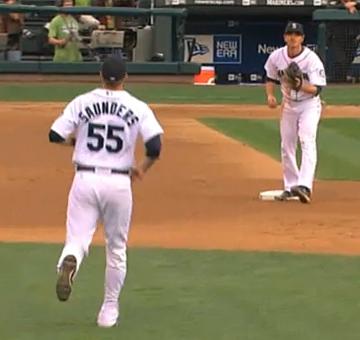
Mariners outfielder Michael Saunders shows us that respect on a ballfield can take many forms.

June 25
Joe Maddon vents near an ump, not at him. It makes no difference; he’s tossed anyway.

June 25
No-hitter etiquette leads to message-board hilarity.

– Jason

No-Hitter Etiquette

Baseball Etiquette 2010: Never Post to a Message Board About a No-Hitter in Progress

Yovani Gallardo took a perfect game into the sixth inning for the Brewers on Thursday, which, as it turns out this season, isn’t all that rare a feat.

Still, it led to some message-board hilarity, as it relates to jinxes and the sort.

The following are all taken from a string on the HF Boards.

A user named Ixcuincle started things off at 2:33 p.m.:

Gallardo allegedly has a perfect game

This drew a sharp retort from STEVE HOLT, at 2:36 p.m.

WTF? You should never, under any circumstances, mention a perfect game as it is in progress. It’s baseball etiquette.

– Jimmy

Jiri Bicek weighed in a minute later:

Now we know that if Gallardo doesn’t get it, it’s because of that post on HF

But really, it was MD23Rewls who decided to go crazy, at 2:38 p.m.:

It has no effect on whether someone pitches a perfect game. You really believe that? I don’t agree with you, that’s not a professional attitude. Why shouldn’t he say it? Tell me Jimmy. Tell me why. Why? Why? Don’t tell me it’s etiquette, you know it used to be etiquette to have black people as slaves. Tell me why. Tell me exactly why. Jimmy, tell me why. That’s a stupid, stupid thing to say. You’re not giving me reasons. That’s why there was Nazi Germany. Why did they march people into ovens? Well, that’s just what they did. That’s what they were told to do. That’s a stupid, stupid reason. “Oh, its baseball etiquette.” That’s ridiculous. “I was just following orders.” But, why? “Well they told me to.” But, why? “Well they told me to.” That’s asinine. People actually believe this. They actually believe this. Mind boggling. It’s just mind boggling. You make no sense. You know how dumb you sound when you think a poster can affect the game? How stupid you sound? How infantile?

It takes some sort of chutzpah to compare talking about a no-hitter in progress to slavery and the Holocaust, but MD23Rewls managed to pull it off.

Rather than address him directly, STEVE HOLT took the most effective measure possible, at 2:39 p.m.:

You see what you people did?

Perfect game over.

Classic.

– Jason

Appearances

Midwest Bound

Some of my Midwest tour dates have just been set. If you’re in or near any of these cities, swing by and say hello. If you know someone who is, be sure to spread the word.

July 8
Birmingham, Michigan
Borders Books, 7 p.m.
34300 Woodward

July 11
Des Moines, Iowa
Beaverdale Books
, 1 p.m.
2629 Beaver Ave., Suite 1

July 12
Milwaukee, Wisconsin
Boswell Books
, 7 p.m.
2559 N. Downer Ave.

July 14
St. Louis, Missouri
Left Bank Books
399 N. Euclid Ave.

– Jason

Gary Cederstrom, Joe Maddon, Umpire Relations

Maddon Vents to Garza, Gets Cederstrom’s Goat

There is a protocol to addressing umpires. Players and managers usually have a wide berth to say what they want, so long as they don’t publically show up the ump with whom they’re arguing. For hitters and catchers, this means not turning around to face him as they speak. For managers, it’s overt displays of anger during the course of a discussion.

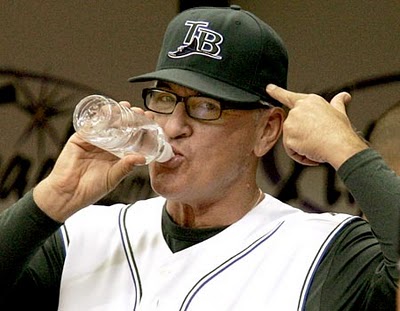
Tampa Bay manager Joe Maddon hewed closely to these rules yesterday, and was tossed anyway—to the delight of his players.

Maddon was angry that, for the second straight day, a Rays pitcher was called for a balk in a critical situation. Because managers are not allowed to argue balk calls, Maddon instead went to the mound and made his case to his pitcher, Matt Garza, loudly enough for the ump in question—Gary Cederstrom, who was manning second base, and who during the course of dialog circled around behind Maddon—to hear. (Watch it here.)

Maddon, surrounded by his infielders, looked just like he would if he was arguing with an umpire, arms waving, finger pointing and volume high—only facing his own pitcher.

It wasn’t enough. Cederstrom quickly tossed him.

“The umpire said, ‘Are you talking to me, or are you talking to your pitcher?’ ” said second baseman Reid Brignac in the St. Petersburg Times. “Joe said, ‘I’m talking to my pitcher.’ Then Joe started again. ‘That’s the second damn day in a row, yada, yada, yada.’ It was definitely amusing.”

One of Maddon’s goals was to vent anger over what he felt was a pattern of bad calls. (Before Wednesday’s balk call on James Shields, pointed out the Times, the pitcher had faced more than 3,600 batters in his career and been called for only one balk; Garza’s last balk was more than 1,300 batters ago.)

He also wanted to give Garza a moment to get his head back in the game. It worked; Garza worked out of the jam and ended up going eight innings.

Maddon accomplished both items while sticking to the Code. He didn’t show up the umpire so much as the umpire showed up himself.

Ultimately, he proved the point that it’s not just how you say something that can get you tossed—it’s what you say, as well.

– Jason

Michael Saunders, Unwritten-Rules

Finding the Code in Unexpected Places

In most instances, baseball’s unwritten rules come in a proscribed package, ready for review every time a pertinent incident crops up on the field.

Sometimes, however, they’re made up on the fly.

After all, the underlying tenet behind the vast majority of the Code is respect, and that respect can take any number of forms.

Tuesday in Seattle, Mariners left fielder Michael Saunders exhibited it in spades, after catching a fly ball off the bat of Chicago’s Tyler Colvin. Alfonso Soriano had been at second base, and, thinking the ball would drop, had already rounded third when the ball was caught.

Saunders was about 70 feet from second and charging directly toward the bag when he made the catch. He could have jogged in and doubled off Soriano, unassisted, without any threat of arriving too late. (Watch the play here.)

For an outfielder, turning an unassisted double-play could be a once-in-a-career moment. As FanHouse pointed out, the all-time career record for major leaguers is six, set by Hall of Famer Tris Speaker.

Why not do it? In the words of Saunders, “I didn’t want to rub their faces in it. There was no need for anything like that. I just needed to get the outs.”

Franklin Guttierez urged Saunders to do it from his position in center field. After the game, Mariners manager Don Wakamatsu said that a more experienced outfielder (Saunders is in just his second season) might feel more comfortable about making such a play without offending the opposition.

But this isn’t about whether Saunders would have stirred up the Cubs had he doubled up Soriano on his own. He almost certainly wouldn’t have made a ripple.

It’s about a player being cognizant enough of the spirit of the game, and holding enough respect for his opponent, to maintain a strict set of ideals. Saunders saw a high road to take, and he took it.

And for that, he gets our kudos.

– Jason

The Baseball Codes

Gonzalez Out in Florida; Ramirez Assumed to be Gloating

Remember Fredi Gonazlez’s spat with Hanley Ramiriez? Gonzalez was praised for publically calling out his superstar for lackadaisical play and a bad attitude, and Ramirez eventually returned, contrite.

It’s been almost exactly a month since Ramirez returned from a one-day benching; he’s since batted .292 with four homers, 23 RBIs and 10 stolen bases.

Gonzalez: fired yesterday.

While there were reasons for the firing that had nothing to do with Ramirez, it’s clear who ultimately got the better of that confrontation.

Update: Buster Olney points out another unwritten rule in this situation: “If you’re going to fire the skipper, do it while you’re playing a really, really bad team so that when you win, it looks like the players responded.”

Yesterday: 7-5, Marlins over the Orioles.

– Jason

Don't Swing on the First Pitch After Back-to-Back Home RUns, Gabe Gross

Don’t Swing at the First Pitch After Back to Back Homers: RIP

Earlier this month, a reader pointed out that Oakland’s Gabe Gross had swung at the first pitch after Jack Cust and Kevin Kouzmanoff hit back-to-back home runs against the Red Sox, and wondered about the propriety of the action.

My initial response was that it was a 9-6 game, the ball was clearly flying at Fenway, and Gross had the leeway to take liberties.

Then I realized just how long I’ve spent with my nose in the Code. Much more important than Gross’ leeway is the fact that this rule barely exists anymore, if at all.

It serves as a great example of the evolution of the Code; in the 1970s, Sparky Anderson lived by the rule, as did many of his disciples. Now that power numbers play such a vital part in contract negotiations, however, it’s fallen into such disuse that finding a player who has even heard of it is a feat.

Gross certainly hadn’t.

“If I have a 3-0 count in a blowout game, I don’t swing,” he told me recently. “That, I understand. But the first pitch thrown over the plate after back-to-back homers . . . With all respect to Sparky, I don’t see any reason to be taking it. I’d never heard of that before.”

The swing in question—Gross fouled the pitch off—was not meant to disrespect the pitcher, Manny Delcarmen, nor did Delcarmen take it that way.

Heck, just across the bay, it recently happened with the Giants—twice. Both times, Aubrey Huff and Juan Uribe went back-to-back; both times, the next hitter (Pat Burrell and Pablo Sandoval, respectively) swung at the next pitch.

Let’s have a moment of silence. As charming as this rule may be, I officially pronounce it deceased.

– Jason

Appearances

In San Francisco Tonight

If you’re in downtown San Francisco tonight, Michael and I will be speaking at the main library, from 6:30-7:30 p.m.

As part of the presentation, we’ll be offering a video look back at the crazy fight between the Padres and Braves in 1984, which Padres infielder Kurt Bevacqua later called “the Desert Storm of baseball fights.” Total damage: six brushback pitches, three hit batters, four bench-clearing incidents, two full-on brawls that nearly spiraled out of control when fans rushed the field, nineteen ejections, five arrests, and a nearly unprecedented clearing of the benches by the umpires.

Plus, we’ll be talking some baseball. Come on down.

– Jason

This Week in the Unwritten Rules

This Week in the Unwritten Rules, Video Edition

Going to the ballpark to talk to players and ex-players about the unwritten rules is an invigorating process. Sometimes, however, interviews turn out differently on the page than they do in person.

That’s why we’ve decided to bring you This Week in the Unwritten Rules, a semi-regular video segment we’re hoping to produce for the rest of the season. With video, we’re able to bring you some of the sport’s key characters, discussing the Code directly.

Enjoy.

– Jason