Rookie Hazing, Ryan Wheeler

One is the Loneliest Number: Arizona Offers Some Long-Lasting Ice

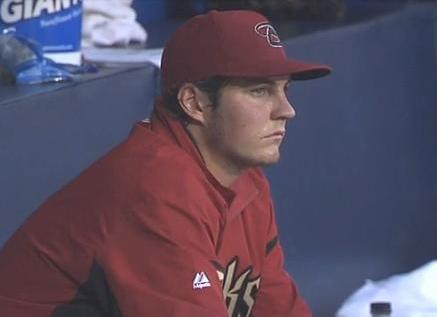
All alone in the dugout.

We’ve grown accustomed to rookies getting the cold shoulder in the dugout after hitting their first home run, a process of good-natured icing by their teammates that serves to remind them that, even with their deserved accolades, they’re still rookies.

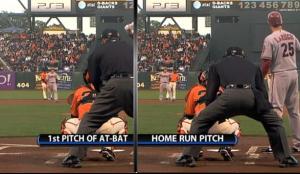
On Saturday in Houston, however, the Diamondbacks took things to an extreme. After Ryan Wheeler hit his first big league jack into the left field stands, he was left to wonder . . . and wonder . . . and wonder just how long his teammates were going to maintain their charade. (Watch it here.)

As a smiling and solitary Wheeler took his seat on the bench, cameras trained in on him, waiting for the moment at which Arizona players would jump up and congratulate him. Stephen Drew, sitting next to him and unable to stifle his grin, had to pull his jersey up over his mouth.

Eventually, however, Astros pitcher Chuckie Fick threw another pitch to the next hitter, Patrick Corbin, which the telecast was obligated to show. They quickly cut back to the dugout camera, without much luck. Wheeler was still sitting, alone, when Fick delivered again. It wasn’t until Fick was winding up for the third pitch of the at-bat—a span of some 40 seconds—that Arizona players finally relented and gave the rookie his just due.

If something’s worth doing, it’s worth doing thoroughly, I guess. Don’t believe anybody who says that the Diamondbacks are not committed to their craft.

Rookie Etiquette, Trevor Bauer

Well, Duh: Miguel Montero probably knows the Padres’ hitters ‘a little bit better’ than Trevor Bauer

The Arizona Republic recently estimated that Diamondbacks pitchers shake off catcher Miguel Montero three or four times per game. Tuesday, however, was not like most games.

That’s because rookie Trevor Bauer—making only his second big league start—shook off the signs, said Montero, on “almost every pitch.”

That said, it was only 3 1/3 innings’ worth of almost-every pitches. Then again, giving up six hits, four walks and seven runs to San Diego necessitated 80 offerings from Bauer. Shaking off even a quarter of them would have made for an astounding number, for no reason more glaring than the fact that Montero is a seven-year vet with more than 4,000 innings behind the plate.

Bauer is unconventional, from his preparatory practices to his delivery, which is  all angles and torque. It doesn’t stop there. From the Republic:

While most pitchers try to pitch down in the strike zone, he prefers to work up in the zone. In the past couple of years, Bauer has worked to learn and incorporate a pitch-sequencing theory called “Effective Velocity,” a way of attacking hitters that aims to disrupt timing.

If there are benefits to Effective Velocity, they weren’t apparent Tuesday afternoon. In fact, Bauer might have inadvertently personified an ongoing disagreement between the old and new schools over whose methodoligy is more effective. It’s a tiny sampling, of course, but a  21-year-old just out of college appears to have put his think-tank strategy to the test at the expense of leveraging wisdom from a guy who knows the game.

There’s something to be said for execution (if Bauer doesn’t hit his spots, it doesn’t matter what kind of strategy he employs), but beyond that is the Code and its mandate that young players defer to veterans, at least until such time as they’re able to carry a significant portion of the load on their own.

Montero opted not to blast Bauer afterward, talking about the youngster’s talent and promise. Still,  he added, “I would like him to get a little trust in me. . . . I don’t have all the answers, but I probably know [the Padres’ hitters] a little bit better [than Bauer].”

For a guy carrying the old-school end of the argument, Montero’s response was anything but. For an example of real old-school when it comes to this stuff, turn to the the Red Sox clubhouse in 1967, after rookie pitcher Sparky Lyle, 22, shook off catcher Elston Howard—at age 38, a nine-time All-Star and the 1963 AL MVP—not once, but twice during the course of an at-bat, throwing sliders instead of fastballs, both out of the strike zone, en route to issuing a base on balls.

After the game, Carl Yazstrzemski cornered Lyle in the clubhouse. “I want to know one thing,” Yaz said to the rookie, as recounted by Lyle in The Bronx Zoo. “How can a guy who’s been in the big leagues two weeks shake off a guy who’s been catching fourteen years?”

To make sure the point wasn’t lost, manager Dick Williams then promised a $50 fine every time Lyle shook off Howard from that point on.

Bauer should be so lucky.

Clayton Kershaw, Ian Kennedy, Retaliation

Ask What You can Do for Your Teammates: Kennedy Avenges Parra, a Season Later

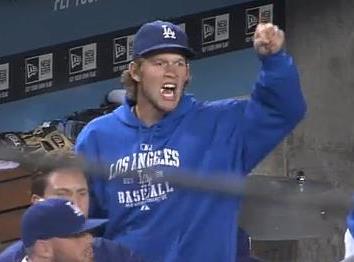
Kershaw responds.

Perhaps this is what Cole Hamels was talking about when he proclaimed his drilling of Bryce Harper last week to be “old-school baseball.”

Old-school baseball frequently involves long memories, and a willingness to respond to a situation even if it has long since passed. On Monday, Arizona’s Ian Kennedy did exactly that.

Kennedy was facing Dodgers ace Clayton Kershaw for the first time since last season, when Kershaw was unceremoniously ejected for hitting Diamondbacks outfielder Gerrardo Parra with a pitch. Parra’s drilling was itself a response to a home run he hit off Los Angeles reliever Hong-Chih Kuo, after which he loitered in the batter’s box as it left the yard. Parra’s loitering was in response to an earlier Kuo pitch that buzzed him as he was squaring around to bunt.

Cause and response. Response and cause.

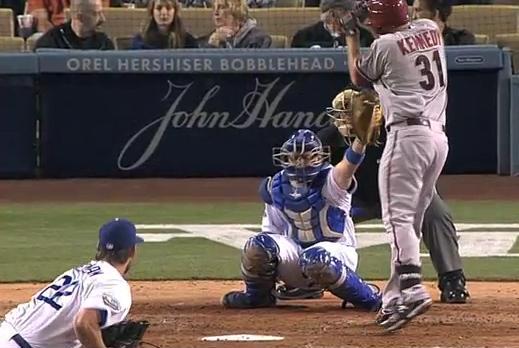
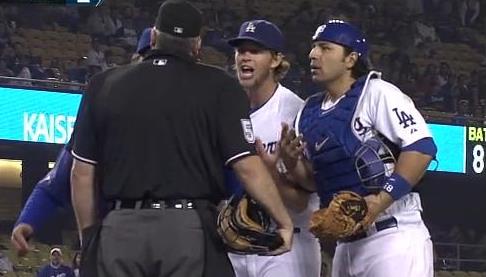
Fast forward eight months, to Monday night. When Kershaw stepped to the plate to lead off the third inning, Kennedy brushed him back with a first-pitch fastball. In case the message was still unclear, three pitches later Kennedy sent one behind Kershaw’s back. Kershaw stared into the Arizona dugout in disbelief, and, wrote Nick Piecoro in the Arizona Republic, “had no problem receiving the message the Diamondbacks were sending.” (Watch it here; for a fuller examination, see the recap.)

Kershaw’s turn came in the fifth, when Kennedy stepped to the plate and was greeted with a fastball, high and inside. That was enough for plate ump Marvin Hudson to issue warnings to both benches.

Was Kennedy trying to hit Kershaw? To judge by his follow-up effort, he was, but didn’t get it done either time. Did Kershaw handle things appropriately, dishing out as good as he got without escalating matters? Absolutely.

Also, unlike Hamels, blanket denials were the order of the day.

“[Kershaw] is a good hitter, so I had to throw inside on him,” Kennedy said in the Republic. “The second one I just pulled way too much.” (D-Backs shortstop Willie Bloomquist, however, admitted that “no one was trying to hurt anyone—it was just to prove a point.”)

“It’s pretty strange that he throws two up and in like that and one at my shins,” responded Kershaw. “His catcher is saying he’s missing his spots. It’s pretty obvious what they’re doing. I don’t really understand it. I know their manager over there likes old-school baseball, but old-school baseball means you don’t carry over things from last year.”

Actually, that’s exactly what old-school baseball means. It’s easy to say that Kennedy should have left well enough alone, and that renewing old hostilities ultimately does little good for anybody involved. The only real counter to that is the tenor of the Arizona clubhouse, and the unknown conversations that may have led to Kennedy’s action, be they with Parra, manager Kirk Gibson or some other aggrieved teammates. There is a palpable charge that a pitcher faces in standing up for his teammates, and those found to be derelict in that duty are quick to lose clubhouse support.

Ultimately, of course, nobody was hit, the fact that both pitchers ended up walking in their targeted at-bats didn’t end up hurting the opposition, several messages were sent, and everybody emerged unscathed.

Old-school baseball.

Robert Andino, Russell Martin, Sign stealing, Willie Bloomquist

Are You Looking at Me?: Basepath Espionage Breaks Out Across the Land

Pablo Sandoval and Willie Bloomquist get acquainted.

Less than a week into the season, and we already have sign-stealing controversies breaking out on both sides of the country. The more prominent of the two came in Baltimore yesterday, when Yankees catcher Russell Martin lit into Orioles second baseman Robert Andino as the final out of New York’s victory was being recorded.

Andino had been a runner at second, which led to speculation that he was either tipping signs or location, or was doing something that looked remarkably similar to tipping signs or location.

Andino was quick to temper following Martin’s accusation, screaming toward the Yankees as they proceeded through their post-game handslaps. (Watch it here.) He later denied everything, calling it a misunderstanding, and came up with the line of the young season when, asked whether the Yankees might retaliate against him, he said, “I ain’t a future teller.”

Martin, of course, is no stranger to ferreting out this type of shenanigan. Last year, he went public with accusations that the Blue Jays were stealing signs at the Rogers Centre during the course of an eight-run first inning against Bartolo Colon. (Joe Girardi backed him up a day later by continuing to mandate the use of complex signs, even with nobody on base.)

Meanwhile, on Sunday in Phoenix, Giants third baseman Pablo Sandoval took exception to some of the movements of Diamondbacks shortstop Willie Bloomquist, at second base with one out in the seventh, as the Giants clung to a 6-5 lead. His ideas about Bloomquist’s motives appeared to closely mirror those Russell Martin held about Andino. During a mid-inning visit to the mound, Sandoval turned toward Bloomquist and let fly with some choice sentiments. (Watch it here.)

Bloomquist had a chance to argue his side of things only moments later, when a walk to Justin Upton loaded the bases, forcing him to third. Sandoval didn’t want any part of an argument and immediately waved away his previous accusation, but by that point it didn’t matter—if Bloomquist had been signaling pitches, he’d already been caught, and his approach was going to have to change.

Which is the thing about sign stealing: Were Bloomquist stealing signs, his actions mandated little more than a brief warning (and a new set of signs), which is precisely what was delivered. (Arizona did go on to score twice in the inning to take the lead, but both runs came on infield errors; if D’Backs hitters continued to be tipped off after Sandoval’s discussion with Bloomquist, they certainly didn’t do much with the information.)

Things will get particularly interesting should such accusations persist the next time these sets of teams meet, or if other clubs begin lobbing similar indictments toward the O’s or D’Backs. Until then, they’ll likely continue to take ’em as they can get ’em—just like always.

– Jason

Daniel Hudson, Retaliation, The Baseball Codes

Daniel Hudson Throws Season’s First Gauntlet

Looks like Diamondbacks starting pitchers learned a lesson. In talking to Arizona radio station Sports 620, Daniel Hudson touched upon the fact that Justin Upton was hit by 19 pitches last season—second most in baseball.

“If it’s a starting pitcher [who hit Upton], remember, he’s got to hit,” Hudson told the station, according to ArizonaSports.com, the station’s Web site. “They either have to hit their spots, or expect something in return.”

Okay, that makes sense. What’s interesting is how Hudson and the rest of the staff came upon this realization. The right-hander said that the subject was raised “halfway through the year.”

There are some obvious follow-up questions: Who brought the subject up with him, and how? Was it an order (or at least a suggestion) from manager Kirk Gibson, or somebody else on the staff? Was it Upton himself, or another of the hitters? Were the pitchers called out in a group setting, or did it happen through individual conversations on the side?

This is all interesting stuff. The way a team communicates information like this can be as vital—if not more so—than the information itself. It should be noted that, for a staff chided halfway through the season for the dearth of protection it offered its own hitters, Diamondbacks pitchers drilled either nine or 10 batters in every month of the season, save for September, when they hit only six; they actually declined in that category in the second half. Even so, their total of 53 HBPs—28 by starters, 25 by relievers—ranked fourth in the National League.

There’s also the fact that Upton stands notoriously close to the plate, which certainly had something to do with the frequency of his drillings. (The next closest Arizona player was Miguel Montero, who was hit eight times; nobody else was touched more than four times.) Upton intoned at the team’s FanFest earlier this month that he’ll continue to stand atop the dish, so one can reasonably expect the frequency of his drillings to continue.

Was Hudson just blustering to try to make opposing pitchers a little more wary of pitching inside to Arizona’s best hitter? When the D-Backs make their way to San Francisco later this season, I’ll see if I can’t track down some answers.

– Jason

Umpires Knowing the Code

And Like That—Poof—he’s Gone. Kershaw Tossed Without Warning

Bill, Clayton. Clayton, Bill.

Call it bad umpiring, if you must, but many will disagree with you.

Legions of fans, in fact, consider it to be horrible umpiring.

It’s inaccurate to say that umpire Bill Welke’s ejection of Clayton Kershaw Wednesday night came from nowhere, but, considering the circumstances, it kind of did.

Those circumstances began Tuesday, when Dodgers reliever Hong-Chih Kuo sent an inside pitch buzzing past the head of Arizona’s Gerardo Parra. It was inside, but not dangerously so; that it came close at all was mostly a function of Parra’s squaring around to bunt.

Parra responded by staring down the pitcher. Moments later, he connected for a home run, then loitered in the batter’s box for several long beats. That raised the hackles of both catcher A.J. Ellis, who had words for Parra as he crossed the plate, and the Dodgers’ bench at large—with the leader of the agitated appearing to be Kershaw, who appeared to deliver a message along the lines of “Just wait ’till tomorrow, Gerry.” (Watch it all here.)

When Kershaw faced Parra to start the sixth inning yesterday—having already surrendered a double to him in the third—he sent an 0-1 fastball spinning inside, and clipped Parra’s right elbow. Wrote Steve Dilbeck in the Los Angeles Times, “[It] hardly appeared like Kershaw was intentionally trying to hit him.”

Still, it was enough for Welke, who ejected the pitcher on the spot. (Watch it here.)

Tuesday night: Kershaw gets fiery.

Never mind that the pitch only grazed Parra. Never mind that it was a 2-0 game, and that Kershaw is chasing 20 victories on the season. Never mind that 29,799 people paid good money to see one of the National League’s best pitchers square off against the presumptive NL West champions.

Never mind all that, if you’d like, but make sure to pay attention to an umpire who refuses to let baseball’s Code play out on its own terms—if that’s even what was happening. Kershaw had every right to send a message to Parra after the previous night’s display, and the only guy in the stadium who seemed oblivious to the notion was Welke. If ever there was a spot to warn the benches, this was it.

Or, as it turned out, not.

Perhaps Kershaw learned a lesson about stifling any animated displays in the dugout. Maybe he spent the rest of the evening thinking about how and when he can next come inside to a guy with whom he has history. Or maybe he just spent a few hours poking pins into his Bill Welke doll.

He shouldn’t have had to any of this. It was a display of over-umpiring at its most blatant, and Kershaw—hell, any major league player—deserves better.

– Jason

Esmerling Vasquez, Jason Marquis, Jayson Werth, Justin Upton, Retaliation, Wilson Ramos

You Talk too Much, you Trot too Slow: Wilson Ramos, Come on Down!

Wilson Ramos approaches home plate.


A lot of things happened last week between the Diamondbacks and Nationals. Jayson Werth was hit three times, and made scary eyes at pitcher Ian Kennedy after the last one. An inning later, Washington’s Jason Marquis drilled Justin Upton for the fourth time in the series, and was tossed—as was his manager, Jim Riggleman. (Watch it here.)

In the eighth, Arizona reliever Esmerling Vasquez hit Danny Espinosa with a clearly intentional fastball (watch it here), bringing Werth to the top step of the dugout with a look that said he wanted nothing more than one more provocation to charge the mound.

It’s can all be dissected down to its core. Marquis denied intent, and while it certainly seemed like he meant it, it must be noted that a 1-0 game is not the time to settle scores. Also, it would have been entirely reasonable for plate ump Rob Drake to give Marquis one shot at response (or even acknowledge that the pitcher probably didn’t want to put anybody else on base) before bringing down the hammer. Still, Marquis drew a five-game suspension.

(To Drake’s benefit, Kennedy hit Michael Morse two batters after he hit Werth, and was not tossed out because it was clearly unintentional.)

Riggleman and D-Backs skipper Kirk Gibson were also suspended. Vasquez drew a three-game ban of his own, which seems well worth it for the third-year pitcher in light of the fact that his teammates appreciate him for having done something others on the staff have shied away from.

Still, despite the drama, it was all very straightforward stuff—you-hit-me, I-hit-you. A standard retaliatory dance.

Wilson Ramos, however, raised the stakes one batter after Espinosa was hit, when he slowed down his home run trot after blasting an eighth-inning bomb, and then slowed it down some more—all the way into the realm of clownishness. (Watch it here.)

Larry Granillo’s Tater Trot Tracker pegged Ramos’ journey at 28 seconds (despite the fact that he ran hard most of the way to first)—more than 20 percent slower than his usually glacial pace.

From Granillo:

My first thought, as I watched the home run the first time, was that it looked like Ramos had slowed down into his final walk—you know how trotters tend to slow down those last 10 or 15 feet before home plate—about 250 feet too early.

But it only got worse. At both second and third base, you can see Ramos go into an even slower trot before essentially strolling the last 45 feet.

The truly crazy part? After the game, Ramos said this:

“I didn’t feel bad. I wanted to see those guys angry.”

Admitting one’s sins  is a cardinal Code violation (although even in the best circumstances it’s difficult to deny ownership over one’s own jogging pace.) Unlike a pitcher who admits to hitting a batter intentionally, this is not an actionable violation as far as the league office is concerned. It is, however, a stratospheric level of trash talk. And Ramos got his wish in seeing them angry, at least as far as Matt Williams was concerned.

Williams, Arizona’s third-base coach, is one of the premiere Code warriors of his generation. He is the standard-bearer when it comes to circling the bases properly after hitting a homer—head down and quickly.

Also, he’s never been shy about informing players—teammates and opposition alike—should they be so foolish as to violate an unwritten rule in his presence. As Ramos circled the bases, Williams visibly steamed.

(Dan Steinberg has some great screenshots of it over at the Washington Post. He also passes along this quote from TV analyst Mark Grace: “If that look is directed towards you, folks? Go home. I suggest you go home when Matt Williams looks at you like that.”)

Ramos got his reward (his trot) and then got it again (his comments), but he’ll almost certainly pay the price. The teams next meet on Aug. 22. The question now seems less about whether Ramos will be drilled, but when—and maybe even how many times.

Considering that Werth, Upton and their teammates already have a short fuse for this type of thing when it concerns this matchup, there’s plenty to look forward to.

– Jason

Ben Davis, Curt Schilling, Don't Bunt to Break Up a No-Hitter

Tenth Anniversary of an Unwritten Rule Violation People Still Delight in Referencing

Today marks a decade since Ben Davis bunted on Curt Schilling. If that reference fails to ring a bell, you clearly have some catching up to do. Might I suggest your nearest copy of The Baseball Codes, from which the following passage is excerpted:

Davis came up in the eighth inning as the twenty-third hitter to face Curt Schilling, entirely cognizant that his team was 0-for-22 to that point. Because swinging the bat against the big right-hander had not yet paid dividends, Davis switched gears and, noting the deep positioning of third baseman Craig Counsell, laid down a bunt. Although the execution was lacking—Davis popped the ball up, just over Schilling’s head—the hit nonetheless fell between the mound and second baseman Jay Bell, who was also stationed deep. Davis safely reached base with his team’s first hit.

The Arizona bench exploded at the audacity, calling the player gutless and intoning that he was afraid to take his hacks like a man. To judge the play by the unwritten rules, the Diamondbacks had a point. “The first hit of a no-hitter is not a bunt,” said Kansas City Royals pitcher Danny Jack­son fifteen years earlier, in 1986, after Angels rookie Devon White attempted to break up his own no-hitter with a failed eighth-inning bunt attempt. “I don’t know how long he’s been around,” Jackson said about the outfielder, “but he’s got to go down.” Arizona manager Bob Brenly felt the same way about Ben Davis, calling the play “chickenshit” and saying that Davis “has a lot to learn about how the game is played.”

“It wasn’t the heat of the pennant race in September, or something like that,” said Diamondbacks left fielder Luis Gonzalez. “They say every game counts, but when a guy’s doing something masterful like that, if you get a hit you want to earn it in the right way.” Third baseman Matt Williams said he wouldn’t have done it. First baseman Mark Grace said that, although he didn’t fault Davis, if it was him he wouldn’t have had the balls. Schilling was “a little stunned” at the move; his experience taught him that players should earn their way on base in that type of situation.

There was, however, a mitigating factor. The score of the game was 2–0, and when Davis reached base it brought the tying run to the plate. The Padres clearly hadn’t been getting it done against Schilling in any other regard, so from a strategic standpoint Davis’s approach worked. “I don’t know if you saw my swings against him . . . ,” the catcher said. “I’m just trying to get on base any way I can right there, and I did.”

“What if it’s the seventh game of the World Series? Would they or any­body be upset?” asked Padres manager Bruce Bochy. “No, because that’s a huge game and you’re trying to win.” Arizona, he said, wanted the Padres to “drop our weapons and raise our hands.”

Even Schilling grasped both sides of the argument. Though stopping short of taking Davis’s side, he expressed understanding for those who did. “Whether I agree with it being the right thing to do or not is not really relevant,” he said. “It was a 2–0 game. . . . If it’s 9–0, yeah, I think it’s a horseshit thing to do. But it was a 2–0 game and the bottom line is, unwritten rules or not, you’re paid to win games. That’s the only reason you’re playing in the big leagues.”

One interesting aspect of the play was that even among the ranks of baseball’s old guard—guys who lived for and played by the Code—there was hardly unanimity of opinion. Cases were made both for and against Davis, with precedents cited from every generation—like the bunt by Milwaukee catcher Bill Schroeder that broke up a 1987 no-hitter by Roy­als left-hander Charlie Leibrandt in the sixth inning. Nineteen years after that, when Tampa Bay rookie Ben Zobrist bunted for his team’s first hit in the sixth inning of a game against Seattle’s Jerrod Washburn, the pitcher himself agreed that nothing improper had transpired. “If it was the eighth or ninth, maybe that would have rubbed me the wrong way,” Washburn said, “but bunting is just part of the game, and he was just trying to make something happen.”

The Schilling-Davis affair, however, was full of gray area. Some base­ball people will accept a no-hitter-spoiling bunt if bunting is an estab­lished part of the hitter’s offensive repertoire—but Ben Davis was hardly a bunter. In fact, said Brenly, “That was the only time Ben Davis ever tried to bunt for a base hit to my recollection. . . . For a backup catcher who had never bunted for a base hit before in his life to do it, I thought that was unnecessary to begin with, and disrespectful, to top it off.”

The notion of disrespect stems from the fact that Davis clearly took advantage of Counsell’s extra-deep positioning, as the infielder attempted to protect against hard-hit balls that might otherwise have shot by him. Counsell felt safe at that range because he thought there was little chance that a runner as slow as Davis would so blatantly violate the unwritten rules.

Part of the problem was that Davis’s bunt wasn’t even good enough to benefit from Counsell’s positioning. “I was mad that it was such a bad bunt and was still a hit,” said Schilling. “He bunted as bad a ball as you can bunt, to the most perfect spot in the infield to bunt it. . . . I never said it was a horseshit play. I thought it was a horseshit bunt.”

Once the dust settled a bit, the last man standing at the center of the controversy wasn’t Schilling or even Davis—it was Brenly, who, as the most outspoken critic of the play, was left in its aftermath to defend his initial anger. He has since softened his stance, even going so far as to admit that much of his posturing was simply a matter of standing up for his pitcher, to make sure that “Curt Schilling knew that I was looking out for his interests.”

Still, years after the fact, he had a question for which he says he never received an adequate answer: “If it’s such a good fuckin’ play, why didn’t he do it every time?”

– Jason

Sign stealing

Lincecum Stops Tipping; Loss Streak Ends

Last week, we discussed the possibility that Tim Lincecum was having his pitches stolen by the Diamondbacks—in particular Stephen Drew, leading from second base.

In the first inning, the Giants’ broadcast crew homed in on Drew giving two indicators that at the very least looked remarkably like he was feeding signs to the guy at the plate, Adam LaRoche. (Watch it here.)

LaRoche capitalized, hitting a three-run homer.

After some prodding from the coaching staff, Lincecum altered his delivery, bringing his hands closer to his body, making it more difficult for a baserunner to peer in at his grip.

It worked well; following the three-run first, the pitcher allowed only one run over his final five frames, none over the last three. Looking at his final numbers for August—0-5 with a 7.82 ERA—it’s hardly a stretch to think that similar tipping might have been a factor for far longer than the game in which it first came to light.

I caught up with Lincecum at AT&T Park last week, and he explained the situation in a bit more detail—while maintaining a steadfast reluctance to accuse the Diamondbacks of anything untoward.

What is it exactly that you did to throw them off the scent?
I moved my hands closer to my body to make it harder for them to see (the grip). The pitching coach, somebody notices it . . . When things like that happen and someone can see it right off the bat, and it’s so blatant like that, you have no choice but to do something about it.

Is stuff like that always on your radar?
Yes and no. Sometimes it will be. Sometimes I’ll be going through grooves where it won’t even enter my mind, and it won’t even be a factor. But there are other times where you have to think about it. I try not to make it too big a factor for me, where it’s taking away from my pitching game, but I want to be aware of it.

Have you ever gone through a stretch where you’ve inadvertently been tipping pitches?
Not that I know of. Not so far.

This seems like less a retaliatory offense than something you simply adjust to and move on.
It’s one of those things where, if you can get a team’s signs, and you have them, why not take advantage? It’s smart on their part. Baseball is a game of adjustments, and I had to make some.

So did those adjustments work? The line from Lincecum’s following start, against Colorado: eight innings, five hits, one walk, nine strikeouts, one earned run and a victory—his first since July.

– Jason

Adam LaRoche, Sign stealing, Stephen Drew, Tim Lincecum

Were the D-Backs on to Lincecum? It Sure Looks That Way

The primary topic in San Francisco these days concerns Tim Lincecum and his disappearing dominance. His velocity’s down, his ERA’s up—way up—and his confidence is so shaken that he changed the mechanics he’s been using since he was a teenager in Washington state.

Another possibility came to light last week: His pockets are being picked.

After Adam LaRoche hit a three-run homer off Lincecum in the first inning of Friday’s game, Giants broadcasters Duane Kuiper and F.P. Santangelo focused in on the guy who had been at second base, Stephen Drew.

The video evidence is difficult to refute. It shows Drew tugging at the brim of his cap before the first pitch of the at-bat (a likely indicator for pitch type or location), then turning his head to the left, toward second base, before the third pitch—on which LaRoche connected. (Watch it here.)

Later, the broadcast showed replays of Drew in the dugout, mimicking Lincecum’s delivery for teammates, ostensibly to show his teammates what the pitcher was giving away.

There are two possibilities here if Drew was, in fact, tipping off LaRoche. He might have been reading catcher Buster Posey, which appears to be the case for the pitch that was hit for the homer. All it takes is a glance at a catcher’s setup to indicate whether the pitch will be inside or outside, which is precisely what Drew did.

The other option is that he was stealing signs directly from Lincecum. In May, I discussed this very topic with former big leaguer Morgan Ensberg. Here’s what he told me:

You’re leading off at second base; estimate you’re probably around 30 feet from the pitcher. If the pitcher hasn’t been taught to protect it, you can see everything that’s in his glove. You can see his hands, you can see his fingers, you can see the ball, you can see the seams.

Generally, pitchers will hold ball in same spot in the glove. On certain pitches you can see some red from the seam, but on other pitches you don’t see the seam. You might see something in the way he holds his glove. All this is just patterns. I’ve been at second base 100,000 times in my life, and learned to pick up patterns in the way a pitcher grips a baseball.

This was clearly on Lincecum’s mind, as well. Shortly after LaRoche’s homer, he tweaked his delivery to move his pitching hand closer to his body, in an effort to better impede a baserunner’s view of his grip.

Did it work? Following the three-run first, the pitcher allowed only one run over his final five frames, none over the last three—something he hasn’t done since his last win, on July 30.

In Arizona’s post-game clubhouse, denials abounded when players were confronted with questions about the video evidence—some delivered more half-heartedly than others.

Diamondbacks manager Kirk Gibson denied that Drew had done anything untoward, while simultaneously positing that it was a tactic at which his team needs to improve.

“Actually, I don’t think we’ve done a very good job at it . . .” he said in an MLB.com report. “It’s a hard thing to master because there’s a lot to it. And I can tell you last night that wasn’t the case, OK? . . . It doesn’t mean we won’t try tonight, but last night that was not the case.”

Drew, in the Arizona Republic: “Nope. Didn’t do that. Sure didn’t.”

LaRoche, however, hewed closer to the likely truth, when asked if he got any assistance on the pitch he hit. “If I did,” he said, “I wouldn’t repeat that to anybody.”

Of course, players are taught to deny everything, because that’s what public perception mandates. On the field, however, they’re simply playing baseball.

Sign stealing isn’t just tolerated, it’s expected. Even Giants manager Bruce Bochy dismissed the allegations, telling MLB.com that “all teams do that.”

The Giants’ concern after the game had little to do with Drew or LaRoche, and everything to do with making sure that Lincecum conceals his grip and Posey gives away no unnecessary clues to the opposition.

Lincecum makes his first start since then tonight, against the Rockies. We’ll see how well the lesson’s been learned.

– Jason