Ian Kinsler, Returning to the Field

Kinsler Came Back, and it Cost Him

Ian Kinsler just had to be with his teammates. The commissioner’s office disagrees.

In the 10th inning of Friday’s Rangers-Yankees game, Kinsler was ejected by plate umpire Dale Scott for arguing balls and strikes.

Three frames later, Nelson Cruz’s leadoff homer won it for Texas, a 6-5.

Kinsler, who was watching the game in a nearby video room, joined the dancing scrum of Rangers on the field. This violated Rule 4.07, which barred him from the field during the game (he rushed the plate as Cruz was circling the bases), and even prohibited him from staying on the bench.

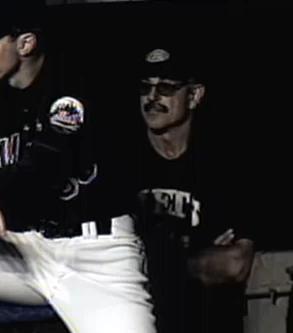
Bobby Valentine returns to the dugout.

Baseball has dealt with similar rules violations before, notably Mets manager Bobby Valentine returning to the bench after being ejected wearing a fake mustache. (He was fined $5,000 and received a two-game suspension for his troubles. Watch the video here.)

Usually, however, ineligible players return not because they’ve been ejected, but because they’re on the disabled list, and not to celebrate, as did Kinsler, but to help protect their teammates during the course of a fight.

In 1996, Montreal’s David Segui did that very thing—dressing and joining a brawl against the Astros, and drawing a rebuke for his actions from MLB.

More famously, Atlanta’s Bob Horner, wearing a cast on his hand and in the broadcast booth for a 1984 game against the Padres, raced to the clubhouse when trouble started brewing, changed into his uniform and rushed the field to help protect his teammates. (During that game, Horner’s teammates, Gerald Perry, Steve Bedrosian and Rick Mahler, all of whom had been previously ejected, returned to the field for one of the game’s later fights.)

In these situations, the rule makes some sense. The number of active players on competing rosters is always even (save for the occasional discrepancy with September call-ups), and additional veterans joining a fray can skew things.

Kinsler, however, saw little harm in his actions.

“I think it’s a little unreasonable,” he said in the Fort Worth Star-Telegram. “It’s not too much common sense. They have the rule in place. They have rules for a reason I guess. I don’t know what the reason is, but they obviously put them in place.”

Update: MLB just rescinded the suspension, admitting, in the words of Aaron Gleeman, “Whoops, nevermind.”

– Jason

Jordan Smith, Rookie Etiquette

How to Make an Inauspicious Outing Even Worse, No. 762

By most measures, Jordan Smith has had a fine rookie season for the Cincinnati Reds. He’s compiled a 3.32 ERA in 37.1 innings out of the bullpen, with 22 strikeouts against only nine walks. He’s even racked up a save.

On Monday, however, he learned a valuable lesson in rookie comportment.

In what was by far his worst appearance as a big leaguer—and probably his worst appearance ever—Smith threw nine pitches to two batters, only one of which was a strike. After walking the second man, he was removed by manager Dusty Baker.

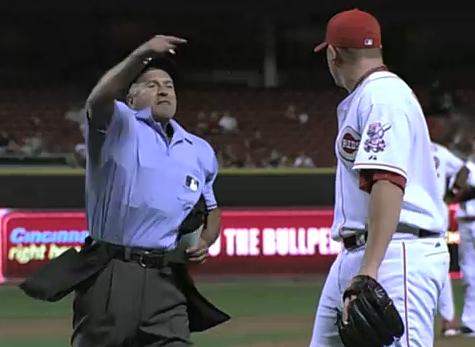
Which is pretty much where things fell apart. On his way off the field, Smith decided to have a chat about the strike zone with plate ump John Hirschbeck.

At this point he would have been well served to observe the first rule of rookiedom (generally more valid in years past than today, but still rock-solid when it comes to umpires): Don’t speak unless spoken to.

Words led to shouting; shouting led to ejection. (Watch it here.)

With his display of ill temper, Smith undoubtedly made it more difficult for himself the next time he sees Hirschbeck. Much like veteran players, many umps like to test rookies, just a little, to see what they’re made of.

“The longer you play, the more rope you get,” said Andy Van Slyke, describing the phenomenon.

Whether Hirschbeck had been intentionally squeezing Smith is unclear, but there’s certainly precedent to fall back on.

Take Wade Miller. In the pitcher’s major league debut for Houston in 1999, a start against Arizona, umpire Rich Rieker was being extremely judicious with his strike calls.

After one pitch that split the plate was called a ball, Miller gave the ump a protracted glare. That was all his catcher, Randy Knorr, needed to see. He quickly trotted out for a mound visit.

“I said, ‘Wade, man, just get through today. If you get through today, you’ll be fine. Just don’t show up the umpire. He’s testing you. I’m trying to work him back there, don’t be snapping the ball on him or anything like that.’ ”

Miller ended up allowing seven runs over three innings, but ultimately passed the test. The final batter he faced, Arizona pitcher Brian Anderson, was called out on strikes.

“As he walked off the field,” said Knorr, “I think the umpire said, ‘Good job, Wade.’ ”

– Jason

Keeping Teammates Honest

Pie, Chewed Out, Improves Status to Cherry

Sometimes, it takes pointed criticism to spur necessary action. It’s one thing for a player to be berated by his manager over things such as lackadaisical play or a standoffish attitude, but it can truly sting to hear it from teammates, an indicator that his act has worn thin even within his peer group.

This was the case when Baltimore’s Luke Scott called out teammate Felix Pie early last season, the result of a nearly complete alienation of his teammates by Pie. Scott, reported the Baltimore Sun, “chastised (Pie’s) work ethic, assailed his character, questioned his discipline and labeled him a bad teammate.”

The meeting took place at the team’s indoor batting cage, and was necessary, according to Scott, because although Pie “was just this big ball of talent,” “there was no character, no discipline, no hard work, no dedication. There was laziness and an attitude that somebody owes him something.”

Pie began 2009 as Baltimore’s primary left fielder, but a .157 batting average in April, combined with inattentive mistakes in the field and on the basepaths, altered things in a hurry. Pie’s attitude was hindering his personal productivity, and it was costing his team chances at victory in multiple ways.

This is where the unwritten rules regarding team leadership come into play. “Challenge” meetings such as this, in which one or more players air out grievances about another, happen far more frequently than is reported (partly because the press doesn’t hear about most of them), and serve as one of the primary methods for quickly improving the tenor of a clubhouse.

In 1990, for example, a firestorm ripped through the roster of the San Diego Padres, when third baseman Mike Pagliarulo told a reporter for the New York Daily News that an unnamed teammate cared far more about his stats than team victories. “He doesn’t give a damn about this team,” he said, “and that’s weak.”

Although Pagliarulo later denied it, widespread speculation fingered Tony Gwynn as his target, and a clubhouse meeting was quickly called, in which Jack Clark and Gary Templeton joined in on ripping Gwynn (as well as pitcher Eric Show).

“Tempy said there were some things in the paper that he didn’t like, and he wanted to know where I was coming from,” said Gwynn in Sports Illustrated. “We started yelling back and forth. So Jack is sitting there with a Coke in his hands. He slams it across the room, it breaks open and shoots all over the place, and he says, ‘Hey, everyone in here knows why we’re having this meeting — because we got some selfish — — in this room, and they’re Eric Show and Tony Gwynn.’ Eric was shocked. I was shocked. . . .

“After that meeting I was lost. I spent many nights asking myself, ‘Is it me?’ In other people’s minds, maybe they were right in thinking some things I did were selfish. But face it, this is a selfish game. You get up to the plate, there’s no one to help you but yourself.”

Ultimately, said Gwynn, he devoted more effort to becoming a leader, and the team as a whole grew more focused. The Padres, 18-21 before the meeting, won six of their next seven games, and two weeks later were five games over .500.

The lesson being that if it can happen to Tony Gwynn, it can happen to anyone. And Felix Pie is no Tony Gwynn.

Scott concluded his 2009 intervention with a question, asking Pie if he really even wanted to be in the big leagues, and telling him that if he was unwilling to make the effort he should step aside in favor of someone who was.

“The whole time, his head was down,” said Scott. “Finally, he just said, ‘OK, I’ll work.’ ”

The result: Pie raised his 2009 average to .266, and on Aug. 25 of this year was batting .304, before a recent slump dropped it to .278. He’ll probably never be a superstar, but, thanks in part to Scott, at least he has a chance to reach his potential, whatever that may be.

– Jason

Johnny Cueto, Juggling the Rotation

Quirk in the Rotation Helps Cueto Avoid Cards

When Reds pitcher Johnny Cueto went all Jet Li on Jason LaRue’s face on Aug. 10, kicking the St. Louis catcher onto the disabled list during a mid-fight scrum, everybody’s eyes quickly turned toward the teams’ next meeting—which happened over the weekend.

Anticipation can be a wondrous thing.

This particular anticipation, of course, was short-circuited when the Reds rotation shook out (inadvertently or otherwise) so that Cueto was not scheduled to face the Cardinals.

Cueto would have served as the most obvious target in recent memory, and Reds manager Dusty Baker opted to delay the inevitable; because it was the final meeting for the teams this season (barring a potential showdown in the playoffs), any retribution the Cardinals are able to inflict will have to wait for next year.

There had already been talk that the Reds might try to limit the pitcher’s visibility over the course of the weekend, but Cueto took things a step further, leaving the country with team permission to attend the funeral of an uncle in the Dominican Republic.

Since the fight, LaRue’s injuries—reported as concussion syndromes—have knocked him out for the season. Cueto was suspended seven games for his actions, essentially missing one start in the process.

The suspension also Baker the leeway to mix and match where in the rotation he reinserted Cueto (which he did in conjunction with figuring out how to reduce the work on fatigued rookie Mike Leake), the better to have the pitcher avoid St. Louis.

It wouldn’t be the first time such juggling has occurred. After Roger Clemens bounced a fastball off Mike Piazza‘s helmet in 2000, Yankees manager Joe Torre arranged his pitching rotation to ensure that Clemens was his Game 2 starter at Yankee Stadium, despite the fact that he was the Yankees’ best pitcher that year. This made Clemens the only member of the four-man World Series rotation to avoid pitching at Shea (where he would have been an obvious target the moment he stepped to the plate in the non-DH park).

“Did I juggle the rotation to keep him from pitching at Shea? Yeah, I probably did,” said Torre. “I’m not going to deny that. I didn’t need another soap opera.”

– Jason

Articles, Everybody Joins a Fight

The Unwritten Rules of Baseball Fights

The media rarely expresses fascination with baseball’s unwritten rules with quite the same fervor as it does shortly following a Code-based incident. Thus, 41,600 results for a Google search of “Nyjer Morgan” and “unwritten rules.”

Some, however, even manage to look beyond the momentary fireworks to examine the bigger picture.

Such was the case with ESPN’s Patrick Hruby, who last week discussed the unwritten rules for baseball fights. For a 500-word summary, he pretty much nailed it.

The main Code tenets upon which he touches:

Everyone fights
Key statement: “Unless you’re playing clubhouse cards with Bobby Bonilla and Rickey Henderson, on-field attendance is mandatory.”
Key thesis: “More people means more grabbing, pulling, pushing and holding each other back in a big, harmless sea of sunflower seed-spitting humanity; by contrast, nobody leaving the dugout would mean hitter versus pitcher, unrestrained, exchanging dangerous blow after dangerous blow. In essence, a hockey fight.”
Baseball Codes tie-in: Chapter 22: Everybody Joins a Fight

Look angry
Key statement: “True pros know that the safe dissipation of bad baseball blood is a lot like an ancient scapegoat rite. Ya gotta honor appearances.”
Key thesis: Hruby brings up a moment that was also touched upon in The Baseball Codes, involving Derek Jeter and Alex Rodriguez. From TBC: “Derek Jeter once took heat from teammate Chad Curtis for laughing with Seattle’s Alex Rodriguez as the field cleared after a fight between the Yankees and the Mariners in 1999. The pair’s main mistake wasn’t joking around instead of fighting—it was failing to look more serious as they did so.”

Hruby also touches on some tenets that have been raised in recent baseball fights. From the Reds-Cardinals fight in which Johnny Cueto donned his kickboxing cleats:

Keep it clean
Key statement: “Baseball players have bats. They also wear spikes. Two things you almost never see in basebrawls? Stickwork and stomping.”

And from the Nyjer Morgan-Florida Marlins fight:

Coaches fight at their peril
Key statement: “For every Pat Listach, the Nationals third base coach who pinned Marlins pitcher Chris Volstad in the brawl Tuesday night, there’s a Don Zimmer.”

Good stuff.

– Jason

Sign stealing

Lincecum Stops Tipping; Loss Streak Ends

Last week, we discussed the possibility that Tim Lincecum was having his pitches stolen by the Diamondbacks—in particular Stephen Drew, leading from second base.

In the first inning, the Giants’ broadcast crew homed in on Drew giving two indicators that at the very least looked remarkably like he was feeding signs to the guy at the plate, Adam LaRoche. (Watch it here.)

LaRoche capitalized, hitting a three-run homer.

After some prodding from the coaching staff, Lincecum altered his delivery, bringing his hands closer to his body, making it more difficult for a baserunner to peer in at his grip.

It worked well; following the three-run first, the pitcher allowed only one run over his final five frames, none over the last three. Looking at his final numbers for August—0-5 with a 7.82 ERA—it’s hardly a stretch to think that similar tipping might have been a factor for far longer than the game in which it first came to light.

I caught up with Lincecum at AT&T Park last week, and he explained the situation in a bit more detail—while maintaining a steadfast reluctance to accuse the Diamondbacks of anything untoward.

What is it exactly that you did to throw them off the scent?
I moved my hands closer to my body to make it harder for them to see (the grip). The pitching coach, somebody notices it . . . When things like that happen and someone can see it right off the bat, and it’s so blatant like that, you have no choice but to do something about it.

Is stuff like that always on your radar?
Yes and no. Sometimes it will be. Sometimes I’ll be going through grooves where it won’t even enter my mind, and it won’t even be a factor. But there are other times where you have to think about it. I try not to make it too big a factor for me, where it’s taking away from my pitching game, but I want to be aware of it.

Have you ever gone through a stretch where you’ve inadvertently been tipping pitches?
Not that I know of. Not so far.

This seems like less a retaliatory offense than something you simply adjust to and move on.
It’s one of those things where, if you can get a team’s signs, and you have them, why not take advantage? It’s smart on their part. Baseball is a game of adjustments, and I had to make some.

So did those adjustments work? The line from Lincecum’s following start, against Colorado: eight innings, five hits, one walk, nine strikeouts, one earned run and a victory—his first since July.

– Jason

Nyjer Morgan, Retaliation

Morgan Not Exactly Repentant

With a near-certain suspension in his future on the heels of a litany of on-field malfeasance this week, Nyjer Morgan didn’t exactly back down.

“Everyone kind of blew it out of proportion and put it on Morgan,” he told MLB.com. “I knocked down the catcher, I took my dose and everybody is blowing it way out of proportion, which I don’t understand. I guess baseball isn’t used to seeing this anymore—good old-fashioned hard-nose baseball.”

While he has a point—his reaction to getting hit by Marlins starter Chris Volstad, in retaliation for bowling over catcher Brett Hayes, was entirely appropriate—but Morgan is overlooking the other basic tenets of this tale.

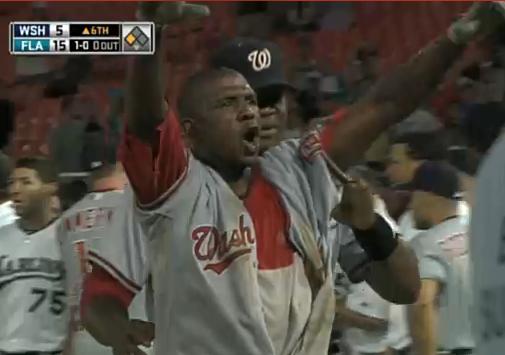
As a player on a rampage—instigating two home-plate collisions, one wildly inappropriate, the other mildly so; two separate incidents involving fans, one of which earned him a seven-day suspension; a public rebuke from his manager and an ensuing spat; and initiating an all-hands fight on the field, after which he emerged faux-triumphantly, arms raised and shirt torn, even though he had taken more abuse than anybody—Morgan has a lot to be introspective about.

Focusing on the one thing he did last week that wasn’t offensive isn’t the way to go about it.

Suspension looming.

– Jason

Chris Volstad, Fights, Nyjer Morgan, Retaliation, Running Into the Catcher

It Really Hasn’t Been a Good Week for Nyjer Morgan

There has to be a wager involved with this, somehow. Why else would a major league player attempt to go from zero-to-Alex Rodriguez in a bizarre and misguided weeklong quest to become baseball’s Most Hated Player?

World, meet Nyjer Morgan. You might not have known him in mid-August, but you certainly do now.

Over the last seven days, he’s gotten into it with fans, his own manager and various members of the opposition, both as the player delivering punishment and the one receiving it.

Had he paid a lick of attention to baseball’s unwritten rules along the way, virtually all of it could have been avoided.

He’s in today’s news for yesterday’s fight, but Morgan’s slide began on Aug. 25, when he threw a ball into the stands in Philadelphia. Some say he threw it to the fans, some say he threw it at the fans. Morgan claims it was a big misunderstanding (a tack corroborated by at least one member of the crowd), but the league quickly levied a suspension for his actions, which is currently under appeal. (The piece of Code he ignored: Never engage with hecklers. It rarely ends well.)

On Aug. 27, Morgan got picked off base in the eighth inning of a close game against St. Louis, which proved particularly costly when the batter, Willie Harris, subsequently hit a home run. The Nationals lost, 4-2. Morgan was confronted after the game by Nationals manager Jim Riggleman, and dropped from leadoff to eighth in the batting order.

His response: The following day, he attempted to level Cardinals catcher Bryan Anderson in a play at the plate, despite the fact that Anderson had his back to the play and was moving in the opposite direction. Morgan was so focused on his target that he veered away from the plate to make contact, and in fact never scored. (Code: Run into catchers only when a slide would lead to a likely out. Even more importantly, never let personal vendettas get in the way of your team’s success.)

Riggleman was angry enough about it to call his player out in public, after apologizing to both Anderson and Tony La Russa. Morgan, he said, as reported by Nationals Daily News, did an “unprofessional thing,” and, indicating that lessons would be learned, “you’ll never see it again” from him. (The manager wasn’t quite accurate on this point.)

Riggleman then benched Morgan for the series finale, under the auspices that he had become too prominent a target to safely take the field.

On Aug. 30, Morgan responded to Riggleman. “I guess he perceived it as some nasty play with the intentions of trying to hurt somebody before coming to me and asking me about the situation, which was very unacceptable,” he told the Washington Post. “But on my half, I’m not going to go ahead and throw fuel on the fire. I’m going to try to be as professional as I can about the situation.”

It’s frequently the case, of course, that when players feel the need to proclaim the fact that they’re being “professional,” they’re actually anything but. (Code violation: Never call out your manager in public.)

In fact, Morgan cited the unwritten rules in his own defense, saying that Riggleman “just basically did a cardinal sin. You don’t blast your player in the papers.” (This is true, unless the player’s behavior has deteriorated to the point where the manager feels he has few other options. )

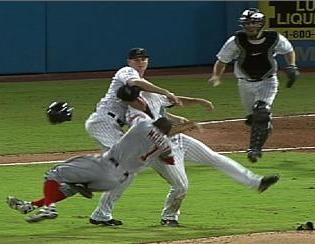
It didn’t take long for Morgan to stir further controversy. In the 10th inning of a scoreless game on Aug. 31, he ran into Marlins catcher Brett Hayes with enough force to place him on the disabled list for the remainder of the season with an injured shoulder. While Morgan didn’t go out of his way to reach his target this time, consensus held that he would have been safe—with the winning run, no less—had he slid. (See previous Code citation about running into catchers. The Marlins won it with a run in the bottom of the frame.)

In light of Morgan’s previous indiscretion with a catcher, the play seemed like the act of a guy hoping for someone to try to knock the chip off his shoulder. (Watch it here.)

When he took the field for the bottom of the inning, Morgan again got into it with fans, this time being caught on tape cussing them out. (See previous unwritten-rule citation regarding fan interactions.)

Any one of these things can constitute a distraction in the clubhouse. The sum of them, especially coming as they did in the span of a week, reads like the linescore of a borderline sociopath.

Which brings us to yesterday’s firestorm.

Morgan was hit in the fourth inning by Marlins starter Chris Volstad—clear retaliation for his treatment of Hayes the day before. Not content to let it end there, Morgan subsequently stole second and third on the next two pitches, while his team trailed by 11 runs in the fourth inning.

This is a clear violation of the unwritten rules, although under ordinary circumstances, a player’s own teammates care more about him staying put in that type of situation than does the opposition. Morgan’s steals, however, were an unequivocal message to the Marlins, conveying that he neither appreciated their treatment of him, nor respected their right to do what they did. (Code: If you send a message to the other team, expect one in return.)

“That was garbage,” he told reporters after the game. “That’s just bad baseball. It’s only the fourth inning. If they’re going to hold me on, I’m going to roll out. The circumstances were kind of out of whack, but the game was too early. It was only the fourth inning. If it happened again, I’d do it again. It’s one of those things where I’m a hard-nosed player. I’m grimey. And I just wanted to go out there and try to protect myself. I didn’t want to get outside the box. There’s bit a little bit of controversy surrounding the kid lately. But it’s just one of things.”

That’s one way to look at it. Another way is that “the kid” essentially gave the Marlins little choice but to reinforce their point. Which they did, when Volstad threw a pitch behind him two innings later.

“I think that’s the only reason we tried to go after him a second time,” said Marlins third baseman Wes Helms in the South Florida Sun-Sentinel. “Since he stole the bases, I think it pumped us up a little more and got to Volstad a little bit. . . . I cannot stand when a guy shows somebody up or show the integrity of the game up to the fans or whatever. There’s just no place in baseball for that. In my opinion, you’re going to get what’s coming to you if you do that. Tonight, it was time we had to show him we weren’t going to put up with the way he was treating us, but also with the way he was trying to take bases down 10 runs. After he got hit, you know why he did it. . . . I can’t really say anything good about a guy that doesn’t play the game the right way and doesn’t play for the integrity of the game.”

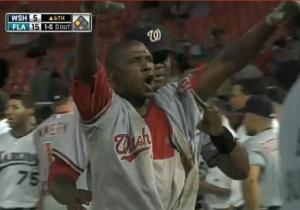
It’s not like Morgan needed to further prove a willingness to put his personal agenda ahead of the integrity of the game, but he did. After Volstad’s pitch sailed behind him, Morgan charged the mound, and a rarity in baseball occurred—a fight that involved actual fighting.

The Marlins—particularly first baseman Gaby Sanchez—couldn’t wait to get their hands on Morgan, and players quickly piled up near the mound. (Watch it here.)

Other accounts offer copious details of the fight. One pertinent example doesn’t even involve Morgan, but third base coach Pat Listach, who was among the first people in the scrum. Baseball’s Code mandates that fighting is left to the players, with coaches and managers serving to fill the role of peacemakers. That was clearly not Listach’s intent, and he may well be disciplined by the league for his actions.

Should Morgan be given any sort of pass in this situation, it’s for the fact that his response to being drilled—the stealing of back-to-back bases—fell within the boundaries of reason; as he said, it was only the fourth inning and the Marlins were holding him on, which is frequently taken as a tacit green light for eager baserunners.

Also, even more importantly, the Marlins took their shot earlier in the game. Between Morgan’s steals and the injury to his catcher, Volstad can hardly be blamed for wanting to get in another blow—but Morgan’s assumption that it was one too many is not unreasonable. In the middle of the fight, Riggleman could be seen mouthing the words “one time” to Florida manager Edwin Rodriguez, indicating the number of retaliatory attempts to which he felt the Marlins were entitled. (“We decide when we run,” said Riggleman in the Sun-Sentinel. “The Florida Marlins will not decide when we run.”)

“I understand they had to get me back a little bit,” said Morgan in the Post. “It’s part of the game. . . . I guess they took it the wrong way. He hit me the first time, so be it. But he hit two other of our guys?” (Volstad did indeed hit three batters on the day.) “Alright, cool. But then he whips another one behind me, we got to go. I’m just sticking up for myself and just defending my teammates. I’m just going out there and doing what I have to do.”

Doing what he had to do, of course, is up for interpretation. Saying that there’s a case to be made for Morgan’s viewpoint on the incidents leading up to the fight does nothing to discourage the sentiment that the guy has been wildly, unassailably, dangerously out of line for the better part of a week.

Guys like Manny Ramirez and Alex Rodriguez can flaunt the unwritten rules at their discretion; their jobs are safe, so long as they continue to produce.

When it’s a leadoff hitter with a .317 OBP, who led the league in being caught stealing last year and is on the way to doing it again, the margins are considerably tighter.

Watch out, Nyjer Morgan. There aren’t many people in your corner right about now.

– Jason

Update: Gaby Sanchez now says that the Marlins were not “really holding (Morgan) on,” prior to his fourth-inning stolen bases. For what it’s worth.

Update (9-03-10): MLB has ruled. Morgan will be suspended for eight games, in addition to the seven that had already been handed out (which is currently under appeal). Also suspended were, from the Marlins, Volstad (six games), pitcher Alex Sanabia (who must have done some heavy and unnecessary hitting in the scrum, for five), Sanchez (three), Edwin Rodriguez (one). Pitcher Jose Veras was fined.

Suspended from the Nationals were pitcher Doug Slaten (probably for furthering tensions by hitting Sanchez in response to the first baseman’s clothesline tackle of Morgan to begin the fight) and Listach (three games each), and Jim Riggleman (two games). Riggleman and Listach also were fined.

Update (9-16-10): Morgan’s suspension was reduced to eight games.

Matt Diaz, Showing Players Up

When Bad Things Happen to Good Players

Chalk one up for the good guys.

Matt Diaz hit a game-tying, two-run homer for the Braves on Sunday, then flipped his bat in celebration. In cases like this, players are usually granted a degree of leeway, for celebratory purposes.

A degree.

It wasn’t until he rounded the bases and took a gander at exactly how far he’d flipped it, however, that Diaz realized his actions might have been a bit too enthusiastic.

“Coming around third you see the dugout and you see the bat boy picking up the bat over by the dugout, like wow, did I do that?” Diaz told the Atlanta Journal Constitution after the game. “I didn’t know how far. It was ugly. There was a Sammy Sosa hop involved, with a Bret Boone bat flip, with a Paul O’Neill head-down-not-look-at-it but then look at it later.” (Watch it here.)

It wasn’t quite an apology to the pitcher, Leo Nunez, but it was certainly an admission of guilt—which can go a long way toward mollifying sensitive feelings, especially since the teams play again this weekend.

Then again, Diaz and Nunez were once teammates in Kansas City, and Diaz thinks he has a handle on the pitcher’s state of mind.

“Leo is a high emotional pitcher anyway, and when he has a big strikeout, he’ll let you know it,” he said. “Those guys usually understand guys who get caught up in emotion and do something like I did yesterday.”

It wasn’t recognition of the Code quite along the lines exhibited by Michael Saunders earlier in the year, but the guy dropped a Paul O’Neill reference. What more can one reasonably ask?

– Jason

Adam LaRoche, Sign stealing, Stephen Drew, Tim Lincecum

Were the D-Backs on to Lincecum? It Sure Looks That Way

The primary topic in San Francisco these days concerns Tim Lincecum and his disappearing dominance. His velocity’s down, his ERA’s up—way up—and his confidence is so shaken that he changed the mechanics he’s been using since he was a teenager in Washington state.

Another possibility came to light last week: His pockets are being picked.

After Adam LaRoche hit a three-run homer off Lincecum in the first inning of Friday’s game, Giants broadcasters Duane Kuiper and F.P. Santangelo focused in on the guy who had been at second base, Stephen Drew.

The video evidence is difficult to refute. It shows Drew tugging at the brim of his cap before the first pitch of the at-bat (a likely indicator for pitch type or location), then turning his head to the left, toward second base, before the third pitch—on which LaRoche connected. (Watch it here.)

Later, the broadcast showed replays of Drew in the dugout, mimicking Lincecum’s delivery for teammates, ostensibly to show his teammates what the pitcher was giving away.

There are two possibilities here if Drew was, in fact, tipping off LaRoche. He might have been reading catcher Buster Posey, which appears to be the case for the pitch that was hit for the homer. All it takes is a glance at a catcher’s setup to indicate whether the pitch will be inside or outside, which is precisely what Drew did.

The other option is that he was stealing signs directly from Lincecum. In May, I discussed this very topic with former big leaguer Morgan Ensberg. Here’s what he told me:

You’re leading off at second base; estimate you’re probably around 30 feet from the pitcher. If the pitcher hasn’t been taught to protect it, you can see everything that’s in his glove. You can see his hands, you can see his fingers, you can see the ball, you can see the seams.

Generally, pitchers will hold ball in same spot in the glove. On certain pitches you can see some red from the seam, but on other pitches you don’t see the seam. You might see something in the way he holds his glove. All this is just patterns. I’ve been at second base 100,000 times in my life, and learned to pick up patterns in the way a pitcher grips a baseball.

This was clearly on Lincecum’s mind, as well. Shortly after LaRoche’s homer, he tweaked his delivery to move his pitching hand closer to his body, in an effort to better impede a baserunner’s view of his grip.

Did it work? Following the three-run first, the pitcher allowed only one run over his final five frames, none over the last three—something he hasn’t done since his last win, on July 30.

In Arizona’s post-game clubhouse, denials abounded when players were confronted with questions about the video evidence—some delivered more half-heartedly than others.

Diamondbacks manager Kirk Gibson denied that Drew had done anything untoward, while simultaneously positing that it was a tactic at which his team needs to improve.

“Actually, I don’t think we’ve done a very good job at it . . .” he said in an MLB.com report. “It’s a hard thing to master because there’s a lot to it. And I can tell you last night that wasn’t the case, OK? . . . It doesn’t mean we won’t try tonight, but last night that was not the case.”

Drew, in the Arizona Republic: “Nope. Didn’t do that. Sure didn’t.”

LaRoche, however, hewed closer to the likely truth, when asked if he got any assistance on the pitch he hit. “If I did,” he said, “I wouldn’t repeat that to anybody.”

Of course, players are taught to deny everything, because that’s what public perception mandates. On the field, however, they’re simply playing baseball.

Sign stealing isn’t just tolerated, it’s expected. Even Giants manager Bruce Bochy dismissed the allegations, telling MLB.com that “all teams do that.”

The Giants’ concern after the game had little to do with Drew or LaRoche, and everything to do with making sure that Lincecum conceals his grip and Posey gives away no unnecessary clues to the opposition.

Lincecum makes his first start since then tonight, against the Rockies. We’ll see how well the lesson’s been learned.

– Jason