Review

A Little Love from the Merc

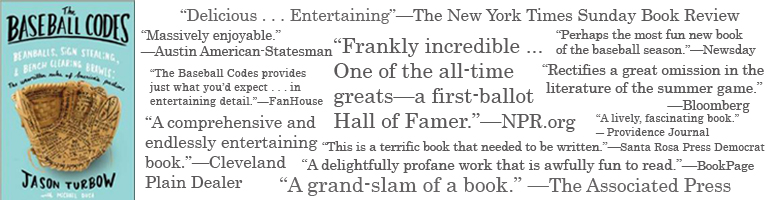
A nice blurb from San Jose Mercury News Giants beat writer Andrew Baggarly yesterday, in support of The Baseball Codes:

Turbow and Duca are press box regulars at AT&T Park – Duca was the official scorer for Jonathan Sanchez’s no-hitter — and I’ve seen them collecting material for this book nearly every day at the ballpark for the past three years. It’s bound to be packed with a lot of great, funny anecdotes and the positive praise is already starting to filter in. I’m looking forward to buying a copy, myself.

Nice to get some appreciation from the hometown set. Thanks, Bags.

– Jason

George Will, Review

George Will: Baseball Fan, Man of Impeccable Literary Taste

George Will just called me. He’s planning a column about the book to run in the Washington Post on or near opening day. But here’s the thing: He didn’t call to ask about the book. He didn’t want to know anything about the writing or reporting or genesis or goals that isn’t already evident within its pages.

He just wanted to say that he liked it.

Scratch that. He just wanted to say that he loved it. His direct quote: “This is the greatest book in the history of books.” Seriously. He said that he couldn’t stop laughing as he was reading it.

It’s enough to tickle a first-time author pink.

My only regret is that he wasn’t contacted to write a cover blurb. Because, you know, “Greatest book in the history of books” would look pretty good over the title.

– Jason

Dustin Pedroia

Dustin Pedroia, You Talkin’ to Me?

So it seems that Dustin Pedroia wants a piece of me.

Apparently, WBZ’s Jonny Miller brought up The Baseball Codes to the Red Sox star, and relayed that many players on the current Boston roster are accused within its pages of stealing signs. For the rest of the story, we go to Comcast SportsNet New England’s Joe Haggerty:

As expected, Pedroia took exception to the accusation as only the feisty, colorful second baseman can when he’s sparked by a topic.

“That’s why I don’t read much because that’s 110 percent [expletive],” said Pedroia. “Give me the guy that wrote it and I’ll talk to him. I can tell you firsthand. We don’t tip signs because half of the guys on our team aren’t smart enough to see the fingers and all of that stuff. We don’t do that crap.

“I want the author. I’m fighting him.”

Never mind the fact that, contrary to what Miller reportedly told Pedroia, the book accuses nobody on the current Red Sox squad of any such thing. In fact, we mention two occasions in which Red Sox teams of the past were themselves victims of sign stealing (including one unbelievable instance against the Blue Jays in Fenway Park).

Still, the opportunity to fight Pedroia is intriguing.

Positives: I have at least a couple inches on the guy when it comes to reach.

Negatives: He undoubtedly outpoints me in fast-twitch muscles; he’s 13 years younger; he’s 10 pounds heavier (but certainly no fatter); he might pull a dirty pro wrestling maneuver and pummel me with his MVP Award while the ref isn’t looking.

Still, this is an opportunity that doesn’t come along too often. Bring it, Dustin. I shall fight the fight of a crazed wolverine until one of us either leaves on a stretcher or is laughing too hard to exit his corner.

Come discover the power of the press. I’m waiting.

– Jason

Review

The First Big, Sunday Book Review: The New York Post Approves

The first big one is in, and the New York Post seems to have enjoyed The Baseball Codes. That is, if recounting no fewer than 13 stories from the book indicates enjoyment.

From reviewer Larry Getlen:

As veteran sportswriters Turbow and Duca lay out in this remarkably well-researched book, filled with intricate details of plays from the past 100 years, the Code has affected careers, long-boiling team rivalries, World Series victories, and the game’s most hallowed feats in surprising ways.

We’re now batting 1.000 when it comes to positive reviews (hey, what do you know, a baseball metaphor!), but this is the first one to devote more than a single paragraph to the endeavor (an indicator that we must be getting close to the release date).

As of tomorrow, we’re nine days out. Welcome to March, everyone.

– Jason

The Baseball Codes

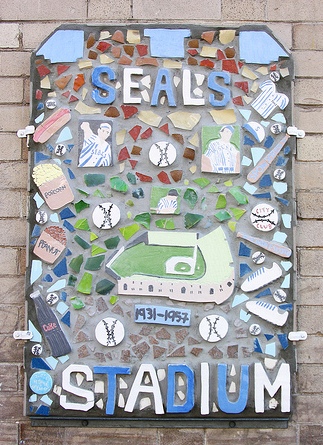
Digging for History When None is Apparent: The Search for Seals Stadium’s Home Plate

Okay, this doesn’t have much to do with the unwritten rules, unless one wants to view it from the perspective that the essence of the Code is to preserve the essential tenets of baseball’s past. In that case, so too does this page, in a way.

Todd Lappin took the time to examine aerial photos of Seals Stadium—the Giants’ first home in San Francisco, and the ballpark where Joe DiMaggio played as a member of the San Francisco Seals before he joined the Yankees—to figure out where, exactly, home plate would have been amid the shopping center that now stands on the site.

It’s essentially trivia at this point, but for people like me, who love the history of the game, from statistics and stories all the way to real estate, it’s a labor of love that’s utterly appreciated.

– Jason

Review

The Baseball Codes: Resonating Well with the Artist/Poet/Cartoonist Demographic

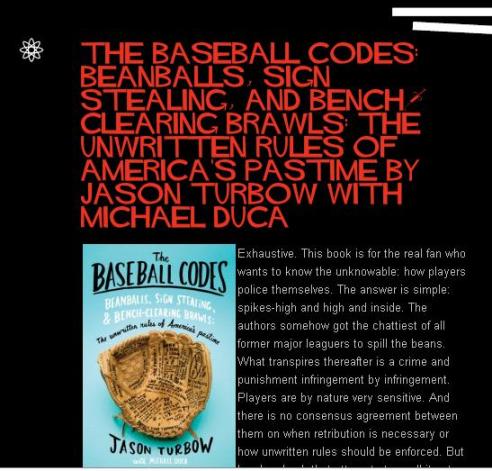
Jim Behrle is an artist in Manhattan. And a baseball fan. And a lover of quality literature. How do we know this? Because he loved this book:

Exhaustive. This book is for the real fan who wants to know the unknowable: how players police themselves. The answer is simple: spikes-high and high and inside. The authors somehow got the chattiest of all former major leaguers to spill the beans. What transpires thereafter is a crime and punishment infringement by infringement. Players are by nature very sensitive. And there is no consensus agreement between them on when retribution is necessary or how unwritten rules should be enforced. But here’s a book that attempts to spell it out and illuminate the different philosophies behind when to retaliate. Strong Buy. A baseball dork’s delight. Nolan Ryan figures prominently. Good to pull of the shelf that summer night after your favorite player gets hit between the shoulder blades with a fastball. Very aptly shows how the game is changing—and depicts baseball as it was as an old school game of tit-for-tat. Truly enjoyable hot stove reading for this gentle correspondent. Loved the Rays-Sox scoop—great to finally get the story on all that nonsense.

Thank you, Mr. Behrle. Come back any time.

– Jason

Ken Griffey Jr., Tiger Woods

Griffey’s Words of Wisdom for a Young Tiger Woods

Tiger Woods’ mea culpa today called to mind something Ken Griffey Jr. told us several years ago, when Woods was not yet known as anything but a world-beating golfer.

The question had to do with passing down baseball’s code from generation to generation, but Griffey veered off course and drew Woods—who as a young professional moved into Griffey’s Orlando neighborhood—into the discussion.

They’re words of wisdom. Had Tiger payed closer attention, the clip below might never have been necessary.

When Tiger moved down (to Orlando), he’d come over and my wife would cook for him. You want to make sure that the next generation of athletes understands what’s going on. Tiger asked me a question: “How do you deal with media?” I told him, “I’m not the one you need to talk to. The person you’re going to have to talk to is Michael (Jordan), because I wear a uniform and I don’t stand out that much. I’m not 6-foot-6 or 6-foot-7. Everybody knows that bald head anywhere.”

A couple of days later, that’s when he played golf with Michael and was on the Oprah Winfrey Show. I told him, “You wear street clothes to play a sport, and people are going to notice you wherever you go. Me, I’ve got a chance because they’re going to look at me and say, ‘Is that him, or isn’t it?’ Unless they’re really true baseball fans, they’re not going to know.” I told him, “I’m not going to sit there and sugarcoat things. You’re going to like some things, and dislike some things.”

The biggest thing is getting the right people by you. People you can trust all the time. It’s not easy. I’ve got the same friends from when I was 12. When I moved out to Seattle, they moved out there. When I moved to Orlando, they moved again. I’m still in Orlando, but when I went to Cincinnati, they came up to visit me—they said, “Nooooo, not gonna move there,” but that’s okay.

– Jason

Frank Thomas, Retaliation

Thomas Knew When to Hold ’em, Knew When to Fold ’em

After 19 seasons and 521 home runs, Frank Thomas called it a career this week. He’ll be remembered for back-to-back MVP awards, a batting championship and the crazy levels of fear he inspired in American League pitchers for nearly two decades.

Thomas also left the big leagues with an astronomical baseball IQ. He understood the unwritten rules, and how, as the centerpiece of almost every team he played for, he inevitably wore a target on his back. The following story, taken from the final version of The Baseball Codes, illustrates as much:

It’s rare for a hitter to request retaliation on his own behalf, largely because most pitchers don’t need to be told. They judge appropriate response by any number of things, none more immediate than the reaction of their offended teammate. During a game in 2006, for example, A’s pitcher Joe Blanton hit Blue Jays third baseman Troy Glaus to lead off the second inning. (It appeared to be inadvertent, although Glaus had hit two home runs in the previous meeting between the teams 10 weeks earlier.) As it happened, Oakland’s designated hitter, Frank Thomas, led off the following inning for the A’s, and the first pitch from Toronto starter Ted Lilly hit him in the back—clear retaliation—and drew warnings for both benches from umpire Jeff Nelson.

As one of the best players in the American League over the course of the previous decade, Thomas was no stranger to being the unwitting subject of similar retaliatory measures. He didn’t so much as look at Lilly after getting hit, just trotted to first base as if he had drawn a walk.

“That’s happened to me 30, 40 times,” he said later. “Nowadays it’s what you expect. (Glaus) is their big guy, their big slugger, and we got him. He was the first one up in the inning, and I was the first one up the next inning. I knew I was going to wear it. You just take it and move on down to first. That’s baseball.”

Thomas’ attitude informed the reaction on the A’s bench. Because the slugger was calm about the matter, so too were his teammates; had he reacted differently, the situation could have been far more volatile. “We all saw what happened, but Frank took it calmly, so we took it calmly,” said Oakland third base coach Ron Washington. “If Frank had taken it with an uproar, we’d have taken it with an uproar. We have to wait for the reaction of the guy who it happened to. If Frank had charged him, there would have been a fight. If Frank had raised some hell going down to first base, we’d have raised some hell. But Frank took it calmly and went on down there, the umpire checked everything and we played baseball.”

Of course, such iron-clad protection does have its downsides. One member of the A’s posited that Lilly’s retaliatory strike against Thomas threw the pitcher off his rhythm, which appears to be true: six of the next 11 batters reached base, including a Jay Payton home run. “When he hit Big Frank, he wasn’t so sure that Big Frank wasn’t coming out to get him,” said the Athletic. “He thinks he helped his team by hitting Big Frank, but I’ll tell you what—his heart was pumping a mile a minute until he realized that Frank was just going to take first base. And after that, Lilly couldn’t find the strike zone. He was all over the place.”

– Jason

Jose Mesa, Omar Vizquel, Retaliation

Mesa, Vizquel Shake Hands, Make Up. Except for the Shaking Hands Part. And the Making Up

This is the third and final segment of our  series detailing the ludicrously extended on-field feud between Omar Vizquel and Jose Mesa. Really, it’s just our way of wishing Omar luck in his new gig with the White Sox.

You can also read Part 1 and Part 2.

__________________________________________________

“I thought he had taken care of business last year,” Vizquel told the Cleveland Plain Dealer after Mesa drilled him for the second time in two chances, and the first after Vizquel criticized him in print. “He hit me last year. And he hit me when he was with Seattle before the book came out. I don’t know what that was all about.”

Vizquel would continue to not know, because although Mesa proclaimed the feud to be over, he didn’t really mean it.

The next time the two met was in April, 2006; Mesa was with the Colorado Rockies, and despite the fact that Vizquel was disguised in the colors of the San Francisco Giants, the pitcher still managed to recognize him when he stepped to the plate.

The right-hander’s greeting: another fastball into the back.

This was the third straight time Mesa had plunked Vizquel. The protests of Giants manager Felipe Alou were met with deaf ears and a complete absence of warnings by the umpiring crew. After the game, plate ump Jeff Nelson went so far as to say that he had no previous knowledge of the bad blood between the players. And although the shortstop voiced his displeasure (going so far as to joke with media that he’d wear shin guards to the plate in the future), he once again chose to head to first base rather than a confrontation at the mound.

(It’s not like Vizquel was afraid to charge. In 1998 he went after White Sox pitcher Jim Parque after the lefty sailed a pitch over his head, for which he served a two-game suspension. Of course, at 5-foot-11 and 170 pounds, Parque was virtually the same size as the shortstop, and far smaller than the imposing Mesa.)

This was all clearly fueled by a lack of closure on Mesa’s part. Any confusion about why Vizquel wrote what he did never abated; at the time the interviews were done for this story, the two had yet to speak to each other on the topic. (And Mesa certainly wasn’t speaking to reporters about it.)

“I think that was one of the things that bothered him so much—that I didn’t even talk to him about it,” said Vizquel. “I don’t think that I should. He doesn’t want to let it go. It’s still inside him, but it’s time to move on.”

As for the Giants’ response to Mesa’s attack, because it occurred in a 5-4 game (which the Giants would win 6-4 after scoring a run in the ninth), they were forced to keep their bullets chambered until the following day. Even worse form than a lack of retaliation, of course, would be to let ill-timed retaliation come at the expense of a victory.

The man to eventually handle the team’s business was San Francisco starter Matt Morris, who wasted no time in hitting Rockies slugger Matt Holliday in the first inning. It was a clear purpose pitch, and everybody with any sense of the situation was aware of its meaning.

Everybody, it seems, but plate umpire Travis Reininger. Reininger, a fill-in replacement from Triple-A, immediately warned both benches in an effort to stem the beanball tide.

For Morris, however, the problem with hitting a guy intentionally and absorbing an ump’s warning is that he was then forced into an uncomfortable attempt at precision, staying well off the plate lest he he hit a batter by accident. Which is exactly what he did, just two hitters later.

It was, in fact, just his eighth pitch of the game. Morris hit Rockies catcher Eli Marerro with a fastball, and was promptly tossed. The pitcher, well acquainted with the deny-everything rule about which Mesa seemed ignorant, offered up a quick disavowal when it came to Holliday. But when the subject of the Marerro pitch came up, he grew passionate.

“Why would I . . . after a warning, get thrown out of the game?” he asked reporters. “That’s the last thing I wanted. It’s unfortunate they think that way. The last thing I wanted to do was be taken out of the game. You wait five days to pitch, and to do that after a warning just doesn’t make any sense.”

Even some Rockies took up for Morris.

“Holliday was hit on purpose, but Eli’s wasn’t on purpose, and right then and there they blew the call,” said Rockies reliever Ray King—who was himself thrown out when he hit Vizquel in the eighth inning. “They shouldn’t have thrown Matt Morris out right there. It wasn’t intentional. We hit their guy the other day, they hit our guy. It’s over with. The umpires tried to take control of the game and they blew it by tossing Matt Morris right there, and that takes away from the game.”

It was, in the opinion of King and many others around baseball, another example of umpires legislating the Code out of existence—which is fine, until an excess of built-up pressure with no release valve leads to something far uglier than a simple fastball to the thigh.

In the San Francisco locker room, the bottom line was less about Morris’s ejection, which caused the Giants to burn through eight-plus innings of bullpen work, than the fact that the umpiring crew claimed no prior knowledge of Mesa’s ongoing vendetta. After all, the Giants’ starter was ejected after eight pitches and two maybe-he-meant-to, maybe-he-didn’t hit batters. Mesa remained undisciplined after his no-doubter from the night before.

When it came time for MLB’s discipline czar, Bob Watson, to dole out punishment, the Giants finally got their day in court. Although Morris was fined—along with Alou and pitching coach Dave Righetti, who were ejected along with him—none of the three was suspended. Mesa, however, was tagged for four games, which probably sent some signals that his antics were wearing thin with the folks at league headquarters.

This was fully evident when he and Vizquel next met, on Aug. 5. That day, in the bottom of the eighth inning of a 1-1 game, with a runner on second base—that’s right, first base was open—Mesa actually pitched to Vizquel, not at Vizquel. That the shortstop grounded out to second base, advancing the runner to third, was almost incidental.

The battle, as far as anyone could tell, was over. (The two met twice more that season, with Vizquel grounding out and singling to right field; each time he drove in a run.)

And the real take-home from this whole exchange? Vizquel said it best, speaking with the Cherry Hill Courier Post in 2003: “I guess you have to wait until you retire before you write a book.”

– Jason