All-Star Game

An All-Star Extravaganza to Celebrate the Mid-Summer Classic

In honor of the All-Star Game, I offer you three related stories, only one of which made the final draft of The Baseball Codes. Consider it as bonus material to help fill the downtime until games resume.

In the 1978 All-Star Game in San Diego, Pete Rose went so far as to import to the National League clubhouse cases of Japanese baseballs—smaller and more tightly wound than their American counterparts, which caused them to carry farther. Working the locker room like a politician, he garnered buy-in from his teammates on two counts: The National Leaguers agreed to use the balls during batting practice, and they also agreed that nobody would tell members of the American League team what was going on. Rose then sauntered over to the AL locker room and convinced many of the players to come out and watch their opponents take pre-game hacks.

Jack Murphy Stadium was vast in 1978, running 420 feet to center field, but Rose’s teammates for the day put on quite a show, hammering ball after ball over the fence’s deepest reaches. When they were done, the National Leaguers gathered all the balls and returned them to their locker room for safekeeping. Using standard major league baseballs in their own batting practice, the American Leaguers had a much rougher go of it.

It might not have meant much . . . or maybe it did. At the very least, it didn’t hurt. The National League went on to win its seventh straight contest, 7-3.

* * *

In the National League clubhouse prior to the 1968 All-Star Game, Dodgers catcher Tom Haller saw Houston’s Rusty Staub rummaging through Don Drysdale’s shaving kit, ostensibly to find evidence of the long-whispered rumor that Drysdale doctored the ball. When Haller told the pitcher about it, it wasn’t taken lightly.

Fifteen days later, Drysdale faced the Astros in Los Angeles. Trailing 1-0 with two outs and nobody on in the eighth inning, Drysdale buried a pitch into Staub’s ribs.

“That’s for looking through my goddamn shaving kit,” he yelled as the hitter stumbled down to first base. Staub might not have been the world’s best sleuth, but he was smart enough to not say a word.

* * *

Orioles skipper Earl Weaver was once sitting in the dugout when one of his pitchers gave up a home run. As the batter rounded third, he looked toward the Orioles bench, made eye contact with the manager and extended his middle finger. “What the hell was that?” a befuddled Weaver asked Billy Hunter, one of his coaches. Hunter knew exactly what the hell that was. “You didn’t select him for the All-Star Game,” he said.

– Jason

Gaylord Perry, No-Hitter Etiquette

Perry’s No-Hitter Aided by Fan in Blue

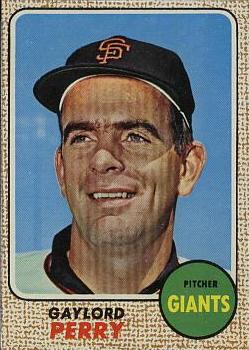
Gaylord Perry recently discussed his 1968 no-hitter, thrown against St. Louis when he played for the Giants. Perry brought a new layer to the discussion about how players (and, in this case, officials) react to significant accomplishments as they unfold on a ballfield.

“After seven innings, I saw the umpire (Harry Wendelstedt) as I was coming out of the dugout and he said, ‘You don’t have to get it so close,’ ” Perry told the San Jose Mercury News. “And I didn’t really pay attention. He started giving me the outside, and after eight innings he said, ‘You don’t have to get it so close’ again, and I realized that guy has never called a no-hitter and he wants to call one. So I didn’t come close that ninth inning.”

The final hitter he faced, Curt Flood, struck out looking. Of course he did.

As with Wendelstedt, most everyone appreciates greatness. They’d also like their appreciation of it returned. From The Baseball Codes:

The more a pitcher mows down the opposition, the more the opposition is expected to respect the feat. Cardinals outfielder George Hendrick did exactly this in 1984, when he stepped to the plate with two outs in the ninth inning against Reds ace Mario Soto, who had yet to allow a hit. Hendrick stood passively and watched the first two pitches of the at-bat split the plate for strikes. Rather than go for the kill, however, Soto inexplicably used a third-pitch fastball to buzz Hendrick’s chin, knocking him to the ground. The slugger got up, slowly returned to the box, and knocked Soto’s next offering over the fence in left field. “I don’t know why he did that,” Hendrick said afterward. “I was going to let the man have his no-hitter.”

Players aren’t always so generous. When Detroit pitcher Tommy Bridges was within an out of a perfect game against the Senators in 1932, Washington manager Walter Johnson—despite trailing 13–0—sent up curveball-hitting specialist Dave Harris as a pinch-hitter, to try to figure out the bender with which Bridges had baffled Washington all afternoon. Harris connected for a single, and Johnson absorbed criticism from around the league. Bridges himself abstained, however, saying, “I would rather earn it the competitive way than have it handed to me.”

– Jason

Bud Norris, Clubhouse pranks

Houston Outfield Turned into Parking Lot

It’s not difficult for a major league clubhouse to become a testy place. They’re populated with men facing enormous pressure, both externally and internally, to perform and win. When expectations fail to be met, tension can run high.

As a result, players have developed a variety of methods for keeping things loose. One of their primary tools in this regard is the practical joke. It can be directed at anybody on the roster, but three primary groups stand out as perpetual victims:

  • Rookies: The lowest men on any totem, a barrage of (mostly good-natured) abuse serves as standard initiation into the big leagues.
  • Those who don’t take it well: A negative reaction to being pranked will inevitably serve as inspiration for more of the same.
  • Those who fail to fit in: If you’re not like your big league brethren, it’s not a stretch to think that they’ll let you know about it.

Astros pitcher Bud Norris only recently escaped rookie status on an official level, but he’s still close enough for the purposes of some of his teammates. He also falls into the latter category, in at least one way: his car.

Major Leaguers expect each other to present themselves as such. Jeans and T-shirts serve as accepted wardrobe in most clubhouses, but when it comes to vehicles, a player’s ride must sparkle. Even a vehicle so simple as a pickup truck—found more frequently than one might think in players’ parking lots—must reflect a level of class not ordinarily found in the rides of regular folk.

With that in mind it’s easy to see that although Norris has no problem driving a 1997 Accura, some of his teammates possess different opinions.

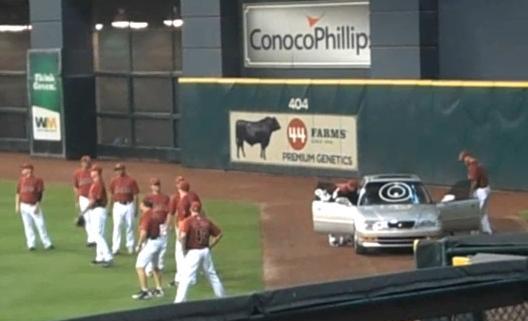
When Norris took the field for pre-game warmups on Wednesday, he was stunned to see, sitting on the center field warning track, his car. On the front windshield was a target, drawn in shaving cream, to give inspiration for players about to go through batting practice. Written on other windows were the sentiments “For sale,” and “$100.” (Watch footage here.)

“Bud’s been wanting to sell it for a while and the market’s been kind of low on him,” said Astros pitcher Tim Byrdak in the Houston Chronicle. “We thought he could use some free advertising.”

Byrdak went on, in an MLB blog post: “It’s got 116,000 miles to it. Fifteen hundred, or the best offer. The check engine light’s on, but that’s a mild thing.”

Astros players marked the situation by stretching out near the car in center field, rather than alongside their dugout, as usual. Brandon Lyon eventually started to hit fly balls toward the car, just missing with one.

If anything, Norris helped his own cause by refusing to get angry about it, and thus disqualified himself in at least one of the above three categories.

“I thought it was funny,” he said. “We’ll go with it. It’s fun.”

– Jason

Johan Santana, Pitch Tipping

Santana’s Struggles Due to Tipped Pitches? It’s a Moot Point, Now

It seems so obvious for pitchers: Don’t telegraph what type of pitch you’re about to throw, or hitters will jump all over it. (Matt Morris, for example, once had the habit of pointing the exposed index finger on his glove hand straight up when delivering fastballs, which allowed the opposition to pounce . . . until he affixed a flap to cover the finger.)

We saw the phenomenon (or at least reports of it) last month, when A’s pitcher Ben Sheets went through a stretch in which he gave up 17 runs in seven-plus innings over the course of two starts. Once he emerged from the mini-slump, there were reports that his problem had stemmed from the fact that he did something to give away his curveball before throwing it.

Sheets insisted that his problem was strictly mechanical; either way, he fixed it fairly quickly.

This week, however, another tale of a tell has surfaced—this time with Johan Santana.

Writes Bob Klapich in the Bergen Record, the Mets’ ace was unknowingly tipping his devastating changeup, which cost him dearly against the Twins, who elicited 41 first-inning pitches while swinging and missing at exactly one pitch. They scored five runs in six innings against him.

Writes Klapich: “Turns out the give-away was the action of Santana’s glove as he began his windup: the fingers would flare as Santana dug into the leather to grip the change, which required him to make an A-OK configuration with his hand. The glove, however, remained still as Santana prepared to throw the fastball.”

Once they caught on, the Mets instructed Santana to lower his glove to belt level, which better hid his pre-pitch mechanics.

The results: In Santana’s most recent start he threw a complete-game, three-hit shutout against the powerful Reds, and has given up only one run given up over his last 16 innings.

Pitchers don’t generally like to talk about (or admit to) any tells they might suffer, but even though Santana’s silence, it’s incredible how much difference one small adjustment can make.

– Jason

Alex Rodriguez, Dallas Braden, Don't Incite the Opposition

Braden Tries to Make Nice with A-Rod; A’s Fail to Follow Suit

Dallas Braden takes these things seriously. When he first called out Alex Rodriguez in April for running across the Oakland Coliseum pitcher’s mound, many—especially those who knew nothing of him—assumed that the outspoken young pitcher was merely a hot-head, looking for attention.

Now: not so much.

The A’s, looking to capitalize on the mound controversy in advance of the Yankees’ return to Oakland on Monday, printed T-shirts for sale in the Coliseum, reading, “Get Off My Mound,” with the silhouette of a left-handed pitcher that can be assumed to be Braden.

The A’s were no doubt hoping that the shirts would be hot sellers while raising some ire in the visitors’ clubhouse. What they didn’t figure on was catching heat from the home team.

It was Braden himself who found the shirts most offensive.

“I think we all understand where they are coming from, but it’s just a serious, gross, lack of tact,” Braden told Jeff Fletcher of FanHouse on Monday. “At the end of the day, I hope I do not become associated with that kind of approach.”

Braden said that his opinion on the shirts was not solicited, and that the Major League Baseball Players’ Association twice denied approval for them.

For Braden, the issue was about respect—of the league’s highest-profile player on the league’s highest-profile team overestimating his ability to take liberties on a baseball diamond, especially against a little-known pitcher on the small-market A’s.

The T-shirt has nothing to do with that.

Secondly, Braden and the rest of the A’s understand the meaning behind the cliché “let sleeping dogs lie.” The issue had faded, if not disappeared entirely once it became apparent that the injured Braden would not pitch against the Yankees. The shirt brought it roaring back to headlines around the country.

“That’s probably not smart,” said Oakland’s Jack Cust in the San Francisco Chronicle. “We don’t need to fuel anything with A-Rod, not with his ability.”

“There isn’t a guy in this locker room that wanted those T-shirts made,” added A’s reliever Brad Ziegler in the FanHouse report, reiterating the fact that it’s rarely in a team’s best interest to unnecessarily incite the opposition.

Braden took things a step further, sending an assortment of memorabilia from his perfect game to Rodriguez, including a ball, a T-shirt and a poster, inscribed, according to the Chronicle, “Dear Alex, here’s the poster you requested. I think you’re right, it will look great over your mantel. … I know you realize it’s all in fun.”

Still, the Yankees took notice of the T-shirt (the one made by the A’s, not the one delivered by Braden). Although A-Rod said all the right things—joking that he hoped for a cut of the profits, and that one of his teammates went so far as to put one on—the fact that the shirt permeated the New York clubhouse only increases the possibility that it could be used as extra motivation against the A’s.

That’s something even Oakland’s marketing department probably wouldn’t appreciate.

– Jason

Billy Butler, Ervin Santana, Retaliation

Butler Drilled, but Royals Have the Last Laugh

The recent series between the Angels and Royals put the power of retaliation on full display. It also illustrated the downside of the practice. While a well-aimed fastball can bring a measure of satisfaction to an angry pitcher, it can also bring longer-lasting pain to his teammates, courtesy of an injured box score.

For an example of this, look no farther than Ervin Santana.

If Santana holds no grudge against Kansas City’s Billy Butler, he hides it well. In the first inning of Saturday’s game, with two out and a runner on second—first base open being an ideal situation for a pitcher wanting to drill a batter—he hit Butler with a fastball.

Then in the eighth, he did it again. Butler—who angrily ripped off his batting glove and delivered several withering stares toward the mound—ended up with bruised ribs, but the Royals ended up with a game-winning rally. By drilling Butler, Santana loaded the bases, and Jose Guillen’s ensuing two-run single proved to be the difference in a 4-2 Kansas City victory.

If the double-drilling is more than a coincidence, and insider grumblings say that there’s something behind it, the source is inconclusive. The last time Santana faced the Royals was May 31, and he won, 7-1. “That’s the best I’ve seen Santana,” an effusive Butler said in the Kansas City Star after that game, “and I’ve had quite a few at-bats against him.”

Still, Butler has been known to anger the occasional pitcher. Just last week against Jake Peavy, he slammed his bat to the ground after hitting a flyball in his second at-bat, eliciting a verbal barrage from the pitcher (which might also have had to do with the fact that Butler homered off Peavy in his first at-bat). It ended there, however, as Peavy not only failed to hit Butler later in the game, he passed up the perfect opportunity to do so when he intentionally walked him in the fifth.

The Royals benefitted from Santana’s miscue, then set out the following day to illustrate how retaliation should be properly executed.

On Sunday, Kansas City starter Anthony Lerew hit Bobby Abreu in the first inning with two outs and nobody on base, a clear response to Santana’s manhandling of Butler. Umpire Jim Joyce demonstrated an appropriate understanding of the situation, allowing two inside fastballs to go unchallenged before finally issuing a warning once Abreu was drilled.

Lerew retired the next hitter, Torii Hunter, to escape the inning, and set down Los Angeles in order in the second. While the Angels’ four-run rally in the third—highlighted by Hunter’s three-run homer—wasn’t a direct result of Abreu’s being hit, the moment might have served as inspiration.

“When Bobby got hit—we saw him trying to hit him, three pitches inside, he definitely tried to hit him—I think it kind of woke up the sleeping dogs over here and the guys started swinging the bat,” Hunter said on the Angels’ Web site.

The Angels ultimately won, 11-0, which made Butler’s revenge the likely highlight of the day for Kansas City. Coming up on Friday: Royals-White Sox, just in case Peavy yet has a message to convey.

– Jason

Carlos Monasterios, Creative Use of the Disabled List, Oliver Perez

Just Because a Player is on the DL Doesn’t Mean he’s Hurt

Just as players have a set of unwritten rules, so too do general mangers. Sometimes, those rules intersect.

We saw an example of that recently, when the Dodgers placed Carlos Monasterios on the disabled list.

Los Angeles had claimed the pitcher from the Phillies in the Rule 5 draft, meaning that if he didn’t stay on the big league roster all season, they had to return him to Philadelphia. Monasterios, however—who lasted all of six and two-thirds innings over his previous two starts combined, giving up 10 runs in the process—was making that proposal difficult.

To judge by appearances, Los Angeles didn’t want him pitching in the major leagues, but didn’t have the leeway to send him to the minors. The solution: DL. The cause: a blister and a split nail on his pitching hand.

Such a move, should it be bogus, would be illegal. According to the Los Angeles Times, it was questionable:

How’s the blister?

“It doesn’t affect me,” Monasterios said.

What about the nail?

“There’s nothing wrong with the nail,” he said.

It’s not the first time this sort of maneuvering has happened this season. The Mets used the disabled list in a similar fashion, but for far different reasons.

When New York placed Oliver Perez on the DL, they claimed it was due to patella tendinitis. To many outsiders, however, it was because Perez was pitching too putridly to risk using. (The team would perhaps have a need in “extra innings or something like that,” said manager Jerry Manuel in the New York Post at the time, “but it’s going to be tough to find spots for him.”)

Perez had contract leeway to refuse a minor-league assignment. The Mets were unwilling to eat the $20 million they owe him over the next three years. (Said an unnamed Mets player in the Post: “At some point you have to cut bait. You owe him a lot of money, but for what?”)

So they did the next best thing—they stashed him on the DL (and not for the first time), or at least it appears that way. As with the Monasterios situation, this would be illegal were it true.

The commissioner’s office stepped in to review the situation, and Perez ultimately decided to accept a stint in the minors, albeit as a rehab assignment rather than as a demotion.

Sound shady? Of course it does. Just like the pitcher who denies intent after hitting a batter, the teams in question paint themselves as virtuous and true—at least according to their own PR.

Take Dodgers manager Joe Torre, who defended the Monasterios move. “Is it there or is it not?” he asked in the Times. “It’s not like I’m making up something. It’s there.”

– Jason

Aaron Rowand, Retaliation, Vicente Padilla

Presenting Baseball’s Best Retaliatory Escape Artist: Vicente Padilla

Vicente Padilla

Oh, the merits of retaliation.

On April 16, Dodgers right-hander Vicente Padilla broke Aaron Rowand’s face with a pitch, putting him out of action for two weeks. Some feel that a hit batsman, even an unintentionally hit one, merits retaliation, because points must be proved about topics such as willingness to take whatever it is an opponent wishes to dish out, or not.

Padilla’s strike may well have been unintentional, but that doesn’t alter the fact that he holds the distinction of being the game’s preeminent headhunter. That, by itself,  is reason enough for suspicion.

The Giants had an opportunity to retaliate that day. Padilla came to bat the very next inning, Los Angeles led 9-2 at the time and there were two outs in the inning. A perfect set-up.

Instead of drilling Padilla, however, Giants reliever Waldis Joaquin pitched to him, getting him to ground out to end the fifth inning. Dodgers manager Joe Torre pinch-hit for Padilla the next time he was scheduled to bat.

Discussion around the Bay Area mounted a number of theories as to why the Giants chose not to retaliate. It could have been that Joaquin, just 23 years old and with fewer than 15 innings of big league experience, simply didn’t know any better, and hadn’t received specific instructions.

It could have been that the Giants’ braintrust wanted some time to assess the situation, knowing that they’d have other chances during the season to attack their nemesis.

To complicate matters, Padilla broke an unwritten rule after the fact by failing to call over to the Giants dugout to check on the guy he’d seriously injured. By itself, said some, that was justification for a retaliatory pitch the next time San Francisco saw him.

Well, San Francisco saw him yesterday for the first time since the incident and … nothing.

Padilla’s first two at-bats came with a runner on base and nobody out; the score was 0-0 the first time, and the Dodgers led 2-0 the second. Giants starter Jonathan Sanchez can hardly be faulted for his desire to minimize the damage each inning, rather than extend it.

When Padilla came up in the seventh, however, the Dodgers led 5-1. Giants reliever Santiago Casilla apparently attempted to send a message, throwing a fastball behind Padilla that failed to hit him. The intent behind the pitch—whether he wanted to hit him, or to send a message at all—is unknown, as Casilla stuck to the Code afterward, blaming the pitch’s location on a faulty “delivery point.”

It was enough, however, for umpire Tom Hallion to warn both benches, and put an end to Casilla’s endeavor. Padilla skated unscathed, eventually striking out. If there was a message sent, it was a mild one. After the game, Rowand refused to discuss anything that had to do with Padilla.

Interestingly, this exchange signaled a pattern—not with the Giants, but with Padilla himself. It was Padilla, after all, who instigated the series of events that led to White Sox manager Ozzie Guillen berating rookie pitcher Sean Tracey on the Comisky Park mound in 2006.

From The Baseball Codes:

Guillen quickly identified Texas’s Hank Blalock as a target for retaliation after Padilla twice hit Chicago catcher A. J. Pierzynski during a game. That was the plan, anyway. Filling the space between conception and execution, however, was Guillen’s choice of executioner: rookie Sean Tracey.

The right-hander had appeared in all of two big-league games to that point and was understandably nervous. Even under optimal circumstances he didn’t have terrific control, having led the Carolina League in wild pitches two years earlier, while hitting twenty-three batters. When Tracey was suddenly inserted into a game at Arlington Stadium with orders to drill the twentieth major-league hitter he’d ever faced, it was hardly because he was the best man for the job. To Guillen, Tracey was simply an expendable commodity, a reliever whose potential ejection wouldn’t much hurt the team, especially trailing 5–0, as the Sox were at the time.

If the manager knew his baseball history, he might have realized that precedent had already been set in this regard. In 1942, Boston Braves manager Casey Stengel, wanting to get even with the Brooklyn Dodgers for stealing his signs, ordered his own rookie pitcher—greener even than Tracey, appearing in just his second big-league game—to hit Dodgers shortstop Pee Wee Reese. Faced with an assassin’s assignment, the  nervous lefty tried three times to hit Reese, and three times he missed. The following day, a fuming Stengel shipped him back to the minors, an action he would later call his biggest mistake as a manager. It would be four more years before Warren Spahn returned to the big leagues (a span extended by his service in World War II), by which point he was better prepared to handle the rigors that came with his promotion.

The same probably won’t be said about Sean Tracey. When the right-hander’s first pitch to Blalock ran high and tight but missed the mark, Tracey did what he’d been taught in the minors, sending his next pitch to the outside corner in order to avoid suspicion. Blalock tipped it foul. When Tracey’s third effort was also fouled back, for strike two, the pitcher altered his strategy and decided to go after the out, not the batter.

According to his manager, it was the wrong decision. After Blalock grounded out on the fifth pitch of the at-bat, Guillen stormed to the mound and angrily yanked Tracey from the game. He didn’t let up after they returned to the dugout, berating the twenty-five-year-old in front of both his teammates and a television audience. With nowhere to hide, Tracey sat on the bench and pulled his jersey up over his head, doing his best to disappear in plain sight. Two days later, without making another appearance, he was returned to the minor leagues, and during the off¬season was released.

In his previous game, Tracey had hit a batter without trying to, said Tim Raines, Chicago’s bench coach, “so we figured it’d be easy for him to hit a guy if he was trying. . . . But it’s much harder than it looks. I think it’s harder knowing you’re going to hit a guy. And if the target knows you’re trying to hit him, he’s going to be loose in the box. It’s not something you’re taught. You can’t practice hitting a guy.”

Ultimately, Tracey shouldered the responsibility for his actions, saying he “learned from it,” but the lesson was lost on his more tenured teammate, Jon Garland, a seven-year veteran en route to his second consecutive eighteen-win season. Before Padilla’s next start against the White Sox, Guillen launched a pre-emptive verbal sortie, positing to members of the media that if the Rangers right-hander hit any Chicago player, retribution would be fast and decisive. His exact words: “If Padilla hits somebody, believe me, we’re going to do something about it. That’s a guarantee. I don’t know what’s going to happen, but something’s going to happen. Make sure [the Rangers] know it, too.” Padilla did, in fact, hit Chicago shortstop Alex Cintron in the third inning, at which point it didn’t take much predictive power to see that a member of the Texas lineup would soon be going down. The smart money was on the following inning’s leadoff hitter, second baseman Ian Kinsler.

The smart money was correct, but the payoff left something to be desired. Garland’s first pitch sailed behind Kinsler, a mark clearly missed. Plate umpire Randy Marsh, well versed in the history between the clubs, opted against issuing a warning, effectively granting Garland a second chance. The pitcher didn’t exactly seize the opportunity, putting his next pitch in nearly the same place as the first. At this point, Marsh had no choice—warnings were issued and hostilities were, willingly or not, ceased. Guillen rushed to the mound for a vigorous discussion about the merits of teammate protection. Kinsler ultimately walked, and after the inning Guillen reprised his dugout undressing of Sean Tracey, spewing invective while Garland listened and the White Sox batted. “I make it clear, I won’t wait for two months or until I see you in spring training or until I see you next year,” Guillen told reporters the following day. “When you get it done, you get something done right away. If it didn’t happen that day, we get over it and move on.”

As Raines said, however, it’s not as easy as it looks. A designated driller carries the expectations of twenty-four guys, plus coaches, plus fans. If he tends to internalize things the task can become difficult, with the neces¬sary steps to intentionally hitting someone growing surprisingly involved.

Santiago Casilla can attest to that much.

San Francisco next sees the Dodgers on July 19. The Code says that the Giants had their shot, and they blew it, so the slate should be wiped clean. That’s not always the way things work, however.

Stay tuned.

– Jason

B.J. Upton, Carlos Zambrano, Derrek Lee, Evan Longoria, Teammate Relations

A Weekend of Dugout Scuffles Means Different Things to Different Teams

It wasn’t a great weekend for peace and harmony in major league dugouts, with spats and squabbles bursting into the open across the country.

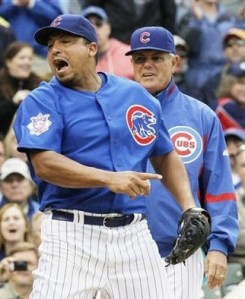
The most replayed of them—and the one with the most lasting repercussions—blew through Chicago’s south side, when Cubs pitcher Carlos Zambrano, at risk of implosion even on a good day, unleashed a barrage of venom at the world, and at Cubs first baseman Derrek Lee, in that order.

Zambrano, only recently returned to the starting rotation following an unremarkable demotion to the bullpen, was on a short leash, and he knew it. The first batter he faced, White Sox leadoff hitter Juan Pierre, smoked a ball down the first base line, possibly playable by Lee although it was ruled a clean hit, and went for a double. The White Sox followed with another double, a single and a three-run homer by Carlos Quentin. By the end of the frame, it was 4-0.

Zambrano recorded the final out of the inning while covering first base, stomping down angrily on the bag. He started screaming before he even reached the dugout, and rampaged down the length of the bench until reaching Lee, at which point he tore into him at top volume. (Watch it here.)

(If nothing else, Zambrano’s no coward. The 6-foot-5, 245 lb. Lee is among the most physically intimidating men on the team.)

Lee didn’t back down, but neither did he seek to escalate the confrontation. Players quickly came between the two, at which point Zambrano punched a container holding paper cups, and was summarily dismissed by manager Lou Piniella. He was pulled from the game, thrown out of the stadium, and eventually suspended from the team.

(The fact that it might all have been premeditated doesn’t seem to carry much weight with the Cubs.)

This was due partly to the clearly disruptive nature of Zambrano’s outburst, and also to a pretty easy deduction that it wasn’t the first time something like this had happened. He has a history of failing to be “the best teammate,” said Cubs GM Jim Hendry in the Chicago Tribune, including other public outbursts.

In 2007, Zambrano pitched a similar dugout fit after Cubs catcher Michael Barrett’s throwing error helped lead to a five-run inning by the Braves. Where Lee was content to take the high road, however, Barrett followed Zambrano into the clubhouse to fight. How many blows Barrett managed to get in is unknown; he was, however, the only one hospitalized, to have his split lip stitched up.

This incident led to a valuable unwritten rule concerning baseball hierarchy. When it comes to intra-team squabbles, the bottom line rarely concerns right and wrong; it’s all about value to the roster. Although a public reconciliation was eventually staged, Zambrano—clearly the better player—eventually won the war when Barrett was traded to San Diego three weeks later.

What these situations have in common, aside from Zambrano, is frustrating streaks of losing.

* * *

Also last weekend but across the country, in St. Petersburg, Fla., more anger flowed following a play not made by a defender. Like the Zambrano affair, this one was also spurred by frustration over a losing streak.

Whereas Zambrano’s tirade helped establish his credentials as a nut job, Tampa Bay third baseman Evan Longoria was perceived to be taking a new level of responsibility in his role as a team leader.

It started when Tampa Bay outfielder B.J. Upton lazed after a ball hit to the wall—nothing as blatant as Hanley Ramirez‘s loaf earlier this season, but still plenty obvious—allowing Arizona’s Rusty Ryal to reach third base on what would have otherwise likely been a double.

Upton, having already earned a reputation for insubordination and something less than all-out play, was met by Longoria upon reaching the dugout and told in no uncertain terms that his example was detrimental to a winning atmosphere. Upton did not respond well, yelling and pointing at Longoria before being pulled away. (Watch it here.)

Longoria turned his back to the situation, and, to judge by the players’ post-game comments, it more or less ended there (although Upton was benched to start the following game). [Update: Upton was benched at the start of the following game as well. Rays manager Joe Maddon insisted that it had nothing to do with his behavior, but instead with a balky quadriceps. Then again, the Code dictates that’s precisely the type of thing Maddon is supposed to say, even if Upton was indeed benched to send a message.)

“B.J.’s an emotional player and when we’re not playing up to our potential, things get multiplied,” Longoria said in the St. Petersburg Times. “I don’t think it got that out of hand to be honest with you. Obviously it looks a lot worse from the outside. But what’s done is done, and we move on.”

These types of incidents, minus Zambrano’s particular brand of mania, aren’t uncommon in the big leagues—it’s just that they don’t ordinarily happen out in the open.

“It’s stuff about playing the game hard, playing it to win,” said 1993 Cy Young Award winner Jack McDowell. “I wasn’t afraid to say stuff like that to teammates; it was usually pretty necessary.”

The list of in-the-open fights between teammates is a long one: Bonds-Kent in 2002; Sutton-Garvey in 1978; Jackson-Martin in ’77 . . . It’s a fertile topic, and serves as only a tiny percentage of teammate spats over that time, most of which never come to light. Teams, in fact, will go to great lengths to keep details away from the media. From The Baseball Codes:

Take the dramatic hotel-room brawl between Davey Johnson, then a star second baseman for the Braves, and his manager, Hall of Famer Eddie Matthews, in 1973. The way Johnson tells it, after an initial verbal disagreement the manager invited him into his room and challenged him to a fight. Johnson, reluctant at first, changed his mind when Matthews wound up for a roundhouse punch, then knocked the older man down. Matthews charged back, and as the sounds of the scrape flooded the hallway, players converged on the scene. In the process of breaking things up, several peacemakers were soon bearing welts of their own.

“The next day at the ballpark we looked like we had just returned from the Revolutionary War,” wrote Tom House (a member of the team, who, true to the code of silence, left all names out of his published account). “Everybody had at least one black eye, puffed-up lips, scraped elbows and sore hands. It had been a real knockdown battle.”

This was something that couldn’t be hidden from the press. Matthews called the team together, and as a unit they came up with a story about a game that got carried away, in which guys took good-natured beatings. Flimsy? Maybe. Accepted? Absolutely.

“You can ask Hank Aaron and others on that team,” Johnson said, laughing. “Eddie said his biggest regret [in his baseball career] was not having it out with me again. That one never got out. It never made the papers.”

Ultimately, one hopes that these sort of confrontations allow for the airing of disparate viewpoints, and ultimately serve to bring teams closer together. At the very least, one hopes they don’t lead to physical injury.

That’s not always the case.

In the Oakland clubhouse in 1974, a stark naked Reggie Jackson responded to a game’s worth of needling from teammate Billy North by instigating a vicious clubhouse brawl.

Vida Blue was the first teammate to attempt to break it up; when it became clear he needed help, catcher Ray Fosse entered the fray—and for his trouble ended up with two crushed vertebra in his neck when he was thrown against a locker. The catcher wouldn’t play again for almost three months and batted just .185 upon his return.

When North and Jackson went after each other again just moments later, their teammates failed even to acknowledge it. (“I had a damn good hand—a once-in-a-month hand—and I was going to stay with it,” said Ken Holtzman of his bridge game. “I didn’t really give a damn if Billy and Reggie were kicking the crap out of each other for half an hour.”)

Bemoan your team all you want, Cubs fans. At least your team is proactive.

– Jason
This Week in the Unwritten Rules

This Week in the Unwritten Rules

June 21
Tigers closer Jose Valverde and Arizona’s Miguel Montero get into a public war of words over Valverde’s mound antics.

June 22
Adam Jones lobbies to have an error changed to a hit in a game in which his team was soundly defeated. This doesn’t always play well in the clubhouse.

June 23
The already outdated rule about not swinging after back-to-back home runs has officially been decreed dead

June 24
Fredi Gonzalez’s spat with Hanley Ramirez finally catches up with him.

June 24
Mariners outfielder Michael Saunders shows us that respect on a ballfield can take many forms.

June 25
Joe Maddon vents near an ump, not at him. It makes no difference; he’s tossed anyway.

June 25
No-hitter etiquette leads to message-board hilarity.

– Jason