So the big showdown happened. Nearly three weeks after his drilling of Bryce Harper renewed baseball’s fascination with the unwritten rules, Cole Hamels stepped to the plate three times against Edwin Jackson, once with first base open, and didn’t even get brushed back.
People seem almost disappointed.
The Phillies, of course, got their retaliation back in the same game that Harper was first hit, when Jordan Zimmerman drilled Hamels in the leg. That effectively closed the book for both parties. There was a chance that Hamels’ after-the-fact admission could have earned him some extra attention, but that never came to pass.
Hamels said that it wasn’t “even in the back of my mind.”
Harper said everything was behind him, and that he didn’t think “anybody really cares about it anymore.”
Old-school baseball frequently involves long memories, and a willingness to respond to a situation even if it has long since passed. On Monday, Arizona’s Ian Kennedy did exactly that.
Kennedy was facing Dodgers ace Clayton Kershaw for the first time since last season, when Kershaw was unceremoniously ejected for hitting Diamondbacks outfielder Gerrardo Parra with a pitch. Parra’s drilling was itself a response to a home run he hit off Los Angeles reliever Hong-Chih Kuo, after which he loitered in the batter’s box as it left the yard. Parra’s loitering was in response to an earlier Kuo pitch that buzzed him as he was squaring around to bunt.
Cause and response. Response and cause.
Fast forward eight months, to Monday night. When Kershaw stepped to the plate to lead off the third inning, Kennedy brushed him back with a first-pitch fastball. In case the message was still unclear, three pitches later Kennedy sent one behind Kershaw’s back. Kershaw stared into the Arizona dugout in disbelief, and, wrote Nick Piecoro in the Arizona Republic, “had no problem receiving the message the Diamondbacks were sending.” (Watch it here; for a fuller examination, see the recap.)
Kershaw’s turn came in the fifth, when Kennedy stepped to the plate and was greeted with a fastball, high and inside. That was enough for plate ump Marvin Hudson to issue warnings to both benches.
Was Kennedy trying to hit Kershaw? To judge by his follow-up effort, he was, but didn’t get it done either time. Did Kershaw handle things appropriately, dishing out as good as he got without escalating matters? Absolutely.
Also, unlike Hamels, blanket denials were the order of the day.
“[Kershaw] is a good hitter, so I had to throw inside on him,” Kennedy said in the Republic. “The second one I just pulled way too much.” (D-Backs shortstop Willie Bloomquist, however, admitted that “no one was trying to hurt anyone—it was just to prove a point.”)
“It’s pretty strange that he throws two up and in like that and one at my shins,” responded Kershaw. “His catcher is saying he’s missing his spots. It’s pretty obvious what they’re doing. I don’t really understand it. I know their manager over there likes old-school baseball, but old-school baseball means you don’t carry over things from last year.”
Actually, that’s exactly what old-school baseball means. It’s easy to say that Kennedy should have left well enough alone, and that renewing old hostilities ultimately does little good for anybody involved. The only real counter to that is the tenor of the Arizona clubhouse, and the unknown conversations that may have led to Kennedy’s action, be they with Parra, manager Kirk Gibson or some other aggrieved teammates. There is a palpable charge that a pitcher faces in standing up for his teammates, and those found to be derelict in that duty are quick to lose clubhouse support.
Ultimately, of course, nobody was hit, the fact that both pitchers ended up walking in their targeted at-bats didn’t end up hurting the opposition, several messages were sent, and everybody emerged unscathed.
Because such thing exists as a pre-emptive strike, it goes to follow that its opposite must be pre-emptive strike avoidance. It’s a term not frequently utilized, especially in Major League Baseball, but it concisely sums up the strategy employed by Mets manager Terry Collins Tuesday at Citi Field.
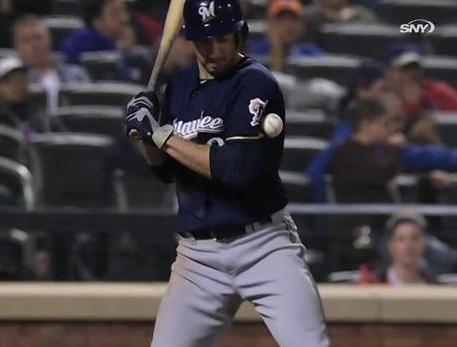
That there was anything to avoid was courtesy of relief pitcher D.J. Carrasco, who, one pitch after a seventh-inning homer by Milwaukee’s Rickie Weeks extended the Brewers’ lead to 8-0, drilled Ryan Braun. Plate ump Gary Darling ejected the right-hander on the spot. (Watch it here.)
The first thing that crossed Collins’ mind appeared to be disbelief that Carrasco, the guy he was probably counting on to eat the game’s final three innings, was gone after only three batters. Shortly thereafter, the ramifications became clear: Braun was Milwaukee’s No. 3 hitter, and his counterpart on the Mets, David Wright, was due to lead off the bottom of the inning.
Factor in that Brewers starter Zach Greinke had to that point given up only four hits over six shutout innings; that the Mets would be lucky to avoid being shut out, let alone win the game; that Brewers manager Ron Roenickehas a bit of history when it comes to Code enforcement; that Wright has his own history when it comes to being hit by pitches; that there’s no player less dispensable to New York’s lineup than the .408-hitting Wright; and that if anybody was going to wear one for the sins of his team, it would clearly be the Mets’ third baseman.
Taking all that into consideration, Collins did what he felt prudent: He removed Wright.
Ryan Braun, and the pitch that started it all.
If Greinke had feelings about seeing pinch-hitter Jordany Valdespin instead of Wright, he kept them to largely to himself after the game, telling the Milwaukee Journal-Sentinel, “I don’t know what would have happened if [Wright] stayed in. They don’t want anyone important to get hurt, just like we don’t want someone important getting hurt.”
Wright, however, was clearly agitated, shouting at Collins in the dugout before turning on his heel and stalking away from the manager. (Watch it here.) Two batters later, Collins removed David Murphy for precisely the same reason.
“In my opinion, why I took him out of the game, he wasn’t getting hurt,” Collins said in a Newsday report. “I’m not accusing anybody for the possibility of retaliation. But I don’t blame the umpires for doing what they do. I don’t blame the other team for any perception they had of what happened, but I’ve got news for you: In this game there are unwritten rules. And one of the unwritten rules, is you hit my guy, I’m hitting your guy. They are not hitting my guy tonight. I’m not exposing him to being hit.”
“Terry’s the manager and I try to go to battle for Terry every day . . .” said Wright, who added that his response looked worse than it actually was. “Whether I agree or disagree with it, he’s got to make the move he thinks is best for the team, and he obviously did that . . . I respect him. I love playing for him.”
Carrasco issued a standard denial, and Braun claimed to have no feelings one way or the other about his opponent’s intent.
As a guy with eight seasons as a big league manager and 10 years of minor league playing time under his belt, Collins probably understands the game’s unwritten rules pretty well. In this instance, however, he may have been upstaged by Wright, when the third baseman told him in the dugout, “If anybody gets hit, I want it to be me.”
“My thinking at the time was, Ryan gets hit and then I go up there and get hit and then everything is settled,” Wright said in a MLB.com report.
In that, he was exactly correct. If it wasn’t the series’ final game, or if the teams’ next scheduled meeting wasn’t four months away, or if Wright was anything but a target of circumstance—were he drilled, it would have been because of where he hit in the lineup, not anything he did on the field—he would have had an air-tight case. Waiting a day to respond to an incident like this is hardly rogue strategy, but Roenicke and his team would have to be harboring a pretty serious grudge to put a target on Wright when they next see him in September.
It will all probably pass without incident, but that may have happened anyway. One thing Collins has assured, however, is that the Mets now have 16 weeks to consider the possibilities before actually seeing the results of this particular experiment.
Update (5/17): The principals have spoken, and the matter has been “handled.”
Prince Fielder connects for the first of his homers on Sunday. Phil Coke did not approve.
On Saturday, Prince Fielder launched two home runs off of Boston’s Josh Beckett within the game’s first five innings. In the bottom of the seventh, he was hit on the calf by Red Sox reliever Matt Albers.
Phil Coke came out of the Detroit bullpen a half-inning later with the perfect opportunity to exact retribution: He faced Fielder’s first-base counterpart and fellow superstar, Adrian Gonzalez, with a 10-run lead. Instead of sending a message, however, he struck Gonzalez out.
There may be great power in hindsight for Phil Coke, or he may have had the finer points of the “We’ve seen enough of this crap” method of pitching explained to him by teammates or coaches after the game. That would explain his appearance on Sunday, when, in the seventh inning, the left-hander made up for opportunities lost. With Dustin Pedroia on second and two outs in a game the Tigers trailed 9-7, Coke—a day late—went gunning for his man.
His aim was as poor as his timing, however, as Coke’s pitch sailed up near Gonzalez’s head, without any real danger of hitting him. Which is where the umpiring at Comerica Park comes into question.
At this point, plate ump Dan Iassogna should have been all over Coke. Ejection would have been justified even without the previous day’s action, based only on the location of the pitch, but Iassogna did nothing. (In his defense, even Gonzalez didn’t take the pitch too seriously, joking with Iassogna and Tigers catcher Alex Avila about whether he should start to get scared.)
It might have been a good idea. With his next offering—and two bases open, after Pedroia took third on the previous pitch—Coke hit Gonzalez in the back. Bobby Valentine raced out for a chat involving, among other things, disbelief that the pitcher had not yet been ejected. It didn’t have much effect; only after crew chief Dale Scott consulted with Iassogna were warnings even issued. Coke remained in the game.
Iassogna has some history with this type of thing, having notably erred on the reactionary side earlier in his career, much to his own detriment. In 2002, before he had even reached full-time status with MLB, Iassogna was behind the plate for a game in which the Dodgers led the Reds 4-0 going into the ninth inning. After Los Angeles closer Eric Gagne gave up a bloop single and a two-run homer, he hit Adam Dunn with his next pitch. That was all Iassogna needed to see; he tossed Gagne on the spot.
The details of this particular story matter, however. Gagne’s pitch to Dunn was clearly unintentional; it only grazed the bottom of the slugger’s jersey, failing even to hit flesh. When Gagne was ejected, Dogers manager Jim Tracy lost his mind.
“I went crazy,” he said. “I’ve been very upset a few times as a big league manager, but that was maybe the most upset I’ve been on a baseball field, because of what I perceived to be as a lack of understanding as to exactly what it was that was going on. . . . I don’t know of any pitcher in baseball, after a home run has preceded the at-bat and you’re in the ninth inning trying to win, who’s going to hit the next guy and bring the tying run to the plate.”
Gagne and Tracey were both ejected, the Reds tied the game with two more runs off three more pitchers, and Cincinnati won it in the 13th against Omar Daal, who had been scheduled to start for the Dodgers the following day.
It’s enough to make an ump gun shy, which Iassogna might be these days. That certainly appeared to be the case on Sunday.
“They should’ve given a warning after the one at (Gonzalez’s) head, the first pitch,” said Valentine in the Boston Herald.
Gonzalez, too, worried about the lasting effects of the umpire’s decision.
“You know it’s going to happen,” he said of potential future retribution, in an ESPN Boston report. “We’ve all got seven more years here. It might not happen the next series, but eventually it’s going to happen. . . . I just think it’s a bad call on their end because now it’s putting Miggy’s (Miguel Cabrera) and Prince’s careers at risk. You know it’s going to happen eventually.”
Next chance: May 28, in Boston. No word yet on the whereabouts of Dan Iassogna that week.
The season’s first lesson on sensitivity awareness was given yesterday in Cleveland, when benches emptied after Shin-Soo Choo was forced to duck under a head-high fastball from Toronto reliever Luis Perez in the 15th inning.
While no hitter in baseball would react well to an inside pitch above his shoulders, Choo was particularly sensitive. He missed six weeks last season after having his thumb broken by a pitch. He had been drilled earlier in Wednesday’s game by Ricky Romero. So when he was forced to the dirt by Perez in the 15th, he responded by jumping up and taking angry steps toward the mound, spurring the benches to empty. (Watch it here.)
Which is where intent comes into the equation.
Perez’s pitch arrived after warnings had already been issued by plate ump Tim Welke in the fourth, after Cleveland’s Justin Masterson came inside twice against Kelly Johnson, apparent retaliation for Choo’s HBP an inning earlier.
Perez was Toronto’s seventh pitcher of the day. That left one guy in the pen—closer Sergio Santos—to go the rest of the way, were Perez ejected, in a game that looked as if it might never end. There were two possibilities for Perez’s motivation—he’s a baseball imbecile, with no shred of insight into the appropriate time to respond to something; or the pitch simply got away from him.
The smart money’s on the latter; Welke’s certainly was. Despite the earlier warnings, Perez was not ejected, and it’s not difficult to see why.
Even Choo came around to that viewpoint, saying after the game in the Cleveland Plain Dealer, “I was hit by a pitch last year and broke my thumb. Maybe that’s why I’m sensitive right now. But I know it’s part of the game. Pitchers have to go inside. I understand it.”
And so we move on. Teams play again Saturday; we’ll see how Toronto reacts once the timing is right.
Isn’t it great when scientists give serious consideration to things they probably shouldn’t be giving serious consideration to? Case in point: the recent study from researchers out of Brown, Hofstra and Boston universities, which determined that while fans don’t think a guy drilled in retaliation necessarily deserved it, they enjoy it anyway.
The study itself is behind a paywall, but the good folks at Miller-McCune have excerpted it for our enjoyment and edification. What we learn from the surveys, conducted outside Fenway Park and Yankee Stadium, and online:
Fans were asked in general terms about how appropriate they felt it would be for a pitcher to drill a member of the opposing team in response to an injury suffered by one of his teammates as the result of being hit by a pitch.
Turns out that just short of half the fans surveyed felt it would be acceptable.
Somehow, 19 percent of Red Sox fans thought it was okay for a pitcher to retaliate against a third, unrelated team, despite the fact that such a scenario makes absolutely no sense.
More fans—70 percent—felt that retaliation is appropriate if the drilling victim was the pitcher responsible for the HBP that started it all.
The labspeak summary of this concept is, “Endorsement of collective punishment is widespread, but not as widespread as endorsement of individual punishment.”
Only 25 percent of the fans who approve of retaliation feel that the target of said retaliation is responsible for the situation. In other words, the guy getting beaned in response to a prior kerfluffle has nothing to do with it.
Still, more than a third want to see him drilled anyway.
Two key takeaways here. Between the four surveys, researchers interacted with only a few hundred people—not exactly a huge sample size. More importantly, the vast majority of respondents were fans of either the Yankees or Red Sox, so how representational can they be? (More knowledgeable than your average fan, sure, but also more bloodthirsty.)
Ultimately, this kind of thing is the reason that players don’t much like to talk about this section of the unwritten rulebook. Things like retaliation, that make sense to them within the context of the game, strike a large portion of the fanbase as vulgar and irresponsible. Ballplayers have known about this divide forever, without benefit of scientific studies. Maybe they’re smarter than us, after all.
Usually, pitchers can unbunch their panties via well-placed fastballs aimed at or near the player responsible for said bunching. It’s time-honored and it’s effective and, if it’s executed properly, it allows adequate venting with no long-term damage.
The long-term nature of the damage Mike Napoli suffered yesterday is up for debate, but there’s little question that he’ll be feeling this particular pinch far longer than he would a baseball to the thigh.
Napoli apparently riled pitcher and former teammate C.J. Wilson by saying, upon Wilson’s signing with Anaheim during the off-season, that he was looking forward to taking the left-hander deep.
Were Wilson truly miffed, he could have called Napolito talk it over. Were he baseball miffed, he could have drilled him the next time the two faced each other. Wilson, however, appears to have been more provoked than angry, gladly looking for an excuse to execute what can only in baseball and frat-house circles qualify as a “prank.”
He tweeted Napoli’s phone number. (That’s what Wilson considers a prank? No, this is a prank.)
Sure, there’s long been a place for off-field retaliation in baseball. Before there was Twitter, Ty Cobb and Buck Herzog fought in Cobb’s hotel room, some hours after Cobb had spiked the second baseman during a game. In this modern age of mass communication, however, it seems that one can do far worse deeds digitally than with one’s fists.
Wilson’s prank—again, we use the term loosely—may have been marginally appropriate had he and Napoli possessed a relationship strong enough to sustain such shenanigans. Napoli, however, told the Fort Worth Star-Telegram that this is not the case.
“I don’t even know why he did it,” he said. “You don’t do that. I am not taking it as a prank. You know, I haven’t even talked to him since the end of last season. We don’t have that type of relationship.”
So Napoli has to deal with the inconvenience of getting a new phone number. Wilson has to defend himself from the outraged masses. And the rest of us get to consider what may yet happen when these guys meet during the regular season (never mind the two spring training contests left between the teams, on March 24 and 25).
Looks like Diamondbacks starting pitchers learned a lesson. In talking to Arizona radio station Sports 620, Daniel Hudson touched upon the fact that Justin Upton was hit by 19 pitches last season—second most in baseball.
“If it’s a starting pitcher [who hit Upton], remember, he’s got to hit,” Hudson told the station, according to ArizonaSports.com, the station’s Web site. “They either have to hit their spots, or expect something in return.”
Okay, that makes sense. What’s interesting is how Hudson and the rest of the staff came upon this realization. The right-hander said that the subject was raised “halfway through the year.”
There are some obvious follow-up questions: Who brought the subject up with him, and how? Was it an order (or at least a suggestion) from manager Kirk Gibson, or somebody else on the staff? Was it Upton himself, or another of the hitters? Were the pitchers called out in a group setting, or did it happen through individual conversations on the side?
This is all interesting stuff. The way a team communicates information like this can be as vital—if not more so—than the information itself. It should be noted that, for a staff chided halfway through the season for the dearth of protection it offered its own hitters, Diamondbacks pitchers drilled either nine or 10 batters in every month of the season, save for September, when they hit only six; they actually declined in that category in the second half. Even so, their total of 53 HBPs—28 by starters, 25 by relievers—ranked fourth in the National League.
There’s also the fact that Upton stands notoriously close to the plate, which certainly had something to do with the frequency of his drillings. (The next closest Arizona player was Miguel Montero, who was hit eight times; nobody else was touched more than four times.) Upton intoned at the team’s FanFest earlier this month that he’ll continue to stand atop the dish, so one can reasonably expect the frequency of his drillings to continue.
Was Hudson just blustering to try to make opposing pitchers a little more wary of pitching inside to Arizona’s best hitter? When the D-Backs make their way to San Francisco later this season, I’ll see if I can’t track down some answers.
Talk about setting a tone. There’s a new order on the south side of Chicago, and one of those taking charge, White Sox bench coach Mark Parent, wasted little time in establishing the team’s tenor this season.
“You hit our guy, we’ll hit your guy,” he said in response to a fan’s question at the team’s fan fest on Sunday, according to the Chicago Tribune.
Well, okay. Parent was a big league catcher for 13 years and has opinions. And what better way to fire up the base than with an inflammatory statement that also serves to let the opposition know exactly how you operate?
Well, you could start with not talking about it at all. Blanket statements like Parent’s—and years’ worth of those by previous White Sox manager Ozzie Guillen—don’t do a lot to stem a practice that’s not particularly popular, even among its practitioners. Go ahead and stand up for a teammate who’s been wronged, but the La Russa Standard—revenge for its own sake, regardless of intent—does few favors for anybody.
Baseball retaliation is all about the message. You mess with my guy, you’ll hear from me. Few are those still in the game, however, who think that a hitter clipped by a running fastball late in a close game receives any message beyond the fact that his opponent is trying to win. To seek retribution for that type of situation is as outdated as stirrup socks and double-headers.
Few in baseball today have more hands-on experience in this particular matter than Parent’s boss, new White Sox manager Robin Ventura—who, you might recall, had a bit of a Code-based kerfluffle with Nolan Ryan during his playing days, some years back. The first six pages of The Baseball Codes are devoted to the event, which was predicated on Ryan’s propensity for intimidating the White Sox with inside fastballs.
“It’s not going to be a necessary order, but … if we feel it’s necessary, obviously the game takes care of itself and guys take care of their own teammates.,” Ventura said Sunday. “That’s important for the guys on our team and staff to know we’re standing behind each other and protecting each other.”
That’s rock-solid reasoning. Hell, it’s why he charged Ryan in the first place. That one phrase—“If we feel it’s necessary”—is the basis for The Baseball Codes. To reduce it to “You hit our guy, we’ll hit your guy,” is a disservice to those who embrace the notion of respect on a baseball diamond, and measure appropriate levels of response should it be less than forthcoming. Ventura seems willing to let his pitchers handle their business on a case-by-case basis, which is exactly how it should be.
For the moment, let’s give Parent the benefit of the doubt, and attribute his remark to simple capitulation to populist sentiment in a fan-focused environment.
Here’s hoping it doesn’t play out that way on the field.
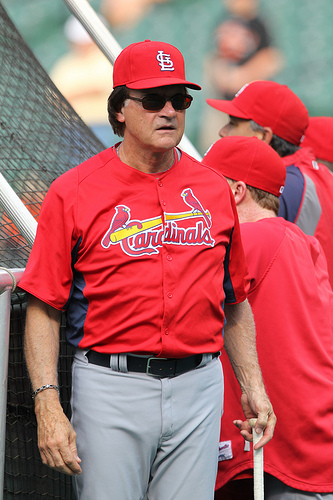
They say retirement softens people. It remains to be seen whether Tony La Russa might fall into this category, but in the short term, his newfound freedom seems to have loosened his lips.
While managing the Cardinals last season, La Russa was in no position to discuss the detailed merits of various incidents that were widely construed to be retaliation on the part of the St. Louis pitching staff. Now that he’s beyond repercussions from the commissioner’s office, however, state secrets may be beginning to spill.
It started Friday, when La Russa opened up a bit about a game last year in which Cardinals reliever Jason Motte drilled Ryan Braun, an inning after the Brewers had—unintentionally, by all indications—hit Albert Pujols. Looking back, the ex-manager said, according to the St. Louis Post-Dispatch, that it had been his “responsibility” to respond.
It shouldn’t be all that surprising, really. Even at the time of the incident, La Russa pressed the boundaries of what he could get away with, saying, “We threw two balls in there real good just to send a message. If he ducks them, it’s all over and we don’t hit him.” If anybody in baseball has a deeper love of eye-for-an-eye on-field justice, he has yet to be found.
Heck, an entire book—Buzz Bissinger’s Three Nights in August—is devoted to intricate detail about La Russa’s inner machinations as he pondered whether or not response was merited in various situations. To believe the book, the guy likes to ponder. A lot.
La Russa has yet to go into too much detail about anything untoward, and his consideration for a VP post within Major League Baseball could well change everything, but at the very least, Friday gave us an inkling about what it could be like should the reigning master of retaliation ever decide to truly speak freely on the topic.
 So the big showdown happened. Nearly three weeks after his drilling of Bryce Harper renewed baseball’s fascination with the unwritten rules, Cole Hamels stepped to the plate three times against Edwin Jackson, once with first base open, and didn’t even get brushed back.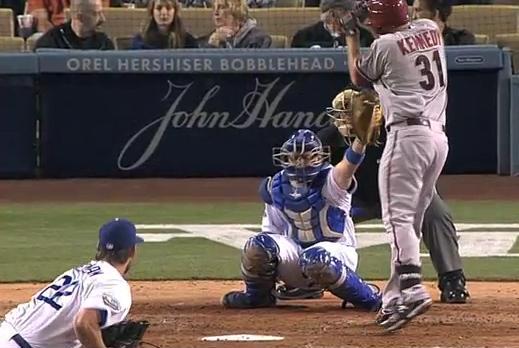





 The Baseball Codes